

Automated valuation models carry a median absolute error of 3–7% on their best day — and that figure balloons to 15–20% for lower-confidence properties [2]. On a £500,000 home, a 15% miss equals a £75,000 miscalculation. In a cautious 2026 market where buyers and lenders are scrutinising every penny, that gap is not a rounding error — it is a financial catastrophe waiting to happen. The debate around Level 3 Home Surveys vs AVMs in Cautious 2026 Markets: Why Chartered Surveyor Expertise Outperforms Automated Tools has never been more urgent, and the evidence increasingly favours the human expert walking through your front door.

Key Takeaways 📋
- AVMs carry significant error margins (up to 15–20%) that can mislead buyers and lenders in volatile conditions [2].
- Level 3 Building Surveys provide granular, on-site condition data that no algorithm can replicate.
- Chartered surveyors detect hidden defects — structural movement, damp, asbestos, and environmental risks — that directly affect value and negotiating power.
- Cautious 2026 market conditions amplify the cost of AVM errors; thin transaction volumes reduce the comparable sales data that AVMs rely upon.
- Buyers who insist on a Level 3 report are better positioned to negotiate price reductions, avoid costly surprises, and secure appropriate mortgage terms.
What Are AVMs and Why Are Lenders Using Them?
An Automated Valuation Model (AVM) is a software-driven tool that estimates property value by analysing historical sales data, land registry records, local market trends, and property characteristics such as size and postcode [2]. Major mortgage lenders have increasingly adopted AVMs to speed up the valuation process and reduce costs [3].
On paper, the appeal is obvious:
- ⚡ Speed — results in seconds rather than days
- 💰 Cost — cheaper than commissioning a physical inspection
- 📊 Scalability — can process thousands of valuations simultaneously
However, AVMs are only as good as the data fed into them. They cannot open a loft hatch, probe a damp wall, or spot crumbling mortar on a Victorian chimney stack. As lenders increasingly rely on AVMs — sometimes without any physical surveyor inspection [3] — buyers who skip an independent Level 3 survey are exposing themselves to significant risk.
💬 "An AVM can tell you what similar houses sold for. It cannot tell you whether the house you are buying is structurally sound."
Understanding Level 3 Building Surveys: The Gold Standard
A Level 3 Building Survey (formerly known as a Full Structural Survey) is the most comprehensive residential property inspection available in the UK. Conducted by a RICS-qualified chartered surveyor, it covers every accessible element of a property's construction, condition, and fabric [1].
What a Level 3 Survey Covers
| Element | Level 3 Survey | AVM |
|---|---|---|
| Structural integrity | ✅ Full assessment | ❌ Not assessed |
| Roof condition | ✅ Inspected | ❌ Not assessed |
| Damp and moisture | ✅ Tested on-site | ❌ Not assessed |
| Asbestos risk | ✅ Flagged | ❌ Not assessed |
| Environmental risks | ✅ Identified | ❌ Not assessed |
| Market value estimate | ✅ Optional add-on | ✅ Core function |
| Defect repair costs | ✅ Estimated | ❌ Not assessed |
| Negotiation leverage | ✅ Strong | ❌ None |
For older properties, non-standard construction, or homes showing visible signs of wear, a Level 3 survey is not merely advisable — it is essential. Buyers purchasing in areas with period housing stock, for instance, should read about building problems and solutions identified during full building surveys to understand what a thorough inspection can uncover.
It is also worth noting the difference between survey levels. If a property is modern and in good condition, some buyers consider a Level 2 survey. Understanding what is in a Level 2 survey can help buyers decide whether they need to upgrade to the more comprehensive Level 3 option.
Level 3 Home Surveys vs AVMs in Cautious 2026 Markets: The Accuracy Problem
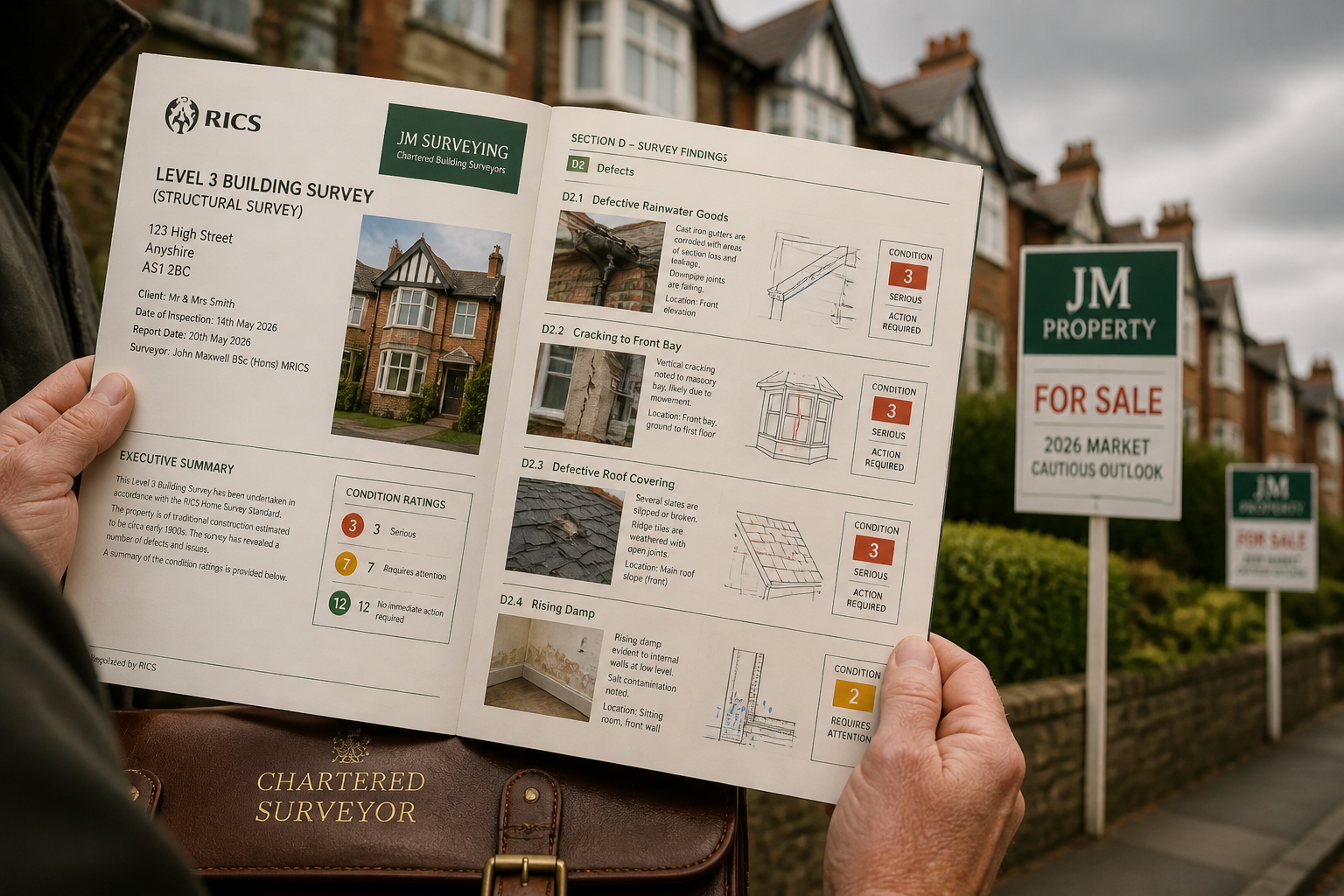
The core weakness of AVMs is data dependency. They require a rich pool of recent, comparable transactions to produce reliable estimates [5]. In a cautious 2026 market — characterised by lower transaction volumes, price corrections in certain segments, and heightened buyer caution — that pool shrinks dramatically.
Why 2026 Market Conditions Expose AVM Weaknesses
1. Thin Transaction Data
When fewer properties are selling, AVMs have fewer recent comparables to draw upon. This directly widens their confidence intervals and increases error margins [2].
2. Rapid Price Shifts
AVMs rely on historical data. In a market where sentiment shifts quickly — driven by interest rate decisions, inflation data, or geopolitical events — AVM estimates can lag real-time conditions by weeks or months [4].
3. Property-Specific Factors Are Invisible to Algorithms
An AVM cannot distinguish between a well-maintained 1930s semi and an identical property next door with severe subsidence, outdated wiring, or an undisclosed asbestos-containing roof [2]. Both properties might receive similar AVM estimates, yet their true market values — and the costs a buyer faces post-purchase — could differ by tens of thousands of pounds.
4. Unreported Improvements Are Missed
Conversely, if a seller has added a high-specification kitchen extension or converted a loft but not formally registered the improvement, an AVM will undervalue the property [2]. A chartered surveyor will identify and account for these features.
AVM Confidence Tiers: A Reality Check
| AVM Confidence Level | Typical Error Range | Risk to Buyer |
|---|---|---|
| High confidence | 3–7% | Moderate |
| Medium confidence | 8–14% | High |
| Low confidence | 15–20%+ | Very High |
Source: [2]
For a £400,000 property at low confidence, a 20% error means the AVM could be off by £80,000 in either direction. No buyer should accept that level of uncertainty without independent professional verification.
What Chartered Surveyors See That Algorithms Never Will
A RICS-qualified surveyor brings something no software can replicate: trained human judgement applied in real time, on-site, to a specific property.
The On-Site Advantage
During a Level 3 inspection, a chartered surveyor will:
- 🔦 Probe and test walls, floors, and ceilings for hidden damp
- 🏗️ Assess structural movement — cracks, subsidence, settlement
- 🏠 Inspect roof spaces for timber decay, inadequate insulation, or poor ventilation
- ⚠️ Flag asbestos risk in older properties — a critical issue in homes built before 2000. Detailed guidance on asbestos in building surveys explains why this matters so much
- 🌿 Identify environmental issues such as Japanese knotweed, flood risk, or contaminated land. Buyers can explore environmental issues covered in Level 3 surveys for a full breakdown
- 📐 Evaluate drainage, services, and outbuildings
Modern surveying firms have also embraced technology — not to replace human expertise, but to enhance it. Premium drone surveys allow surveyors to inspect inaccessible roof areas and high-level elevations with precision that even a physical ladder inspection cannot always match.
The Negotiation Dividend 💷
One of the most tangible benefits of a Level 3 survey is its power as a negotiation tool. When a surveyor identifies significant defects, buyers have documented, professional evidence to request a price reduction or require remedial works before exchange. Learn more about how to negotiate a house price down after a survey to maximise this advantage.
In a cautious 2026 market where sellers are more flexible than in boom conditions, a well-evidenced Level 3 report can save buyers far more than the survey cost itself.
Practical Tips for Buyers Insisting on Level 3 Reports
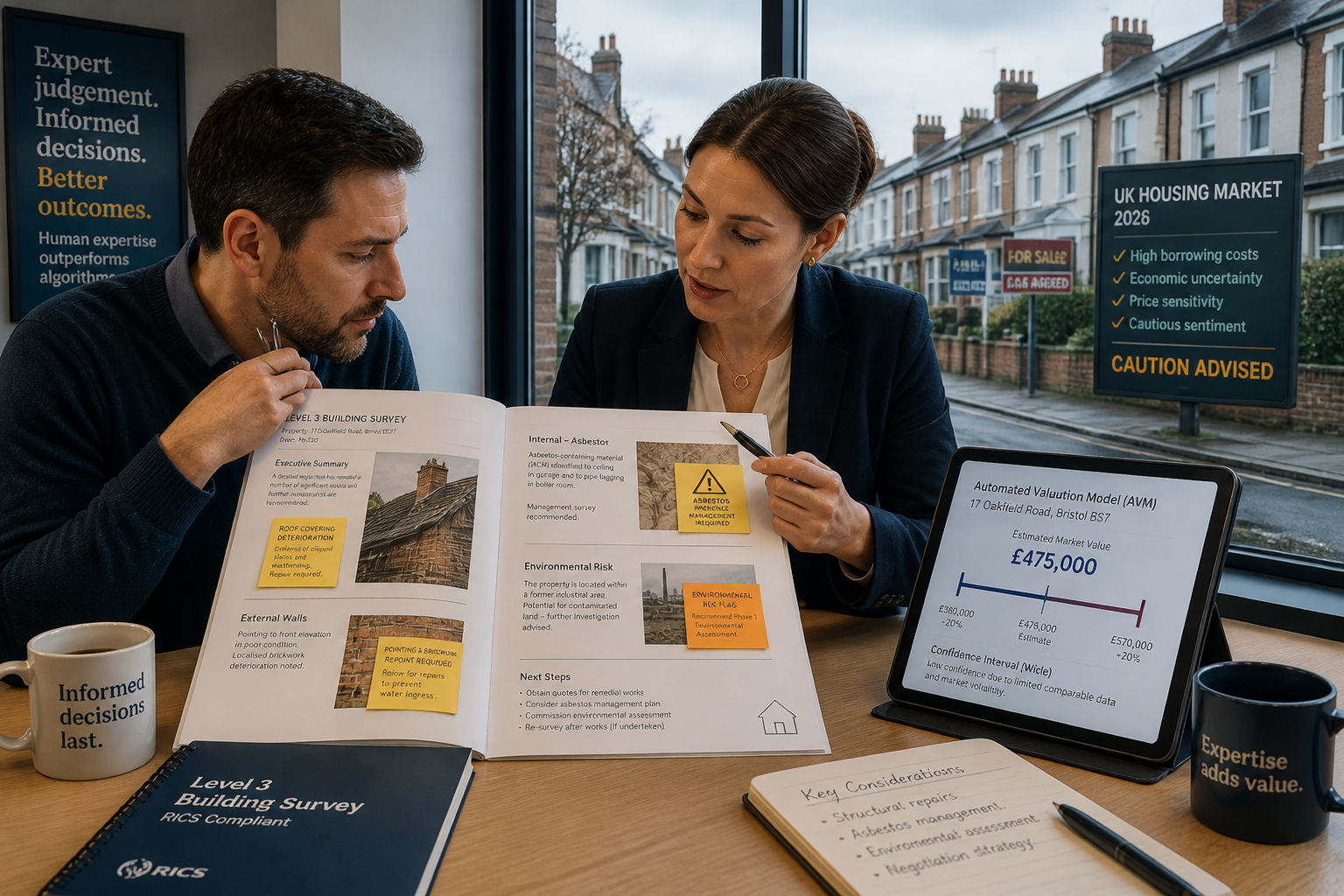
Given the clear superiority of professional surveyor expertise, here are actionable steps for buyers navigating the 2026 market:
✅ Before Commissioning a Survey
- Always choose a RICS-regulated firm — this guarantees professional standards, indemnity insurance, and a formal complaints process.
- Request a Level 3 survey for any property over 20 years old, non-standard construction, or showing any visible defects.
- Understand survey timeframes — a Level 3 survey takes longer than a desktop AVM. Reviewing building survey timeframes helps buyers plan their transaction timeline realistically.
- Do not rely solely on the lender's valuation — even if a lender commissions an AVM or a basic mortgage valuation, this protects the lender's interest, not yours.
✅ During the Survey Process
- Ask if the surveyor can attend in person — some firms offer telephone or video consultations after the inspection to walk through findings.
- Request specialist reports where flagged — if the surveyor identifies potential structural issues or drainage problems, follow their advice on sourcing extra specialist advice promptly.
- Keep the report confidential — do not share it with the seller before negotiating.
✅ After Receiving the Report
- Prioritise Category 3 defects (requiring urgent attention) for immediate cost estimates.
- Use the report to renegotiate — present specific defects with estimated repair costs to the seller or their agent.
- Factor remediation costs into your mortgage planning — some lenders may require works to be completed before releasing funds.
The False Economy of Skipping a Level 3 Survey
A Level 3 Building Survey typically costs between £500 and £1,500 depending on property size, location, and complexity. That figure sounds significant — until it is weighed against the cost of undiscovered defects.
Consider these real-world scenarios:
- Undiscovered subsidence: Remediation costs can exceed £30,000–£50,000
- Hidden roof failure: Full replacement on a detached house can reach £15,000–£25,000
- Asbestos removal: Depending on extent, costs range from £1,000 to £10,000+
- Damp and timber treatment: A serious outbreak can cost £5,000–£20,000
An AVM will not flag any of these. A Level 3 survey will. The arithmetic is straightforward.
💬 "The survey fee is not a cost — it is an investment in knowing exactly what you are buying."
Level 3 Home Surveys vs AVMs in Cautious 2026 Markets: Making the Right Choice
The choice between relying on an AVM and commissioning a Level 3 survey is not really a choice between two equivalent tools. It is a choice between partial, algorithm-generated data and comprehensive, expert-verified intelligence about one of the largest financial decisions most people will ever make.
AVMs have a legitimate role in the mortgage process — they are useful for rapid portfolio assessments and initial screening [4][5]. But they were never designed to replace the trained eye of a chartered surveyor standing inside a property, moisture meter in hand, torch pointed at a suspicious crack above the lintel.
In the cautious conditions defining the 2026 property market — where buyers are more risk-aware, lenders are more conservative, and the consequences of overpaying or inheriting hidden defects are more severe — the case for Level 3 Home Surveys vs AVMs in Cautious 2026 Markets: Why Chartered Surveyor Expertise Outperforms Automated Tools is not just compelling. It is conclusive.
Conclusion: Act on Expert Insight, Not Algorithmic Estimates
The 2026 property market rewards caution and punishes assumptions. Buyers who treat an AVM figure as a reliable valuation — without independent professional verification — are accepting risks that a Level 3 Building Survey would quantify and, in many cases, eliminate.
Actionable next steps for buyers in 2026:
- 📞 Contact a RICS-regulated chartered surveyor before proceeding past the offer stage on any property.
- 📋 Specify a Level 3 survey for older, larger, or visibly imperfect properties.
- 🔍 Challenge AVM-only lender valuations — ask whether a physical inspection has been carried out.
- 💬 Use survey findings to negotiate — a detailed defect report is a powerful tool at the negotiating table.
- 🏠 Factor survey costs into your purchase budget from day one — they are among the most cost-effective expenditures in any property transaction.
The algorithm does not care about the crack in your future kitchen wall. A chartered surveyor does.
References
[1] Home Survey Level 2 Vs Level 3 Which Is Right For Your Next Move – awh.co.uk
[2] Automated Valuation Models In How Avms Work Their Limits And What They Mean For Your Mortgage – amerisave.com
[3] Level 2 3 Survey – chantsurveys.co.uk
[4] Avms To Finally Replace Appraisers 3 – workingre.com
[5] Selecting The Right Avm – visitcss.com