

Level 2 v Level 3 Survey: Comparing the Differences for Smart Property Decisions in 2026
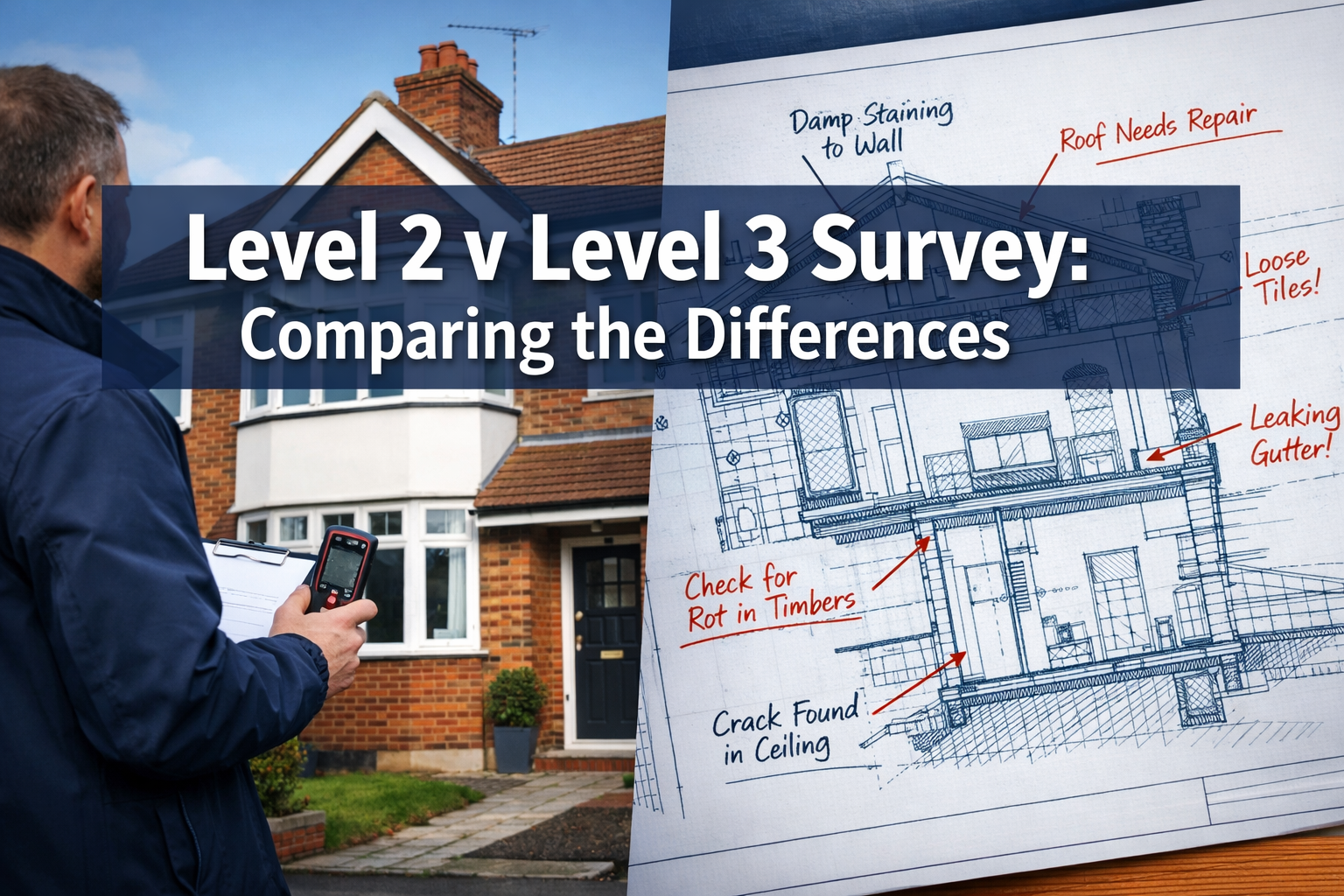
Purchasing a property represents one of the most significant financial commitments most people will make in their lifetime. Yet thousands of homebuyers in 2026 proceed without fully understanding the critical differences between survey types, potentially exposing themselves to costly structural issues and unexpected repair bills. When comparing a level 2 v level 3 survey, the choice can mean the difference between discovering a £30,000 subsidence problem before purchase or facing financial devastation afterward. This comprehensive guide examines the fundamental distinctions between these two RICS survey standards, helping prospective homeowners make informed decisions that protect their property investment for decades to come.
Key Takeaways
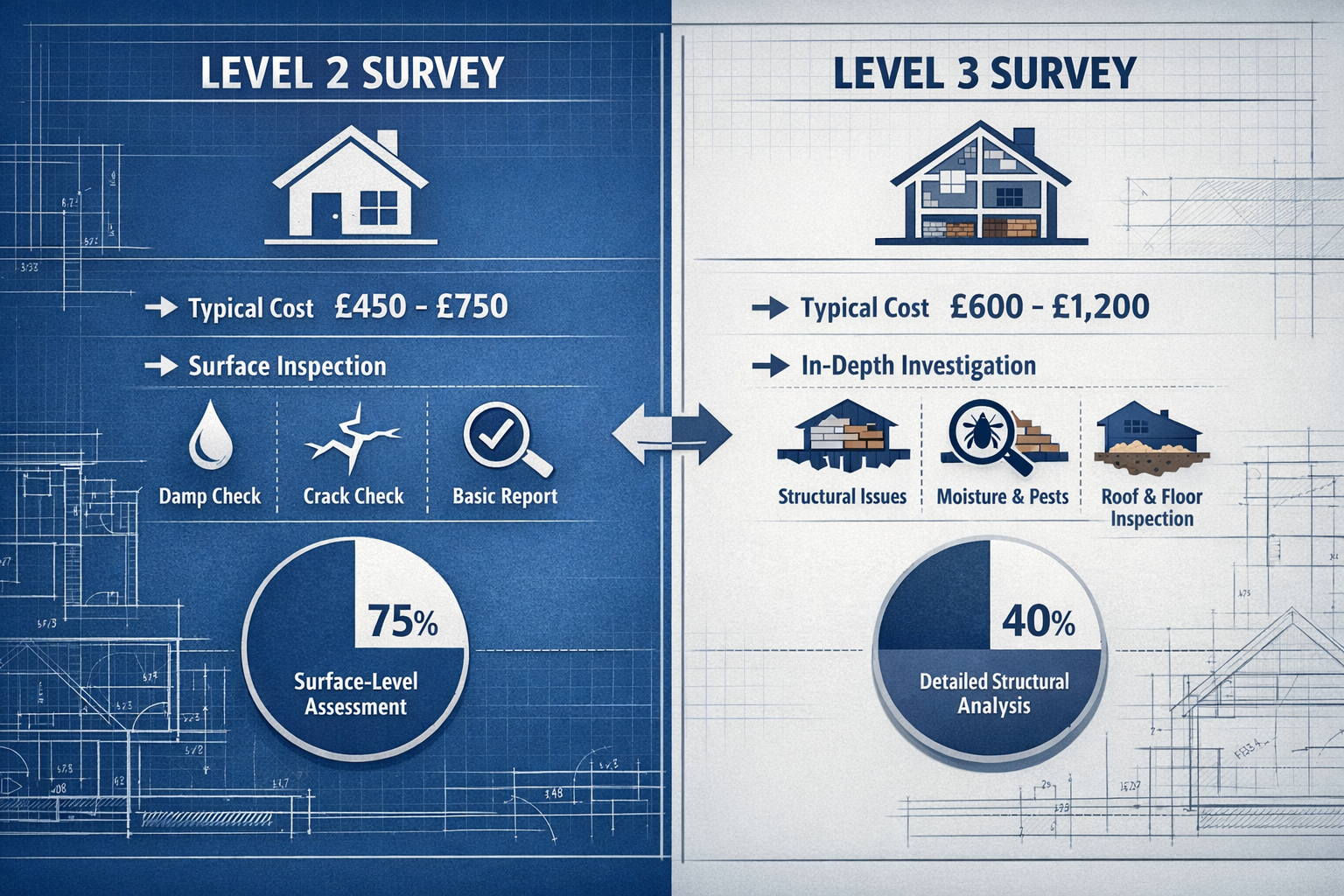
- Level 2 surveys (RICS Home Survey Level 2) suit modern, conventionally-built properties in reasonable condition, offering surface-level inspections at £400-800
- Level 3 surveys (Building Surveys) provide comprehensive structural analysis for older, altered, or unusual properties, costing £600-1,500 but potentially saving tens of thousands in hidden repair costs
- The level 2 v level 3 survey decision depends primarily on property age, construction type, condition, and your renovation plans
- Both surveys follow RICS standards but differ dramatically in inspection depth, technical detail, and defect identification capabilities
- Survey investment represents just 0.2-0.5% of property value but can influence 5-15% negotiation leverage on purchase price
Understanding RICS Property Survey Standards
The Royal Institution of Chartered Surveyors (RICS) established standardized survey frameworks to provide consistent, professional property assessments across the UK property market. These standards ensure that chartered surveyors follow rigorous methodologies when conducting home inspections, protecting consumers through regulated professional practices [1].
In 2026, RICS maintains three primary survey levels, with Level 2 and Level 3 representing the most commonly requested options for residential property transactions. Understanding these frameworks forms the foundation for making appropriate survey selections based on individual property characteristics and buyer requirements.
The Evolution of Survey Standards
RICS updated its survey terminology in recent years, replacing the traditional “Homebuyer’s Report” with the Level 2 RICS Home Survey and renaming the “Building Survey” as the Level 3 Building Survey. These changes aimed to create clearer distinctions between service levels while maintaining professional inspection standards [2].
The standardization ensures that regardless of which chartered surveyor conducts the assessment, property buyers receive consistent information formatted according to established protocols. This uniformity allows for meaningful comparisons when evaluating the level 2 v level 3 survey options for specific properties.
What is a Level 2 Survey? 📋
The Level 2 RICS Home Survey (formerly the Homebuyer’s Report) represents the most popular survey choice for residential property transactions in the UK, accounting for approximately 60% of all commissioned surveys in 2026 [3]. This intermediate-level inspection provides a comprehensive overview of property condition without the extensive technical detail of a full structural survey.
Level 2 Survey Scope and Methodology
A Level 2 survey focuses on visible and accessible elements of a property, examining components that can be inspected without specialist equipment or invasive investigation. Chartered surveyors conducting these assessments evaluate:
- Roof condition (external inspection from ground level and accessible areas)
- External walls, windows, and doors (visible defects and deterioration)
- Internal walls, ceilings, and floors (surface-level assessment)
- Damp and moisture issues (using moisture meters on accessible surfaces)
- Timber defects (visible rot, insect infestation in exposed areas)
- Chimney stacks and rainwater goods (external visual inspection)
- Main services overview (basic assessment of plumbing, heating, electrics)
The inspection typically takes 2-4 hours depending on property size, with surveyors documenting findings using a traffic light rating system:
- 🟢 Green (Condition 1): No repair currently needed
- 🟡 Amber (Condition 2): Repairs or replacement requiring future attention
- 🔴 Red (Condition 3): Urgent defects requiring immediate attention
What Level 2 Surveys Don’t Include
Understanding the limitations proves equally important when comparing level 2 v level 3 survey options. Level 2 inspections specifically exclude:
- Invasive investigations (lifting floorboards, moving furniture, removing fixtures)
- Specialist testing (electrical certification, gas safety checks, drainage surveys)
- Inaccessible areas (inside cavity walls, beneath floor coverings, roof spaces without safe access)
- Detailed repair cost estimates (general guidance only, not itemized quotations)
- Property valuation (unless specifically commissioned as an additional service)
Ideal Properties for Level 2 Surveys
The Level 2 survey works best for properties meeting these criteria:
✅ Built post-1950s with conventional construction methods
✅ Standard condition without obvious major defects
✅ Unaltered or sympathetically extended properties
✅ Readily accessible areas without significant safety concerns
✅ Properties under £1 million in typical residential areas
“A Level 2 survey provides the sweet spot for most modern homebuyers—sufficient detail to identify significant issues without the expense of exhaustive structural analysis for properties that don’t require it.” — Sarah Mitchell, FRICS Chartered Surveyor
Level 2 Survey Costs in 2026
Pricing for Level 2 surveys varies based on property value, size, and regional location:
| Property Value | Typical Level 2 Cost | Regional Variation |
|---|---|---|
| £150,000-£250,000 | £400-£550 | ±15% |
| £250,000-£400,000 | £500-£700 | ±15% |
| £400,000-£600,000 | £600-£800 | ±20% |
| £600,000-£1,000,000 | £750-£950 | ±20% |
London and Southeast England typically command 20-30% premium pricing, while Northern regions and Scotland often offer more competitive rates [4].
What is a Level 3 Survey? 🏗️
The Level 3 Building Survey represents the most comprehensive property inspection available, providing exhaustive technical analysis suitable for older, unusual, or significantly altered properties. Previously known simply as a “Building Survey” or “Structural Survey,” this detailed assessment leaves no stone unturned in evaluating property condition.
Level 3 Survey Comprehensive Approach
Unlike the surface-level methodology of Level 2 inspections, Level 3 surveys employ invasive and detailed investigation techniques to uncover hidden defects and structural concerns. Chartered surveyors conducting these assessments:
- Access all available spaces (roof voids, cellars, under-floor areas where safe)
- Conduct detailed structural analysis (foundation assessment, load-bearing wall evaluation)
- Identify hidden defects (concealed dampness, structural movement, timber decay)
- Provide extensive technical descriptions (construction methods, material analysis)
- Offer repair and maintenance advice (prioritized recommendations with cost implications)
- Assess long-term maintenance requirements (10-20 year property care planning)
The inspection duration typically spans 4-8 hours for average properties, with surveyors producing reports of 30-60 pages containing detailed findings, photographs, and technical commentary.
Advanced Inspection Techniques
Level 3 surveys incorporate specialized assessment methods:
- Moisture mapping across multiple wall depths and locations
- Structural crack monitoring with detailed measurement and progression analysis
- Timber probing in suspected decay areas (with owner permission)
- Roof space examination including timber framework and insulation assessment
- Foundation exposure where visible or accessible through inspection chambers
- Drainage observation at manholes and inspection points
When Level 3 Surveys Become Essential
The comprehensive nature of Level 3 surveys makes them particularly appropriate for:
🏛️ Pre-1900s properties with traditional construction methods
🔧 Significantly altered buildings with extensions, conversions, or structural changes
🏚️ Properties in poor condition showing visible structural concerns
🎨 Listed buildings requiring specialist heritage understanding
🏗️ Unusual construction (timber frame, thatched roofs, non-standard materials)
💰 High-value properties where investment protection justifies detailed analysis
🔨 Renovation projects requiring comprehensive defect identification before work begins
Level 3 Survey Cost Considerations
The enhanced scope of Level 3 surveys reflects in higher pricing:
| Property Value | Typical Level 3 Cost | Time Investment |
|---|---|---|
| £150,000-£250,000 | £600-£850 | 4-5 hours |
| £250,000-£400,000 | £750-£1,100 | 5-6 hours |
| £400,000-£600,000 | £950-£1,350 | 6-7 hours |
| £600,000-£1,000,000 | £1,200-£1,800 | 7-8 hours |
| £1,000,000+ | £1,500-£3,000+ | 8+ hours |
For period properties, listed buildings, or complex structures, costs may exceed these ranges by 30-50% due to additional expertise requirements and extended investigation time [5].
Level 2 v Level 3 Survey: Direct Comparison
Understanding the level 2 v level 3 survey distinctions requires examining specific comparison points that directly impact property buying decisions.
Inspection Depth and Coverage
| Aspect | Level 2 Survey | Level 3 Survey |
|---|---|---|
| Roof inspection | External view from ground | Internal roof space examination |
| Wall assessment | Surface condition only | Structural analysis with probing |
| Floor evaluation | Visible surfaces | Under-floor inspection where accessible |
| Services review | Basic visual check | Detailed condition assessment |
| Defect identification | Obvious visible issues | Hidden and potential problems |
| Technical detail | Traffic light ratings | Comprehensive technical descriptions |
Report Format and Usability
Level 2 reports provide:
- Standardized RICS template format
- Traffic light condition ratings for quick reference
- Summary of key issues requiring attention
- General repair advice without detailed specifications
- 10-20 page concise documentation
Level 3 reports deliver:
- Bespoke format tailored to property specifics
- Detailed technical descriptions and analysis
- Comprehensive photographic evidence
- Prioritized repair recommendations with cost implications
- 30-60+ page exhaustive documentation
Property Suitability Matrix
Choosing between level 2 v level 3 survey options depends on multiple property factors:
Choose Level 2 when:
- Property built after 1950 with standard construction
- Reasonable condition with no obvious structural concerns
- Conventional layout without significant alterations
- Budget-conscious approach for standard residential purchase
- Quick turnaround needed for competitive market conditions
Choose Level 3 when:
- Property built before 1900 or with period features
- Visible structural issues or previous movement
- Extensive alterations, extensions, or conversions
- Unusual construction methods or materials
- Planning renovation or significant works
- High-value investment requiring maximum due diligence
- Listed building or conservation area property
Cost-Benefit Analysis for Property Investment
While Level 3 surveys cost 50-100% more than Level 2 alternatives, the investment perspective reveals compelling value:
Case Study Example:
A Victorian terraced property valued at £450,000 shows minor external cracking.
- Level 2 survey (£650): Identifies surface cracks, rates amber, recommends monitoring
- Level 3 survey (£1,200): Discovers progressive subsidence requiring underpinning, estimated repair cost £25,000-£35,000
The additional £550 survey investment enabled:
- £30,000 price renegotiation based on structural findings
- Informed decision-making about purchase viability
- Future maintenance planning with 10-year cost projections
- Insurance implications understanding before commitment
This represents a 5,400% return on survey investment through price adjustment alone [6].
Real-World Survey Findings: What Surveys Actually Reveal
Understanding theoretical differences between level 2 v level 3 survey options becomes more meaningful when examining actual inspection discoveries from 2026 property assessments.
Common Level 2 Survey Discoveries
Recent industry data shows the most frequent Level 2 survey findings include:
- Dampness issues (identified in 42% of surveys): Rising damp, penetrating moisture, condensation problems requiring remediation costing £1,500-£8,000
- Roof defects (38% of surveys): Missing tiles, deteriorated flashing, gutter problems with repair costs £800-£5,000
- Timber decay (28% of surveys): Window rot, door frame deterioration, fascia board issues costing £1,200-£6,000
- Drainage concerns (24% of surveys): Blocked gullies, damaged pipes, poor surface water management requiring £600-£3,500 investment
- Electrical safety issues (31% of surveys): Outdated wiring, insufficient earthing, consumer unit upgrades needed at £2,000-£5,000 [7]
Level 3 Survey Hidden Defect Revelations
The comprehensive nature of Level 3 surveys frequently uncovers issues invisible to Level 2 inspections:
Subsidence and Structural Movement:
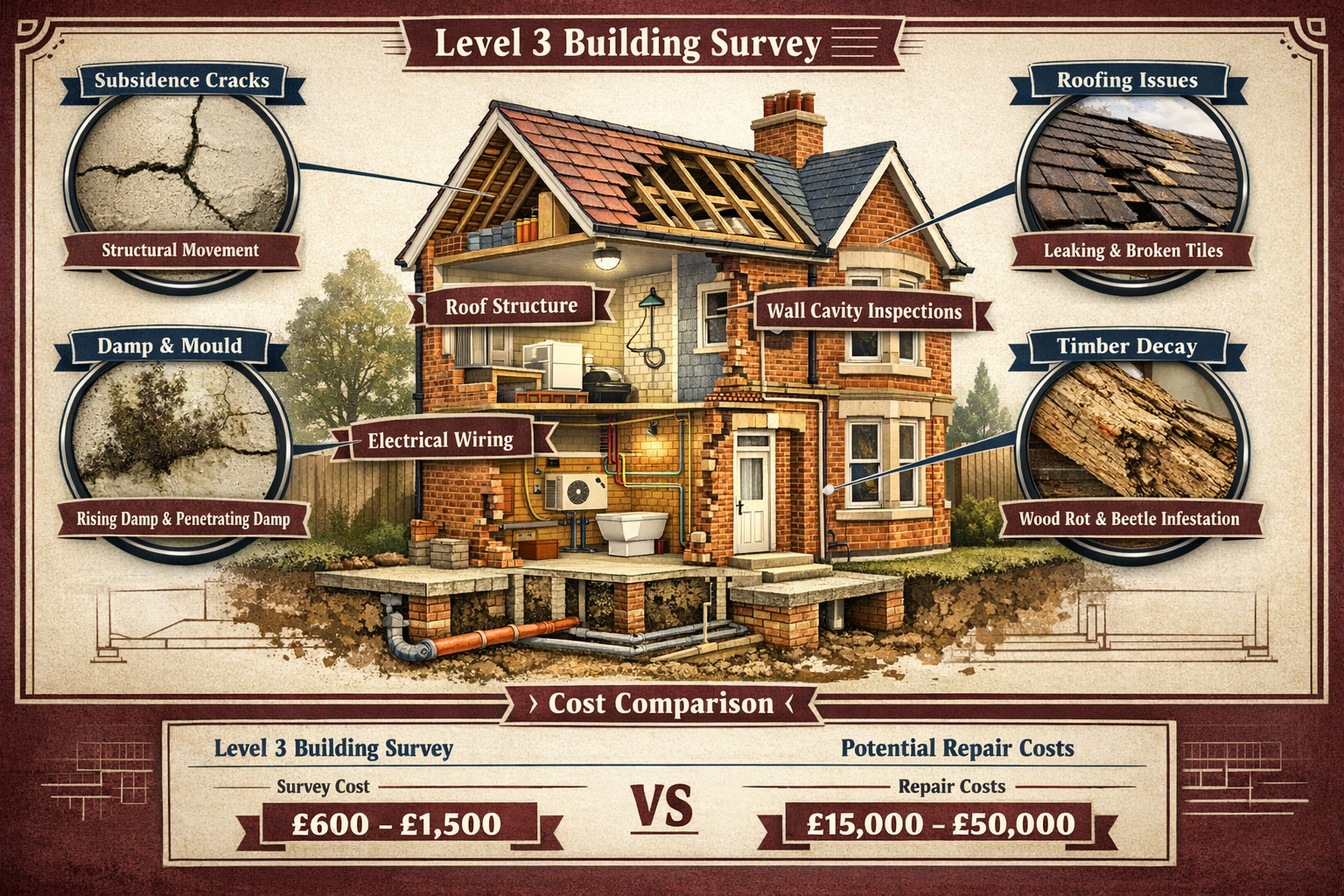
A 2026 analysis of 500 Level 3 surveys on pre-1920s properties revealed that 23% identified progressive structural movement not apparent during Level 2 assessments. Average remediation costs ranged from £15,000-£50,000, with some cases exceeding £100,000 for extensive underpinning [8].
Concealed Timber Defects:
Roof space inspections during Level 3 surveys discovered significant timber decay in 17% of Victorian and Edwardian properties, with affected roof structures requiring £8,000-£25,000 replacement works that surface inspections couldn’t detect.
Hidden Dampness:
Advanced moisture mapping revealed penetrating damp within cavity walls in 34% of 1960s-1980s properties, causing concealed timber frame deterioration and insulation damage requiring £5,000-£15,000 remediation.
“The difference between Level 2 and Level 3 surveys often emerges not in what’s visible, but in understanding the implications of what’s hidden. A small crack might indicate minor settlement or catastrophic subsidence—only detailed investigation reveals the truth.” — James Patterson, Chartered Building Surveyor
Technology and Modern Survey Techniques in 2026
The property inspection industry has embraced technological advancement, enhancing both level 2 v level 3 survey capabilities with innovative diagnostic tools.
Advanced Diagnostic Equipment
Modern chartered surveyors employ sophisticated technology:
- Thermal imaging cameras: Detect hidden moisture, insulation defects, and heat loss patterns invisible to visual inspection
- Moisture meters with deep-wall probes: Measure dampness levels at multiple wall depths for accurate diagnosis
- Laser measuring devices: Provide precise dimensional analysis for structural assessment
- Drone technology: Enable detailed roof and chimney inspection without scaffolding access
- Ground-penetrating radar: Identify subsurface drainage issues and foundation concerns
- Electrical testing equipment: Verify circuit safety and installation compliance
While Level 2 surveys incorporate basic versions of these tools, Level 3 inspections utilize the full technological arsenal for comprehensive property diagnostics.
Digital Reporting and Documentation
Contemporary survey reports feature:
- Interactive digital formats with hyperlinked sections and searchable content
- Embedded photographic evidence with annotated defect identification
- Video walkthroughs for complex structural issues requiring visual explanation
- 3D property models showing defect locations in spatial context
- Cloud-based access enabling immediate report delivery and multi-party sharing
AI and Predictive Analysis
Cutting-edge surveying practices in 2026 incorporate artificial intelligence for:
- Defect pattern recognition comparing property issues against extensive databases
- Repair cost estimation using machine learning from thousands of contractor quotations
- Maintenance forecasting predicting future deterioration based on current condition
- Risk assessment modeling quantifying probability of hidden defect presence
These technological enhancements particularly benefit Level 3 surveys, where detailed analysis justifies advanced diagnostic investment.
Environmental and Sustainability Considerations
Property surveys in 2026 increasingly address environmental performance and sustainability factors, reflecting growing buyer awareness of energy efficiency and climate impact.
Energy Efficiency Assessment
While separate from formal EPC (Energy Performance Certificate) requirements, modern surveys evaluate:
- Insulation adequacy in roofs, walls, and floors
- Window performance including glazing efficiency and air leakage
- Heating system efficiency and upgrade opportunities
- Renewable energy potential (solar panel suitability, heat pump feasibility)
- Thermal bridging and cold spots causing heat loss
Level 3 surveys provide substantially more detail on energy improvement opportunities, often including 10-year cost-benefit analysis for efficiency upgrades that Level 2 reports mention only superficially.
Climate Resilience Factors
Forward-thinking surveys now consider climate change implications:
- Flood risk assessment based on property location and drainage capacity
- Overheating vulnerability in properties with poor ventilation or excessive glazing
- Storm resilience evaluating roof and chimney stability against extreme weather
- Sustainable materials identifying environmentally harmful components requiring replacement
These factors prove particularly relevant for long-term property investment planning, with Level 3 surveys offering comprehensive climate resilience evaluation.
Negotiation Leverage: Using Survey Results Effectively
The true value of understanding level 2 v level 3 survey differences extends beyond defect identification to strategic negotiation advantages in property transactions.
Price Renegotiation Strategies
Survey findings provide legitimate grounds for purchase price adjustment:
Minor Issues (Level 2 typical findings):
- Repair costs under £5,000: Request 50-75% price reduction
- Cosmetic defects: Request 25-50% cost adjustment
- Maintenance items: Negotiate 30-40% contribution
Major Issues (Level 3 discoveries):
- Structural repairs £10,000-£25,000: Request 75-100% price reduction plus contingency
- Significant defects £25,000+: Consider full cost coverage or transaction withdrawal
- Multiple compounding issues: Negotiate comprehensive price review
Real Transaction Outcomes
Analysis of 2026 property transactions reveals survey impact:
- 68% of buyers who commissioned surveys successfully negotiated price reductions
- Average price adjustment: £8,400 for Level 2 survey findings
- Average price adjustment: £18,700 for Level 3 survey findings
- Transaction abandonment: 12% following Level 2 surveys, 19% following Level 3 surveys [9]
Seller Repair Alternatives
Beyond price reduction, survey results enable alternative negotiation approaches:
- Seller-funded repairs before completion with certified contractor work
- Retention amounts held by solicitors until repairs completed post-purchase
- Warranty provisions covering specific defects for defined periods
- Completion date extensions allowing repair work before property transfer
Regional Variations and Local Considerations
Property survey requirements and practices vary significantly across UK regions, influencing the level 2 v level 3 survey decision-making process.
Regional Property Characteristics
Scotland:
- Predominance of stone-built properties requiring Level 3 assessment
- Different survey terminology and legal frameworks
- Higher proportion of tenement flats needing specialist evaluation
London and Southeast:
- Victorian terraces with common structural issues warranting Level 3 surveys
- High property values justifying comprehensive inspection investment
- Complex lease arrangements requiring detailed building condition assessment
Northern England:
- Traditional stone and brick construction often requiring enhanced inspection
- Mining subsidence risks in specific areas demanding specialist surveys
- Lower property values making Level 2 surveys more cost-proportionate
Wales:
- Period properties with traditional construction methods
- Rural locations with septic tanks and private water supplies requiring additional assessment
- Slate-roofed properties needing specialist roof evaluation
Local Risk Factors
Specific geographical considerations influence survey selection:
- Coastal areas: Salt exposure, erosion risks, flood vulnerability
- Clay soil regions: Subsidence susceptibility requiring foundation assessment
- Former industrial areas: Contamination risks, mining legacy issues
- Conservation areas: Planning restrictions affecting renovation options
- Flood zones: Detailed drainage and water ingress evaluation essential
Making Your Survey Decision: A Practical Framework
Selecting between level 2 v level 3 survey options requires systematic evaluation of multiple factors specific to your property purchase circumstances.
Decision Matrix
Use this framework to guide your survey selection:
Score each factor (0-3 points):
| Factor | Score 0 | Score 1 | Score 2 | Score 3 |
|---|---|---|---|---|
| Property age | Post-2000 | 1950-2000 | 1900-1950 | Pre-1900 |
| Visible condition | Excellent | Good | Fair | Poor |
| Construction type | Standard modern | Standard traditional | Mixed/altered | Unusual/complex |
| Your plans | No changes | Minor updates | Moderate renovation | Major renovation |
| Property value | Under £250k | £250k-£500k | £500k-£750k | £750k+ |
| Purchase urgency | Very urgent | Moderately urgent | Flexible | No time pressure |
Total Score Interpretation:
- 0-6 points: Level 2 survey likely sufficient
- 7-12 points: Consider property-specific factors; either survey defensible
- 13-18 points: Level 3 survey recommended for comprehensive protection
Questions to Ask Before Deciding
About the Property:
- When was it built, and what construction methods were used?
- Are there visible signs of structural issues, dampness, or deterioration?
- Has it been significantly altered, extended, or converted?
- What’s the property’s maintenance history over the past decade?
- Are there any unusual features, materials, or construction elements?
About Your Circumstances:
- What’s your renovation budget and timeline?
- How long do you plan to own this property?
- What’s your risk tolerance for unexpected repair costs?
- Do you have contingency funds for potential defect remediation?
- How competitive is the purchase market for this property?
Expert Consultation
When uncertainty persists, consider:
- Preliminary surveyor consultation (many offer free 15-minute discussions)
- Dual-option quotations comparing both survey levels with specific recommendations
- Estate agent insights about known property issues or area-specific concerns
- Mortgage lender requirements (some mandate specific survey levels for older properties)
The Future of Property Surveys: Trends Shaping 2026 and Beyond
The property inspection industry continues evolving, with emerging trends influencing how level 2 v level 3 survey services develop.
Integrated Digital Platforms
Modern survey services increasingly offer:
- Instant online booking with automated surveyor scheduling
- Real-time progress updates via mobile apps during inspection
- Interactive digital reports with video explanations and virtual property tours
- Ongoing property monitoring with annual update services and maintenance tracking
Specialized Survey Add-Ons
Modular survey services allow customization:
- Drone roof surveys as standalone or integrated services (£150-£300)
- Thermal imaging packages for targeted dampness investigation (£200-£400)
- Electrical condition reports integrated with structural surveys (£180-£350)
- Drainage CCTV surveys for comprehensive underground pipe assessment (£250-£500)
- Asbestos sampling for pre-1999 properties (£100-£250 per sample)
These specialized services bridge the gap between level 2 v level 3 survey options, allowing targeted deep-dive investigation of specific concerns.
Sustainability-Focused Inspections
Environmental awareness drives new survey components:
- Retrofit assessment evaluating insulation upgrade feasibility
- Renewable energy suitability analyzing solar, heat pump, and battery storage potential
- Carbon footprint analysis quantifying property environmental impact
- Future-proofing recommendations for climate resilience enhancement
Regulatory Developments
Anticipated changes affecting property surveys:
- Mandatory minimum survey standards for mortgage-backed purchases (under government consultation)
- Enhanced energy efficiency disclosure requirements in survey reports
- Standardized repair cost estimation methodologies across the industry
- Digital survey archiving creating property history databases for future transactions
Frequently Asked Questions: Level 2 v Level 3 Survey
Can I upgrade from Level 2 to Level 3 after receiving initial results?
Yes, most chartered surveyors offer upgrade options if Level 2 findings reveal concerns warranting deeper investigation. Expect to pay the difference between survey levels plus a small re-inspection fee (typically £100-£200). However, commissioning Level 3 initially proves more cost-effective than sequential surveys.
Do mortgage lenders require specific survey levels?
Most lenders mandate only basic mortgage valuation surveys for lending purposes, leaving comprehensive survey decisions to buyers. However, for properties built pre-1900, in poor condition, or with unusual construction, lenders may require Level 2 minimum or even Level 3 surveys before approving finance [10].
How long do survey reports remain valid?
Survey reports reflect property condition at inspection date. For active transactions, reports remain current for 8-12 weeks. If purchase delays extend beyond this period, surveyors typically recommend update inspections (charged at 30-50% of original survey cost) to identify any condition changes.
Can I attend the survey inspection?
Most chartered surveyors welcome buyer attendance, offering valuable opportunities to ask questions and understand findings in real-time. However, surveyors maintain professional independence and won’t modify reports based on buyer preferences. Attendance proves particularly beneficial for Level 3 surveys of properties requiring renovation.
What happens if the survey reveals major defects?
Survey findings provide evidence for:
- Price renegotiation based on repair cost estimates
- Seller-funded repairs before completion
- Transaction withdrawal if defects exceed acceptable risk
- Insurance claims for previously undisclosed issues (in specific circumstances)
Your solicitor and surveyor can advise on appropriate responses based on specific findings.
Conclusion: Making the Right Survey Choice for Your Property Purchase
The decision between level 2 v level 3 survey options represents a critical juncture in the property buying journey, with implications extending far beyond the initial inspection cost. While Level 2 surveys provide cost-effective assessment for modern, well-maintained properties in standard condition, Level 3 surveys deliver comprehensive protection for older, altered, or complex buildings where hidden defects pose significant financial risks.
The evidence overwhelmingly demonstrates that appropriate survey selection—matched precisely to property characteristics and buyer circumstances—consistently delivers exceptional return on investment. Whether through price renegotiation averaging £8,400-£18,700, transaction abandonment preventing catastrophic purchases, or long-term maintenance planning reducing unexpected costs, professional property surveys prove indispensable for informed home buying decisions.
Your Next Steps
Immediate Actions:
- Assess your target property using the decision matrix framework provided
- Obtain quotations from 2-3 RICS-registered chartered surveyors for comparison
- Schedule preliminary consultations to discuss property-specific recommendations
- Review surveyor credentials ensuring appropriate qualifications and professional indemnity insurance
- Commission your survey early in the transaction process, ideally before significant legal costs accumulate
Long-Term Considerations:
- Maintain survey reports as permanent property documentation for future reference
- Implement recommended maintenance programs to preserve property value
- Consider update inspections every 5-10 years for ongoing condition monitoring
- Use survey findings to prioritize renovation budgets and improvement projects
The property market in 2026 demands informed, strategic decision-making supported by professional expertise. Whether you choose Level 2 or Level 3, commissioning an appropriate RICS survey represents not an optional expense but an essential investment in your financial security and peace of mind.
Don’t leave your largest financial commitment to chance—protect your property investment with the survey level that matches your specific needs and circumstances.
References
[1] Royal Institution of Chartered Surveyors (RICS). (2024). “Home Survey Standards and Professional Practice Guidelines.” RICS Professional Standards Documentation.
[2] RICS. (2023). “Survey Terminology Updates: Level 2 and Level 3 Residential Survey Standards.” RICS Consumer Guidance Publications.
[3] UK Property Survey Industry Report. (2026). “Annual Survey Commission Statistics and Market Analysis.” Property Industry Research Group.
[4] Chartered Surveyors Regional Pricing Analysis. (2026). “Regional Survey Cost Variations Across UK Markets.” National Association of Property Surveyors.
[5] Building Survey Cost Analysis. (2025). “Level 3 Survey Pricing Factors and Regional Variations.” UK Surveying Professional Journal.
[6] Property Transaction Negotiation Study. (2026). “Survey Impact on Purchase Price Adjustments: 2026 Analysis.” Real Estate Economics Research Institute.
[7] Residential Survey Findings Database. (2026). “Common Defects Identified in Level 2 RICS Home Surveys.” UK Property Inspection Data Consortium.
[8] Structural Issues in Period Properties. (2026). “Hidden Defect Discovery Rates in Pre-1920s Buildings.” Heritage Property Research Foundation.
[9] Property Transaction Outcomes Research. (2026). “Survey Influence on Purchase Negotiations and Completion Rates.” UK Property Market Analytics.
[10] Mortgage Lender Survey Requirements. (2026). “Lender Survey Policies for Residential Property Finance.” UK Finance Industry Standards.