

Over 4.9 million leasehold dwellings exist in England alone — and in 2026, the legal framework governing almost every one of them is changing. The convergence of the Leasehold and Freehold Reform Act 2024, the Draft Commonhold and Leasehold Reform Bill, and a cascade of new building safety regulations means that chartered surveyors face an unprecedented challenge: how to produce defensible valuations and communicate layered risks clearly to clients who may not yet understand the scale of what is shifting beneath their feet.
This guide addresses Leasehold and Commonhold Reforms 2026: Surveyor Strategies for Valuation Adjustments and Client Risk Communication directly — providing practical frameworks for adjusting valuation methodologies, structuring client advice, and staying ahead of legislative timelines that are already in motion.
Key Takeaways 📌
- Ground rents will be capped at £250/year and automatically convert to peppercorn after 40 years — directly reducing freehold investment values and altering leasehold yield calculations.
- Commonhold conversion now requires only 50% leaseholder consent (down from 100%), creating transition risk for buildings mid-conversion.
- Forfeiture rights are being abolished, fundamentally changing the risk balance in landlord-tenant relationships and valuation models.
- The Building Safety Levy launches 1 October 2026, adding new cost pressures to viability assessments for residential development schemes.
- Surveyors must adopt scenario-based valuation reporting and structured risk communication protocols to protect clients and their own professional liability.
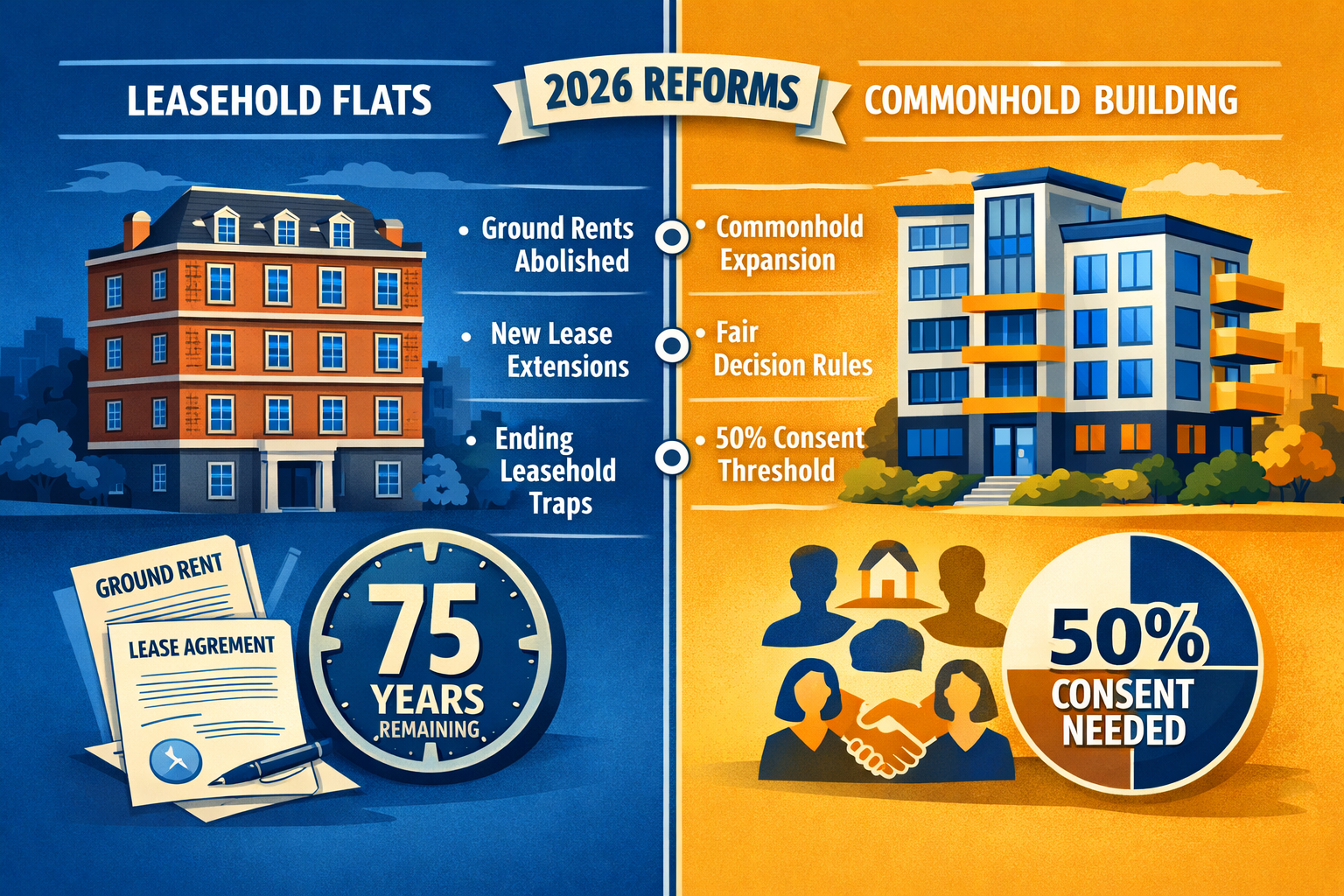
Understanding the 2026 Reform Landscape: What Has Changed and Why It Matters
The Leasehold and Commonhold Reforms 2026 agenda is not a single piece of legislation — it is a layered programme of reform rolling out across multiple statutes and implementation dates. Surveyors who treat it as a single event risk missing critical valuation triggers.
The Leasehold and Freehold Reform Act 2024: Key Provisions Now Active
Multiple provisions of the Leasehold and Freehold Reform Act 2024 are taking effect throughout 2026, including:
- Banning new leasehold houses (with limited exceptions)
- Overhauling enfranchisement rights — making it easier and cheaper for leaseholders to extend leases or buy their freehold
- Tightening service charge regulation with mandatory transparency requirements
- Introducing mandatory redress schemes and a strengthened right to manage [1]
These changes affect both the income profile of freehold reversions and the relative attractiveness of leasehold flats as investment or owner-occupier assets.
The Draft Commonhold and Leasehold Reform Bill: The Bigger Picture
The government's consultation on moving to commonhold — which closed on 24 April 2026 — proposes mandating that all new flats be sold on a commonhold basis rather than leasehold. This covers purpose-built blocks, flats above commercial units, and converted house flats [4].
💬 "The consultation represents the most fundamental shift in residential property ownership since the Leasehold Reform Act 1967. Surveyors who do not adapt their valuation frameworks now will be caught flat-footed."
Critically, the commonhold conversion threshold has been reduced from 100% to 50% of leaseholder consent, though freeholder consent and lender approval remain mandatory [4]. This creates a new category of transitional risk for existing blocks where a vocal majority could trigger conversion proceedings — a scenario that must now be reflected in valuations of both leasehold flats and freehold reversions.
Ground Rent Cap and Forfeiture Abolition
Two provisions carry especially significant valuation implications:
| Reform | Detail | Valuation Impact |
|---|---|---|
| Ground rent cap | £250/year maximum; peppercorn after 40 years | Reduces freehold reversion income; lowers leasehold premium |
| Forfeiture abolition | Freeholders lose right to forfeit lease for breach | Alters risk weighting in landlord-tenant models |
| Commonhold threshold | 50% consent (down from 100%) | Increases conversion risk for mixed-tenure blocks |
| New leasehold houses ban | No new leasehold houses (limited exceptions) | Affects development land values and site appraisals |
For surveyors undertaking leasehold extension and enfranchisement valuations, the ground rent cap alone requires a fundamental recalibration of the deferment rate and term value components in the standard Sportelli methodology.
Surveyor Strategies for Valuation Adjustments Under the 2026 Reforms

The practical challenge for surveyors is translating legislative change into defensible numbers. The Leasehold and Commonhold Reforms 2026: Surveyor Strategies for Valuation Adjustments and Client Risk Communication framework requires surveyors to work across three distinct valuation scenarios simultaneously.
Scenario 1: Existing Leasehold Flats — Adjusting for Ground Rent and Enfranchisement Changes
For residential leasehold flats, the key adjustments centre on:
1. Ground rent income capitalisation
- Where ground rents exceed £250/year, surveyors must now apply a capped income figure in freehold reversion calculations
- The 40-year peppercorn conversion clause requires a terminal value adjustment — the income stream ends, not continues in perpetuity
- This materially reduces freehold investment values, particularly for portfolios with high ground rent income [4]
2. Enfranchisement premium reductions
- Reformed enfranchisement rights make it cheaper for leaseholders to extend or buy — reducing the premium a freeholder can expect
- Surveyors should apply a downward adjustment of 5–15% to freehold reversion values depending on the lease term profile and ground rent level [1]
- For properties with short leases (under 80 years), the marriage value calculation is also affected by the new enfranchisement cost framework
3. Lease length and saleability
- Lenders remain cautious about short leases. Properties with fewer than 70 years remaining face compounding valuation risk as reform uncertainty intersects with mortgage eligibility thresholds
- A professional property valuation that does not explicitly address lease length risk in 2026 is incomplete
Scenario 2: New-Build and Development Viability Assessments
The Building Safety Levy, effective 1 October 2026, applies to qualifying residential and Purpose-Built Student Accommodation building control applications, including mixed-use and retirement schemes [2]. Combined with the two-staircase requirement for all new residential buildings over 18 metres (effective 30 September 2026), development viability assessments must now account for:
- Increased construction costs from dual-staircase design requirements — estimated to reduce net saleable area by 3–8% in tower schemes
- Building Safety Levy contributions as a direct cost line in residual land valuations
- Commonhold-by-default for new flat developments — affecting sales strategy, management structure, and marketing timelines
Surveyors working on development appraisals should revisit residual valuations completed before April 2026. In many cases, the combined cost impact of the levy and staircase requirements will push marginal schemes below viability thresholds. This is particularly relevant for surveyors operating in high-density urban areas — for example, those providing chartered surveyor services in South East London or East London, where tall residential schemes are common.
Scenario 3: Freehold Reversions and Block Management Portfolios
For institutional and private investors holding freehold reversions, the 2026 reforms represent a structural devaluation event. Key adjustment strategies include:
- Stress-testing income streams against the £250/year ground rent cap across the portfolio
- Modelling commonhold conversion probability for each block — particularly those with active leaseholder groups or right-to-manage applications
- Reviewing service charge exposure under the new transparency requirements, which may increase management costs and dispute frequency
Surveyors advising on block management portfolios should be familiar with Section 20 major works consultation requirements and service charge accounting obligations, both of which become more legally exposed under the tightened regulatory framework.
🔑 Practical Valuation Adjustment Checklist
- Apply £250/year ground rent cap to all freehold reversion income calculations
- Model 40-year peppercorn conversion terminal value in long-term income projections
- Adjust enfranchisement premiums for reformed cost framework (5–15% downward)
- Include Building Safety Levy as a cost line in all post-October 2026 development appraisals
- Reduce net saleable area by 3–8% for 18m+ schemes requiring dual staircases
- Flag commonhold conversion risk for all existing leasehold blocks with >50% active leaseholder groups
- Update risk narrative in all RICS Red Book compliant reports to reference 2026 legislative context
Client Risk Communication: A Framework for Buy-to-Let Landlords and Owner-Occupiers

Valuation adjustments mean nothing if clients do not understand the risks they face. The Leasehold and Commonhold Reforms 2026: Surveyor Strategies for Valuation Adjustments and Client Risk Communication challenge is as much about professional communication as it is about technical methodology.
Why Standard Risk Disclaimers Are No Longer Sufficient
The 2026 reforms are not market fluctuations — they are structural legal changes with permanent valuation consequences. A boilerplate "market conditions may change" disclaimer does not adequately communicate:
- The risk of owning a leasehold flat in a block where 50% of leaseholders vote for commonhold conversion
- The impact of forfeiture abolition on a buy-to-let landlord's enforcement options
- The cost exposure of a service charge dispute under the new mandatory transparency regime
Surveyors have a professional duty under RICS guidance to communicate material risks clearly. In 2026, failing to address reform-specific risks in client reports creates genuine professional liability exposure.
Tailoring Risk Communication by Client Type
🏠 Owner-Occupiers (Leasehold Flat Buyers)
Key risks to communicate:
- Commonhold transition uncertainty: If the block converts to commonhold, ownership structure, management obligations, and mortgage eligibility may all change
- Service charge exposure: New transparency requirements may surface previously hidden costs
- Lease length: Even with reformed enfranchisement rights, short leases carry mortgage and resale risk
Recommended approach: Provide a two-page plain-English risk summary alongside the technical valuation report. Use tables and traffic-light ratings (🟢 Low / 🟡 Medium / 🔴 High) for each risk category.
🏢 Buy-to-Let Landlords
Key risks to communicate:
- Rental yield recalculation: The Renters' Rights Act (Phase 1 effective 1 May 2026) abolishes assured shorthold tenancies and Section 21 evictions, replacing them with open-ended assured periodic tenancies [2]. This fundamentally alters void risk and income security assumptions
- Rent bidding ban and advance rent restrictions: These reduce landlords' ability to maximise short-term yield in competitive markets [2]
- Mandatory PRS Landlord Ombudsman (launching late 2026): Compliance costs and dispute exposure increase [2]
- Ground rent income loss: For landlords holding freehold reversions, the £250/year cap directly reduces investment income
💬 "A buy-to-let landlord in 2026 who has not reviewed their portfolio against the Renters' Rights Act changes and the leasehold reforms is operating with an outdated risk model."
🏗️ Developers and Investors
Key risks to communicate:
- Viability recalculation for all schemes with building control applications post-October 2026
- Commonhold-by-default for new flat developments — requiring early legal and management structure planning
- Register of contractual controls: Developers holding options or using conditional contracts will face mandatory registration duties, affecting transaction timelines [2]
The Risk Communication Protocol: A Step-by-Step Approach
Step 1: Identify applicable reforms — Use the client's property type, tenure, and intended use to filter which 2026 reforms are directly relevant.
Step 2: Quantify impact — Where possible, attach a monetary value to each risk (e.g., "Ground rent cap reduces freehold reversion value by approximately £X based on current income").
Step 3: Rate probability and severity — Use a simple 3×3 matrix (Low/Medium/High for both probability and impact).
Step 4: Recommend action — Every risk identified should have a corresponding recommended action, whether that is legal advice, a lease extension application, or a portfolio review.
Step 5: Document the conversation — Record all risk communications in writing, including client acknowledgements. This is essential for professional liability protection.
For surveyors advising clients in London and the South East — including those seeking chartered surveyor services in Islington, Chelsea, or Battersea — the concentration of leasehold flats in these areas makes reform-aware risk communication a non-negotiable professional standard in 2026.
Business Rates: A Commercial Property Overlay
For surveyors with mixed residential and commercial portfolios, the business rates revaluation effective 1 April 2026 introduces a five-tier multiplier system with updated rateable values across England and Wales [3]. Commercial property valuations must now reflect the recalibrated rates burden, particularly for mixed-use buildings where ground-floor commercial units may face significantly altered holding costs. This directly affects the value of mixed-use freehold reversions and the viability of commercial-to-residential conversion schemes.
Surveyors should also be aware of the annual tax on enveloped dwellings (ATED) implications for high-value residential properties held within corporate structures, as the 2026 reform environment increases scrutiny of such arrangements.
Conclusion: Actionable Next Steps for Surveyors in 2026
The Leasehold and Commonhold Reforms 2026: Surveyor Strategies for Valuation Adjustments and Client Risk Communication challenge is real, immediate, and professionally consequential. Surveyors who adapt their methodologies and communication frameworks now will be better positioned to deliver defensible valuations and genuinely useful client advice.
✅ Immediate Actions for Surveyors
- Audit your valuation report templates — Ensure all leasehold and development reports include 2026 reform-specific risk disclosures as standard
- Recalibrate ground rent income models — Apply the £250/year cap and 40-year peppercorn conversion to all freehold reversion calculations immediately
- Update development appraisals — Incorporate Building Safety Levy and dual-staircase cost impacts for all schemes with post-September 2026 building control applications
- Train client-facing staff on the Renters' Rights Act changes — particularly the abolition of Section 21 and its impact on buy-to-let yield models
- Review professional indemnity coverage — Ensure your PI policy reflects the increased complexity and liability exposure of reform-era valuations
- Engage with RICS guidance — Monitor updated Red Book guidance on commonhold valuation methodology as it emerges from the consultation process [4]
- Communicate proactively with existing clients — Do not wait for clients to ask. Reach out to leasehold flat owners, buy-to-let landlords, and freehold investors in your portfolio to flag the reforms and their implications
The property market of 2026 rewards surveyors who combine technical precision with clear, client-centred communication. The reforms are complex — but the surveyor's role is to make that complexity navigable.
References
[1] Valuing Freehold Vs Leasehold Reforms In 2026 Surveyor Adjustments Post Latest Legislation Changes – nottinghillsurveyors.com
[2] Preparing For 2026 Key Real Estate Law Reforms – tlt.com
[3] Scanning The Real Estate Horizon 2026 – traverssmith.com
[4] Draft Commonhold Leasehold Reform Bill – ww3.rics.org
[5] Moving To Commonhold Banning Leasehold For New Flats – gov.uk
[6] Draft Commonhold And Leasehold Reform Bill Command Paper – assets.publishing.service.gov.uk