

Over 4.98 million leasehold dwellings exist in England alone — and the legal ground beneath every one of them is shifting fast. The draft Commonhold and Leasehold Reform Bill, published on 27 January 2026, marks the most sweeping overhaul of residential property tenure in a generation [1]. For building surveyors working across multi-occupancy properties, the practical consequences are immediate: existing valuation frameworks, condition assessments, and client advice protocols all need updating to reflect the new legislative landscape.
This guide on Leasehold and Commonhold Reforms 2026: Building Surveyors' Checklists for Valuation Adjustments in Multi-Occupancy Properties delivers the structured, actionable checklists that practitioners need right now — covering ground rent changes, commonhold conversion triggers, and the physical and legal factors that directly affect market worth.
Key Takeaways 📋
- The draft Commonhold and Leasehold Reform Bill (published January 2026) will ban new leasehold flats and cap ground rents, fundamentally changing how multi-occupancy properties are valued.
- Ground rents on existing long leases will be capped at £250 per annum, eventually reducing to a peppercorn — surveyors must adjust income-based valuations accordingly.
- The consent threshold for commonhold conversion drops from unanimous to 50% of qualifying leaseholders, making conversions far more likely in existing blocks.
- Forfeiture of long residential leases will be abolished, replacing a key risk factor that previously discounted valuations.
- Building surveyors need updated checklists covering tenure status, physical condition, service charge structures, and EPC compliance to deliver accurate 2026 valuations.
Why 2026 Is a Turning Point for Leasehold Valuations
The legislative timeline is accelerating rapidly. The Regulatory Policy Committee received the impact assessment for the draft Bill on 19 March 2026 [4], and a government consultation on "Moving to commonhold: banning leasehold for new flats" remains open until 24 April 2026 [3]. The ban on new leasehold flats is expected to come into force from 2029, with ground rent cap changes potentially arriving as early as late 2028 [3].
💡 Pull Quote: "The consent threshold for commonhold conversion is dropping from unanimous agreement to just 50% of qualifying leaseholders — making block-wide tenure changes a realistic prospect for the first time." [5]
These are not distant policy discussions. They are live valuation variables. A flat in a 20-unit block where 10 leaseholders could now trigger a commonhold conversion carries a materially different risk and opportunity profile than it did in 2024. Surveyors who fail to account for these changes risk producing assessments that are outdated before the ink dries.
The Core Legislative Changes Affecting Valuations
| Reform | Detail | Valuation Impact |
|---|---|---|
| Ground rent cap | Capped at £250/year, reducing to peppercorn after 40 years [1] | Reduces investment value of freehold reversions |
| New leasehold ban | No new long residential leases (>21 years) for flats after commencement [5] | Shifts demand to commonhold and freehold stock |
| Conversion threshold | Drops from unanimous to 50% of qualifying leaseholders [5] | Increases conversion risk/opportunity in existing blocks |
| Forfeiture abolition | Replaced by statutory "lease enforcement claim" process [5] | Removes a discount factor from some leasehold valuations |
| Sectional commonhold | Mixed-use buildings can have section-specific obligations [5] | Requires granular service charge analysis |
The Surveyor's Core Checklist: Tenure and Legal Status

Before any physical inspection begins, a thorough review of tenure documents is essential. The reforms mean that the legal structure of a multi-occupancy property now carries greater weight in determining market value than at any point in the last decade.
✅ Tenure Documentation Checklist
Ground Rent Review
- Confirm current ground rent level and review clause
- Identify whether ground rent exceeds the incoming £250/year cap [1]
- Calculate the timeline to peppercorn reduction (40 years from legislation commencement) [1]
- Note: no landlord compensation is payable for income lost above the cap [2]
Lease Length and New Prohibition
- Record unexpired lease term precisely
- Flag any leases approaching the 80-year threshold (marriage value trigger)
- Identify whether the property would qualify as a "new long residential lease" under the prohibition on leases exceeding 21 years [5]
- Check for shared ownership or home finance plan exemptions [5]
Commonhold Conversion Potential
- Establish total number of qualifying leaseholders in the block
- Assess whether 50% consent threshold for conversion could realistically be reached [5]
- Review existing Commonhold Community Statement (CCS) if conversion is underway
- Identify any mixed-use sections requiring separate voting rights or service cost obligations [5]
Forfeiture and Enforcement
- Note any existing forfeiture proceedings — these will be replaced by the new statutory "lease enforcement claim" process [5]
- Review covenant breach history as context for future remedial order risk
- Assess whether abolition of forfeiture removes a previously applied valuation discount
For complex tenure arrangements, particularly in mixed-use developments, legal works and block management support can help surveyors navigate the documentation review process efficiently.
Valuation Adjustment Checklists: Physical Condition and Market Factors
Leasehold and Commonhold Reforms 2026 do not operate in isolation. The physical condition of a multi-occupancy building interacts directly with its tenure status to determine value. A block with deferred maintenance, poor EPC ratings, or structural concerns will face compounded valuation challenges as reform-driven buyer expectations rise.
✅ Physical Condition Checklist for Multi-Occupancy Valuations
Structural and Fabric Assessment
- Inspect external envelope: cladding, brickwork, render, and roof coverings
- Check for evidence of movement, cracking, or subsidence
- Assess communal areas: stairwells, corridors, lift shafts
- Review any urgent or dangerous building issues that could affect habitability or sale
A Level 3 Full Building Survey is strongly recommended for any multi-occupancy property where commonhold conversion is being considered or where the lease term is under review. This level of inspection captures defects that directly affect reinstatement costs and, by extension, service charge projections.
Energy Performance and Compliance
- Obtain current EPC ratings for individual units and communal areas
- Identify whether the block meets Minimum Energy Efficiency Standards (MEES)
- Flag any units rated below E — these carry increased void and remediation cost risk
- Consider the impact of planned energy upgrades on service charge budgets
The relationship between EPC compliance and building survey findings is explored in detail in our guide on EPC, MEES, and building surveys, which remains highly relevant to 2026 valuations.
Service Charge and Maintenance Reserve Analysis
- Review the last three years of service charge accounts
- Assess the adequacy of the sinking/reserve fund relative to the building's age and condition
- Identify any major works planned or recently completed
- Check service charge accounting and budgeting records for transparency and accuracy
💡 Pull Quote: "In a post-reform landscape, a well-funded reserve and a transparent service charge history are no longer just good management — they are active value drivers that buyers and lenders will scrutinise closely."
Environmental and Location Factors
- Assess flood risk, contamination history, and proximity to hazardous sites
- Review environmental issues relevant to the specific location
- Note transport links and local amenity access, which remain key drivers of comparative value in multi-occupancy markets
✅ Market and Comparable Evidence Checklist
- Source recent comparable sales of both leasehold and commonhold units in the same area
- Apply appropriate adjustments for lease length differentials
- Account for ground rent cap impact on investor-held units
- Consider the "commonhold premium" — early evidence suggests commonhold units may command a modest premium as the market adjusts to the new tenure landscape
- Review whether the block's management structure (RTM company, RMC, or freeholder-managed) affects buyer perception and lender appetite
Checklist for Commonhold Conversion Assessments
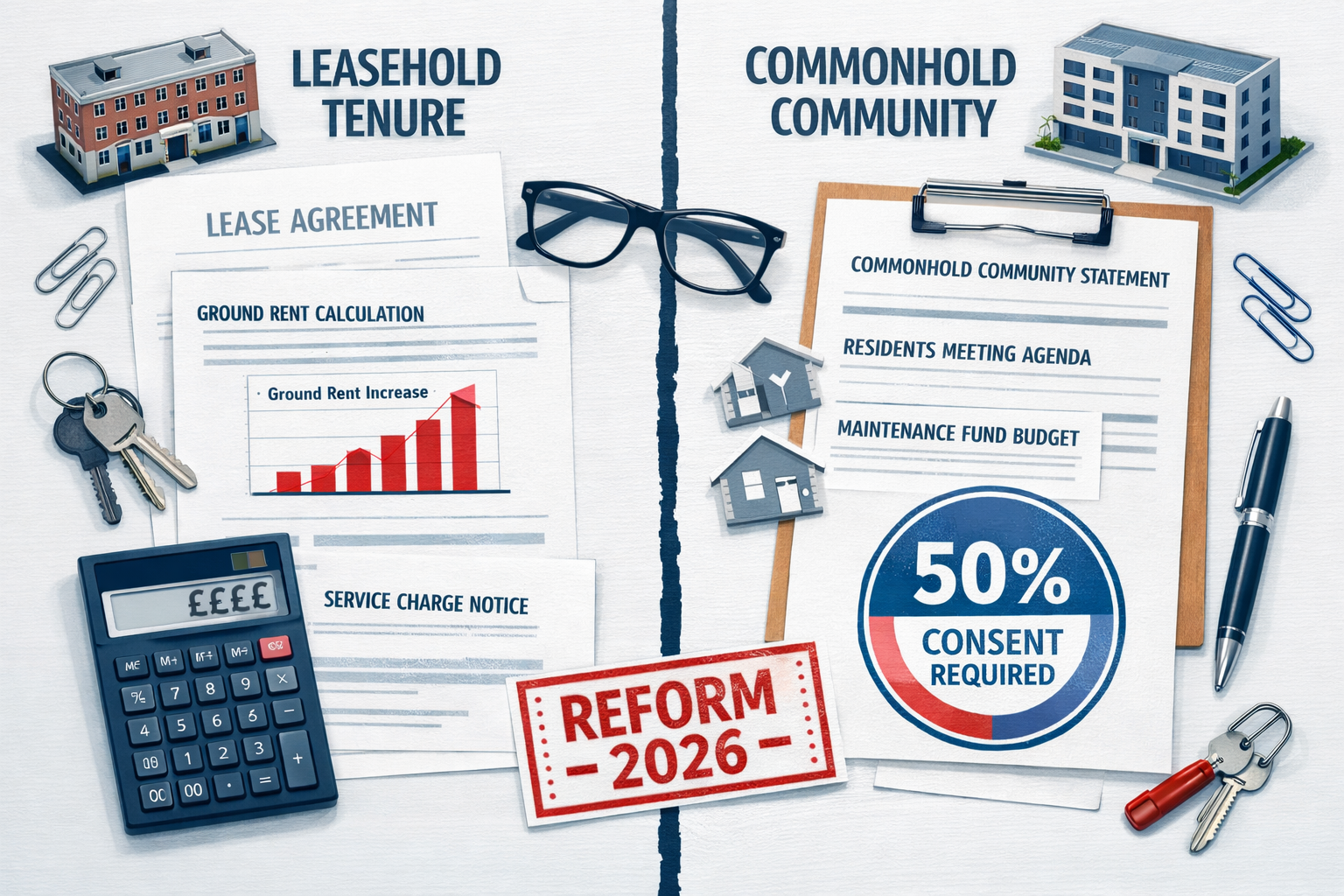
As the 50% consent threshold makes conversions more accessible [5], surveyors are increasingly being asked to assess blocks pre- and post-conversion to advise on value implications. This is a specialist area that requires a structured approach.
✅ Pre-Conversion Assessment Checklist
Governance and Consent
- Confirm the number of qualifying leaseholders and current consent levels
- Review the proposed Commonhold Community Statement for section definitions
- Assess mixed-use sections: commercial units may have different voting rights and service cost obligations [5]
- Check whether shared ownership leaseholders are included — shared owners in commonhold blocks will benefit from combined commonhold rights and leasehold protections [6]
Financial Viability
- Estimate the cost of buying out the freehold reversion (where applicable)
- Model the impact of ground rent cap on existing freehold investment value [1]
- Project service charge levels under the proposed commonhold structure
- Identify any mandatory leaseback arrangements for residual leaseholders [5]
Physical Readiness
- Confirm the building's condition supports the transition (no unresolved major defects)
- Review budgeting for repairs and restoration to establish a realistic reserve fund baseline
- Ensure asbestos surveys and fire safety assessments are current — these are non-negotiable pre-conversion requirements
- Consider whether a drone survey could provide cost-effective access to roof and upper-level areas that are difficult to inspect conventionally
Post-Conversion Valuation Adjustments
- Recalculate unit values on a commonhold basis, removing lease length discounts
- Adjust for the removal of ground rent as an outgoing
- Reassess lender appetite — most major lenders now accept commonhold security, though criteria vary
- Document the rationale for any uplift or discount applied relative to pre-conversion comparables
Social Housing and Shared Ownership Considerations 🏠
The reforms include specific provisions for the social housing sector. Shared ownership homes will have permitted leases, allowing shared owners in commonhold blocks to benefit from the combined protections of both tenure types [6]. Surveyors working with registered providers or local authorities should:
- Confirm whether the property falls within social housing exemptions
- Review the interaction between shared ownership lease terms and the new commonhold framework
- Assess whether staircasing provisions are affected by the conversion structure
- Liaise with housing associations regarding their own consultation responses, as multiple stakeholder engagement sessions are ongoing throughout 2026 [6]
Practical Guidance: Communicating Reform Impacts to Clients
Surveyors have a professional duty to communicate material valuation risks clearly. In the context of the 2026 reforms, this means:
In Valuation Reports:
- Explicitly state the current ground rent level and its relationship to the incoming £250/year cap [1]
- Note the unexpired lease term and flag the 80-year threshold
- Identify whether the block has conversion potential under the new 50% threshold [5]
- Include a brief legislative context section referencing the draft Bill and expected commencement dates
In Survey Reports:
- Cross-reference physical defects with their likely impact on service charges under a commonhold structure
- Flag any cladding, fire safety, or structural issues that could complicate conversion
- Note EPC ratings and their relevance to future MEES compliance costs
For Lender Instructions:
- Confirm whether the lender's handbook has been updated to reflect commonhold security requirements
- Flag any ground rent levels that exceed the incoming cap, as these may affect mortgage offer conditions
- Note forfeiture abolition as a change to the security risk profile [5]
A comprehensive building survey that integrates both physical condition findings and tenure context provides the most robust foundation for client advice in the current legislative environment.
Conclusion: Adapting Practice to the Reform Landscape
The Leasehold and Commonhold Reforms 2026: Building Surveyors' Checklists for Valuation Adjustments in Multi-Occupancy Properties framework outlined above is not a theoretical exercise — it reflects live legislative change that is already affecting buyer decisions, lender policies, and market pricing across England.
Actionable Next Steps for Surveyors 🎯
- Update your valuation templates to include ground rent cap analysis and commonhold conversion potential as standard fields.
- Review your survey report structure to cross-reference physical condition findings with service charge and tenure implications.
- Brief your clients proactively on the timeline: ban on new leasehold flats expected from 2029, ground rent changes from late 2028 [3].
- Invest in CPD covering commonhold governance, the new lease enforcement claim process, and sectional commonhold for mixed-use buildings [5].
- Commission Level 3 surveys for any multi-occupancy property where conversion is under consideration — the physical condition baseline is critical to financial modelling.
- Monitor the consultation on "Moving to commonhold: banning leasehold for new flats," which closes on 24 April 2026 [3], and track subsequent parliamentary progress.
The surveyors who adapt their checklists and client communication protocols now will be best positioned to deliver accurate, defensible valuations as the reform programme gathers pace through 2026 and beyond.
References
[1] Commonhold And Leasehold Bill Update What Is It All About – tlt.com
[2] Commonhold And Leasehold Reform Steps Up A Pace – traverssmith.com
[3] Leasehold And Freehold Reform Updates 2026 Moving Towards Commonhold – hcrlaw.com
[4] Rpc Statement Draft Commonhold And Leasehold Reform Bill – gov.uk
[5] United Kingdom Commonhold And Leasehold Reform Bill – bakermckenzie.com
[6] The Draft Commonhold And Leasehold Reform Bill – housing.org.uk