

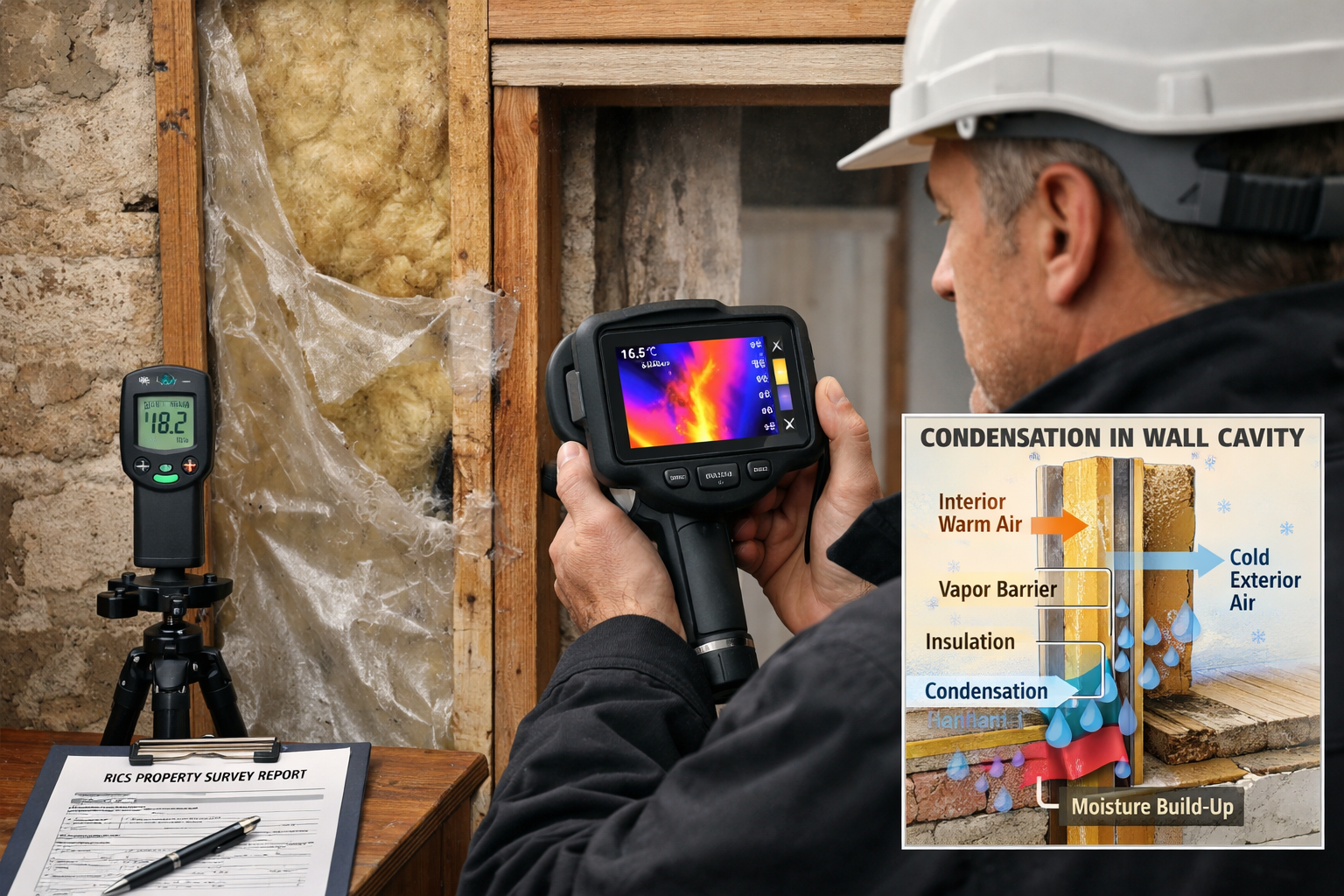
Hidden moisture trapped within wall cavities accounts for approximately 40% of all structural defects identified during comprehensive property surveys, yet remains one of the most challenging conditions for surveyors to detect and diagnose accurately. As building standards evolve and construction methods become more complex, Interstitial Condensation in RICS Home Surveys: Advanced Detection Techniques for 2026 Level 3 Reports has emerged as a critical competency area for chartered surveyors conducting thorough property assessments.
The 2026 updates to RICS Home Survey standards have introduced enhanced inspection requirements that specifically address the growing prevalence of concealed moisture issues in modern and retrofitted properties. With thermal imaging and moisture mapping technologies now considered essential tools rather than optional extras, surveyors must master advanced detection techniques to provide clients with the certainty they demand when making significant property investments.
Key Takeaways
- Interstitial condensation differs fundamentally from surface condensation and requires specialized detection equipment including thermal imaging cameras and calibrated moisture meters
- 2026 RICS Level 3 surveys mandate more comprehensive assessment protocols for hidden defects, with enhanced reporting standards for moisture-related issues [2]
- Advanced detection techniques combine thermal imaging, moisture profiling, and environmental monitoring to identify condensation within building cavities before visible damage occurs
- Early identification of interstitial moisture can prevent costly structural repairs, with intervention typically costing 60-80% less than remediation after significant damage develops
- Professional surveyors must distinguish interstitial condensation from five other damp types using evidence-based assessment methods [5]
Understanding Interstitial Condensation in Building Structures
What Makes Interstitial Condensation Different? 🏠
Interstitial condensation occurs when warm, moisture-laden air penetrates into wall cavities, roof spaces, or floor voids and reaches its dew point temperature on cooler surfaces within the building envelope. Unlike surface condensation that appears visibly on walls and windows, this hidden moisture accumulates within the structure itself—making it particularly dangerous and difficult to detect.
Professional surveyors must distinguish interstitial moisture from five other primary damp types [5]:
- Rising damp – moisture ascending through masonry via capillary action
- Penetrating damp – water ingress through external defects
- Surface condensation – moisture forming on visible interior surfaces
- Salt contamination – hygroscopic salts drawing moisture from the air
- Plumbing leaks – water escape from internal systems
The critical difference lies in location and formation mechanism. While other damp types originate from external sources or visible failures, interstitial condensation develops silently within building cavities where temperature differentials and vapor pressure drive moisture into structural elements.
Common Causes and Risk Factors
Several building characteristics and occupancy patterns increase interstitial condensation risk:
Building Design Factors:
- Inadequate or poorly positioned vapor barriers
- Insufficient cavity ventilation
- Cold bridging through structural elements
- Retrofit insulation without vapor control upgrades
- Complex roof geometries with limited ventilation paths
Environmental Conditions:
- High internal moisture generation (cooking, bathing, drying clothes)
- Inadequate mechanical ventilation systems
- Significant temperature differentials between heated and unheated spaces
- Properties in high-humidity geographical locations
- Seasonal temperature fluctuations affecting wall cavity conditions
Properties constructed or renovated between 1960-1990 face particular vulnerability, as cavity wall insulation was often retrofitted without adequate vapor control measures. Similarly, modern airtight construction without proper mechanical ventilation creates ideal conditions for moisture accumulation within building elements.
Advanced Detection Techniques for Interstitial Condensation in RICS Home Surveys
Thermal Imaging Technology Applications 📷
Thermal imaging has transitioned from optional to essential for comprehensive damp assessment in 2026 Level 3 surveys [5]. Modern infrared cameras detect temperature variations across building surfaces, revealing hidden moisture accumulation patterns invisible to visual inspection alone.
Key thermal imaging applications include:
| Detection Application | What It Reveals | Interpretation Considerations |
|---|---|---|
| Surface temperature mapping | Cold spots indicating moisture presence | Must account for thermal mass differences |
| Cavity moisture patterns | Temperature differentials across wall thickness | Requires external temperature reference |
| Insulation defects | Areas of heat loss where moisture may accumulate | Distinguish from air leakage paths |
| Condensation risk zones | Areas where dew point is regularly reached | Compare against ventilation adequacy |
Professional surveyors conducting Level 3 full building surveys use thermal imaging in conjunction with environmental monitoring to establish whether observed temperature patterns indicate active interstitial condensation or historical moisture events.
Best practice thermal imaging protocols for interstitial condensation detection require:
- Minimum 10°C temperature differential between interior and exterior
- Survey timing during heating season (October-March optimal)
- Multiple readings taken at different times to establish patterns
- Correlation with moisture meter readings for confirmation
- Documentation of external weather conditions affecting results
Moisture Profiling and Meter Technologies
Moisture profiling remains the primary detection method for confirming suspected interstitial condensation identified through thermal imaging [5]. Advanced moisture meters provide quantitative data that thermal imaging cannot deliver, establishing the actual moisture content within building elements.
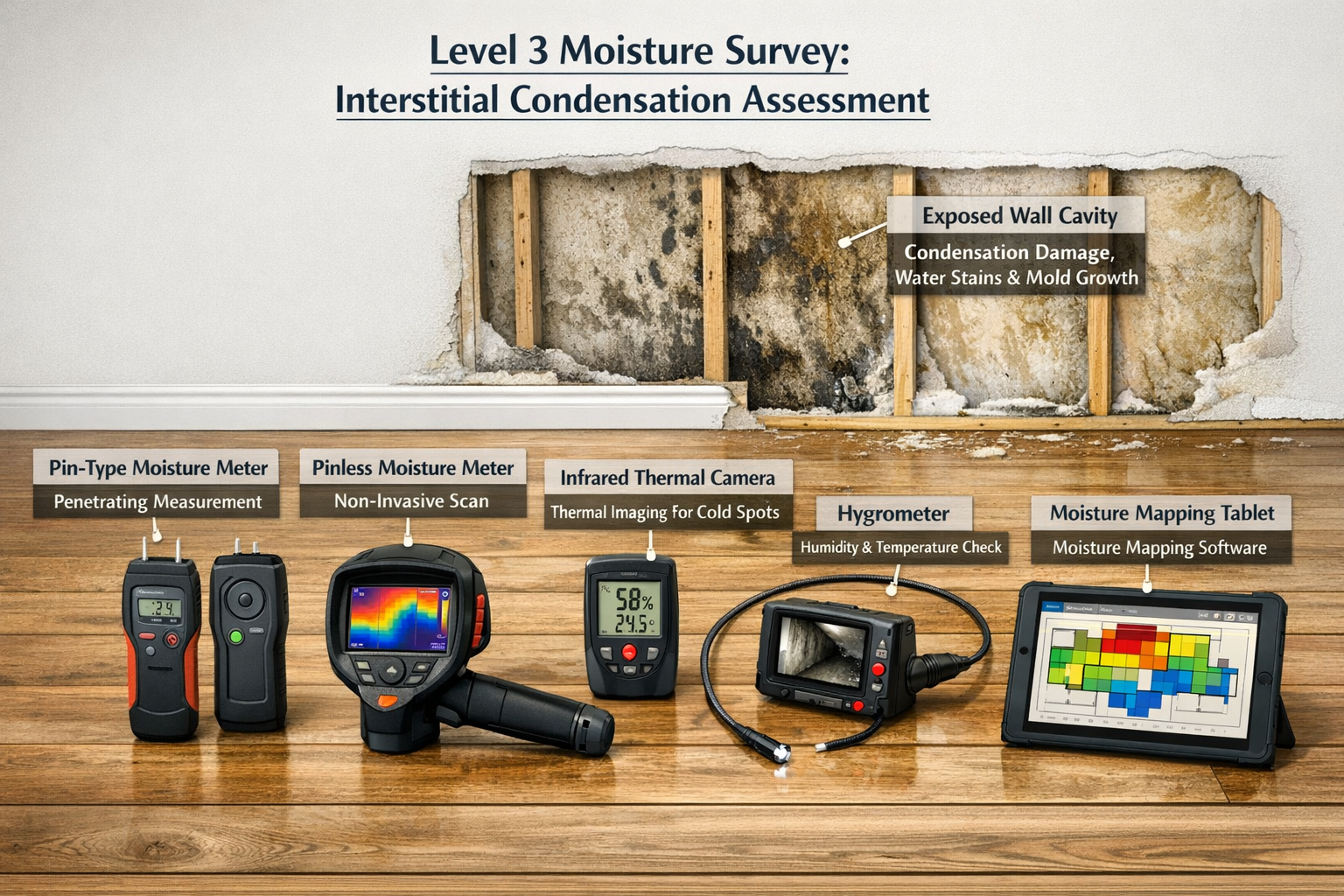
Two primary moisture meter technologies serve different assessment purposes:
Pin-Type Meters:
- Penetrate surface materials to measure electrical resistance
- Provide depth-specific moisture readings
- Ideal for timber elements and plasterboard
- Limited effectiveness in masonry and dense materials
- Readings affected by salt contamination requiring correction factors
Pinless (Capacitance) Meters:
- Non-invasive scanning of surface areas
- Detect moisture up to 25mm depth in most materials
- Rapid screening of large wall areas
- Less affected by surface salts
- Cannot determine precise moisture location within cavity
Professional surveyors typically employ both technologies in combination, using pinless meters for initial screening and pin-type meters for detailed investigation of suspect areas. When assessing areas of further investigation, moisture profiling creates a documented baseline against which future readings can be compared.
Environmental Monitoring and Dew Point Analysis
Understanding the environmental conditions that create interstitial condensation requires measurement of three critical parameters:
- Internal relative humidity – moisture content of indoor air
- Internal temperature – warmth of occupied spaces
- External temperature – ambient conditions affecting building envelope
Dew point calculation combines these measurements to determine where within the building envelope condensation will form. When internal air with specific temperature and humidity characteristics penetrates into wall cavities, it cools as it moves toward the exterior. The point at which this air reaches 100% relative humidity—its dew point—is where condensation occurs.
Professional surveyors use psychrometric calculations to model condensation risk:
- Vapor pressure differentials between interior and exterior
- Temperature gradients through wall construction layers
- Vapor resistance of building materials and membranes
- Ventilation rates affecting moisture removal capacity
This analytical approach distinguishes competent Level 3 building surveys from basic visual inspections, providing evidence-based assessment rather than superficial observation.
Interstitial Condensation in RICS Home Surveys: 2026 Level 3 Reporting Standards
Enhanced Inspection Requirements Under 2026 Standards
The 2026 updates to RICS Home Survey standards have introduced substantially more thorough examination protocols for moisture-related defects [2]. These enhanced requirements reflect growing industry recognition that hidden defects, particularly interstitial condensation, represent significant financial risks that previous survey standards inadequately addressed.
Key changes affecting Interstitial Condensation in RICS Home Surveys: Advanced Detection Techniques for 2026 Level 3 Reports include:
✅ Mandatory thermal imaging for properties with cavity wall insulation
✅ Moisture profiling requirements for all suspect areas identified during inspection
✅ Environmental monitoring documentation including internal humidity levels
✅ Risk assessment protocols for condensation potential in unheated spaces
✅ Enhanced reporting standards requiring quantitative moisture data rather than qualitative observations
These standards align with broader industry trends toward greater certainty in property transactions. Buyers increasingly demand comprehensive technical evidence supporting survey conclusions, particularly regarding hidden defects that may require expensive remediation.
Documentation and Reporting Protocols
Professional surveyors must now provide detailed documentation supporting interstitial condensation findings. The enhanced 2026 standards require Level 3 survey reports to include:
Quantitative Moisture Data:
- Specific moisture meter readings with equipment calibration details
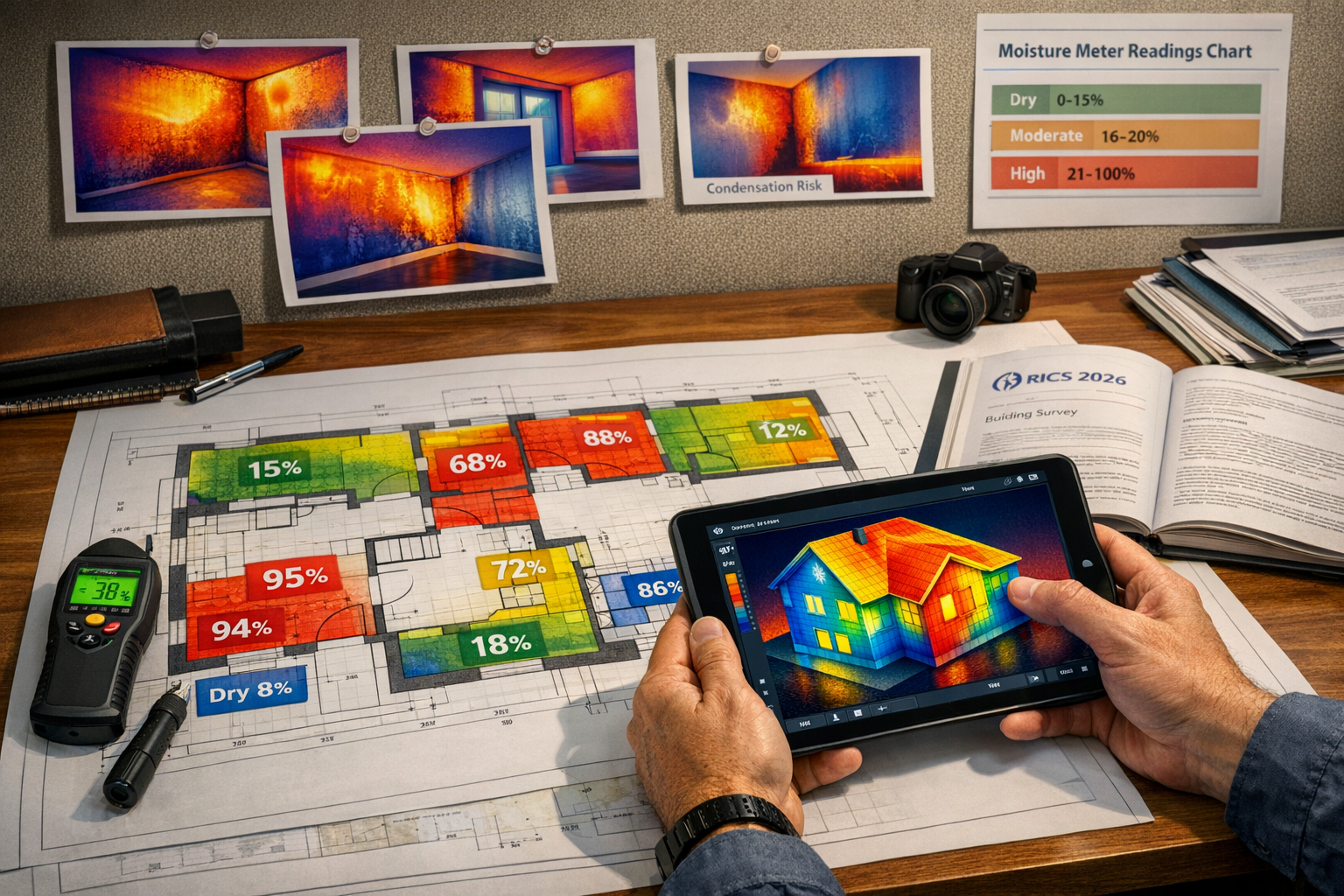
- Thermal imaging photographs with temperature scales and reference points
- Environmental monitoring data (temperature, relative humidity, dew point)
- Comparison against baseline moisture levels for building materials
Risk Assessment Analysis:
- Evaluation of condensation formation mechanisms
- Assessment of ventilation adequacy
- Analysis of vapor control measures (or deficiencies)
- Prediction of progression if left unaddressed
Remediation Recommendations:
- Specific interventions required to resolve moisture sources
- Ventilation improvements needed
- Vapor barrier upgrades or installations
- Estimated costs for recommended works
Survey reports must clearly distinguish between confirmed interstitial condensation and suspected moisture issues requiring further investigation. When definitive diagnosis requires invasive investigation beyond the survey scope, surveyors should recommend specialist damp surveys with endoscopic cavity inspection.
Typical reporting timelines have been maintained, with most comprehensive damp assessments issued within 3-5 working days, though urgent or dangerous building issues are flagged immediately [5].
Integration with Construction and Condition Assessment
Interstitial condensation assessment cannot occur in isolation—it must integrate with comprehensive evaluation of building construction and overall condition. Professional surveyors conducting construction and condition surveys examine how building design, materials, and maintenance history contribute to moisture risk.
Critical integration points include:
Roof Construction Analysis:
- Adequacy of roof space ventilation
- Presence and condition of vapor control layers
- Insulation type and installation quality
- Cold deck vs. warm deck roof construction
- Ventilation of boxed eaves and enclosed valleys
Wall Construction Evaluation:
- Cavity wall construction details and insulation status
- Vapor barrier presence in solid wall insulation systems
- Render and cladding systems affecting breathability
- Window and door reveals as thermal bridge locations
Floor Construction Assessment:
- Suspended timber floor ventilation adequacy
- Solid floor insulation and vapor barrier installation
- Underfloor heating systems and condensation risk
- Basement and cellar construction affecting ground floor moisture
Properties with complex construction—particularly listed buildings, conversions, and extensively renovated homes—require especially careful assessment. The listed building survey guide emphasizes that traditional construction methods often conflict with modern insulation standards, creating elevated interstitial condensation risk [6].
Practical Application: Case Studies and Common Scenarios
Scenario 1: Retrofit Cavity Wall Insulation
A common source of interstitial condensation involves properties where cavity wall insulation was retrofitted without adequate assessment of existing vapor control measures. In a typical case:
Initial Presentation:
- Homeowner reports musty odors and isolated mold patches
- Surface condensation visible on north-facing bedroom walls
- Property had cavity wall insulation installed 5-8 years previously
Advanced Detection Findings:
- Thermal imaging reveals extensive cold bridging at wall-floor junctions
- Moisture meter readings show elevated readings (18-22% WME) in affected walls
- Environmental monitoring confirms high internal humidity (65-70% RH)
- Dew point analysis indicates condensation forming within cavity
Root Cause:
Retrofit insulation filled the cavity, eliminating the ventilated air gap that previously allowed moisture vapor to dissipate. Without vapor control layer on the warm side of the insulation, moisture-laden internal air penetrates into the now-cold cavity where it condenses on the inner leaf.
Remediation Approach:
- Internal wall lining system with integrated vapor control layer
- Enhanced mechanical ventilation with humidity control
- Targeted cavity ventilation at vulnerable junctions
- Estimated cost: £8,000-£15,000 depending on property size
Scenario 2: Loft Conversion with Inadequate Ventilation
Modern loft conversions frequently create interstitial condensation risks when ventilation design fails to account for increased moisture generation in newly habitable spaces.
Detection Indicators:
- Thermal imaging shows temperature variations in sloping ceiling areas
- Moisture readings elevated in roof timber members
- Condensation staining visible in unheated eaves storage areas
- Mold growth on cold surfaces in enclosed roof voids
Contributing Factors:
- Bathroom installed in loft space without adequate extract ventilation
- Insulation installed between rafters without ventilation gap
- Vapor control layer absent or poorly detailed at junctions
- Eaves ventilation blocked during conversion works
Understanding these common scenarios helps surveyors recognize patterns during property inspections and provide accurate assessment of condensation risks.
Prevention Strategies and Long-Term Solutions
Design-Stage Considerations
Preventing interstitial condensation begins with proper building design incorporating three fundamental principles:
- Vapor Control – Installing vapor barriers on the warm side of insulation
- Adequate Ventilation – Providing moisture removal pathways
- Thermal Continuity – Eliminating cold bridging that creates condensation points
New construction and major renovations should incorporate:
- Continuous vapor control layers with properly sealed junctions
- Mechanical ventilation with heat recovery (MVHR) in airtight construction
- Breathable construction allowing outward vapor diffusion where appropriate
- Thermal modeling to identify condensation risk zones before construction
Remediation Approaches for Existing Properties
When interstitial condensation is identified during RICS surveys, remediation typically involves one or more interventions:
Ventilation Enhancement:
- Installation of continuous mechanical extract ventilation
- Positive input ventilation systems for whole-house air change
- Passive stack ventilation in appropriate locations
- Humidity-controlled extract fans in moisture-generating rooms
Vapor Control Improvements:
- Internal wall lining systems with integrated vapor barriers
- Vapor-permeable external insulation systems
- Breathable lime plasters in traditional construction
- Sealed vapor control layers in roof spaces
Insulation Modifications:
- Removal of inappropriate cavity insulation
- Installation of external wall insulation with proper detailing
- Warm roof conversions eliminating cold deck condensation risk
- Insulated plasterboard with integrated vapor control
The budgeting repairs and restoration guidance helps property owners understand typical costs and prioritize interventions based on severity and risk.
Maintenance and Monitoring Protocols
Even after remediation, ongoing monitoring ensures interstitial condensation doesn't recur:
Occupant Behavior Management:
- Appropriate heating patterns maintaining consistent internal temperatures
- Adequate ventilation during moisture-generating activities
- Avoidance of blocking ventilation pathways
- Regular cleaning of mechanical ventilation filters
Periodic Professional Assessment:
- Annual moisture surveys in high-risk properties
- Thermal imaging surveys every 3-5 years
- Immediate investigation of new condensation symptoms
- Documentation of moisture readings for trend analysis
Property owners should understand that interstitial condensation often results from the interaction between building characteristics and occupancy patterns. Even well-designed buildings can develop moisture issues if occupied inappropriately or if ventilation systems are not maintained.
Choosing the Right Survey Level for Condensation Assessment
Not all property surveys provide adequate assessment of interstitial condensation risks. Understanding which survey level meets specific needs helps buyers and property owners make informed decisions.
When Level 3 Surveys Are Essential
The comprehensive nature of Level 3 building surveys makes them essential for properties with elevated condensation risk:
- Pre-1919 properties with solid wall construction
- Properties with retrofit insulation of any type
- Loft conversions and extensions creating new thermal envelopes
- Properties showing any visible damp symptoms
- Buildings in high-humidity locations near water bodies
- Homes with previous moisture-related insurance claims
The enhanced inspection protocols and advanced detection techniques employed in Level 3 surveys provide the comprehensive assessment necessary to identify hidden interstitial condensation before completion.
Limitations of Lower Survey Levels
Level 2 (HomeBuyer) surveys and basic valuations typically do not include:
- Thermal imaging inspection
- Quantitative moisture meter readings
- Environmental monitoring or dew point analysis
- Assessment of cavity conditions
- Detailed ventilation adequacy evaluation
While these surveys may note visible damp symptoms, they cannot reliably detect or diagnose interstitial condensation occurring within building cavities. Buyers relying on lower survey levels may face unexpected costs if hidden moisture issues emerge after purchase.
Understanding the consequences of failing to act on survey recommendations helps property buyers appreciate the value of comprehensive assessment.
Conclusion: Embracing Advanced Detection for Property Certainty
Interstitial Condensation in RICS Home Surveys: Advanced Detection Techniques for 2026 Level 3 Reports represents a significant evolution in professional surveying practice. The enhanced standards introduced in 2026 reflect industry recognition that hidden moisture defects pose substantial financial risks requiring sophisticated detection methods and evidence-based reporting.
The integration of thermal imaging, moisture profiling, and environmental monitoring into standard Level 3 survey protocols provides property buyers with unprecedented certainty about building condition. These advanced techniques identify problems before they cause visible damage, enabling early intervention that typically costs 60-80% less than remediation after structural deterioration occurs.
For property professionals, mastering these detection techniques is no longer optional—it's an essential competency for delivering the comprehensive assessment clients expect when commissioning Level 3 surveys. The combination of specialized equipment, technical knowledge, and analytical skills distinguishes professional chartered surveyors from basic visual inspectors.
Actionable Next Steps
For Property Buyers:
- Commission Level 3 surveys for properties with any condensation risk factors
- Request specific interstitial condensation assessment if concerns exist
- Review thermal imaging and moisture profiling data in survey reports
- Budget appropriately for recommended remediation works before completion
For Property Owners:
- Arrange specialist moisture surveys if condensation symptoms appear
- Implement recommended ventilation improvements promptly
- Monitor internal humidity levels and adjust heating/ventilation accordingly
- Commission periodic thermal surveys to verify remediation effectiveness
For Surveyors:
- Invest in quality thermal imaging and moisture detection equipment
- Develop competency in dew point analysis and psychrometric principles
- Stay current with 2026 RICS standards and reporting requirements
- Document findings with quantitative data supporting conclusions
The future of property surveying lies in evidence-based assessment using advanced detection technologies. As building construction becomes increasingly complex and energy efficiency requirements drive changes in building envelopes, the ability to identify and diagnose interstitial condensation will remain a critical surveying competency throughout 2026 and beyond.
References
[1] Survey For Basements And Cellars 2025 – surveymatch.co.uk
[2] Building Survey Quality Standards 2026 Navigating Rics Updates And Enhanced Home Inspection Requirements – nottinghillsurveyors.com
[3] Description Of The Rics Home Survey Level 3 – rics.org
[4] Rics Level 3 Home Survey Findings Explained – findmysurveyor.com
[5] What Does A Damp Survey Involve A Step By Step Guide For Homeowners And Buyers – hfwjsurveyors.com
[6] Listed Building Survey Guide – strutsurveyors.com
[7] Damp And Mould – rics.org