

Over 1.5 million people in England live in residential buildings that fall within the scope of the Building Safety Act 2022 — and as of 2026, the regulatory landscape governing those buildings has shifted in ways that directly affect how surveyors value them, how disputes are argued, and how expert witnesses must prepare their evidence. Higher-Risk Building Valuations Post-2026 Reforms: Expert Witness Preparation for Safety Compliance Disputes is no longer a niche concern for specialist solicitors. It sits at the centre of tribunal hearings, lease extension negotiations, and insurance disputes across England.
This article sets out what expert witnesses need to know about the 2026 regulatory changes, how to structure valuation reports for compliance-related disputes, and what RICS-aligned checklists should look like when a case goes before a tribunal.
Key Takeaways 📋
- The definition of a higher-risk building (HRB) remains unchanged post-2026 (generally 18m+ or 7+ storeys), but a scheduled review means valuation opinions must account for potential future scope expansion [6].
- The Building Safety Regulator (BSR) introduced key operational changes from January 2026, including enhanced oversight of the design and construction of new HRBs and stricter in-occupation regime enforcement [2].
- Expert witnesses must demonstrate RICS-compliant methodology and clearly separate factual findings from opinion when preparing valuation evidence for safety compliance disputes.
- Remediation costs, including cladding removal, fire door replacement, and structural upgrades, must be quantified with precision and sourced from verified contractor schedules.
- Surveyors who fail to engage with the 2026 reforms risk having their evidence challenged or disregarded by tribunals on grounds of inadequate regulatory awareness.
The 2026 Regulatory Landscape: What Has Changed and Why It Matters for Valuers
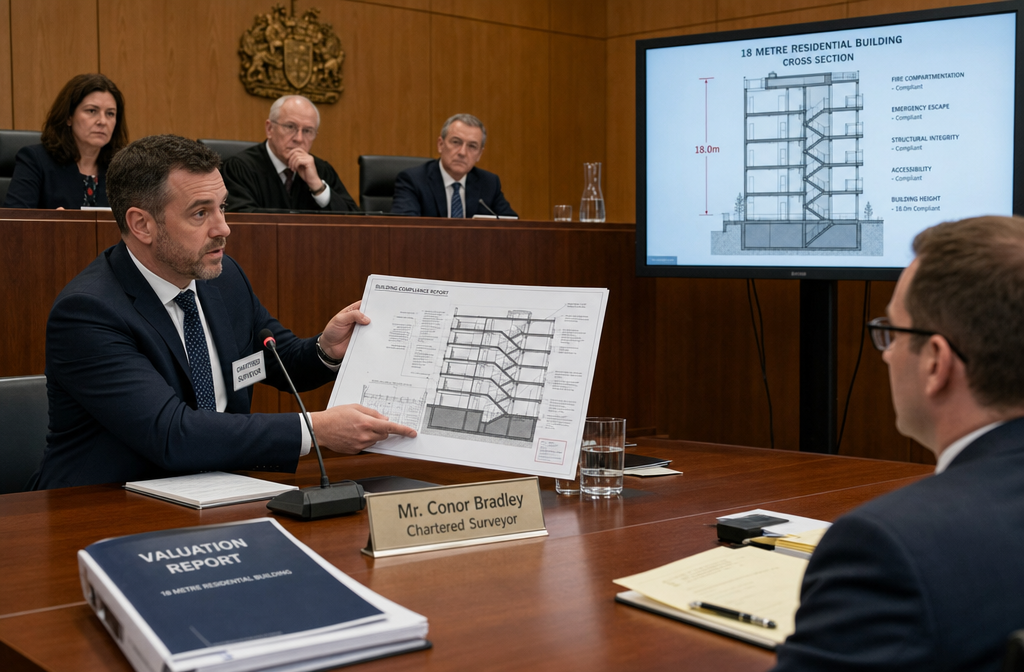
The Building Safety Act 2022 created a phased reform programme. By 2026, several of those phases have reached maturity, creating a more demanding environment for anyone producing property valuations on higher-risk buildings [7].
Key 2026 Developments Affecting HRB Valuations
The BSR published its 2026 plan with a clear focus on enforcement and accountability [9]. The following changes are directly relevant to valuation work:
| Reform Area | 2026 Status | Valuation Impact |
|---|---|---|
| HRB definition review | No change recommended; ongoing review scheduled [6] | Scope uncertainty must be reflected in risk assumptions |
| BSR enforcement powers | Strengthened; stop notices and compliance notices now active [2] | Non-compliant buildings carry measurable value discount |
| Principal accountable person (PAP) duties | Fully operational [5] | Liability exposure affects investment value |
| Golden thread documentation | Mandatory for all registered HRBs [1] | Absence of documentation is a material valuation factor |
| Second staircase requirement | Phased implementation underway [10] | Retrofit costs affect capital value of affected blocks |
💡 Pull Quote: "The 2026 reforms have not just changed what buildings must do — they have changed what those buildings are worth. Valuers who ignore this do so at their professional peril."
The Building Safety Regulator's initial review of the HRB definition confirmed that the current threshold — broadly, residential buildings of at least 18 metres or 7 storeys, plus certain care and health facilities — remains in place [6]. However, the review also confirmed that ongoing scrutiny is planned, meaning that mid-rise blocks between 11m and 18m could be drawn into the regime in future iterations. This regulatory change risk is a material valuation consideration that expert witnesses must address explicitly.
Gowling WLG's analysis of what to expect from the Building Safety Act in 2026 highlights that the year marks a transition from implementation to enforcement — a shift that has real consequences for asset values [7]. Buildings with unresolved safety defects, incomplete registration, or absent golden thread documentation are now demonstrably less attractive to lenders and investors.
For a deeper understanding of how structural issues affect commercial and residential property values, the analysis of stresses in structural members of commercial buildings provides useful technical context that expert witnesses can draw upon when quantifying defect severity.
Expert Witness Preparation for Safety Compliance Disputes: Building the RICS-Aligned Report
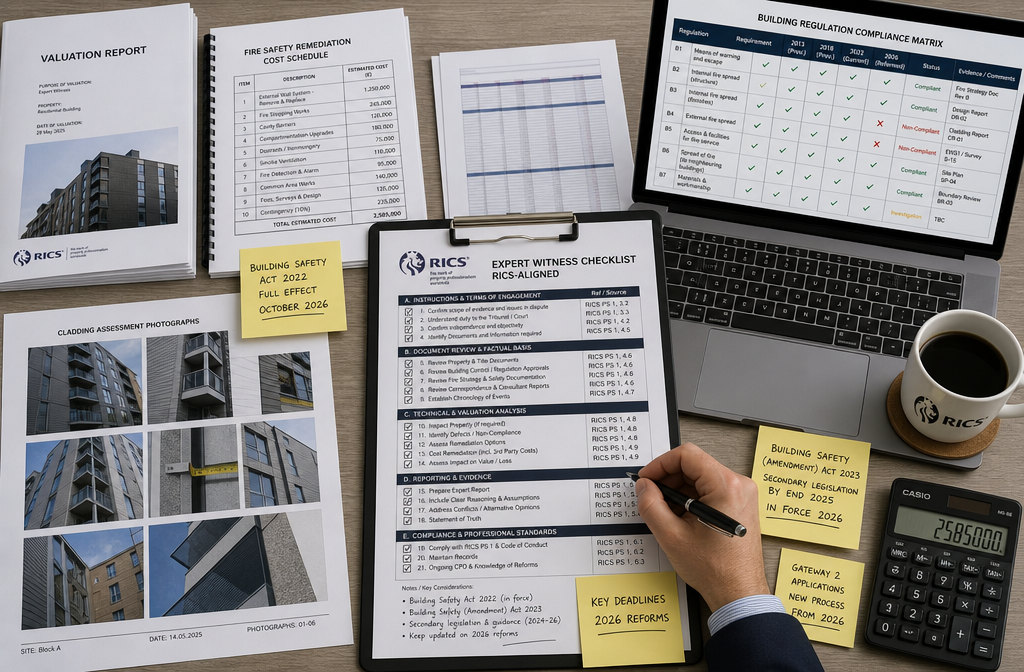
When a dispute reaches a tribunal — whether that is the First-tier Tribunal (Property Chamber), the Upper Tribunal, or an arbitration panel — the quality of the expert witness report often determines the outcome. In the context of Higher-Risk Building Valuations Post-2026 Reforms: Expert Witness Preparation for Safety Compliance Disputes, the bar has risen considerably.
The Expert Witness's Overriding Duty
Under CPR Part 35 and the RICS Practice Statement Surveyors Acting as Expert Witnesses (4th edition), the expert's primary duty is to the tribunal, not to the instructing party. This is fundamental. Any valuation report that reads as advocacy rather than independent analysis will be scrutinised — and potentially dismissed.
For surveyors preparing to act in this capacity, the expert witness reports service offered by chartered surveying firms provides a structured framework for meeting these obligations.
RICS-Aligned Checklist for HRB Valuation Expert Reports ✅
The following checklist reflects best practice for 2026 compliance dispute contexts:
Section 1: Instructions and Scope
- Written instructions received and confirmed
- Single joint expert or party-appointed expert status declared
- Conflicts of interest checked and disclosed
- Scope of valuation clearly defined (market value, reinstatement cost, diminution in value, etc.)
Section 2: Regulatory Compliance Assessment
- Building registration status with BSR confirmed [2]
- Principal accountable person identified and documented [5]
- Golden thread documentation reviewed (or absence noted)
- Relevant enforcement notices or compliance notices identified [9]
- Fire risk appraisal of external walls (FRAEW) obtained or requested
- EWS1 form status confirmed
Section 3: Remediation Cost Quantification
- Itemised schedule of defects prepared
- Contractor quotes or industry benchmarks referenced
- Distinction drawn between qualifying leaseholder costs and developer/landlord liability under the Building Safety Act [1]
- Phasing of remediation works and interim management costs included
Section 4: Valuation Methodology
- Comparables selected and adjusted for safety compliance status
- Regulatory change risk explicitly modelled (see HRB definition review [6])
- Discounted cash flow or residual method used where income approach is appropriate
- Sensitivity analysis provided for key assumptions
Section 5: Opinion and Conclusions
- Clear separation of fact and opinion
- Statement of truth signed
- Limitations and caveats clearly stated
The importance of thorough documentation cannot be overstated. Tribunals in 2026 are increasingly familiar with the BSR framework, and reports that fail to engage with it are routinely criticised. A Level 3 full building survey often forms the evidential foundation upon which a valuation expert report is built — particularly where structural or material defects are in dispute.
Common Pitfalls in Expert Witness Reports for HRB Disputes
🚫 Pitfall 1: Ignoring the regulatory timeline. Valuations that treat a non-compliant building as if enforcement action is theoretical — rather than imminent — will be challenged. The BSR's 2026 enforcement posture makes this untenable [9].
🚫 Pitfall 2: Failing to address leaseholder protections. The Building Safety Act 2022 contains significant protections for qualifying leaseholders. Expert witnesses must understand which costs can and cannot be passed through service charges, as this directly affects investment value [5].
🚫 Pitfall 3: Using unadjusted comparables. A comparable sale of a fully remediated building cannot be applied without adjustment to a building with outstanding defects. Tribunals expect this adjustment to be explicit and reasoned.
🚫 Pitfall 4: Overlooking building materials. Combustible cladding, ACM panels, and HPL cladding remain the most visible safety issues, but internal defects — including fire stopping, compartmentation failures, and defective balconies — are equally material. A building materials assessment is often essential evidence.
For disputes involving cost allocation and construction liability, construction law advice can help surveyors understand the legal framework within which their valuation evidence will be tested.
Quantifying the Value Impact: How Post-2026 Reforms Reshape HRB Valuations
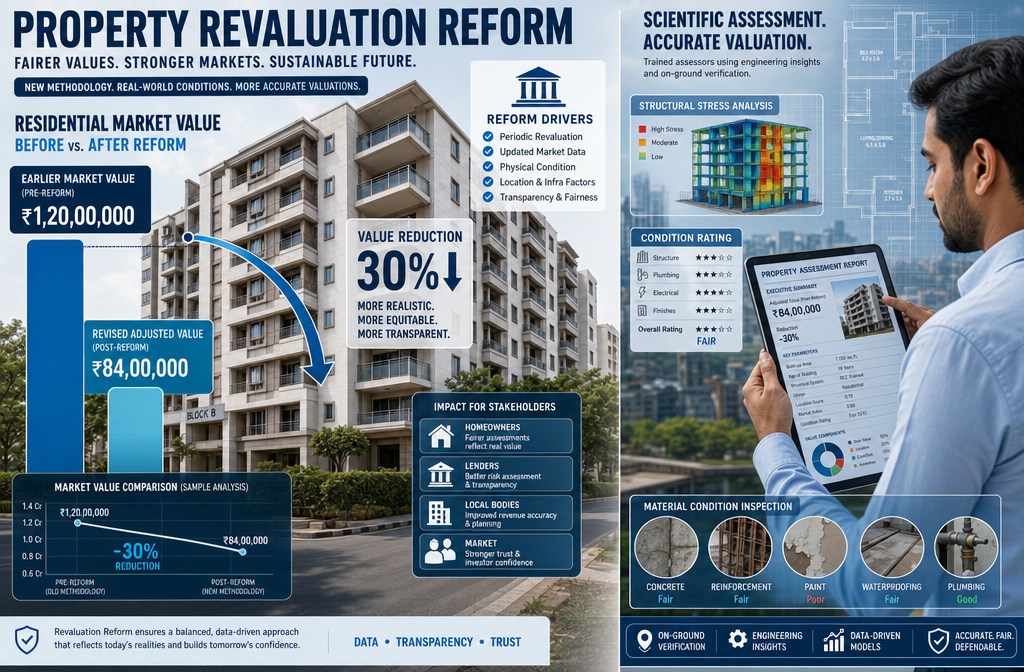
The practical question for any expert witness is: by how much does safety non-compliance reduce the value of a higher-risk building? The answer is never simple, but the 2026 reforms have introduced new variables that must be systematically addressed.
Factors Driving Value Adjustment in 2026
1. Mortgage lender restrictions 🏦
Lenders remain cautious about buildings without a satisfactory EWS1 form or equivalent fire safety assessment. Where financing is restricted, the pool of potential buyers shrinks, and values fall. This is a market-observable fact that expert witnesses can evidence through comparable analysis and lender policy documentation.
2. Service charge liability and leaseholder protections
The Building Safety Act 2022 caps or eliminates service charge liability for qualifying leaseholders in many remediation scenarios [1]. However, where a building is owned by a freeholder who is also the original developer, the liability picture is different. Expert witnesses must map the ownership structure carefully before reaching any opinion on investment value.
3. BSR enforcement risk
Buildings that have not registered with the BSR, or that have received compliance notices, carry a measurable enforcement risk premium [2]. Norton Rose Fulbright's analysis of key BSR changes from January 2026 highlights that the regulator's powers to issue stop notices and impose conditions on occupation are now fully operational — a material risk for income-producing assets [2].
4. Second staircase retrofit costs
Howard Kennedy's review of 2026 building safety changes notes that the second staircase requirement for new buildings above 18 metres is creating a two-tier market between compliant new stock and older blocks that cannot easily be retrofitted [10]. For expert witnesses valuing older mid-rise buildings, this structural market shift must be acknowledged.
5. Insurance premium inflation
Buildings with unresolved fire safety defects attract higher buildings insurance premiums. This affects both the net income of investment properties and the service charge burden on leaseholders. Shoosmiths' 2026 building safety outlook identifies insurance as a continuing pressure point for HRB owners and managers [1].
A Framework for Valuation Adjustment
The following framework provides a structured approach to quantifying value impact:
Gross Market Value (as if fully compliant)
LESS: Estimated remediation costs (net of any developer/government funding)
LESS: Holding costs during remediation (lost income, management costs)
LESS: Risk premium for regulatory uncertainty (HRB definition review risk)
LESS: Residual stigma discount (post-remediation market perception)
= Adjusted Market Value
Each deduction requires evidential support. Remediation costs should be sourced from contractor schedules or published benchmarks (e.g., BCIS data). Holding costs should reflect realistic programme timelines. The regulatory uncertainty discount is the most subjective element — but it is defensible where the expert can point to the BSR's stated intention to review the HRB definition [6].
Understanding what factors drive property valuations more broadly is useful context; the top 3 things looked at during a property valuation provides a helpful baseline from which HRB-specific adjustments can be explained to a tribunal.
The Mid-Rise Question: 11m to 18m Buildings
One of the most significant areas of uncertainty in 2026 is the status of buildings between 11 metres and 18 metres. The BSR's initial review confirmed no change to the current HRB definition [6], but the RIBA's analysis of the BSR's 2026 plan notes that the regulator is actively considering how to extend oversight to this category [9]. RWK Goodman's commentary on 2026 Building Safety Act developments similarly flags mid-rise buildings as a key watch area [5].
For expert witnesses, this means:
- Do not assume that a 14-storey building outside the current HRB definition is unaffected by safety reform pressures.
- Do model the probability of future regulatory capture in your risk assumptions.
- Do disclose this uncertainty clearly in your report's limitations section.
Conclusion: Actionable Steps for Expert Witnesses in 2026 ✅
The intersection of Higher-Risk Building Valuations Post-2026 Reforms: Expert Witness Preparation for Safety Compliance Disputes demands a new level of regulatory literacy from chartered surveyors. The reforms are no longer theoretical — enforcement is live, tribunals are experienced, and the financial stakes are high.
Here are the actionable next steps for surveyors preparing expert witness evidence in 2026:
-
Audit your regulatory knowledge. Ensure you are current on BSR enforcement powers, the golden thread requirements, and leaseholder protection provisions under the Building Safety Act 2022 [2][5].
-
Structure your report to the RICS checklist. Use the five-section framework above as a minimum standard. Every opinion must be traceable to evidence.
-
Quantify remediation costs rigorously. Do not rely on estimates. Obtain contractor schedules, reference BCIS benchmarks, and clearly state the basis of each figure.
-
Address regulatory change risk explicitly. The HRB definition review is ongoing [6]. Your valuation must acknowledge this uncertainty and explain how it has been modelled.
-
Engage construction law advice early. Understanding the liability framework — who pays, under what statutory provisions, and on what timeline — is essential context for any valuation opinion. Construction law advice from a specialist surveying firm can clarify these boundaries before you commit to a written opinion.
-
Commission a full building survey where needed. A Level 3 full building survey provides the depth of physical inspection evidence that tribunals expect when significant defects are in dispute.
The buildings at the centre of these disputes house real people. The valuations produced in these cases affect whether remediation happens, who pays, and how quickly residents can move on. Getting the expert evidence right is not just a professional obligation — it is a matter of public safety.
References
[1] Building Safety Developments Expected In 2026 – shoosmiths.com
[2] Building Safety Regulator Key Changes From January 2026 – connections.nortonrosefulbright.com
[5] Biz Const Building Safety Act 2026 Key Developments And What To Expect – rwkgoodman.com
[6] Definition Of Higher Risk Buildings Initial Review And Plans For Ongoing Review – gov.uk
[7] Building Safety Act 2022 What To Expect In 2026 – gowlingwlg.com
[9] Inside The Building Safety Regulators 2026 Plan – riba.org
[10] Building Safety Changes In 2026 – howardkennedy.com