

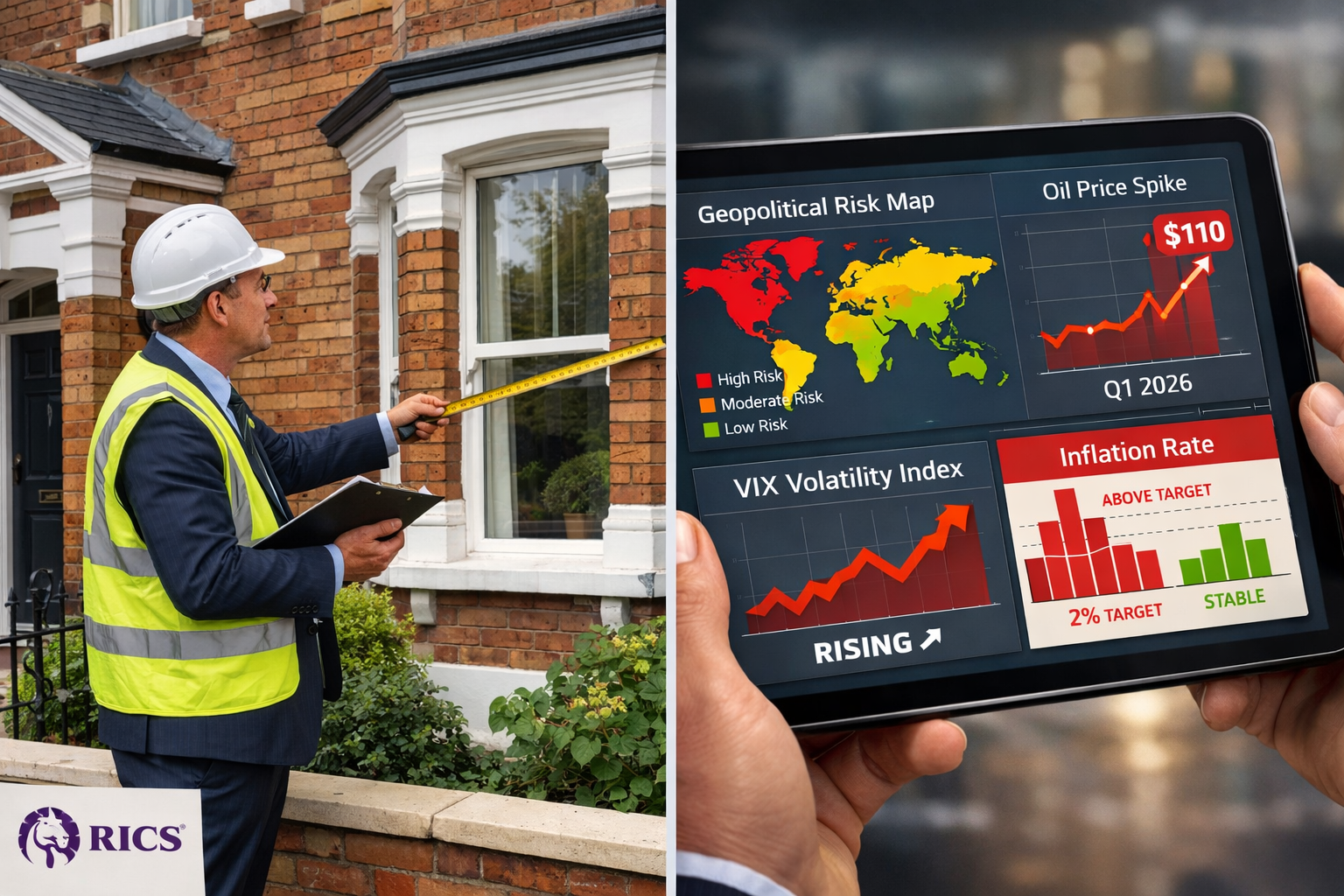
Recent data reveals a stark reality: the S&P 500 recorded 39 record closing highs in 2025, yet the first quarter of 2026 delivered the market's first meaningful pullback, driven by geopolitical conflict, inflation concerns, and oil price spikes[1]. For chartered surveyors navigating property valuations in this volatile environment, maintaining accuracy and client confidence has become increasingly complex. The intersection of geopolitical uncertainty and valuation confidence demands new strategies as surveyor approaches adapt to cautious 2026 market sentiment.
The property valuation profession faces unprecedented challenges as Middle East tensions dampen buyer sentiment and price expectations shift rapidly. Understanding how to maintain professional valuation standards while acknowledging market volatility has become essential for chartered surveyors across all sectors—from residential to commercial valuations.
Key Takeaways
- 📉 CEO confidence declined 1.7 points to 87.2 in Q1 2026, with only 27% of business leaders expecting economic improvement—down from 32% in late 2025[2]
- 💰 Profitability concerns are rising, with 17% of CEOs expecting worsening profitability (up from 13% in Q4 2025) amid tariff uncertainty and cost pressures[2]
- 🛢️ Oil price spikes and inflation above the Federal Reserve's 2% target are creating difficult policy conditions that directly impact property market sentiment[1]
- 🎯 Surveyor strategies must evolve to incorporate geopolitical risk assessment, enhanced comparable analysis, and transparent client communication
- ✅ Valuation confidence requires systematic risk documentation, scenario-based valuations, and adherence to RICS standards during market uncertainty
Understanding the 2026 Market Sentiment Shift
The Geopolitical Landscape Reshaping Valuations
The first quarter of 2026 marked a significant turning point for market sentiment. While 2025 delivered exceptional returns with consistent record highs, geopolitical tensions—particularly in the Middle East—have introduced supply-side shocks in energy markets that ripple through property valuations[1]. Oil prices surged, creating inflationary pressures that limit the Federal Reserve's ability to ease monetary policy, directly impacting borrowing costs and property affordability.
For chartered surveyors, these macroeconomic shifts translate into tangible valuation challenges. The VIX volatility index reached its highest level since April 2025, signaling increased market anxiety[1]. Although volatility remains within normal historical ranges, the psychological impact on buyers and sellers cannot be understated.
Key market indicators affecting valuations include:
- Inflation persistence above 2% across multiple measures
- Energy cost increases driven by geopolitical supply disruption
- Federal Reserve policy uncertainty limiting rate cut expectations
- Labor market cooling beneath surface-level employment statistics[1]
Small Business Confidence as a Leading Indicator
The Vistage CEO Confidence Index provides crucial insights for property surveyors, particularly those working on commercial valuations. The index dropped 1.7 points to 87.2 in Q1 2026, ending a three-quarter climb[2]. This decline reflects broader economic anxiety that directly influences commercial property demand and valuation assumptions.
More concerning for surveyors are the specific business outlook metrics:
| Metric | Q4 2025 | Q1 2026 | Change |
|---|---|---|---|
| CEOs expecting economic improvement | 32% | 27% | ↓ 5 points |
| CEOs expecting higher revenues | 69% | 65% | ↓ 4 points |
| CEOs expecting improved profitability | 53% | 51% | ↓ 2 points |
| CEOs expecting worse profitability | 13% | 17% | ↑ 4 points |
These figures suggest dampened economic optimism across the business leadership community[2], which translates into more cautious property investment decisions and potentially softer demand for commercial space.
Tariff Uncertainty and Property Market Implications
Perhaps the most operationally challenging factor for 2026 is tariff policy uncertainty. Business leaders report that tariff uncertainty is stalling decisions and squeezing profit margins[2]. For surveyors conducting property development valuations, understanding how tariffs impact construction costs, material availability, and development timelines has become essential.
Open-ended survey responses from business leaders highlight:
- ⚠️ Refund complexity and administrative burden
- 🔄 Delayed investment decisions pending policy clarity
- 💸 Unsustainable absorbed costs affecting business viability
- 📊 Difficulty forecasting expenses for planning purposes[2]
These operational challenges directly impact property valuations, particularly for development sites and commercial properties where business tenant viability influences rental income projections.
Geopolitical Uncertainty and Valuation Confidence: Surveyor Strategies for Maintaining Accuracy

Enhanced Comparable Analysis in Volatile Markets
Traditional comparable analysis relies on recent transactions reflecting stable market conditions. However, when geopolitical uncertainty creates rapid sentiment shifts, surveyors must adapt their methodology. The key lies in understanding which comparables remain relevant and which require adjustment for changed market conditions.
Best practices for comparable analysis in 2026:
- Time-weight recent transactions more heavily, with transactions from Q4 2025 potentially requiring adjustment for changed sentiment
- Segment comparables by buyer type, recognizing that institutional investors may react differently to geopolitical risk than individual buyers
- Document market sentiment shifts explicitly in valuation reports, referencing objective data like the CEO Confidence Index[2]
- Apply conservative adjustments when comparable evidence predates significant geopolitical events
- Cross-reference multiple data sources including auction results, asking prices, and actual transaction prices
For leasehold extension and enfranchisement valuations, this approach becomes particularly important as both landlord and tenant valuations must reflect current market realities rather than outdated comparable evidence.
Scenario-Based Valuation Approaches
Given the uncertainty surrounding geopolitical developments, inflation trajectories, and policy responses, scenario-based valuations provide clients with a more complete picture of potential outcomes. This approach acknowledges uncertainty while maintaining professional rigor.
A scenario-based framework might include:
Base Case Scenario:
- Assumes gradual stabilization of geopolitical tensions
- Inflation moderating toward 2% target over 12-18 months
- Federal Reserve implementing modest rate cuts in late 2026
- Property market sentiment improving gradually
Downside Scenario:
- Escalating geopolitical conflict affecting energy supplies
- Persistent inflation limiting monetary policy flexibility
- Continued market volatility dampening buyer confidence
- Property values declining 5-10% from current levels
Upside Scenario:
- Rapid resolution of geopolitical tensions
- Inflation falling faster than expected
- Aggressive Federal Reserve easing stimulating property demand
- Property values appreciating 3-5% as confidence returns
This framework allows clients to understand the range of potential outcomes while the surveyor maintains a defensible base case valuation. For right-to-buy valuations, this transparency helps both local authorities and applicants understand market positioning.
Risk Adjustment and Uncertainty Documentation
Professional valuation standards require surveyors to document assumptions and limitations. In the current environment, explicit risk documentation becomes a critical component of maintaining valuation confidence.
Key risk factors to document in 2026 valuations:
- 🌍 Geopolitical risk exposure: How regional or global tensions might affect property demand, particularly for commercial properties dependent on specific industries
- 📈 Inflation risk: Potential for construction costs to escalate beyond current estimates, affecting development viability
- 💵 Interest rate risk: Sensitivity of property values to potential rate changes as Federal Reserve policy evolves
- 🏢 Tenant viability risk: For commercial properties, the impact of business profitability concerns on lease renewals and rental income
- 🔄 Market liquidity risk: Potential for extended marketing periods if buyer sentiment continues to weaken
By systematically addressing these risks in valuation reports, surveyors demonstrate professional competence while managing client expectations. This approach aligns with RICS valuation standards that require transparency about valuation uncertainty.
Client Communication Strategies for Uncertain Markets
Maintaining client confidence during periods of geopolitical uncertainty requires clear, evidence-based communication that acknowledges market realities without creating unnecessary alarm. Surveyors must balance professional objectivity with practical client needs.
Effective communication strategies include:
- Contextualizing market data: Explain how current conditions compare to historical volatility periods
- Providing objective evidence: Reference specific data points like CEO confidence indices, market transaction volumes, and economic indicators[1][2]
- Avoiding speculation: Distinguish between observable market trends and speculative predictions about geopolitical outcomes
- Offering actionable insights: Help clients understand how market conditions affect their specific property decisions
- Regular market updates: For ongoing client relationships, provide periodic market commentary to maintain informed dialogue
For clients considering property purchases, understanding that the current market pullback "remains within normal historical ranges"[1] can provide reassurance that volatility is manageable rather than catastrophic.
Geopolitical Uncertainty and Valuation Confidence: Practical Implementation for Surveyors
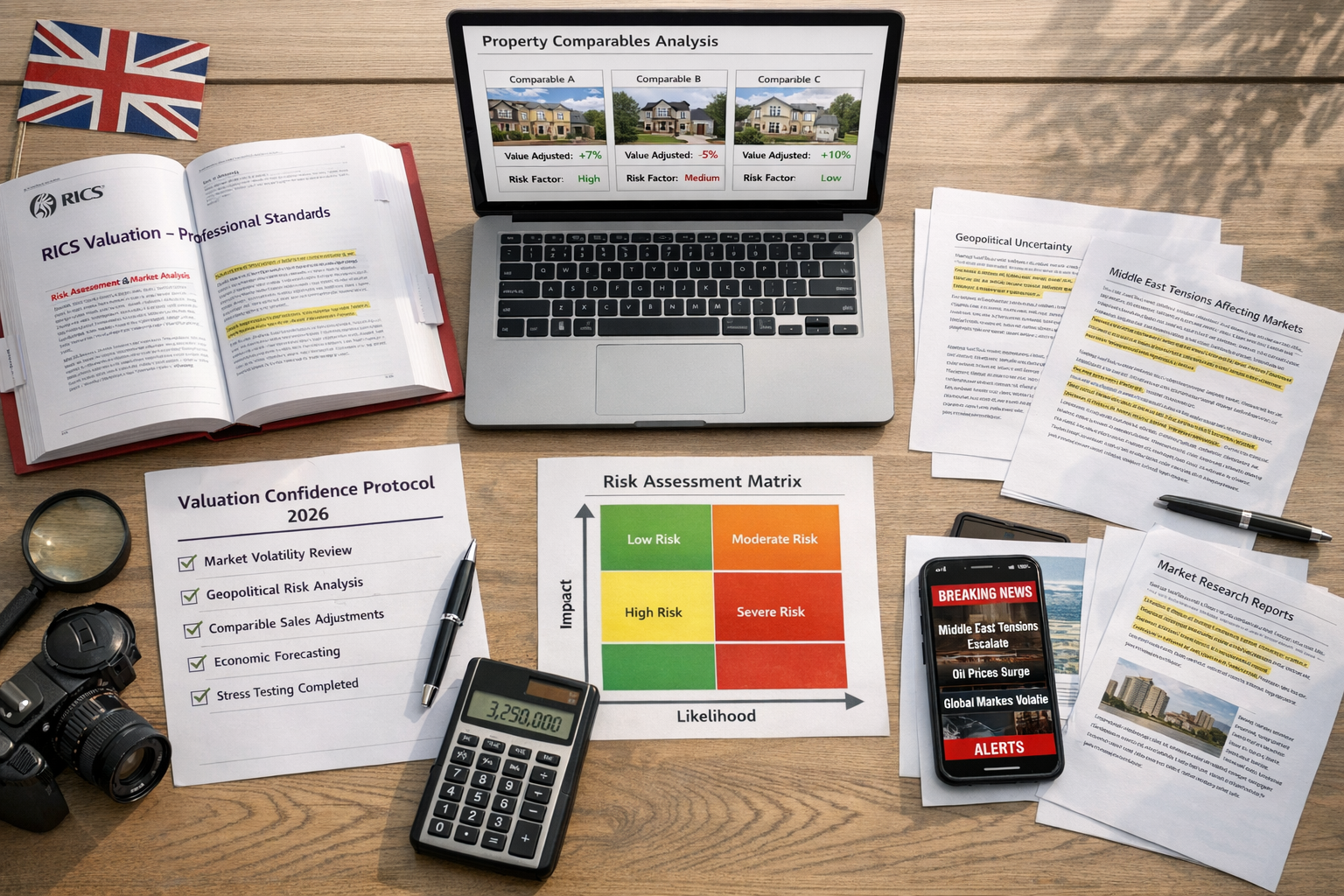
Building a Geopolitical Risk Assessment Framework
Chartered surveyors traditionally focus on property-specific factors—condition, location, comparable evidence. However, the 2026 market environment demands a systematic approach to geopolitical risk assessment as part of the valuation process.
A practical framework includes:
Step 1: Identify Relevant Geopolitical Factors
- Which geopolitical developments directly affect the property's market?
- Are there industry-specific exposures (e.g., energy-dependent businesses for commercial properties)?
- Does the property location have particular sensitivity to global trade patterns?
Step 2: Assess Transmission Mechanisms
- How do geopolitical factors translate into property market impacts?
- What is the timeline for impacts to materialize in transaction data?
- Which market segments (residential, commercial, industrial) are most affected?
Step 3: Quantify Where Possible
- Can specific adjustments be made to comparable evidence?
- Are there objective data points (like the 5-point decline in economic optimism[2]) that inform adjustments?
- What is the range of reasonable valuation outcomes?
Step 4: Document and Communicate
- Include geopolitical risk assessment in valuation reports
- Explain assumptions and their basis in objective evidence
- Provide context for clients unfamiliar with macroeconomic factors
This framework ensures that geopolitical considerations are incorporated systematically rather than as ad hoc adjustments.
Adapting Valuation Methodologies for Market Volatility
Different valuation approaches respond differently to market uncertainty. Understanding these dynamics allows surveyors to select the most appropriate methodology for current conditions.
Comparative Method Considerations:
- Most sensitive to recent market sentiment shifts
- Requires careful adjustment for transaction timing
- Benefits from larger sample sizes to identify trends
- Best when supplemented with market sentiment data[1][2]
Investment Method Considerations:
- Requires careful yield selection reflecting current risk perceptions
- Rental growth assumptions must account for business confidence trends
- Capitalization rates should reflect increased uncertainty
- Particularly relevant for commercial valuations where tenant viability is questioned
Residual Method Considerations:
- Highly sensitive to construction cost inflation
- Requires conservative profit margin assumptions in uncertain markets
- Development timelines may extend due to delayed decisions[2]
- Critical for property development valuations
Profits Method Considerations:
- Directly affected by business confidence and profitability expectations
- Revenue projections should reflect the 4-point decline in revenue optimism[2]
- Particularly important for trade-related properties
By selecting methodologies appropriate to current market conditions and adjusting inputs to reflect geopolitical uncertainty, surveyors maintain valuation reliability.
Leveraging Technology and Data for Enhanced Insights
Modern surveying practice increasingly relies on technology and data analytics to supplement traditional valuation approaches. In uncertain markets, these tools become even more valuable.
Useful technology applications include:
- 📊 Real-time market data platforms: Track transaction volumes, pricing trends, and market sentiment indicators
- 🤖 Automated valuation models (AVMs): Provide rapid market checks, though requiring professional interpretation in volatile conditions
- 📈 Economic data dashboards: Monitor inflation, interest rates, business confidence, and other macroeconomic indicators[1][2]
- 🗺️ Geographic information systems (GIS): Analyze location-specific factors and market segmentation
- 💬 Client communication platforms: Maintain regular dialogue with clients about evolving market conditions
These tools enhance rather than replace professional judgment. The surveyor's role remains interpreting data in context and applying professional expertise to reach defensible valuation conclusions.
Professional Development and Market Knowledge
Maintaining valuation confidence in uncertain markets requires ongoing professional development. Surveyors must expand their knowledge beyond traditional property factors to include macroeconomic literacy and geopolitical awareness.
Recommended knowledge areas for 2026:
- Macroeconomic fundamentals: Understanding how inflation, interest rates, and monetary policy affect property markets
- Geopolitical risk analysis: Recognizing which global developments have property market implications
- Business confidence indicators: Interpreting CEO surveys and business sentiment data[2]
- Market psychology: Understanding how sentiment shifts affect buyer and seller behavior
- Communication skills: Explaining complex market dynamics to clients clearly and confidently
Professional bodies like RICS provide resources and continuing professional development opportunities that help surveyors navigate these expanded knowledge requirements.
Building Valuation Resilience Through Documentation
Perhaps the most practical strategy for maintaining confidence in uncertain markets is comprehensive documentation. Well-documented valuations withstand scrutiny, support professional indemnity claims, and demonstrate competent practice.
Essential documentation elements:
- ✅ Assumption register: All assumptions explicitly stated and justified
- ✅ Limitation register: Scope limitations and their potential impact on valuation accuracy
- ✅ Market evidence log: All comparables considered, including those rejected and reasons why
- ✅ Adjustment rationale: Explicit explanation of all adjustments to comparable evidence
- ✅ Risk assessment: Documented consideration of geopolitical, economic, and property-specific risks
- ✅ Methodology selection: Justification for chosen valuation approach
- ✅ Sensitivity analysis: How valuation conclusions change with varying assumptions
This documentation discipline provides a defensible audit trail while forcing systematic consideration of all relevant factors. For complex assignments like leasehold extension valuations, this thoroughness becomes essential.
Conclusion
The intersection of geopolitical uncertainty and valuation confidence defines the surveying profession's challenge for 2026. With CEO confidence declining, business optimism dampened, and market volatility elevated by Middle East tensions and inflation concerns[1][2], chartered surveyors must adapt their practices to maintain accuracy and client trust.
The strategies outlined—enhanced comparable analysis, scenario-based valuations, systematic risk assessment, and improved client communication—provide a practical framework for navigating cautious 2026 market sentiment. By acknowledging uncertainty while maintaining professional rigor, surveyors can deliver valuations that serve client needs and withstand professional scrutiny.
Actionable next steps for surveyors:
- Review current valuation templates to ensure adequate documentation of geopolitical risk factors and market uncertainty
- Develop scenario-based valuation frameworks that provide clients with a range of potential outcomes rather than single-point estimates
- Establish regular monitoring of business confidence indicators, inflation data, and geopolitical developments affecting property markets
- Enhance client communication protocols to provide context for valuations delivered in uncertain market conditions
- Invest in professional development focusing on macroeconomic literacy and geopolitical risk assessment
- Build technology capabilities for real-time market data access and enhanced comparable analysis
The current market environment, while challenging, creates opportunities for surveyors who demonstrate adaptability and professional competence. By implementing robust strategies for managing uncertainty, the profession can maintain valuation confidence even as geopolitical factors create market volatility.
For clients navigating property decisions in 2026, working with surveyors who understand these dynamics and implement systematic risk assessment provides the confidence needed to proceed with informed decision-making despite market uncertainty.
References
[1] Charts Data Markets Q1 2026 Geopolitical Conflict War Oil Prices Us Tariffs Inflation Clearnomics – kitces.com
[2] Ceo Confidence Trends Downward In Q1 2026 As Geopolitical Uncertainty Returns – morningstar.com