

Nearly one in four new-build homes delivered in the UK in recent years has been found to contain defects serious enough to require formal remediation — yet the majority of buyers complete their purchase without commissioning an independent inspection. This guide, From Snagging Lists to Latent Defects: A Chartered Surveyor's Guide to New‑Build Inspection Strategies in 2026, addresses that gap head-on. Rather than offering generic tips, it provides a structured, evidence-based framework for chartered surveyors and informed buyers navigating modern methods of construction (MMC), developer warranty obligations, and the recurring defect patterns that have plagued UK new-build estates since 2010.
Key Takeaways 📋
- Staged inspections — from foundation through to final handover — are the most effective way to catch latent defects before they are permanently concealed.
- Every snagging item must be referenced against a published standard (NHBC, RICS tolerances, manufacturer data) to be enforceable against a developer.
- Modern methods of construction introduce new defect risks that differ significantly from traditional masonry builds and require adapted inspection protocols.
- Independent third-party surveys consistently outperform developer self-certification for identifying workmanship issues.
- Digital tools — including drone surveys, thermal imaging, and BIM — are now mainstream components of a professional new-build inspection strategy in 2026.
Why New-Build Inspections Demand a Different Mindset
Most buyers assume that "new" means "defect-free." That assumption is one of the costliest in residential property. The UK's post-2010 new-build boom produced estates where commercial pressure on build programmes frequently outpaced quality control, embedding a catalogue of recurring defects: poorly installed cavity wall insulation, inadequate roof ventilation, misaligned drainage falls, and thermal bridging at structural junctions.
The 2026 landscape is more regulated but no less complex. The Building Safety Act 2022 has tightened accountability for higher-risk buildings, and Gowling WLG's policy analysis confirms that by 2026 the UK construction sector is operating under more stringent building-safety regimes and performance-based standards, with professionals expected to integrate these evolving requirements into their inspection strategies [10]. Developers are also increasingly using MMC — volumetric modular systems, structural insulated panels (SIPs), and cross-laminated timber (CLT) — which create different failure modes compared with traditional brick-and-block construction.
Understanding whether a new-build actually needs a survey is the first question buyers should ask — and the answer, almost always, is yes.
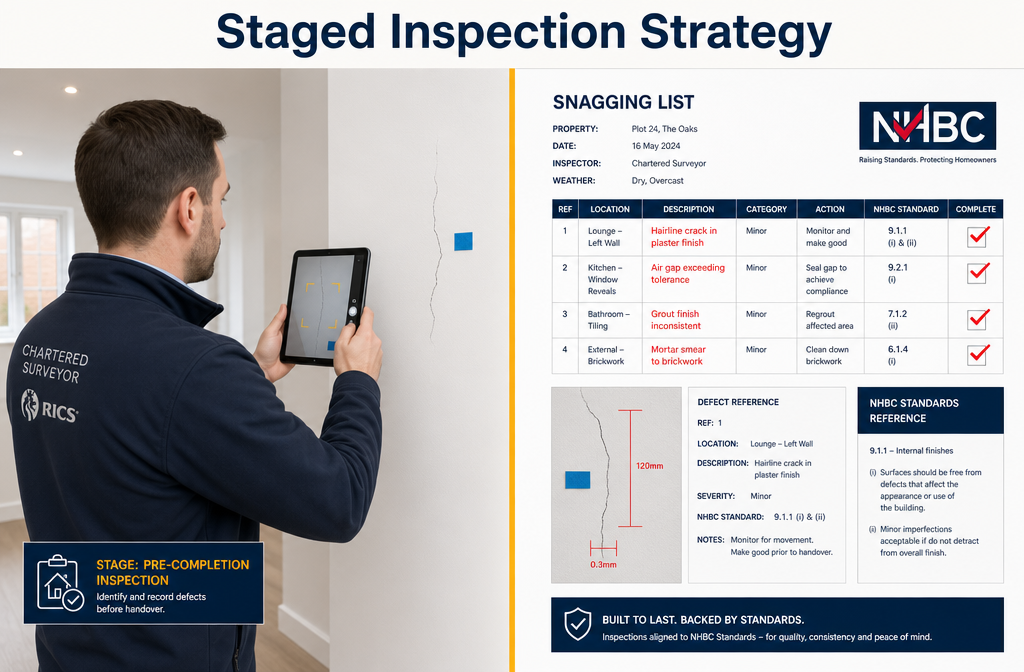
The Staged Inspection Framework: From Foundation to Handover
From Snagging Lists to Latent Defects: A Chartered Surveyor's Guide to New‑Build Inspection Strategies in 2026 is built on a core principle: single-visit inspections are insufficient. A robust strategy requires multiple access points during the build programme, each targeting specific risk windows.
Stage 1 — Foundation and Ground Works
The first inspection opportunity occurs after foundations are poured but before backfilling. Key checks include:
- Concrete specification and pour records
- Drainage layout versus approved drawings
- Damp-proof membrane continuity
- Radon barrier installation (where required by ground conditions)
Stage 2 — Structural Shell and Frame
Once the structural frame is erected — whether traditional masonry, timber frame, or a modular system — the surveyor should verify:
- Wall-tie spacing and type (cavity walls)
- Lintel bearing lengths and type
- Structural connections and fixings in MMC systems
- Fire-stopping at compartment boundaries
Stage 3 — Pre-Drywall / Pre-Plaster Inspection ⚠️
"The pre-drywall inspection is often the only opportunity to document latent-defect risks in plumbing, wiring, and HVAC before they are permanently concealed." [3]
This is arguably the most critical stage. Industry guidance consistently emphasises that once linings are fixed, defects in first-fix services become latent — invisible and expensive to investigate [3]. The inspection checklist at this stage should cover:
| System | Key Inspection Points |
|---|---|
| Electrical first fix | Cable routing, back-box positions, earthing continuity |
| Plumbing | Pipe runs, support clips, pressure test records |
| Ventilation / MVHR | Duct layout, insulation, condensation risk junctions |
| Insulation | Continuity, correct specification, no voids or compression |
| Structural members | No notching outside permitted zones, no damage to engineered joists |
Stage 4 — Final Snagging Inspection
The final walkthrough — the stage most buyers associate with "snagging" — is where cosmetic and specification defects are catalogued. However, its value is dramatically enhanced when it is supported by evidence gathered at earlier stages.
Practical guidance for 2026 recommends bringing the full contract, plans, and specification schedule to the final walkthrough and being prepared to delay legal completion if material items remain unresolved [3][6]. The "blue-tape" method — physically marking each defect on the property — remains highly effective for ensuring nothing is overlooked or disputed later.
For a detailed overview of professional snagging services, see the snagging reports service and the companion guide on what house snagging is and when a snagging survey is necessary.
Standards, Tolerances, and the Evidence-Based Snagging List
One of the most common reasons snagging disputes fail is that defect descriptions are vague or subjective. RICS guidance is clear: every item on a snagging list should be referenced against a documented tolerance or published standard, not a "perfect finish" expectation [5].

Applicable Standards in 2026
The primary benchmarks for UK new-build inspections are:
- NHBC Standards (Buildmark warranty) — the most widely applicable reference for workmanship tolerances on private new-build housing
- RICS Residential Construction Performance Guidelines — used by surveyors to define acceptable deviations for plastered surfaces, floor levels, door/window alignment, and similar elements [5]
- Manufacturer installation data — particularly relevant for MMC systems, windows, and mechanical services
- Building Regulations Approved Documents — the minimum statutory baseline; non-compliance is a defect regardless of warranty status
- British Standards (BS) — referenced for specific elements such as drainage (BS EN 1610), electrical installations (BS 7671), and thermal performance
💡 Pro tip: When a developer disputes a snagging item, a written reference to the precise NHBC clause or BS tolerance converts a subjective complaint into an objective, enforceable claim.
Documenting Defects Properly
Each snagging entry should include:
- Location — room, elevation, grid reference
- Description — what is wrong, not just that it "looks bad"
- Standard breached — specific clause or tolerance
- Photographic evidence — timestamped, with a scale reference
- Measurement data — where applicable (e.g., floor level deviation in mm)
This approach is reinforced by the code-compliance principle that the submittal date — not the permit issuance date — determines which code cycle applies to a scheme [1]. For UK surveyors, the equivalent principle is that the Building Regulations version in force at the time of the initial notice governs compliance, not the version current at inspection. Establishing this at the outset prevents developers from arguing that later standards apply.
Latent Defects: Identification, Risk, and Legal Leverage
A latent defect is one that is not apparent on reasonable inspection at the time of purchase — it only becomes visible or measurable after occupation. The distinction between a snag (visible at handover) and a latent defect (emerging post-occupation) has significant legal and warranty implications.
Common Latent Defects in Post-2010 UK New-Builds
The following defect types recur most frequently in investigations of UK new-build estates completed since 2010:
- 🔴 Cavity wall insulation voids and bridging — leading to cold spots, condensation, and mould
- 🔴 Inadequate roof ventilation — causing interstitial condensation and premature timber decay
- 🔴 Thermal bridging at structural junctions — driving up energy costs and creating surface condensation
- 🔴 Drainage falls below minimum gradient — causing blockages and foul odour ingress
- 🔴 Fire-stopping omissions — a building-safety risk that may not manifest until a fire event
- 🔴 Shrinkage cracking in MMC panel joints — often misidentified as cosmetic but potentially indicating movement
Understanding what causes moisture in buildings is essential context for diagnosing many of these defects, as moisture-related failures account for a disproportionate share of latent defect claims.
Warranty Frameworks and Their Limitations
The NHBC Buildmark warranty provides 2-year developer liability for defects and 10-year structural warranty cover. However, the warranty's scope is narrower than many buyers assume:
| Period | Cover |
|---|---|
| Years 1–2 | Developer must fix defects reported by the buyer |
| Years 3–10 | NHBC covers physical damage caused by a major defect |
| Post-10 years | No warranty cover; latent defects become the owner's liability |
The 2-year window is critical. Buyers who fail to report defects within this period lose their most direct remedy against the developer. A staged inspection strategy — with a formal re-inspection at 12–18 months post-occupation — significantly improves defect capture rates within this window.
For situations where defects are serious or dangerous, understanding the consequences of failing to act on building problems is vital reading for both buyers and their advisers.
Legal Leverage: Construction Law and Dispute Resolution
Where developer negotiation fails, buyers have recourse through:
- NHBC Resolution Service — for Buildmark warranty disputes
- New Homes Ombudsman — operational since 2022 for consumer complaints against developers
- Civil litigation — using the defect documentation as evidence
Detailed construction law advice from a chartered surveyor can be decisive in framing claims correctly, particularly where latent defects involve structural or fire-safety elements that fall outside standard warranty definitions.
Technology and MMC: Adapting Inspection Strategies for 2026
The integration of digital tools and MMC into new-build construction requires chartered surveyors to adapt their inspection methodology, not simply apply traditional checklists to novel building systems.

Drone Surveys and Thermal Imaging
Roof inspections on new-build estates — particularly where access is restricted during construction — benefit significantly from drone technology. Premium drone surveys can document roof covering installation, ridge and verge details, and drainage outlet positions without requiring scaffold access, creating a photographic baseline that supports latent-defect claims years later.
Thermal imaging at the pre-plaster stage is equally valuable: it visualises insulation continuity, identifies thermal bridges, and can detect moisture ingress that is invisible to the naked eye.
Virtual Inspections and Digital Audit Trails
Policy analysis from SPUR (2026) documents how building departments in high-demand markets are piloting virtual inspections via video calls, mobile apps, and digital documentation to accelerate approvals while maintaining photographic evidence of workmanship quality [8]. Although the primary driver in that context is planning efficiency, the audit-trail benefit is directly applicable to latent-defect investigations: timestamped video and photographic records from multiple build stages provide compelling evidence in warranty and litigation proceedings.
BIM and Digital Twins
Developers using Building Information Modelling (BIM) are increasingly required to provide as-built BIM models at handover. For surveyors, these models offer a powerful comparison tool: deviations between the as-built model and the physical building can be systematically identified and quantified. Gowling WLG's 2026 policy analysis confirms that digital methodologies — BIM, digital twins, and MMC — are central to the UK's strategy for reducing construction error and latent defects [10].
Inspecting MMC Systems: Key Differences
| MMC System | Primary Inspection Risks |
|---|---|
| Volumetric modular | Joint sealing between modules, services continuity across module boundaries |
| SIPs panels | Panel joint integrity, moisture management at openings |
| CLT | Connection detailing, fire protection layer continuity |
| Light gauge steel frame | Thermal bridging at studs, corrosion protection |
Practical Checklist: What to Bring to a New-Build Inspection
✅ Signed contract and specification schedule
✅ Approved drawings (architectural and services)
✅ NHBC or warranty provider documentation
✅ Relevant British Standards and NHBC clauses (pre-downloaded)
✅ Thermal imaging camera or hire arrangement
✅ Moisture meter
✅ Spirit level and straight-edge (floor and wall tolerance checks)
✅ Photographic equipment with timestamp function
✅ Snagging list template (pre-formatted with standard references)
✅ Blue tape or equivalent for physical defect marking
Conclusion: Building a Defensible Inspection Strategy in 2026
From Snagging Lists to Latent Defects: A Chartered Surveyor's Guide to New‑Build Inspection Strategies in 2026 makes one overriding argument: reactive, single-visit snagging is no longer sufficient in an era of MMC, tighter building-safety regulation, and increasingly sophisticated developer warranty frameworks.
The most effective approach combines:
- Staged access at foundation, structural shell, pre-drywall, and final handover
- Standards-referenced documentation for every defect, supported by photographs and measurements
- Independent third-party inspection rather than reliance on developer self-certification [3][4]
- Digital tools — drone surveys, thermal imaging, and BIM review — integrated into the inspection workflow
- Proactive warranty management with a formal re-inspection within the 2-year developer liability period
Actionable Next Steps
- Buyers: Commission an independent surveyor before exchange, not after completion. Request pre-drywall access as a contractual condition.
- Chartered surveyors: Update inspection protocols to address MMC-specific failure modes and integrate digital documentation tools.
- Developers: Engage proactively with independent inspectors — defects identified early are cheaper to fix than latent claims pursued through the New Homes Ombudsman or litigation.
For buyers unsure which level of survey is appropriate for their new-build purchase, the guide on which building survey you need provides a clear starting point.
The cost of a professional inspection is a fraction of the cost of a latent defect claim. In 2026, that calculation has never been more straightforward.
References
[1] California's 2026 Building Code Shift: What LA Landlords Need to Know Before January 1 – labuildinginspections.com
[2] New California Construction Laws Taking Effect in 2026 – hansonbridgett.com
[3] A Seven-Step Comprehensive Guide to New Construction Inspections – calprogroup.com
[4] The Dark Side of New Construction Homes in 2026 – youtube.com
[5] InterNACHI Forum – Residential Construction Performance Guidelines – forum.nachi.org
[6] Don't Buy New Construction in 2026 – youtube.com
[8] How Virtual Construction Inspections Can Address California's Housing Crisis – spur.org
[10] UK Construction 2026: What Are the Policy Shifts and Developments You Need to Know – gowlingwlg.com