

The landscape of residential property transactions has fundamentally shifted. As homebuyers and property investors navigate the 2026 market, Fire Safety Building Surveys Post-2026 Regulations: Cladding Remediation and Compliance for Residential Valuations has emerged as the critical cornerstone of due diligence. With sweeping regulatory changes now in force, the days of purchasing a flat or apartment without comprehensive fire safety verification are over. For surveyors, valuers, and homebuyers alike, understanding these new compliance requirements isn't just about ticking boxes—it's about protecting lives, investments, and ensuring properties remain mortgageable and insurable in an increasingly scrutinised market.
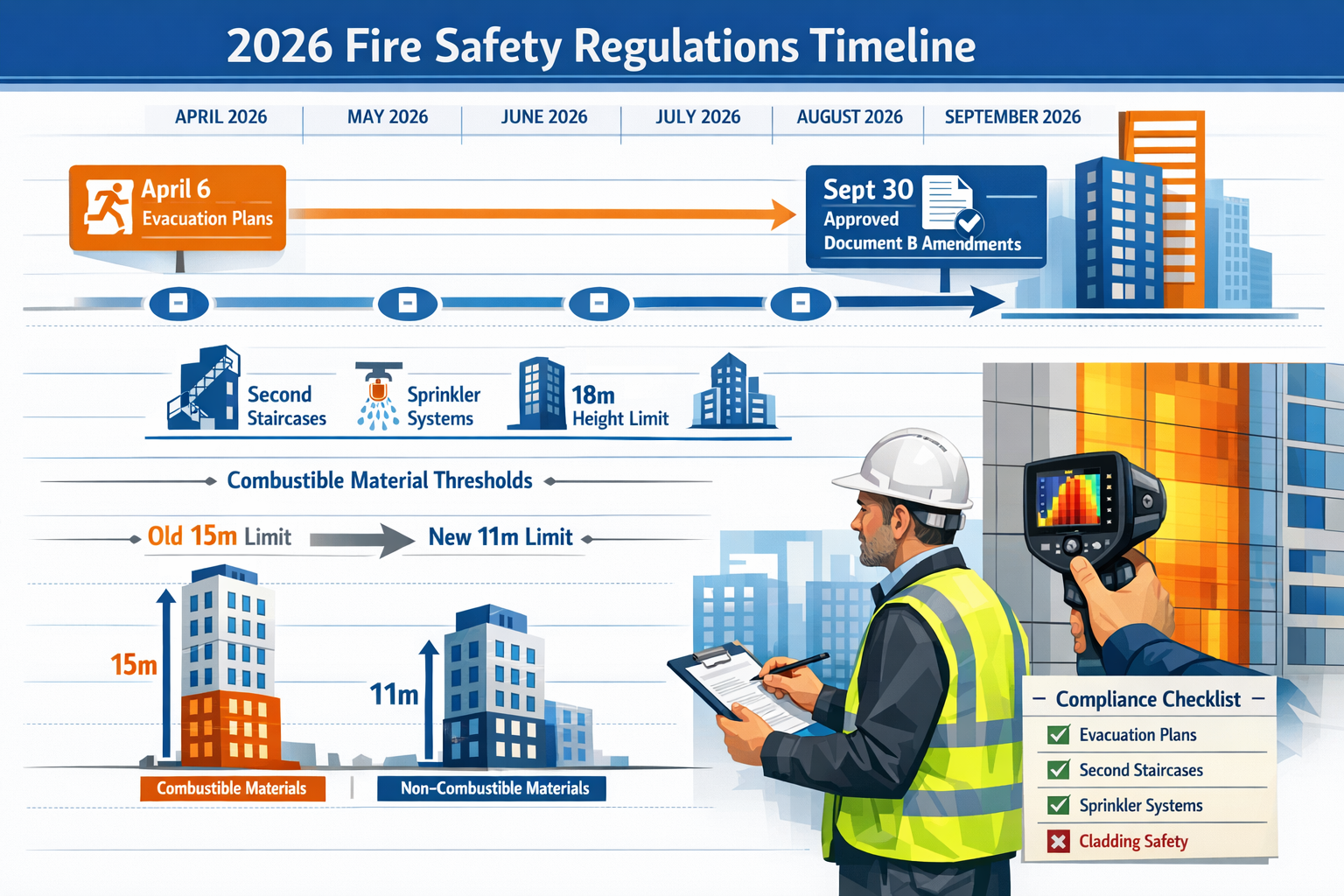
The tragic lessons of the past decade have catalysed the most comprehensive overhaul of building safety legislation in generations. From April 2026 onwards, new evacuation planning requirements for disabled residents came into effect[3], followed by game-changing amendments to Approved Document B in September 2026 that mandate second staircases in all new residential buildings above 18 metres[2][4]. These regulations don't exist in isolation—they directly impact property valuations, mortgage lending criteria, and the speed at which residential transactions can complete.
Key Takeaways
🔥 Regulatory Timeline Critical: April and September 2026 brought sweeping changes including mandatory evacuation plans, second staircase requirements for 18m+ buildings, and lowered combustible material thresholds from 15m to 11m[1][2][3]
📊 Valuation Impact Significant: Properties with non-compliant cladding face severe valuation penalties, mortgage restrictions, and potential unmarketability until remediation completion
🏗️ Remediation Deadlines Approaching: Government targets require all 18m+ buildings in funded schemes remediated by 2029, with penalties for landlords missing deadlines[3]
✅ Enhanced Survey Requirements: RICS building surveys must now incorporate comprehensive fire safety assessments, cladding material verification, and compliance documentation review
⚖️ Legal Obligations Expanded: Responsible Persons face new duties under Building Regulation 38 regarding fire safety information provision, with enforcement mechanisms strengthened[2]
Understanding the 2026 Fire Safety Regulatory Framework
The regulatory environment governing Fire Safety Building Surveys Post-2026 Regulations: Cladding Remediation and Compliance for Residential Valuations represents a multi-layered framework that fundamentally reshapes how residential buildings are designed, constructed, maintained, and valued.
The Fire Safety (Residential Evacuation Plans) Regulations 2026
Effective from April 6, 2026, these regulations impose significant new obligations on Responsible Persons of high-rise residential buildings. The core requirement centres on protecting disabled residents through comprehensive evacuation planning[3]. This isn't merely a theoretical exercise—these plans must be:
- Personalised to individual residents with mobility, sensory, or cognitive impairments
- Regularly reviewed and updated as resident circumstances change
- Communicated clearly to residents, emergency services, and building management
- Tested periodically through evacuation drills and scenario planning
- Integrated with building-wide fire safety strategies
For surveyors conducting building regulation compliance testing, verification that these plans exist and meet regulatory standards has become a mandatory component of comprehensive fire safety assessments.
Approved Document B Amendments: September 30, 2026
The amendments to Part B of the Building Regulations represent perhaps the most significant structural changes to residential building design in decades[2][4]. The headline requirement—second staircases in all new residential buildings above 18 metres—fundamentally alters the economics and design of mid-rise residential development.
Key provisions include:
Height Thresholds and Staircase Requirements
- Buildings with top storey exceeding 18m: Mandatory second staircase
- Design provisions must accommodate evacuation lifts in blocks of flats
- Staircase separation requirements to prevent simultaneous compromise
- Enhanced fire resistance standards for stairwell enclosures
Combustible Materials Restrictions Tightened
The height threshold for combustible material restrictions in external walls has decreased from 15m to 11m for material change of use in residential buildings[2]. This seemingly technical adjustment has profound implications:
- Significantly more existing buildings now fall within restricted categories
- Conversion projects face stricter material specifications
- Refurbishment works trigger compliance requirements at lower heights
- Remediation obligations extend to a broader building stock
Sprinkler System Expansion
All new care homes must now install sprinklers irrespective of height[2]. Additionally:
- Facilities must limit compartment sizes to ten beds maximum
- All doors must be self-closing with appropriate fire resistance ratings
- Integration with alarm systems for immediate alert propagation
- Regular maintenance and testing protocols mandated
Evacuation Alert Systems and Information Boxes
Buildings with a top storey exceeding 18 metres must install evacuation alert systems complying with BS 8629[2]. These systems represent a technological leap beyond traditional fire alarms, providing:
- Zoned alerting capabilities for phased evacuation strategies
- Voice communication systems for clear instruction delivery
- Integration with building management systems and emergency services
- Backup power provisions ensuring operation during mains failure
Complementing these systems, all new blocks of flats with a floor 11 metres or more above ground level must install secure information boxes[2]. These weatherproof, accessible containers provide emergency services with:
- Building layout plans and floor configurations
- Fire safety equipment locations (hydrants, risers, extinguishers)
- Evacuation route diagrams and assembly point locations
- Contact information for Responsible Persons and building managers
- Details of vulnerable residents requiring evacuation assistance
Cladding Remediation: Progress, Challenges, and Compliance Pathways
The cladding crisis continues to cast a long shadow over the residential property market. Understanding the remediation landscape is essential for anyone involved in Fire Safety Building Surveys Post-2026 Regulations: Cladding Remediation and Compliance for Residential Valuations.
The Remediation Acceleration Plan: 2029 Targets
The government's July 2025 plan update established ambitious targets[3]:
- Every 18m+ residential building in funded schemes remediated by 2029
- All 11m+ buildings with unsafe cladding either remediated or with completion dates set by 2029
- Penalties for landlords who fail to meet deadlines, including potential enforcement action
These aren't aspirational goals—they're backed by enforcement mechanisms and financial consequences. For property valuers, this creates a clear timeline framework: properties without remediation plans or completion dates face increasing valuation discounts as 2029 approaches.
Identifying Non-Compliant Cladding Systems
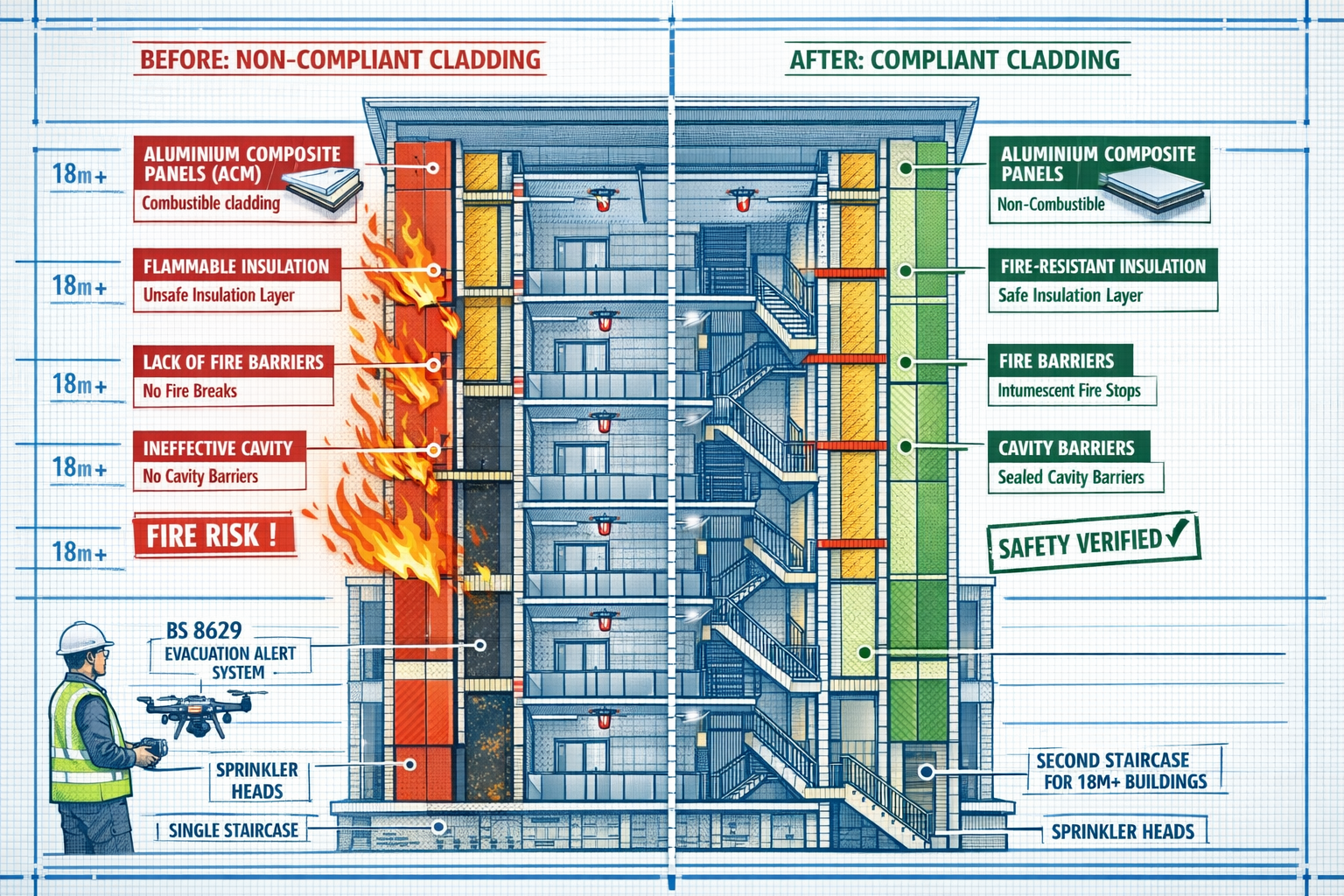
Modern building surveys must incorporate sophisticated cladding assessment methodologies. The most common non-compliant systems include:
Aluminium Composite Material (ACM) Panels
- Polyethylene core variants present highest fire risk
- Fire-retardant (FR) cores still may not meet current standards
- Complete removal typically required rather than over-cladding
- Replacement costs range from £5,000-£15,000 per flat depending on building height
High-Pressure Laminate (HPL) Cladding
- Combustibility varies significantly between products
- Testing required to determine compliance status
- Some HPL systems may achieve compliance with cavity barrier installation
- Remediation costs generally lower than ACM but still substantial
Expanded Polystyrene (EPS) Insulation
- Highly combustible when exposed to flame
- Often found behind seemingly innocuous render systems
- Detection requires invasive investigation or thermal imaging
- Remediation involves complete insulation system replacement
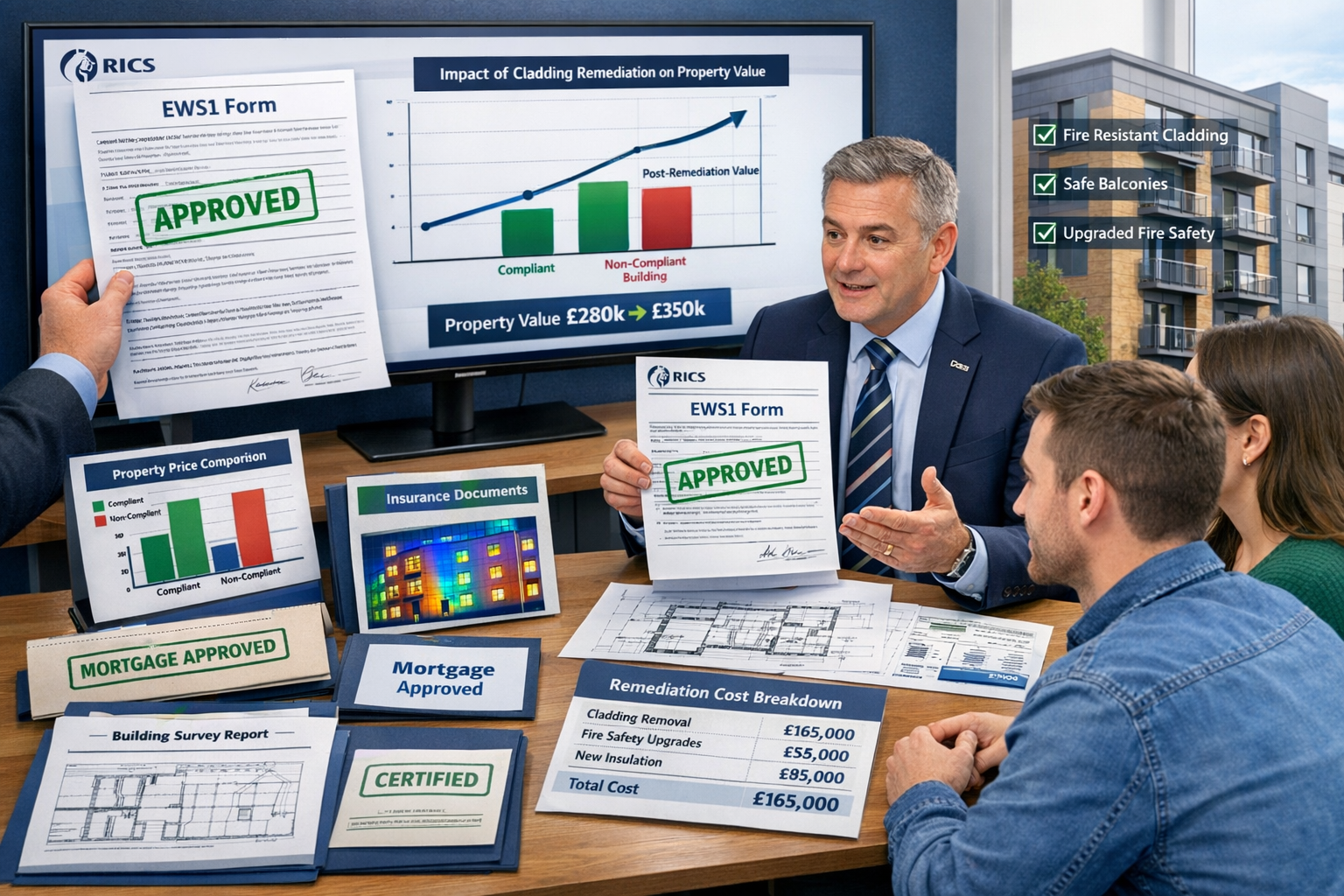
The EWS1 Form: Still Relevant in 2026?
The External Wall System (EWS1) form remains a critical document in residential transactions despite ongoing debate about its future. For buildings requiring assessment:
- Qualified assessors (typically chartered building surveyors or fire engineers) must complete evaluations
- Form B1 (attached to EWS1) indicates remediation required before building deemed safe
- Form B2 confirms building meets current standards without remediation
- Absence of EWS1 for applicable buildings creates immediate valuation and mortgageability issues
Surveyors must understand when EWS1 assessments are required and how to interpret results within the broader compliance framework. When conducting a Level 3 full building survey, cladding assessment should integrate:
- Visual inspection using drone survey technology for high-level facades
- Documentation review including original specifications and any variation records
- Thermal imaging to identify insulation types and cavity construction
- Verification of fire barrier installations and compartmentation integrity
Funding Mechanisms and Financial Responsibilities
The financial burden of cladding remediation remains contentious. Current funding landscape includes:
Building Safety Fund
- Covers buildings 18m+ with unsafe ACM or non-ACM cladding
- Application deadlines passed but existing commitments honoured
- Covers external wall system remediation costs
- Does not cover internal fire safety defects or building insurance increases
Developer Remediation Contract
- Major developers committed to remediating buildings 11m+ they developed in past 30 years
- Self-remediation pledge backed by government pressure
- Covers life-critical fire safety defects
- Timeline commitments vary by developer
Leaseholder Protections
- Qualifying leaseholders protected from remediation costs for buildings 11m+
- Protection applies to principal residence or property owned when building safety crisis emerged
- Landlords must pursue developers, manufacturers, or use available funding
- Service charge caps apply for non-cladding defects
Understanding these funding mechanisms is crucial when assessing budgeting for repairs and restoration during property purchase negotiations.
Fire Safety Building Surveys Post-2026 Regulations: Enhanced Survey Protocols and Valuation Methodologies
The integration of fire safety compliance into residential valuations requires surveyors to adopt enhanced protocols that go far beyond traditional structural and condition assessments.
Comprehensive Fire Safety Survey Components
A thorough fire safety building survey in 2026 must encompass multiple assessment layers:
External Wall System Evaluation
- Material identification through visual inspection and documentation review
- Cavity barrier verification at compartment boundaries and around openings
- Fire stopping quality assessment at junctions and penetrations
- Cladding attachment system integrity and compliance with wind loading requirements
- Balcony construction and fire spread prevention measures
Internal Compartmentation Assessment
- Fire door condition, specification, and self-closing mechanism functionality
- Compartment wall and floor integrity throughout building
- Service penetration fire stopping (pipes, cables, ducts)
- Stairwell enclosure compliance and protected route maintenance
- Flat entrance door fire resistance ratings
Active Fire Protection Systems
- Sprinkler system presence, specification, and maintenance records
- Smoke detection and alarm system coverage and interconnection
- Evacuation alert system compliance with BS 8629[2]
- Emergency lighting provision and testing frequency
- Dry riser or wet riser installation and maintenance
Passive Fire Protection Measures
- Compartment size compliance with current standards
- Fire resistance ratings of structural elements
- Cavity barrier installations in concealed spaces
- Intumescent strip condition on fire doors
- Smoke seals and threshold gaps on flat entrance doors
Management and Documentation
- Fire risk assessment currency (must be updated regularly)
- Evacuation plan existence and personalisation for disabled residents[3]
- Building safety case documentation for higher-risk buildings
- Responsible Person identification and contact information
- Fire safety information provision under Building Regulation 38[2]
Valuation Impact Assessment Framework
Determining how fire safety compliance affects residential valuations requires structured methodology. The following framework provides guidance:
Fully Compliant Properties (Green Rating)
- No valuation discount applied
- Mortgage availability unrestricted
- Insurance premiums at standard rates
- Marketing period normal for location and property type
- Buyer confidence high with full documentation package
Minor Non-Compliance (Amber Rating)
- Valuation discount: 5-15% depending on remediation costs
- Mortgage availability: Some lenders may require retention or undertakings
- Insurance: Possible premium increases of 10-30%
- Marketing period: Extended by 2-4 weeks typically
- Examples: Fire door upgrades needed, minor fire stopping defects, alarm system upgrades
Significant Non-Compliance (Red Rating)
- Valuation discount: 15-40% or property deemed unmortgageable
- Mortgage availability: Severely restricted, cash buyers only in many cases
- Insurance: Substantial premium increases (50-200%) or coverage refusal
- Marketing period: Extended significantly, potentially 6+ months
- Examples: Non-compliant cladding requiring remediation, missing evacuation systems, fundamental compartmentation failures
Critical Non-Compliance (Black Rating)
- Property effectively unmarketable until remediation complete
- No mortgage availability from mainstream lenders
- Insurance coverage may be withdrawn or prohibitively expensive
- Valuation: Nominal or based on post-remediation value minus costs
- Examples: Dangerous ACM cladding with no remediation plan, evacuation prohibition notices
Integrating Compliance Costs into Valuations
When properties require remediation, valuers must carefully assess cost implications:
| Remediation Type | Typical Cost Range | Timeline | Funding Availability |
|---|---|---|---|
| ACM Cladding Removal (18m+ building) | £40,000-£80,000 per flat | 18-36 months | Building Safety Fund / Developer pledge |
| Non-ACM Cladding Remediation | £20,000-£50,000 per flat | 12-24 months | Building Safety Fund (limited) |
| Fire Door Replacement Programme | £800-£1,500 per door | 3-6 months | Service charge / leaseholder |
| Compartmentation Works | £5,000-£15,000 per flat | 6-12 months | Service charge / leaseholder |
| Sprinkler Retrofit | £3,000-£8,000 per flat | 12-18 months | Mixed funding |
| Evacuation Alert System | £1,500-£3,000 per flat | 3-6 months | Service charge / leaseholder |
These costs must be factored into valuations alongside consideration of:
- Leaseholder protection eligibility reducing personal liability
- Service charge increases during and after remediation
- Insurance premium impacts both during remediation and post-completion
- Loss of use or temporary decant requirements during works
- Opportunity cost of capital tied up in non-marketable asset
For professionals determining which building survey is needed, fire safety compliance assessment should be standard in all surveys of flats and apartments, regardless of survey level.
The Building Safety Levy and Financial Implications from October 2026
From October 1, 2026, a new levy system based on gross internal floorspace commenced, adding another financial dimension to residential development and valuations[3].
Levy Structure and Rates
The Building Safety Levy applies to new residential development with rates varying by local authority, linked to local house prices. Key features include:
Rate Calculation Methodology
- Based on gross internal floorspace of new residential buildings
- Rates range from £30-£90 per square metre depending on local authority
- Higher rates in high-value areas (London, South East)
- Lower rates in areas with lower property values
Exemptions and Reliefs
- Smaller projects below threshold floorspace (typically under 500m²)
- Housing association developments for social rent
- Hospital and healthcare facility construction
- School and educational building projects
- Conversion projects not creating new floorspace
Revenue Allocation
- Funds directed to Building Safety Fund for historical remediation
- Supports regulatory framework operation and enforcement
- Contributes to resident safety information and advice services
- Finances building safety research and competence initiatives
Impact on Development Viability and Property Values
The levy introduces additional cost into residential development, with implications cascading through to end values:
Development Cost Increases
For a typical 100-flat development in London:
- Average flat size: 70m² gross internal area
- Total floorspace: 7,000m²
- Levy rate (high-value area): £90/m²
- Total levy cost: £630,000
- Cost per flat: £6,300
These costs inevitably influence:
- New build pricing strategies
- Development site viability assessments
- Affordable housing provision calculations
- Investor return expectations
Secondary Market Effects
The levy doesn't directly apply to existing property transactions, but indirect effects include:
- Reduced new build supply potentially supporting existing property values
- Quality differential between levy-compliant new builds and older stock
- Buyer preference shifts toward newer, fully compliant properties
- Pressure on existing building owners to demonstrate compliance to remain competitive
Practical Guidance for Homebuyers and Property Investors
Navigating Fire Safety Building Surveys Post-2026 Regulations: Cladding Remediation and Compliance for Residential Valuations requires proactive due diligence and informed decision-making.
Essential Questions Before Making an Offer
Before committing to purchase any flat or apartment, buyers should obtain satisfactory answers to:
Building-Level Questions
- What is the building height (in metres and storeys)?
- What external wall system is installed (cladding type, insulation)?
- Has an EWS1 assessment been completed? What was the outcome?
- Is remediation work required? If so, what is the timeline and funding source?
- Are second staircases present if building exceeds 18m?
- Is an evacuation alert system installed and compliant with BS 8629?[2]
- When was the last fire risk assessment completed?
- Are evacuation plans in place for disabled residents?[3]
- What is the building insurance situation and premium history?
- Have any enforcement notices been served by the fire authority or building control?
Flat-Level Questions
- Do flat entrance doors meet fire resistance requirements (typically FD30S minimum)?
- Are smoke detectors installed and interconnected as required?[1]
- Have any alterations been made affecting compartmentation?
- What is the service charge history and projected increases?
- Are there any upcoming special levies for fire safety works?
Interpreting Survey Reports and Fire Safety Documentation
When reviewing a RICS building survey report, pay particular attention to:
Red Flag Indicators
- ⚠️ Surveyor unable to confirm external wall system compliance
- ⚠️ EWS1 form not available or shows Form B1 (remediation required)
- ⚠️ Fire doors in poor condition or lacking certification
- ⚠️ Evidence of compartmentation breaches
- ⚠️ Absence of required evacuation alert systems in 18m+ buildings
- ⚠️ Missing or outdated fire risk assessments
- ⚠️ Insurance difficulties or coverage limitations mentioned
Positive Compliance Indicators
- ✅ EWS1 Form B2 (compliant) or building under 11m with low-risk construction
- ✅ Recent fire risk assessment with no significant actions outstanding
- ✅ Comprehensive fire safety documentation package provided
- ✅ Active building safety manager or Responsible Person identified
- ✅ Regular maintenance records for fire safety equipment
- ✅ Resident engagement on fire safety matters evidenced
Negotiation Strategies for Non-Compliant Properties
If purchasing a property with fire safety compliance issues, consider:
Price Reduction Negotiations
- Obtain detailed remediation cost estimates from qualified professionals
- Factor in extended marketing period and restricted buyer pool
- Account for insurance premium increases during remediation period
- Include compensation for uncertainty and stress of remediation process
- Typical negotiation outcomes: 10-30% reduction depending on severity
Contractual Protections
- Retention of portion of purchase price until specific works completed
- Warranty from seller regarding accuracy of fire safety information provided
- Indemnity insurance (though increasingly difficult to obtain for cladding issues)
- Conditional contracts allowing withdrawal if remediation funding not secured
- Completion date flexibility to accommodate remediation timelines
Alternative Approaches
- Delayed completion until remediation substantially complete
- Shared equity arrangements reducing buyer's capital at risk
- Rent-to-buy structures allowing occupation while remediation progresses
- Joint venture arrangements with seller sharing remediation costs
Understanding the consequences of failing to act on fire safety issues is crucial—properties can become unmortgageable and uninsurable, creating severe financial hardship.
The Role of Professional Surveyors in Fire Safety Compliance
Chartered surveyors play a pivotal role in the fire safety compliance ecosystem, bridging technical assessment, regulatory interpretation, and client advisory functions.
Enhanced Competence Requirements
The Building Safety Act and associated regulations have elevated competence expectations for surveyors involved in fire safety assessments. Key requirements include:
Technical Knowledge Domains
- Understanding of combustion science and fire behaviour in buildings
- Familiarity with external wall system construction and materials
- Knowledge of active and passive fire protection systems
- Competence in interpreting fire test data and product certifications
- Understanding of evacuation strategies and building design implications
Regulatory Awareness
- Detailed knowledge of Approved Document B amendments[2]
- Understanding of Fire Safety (Residential Evacuation Plans) Regulations[3]
- Awareness of Building Safety Act provisions and responsible person duties
- Familiarity with BS 8629 evacuation alert system standards[2]
- Knowledge of EWS1 process and assessment criteria
Professional Development
- Completion of fire safety CPD modules and training
- Engagement with RICS guidance notes and practice statements
- Participation in industry working groups and knowledge sharing
- Subscription to regulatory updates and technical bulletins
- Practical experience in fire safety assessments under supervision
Survey Methodologies and Technology Integration
Modern fire safety surveys leverage advanced technologies:
Drone Survey Applications
Premium drone surveys enable:
- High-resolution imagery of cladding systems without scaffolding
- Thermal imaging to identify insulation types and installation defects
- 3D modelling of building facades for remediation planning
- Access to difficult or dangerous inspection locations
- Cost-effective repeat surveys to monitor remediation progress
Thermal Imaging Technology
- Identification of insulation materials through thermal signatures
- Detection of cavity barrier locations and potential gaps
- Assessment of thermal bridging and energy efficiency
- Moisture ingress identification affecting fire resistance
- Non-invasive investigation reducing building disturbance
Documentation and Reporting Systems
- Digital survey platforms with fire safety compliance checklists
- Photographic evidence management with geolocation tagging
- Integration with building information modelling (BIM) systems
- Automated report generation with regulatory cross-referencing
- Client portals for transparent information sharing
Liability Considerations and Professional Indemnity
The heightened focus on fire safety has increased professional liability exposure for surveyors. Considerations include:
Scope of Service Clarity
- Explicit definition of fire safety assessment extent
- Clear limitations on invasive investigation scope
- Disclaimer regarding concealed construction elements
- Reliance on third-party documentation (EWS1, fire risk assessments)
- Recommendation for specialist fire engineer input where appropriate
Professional Indemnity Insurance
- Ensure policy covers fire safety assessment activities
- Adequate coverage limits given potential claim values
- Understanding of policy exclusions and notification requirements
- Consideration of run-off cover for retired practitioners
- Regular review of terms as market conditions evolve
Risk Management Practices
- Comprehensive file documentation and audit trails
- Peer review of complex or high-value assessments
- Client communication documentation (advice given, limitations explained)
- Continuing professional development records
- Engagement with RICS complaints handling and professional standards
Future Developments and Emerging Considerations
The fire safety regulatory landscape continues to evolve. Anticipating future developments helps stakeholders prepare effectively.
Potential Regulatory Enhancements Beyond 2026
Industry discussions and government consultations suggest several potential future changes:
Extended Height Threshold Reductions
- Possible lowering of second staircase requirement to 15m or even 11m
- Expansion of sprinkler requirements to lower-rise buildings
- Stricter compartmentation standards for all multi-occupancy buildings
- Enhanced external wall system standards for buildings currently below thresholds
Retrospective Application Expansion
- Potential requirement for evacuation alert systems in existing 18m+ buildings
- Mandatory sprinkler retrofit programmes for certain building types
- Time-limited compliance deadlines for existing building stock
- Enforcement mechanisms for non-compliant building owners
Digital Building Passports
- Mandatory digital records of building construction and alterations
- Blockchain-based verification of compliance documentation
- Real-time fire safety equipment monitoring and reporting
- Integration with emergency service systems for incident response
Technology and Innovation in Fire Safety
Emerging technologies promise to enhance fire safety and compliance verification:
Smart Building Systems
- IoT-connected fire detection with predictive analytics
- Automated evacuation route optimisation based on fire location
- Real-time occupancy monitoring for evacuation planning
- Integration of building systems for coordinated emergency response
Advanced Materials
- Next-generation non-combustible cladding with enhanced aesthetics
- Self-extinguishing insulation materials
- Transparent fire-resistant glazing systems
- Intumescent coatings with extended durability
Assessment Technologies
- AI-powered image analysis for cladding identification
- Portable X-ray fluorescence for material composition analysis
- Augmented reality for compartmentation inspection
- Digital twins for fire behaviour modelling and evacuation planning
Market Adaptation and Valuation Trends
The residential property market continues adapting to the fire safety compliance paradigm:
Buyer Behaviour Evolution
- Increased sophistication in fire safety due diligence
- Preference for newer, fully compliant buildings
- Willingness to pay premiums for demonstrable compliance
- Risk aversion toward properties with outstanding remediation
Lender Policy Refinement
- More nuanced risk assessment replacing blanket lending restrictions
- Acceptance of properties with funded remediation programmes
- Retention arrangements for properties with minor compliance issues
- Specialist lending products for buildings in remediation
Insurance Market Development
- Differentiated pricing based on detailed fire safety assessment
- Incentives for buildings exceeding minimum compliance standards
- Parametric insurance products for remediation cost overruns
- Increased capacity as remediation programme progresses
Valuation Methodology Maturation
- Industry consensus emerging on compliance-related adjustments
- Standardised fire safety information requirements for valuations
- Integration of fire safety compliance into automated valuation models
- Professional guidance from RICS on fire safety valuation considerations
Conclusion: Protecting Lives, Investments, and Market Confidence
Fire Safety Building Surveys Post-2026 Regulations: Cladding Remediation and Compliance for Residential Valuations represents far more than regulatory compliance—it embodies a fundamental commitment to resident safety and market integrity. The regulatory framework introduced throughout 2026 has created a new baseline for residential building safety, with profound implications for property transactions, valuations, and investment decisions.
For homebuyers, the message is clear: comprehensive fire safety due diligence is non-negotiable. Engaging qualified chartered surveyors to conduct thorough assessments, verifying compliance documentation, and understanding remediation timelines protects both personal safety and financial investment. The modest cost of a professional building survey pales in comparison to the potential consequences of purchasing a non-compliant property.
Property investors must integrate fire safety compliance into investment criteria alongside traditional metrics like yield and capital growth. Buildings with demonstrable compliance will command premium valuations and rental rates, while non-compliant properties face increasing headwinds until remediation completes.
For surveyors and valuers, the enhanced regulatory environment demands continuous professional development, technological investment, and rigorous methodology. The profession's credibility depends on competent, comprehensive fire safety assessments that protect clients and support market confidence.
Actionable Next Steps
For Prospective Buyers:
- Commission a Level 3 full building survey including comprehensive fire safety assessment
- Request all fire safety documentation before making offers (EWS1, fire risk assessments, evacuation plans)
- Verify building insurance status and premium history
- Obtain written confirmation of remediation funding and timelines if applicable
- Consult mortgage broker early regarding lender requirements for specific buildings
- Consider professional valuations to understand compliance impact on market value
For Current Property Owners:
- Review building fire safety documentation and identify any gaps
- Engage with building management or Responsible Person regarding compliance status
- Participate in evacuation planning if you have mobility or other relevant needs
- Maintain records of fire safety improvements and maintenance
- Consider proactive remediation even if not legally required to enhance marketability
- Review insurance coverage and understand policy terms regarding fire safety
For Property Professionals:
- Invest in fire safety competence development through accredited training
- Update survey methodologies and report templates to incorporate 2026 regulatory requirements
- Establish relationships with fire engineers and specialist consultants for complex cases
- Review professional indemnity insurance coverage for fire safety assessment activities
- Engage with RICS guidance and industry working groups to stay current
- Implement quality assurance processes for fire safety assessments
The transformation of residential fire safety regulation represents a watershed moment for the property industry. While the journey toward full compliance across the building stock will take years, the direction of travel is clear. Buildings that meet or exceed the 2026 regulatory standards will thrive in the market, while those that fall short face increasing challenges until remediation is complete.
By embracing comprehensive fire safety assessment as standard practice, the industry protects not only lives but also the integrity and confidence of the residential property market. The regulations may be demanding, but they reflect hard-learned lessons and a collective commitment to ensuring that the tragedies of the past are never repeated.
References
[1] Fire Safety Regulations Whats New In 2026 – https://www.jensengroup.co.uk/fire-safety-regulations-whats-new-in-2026/
[2] Part B Changes England Wales – https://ww3.rics.org/uk/en/journals/built-environment-journal/part-b-changes-england-wales.html
[3] Building Safety Act 2026 Key Developments And What To Expect – https://www.rwkgoodman.com/info-hub/building-safety-act-2026-key-developments-and-what-to-expect/
[4] Preparing For 2026 The Future Of Fire Safety Legislation And What It Means For You – https://www.totalfiregroup.org/preparing-for-2026-the-future-of-fire-safety-legislation-and-what-it-means-for-you/