

Property owners across the United Kingdom face a pivotal moment in fire safety regulation. As the calendar turns toward April 2026, a comprehensive suite of new fire safety standards will fundamentally reshape how residential and commercial buildings are assessed, documented, and maintained. Fire Safety and Regulatory Compliance Surveys: What Property Owners Need to Know About 2026 Standards represents more than just regulatory updates—it signals a complete transformation in how surveying firms, property managers, and building owners approach fire risk management and legal compliance.
The tragic lessons learned from recent fire safety failures have driven lawmakers to implement stricter regulations around cladding, balcony construction, evacuation planning, and fire detection systems. These changes mean that professional surveying firms now provide structured risk assessments and compliance documentation that protect both buyers and sellers from significant legal exposure. Understanding these evolving requirements isn't optional—it's essential for anyone involved in property ownership, management, or transaction.
Key Takeaways
- 🔥 The Fire Safety (Residential Evacuation Plans) Regulations 2025 becomes legally enforceable on April 6, 2026, requiring mandatory evacuation plans for buildings 18 metres or taller, or 11 metres using simultaneous evacuation strategies
- 📊 Property owners must conduct comprehensive fire risk assessments during January-February 2026 to meet compliance deadlines and avoid enforcement action
- 🔧 BS 5839-1:2017 remains the central fire alarm standard, with 2026 updates demanding advanced system integration, remote monitoring, and enhanced documentation
- 🏢 The UK is transitioning from BS 476 to BS EN 13501 and BS EN 1634-1 standards, affecting how building materials and fire doors are tested and certified
- ⚖️ Over 1,800 enforcement notices were issued in 2023 for fire safety breaches, demonstrating intensified regulatory oversight and the serious consequences of non-compliance
Understanding the 2026 Fire Safety Regulatory Landscape
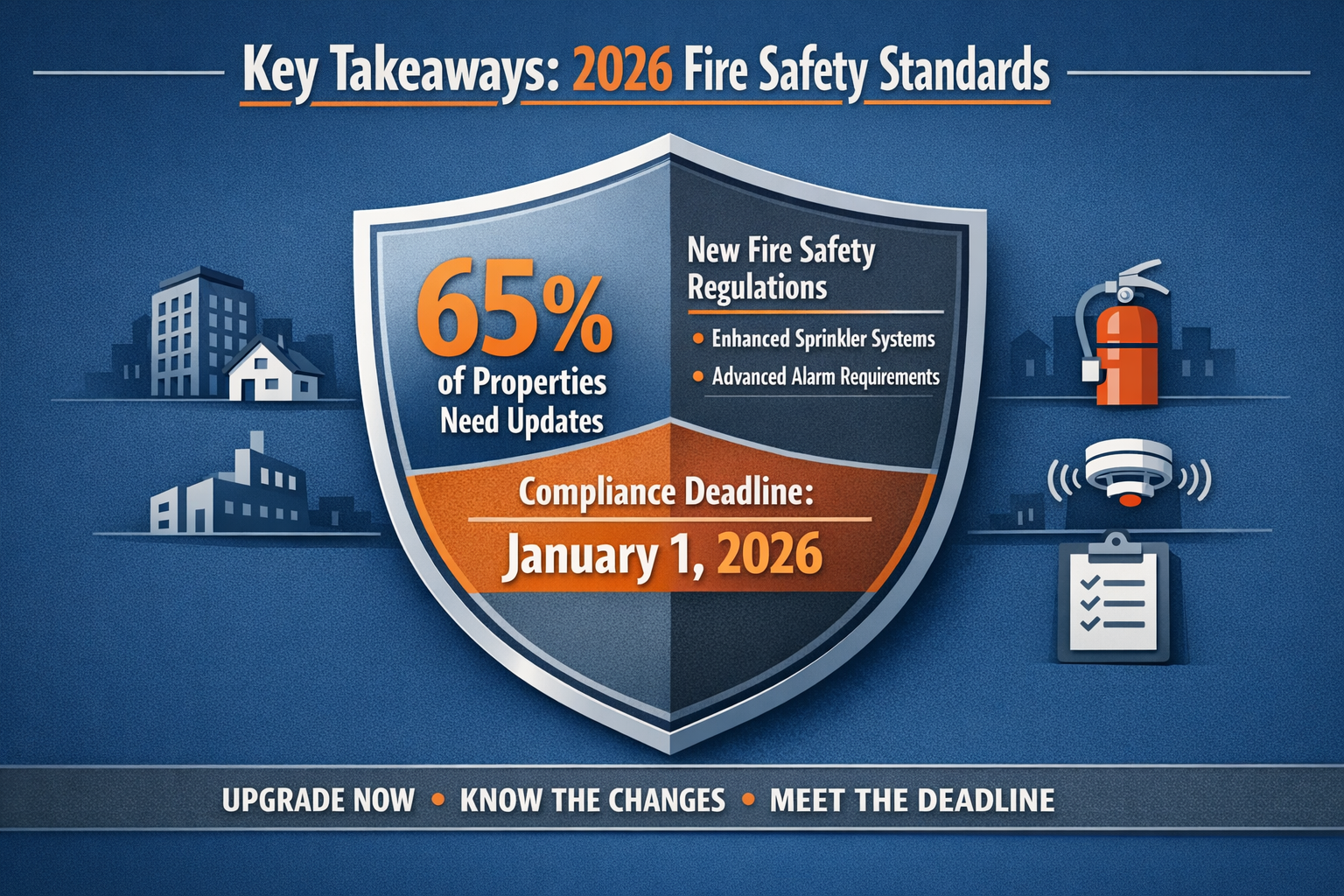
The regulatory environment governing fire safety in the UK has undergone dramatic transformation following high-profile building fire incidents. As we move through 2026, property owners must navigate an increasingly complex web of standards, regulations, and enforcement mechanisms designed to prevent future tragedies.
The Fire Safety (Residential Evacuation Plans) Regulations 2025
The most immediate change facing property owners is the Fire Safety (Residential Evacuation Plans) (England) Regulations 2025, which becomes legally enforceable on April 6, 2026[3]. This regulation establishes mandatory evacuation planning requirements for:
- Residential buildings 18 metres tall (approximately 7 storeys) or higher
- Buildings of 11 metres or higher that use simultaneous evacuation strategies
Building owners and managers must ensure comprehensive evacuation plans are developed, documented, and communicated to all residents before this critical deadline. The plans must account for residents with mobility challenges, provide clear evacuation routes, and establish protocols for different emergency scenarios.
Transition from BS 476 to European Standards
In 2026, the UK is accelerating the move away from BS 476 fire test standards toward European standards, specifically:
- BS EN 13501 for reaction to fire classification
- BS EN 1634-1 for fire resistance testing of doors and shutters[4]
This transition will significantly affect procurement, installation, and inspection practices. Facilities teams must ensure that all products are certified to these updated benchmarks. The change impacts everything from wall cladding materials to fire doors, requiring property owners to verify that existing installations meet current standards or plan for necessary upgrades.
Enhanced Fire Alarm System Requirements
BS 5839-1:2017 remains the central standard for fire alarm installation and maintenance throughout the UK[1]. However, anticipated 2026 updates are expected to increase scrutiny on:
- System integration capabilities: Fire alarm systems must connect with building management platforms
- Remote monitoring features: Real-time alerts and system status monitoring become standard expectations
- Documentation and audit trails: Every stage of fire alarm design must be traceable and verifiable[1]
These enhanced requirements reflect the modern expectation that fire safety systems should be proactive, interconnected, and continuously monitored rather than passive installations checked only during annual inspections.
Fire Safety and Regulatory Compliance Surveys: What Property Owners Need to Know About 2026 Standards and Professional Assessments
Professional fire safety surveys have evolved from simple checklist exercises to comprehensive risk assessments that integrate building pathology, regulatory compliance, and risk management. Understanding what these surveys entail—and why they're increasingly essential—helps property owners make informed decisions about their obligations and investments.
The Role of Chartered Surveyors in Fire Safety Compliance
Chartered surveyors now play a critical role in fire safety compliance, providing expertise that extends far beyond traditional building surveys. Their responsibilities include:
Comprehensive Risk Assessment: Surveyors evaluate fire hazards throughout the property, from electrical systems to combustible materials storage. They assess ignition sources, fuel loads, and potential fire spread pathways.
Regulatory Compliance Verification: Professional surveyors verify that buildings meet current standards for fire detection systems, emergency lighting, fire doors, escape routes, and compartmentation. This includes checking certifications for materials against the latest BS EN standards.
Documentation and Reporting: Surveyors create detailed reports that serve as legal documentation of compliance efforts. These reports are essential for insurance purposes, property transactions, and demonstrating due diligence in the event of enforcement action.
Remediation Planning: When deficiencies are identified, surveyors provide prioritized recommendations for corrective action, cost estimates, and timelines for bringing properties into compliance.
What a Comprehensive Fire Safety Survey Includes
A thorough fire safety compliance survey in 2026 encompasses multiple interconnected assessments:
🔍 Physical Inspection Components
- Fire Detection and Alarm Systems: Verification of BS 5839-1:2017 compliance, testing of all devices, review of maintenance records, and assessment of system integration capabilities[1]
- Emergency Lighting: Testing of illumination levels, battery backup duration, and coverage of escape routes
- Fire Doors and Compartmentation: Inspection of fire door integrity, self-closing mechanisms, intumescent seals, and compartmentation barriers
- Escape Routes: Measurement of travel distances, verification of adequate width, assessment of signage clarity, and evaluation of potential obstructions
- Cladding and External Wall Systems: Detailed assessment of external wall construction against BS EN 13501 standards, particularly for buildings over 11 metres[4]
📋 Documentation Review
- Previous Fire Risk Assessments: Review of historical assessments to identify recurring issues or incomplete remediation
- Maintenance Records: Verification that fire safety systems receive regular servicing and that records are complete
- Building Plans and Modifications: Assessment of how alterations have affected fire safety provisions
- Certification and Compliance Documents: Verification that materials and systems have appropriate certification
When considering questions to ask during a building survey, fire safety compliance should feature prominently, particularly for multi-occupancy buildings.
Digital Documentation and the 40% Efficiency Gain
One of the most significant developments in fire safety compliance is the adoption of digital logbooks and documentation systems. Industry surveys indicate that digital logbooks improve audit efficiency by 40%[1], supporting both compliance and operational resilience.
Digital systems offer several advantages:
- Real-time updates: Maintenance activities are logged immediately, creating an accurate historical record
- Automated reminders: Systems alert property managers when inspections or servicing are due
- Centralized access: Multiple stakeholders can access documentation from any location
- Audit trail integrity: Digital systems prevent retrospective alteration of records
- Integration capabilities: Digital logbooks can connect with building management systems and fire alarm panels
For property owners managing multiple buildings or complex portfolios, digital documentation systems have become essential tools for demonstrating ongoing compliance and managing risk effectively.
Critical Compliance Deadlines and Enforcement Realities
Understanding the timeline for compliance and the consequences of failure helps property owners prioritize their fire safety investments appropriately.
The January-February 2026 Assessment Window
To meet the April 6, 2026 enforcement deadline for the Fire Safety (Residential Evacuation Plans) Regulations, building owners and managers must conduct comprehensive fire risk assessments during January-February 2026[3]. This tight timeline means that property owners should already be:
- Engaging qualified fire safety professionals to schedule assessments
- Gathering existing documentation including building plans, previous assessments, and maintenance records
- Identifying buildings within their portfolio that fall under the new regulations
- Budgeting for remediation work that assessments may identify as necessary
Waiting until March 2026 to begin this process creates significant risk of missing the compliance deadline, potentially exposing property owners to enforcement action.
The NFPA 1970 Deadline for Commercial Properties
For commercial properties with firefighting equipment, the NFPA 1970 standard consolidates requirements for firefighting protective equipment and Self-Contained Breathing Apparatus (SCBA), with a critical compliance deadline of March 28, 2026[5]. After this date, all SCBA previously compliant with NFPA 1981 must meet the new consolidated requirements.
While this primarily affects facilities with on-site firefighting capabilities, property owners should verify whether their buildings fall under this requirement, particularly for:
- Industrial facilities with fire brigades
- Large commercial complexes with dedicated fire response teams
- Facilities handling hazardous materials
Enforcement Statistics and Consequences
The regulatory environment has become significantly more stringent, with enforcement authorities taking a proactive approach to fire safety compliance. Over 1,800 enforcement notices were issued in 2023 due to fire safety breaches across the UK[1], demonstrating the serious attention regulators are paying to compliance.
Failure to meet fire safety standards can result in:
- ⚖️ Criminal prosecution of responsible persons under the Regulatory Reform (Fire Safety) Order 2005
- 💰 Unlimited fines for serious breaches
- 🏢 Prohibition notices that prevent building occupation until deficiencies are remediated
- 📄 Invalidated insurance policies if insurers determine that non-compliance contributed to losses
- 📉 Reduced property values when fire safety deficiencies are disclosed during transactions
For property owners, the financial and legal risks of non-compliance far exceed the cost of proactive assessment and remediation.
Fire Safety and Regulatory Compliance Surveys: What Property Owners Need to Know About 2026 Standards for Different Property Types
Different property types face unique fire safety challenges and regulatory requirements. Understanding these distinctions helps property owners focus their compliance efforts appropriately.
Residential Buildings and Multi-Occupancy Dwellings
Residential properties, particularly multi-occupancy buildings, face the most comprehensive regulatory requirements under the 2026 standards. The Fire Safety (Residential Evacuation Plans) Regulations specifically target these properties because they house vulnerable populations and present complex evacuation challenges[3].
High-Rise Residential Buildings (18+ Metres)
Buildings of this height must:
- Develop and implement comprehensive evacuation plans
- Conduct regular evacuation drills with residents
- Maintain clear communication systems for emergency notifications
- Provide evacuation assistance for residents with mobility limitations
- Install and maintain advanced fire detection and suppression systems
The cladding crisis has particularly affected high-rise residential buildings, requiring extensive surveys to verify that external wall systems meet BS EN 13501 standards[4]. Property owners may need to commission specialized building pathology surveys to assess cladding systems comprehensively.
Mid-Rise Buildings (11-18 Metres)
Buildings in this height range using simultaneous evacuation strategies must also comply with the new evacuation planning requirements[3]. This affects many purpose-built apartment blocks and converted buildings.
For these properties, fire risk assessments should focus on:
- Adequacy of escape routes for simultaneous evacuation
- Fire door integrity throughout the building
- Compartmentation effectiveness
- Alarm system audibility in all occupied spaces
Houses in Multiple Occupation (HMOs)
HMOs face particularly stringent requirements due to the higher risk profile associated with multiple unrelated occupants sharing facilities. Fire safety surveys for HMOs must verify:
- Adequate fire detection in all rooms and circulation spaces
- Fire doors on all habitable rooms
- Emergency lighting in common areas
- Clear and unobstructed escape routes
- Appropriate fire safety signage
Commercial and Mixed-Use Properties
Commercial properties face different but equally important fire safety requirements. The specific obligations depend on the building's use, occupancy levels, and structural characteristics.
Office Buildings
Modern office buildings typically require:
- Integrated fire alarm systems compliant with BS 5839-1:2017[1]
- Regular fire drills and evacuation procedures
- Clear fire safety management responsibilities
- Maintenance of fire safety systems with documented records
For office buildings undergoing property renovations, fire safety compliance must be integrated into the renovation planning from the earliest stages.
Retail and Hospitality Properties
Properties with public access face additional considerations:
- Higher occupancy loads requiring wider escape routes
- More frequent inspections due to changing layouts and stock
- Enhanced emergency lighting for unfamiliar visitors
- Staff training on evacuation procedures
- Special provisions for areas with high fire loads (kitchens, storage)
Industrial and Warehouse Facilities
Industrial properties often present the most complex fire safety challenges:
- Large open spaces requiring specialized detection systems
- High fire loads from stored materials
- Potential for rapid fire spread
- Special suppression systems (sprinklers, foam, gas systems)
- Integration with process safety management
Heritage and Listed Buildings
Historic buildings present unique challenges in balancing fire safety compliance with conservation requirements. Property owners of listed buildings must work with specialists who understand both fire safety regulations and heritage conservation principles.
Surveys of heritage properties require:
- Sensitive integration of fire detection systems that minimize visual impact
- Creative solutions for escape routes that preserve historic fabric
- Specialized fire suppression systems appropriate for irreplaceable materials
- Collaboration between fire safety professionals, conservation architects, and regulatory authorities
When conducting Level 3 building surveys on heritage properties, fire safety compliance often represents one of the most complex and costly aspects of the assessment.
Cladding, Balconies, and External Fire Spread: The 2026 Focus Areas
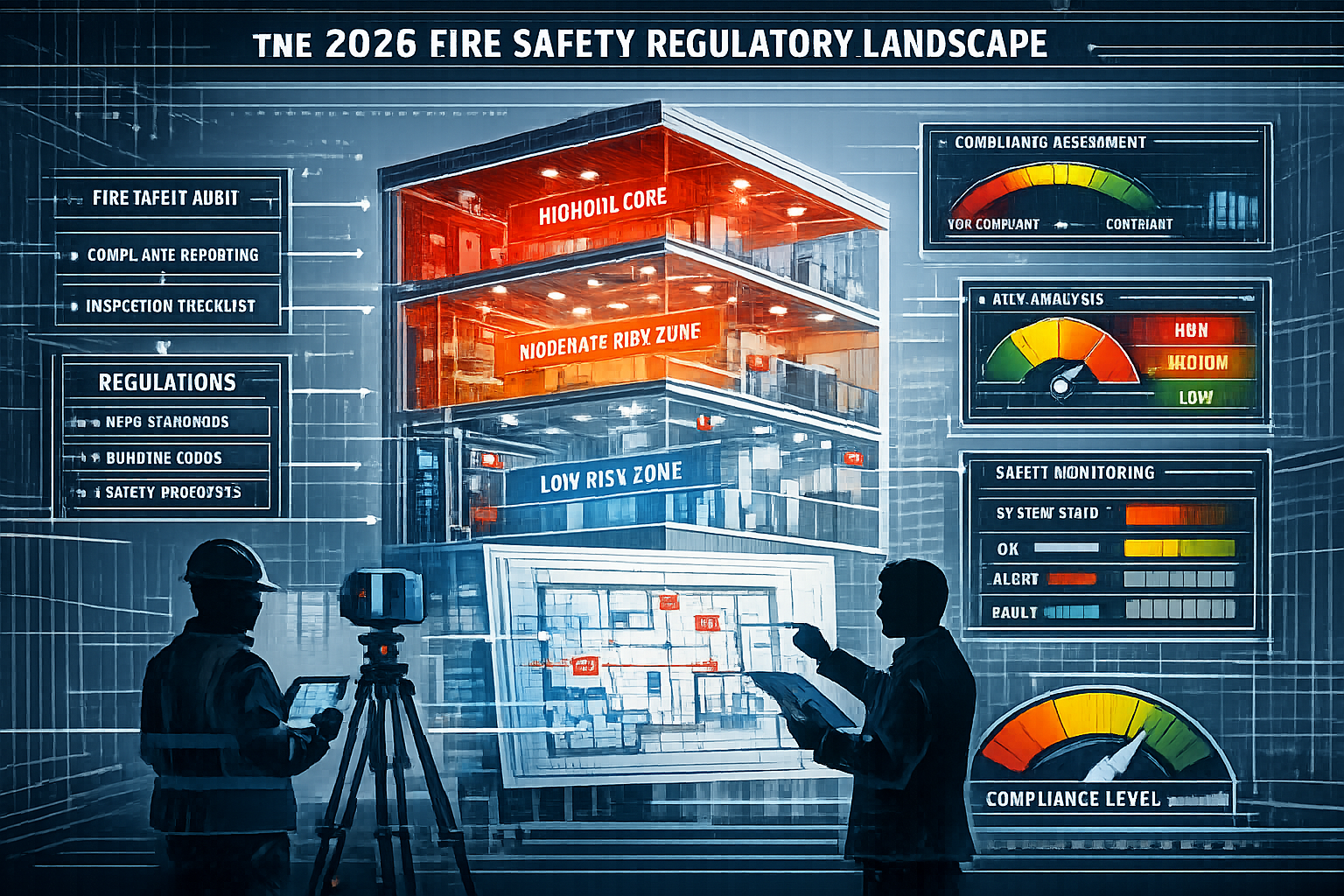
The shift toward European testing standards and heightened scrutiny of external building elements represents one of the most significant changes in fire safety regulation for 2026.
The Cladding Crisis and Regulatory Response
Following devastating fires linked to combustible cladding systems, regulators have fundamentally changed how external wall systems are assessed and certified. The transition to BS EN 13501 for reaction-to-fire classification provides a more rigorous framework for evaluating cladding materials[4].
What Property Owners Need to Know About Cladding Assessments
Comprehensive cladding assessments in 2026 must evaluate:
Material Composition: Detailed analysis of all layers in the external wall system, including:
- Insulation materials
- Cladding panels or tiles
- Cavity barriers
- Fixings and support systems
- Weather-resistant barriers
Fire Performance Classification: Verification that materials achieve appropriate classifications under BS EN 13501:
- Class A1 or A2-s1, d0 for buildings over 18 metres
- Appropriate classifications for lower buildings based on risk assessment
- Documentation of test certificates from accredited laboratories
Installation Quality: Assessment of whether cladding systems were installed according to manufacturer specifications and building regulations:
- Cavity barriers properly positioned and sealed
- Appropriate gaps and fire stops
- Secure fixings that won't fail under fire conditions
Remediation Planning: For buildings with non-compliant cladding, surveyors must provide:
- Prioritized remediation recommendations
- Cost estimates for different remediation approaches
- Interim risk mitigation measures
- Timeline for compliance
Property owners facing cladding issues should consider engaging specialists in building defects surveys who can provide detailed analysis and remediation strategies.
Balcony Fire Safety: An Emerging Concern
Balconies have emerged as a significant fire safety concern, particularly in residential buildings where they can facilitate vertical fire spread or create evacuation hazards.
Key Balcony Assessment Criteria
Fire safety surveys in 2026 must evaluate balconies for:
Fire Spread Potential:
- Combustible materials in balcony construction or furnishings
- Spacing between balconies that could allow fire spread
- Proximity to windows or other openings
Evacuation Route Integrity:
- Whether balconies form part of evacuation strategies
- Structural integrity under fire conditions
- Access to alternative escape routes
Compartmentation:
- Fire barriers between adjacent balconies
- Protection of balcony access from internal fire spread
Material Compliance:
- Verification that balcony materials meet BS EN standards
- Assessment of any combustible cladding or decorative elements
External Wall Fire Review (EWS1) Forms
For residential buildings over 11 metres or with significant cladding, EWS1 forms have become essential documentation for property transactions and mortgage lending. These forms, completed by qualified fire safety professionals, provide an assessment of external wall system fire safety.
Property owners should understand that:
- EWS1 forms are often required for property sales or remortgaging
- Negative assessments can significantly impact property values
- Remediation may be necessary before properties can be sold
- The cost of remediation can be substantial, sometimes exceeding property values
Documentation Requirements and Audit Trails Under 2026 Standards
The enhanced documentation requirements under 2026 standards reflect a fundamental shift toward evidence-based compliance and continuous improvement.
Essential Fire Safety Documentation
Comprehensive documentation must include:
📐 Design and Installation Records
- CAD schematics showing fire alarm system layout, detection zones, and control panel locations
- Layout plans indicating fire doors, escape routes, emergency lighting, and fire safety equipment
- Detailed specifications for all fire safety systems and materials
- Installation certificates from qualified contractors
- Commissioning reports demonstrating that systems function as designed
📊 Risk Assessment Documentation
- Fire risk assessments conducted annually or upon significant changes to the building or its use[1]
- Hazard identification documenting potential ignition sources, fuel loads, and vulnerable occupants
- Risk evaluation assessing the likelihood and potential severity of fire incidents
- Control measures detailing how identified risks are managed
- Review schedules establishing when assessments will be updated
🔧 Maintenance and Testing Records
- Maintenance logbooks updated at each service interval[1]
- Test certificates for fire alarm systems, emergency lighting, and fire suppression systems
- Defect reports documenting issues identified during inspections
- Remediation records showing how defects were addressed
- Service provider qualifications demonstrating that maintenance is performed by competent persons
📋 Operational Documentation
- Evacuation plans meeting the requirements of the Fire Safety (Residential Evacuation Plans) Regulations[3]
- Fire safety policies establishing management responsibilities
- Staff training records demonstrating that responsible persons understand their duties
- Drill records showing that evacuation procedures are regularly practiced
- Incident reports documenting any fire safety events or near-misses
The Importance of Traceable and Verifiable Records
The 2026 standards emphasize that every stage of fire alarm design must be traceable and verifiable[1]. This requirement extends to all aspects of fire safety management, not just alarm systems.
Traceable documentation provides:
Legal Protection: In the event of an incident or enforcement action, comprehensive documentation demonstrates that the responsible person took reasonable steps to ensure fire safety.
Insurance Validation: Insurers increasingly require evidence of ongoing fire safety management. Incomplete documentation can lead to coverage disputes or policy invalidation.
Transaction Facilitation: When properties are sold or leased, comprehensive fire safety documentation reassures buyers and tenants that the property is compliant and well-managed.
Operational Continuity: When management changes or contractors are replaced, complete documentation ensures that new responsible persons understand the building's fire safety systems and requirements.
Implementing Digital Documentation Systems
Given the complexity and volume of required documentation, many property owners are transitioning to digital documentation systems. When selecting a digital platform, property owners should consider:
- Integration capabilities with building management systems and fire alarm panels
- Access controls ensuring that only authorized persons can modify records
- Backup and redundancy protecting documentation from loss
- Audit trail functionality tracking who accessed or modified records and when
- Reporting features generating compliance reports for regulators or insurers
- Mobile accessibility allowing on-site personnel to update records immediately
The 40% efficiency improvement associated with digital logbooks[1] comes from reduced administrative burden, fewer missed inspections, and faster response to compliance queries.
Working with Professional Surveyors: Selecting the Right Expertise
The complexity of 2026 fire safety standards means that property owners need qualified professionals to navigate compliance requirements effectively.
Qualifications and Accreditations to Look For
When engaging fire safety professionals, property owners should verify:
Professional Memberships:
- Royal Institution of Chartered Surveyors (RICS) membership
- Institution of Fire Engineers (IFE) membership
- Association for Specialist Fire Protection (ASFP) membership
Relevant Certifications:
- Fire Risk Assessment qualifications
- BS 5839 system design and inspection training
- Cladding assessment competency (for external wall surveys)
Insurance and Indemnity:
- Professional indemnity insurance adequate for the property value
- Public liability coverage
- Errors and omissions insurance
Experience and Track Record:
- Demonstrated experience with similar property types
- Knowledge of local authority requirements
- References from previous clients
Understanding Survey Scope and Deliverables
Before engaging a surveyor, property owners should clarify:
Survey Scope:
- Which systems and building elements will be assessed
- Whether the survey includes cladding and external elements
- If remediation cost estimates are included
- Whether the surveyor will assist with regulatory submissions
Deliverables:
- Format and detail level of the survey report
- Timeline for report delivery
- Whether follow-up consultations are included
- If the surveyor will attend meetings with regulators or insurers
Costs and Payment Terms:
- Fixed fee versus time-and-materials pricing
- What expenses are included
- Payment schedule
- Costs for additional services if deficiencies are identified
For comprehensive property assessments, property owners might consider Level 3 full building surveys that integrate fire safety compliance with broader building condition analysis.
The Survey Process: What to Expect
A typical fire safety compliance survey follows this process:
1. Pre-Survey Preparation (1-2 Weeks)
- Document collection: gathering existing fire risk assessments, building plans, and maintenance records
- Access arrangements: coordinating access to all areas of the building
- Occupant notification: informing residents or tenants about the survey
- Preliminary review: surveyor reviews documentation before the site visit
2. Site Inspection (1-3 Days)
The duration depends on building size and complexity. The surveyor will:
- Inspect all fire safety systems and equipment
- Test fire alarms and emergency lighting
- Assess escape routes and fire doors
- Evaluate cladding and external elements
- Photograph deficiencies and areas of concern
- Interview building managers about fire safety procedures
3. Analysis and Report Preparation (1-2 Weeks)
The surveyor analyzes findings and prepares a comprehensive report including:
- Executive summary of key findings
- Detailed assessment of each building element
- Prioritized recommendations for remediation
- Cost estimates for corrective work
- Timeline for achieving compliance
4. Report Delivery and Review (1 Week)
- Report delivery to the property owner
- Review meeting to discuss findings and recommendations
- Clarification of any questions
- Discussion of implementation priorities
5. Implementation Support (Ongoing)
Many surveyors offer ongoing support including:
- Assistance with contractor selection for remediation work
- Review of remediation proposals
- Verification inspections after work completion
- Support with regulatory submissions
Understanding how long a building survey takes helps property owners plan appropriately for the assessment process.
Cost Considerations and Financial Planning for Fire Safety Compliance
Fire safety compliance represents a significant investment, but the costs of non-compliance—both financial and human—far exceed the expense of proactive management.
Typical Survey Costs
Fire safety compliance survey costs vary based on:
Property Size and Complexity:
- Small residential buildings (under 10 units): £1,500-£3,000
- Medium residential buildings (10-50 units): £3,000-£8,000
- Large residential buildings (50+ units): £8,000-£20,000+
- Commercial properties: £2,000-£15,000+ depending on size and use
Survey Scope:
- Basic fire risk assessment: Lower end of range
- Comprehensive compliance survey including cladding: Higher end of range
- Specialized assessments (heritage buildings, complex industrial facilities): Premium pricing
Geographic Location:
- London and Southeast England: 20-30% premium over national averages
- Regional variations based on local market conditions
Remediation Cost Planning
Survey costs represent only the assessment phase. Remediation costs can be substantial:
Fire Alarm System Upgrades:
- Basic system upgrades: £5,000-£15,000
- Complete system replacement with integration: £20,000-£100,000+
- Advanced systems with building management integration: £50,000-£200,000+
Cladding Remediation:
- Partial cladding replacement: £50,000-£500,000
- Complete cladding system replacement: £500,000-£5,000,000+
- The cost per square meter varies dramatically based on building height and access challenges
Fire Door Replacement:
- Standard fire door replacement: £500-£1,500 per door
- Specialized fire doors (heritage, acoustic, security): £2,000-£5,000+ per door
- Large buildings may require dozens or hundreds of door replacements
Compartmentation Improvements:
- Cavity barrier installation: £10,000-£50,000
- Fire stopping and penetration sealing: £5,000-£30,000
- Structural compartmentation improvements: £50,000-£200,000+
Funding and Financial Assistance
Property owners facing significant remediation costs should explore:
Government Funding Programs:
- Building Safety Fund for cladding remediation on buildings over 18 metres
- Local authority grants or loan programs
- Tax relief for qualifying fire safety improvements
Insurance Claims:
- Professional indemnity claims against designers or contractors if defects resulted from negligence
- Building defects insurance if available
Leaseholder Protections:
- Recent legislation limits costs that can be passed to leaseholders in certain circumstances
- Property owners should understand their obligations and limitations
Financing Options:
- Bank loans secured against the property
- Specialized fire safety remediation financing
- Spreading costs across leaseholders through service charges (subject to legal limitations)
Return on Investment Considerations
While fire safety compliance is primarily a legal and moral obligation, it also provides financial benefits:
Property Value Protection: Properties with documented fire safety compliance maintain their value and marketability. Non-compliant properties face significant value reduction or become unsaleable.
Insurance Cost Reduction: Comprehensive fire safety management can reduce insurance premiums by demonstrating reduced risk.
Reduced Liability Exposure: Proactive compliance reduces the risk of prosecution, fines, and civil liability in the event of an incident.
Operational Efficiency: Modern integrated fire safety systems reduce management burden and improve building operations.
Tenant Attraction and Retention: Properties with excellent fire safety records attract quality tenants and experience lower vacancy rates.
Fire Safety and Regulatory Compliance Surveys: What Property Owners Need to Know About 2026 Standards and Future Trends
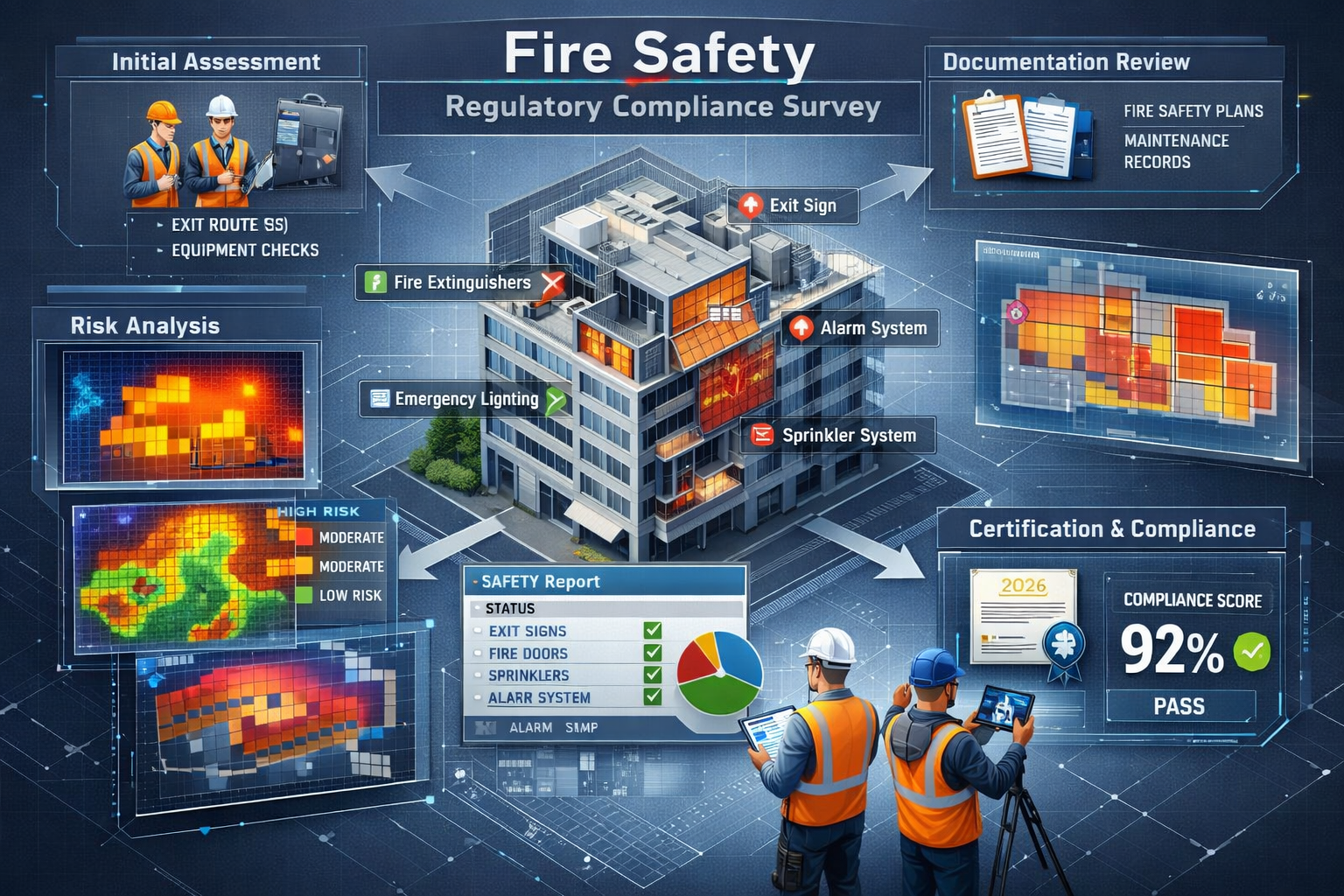
Looking beyond the immediate 2026 compliance deadlines, property owners should understand emerging trends that will shape fire safety regulation in coming years.
Technology Integration and Smart Building Systems
Fire safety systems are increasingly integrated with broader building management platforms:
Internet of Things (IoT) Integration: Fire detectors, alarm panels, and suppression systems connect to building networks, providing:
- Real-time monitoring from any location
- Predictive maintenance based on system performance data
- Automated compliance reporting
- Integration with access control and HVAC systems
Artificial Intelligence and Machine Learning: Advanced systems use AI to:
- Distinguish between genuine fire events and false alarms
- Optimize evacuation routing based on fire location and building occupancy
- Predict equipment failures before they occur
- Analyze historical data to identify risk patterns
Remote Monitoring and Management: Cloud-based platforms enable:
- Centralized monitoring of multiple properties
- Automated alerts to property managers and emergency services
- Remote system testing and diagnostics
- Digital documentation accessible from anywhere
Sustainability and Fire Safety: Balancing Objectives
The push toward energy efficiency and sustainable construction sometimes conflicts with fire safety objectives:
Insulation Materials: High-performance insulation materials must balance thermal performance with fire safety. The shift to BS EN 13501 standards[4] helps ensure that sustainability doesn't compromise safety.
Renewable Energy Systems: Solar panels, battery storage, and other renewable energy installations create new fire risks that must be assessed and managed.
Timber Construction: Engineered timber construction offers sustainability benefits but requires careful fire safety design and enhanced protection measures.
Property owners planning property renovations must ensure that sustainability objectives don't compromise fire safety compliance.
Regulatory Evolution: What's Next After 2026?
The regulatory landscape will continue evolving:
Expanded Building Heights Coverage: Regulations currently focused on buildings over 11 or 18 metres may extend to lower buildings as lessons are learned.
Stricter Material Standards: The transition to BS EN standards[4] may be followed by even more stringent requirements for certain building types or uses.
Enhanced Enforcement: The trend toward more enforcement actions[1] is likely to continue, with regulators taking a more proactive approach.
Occupant Engagement Requirements: Future regulations may require more extensive occupant education and engagement in fire safety management.
Climate Change Adaptation: As climate change increases fire risk in some regions, regulations may adapt to address changing risk profiles.
Professional Development and Competency Requirements
The complexity of modern fire safety regulation is driving changes in professional competency requirements:
Enhanced Training Standards: Fire safety professionals face increasing expectations for specialized training and continuing professional development.
Competency Frameworks: Industry bodies are developing competency frameworks to ensure consistent standards across the profession.
Specialization: The breadth of fire safety knowledge required is leading to increased specialization in areas like cladding assessment, heritage buildings, or complex industrial facilities.
Property owners should verify that their fire safety professionals maintain current competency through ongoing training and professional development.
Practical Steps for Property Owners: A 2026 Compliance Roadmap
To navigate the complex landscape of Fire Safety and Regulatory Compliance Surveys: What Property Owners Need to Know About 2026 Standards, property owners should follow this practical roadmap:
Immediate Actions (January-February 2026)
✅ Identify Affected Properties: Determine which buildings in your portfolio fall under the Fire Safety (Residential Evacuation Plans) Regulations[3]
✅ Engage Qualified Surveyors: Schedule fire safety compliance surveys before the April 6, 2026 deadline
✅ Gather Existing Documentation: Compile all fire risk assessments, maintenance records, and building plans
✅ Budget for Remediation: Allocate financial resources for addressing deficiencies that surveys may identify
✅ Review Insurance Coverage: Verify that insurance policies are current and that insurers are aware of compliance efforts
Short-Term Actions (March-June 2026)
✅ Implement Survey Recommendations: Address critical deficiencies identified in fire safety surveys
✅ Develop Evacuation Plans: Create comprehensive evacuation plans meeting regulatory requirements[3]
✅ Update Documentation Systems: Implement or enhance digital documentation platforms
✅ Train Responsible Persons: Ensure that building managers and staff understand their fire safety obligations
✅ Communicate with Occupants: Inform residents or tenants about evacuation procedures and fire safety measures
Medium-Term Actions (2026-2027)
✅ Establish Regular Assessment Schedules: Implement annual fire risk assessment cycles
✅ Upgrade Fire Safety Systems: Plan and execute upgrades to fire alarm systems to meet BS 5839-1:2017 requirements[1] and anticipated updates
✅ Address Cladding Issues: Develop and implement cladding remediation plans for non-compliant buildings
✅ Implement Continuous Improvement: Use data from incidents, drills, and inspections to continuously enhance fire safety
✅ Monitor Regulatory Developments: Stay informed about evolving standards and requirements
Long-Term Strategic Planning
✅ Integrate Fire Safety into Asset Management: Make fire safety compliance a core component of property management strategy
✅ Invest in Technology: Adopt integrated building management systems that enhance fire safety and operational efficiency
✅ Build Professional Relationships: Develop ongoing relationships with qualified fire safety professionals
✅ Plan for Future Requirements: Anticipate regulatory evolution and plan investments accordingly
✅ Document Everything: Maintain comprehensive records that demonstrate ongoing compliance and due diligence
Conclusion: Protecting People, Property, and Legal Position Through Proactive Compliance
Fire Safety and Regulatory Compliance Surveys: What Property Owners Need to Know About 2026 Standards represents a fundamental shift in how property owners must approach fire risk management. The new regulations coming into force on April 6, 2026[3], the transition to BS EN standards[4], and the enhanced requirements for fire alarm systems[1] all reflect lessons learned from tragic fire safety failures.
Property owners who approach these requirements as mere compliance exercises miss the broader opportunity. Comprehensive fire safety management protects lives, preserves property values, reduces liability exposure, and demonstrates responsible stewardship. The 1,800+ enforcement notices issued in 2023[1] make clear that regulators are serious about fire safety compliance, and the consequences of failure extend far beyond financial penalties.
Your Next Steps
The path forward requires immediate action:
- Schedule a comprehensive fire safety survey with qualified professionals before the April 2026 deadline
- Review your entire property portfolio to identify buildings affected by new regulations
- Allocate appropriate resources for both assessment and remediation
- Implement robust documentation systems that support ongoing compliance
- Engage with specialists who understand the intersection of fire safety, building pathology, and regulatory compliance
For property owners seeking comprehensive support, consider partnering with professionals who offer integrated services including fire risk assessments, health and safety inspections, and building surveys that address fire safety within the broader context of property condition and compliance.
The 2026 standards represent not just a regulatory burden but an opportunity to create safer, more valuable, and better-managed properties. Property owners who embrace this opportunity will find themselves well-positioned for the evolving regulatory landscape while protecting the people who live, work, and visit their buildings.
The time to act is now. With the April 6, 2026 deadline approaching rapidly, property owners must move quickly to assess their compliance status, address deficiencies, and implement the systems and processes that will support ongoing fire safety management. The investment in professional surveys, system upgrades, and enhanced documentation will pay dividends in reduced risk, protected property values, and the peace of mind that comes from knowing you've met your legal and moral obligations to protect building occupants.
References
[1] Fire Alarm Design – logicfireandsecurity.com
[2] Erces Requirements By State Complete 2026 Compliance Map Interactive Guide – dassystems.com
[3] New Fire Safety Regulations Coming April 2026 Are You Prepared – totalsafeuk.com
[4] Preparing For 2026 The Future Of Fire Safety Legislation And What It Means For You – totalfiregroup.org
[5] Whats Ahead For Workplace Safety Key Regulatory Changes Coming In 2026 – naspweb.com
[6] Fire Safety In Construction – ajg.com
[7] The Key Changes In 2026 That You Need To Be Aware Of – selo.global
[8] Fire Code Updates That Affect Businesses In 2026 – hedrickfireprotection.com
[9] Fire Safety Readiness In 2026 How Often Should Buildings Conduct Fire Safety Audits – dsolfacilities.com