

The aftermath of the Grenfell Tower tragedy fundamentally transformed how property professionals approach fire safety assessments. In 2026, Fire Safety and Cladding Compliance: Essential Checks in 2026 Property Surveys have become more rigorous, technical, and legally consequential than ever before. With the revised European cladding fire test standard taking effect on January 31, 2026, property surveyors, buyers, and building owners face a new landscape of compliance requirements that demand specialist knowledge and meticulous attention to detail[1][2].
Understanding these essential checks isn't just about regulatory compliance—it's about protecting lives, preserving property values, and ensuring financial transactions can proceed smoothly. Whether you're purchasing a flat in a high-rise building, managing a residential block, or conducting professional property assessments, knowing when to seek specialist advice and what red flags to identify has become critical to navigating the post-Grenfell regulatory environment.
Key Takeaways
- 🔥 New testing standards: The revised EN 13501-1 standard replaces subjective visual assessments with a 270°C temperature threshold, creating consistent, objective fire safety classifications across Europe[2][5]
- 📋 PAS 9980 is now mandatory: Financial lenders consistently expect PAS 9980 external wall fire risk assessments and refuse to proceed without them during property transactions[6]
- 🏢 Height matters more than ever: Buildings exceeding 11 meters now require sprinkler systems, and properties with balconies, conversions, or mixed-use features face heightened scrutiny[4]
- 📝 Documentation is critical: Comprehensive maintenance logs for fire doors, alarms, sprinklers, and smoke control systems directly impact insurance premiums and coverage availability[6]
- 👷 Specialist qualifications required: EWS1 forms must be completed by chartered building surveyors or fire engineers with specific cladding assessment training—general surveyors cannot provide these assessments[3][4]
Understanding the 2026 Regulatory Landscape for Fire Safety and Cladding Compliance
The Revolutionary Changes in European Cladding Standards
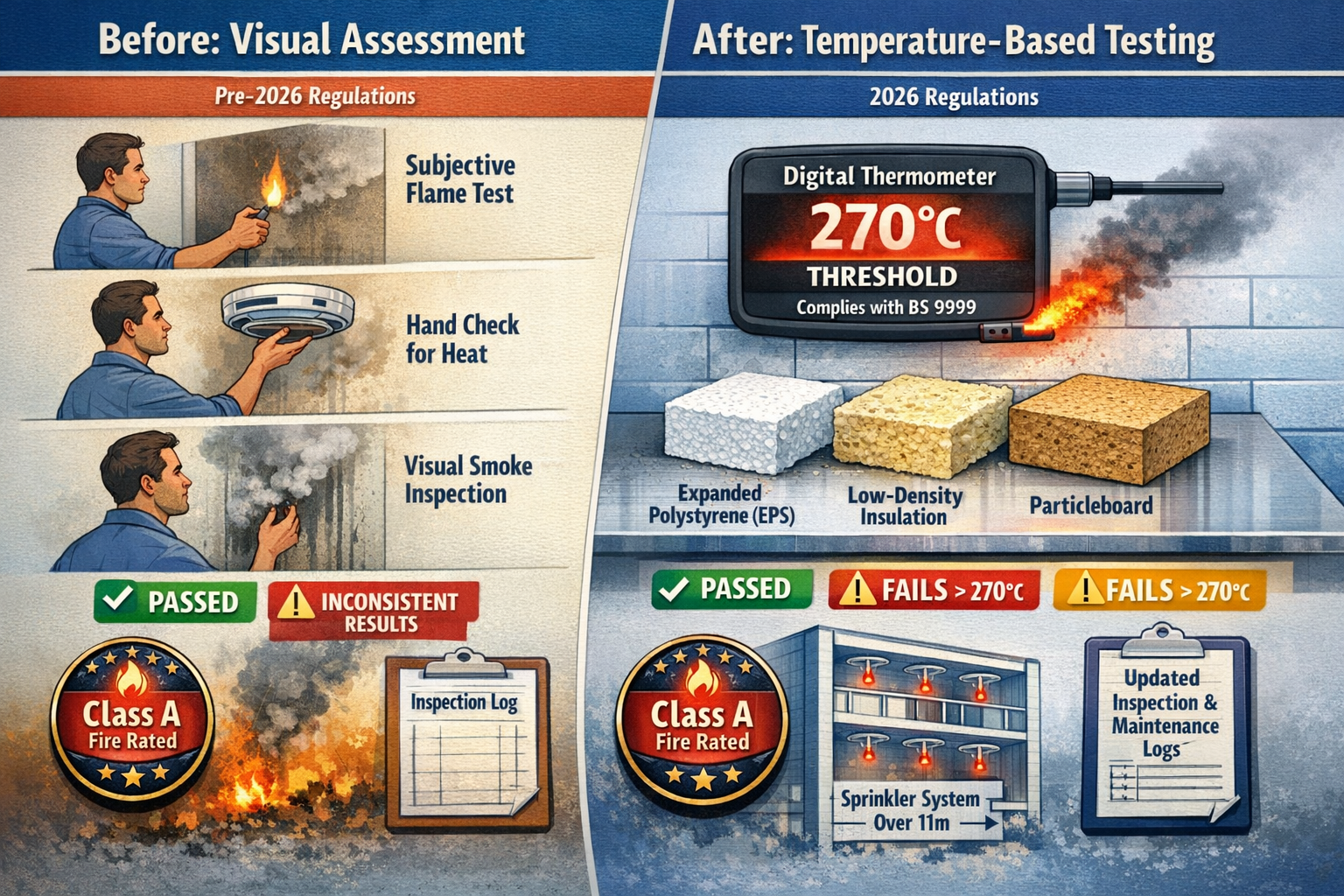
The construction industry witnessed a fundamental shift when the revised European cladding fire test standard (EN 13501-1) came into force on January 31, 2026. This represents the most significant change to fire safety testing protocols in decades, moving away from subjective visual assessments that produced inconsistent results between different testing laboratories[2][5].
The new temperature-based system uses a precise 270°C threshold to determine whether cladding materials pass or fail fire safety requirements. This objective measurement eliminates the ambiguity that previously plagued the industry, where different assessors might reach different conclusions about the same material[2][5].
Key changes in the 2026 testing regime include:
| Previous Standard | 2026 Revised Standard |
|---|---|
| Visual assessment of flame spread | Temperature-based measurement at 270°C |
| Single substrate testing | Three base materials required (EPS, low-density insulation, particleboard) |
| Inconsistent results between labs | Standardized, reproducible outcomes |
| Limited scope for sustainable materials | Easier incorporation of bio-based products |
| Multiple tests for different applications | One test covers multiple installation methods |
The requirement for testing on three key base materials—expanded polystyrene (EPS), low-density insulation, and particleboard—better reflects real-world installation conditions. Significantly, EPS testing represents the worst-case scenario, meaning products tested successfully on EPS can be installed on any substrate, reducing duplication and costs for manufacturers[2][5].
Why These Changes Matter for Property Surveys
For property surveyors conducting assessments in 2026, these regulatory changes create both challenges and opportunities. Nearly 80% of construction and design professionals now insist on Class A Fire Rating and Ignition Resistance for building materials, reflecting the industry's heightened awareness of fire safety risks[7].
The statistics driving these regulations are sobering: an estimated 5,000 people lose their lives annually in residential fires across Europe[2]. This human cost provides the evidence base for increasingly stringent requirements, particularly for high-rise residential buildings, conversions, and properties with complex external wall systems.
When conducting a Level 3 full building survey, surveyors must now incorporate these updated standards into their assessments, identifying not just current compliance status but also potential future liabilities as regulations continue to evolve.
Essential Fire Safety Checks in 2026 Property Surveys: What Surveyors Must Assess
External Wall System (EWS) Assessments and EWS1 Forms
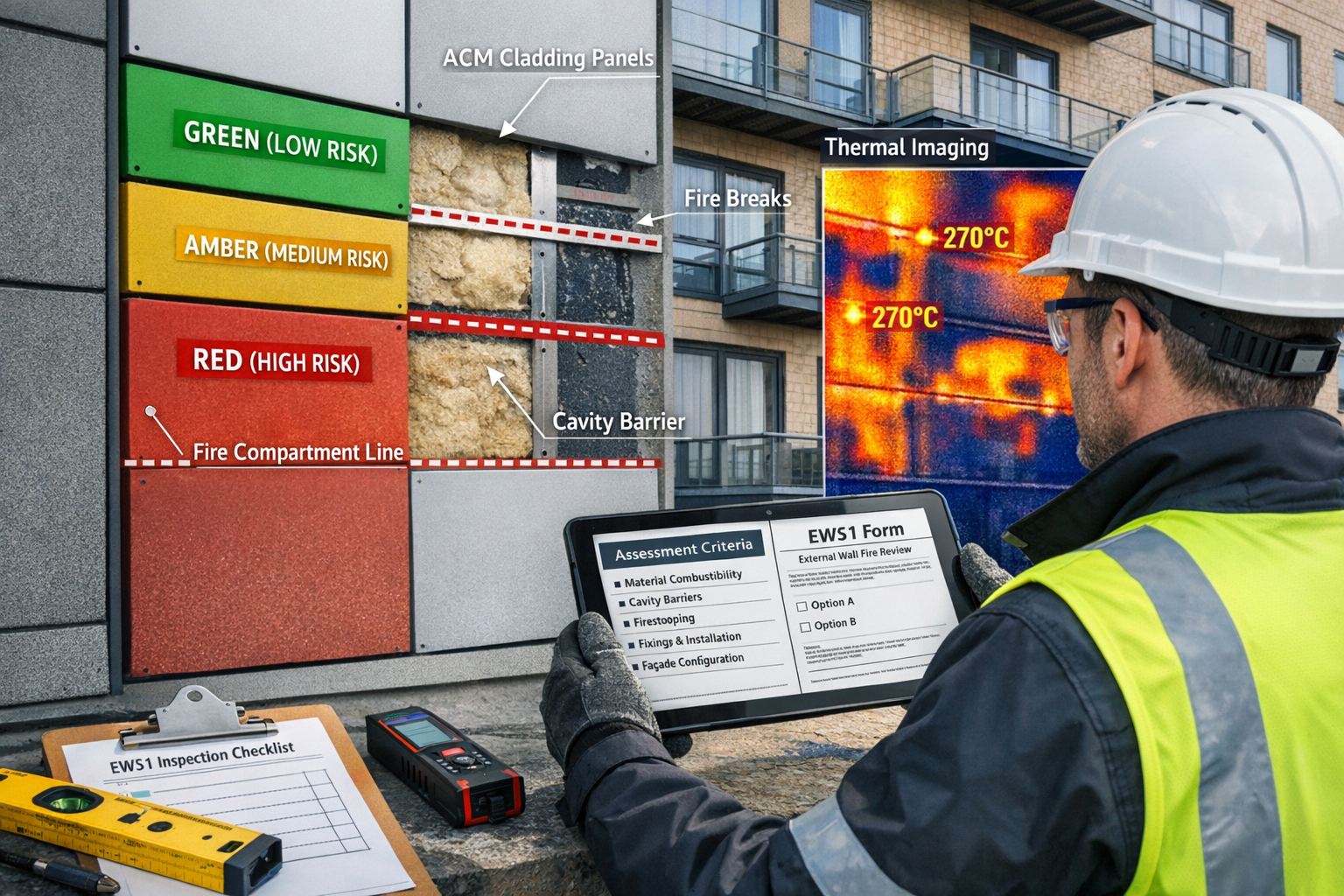
The EWS1 form has become the cornerstone document in property transactions involving buildings with external wall systems. This form must be completed by qualified, competent members of relevant professional bodies—typically chartered building surveyors or fire engineers who have undertaken additional training specifically in cladding assessment[3][4].
Who can complete an EWS1 form?
✅ Chartered building surveyors with cladding assessment training
✅ Fire engineers with appropriate qualifications
✅ Members of RICS, CABE, or equivalent professional bodies
❌ General property surveyors without specialist training
❌ Building control officers (unless appropriately qualified)
❌ Estate agents or property managers
The assessment process examines multiple factors beyond just the cladding material itself. Surveyors must evaluate the entire external wall construction, including insulation materials, cavity barriers, fire breaks, and the interaction between different building components. This holistic approach recognizes that fire safety depends on the system as a whole, not individual materials in isolation[3].
PAS 9980:2022 Code of Practice Implementation
The PAS 9980:2022 code of practice has emerged as the standard methodology for external wall fire risk assessments in 2026. Financial lenders now consistently expect PAS 9980 outputs during property sales and transactions, with many refusing to proceed without this documentation[6].
This standardized approach provides a consistent framework for assessing fire risk across different building types and configurations. The methodology considers:
- Building height and occupancy type
- External wall construction and materials
- Presence and condition of fire safety systems
- Compartmentation and fire stopping measures
- Means of escape and evacuation routes
- Building management and maintenance procedures
For property buyers, understanding whether a building has undergone a PAS 9980 assessment—and what the results indicate—has become as important as traditional structural surveys. Without this documentation, mortgage lenders may refuse financing, effectively making properties unsaleable until compliance is demonstrated[6].
High-Risk Features Requiring Specialist Assessment
Certain building features trigger automatic requirements for specialist fire safety assessments in 2026. Understanding these triggers helps property professionals identify when to engage qualified experts rather than attempting general assessments.
🔴 High-risk features requiring specialist advice:
- Balconies and external projections: Balconies create additional fire spread pathways and require assessment of fire resistance ratings, materials used, and potential for vertical fire spread between floors
- Building conversions: Properties converted from commercial to residential use, or buildings with mixed-use occupancy, face complex fire safety requirements that differ from purpose-built residential structures
- Buildings over 11 meters: Approved Document B now mandates sprinkler systems in new residential buildings exceeding 11 meters in height, with retrofit requirements for existing buildings in many circumstances[4]
- Aluminium Composite Material (ACM) cladding: Any building with ACM cladding requires immediate specialist assessment, regardless of height or occupancy
- Timber frame construction with external insulation: The combination of combustible structural materials and external insulation systems creates elevated risk profiles
- Buildings with limited means of escape: Single-staircase buildings, properties with long travel distances to exits, or inadequate fire escape routes
When conducting surveys on properties with these features, general building surveyors should recognize the limits of their expertise and recommend specialist fire safety assessments. The consequences of failing to act on identified fire safety concerns can be severe, both legally and in terms of human safety.
Critical Documentation and Maintenance Records for Fire Safety Compliance
The Growing Importance of Maintenance Logs
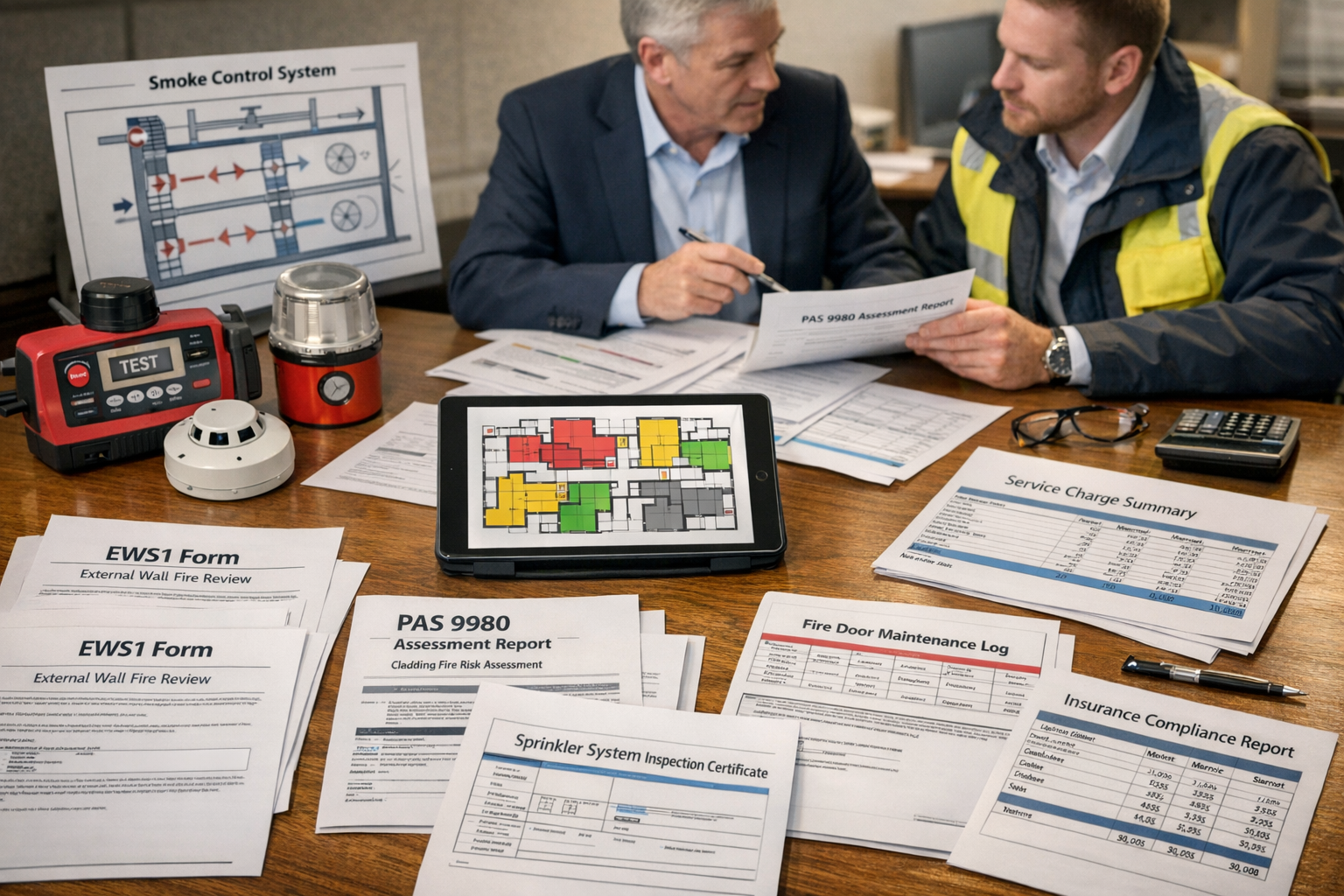
Property management companies and building owners must now prepare comprehensive logs documenting the maintenance and testing of all fire safety systems. This documentation has evolved from a best practice recommendation to an essential requirement that directly impacts insurance coverage and premiums[6].
Essential maintenance documentation includes:
📋 Fire door inspection records: Quarterly checks of fire door condition, self-closing mechanisms, intumescent strips, and smoke seals
📋 Fire alarm testing logs: Weekly alarm testing, annual servicing by qualified engineers, and records of any faults or repairs
📋 Sprinkler system maintenance: Regular testing, inspection certificates, and service records for all sprinkler installations
📋 Smoke control system documentation: Testing schedules for smoke vents, pressurization systems, and automatic opening vents
📋 Lift maintenance records: Particularly important for evacuation lifts and firefighting lifts in taller buildings
📋 Emergency lighting testing: Monthly function tests and annual duration tests with documented results
Missing or incomplete maintenance evidence may lead to higher insurance premiums, policy exclusions for fire-related claims, or outright refusal to provide insurance coverage[6]. For property buyers, requesting and reviewing these maintenance logs during the survey process provides crucial insight into how seriously building management takes fire safety compliance.
Service Charge Accounting and Fire Safety Budgeting
The financial implications of fire safety compliance extend beyond one-time remediation costs. Ongoing maintenance, testing, and documentation create recurring expenses that must be properly budgeted and accounted for through service charges.
Building managers should ensure service charge accounting and budgeting includes adequate provisions for:
- Annual fire safety equipment servicing
- Periodic external wall system inspections
- Fire risk assessment updates (typically required every 3-5 years)
- Remediation reserves for identified defects
- Professional indemnity insurance for fire safety assessors
- Waking watch costs (where required pending remediation)
Property surveys should assess not just the current state of fire safety compliance, but also whether adequate financial provisions exist for ongoing maintenance and future remediation work. Buildings with insufficient reserves or poorly managed service charge funds may face special levies or deferred maintenance that creates escalating risks.
Approved Document B Updates and Their Impact on Property Assessments
New Requirements for Sprinkler Systems
Approved Document B (Fire Safety) underwent significant revisions that now mandate sprinkler systems in specific building types. As of 2026, new residential buildings exceeding 11 meters in height must incorporate automatic sprinkler systems, as must all new care homes regardless of height[4].
For existing buildings, these requirements create a two-tier market:
Tier 1: Compliant buildings with sprinkler systems installed benefit from:
- Enhanced safety for occupants
- Lower insurance premiums
- Easier mortgage financing
- Higher market values
- Reduced waking watch requirements
Tier 2: Non-compliant buildings without required sprinklers face:
- Retrofit obligations with significant costs
- Interim fire safety measures (waking watch patrols)
- Difficulty obtaining mortgages
- Depressed property values
- Higher insurance costs or coverage limitations
When surveying properties that fall within the scope of these requirements, assessors must clearly identify whether sprinkler systems are installed, their condition and maintenance status, and any remediation obligations that may affect the property's value or marketability.
Expected Regulatory Changes Under Review
Looking beyond the changes already implemented in 2026, several additional updates to Approved Document B remain under review and are expected to impact property assessments in the near future[1]:
Anticipated changes include:
🔄 Removal of national class testing (BS 476): Further harmonization with European standards, eliminating duplicate testing requirements
🔄 Refined guidance on means of escape: Particularly for higher-risk buildings with vulnerable occupants or complex layouts
🔄 Enhanced requirements for multi-storey buildings: Additional fire safety measures for buildings between 11-18 meters that currently fall outside the most stringent regulations
🔄 Stricter standards for residential conversions: Recognition that converted buildings present unique fire safety challenges compared to purpose-built structures
Property professionals conducting surveys in 2026 should maintain awareness of these pending changes, as buildings that currently meet minimum standards may face additional compliance obligations as regulations continue to evolve. This forward-looking approach helps buyers understand not just current compliance status, but potential future liabilities and costs.
When to Seek Specialist Fire Safety Advice During Property Surveys
Recognizing the Limits of General Survey Expertise
Even the most comprehensive Level 3 building survey conducted by an experienced chartered surveyor has limitations when it comes to fire safety and cladding compliance. The specialized knowledge required to properly assess external wall systems, fire engineering principles, and complex regulatory compliance means that general surveyors must recognize when to recommend specialist input.
Indicators that specialist fire safety assessment is required:
⚠️ Building height exceeds 11 meters with residential occupancy
⚠️ Presence of external cladding systems of any type, particularly ACM panels
⚠️ Mixed-use buildings combining residential and commercial occupancy
⚠️ Buildings with significant alterations or conversions from original use
⚠️ Absence of EWS1 form for buildings where lenders require this documentation
⚠️ Visible fire safety defects such as damaged fire doors, missing cavity barriers, or compromised compartmentation
⚠️ Incomplete or missing maintenance records for fire safety systems
⚠️ Buildings with ongoing remediation work or identified fire safety issues
The professional responsibility of surveyors includes clearly communicating these limitations to clients and making appropriate recommendations for specialist assessments. Attempting to provide definitive fire safety conclusions without proper qualifications exposes both the surveyor and the client to significant risks.
The Role of Chartered Building Surveyors vs. Fire Engineers
Understanding the different roles and qualifications of fire safety professionals helps property buyers and managers engage the right expertise for their specific needs.
Chartered Building Surveyors with fire safety specialization can:
- Conduct EWS1 assessments (with appropriate training)
- Identify visible fire safety defects during building surveys
- Assess compliance with building regulations for construction details
- Evaluate fire door condition and compartmentation
- Review maintenance documentation and building management practices
Fire Engineers bring specialized expertise in:
- Complex fire modeling and risk assessment
- Fire safety strategy design for new construction or major alterations
- Performance-based fire safety solutions
- Evacuation modeling and means of escape analysis
- Fire suppression system design and specification
For most residential property transactions, a chartered building surveyor with cladding assessment training provides appropriate expertise. However, buildings with complex fire safety issues, ongoing disputes about remediation approaches, or unique architectural features may require the additional specialized knowledge that fire engineers provide.
Buyers should budget for these specialist assessments as a necessary component of due diligence, particularly given that the cost of specialist advice (typically £500-£2,000 depending on building complexity) pales in comparison to the potential costs of purchasing a property with undisclosed fire safety defects.
Regional Variations and Specific Compliance Requirements
The Scottish Single Building Assessment Pilot
Scotland has implemented its own approach to building safety assessment through the Single Building Assessment (SBA) pilot program. As of 2026, this pilot currently includes 107 buildings and is set to expand during 2024/25 as specifications are applied more widely[3].
The SBA program aims to create a comprehensive, standardized assessment framework that goes beyond fire safety to encompass all aspects of building condition and compliance. For properties in Scotland, surveyors must familiarize themselves with SBA requirements and how they interact with broader UK fire safety regulations.
Key features of the SBA approach:
- Single comprehensive assessment replacing multiple separate reports
- Standardized data collection and reporting formats
- Digital building passports containing all compliance documentation
- Mandatory periodic reassessment schedules
- Integration with building warranty and insurance systems
As the program expands beyond the initial pilot buildings, considerably more properties will come into scope once detailed specifications and data requirements become available[3]. Property professionals working in Scotland should monitor SBA developments closely, as this may represent the future direction for building assessment across the UK.
Local Authority Enforcement Variations
While fire safety regulations are set at the national level, enforcement approaches and priorities vary significantly between different local authorities. Some councils have adopted aggressive enforcement stances, issuing improvement notices and prohibition orders for relatively minor deficiencies, while others take more collaborative approaches focused on supporting building owners to achieve compliance.
Property surveys should consider the local enforcement context when assessing fire safety risks:
🏛️ High-enforcement areas: Properties in jurisdictions with active enforcement programs face higher risks of formal action if deficiencies are identified
🏛️ Remediation support programs: Some local authorities offer grants or low-interest loans for fire safety improvements
🏛️ Building Safety Regulator oversight: Higher-risk buildings fall under the Building Safety Regulator's jurisdiction, with more stringent oversight
🏛️ Fire and Rescue Service engagement: Local fire services may conduct inspections and issue enforcement notices under the Regulatory Reform (Fire Safety) Order
Understanding these local variations helps property professionals provide context-appropriate advice to clients about the urgency and approach to addressing identified fire safety concerns.
The Financial Impact of Fire Safety Compliance on Property Values
Mortgage Lending Requirements and EWS1 Forms
The mortgage lending landscape transformed dramatically following Grenfell, with lenders implementing strict requirements for fire safety documentation before approving financing. In 2026, the presence or absence of appropriate fire safety assessments directly determines whether properties can be mortgaged, creating a stark divide in the market[6].
Typical lender requirements for buildings with external wall systems:
✓ Valid EWS1 form completed by appropriately qualified professional
✓ PAS 9980 fire risk assessment for buildings over 11 meters
✓ Evidence of building insurance covering fire risks
✓ Confirmation of ongoing maintenance for fire safety systems
✓ Remediation plans (if defects identified) with funding confirmation
✓ Building Safety Certificate (for higher-risk buildings under new regime)
Properties lacking this documentation face severe marketability constraints. Even cash buyers often hesitate to purchase properties without proper fire safety assessments, recognizing that future resale will prove difficult and that insurance coverage may be unavailable or prohibitively expensive.
The value impact varies depending on the specific issues identified:
| Fire Safety Status | Typical Value Impact |
|---|---|
| Fully compliant with documentation | No impact (baseline) |
| Requires minor remediation (<£5,000) | 2-5% reduction |
| Moderate issues requiring remediation (£5,000-£50,000) | 10-20% reduction |
| Major cladding replacement required (>£50,000) | 30-50% reduction or unsaleable |
| ACM cladding requiring immediate removal | Often unsaleable until remediated |
Insurance Implications and Premium Calculations
Building insurance underwriters have become significantly more sophisticated in their assessment of fire safety risks. Properties with inadequate fire safety measures, poor maintenance documentation, or identified defects face substantial premium increases or outright refusal of coverage[6].
Factors affecting insurance premiums in 2026:
🔥 External wall system type and condition: ACM cladding creates the highest premiums; some insurers exclude fire coverage entirely
🔥 Sprinkler system presence: Can reduce premiums by 30-50% for eligible buildings
🔥 Fire alarm and detection systems: Modern, well-maintained systems reduce premiums
🔥 Maintenance documentation quality: Comprehensive logs demonstrate risk management commitment
🔥 Building height and occupancy: Taller buildings and higher occupancy densities increase premiums
🔥 Previous fire incidents: Building history affects risk assessment
🔥 Waking watch arrangements: Interim fire safety measures affect premiums while remediation is completed
For buildings with fire safety deficiencies, insurance costs can increase by 200-500% compared to compliant buildings, creating ongoing financial burdens that affect service charges and property values. In extreme cases, buildings may become uninsurable, creating legal and practical problems for leaseholders and building owners.
Property surveys should explicitly address insurance implications when fire safety issues are identified, helping buyers understand the full financial picture beyond purchase price and immediate remediation costs.
Practical Guidance for Property Buyers and Building Owners
Questions to Ask Before Purchasing a Property
Armed with understanding of Fire Safety and Cladding Compliance: Essential Checks in 2026 Property Surveys, property buyers should ask specific questions before committing to purchase:
Pre-purchase fire safety questions:
- Has an EWS1 assessment been completed? If so, request a copy and verify the assessor's qualifications
- What is the building's height? Buildings over 11 meters face additional requirements and scrutiny
- What external wall materials are present? Specifically identify any ACM cladding or combustible insulation
- Are sprinkler systems installed? Determine if required systems are present and properly maintained
- What fire safety maintenance records exist? Request logs for fire doors, alarms, sprinklers, and other systems
- Has a PAS 9980 assessment been conducted? Lenders increasingly require this for buildings with external wall systems
- Are there any ongoing remediation projects? Understand the scope, timeline, and funding arrangements
- What are the current building insurance arrangements? Verify coverage and premium levels
- Have any enforcement notices been issued? Check for local authority or fire service enforcement action
- What are the service charge provisions for fire safety? Ensure adequate budgeting for ongoing compliance
Buyers should treat incomplete or evasive answers to these questions as significant red flags warranting further investigation. The cost of comprehensive fire safety due diligence is minimal compared to the potential liabilities of purchasing a non-compliant property.
Creating a Fire Safety Compliance Action Plan
For building owners and managers facing fire safety compliance challenges, a structured action plan helps prioritize activities and allocate resources effectively:
Step 1: Baseline Assessment
- Commission appropriate fire safety assessments (EWS1, PAS 9980, etc.)
- Compile all existing maintenance records and documentation
- Identify all fire safety systems and their condition
- Determine current compliance status against 2026 standards
Step 2: Gap Analysis
- Compare current status against regulatory requirements
- Identify deficiencies requiring remediation
- Prioritize issues by risk level and regulatory urgency
- Estimate costs for required improvements
Step 3: Funding Strategy
- Assess available reserves and service charge income
- Explore government remediation funding programs
- Consider special levies or payment plans for major works
- Investigate insurance requirements and implications
Step 4: Implementation Timeline
- Develop phased remediation plan addressing highest risks first
- Establish interim measures for issues pending full remediation
- Engage qualified contractors and specialists
- Communicate plans clearly to residents and stakeholders
Step 5: Ongoing Compliance
- Implement regular maintenance schedules for all fire safety systems
- Establish documentation protocols for maintenance activities
- Schedule periodic reassessments to verify continued compliance
- Monitor regulatory developments for future requirements
This systematic approach ensures that fire safety compliance becomes an integrated part of building management rather than a crisis-driven reactive process.
The Role of Technology in Fire Safety Assessments
Digital Tools and Thermal Imaging
Modern fire safety assessments increasingly incorporate advanced technology to identify issues that visual inspection alone might miss. Thermal imaging cameras have become standard equipment for comprehensive external wall assessments, revealing hidden defects in insulation, cavity barriers, and fire stopping that affect fire safety performance.
These tools can identify:
- Temperature differentials indicating missing or damaged insulation
- Thermal bridging that may compromise fire resistance ratings
- Moisture ingress that degrades fire protection materials
- Cavity barrier placement and effectiveness
- Fire stopping integrity around penetrations and junctions
The revised European standard's emphasis on the 270°C temperature threshold aligns with this technology-driven approach, moving fire safety assessment from subjective visual judgment to objective, measurable criteria[2][5].
Property surveys that incorporate thermal imaging provide more comprehensive fire safety assessments, particularly for buildings with concealed construction details or suspected deficiencies in fire protection measures.
Building Information Modeling and Digital Records
Building Information Modeling (BIM) and digital building passports represent the future of fire safety compliance documentation. These systems create comprehensive digital records of building construction, materials, and systems that facilitate ongoing maintenance and future assessments.
Benefits of digital fire safety documentation include:
📱 Centralized information repository: All fire safety assessments, maintenance records, and compliance certificates in one accessible location
📱 Automated maintenance scheduling: Digital systems can trigger alerts for required inspections and testing
📱 Historical tracking: Complete audit trail of all fire safety activities and modifications
📱 Improved transparency: Buyers and lenders can access comprehensive fire safety information efficiently
📱 Regulatory compliance: Digital systems facilitate reporting to Building Safety Regulator and local authorities
As Scotland's Single Building Assessment pilot demonstrates, digital building passports may become mandatory for all properties in the future[3]. Building owners who implement these systems proactively position themselves advantageously for future regulatory requirements while improving current fire safety management.
Understanding the Building Safety Act and Higher-Risk Buildings
The New Building Safety Regime
The Building Safety Act introduced a comprehensive regulatory framework for higher-risk buildings, defined primarily by height (over 18 meters or seven stories) and residential occupancy. This regime creates additional compliance obligations beyond the fire safety requirements that apply to all buildings.
Key features of the higher-risk building regime:
🏢 Building Safety Regulator oversight: Direct regulatory supervision by the Health and Safety Executive
🏢 Accountable Person designation: Legal responsibility assigned to specific individuals
🏢 Safety Case Reports: Comprehensive documentation of all building safety measures
🏢 Mandatory occurrence reporting: Requirements to report fire safety incidents and near-misses
🏢 Resident engagement: Formal mechanisms for resident participation in safety decisions
🏢 Building Safety Certificates: Required documentation for occupation
For property surveys involving higher-risk buildings, assessors must verify compliance with this enhanced regulatory regime. The presence of an Accountable Person, current Safety Case Report, and valid Building Safety Certificate should be confirmed as part of comprehensive due diligence.
Resident Rights and Responsibilities
The post-Grenfell regulatory environment created new rights and responsibilities for residents in buildings with fire safety concerns:
Resident rights include:
✓ Access to fire safety information about their building
✓ Participation in fire safety decisions through resident engagement panels
✓ Protection from unfair remediation costs (subject to certain conditions)
✓ Ability to request fire safety assessments from building owners
✓ Legal protections against retaliatory action for raising safety concerns
Resident responsibilities include:
✓ Not obstructing fire safety measures or escape routes
✓ Maintaining fire safety features within their individual units
✓ Reporting fire safety concerns to building management
✓ Participating constructively in resident engagement processes
✓ Complying with building fire safety policies and procedures
Understanding these rights and responsibilities helps property buyers assess not just the physical fire safety condition of buildings, but also the quality of safety culture and resident-management relationships that affect ongoing compliance.
Future Trends in Fire Safety and Cladding Compliance
Sustainable Materials and Fire Safety
The revised European standard's aim to reduce duplication while making it easier to incorporate sustainable, bio-based products without compromising safety reflects growing industry focus on environmental sustainability alongside fire safety[2].
This creates both opportunities and challenges:
Opportunities:
- Timber and other bio-based materials can meet fire safety requirements with proper design and treatment
- Reduced testing requirements lower barriers to innovation
- Sustainable materials may offer superior thermal performance alongside adequate fire resistance
Challenges:
- Ensuring fire safety performance of new materials through rigorous testing
- Educating surveyors and assessors about appropriate use of sustainable materials
- Balancing environmental objectives with fire safety imperatives
Property surveys in 2026 and beyond will increasingly encounter buildings incorporating sustainable materials in external wall systems. Assessors must understand how these materials perform in fire conditions and verify that appropriate testing and certification exists.
The Evolution of Fire Safety Regulation
The trajectory of fire safety regulation suggests continued evolution toward:
🔮 Performance-based standards: Moving beyond prescriptive requirements to outcome-focused regulation
🔮 Digital compliance verification: Automated systems for monitoring and reporting fire safety compliance
🔮 Integrated building safety: Fire safety considered alongside structural, environmental, and accessibility requirements
🔮 Lifecycle compliance: Requirements extending beyond initial construction to ongoing maintenance and modification
🔮 Enhanced accountability: Personal liability for building safety failures extending to more parties in the development and management chain
Property professionals who anticipate these trends and implement forward-looking compliance approaches will be better positioned to navigate future regulatory changes and serve clients effectively.
Conclusion: Navigating Fire Safety and Cladding Compliance in 2026
Fire Safety and Cladding Compliance: Essential Checks in 2026 Property Surveys represent a fundamental shift in how property professionals approach building assessment and due diligence. The regulatory landscape has evolved from relatively simple visual inspections to comprehensive, technically sophisticated assessments requiring specialist expertise and detailed documentation.
The key to successful navigation of this complex environment lies in understanding when general building survey expertise is sufficient and when specialist fire safety assessment is essential. The consequences of inadequate fire safety due diligence extend far beyond financial considerations—they involve fundamental questions of life safety and legal liability.
Actionable Next Steps
For Property Buyers:
- Request fire safety documentation early in the purchase process, including EWS1 forms and PAS 9980 assessments
- Engage qualified surveyors with appropriate fire safety expertise for buildings with external wall systems
- Budget for specialist assessments as a necessary component of due diligence
- Verify lender requirements before committing to purchase
- Review maintenance documentation and service charge provisions for fire safety compliance
For Building Owners and Managers:
- Commission comprehensive fire safety assessments using current 2026 standards
- Implement robust maintenance documentation systems for all fire safety equipment
- Establish adequate service charge provisions for ongoing compliance and future remediation
- Engage with residents to build positive safety culture
- Monitor regulatory developments and plan proactively for anticipated changes
For Property Professionals:
- Recognize the limits of general survey expertise regarding fire safety
- Develop relationships with qualified fire safety specialists for referrals
- Stay current with evolving regulations and testing standards
- Incorporate fire safety considerations systematically into all property assessments
- Communicate clearly with clients about fire safety risks and recommendations
The post-Grenfell regulatory environment demands higher standards of professionalism, technical competence, and ethical responsibility from everyone involved in property transactions and building management. By understanding Fire Safety and Cladding Compliance: Essential Checks in 2026 Property Surveys and implementing the guidance outlined in this article, property professionals can protect their clients, preserve property values, and contribute to the fundamental goal of preventing future fire safety tragedies.
The investment in comprehensive fire safety assessment and compliance is not merely a regulatory obligation—it represents a commitment to the safety and wellbeing of building occupants and the broader community. As regulations continue to evolve and standards become more stringent, those who embrace these higher expectations will find themselves better positioned to serve clients effectively while contributing to genuinely safer buildings for everyone.
References
[1] 2025 In Review Whats Ahead In 2026 – https://commercialfireprotection.co.uk/our-blogs/2025-in-review-whats-ahead-in-2026
[2] Revised European Cladding Fire Safety Standard Coming 2026 – https://firesafetydigital.com/news/revised-european-cladding-fire-safety-standard-coming-2026
[3] Cladding External Wall System Ews Faqs – https://www.rics.org/news-insights/current-topics-campaigns/fire-safety/cladding-external-wall-system-ews-faqs
[4] Cladding And High Risk Buildings Rebuild Assessment Misconceptions – https://www.rebuildcostassessment.com/technical-insight/cladding-and-high-risk-buildings-rebuild-assessment-misconceptions
[5] Revised European Cladding Fire Safety Standard To Take Effect January 2026 – https://www.fia.uk.com/news/revised-european-cladding-fire-safety-standard-to-take-effect-january-2026.html
[6] Building Safety Compliance Heightened What 2026 Could Look Like – https://manageyourblock.co.uk/building-safety-compliance-heightened-what-2026-could-look-like/
[7] 2026 Design And Construction Pros Industry Survey The Future Of Fire Resistant Building Materials – https://www.mataverdedecking.com/blog/2026-design-and-construction-pros-industry-survey-the-future-of-fire-resistant-building-materials