

Social landlords now face a 15-day deadline to fix fire hazards—a regulatory shift that has transformed how building surveyors approach fire safety assessments in the private rented sector (PRS). With Awaab's Law Phase 2 taking effect in 2026, fire doors, electrical risks, and escape routes have moved from routine inspection items to urgent compliance priorities with enforcement teeth. The consequences of missing these deadlines extend beyond penalties: rent suspension, tenant compensation, and potential loss of property income make fire hazard assessments a critical component of Fire Hazard Assessments in Building Surveys Post-Awaab's Law 2026: PRS Compliance Essentials.
This comprehensive guide explores the surveyor strategies, remediation costing frameworks, and valuation impacts that define compliant building surveys under the new fire safety regime. Whether conducting Level 3 building surveys or preparing expert witness testimony, understanding these compliance essentials is no longer optional—it's fundamental to protecting landlord interests and tenant safety.
Key Takeaways
- 🔥 15-day remediation deadline: Fire hazards and electrical risks must be fixed within 15 days of investigation completion under Awaab's Law Phase 2
- 📋 Expanded hazard scope: Building surveys must now assess fire doors, escape routes, smoke alarms, electrical systems, and thermal risks as significant hazards
- ⚖️ Enforcement consequences: Non-compliance triggers enforcement orders, rent suspension, tenant compensation, and covering legal costs
- 🔍 Enhanced survey protocols: Level 3 surveys now incorporate thermal imaging, real-time sensors, and EN standard verification for fire-rated materials
- 💰 Valuation impacts: Properties with unresolved fire hazards face significant devaluation and rental income disruption affecting investment returns
Understanding Awaab's Law Phase 2: Fire and Electrical Hazard Mandates
Awaab's Law Phase 2 represents a fundamental expansion of hazard reporting and remediation requirements for social landlords. While Phase 1 focused exclusively on damp and mould following the tragic death of two-year-old Awaab Ishak, the 2026 expansion brings fire and electrical hazards into the same urgent compliance framework [1][3].
The New Hazard Categories
Phase 2 extends significant hazard classifications to include:
- Fire hazards: Defective fire doors, inadequate escape routes, missing or non-functional smoke alarms, combustible cladding materials
- Electrical hazards: Faulty wiring, overloaded circuits, exposed electrical components, non-compliant consumer units
- Excess cold and heat: Inadequate heating systems, thermal deficiencies affecting vulnerable residents
- Falls and structural collapse: Structural integrity issues that create immediate safety risks
- Explosions: Gas safety and ventilation deficiencies
- Domestic hygiene issues: Sanitation failures affecting health and safety [3]
Critical Timeline Requirements
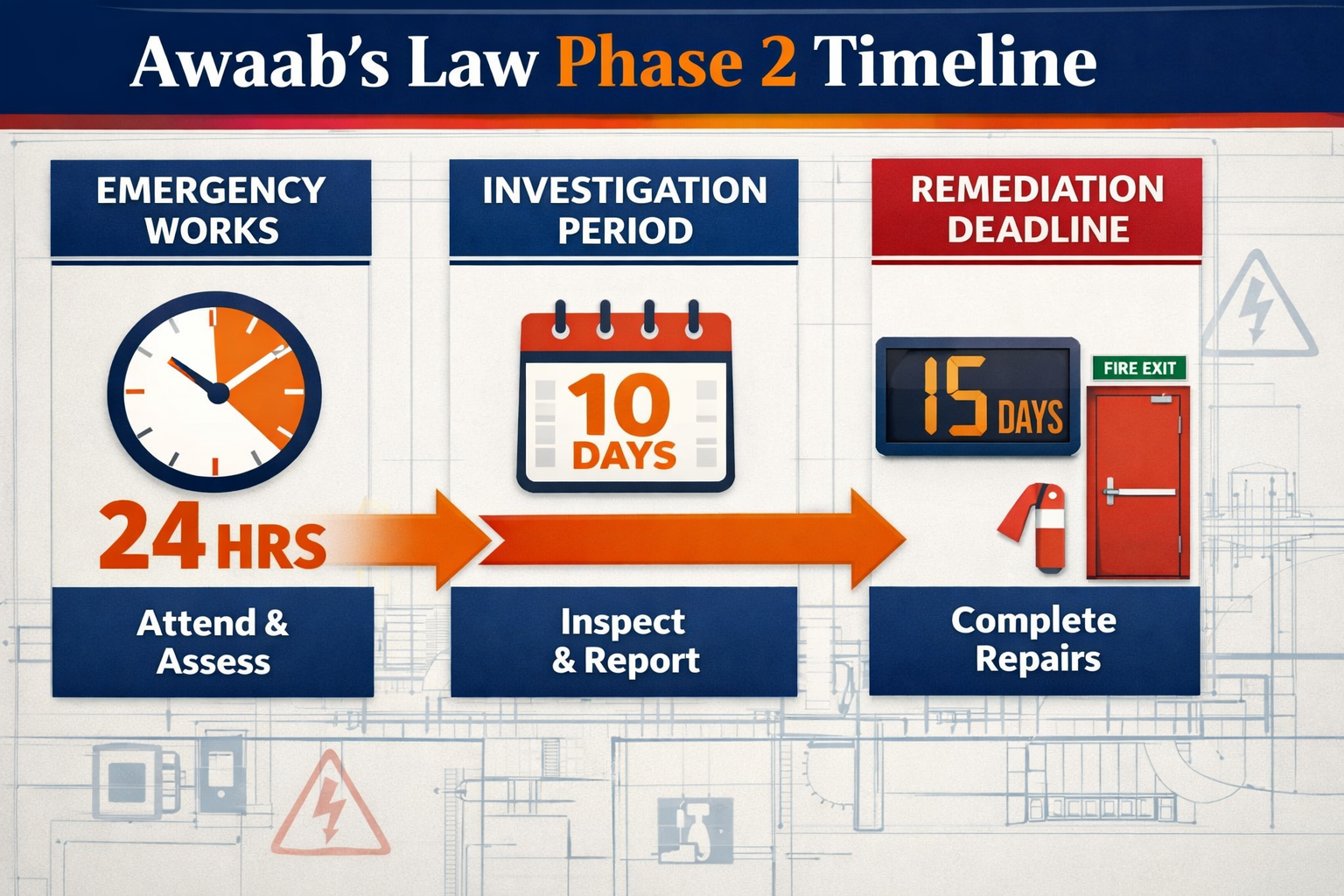
The legislation establishes strict investigation and remediation timelines that directly impact building survey protocols:
| Stage | Timeline | Requirements |
|---|---|---|
| Emergency works | 24 hours | Immediate investigation and remedy |
| Hazard investigation | 10 working days | Complete assessment of reported hazard |
| Written summary | 3 working days | Provide investigation findings to tenant |
| Remedial works commencement | 5 working days | Begin safety improvements after investigation |
| Fire/electrical remediation | 15 days | Complete all fire and electrical hazard fixes [2][3] |
This 15-day remediation window for fire hazards represents the most aggressive timeline in the legislation, reflecting the immediate life-safety implications of fire safety deficiencies.
Enforcement and Penalties
Social landlords face substantial consequences for non-compliance:
- Enforcement orders from local housing authorities
- Tenant compensation payments for distress and inconvenience
- Covering tenant legal costs in enforcement proceedings
- Rent suspension if properties become uninhabitable
- Reputational damage affecting tenant recruitment and retention [3]
For building surveyors conducting RICS building surveys, these enforcement mechanisms create a professional obligation to identify fire hazards with precision and document them according to expert witness standards.
Fire Hazard Assessment Protocols in Level 3 Building Surveys
The integration of fire hazard assessments into comprehensive building surveys requires systematic protocols that meet both professional standards and regulatory compliance requirements. Fire Hazard Assessments in Building Surveys Post-Awaab's Law 2026: PRS Compliance Essentials demand a structured approach to inspection, documentation, and risk evaluation.
Fire Door Inspection Framework
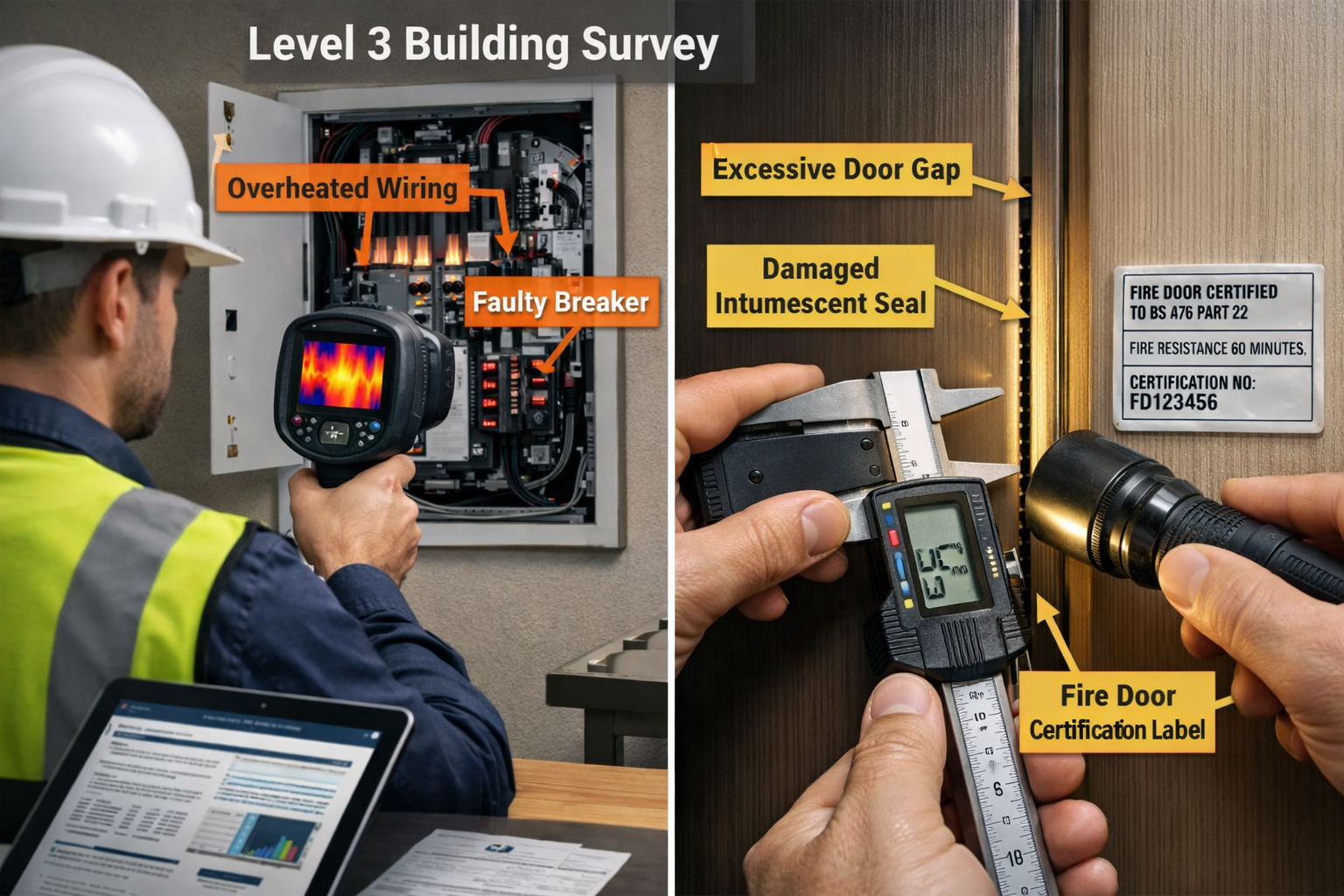
Fire doors represent the most common fire hazard identified in building surveys, with deficiencies ranging from improper installation to deteriorated seals and non-compliant hardware. Surveyors must assess:
Physical integrity checks:
- Door leaf thickness and material composition
- Frame condition and fixing adequacy
- Glazing panels and vision panels compliance with fire rating
- Intumescent strip condition and placement
- Smoke seal integrity and continuity
- Gap measurements (maximum 4mm around door perimeter, 8mm at threshold)
Hardware verification:
- Self-closing mechanism functionality and adjustment
- Latch engagement and strike plate alignment
- Hinge quantity (minimum three per door) and condition
- Lock and panic hardware operation
- Signage presence and visibility [1]
Certification documentation:
- Fire rating certification (FD30, FD60, FD90 designations)
- Manufacturer specifications and installation records
- EN standard compliance verification (BS 476-22 phased out by September 2029) [2]
- Maintenance history and previous inspection reports
Electrical System Assessment
Electrical hazards require specialized assessment techniques that often necessitate collaboration with qualified electricians. Building surveyors should document:
- Consumer unit condition: Age, capacity, RCD protection, labeling adequacy
- Visible wiring defects: Exposed cables, damaged insulation, improper junction boxes
- Socket and switch condition: Cracked faceplates, loose connections, signs of overheating
- Fixed appliance safety: Boiler electrical connections, immersion heaters, extractor fans
- Electrical Installation Condition Report (EICR) status: Date of last inspection, outstanding recommendations, code C1/C2 defects [4]
Advanced Level 3 surveys now incorporate real-time sensor technology to detect electrical faults and thermal anomalies before they escalate to hazards [5].
Fire Escape Route Evaluation
Escape route assessments examine both physical infrastructure and practical usability:
Route adequacy:
- Travel distances to nearest exit (maximum 18m for flats, 45m for other properties)
- Corridor and stairwell widths meeting building regulation minimums
- Alternative escape routes where required
- Emergency lighting provision and functionality
Obstruction identification:
- Stored items blocking escape paths
- Locked or difficult-to-operate exit doors
- Inadequate signage or wayfinding
- Combustible materials in escape routes [1]
Smoke and Heat Detection Systems
Modern fire safety requires comprehensive detection coverage:
- Smoke alarm quantity and placement (minimum one per floor, additional coverage in hallways)
- Heat detector installation in kitchens and garages
- Interconnection between alarms (wired or wireless)
- Power source verification (mains-powered with battery backup preferred)
- Testing records and battery replacement schedules
- Grade of system (Grade D minimum for rental properties) [4]
Thermal Imaging and Advanced Detection
Incorporating thermal imaging technology into building surveys enables proactive identification of fire risks:
- Electrical hotspots: Overheating circuits, loose connections, overloaded systems
- Insulation deficiencies: Thermal bridging creating excess heat conditions
- Hidden moisture: Water ingress that may compromise fire-rated materials
- Structural anomalies: Voids and cavities affecting fire compartmentation [5]
This technology-enhanced approach aligns with the expert witness standards now expected in litigation involving fire hazard compliance [4].
Remediation Costing and Valuation Impact Analysis
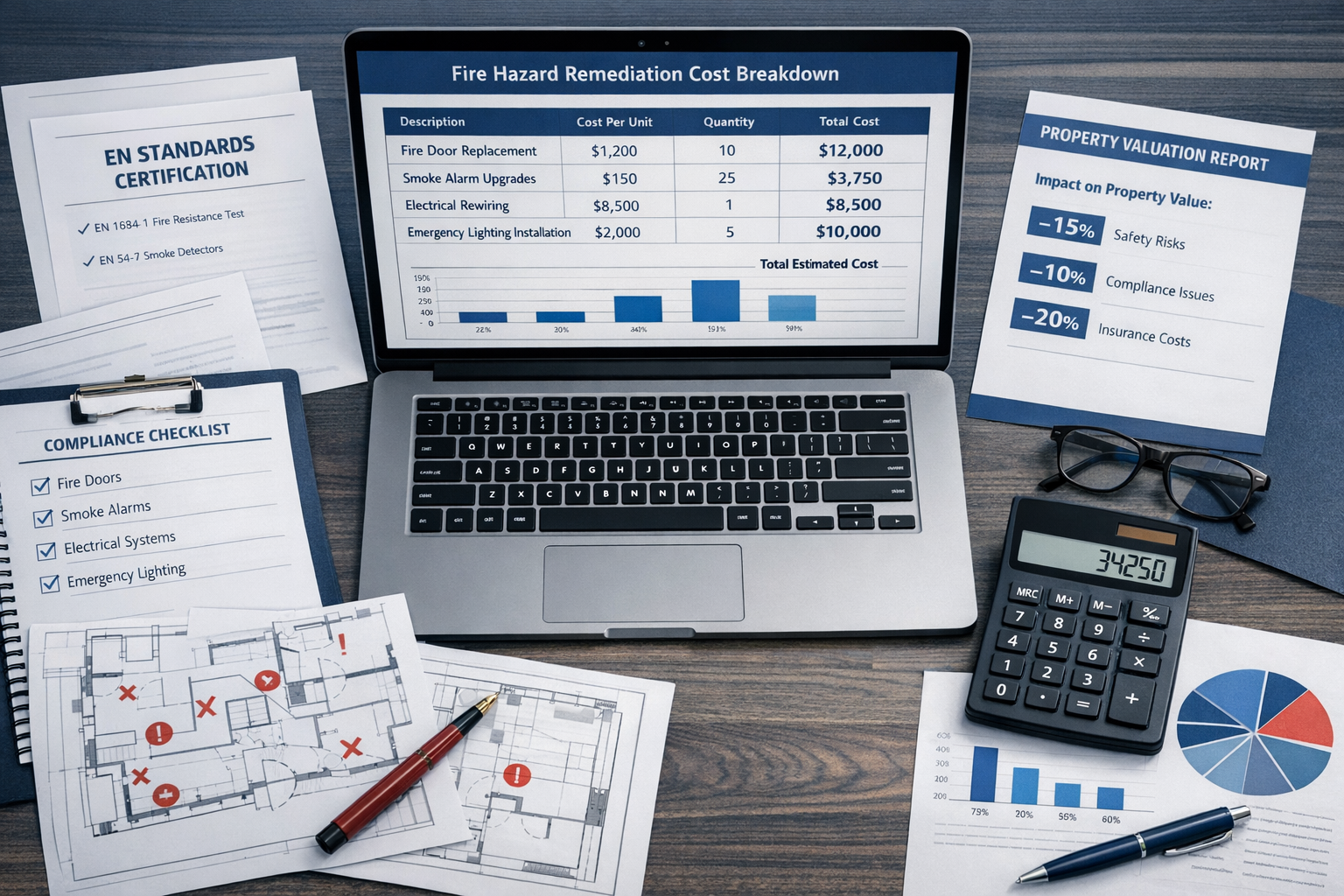
Understanding the financial implications of fire hazard remediation is essential for Fire Hazard Assessments in Building Surveys Post-Awaab's Law 2026: PRS Compliance Essentials. Building surveyors must provide landlords with accurate cost projections and valuation impacts to inform compliance decisions and property negotiations.
Fire Door Replacement Costs
Fire door remediation represents one of the most common and substantial expenses:
| Fire Door Type | Supply Cost | Installation Cost | Total Per Door |
|---|---|---|---|
| FD30 (30-minute rating) | £200-£350 | £150-£250 | £350-£600 |
| FD60 (60-minute rating) | £350-£550 | £200-£300 | £550-£850 |
| FD90 (90-minute rating) | £500-£750 | £250-£350 | £750-£1,100 |
| Communal entrance doors | £800-£1,500 | £300-£500 | £1,100-£2,000 |
Additional considerations:
- Frame replacement (if existing frame non-compliant): £100-£200 per door
- Architectural ironmongery upgrades: £50-£150 per door
- Certification and testing: £75-£150 per installation
- Access equipment for high-level doors: £200-£500 per property
For a typical multi-unit property requiring 10 fire door replacements, total costs range from £3,500 to £8,500, with communal area upgrades potentially adding £2,000-£4,000 [1].
Electrical System Remediation
Electrical hazard remediation costs vary significantly based on installation age and defect severity:
Minor remediation (code C2 defects):
- Consumer unit replacement: £400-£800
- Socket and switch replacement: £30-£60 per unit
- Minor rewiring (single circuit): £200-£500
- RCD protection addition: £150-£300
Major remediation (code C1 defects or full rewire):
- Full property rewire (2-bed flat): £3,000-£5,000
- Full property rewire (3-bed house): £4,500-£7,500
- Emergency lighting installation: £500-£1,500
- Fire alarm system upgrade: £800-£2,500 [4]
Smoke Alarm and Detection System Costs
Compliance with current detection standards requires:
- Mains-powered smoke alarms: £40-£80 per unit
- Heat detectors: £30-£60 per unit
- Carbon monoxide alarms: £25-£50 per unit
- Interconnected system installation: £500-£1,200 (whole property)
- Grade A system (addressable): £2,000-£5,000 (multi-unit buildings)
- Annual maintenance contracts: £100-£300 per property [1]
Escape Route Improvements
Physical modifications to escape routes can involve substantial structural work:
- Emergency lighting installation: £150-£300 per luminaire
- Fire-rated signage: £20-£50 per sign
- Door hardware upgrades (panic bars, emergency releases): £200-£500 per door
- Corridor width modifications: £5,000-£15,000 (structural alterations)
- Additional fire escape construction: £20,000-£50,000+ (major works)
Valuation Impact Assessment
Fire hazards identified in building surveys create measurable impacts on property values and rental income:
Immediate devaluation factors:
- Properties with unresolved code C1 electrical defects: 5-10% value reduction
- Non-compliant fire doors in multi-unit buildings: 3-7% value reduction
- Inadequate escape routes requiring structural modification: 10-15% value reduction
- Properties subject to enforcement orders: 15-25% value reduction [1]
Rental income disruption:
- Average remediation period for fire hazards: 2-6 weeks
- Lost rental income during works: £800-£2,500 per unit
- Tenant relocation costs: £500-£1,500 per household
- Void period extension: 4-8 weeks additional marketing time
Long-term investment implications:
- Insurance premium increases: 15-30% for properties with fire safety history
- Mortgage availability restrictions for non-compliant properties
- Reduced investor demand affecting exit strategies
- Reputational damage affecting tenant quality and retention [4]
For landlords considering property renovations, proactive fire safety upgrades can enhance property values by 3-5% while ensuring compliance and reducing insurance costs.
EN Standard Transition and Documentation Requirements
The transition from British Standards (BS 476) to European Norms (EN standards) for fire-rated products represents a critical compliance shift affecting Fire Hazard Assessments in Building Surveys Post-Awaab's Law 2026: PRS Compliance Essentials.
BS 476-22 Phase-Out Timeline
All national standards for fire protection performance have been removed from building regulations, with a five-year coexistence period ending September 2, 2029 [2]. After this deadline:
- Fire-rated doors must be tested exclusively to EN 1634-1 standards
- Fire protection performance must reference EN 13501-2 classification
- Existing BS 476-22 certified products remain compliant until replacement
- New installations and replacements must use EN-certified products
Surveyor implications:
- Document existing fire door certification standards in survey reports
- Flag BS 476-22 doors approaching end-of-life for replacement planning
- Verify EN standard compliance for recent installations
- Advise clients on transition planning to avoid last-minute compliance issues [2]
PAS 2000 Construction Products Code
The PAS 2000 code of practice establishes comprehensive requirements for construction products entering the market, including fire-rated materials [2]:
Pre-market risk assessment:
- Product testing and certification verification
- Performance consistency evaluation
- Installation requirement specification
- End-of-life considerations
Factory production control:
- Manufacturing process documentation
- Quality assurance protocols
- Batch testing and traceability
- Non-conformity procedures
Product documentation:
- Technical specifications and performance data
- Installation instructions and limitations
- Maintenance requirements and schedules
- Certification and compliance declarations
Product recall processes:
- Defect identification and reporting mechanisms
- Customer notification procedures
- Remediation and replacement protocols
- Regulatory authority coordination
Building surveyors must verify that fire-rated products installed in properties meet PAS 2000 requirements, particularly for installations completed after 2026 [1].
Personal Emergency Evacuation Plans (PEEPs)
The Fire Safety (Residential Evacuation Plans) Regulations 2025 took effect on April 6, 2026, requiring person-centered fire risk assessments for disabled and vulnerable residents [3]:
Responsible person obligations:
- Identify residents requiring PEEPs through conversation and assessment
- Conduct person-centered fire risk assessments understanding individual needs
- Develop written emergency evacuation statements
- Review and update PEEPs regularly (minimum annually)
- Coordinate with emergency services and building management
Building survey integration:
- Document accessibility features affecting evacuation (lifts, refuge areas, evacuation chairs)
- Assess escape route suitability for mobility-impaired residents
- Identify communication systems for hearing or vision-impaired residents
- Evaluate alarm systems for adequate notification of vulnerable residents [3]
For properties housing vulnerable tenants, surveyors should recommend PEEP-compatible infrastructure improvements during comprehensive building surveys.
Expert Witness Standards and Defect Documentation
The expansion of Awaab's Law to include fire hazards elevates the professional standards expected of building surveyors, particularly when survey findings become the basis for enforcement proceedings or tenant litigation.
Documentation Protocols for Fire Hazards
Fire Hazard Assessments in Building Surveys Post-Awaab's Law 2026: PRS Compliance Essentials require meticulous documentation meeting expert witness standards [4]:
Photographic evidence requirements:
- Multiple angles showing defect context and severity
- Close-up images of specific deficiencies (gaps, damage, missing components)
- Measurement verification using scales or measuring tools in frame
- Certification label documentation showing ratings and standards
- Date and location metadata embedded in image files
Written defect descriptions:
- Precise location identification (floor, room, door reference)
- Detailed defect characterization using technical terminology
- Severity classification aligned with HHSRS categories
- Immediate risk assessment (life safety, property damage, compliance breach)
- Remediation recommendations with priority rankings
Technical measurements:
- Door gap measurements at multiple points (top, sides, threshold)
- Travel distances to exits from furthest points
- Smoke alarm spacing and coverage calculations
- Electrical circuit loading assessments
- Thermal imaging data with temperature differentials [1][4]
Chain of Evidence Considerations
When building surveys may support enforcement actions or tenant claims:
- Timestamp verification: Use calibrated equipment with accurate date/time stamps
- Witness statements: Document conversations with tenants reporting hazards
- Access records: Maintain logs of inspection dates, attendees, and conditions
- Sampling protocols: Follow consistent methodologies for representative assessments
- Data preservation: Secure storage of original files, measurements, and observations [4]
Expert Witness Testimony Preparation
Surveyors may be called to testify regarding fire hazard assessments in enforcement proceedings:
Report preparation:
- Executive summary highlighting critical findings
- Methodology section explaining inspection approach
- Findings section with structured defect documentation
- Opinion section with professional conclusions
- Appendices with supporting evidence and calculations [4]
Testimony readiness:
- Familiarity with HHSRS assessment methodology
- Understanding of Awaab's Law timelines and requirements
- Knowledge of EN standards and fire safety regulations
- Ability to explain technical findings in accessible language
- Professional indemnity insurance adequate for expert witness work
For surveyors conducting rental property inspections, maintaining expert witness-grade documentation has become standard practice rather than an exceptional requirement.
Proactive Compliance Strategies for PRS Landlords
Landlords who approach fire safety compliance proactively rather than reactively gain significant advantages in risk management, cost control, and tenant relations.
Pre-Acquisition Fire Hazard Assessments
Before purchasing rental properties, commissioning comprehensive fire hazard assessments provides:
- Negotiation leverage: Identified defects support price reduction requests
- Budget accuracy: Remediation cost projections inform investment analysis
- Timeline planning: Understanding compliance requirements before completion
- Insurance clarity: Pre-disclosure of fire safety status to insurers
- Exit strategy protection: Ensuring resale value isn't compromised by hidden defects
Buyers should specifically request fire hazard assessments as part of Level 2 or Level 3 surveys when acquiring PRS properties.
Annual Fire Safety Audits
Implementing annual fire safety audits creates a compliance framework that prevents hazards from developing:
Audit components:
- Fire door condition surveys with gap measurements
- Electrical installation visual inspections (supplementing 5-year EICRs)
- Smoke alarm functionality testing and battery replacement
- Escape route obstruction checks
- Fire risk assessment updates
- Tenant fire safety awareness verification [1]
Documentation systems:
- Digital audit trails with timestamped photographs
- Defect tracking databases with remediation status
- Compliance certificates and test records
- Maintenance schedules and completion logs
- Tenant communication records [4]
Technology-Enhanced Monitoring
Advanced monitoring systems provide continuous fire safety assurance:
- Connected smoke alarms: Real-time alerts to landlords and property managers when alarms activate
- Thermal monitoring sensors: Continuous electrical system temperature monitoring with anomaly alerts
- IoT door sensors: Monitoring fire door closure and latch engagement
- Predictive maintenance systems: AI-driven analysis identifying developing hazards before they become critical [5]
These systems align with the proactive hazard identification approach encouraged by Awaab's Law's rapid remediation timelines.
Tenant Communication Protocols
Effective tenant communication creates early warning systems for fire hazards:
Move-in procedures:
- Fire safety orientation including escape routes and alarm locations
- Written fire safety information packs
- Demonstration of fire door operation and importance
- Contact procedures for reporting fire safety concerns
- PEEP assessments for vulnerable residents [3]
Ongoing engagement:
- Quarterly fire safety reminders via email or text
- Annual tenant satisfaction surveys including safety questions
- Responsive hazard reporting systems with acknowledgment protocols
- Transparent communication about scheduled safety inspections
- Feedback mechanisms after remediation works [1]
Insurance and Risk Management
Fire safety compliance directly impacts insurance coverage and premiums:
Disclosure requirements:
- Pre-policy fire hazard assessment results
- Outstanding remediation work timelines
- Previous fire safety enforcement history
- Tenant vulnerability assessments for PEEP compliance
Premium optimization:
- Demonstrate proactive compliance programs for premium reductions
- Document fire safety investments for underwriter review
- Maintain continuous coverage during remediation periods
- Consider specialist PRS insurance products with compliance support [4]
Phase 3 Preparation and Future Compliance Landscape
While Phase 2 of Awaab's Law addresses fire and electrical hazards in 2026, Phase 3 implementation expected in 2027 will extend to all remaining significant hazards under HHSRS (excluding overcrowding) [3].
Anticipated Phase 3 Hazard Categories
Building surveyors should prepare assessment protocols for:
- Entry by intruders: Security deficiencies enabling unauthorized access
- Lighting deficiencies: Inadequate natural or artificial lighting affecting safety
- Noise: Excessive noise transmission affecting health and wellbeing
- Domestic hygiene, pests, and refuse: Sanitation and pest control failures
- Food safety: Kitchen facilities inadequate for safe food preparation
- Personal hygiene, sanitation, and drainage: Bathroom and plumbing deficiencies
- Water supply: Inadequate or contaminated water provision
- Falls on level surfaces: Trip hazards and surface defects
- Collision and entrapment: Hazardous building features
- Explosions: Gas safety and ventilation issues
- Position and operability of amenities: Accessibility and usability of facilities
- Uncombusted fuel gas: Carbon monoxide and gas leak risks
- Hot surfaces and materials: Burn hazards from heating systems
- Asbestos and MMF: Presence of hazardous materials
- Biocides: Exposure to harmful chemicals
- Carbon monoxide and fuel combustion products: Inadequate ventilation
- Lead: Lead paint or plumbing hazards
- Radiation: Radon gas or other radiation sources
- Volatile organic compounds: Chemical exposure from materials [3]
Integrated Hazard Assessment Frameworks
The comprehensive scope of Phase 3 necessitates integrated assessment frameworks that address all hazard categories systematically:
Multi-disciplinary survey teams:
- Building surveyors for structural and fabric assessments
- Electrical engineers for electrical system evaluation
- Mechanical engineers for heating and ventilation systems
- Environmental specialists for contamination and air quality
- Security consultants for intruder prevention measures [1]
Technology integration:
- Multi-parameter sensors detecting thermal, air quality, and moisture conditions
- Digital survey platforms with HHSRS hazard scoring algorithms
- Automated compliance reporting against Awaab's Law timelines
- Predictive analytics identifying developing hazards across portfolios [5]
Legislative Developments to Monitor
The fire safety regulatory landscape continues evolving:
- Building Safety Act implementation: Ongoing phases affecting high-rise and complex buildings
- Fire Safety Act enforcement: Enhanced fire risk assessment requirements for multi-occupied residential buildings
- Electrical safety regulations: Potential expansion of 5-year EICR requirements to all PRS properties
- Energy efficiency mandates: Interaction between thermal performance improvements and fire safety
- Smoke and carbon monoxide alarm regulations: Potential strengthening of detection requirements [2][3]
Surveyors should maintain continuous professional development in fire safety compliance to remain current with regulatory changes.
Conclusion
Fire Hazard Assessments in Building Surveys Post-Awaab's Law 2026: PRS Compliance Essentials represent a fundamental shift in how building surveyors approach fire safety in rental properties. The 15-day remediation deadline for fire and electrical hazards demands proactive identification, precise documentation, and rapid response protocols that protect both landlord interests and tenant safety.
Key Action Steps for Landlords
✅ Commission comprehensive fire hazard assessments as part of Level 3 building surveys for all PRS properties
✅ Implement annual fire safety audits with documented inspection protocols and remediation tracking
✅ Verify EN standard compliance for all fire-rated products, planning for BS 476-22 phase-out by 2029
✅ Develop PEEP frameworks for properties housing vulnerable or disabled tenants
✅ Establish tenant communication systems enabling rapid hazard reporting and transparent remediation updates
✅ Budget for remediation costs based on realistic assessment of fire door replacement, electrical upgrades, and detection system improvements
✅ Engage qualified surveyors capable of expert witness-grade documentation meeting enforcement proceeding standards
Key Action Steps for Building Surveyors
✅ Develop systematic fire hazard assessment protocols incorporating thermal imaging, gap measurements, and certification verification
✅ Maintain expert witness-grade documentation with comprehensive photographic evidence, technical measurements, and detailed defect descriptions
✅ Stay current with EN standards transition and PAS 2000 construction product requirements
✅ Integrate PEEP considerations into building survey recommendations for properties with vulnerable residents
✅ Provide accurate remediation costing enabling landlords to make informed compliance and investment decisions
✅ Prepare for Phase 3 expansion by developing multi-disciplinary assessment frameworks addressing all HHSRS hazard categories
The intersection of fire safety regulation, building survey practice, and PRS compliance creates both challenges and opportunities for property professionals. Those who embrace comprehensive fire hazard assessment as a core competency will protect clients from enforcement actions while contributing to genuinely safer rental housing.
For landlords and surveyors navigating these complex requirements, partnering with experienced chartered surveyors who understand both technical fire safety standards and Awaab's Law compliance frameworks is essential. The investment in thorough fire hazard assessments today prevents costly enforcement actions, protects property values, and most importantly, ensures tenant safety in an increasingly regulated PRS landscape.
References
[1] Building Survey Defect Documentation Under Awaabs Law 2026 Fire Electrical And Structural Hazard Protocols For Prs Properties – nottinghillsurveyors.com
[2] The Key Changes In 2026 That You Need To Be Aware Of – selo.global
[3] Awaabs Law Comes Into Force What Does It Mean For Construction – trowers.com
[4] Expert Witness Preparation For Awaabs Law 2026 Expansions Testifying On New Rental Hazards Like Fire And Electrical Risks – nottinghillsurveyors.com
[5] Real Time Sensors In Level 3 Building Surveys Detecting Awaabs Law Hazards Before 2026 Mandates Hit Rentals – nottinghillsurveyors.com
How Prince Surveyors can help: explore our Level 3 building surveys or learn about our Level 2 vs Level 3 guide.