

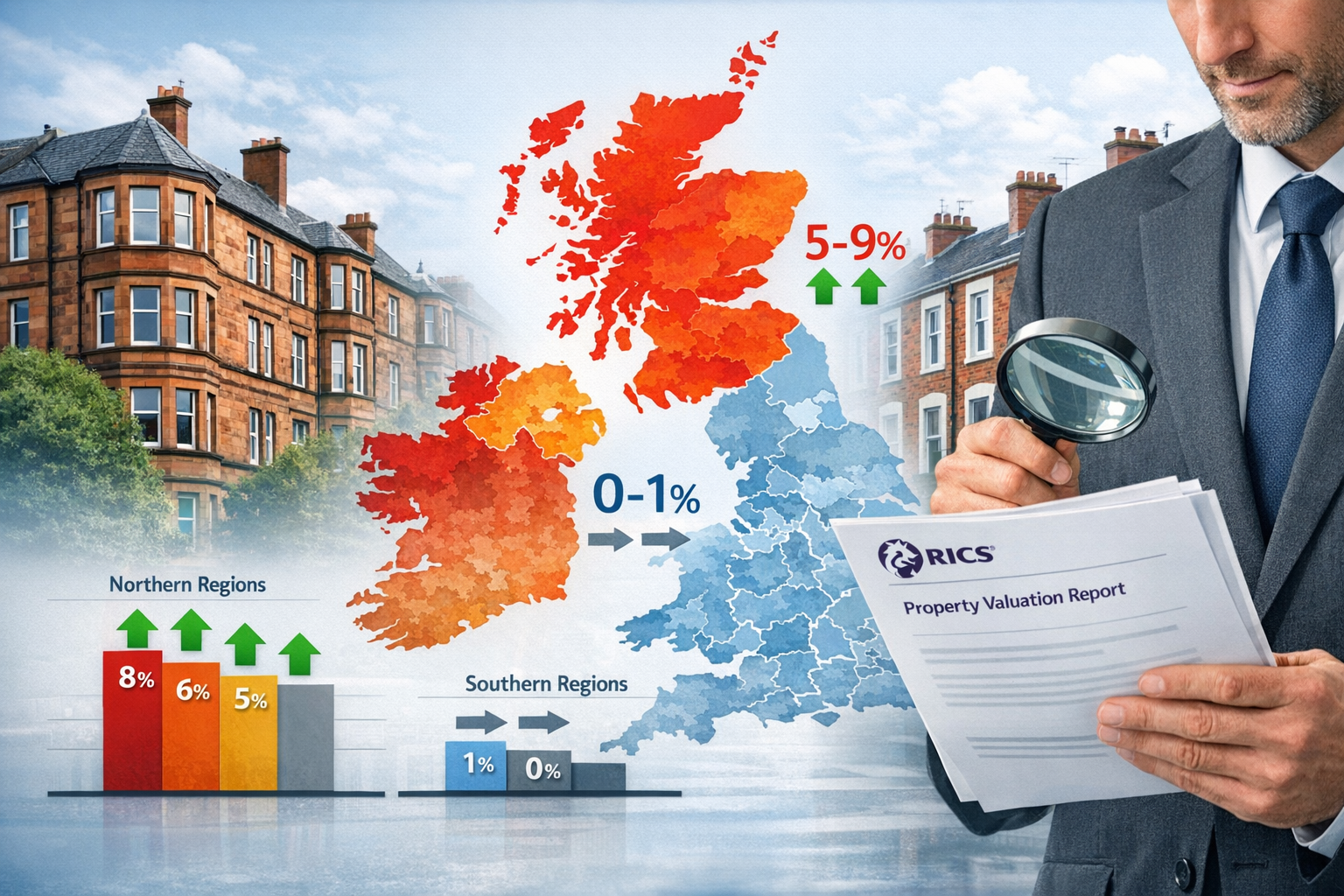
The UK property market in 2026 presents a striking paradox: while Scotland and Northern Ireland record robust annual growth rates of 5.4% and 5.9% respectively, London and the South East languish with minimal gains of just 0.1% [3]. This dramatic regional divergence creates significant challenges for expert witnesses defending property valuations that appear inconsistent across geographic boundaries. When northern markets outpace traditional southern strongholds, Expert Witness Valuations in Regional Price Divergence: Defending Assessments When Scotland and Northern Ireland Outpace Southern Markets require sophisticated frameworks grounded in genuine market dynamics rather than historical assumptions.

Key Takeaways
- 🏴 Scotland and Northern Ireland lead UK price growth with annual increases of 5.4% and 5.9% respectively, while southern markets record near-zero growth
- 📊 Regional divergence demands evidence-based defense strategies that document local market fundamentals, affordability advantages, and economic drivers
- ⚖️ Expert witnesses must defend assessments using robust comparable evidence, market trend analysis, and clear methodology that explains apparent inconsistencies
- 💼 Professional valuation standards require detailed documentation of regional factors including employment growth, housing supply constraints, and buyer demographics
- 📈 Future price expectations remain strong in northern regions, with 55% of Scottish respondents anticipating higher prices over the coming year
Understanding Regional Price Divergence in 2026
The North-South Divide Intensifies
The UK property market has witnessed a fundamental shift in 2026, with traditional geographic price hierarchies being challenged by emerging regional dynamics. Northern Ireland now leads the nation with average property prices reaching £217,206, reflecting a 5.9% annual increase [4]. Scotland follows closely with average prices of £221,711 and 5.4% annual growth [3]. This contrasts sharply with the East and South East of England, which recorded only 0.1% year-on-year growth during the same period [3].
This divergence extends beyond simple percentage comparisons. In Scotland, the house price balance reached 42% net positive among RICS surveyors reporting rising prices over the past three months—the strongest reading in nearly a year [5]. Meanwhile, 23% of Scottish respondents anticipate price rises in the next three months, with 55% expecting higher prices over the coming year [5].
Regional Performance Variations
Within these broader trends, specific localities demonstrate exceptional performance:
| Region | Annual Growth Rate | Key Driver |
|---|---|---|
| Derry City and Strabane | 13.0% | Strong local demand |
| Mid Ulster | 11.2% | Employment growth |
| Ards and North Down | 8.6% | Coastal premium |
| Motherwell | 4%+ | Affordability advantage |
| Glasgow | 3-4% | Economic diversification |
| Edinburgh | 2-3% | Professional employment |
These variations reflect localized supply-demand imbalances, employment opportunities, and relative affordability compared to southern alternatives [6]. For commercial valuations, the divergence extends to non-domestic properties, with Northern Ireland recording a 15% overall increase in non-domestic property values since the last revaluation [2].
Economic Fundamentals Driving Northern Growth
The sustained outperformance of Scotland and Northern Ireland stems from several converging factors:
Affordability Advantages: Lower entry prices in northern regions create broader buyer participation compared with southern markets where affordability remains stretched [1]. This fundamental advantage attracts first-time buyers, investors, and relocating professionals seeking better value.
Employment and Economic Growth: Regional economic development, particularly in technology, financial services, and renewable energy sectors, supports sustained housing demand. Belfast, Glasgow, and Edinburgh have emerged as significant employment hubs beyond London's traditional dominance.
Housing Supply Constraints: Limited new construction in desirable northern locations creates supply-demand imbalances that support price growth. Northern Ireland recorded 5,512 properties sale agreed in Q4 2025, only 3% lower than Q4 2024, demonstrating sustained transaction volumes [4].
Rental Market Strength: Average Northern Ireland rents reached £995 in Q4 2025, up 5.6% annually, demonstrating sustained rental demand that supports property valuations [4]. This rental growth provides additional validation for capital value assessments.
Expert Witness Valuations in Regional Price Divergence: Building Defensible Assessments
Establishing Methodological Rigor
When defending valuations in markets experiencing regional divergence, expert witnesses must establish unimpeachable methodological foundations. The RICS Valuation – Global Standards (Red Book) provides the framework, but application requires careful adaptation to regional contexts.
Comparable Evidence Selection: The cornerstone of defensible valuations lies in appropriate comparable selection. Expert witnesses must demonstrate:
- Geographic relevance: Comparables drawn from the same regional market, acknowledging that Scottish comparables may show stronger growth than London equivalents
- Temporal proximity: Recent transactions reflecting current market conditions rather than historical patterns
- Property characteristics: Matching property types, conditions, and features to ensure like-for-like comparison
- Transaction verification: Confirmed sale prices from reliable sources including Land Registry data
For properties in Scotland and Northern Ireland, expert witnesses should document the 42% net positive price balance among RICS surveyors [5] and the 5.9% annual growth rate [4] as market context supporting their assessments.
Addressing Cross-Regional Challenges
Expert witnesses frequently face challenges when valuations in northern markets exceed expectations based on southern benchmarks. Defending these assessments requires clear articulation of regional market dynamics:
Market Trend Analysis: Present comprehensive data showing sustained northern outperformance. Reference the fact that Scotland expects 55% of respondents to anticipate higher prices over the coming year [5], demonstrating forward-looking market confidence rather than temporary anomalies.
Affordability Metrics: Calculate and present affordability ratios showing that northern properties remain accessible despite price growth, while southern markets face affordability constraints limiting further appreciation.
Economic Indicators: Document regional employment growth, wage trends, and economic diversification supporting sustained housing demand. For matrimonial valuations or contentious matters, this economic context proves particularly valuable.
Documentation Standards for Regional Divergence
Professional documentation becomes critical when valuations appear inconsistent with traditional geographic hierarchies. Expert witnesses should maintain:
✅ Comprehensive market research files documenting regional price trends, transaction volumes, and market sentiment indicators
✅ Detailed comparable analysis schedules showing adjustments for location, property characteristics, and market conditions
✅ Regional economic data supporting demand fundamentals including employment statistics, population trends, and infrastructure investment
✅ Professional judgment rationale explaining how regional factors influenced valuation conclusions
✅ Alternative valuation scenarios demonstrating sensitivity to different assumptions and market conditions
This documentation proves essential when cross-examined on valuations that diverge from southern market norms. Expert witnesses must demonstrate that assessments reflect genuine market evidence rather than personal bias or inadequate analysis.
Defending Assessments: Strategies for Expert Witnesses in Divergent Markets

Anticipating Common Challenges
Expert witnesses defending valuations in outperforming northern markets should anticipate several common challenges:
"Historical Precedent" Arguments: Opposing counsel may argue that northern markets have historically underperformed, questioning why current assessments reflect premium values. Counter this by presenting data showing the 5.4% Scottish growth and 5.9% Northern Ireland growth [3][4], demonstrating that market conditions have fundamentally shifted.
"London-Centric" Comparisons: Challenges may arise when valuations in Glasgow or Belfast approach or exceed certain London suburb values. Address this by presenting affordability-adjusted metrics showing that northern properties offer superior value propositions, supported by the fact that lower entry prices create broader buyer participation [1].
"Temporary Anomaly" Claims: Opposition may suggest that northern outperformance represents temporary market distortion. Refute this by documenting sustained trends, including the fact that 55% of Scottish respondents expect higher prices over the coming year [5], indicating market confidence in continued growth.
Presenting Regional Context Effectively
Effective expert witness testimony requires clear communication of complex regional dynamics to legal professionals and tribunals unfamiliar with property market nuances:
Visual Presentation: Utilize charts, maps, and graphs showing regional price trends, transaction volumes, and market indicators. Visual evidence of the north-south divide proves more persuasive than statistical tables alone.
Plain Language Explanations: Avoid technical jargon when explaining why Derry City and Strabane recorded 13.0% growth while the South East recorded 0.1% [3][6]. Frame explanations in terms of supply, demand, and affordability that non-specialists can readily understand.
Comparable Evidence Hierarchy: Present comparable evidence in clear hierarchical order, explaining why certain transactions carry greater weight. For instance, a recent sale in the immediate locality outweighs a higher-value transaction in a different regional market.
Professional Credentials: Establish credibility by referencing RICS membership, relevant qualifications, and experience with professional valuation services. This foundation supports the technical content that follows.
Handling Cross-Examination
Cross-examination represents the critical test of valuation defensibility. Expert witnesses should prepare for:
Comparable Challenge Questions: Be prepared to defend every comparable selected, explaining why each transaction provides relevant market evidence. If challenged on a comparable's relevance, have alternative comparables available demonstrating consistent value conclusions.
Methodology Scrutiny: Expect detailed questioning about valuation methodology, adjustment factors, and professional judgment. Maintain consistency with RICS standards and document all methodological choices in advance.
Alternative Valuation Approaches: Anticipate questions about alternative valuation methods (income approach, cost approach) and be prepared to explain why the chosen methodology proves most appropriate for the subject property and market conditions.
Regional Expertise Verification: Demonstrate specific knowledge of the regional market, including recent transactions, market trends, and local economic conditions. Generic knowledge proves insufficient when defending assessments in rapidly evolving markets.
Leveraging Professional Standards
The RICS Valuation – Global Standards provide essential support for expert witnesses defending regional valuations:
Red Book Compliance: Demonstrate full compliance with Red Book requirements including basis of value, assumptions, special assumptions, and reporting standards. This compliance establishes professional credibility that supports substantive valuation conclusions.
Professional Judgment Framework: Reference Red Book guidance on professional judgment, explaining how regional market analysis informed specific valuation decisions. Professional judgment, properly documented and explained, provides legitimate basis for valuations that diverge from historical patterns.
Market Evidence Requirements: Emphasize Red Book requirements for market evidence, demonstrating that assessments reflect actual market transactions rather than theoretical models. The 5,512 properties sale agreed in Northern Ireland during Q4 2025 [4] provide substantial market evidence supporting valuations.
Uncertainty and Sensitivity: Where appropriate, acknowledge market uncertainty while maintaining valuation conclusions. Present sensitivity analysis showing how alternative assumptions affect value conclusions, demonstrating thoroughness rather than undermining credibility.
Specific Considerations for Different Valuation Purposes
Regional divergence creates unique challenges depending on valuation purpose:
Matrimonial Matters: When defending matrimonial valuations, explain how regional market strength affects both parties' interests. A property in Glasgow appreciating 4% annually provides different financial outcomes than a London property appreciating 0.1%.
Leasehold Matters: For leasehold extension and enfranchisement valuations, regional price growth directly affects marriage value calculations. Document how Scottish and Northern Irish growth rates of 5.4% and 5.9% [3][4] impact future value projections.
Insurance Purposes: Insurance reinstatement cost valuations must reflect regional construction cost variations. Northern markets may show different rebuild cost trajectories than southern equivalents.
Commercial Property: Non-domestic valuations face additional complexity, with Northern Ireland recording 15% overall increases in non-domestic property values, including 9% for offices and 9% for retail [2]. These figures support commercial assessments that may surprise clients expecting southern market patterns.
Regional Market Dynamics: Key Evidence Points for 2026
Scotland's Market Strength Indicators
Expert witnesses defending Scottish valuations should reference specific market indicators:
- 42% net positive price balance among RICS surveyors—the strongest reading in nearly a year [5]
- 23% of respondents anticipating price rises in the next three months [5]
- 55% expecting higher prices over the coming year [5]
- Rising enquiries and listings contrasting broader UK stagnation [5]
- Average prices of £221,711 representing 5.4% annual growth [3]
These indicators demonstrate sustained market momentum supporting current valuations and positive future expectations.
Northern Ireland's Performance Metrics
Northern Ireland valuations gain support from:
- 5.9% annual growth rate leading the UK [4]
- Average property prices of £217,206 [4]
- Apartment prices rising 7% annually [4]
- New homes averaging £267,000 (up 5.2% year-on-year) [4]
- 5,512 properties sale agreed in Q4 2025, only 3% below prior year [4]
- Average rents of £995, up 5.6% annually [4]
- 15% increase in non-domestic property values overall [2]
Strong performance across Derry City and Strabane (13.0%), Mid Ulster (11.2%), and Ards and North Down (8.6%) [6] provides additional evidence of broad-based regional strength.
Comparative Southern Market Weakness
Contextualizing northern strength requires acknowledging southern weakness:
- East and South East recording only 0.1% growth year-on-year [3]
- Wales recording 0.5% growth [3]
- London experiencing drag on national averages [3]
- Affordability constraints limiting southern market participation [1]
This comparative evidence demonstrates that regional divergence reflects genuine market fundamentals rather than statistical anomalies. For those tracking broader house price trends, the 2026 patterns represent significant departure from historical norms.
Future Market Expectations
Forward-looking indicators support sustained northern outperformance:
Scottish Outlook: With 55% of respondents expecting higher prices over the coming year [5], market sentiment supports valuations reflecting continued appreciation rather than peak pricing.
Northern Irish Momentum: Strong demand in Belfast, Bangor, Lisburn, and Newtownards [4] indicates sustained transaction activity supporting current value levels.
Affordability Sustainability: Lower entry prices in northern regions create affordability advantages that attract broader buyer participation [1], suggesting sustained demand fundamentals rather than speculative excess.
Practical Implementation: Valuation Report Best Practices
Structuring Regional Context Sections
Expert witness valuation reports defending assessments in outperforming northern markets should include dedicated regional context sections:
Market Overview: Begin with macroeconomic context explaining UK regional divergence, referencing the 5.4% Scottish and 5.9% Northern Irish growth rates [3][4] compared to 0.1% southern growth [3].
Local Market Analysis: Narrow focus to the specific locality, presenting transaction volumes, price trends, and market sentiment indicators. For Scottish properties, reference the 42% net positive price balance [5] and rising enquiries [5].
Comparable Evidence Framework: Present comparable transactions with clear explanation of selection criteria, adjustments applied, and weight assigned to each comparable. Demonstrate that northern market comparables reflect genuine market activity rather than outliers.
Professional Judgment Rationale: Explicitly state how regional market factors influenced valuation conclusions, connecting market evidence to specific valuation decisions.
Addressing Valuation Uncertainty
Regional divergence creates inherent uncertainty that expert witnesses must acknowledge appropriately:
Market Volatility Disclosure: Where regional markets show rapid change, disclose this volatility while maintaining valuation conclusions based on current evidence.
Sensitivity Analysis: Present alternative scenarios showing value implications under different market assumptions, demonstrating robustness of primary valuation conclusion.
Temporal Limitations: Clearly state valuation date and acknowledge that rapidly changing markets may require updated assessments for different reference dates.
Assumption Transparency: Explicitly state all assumptions underlying the valuation, particularly those relating to regional market trends and future price expectations.
Quality Assurance Procedures
Implement robust quality assurance to ensure defensibility:
✅ Peer Review: Have valuations reviewed by colleagues with regional market expertise before finalization
✅ Comparable Verification: Independently verify all comparable transactions through multiple sources
✅ Calculation Audit: Review all calculations and adjustments for mathematical accuracy
✅ Consistency Check: Ensure methodology and conclusions remain consistent throughout the report
✅ Red Book Compliance: Verify full compliance with RICS Valuation – Global Standards requirements
These procedures create defensible work product that withstands scrutiny during expert witness proceedings.
Conclusion
Expert Witness Valuations in Regional Price Divergence: Defending Assessments When Scotland and Northern Ireland Outpace Southern Markets demands sophisticated understanding of genuine market dynamics, robust methodological frameworks, and clear communication of complex regional factors. The 2026 UK property market presents unprecedented regional divergence, with Scotland recording 5.4% annual growth and Northern Ireland leading at 5.9%, while southern markets languish at 0.1% [3][4]. This divergence challenges traditional geographic hierarchies and requires expert witnesses to defend valuations that may appear inconsistent with historical patterns.
Successful defense strategies rest on three pillars: comprehensive market evidence documenting regional outperformance through transaction data, market sentiment indicators, and economic fundamentals; methodological rigor ensuring RICS Red Book compliance and appropriate comparable selection; and clear communication explaining complex regional dynamics in accessible terms for legal professionals and tribunals.
Expert witnesses must anticipate challenges including historical precedent arguments, London-centric comparisons, and temporary anomaly claims. Counter these challenges by presenting sustained trend data, affordability metrics, and forward-looking market indicators showing that 55% of Scottish respondents expect higher prices over the coming year [5]. Document regional strengths including employment growth, housing supply constraints, and rental market performance supporting capital value assessments.
Actionable Next Steps
For expert witnesses preparing to defend valuations in divergent regional markets:
- Build comprehensive regional market files documenting price trends, transaction volumes, and economic indicators for Scotland, Northern Ireland, and comparative southern markets
- Develop comparable evidence databases specific to regional markets, ensuring sufficient depth to support valuations and withstand comparable challenges
- Create standard regional context templates for valuation reports explaining market divergence in clear, accessible language
- Implement peer review procedures ensuring valuations receive scrutiny from colleagues with regional expertise before finalization
- Maintain continuing professional development focused on regional market analysis and expert witness skills
The UK property market's regional divergence creates both challenges and opportunities for expert witnesses. Those who develop robust frameworks for defending assessments grounded in genuine market dynamics will provide valuable service to clients navigating these complex valuation scenarios. By combining methodological rigor, comprehensive market knowledge, and clear communication, expert witnesses can successfully defend valuations that reflect the reality of Scotland and Northern Ireland outpacing southern markets in 2026.
For professional assistance with complex valuations in divergent regional markets, consider consulting chartered surveyor valuation services with expertise across UK regions.
References
[1] Why Northern England And Scotland Are Set To Lead Uk House Price Growth In 2026 – https://www.belvoir.co.uk/guides/news/why-northern-england-and-scotland-are-set-to-lead-uk-house-price-growth-in-2026/
[2] Land Property Services Publishes Draft Valuation List Reval 2026 – https://www.finance-ni.gov.uk/news/land-property-services-publishes-draft-valuation-list-reval-2026
[3] Uk Property Prices Show North South Divide As London Drags – https://www.propertywire.com/news/uk-property-prices-show-north-south-divide-as-london-drags/
[4] Northern Ireland Property Market In 2026 Why Now Is A Good Time To Sell – https://www.reedsrains.co.uk/blog/northern-ireland-property-market-in-2026-why-now-is-a-good-time-to-sell
[5] Scottish Housing Market 2026 Rics Survey – https://www.simpsonmarwick.com/journal/scottish-housing-market-2026-rics-survey
[6] Article – https://www.sutherlandreay.com/blog/article.html?id=1772635696