

Since 1 May 2026, every private landlord in England must be registered with an approved ombudsman scheme — or risk losing key possession grounds under the Renters' Rights Act 2025. That single deadline has transformed how rental disputes are resolved, and it has placed expert witness valuations at the centre of a new, high-stakes arena. For landlords, tenants, and their advisers, understanding how to commission, structure, and deploy RICS-compliant valuation evidence is no longer optional — it is the difference between winning and losing a binding ombudsman determination.
This article explains the role of Expert Witness Valuations in Private Rented Sector Ombudsman Disputes: Renters' Rights Act 2026 Case Preparation, covering the legal framework, report structure, mock dispute scenarios, and the professional standards that every expert must meet.
Key Takeaways 📋
- The PRS Ombudsman became mandatory from May 2026, issuing binding decisions that can include financial awards and remedial orders [2].
- Section 21 "no-fault" evictions are abolished — landlords must prove statutory grounds with documented evidence [2].
- Rent increases can no longer rely on contractual clauses; they must be justified before the First-Tier Tribunal, where market rent valuations are critical [2].
- Expert witness reports in ombudsman proceedings must comply with CPR Part 35 standards and RICS Red Book methodology to withstand scrutiny [1].
- Commissioning valuations early — before a dispute escalates — is the single most effective case preparation strategy [2].
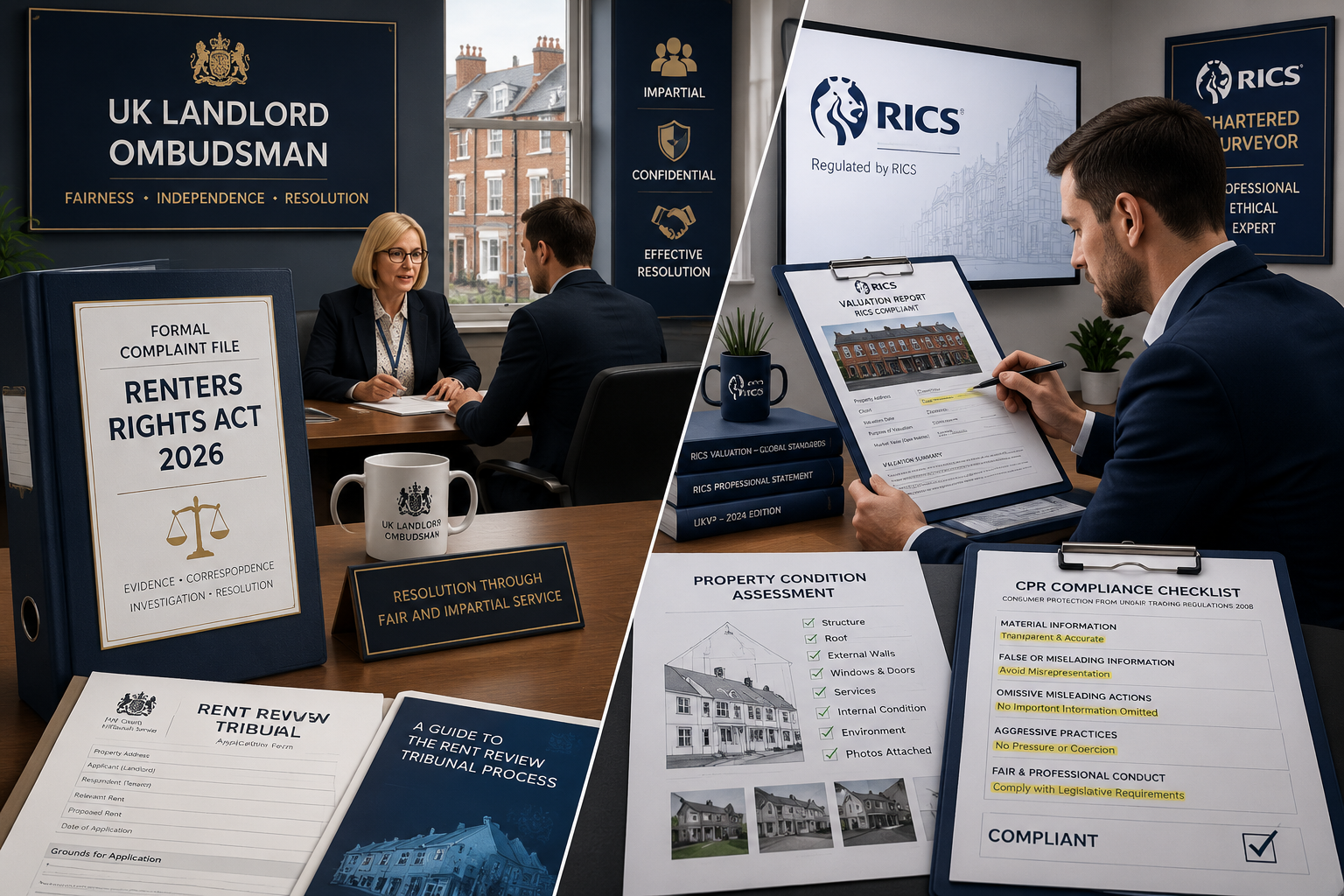
The New Landscape: PRS Ombudsman and the Renters' Rights Act 2026
What Changed on 1 May 2026?
The Renters' Rights Act 2025 (commonly referenced as the Renters' Rights Act 2026 in the context of its operational provisions) fundamentally restructured the private rented sector. The landlord ombudsman scheme went live on 1 May 2026, requiring all private landlords — not just letting agents — to register with an approved scheme [2].
The ombudsman provides tenants with a free, binding route to redress for issues including:
- Repair and maintenance failures
- Substandard property conditions
- Landlord conduct complaints
- Rent increase disputes
Crucially, the ombudsman's decisions are binding on landlords. Non-compliance with a determination can result in loss of access to certain possession grounds — a severe commercial consequence [2].
💡 Pull Quote: "The ombudsman scheme represents a broader shift towards a more professional, transparent rental sector — one where evidence quality will define outcomes." [1]
The End of Section 21 and Its Valuation Implications
The abolition of Section 21 "no-fault" evictions is arguably the most disruptive change for landlords. Every possession claim now requires proof of a statutory ground — and many of those grounds have valuation dimensions:
| Possession Ground | Valuation Evidence Required |
|---|---|
| Redevelopment / major works | Development appraisal, cost estimates |
| Landlord moving in (or family) | Market rent comparables to assess financial viability |
| Persistent rent arrears | Market rent evidence to contextualise arrears |
| Property sale | Open market valuation, comparable sales evidence |
This shift demands preparation, evidence, and consistency — qualities that only a properly instructed expert witness can provide [2].
The Landlord Database: A New Evidence Trail
A new landlord database, expected to be fully operational later in 2026, will require property registration and disclosure of prescribed compliance information [2]. This creates a documented record that expert witnesses will increasingly reference when assessing whether a property meets required standards — and whether a landlord's conduct aligns with their registered obligations.
For guidance on how property market legislation is evolving, see this overview of property market legislation changes.
Expert Witness Valuations in Private Rented Sector Ombudsman Disputes: CPR Compliance and RICS Standards
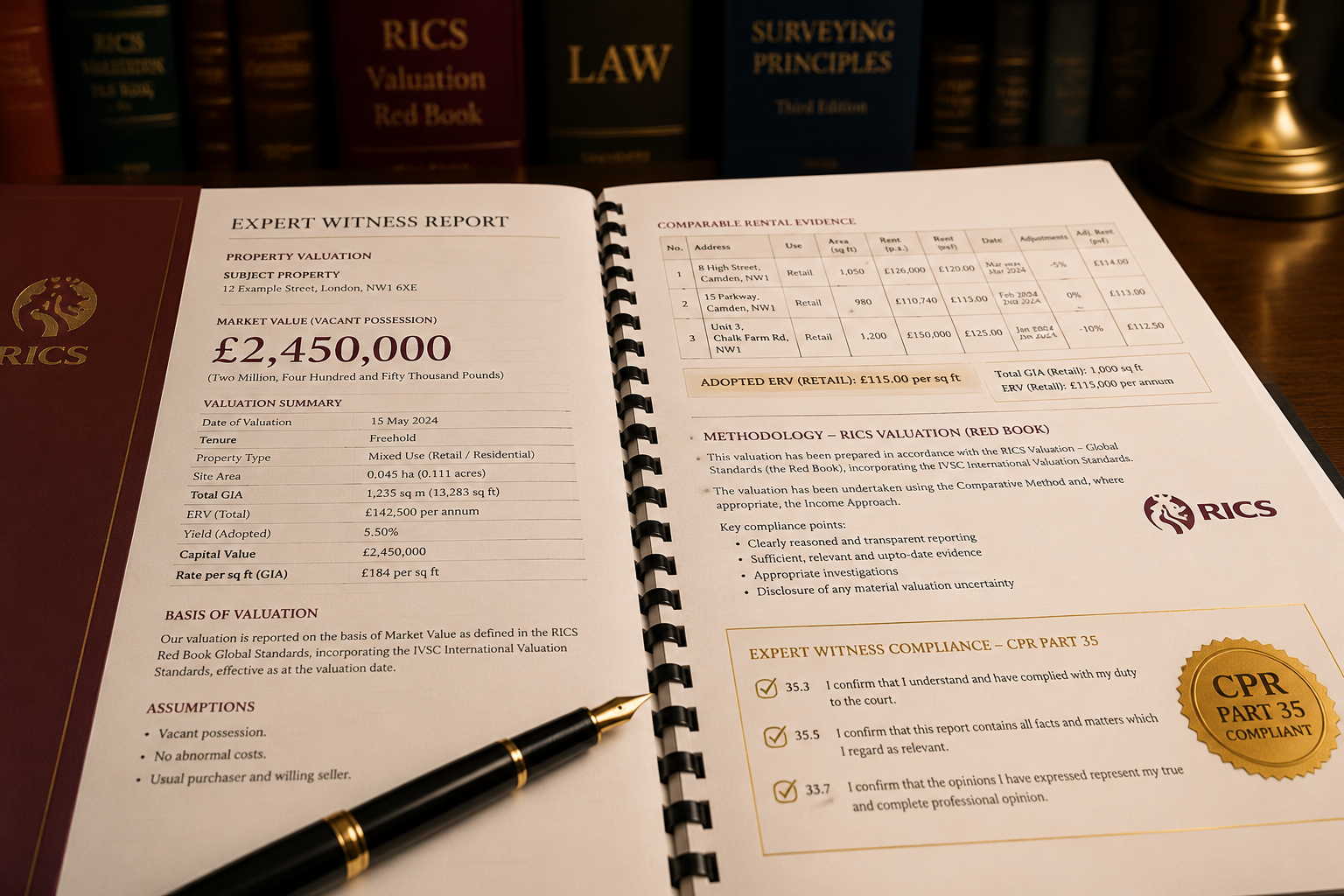
Why CPR Part 35 Matters in Ombudsman Proceedings
Although the PRS Ombudsman is not a court, its proceedings are quasi-judicial in character. Binding decisions, formal submissions, and cross-examination of evidence all feature in complex cases. Expert witnesses who produce reports without CPR Part 35 compliance risk having their evidence dismissed or significantly discounted [1].
CPR Part 35 requires that an expert witness:
- Owes their primary duty to the tribunal, not to the instructing party
- Provides a statement of truth confirming the report is accurate and complete
- Discloses any material conflict of interest
- Sets out the facts, assumptions, and methodology underlying every opinion
- Identifies where issues fall outside their expertise
The RICS Red Book (Valuation — Global Standards) provides the methodological backbone for property valuations submitted in dispute proceedings. Departures from Red Book methodology must be explicitly justified — and in an ombudsman context, they rarely are [1].
The Five Core Components of a Compliant Expert Witness Report
A well-structured expert witness valuation report for ombudsman disputes should contain:
- Instructions and Scope — Who instructed the expert, on what basis, and what questions must be answered
- Property Description and Inspection Record — Date of inspection, condition observations, photographic evidence
- Methodology Statement — Comparable evidence approach, market analysis, adjustments applied
- Valuation Opinion — Clear, unambiguous figures with a stated effective date
- CPR Declaration — Signed statement of independence and duty to the tribunal
⚠️ Critical Point: Technical compliance failures — such as missing declarations or undisclosed assumptions — can undermine an otherwise valid claim, regardless of the strength of the underlying valuation [2].
RICS Membership and Accreditation
Expert witnesses in PRS ombudsman disputes should hold RICS membership and ideally be registered with the Expert Witness Institute or hold equivalent accreditation. The ombudsman scheme's emphasis on professional standards means that unaccredited or poorly qualified valuers face significant credibility challenges [1].
For an understanding of what a thorough property valuation involves, the top three things looked at during a property valuation provides useful context for both landlords and tenants preparing their cases.
Mock Dispute Scenarios: Applying Expert Witness Valuations in Practice
Scenario 1: Rent Review Challenge at the First-Tier Tribunal 🏠
The Dispute:
A landlord in South-East London issues a Section 13 notice proposing a rent increase from £1,450 to £1,850 per month — a 27.6% uplift. The tenant challenges this before the First-Tier Tribunal (Property Chamber), arguing the proposed rent exceeds the open market rent for comparable properties.
What the Expert Must Provide:
- A market rent valuation with an effective date matching the proposed increase date
- Comparable rental evidence from at least five similar properties within a defined search radius, adjusted for size, condition, and amenity
- Commentary on market movement over the preceding 12 months
- An opinion on the open market rent expressed as a range, with a mid-point figure
Key Pitfall: Contractual rent review clauses are no longer enforceable under the Renters' Rights Act 2026 [2]. Any expert who references a lease clause as justification for the increase will immediately undermine their credibility. The analysis must be purely market-based.
For landlords seeking professional valuation support, chartered surveyors' valuation services offer the kind of RICS-accredited expertise required in these proceedings.
Scenario 2: Ombudsman Complaint — Disrepair and Diminution in Value 🔧
The Dispute:
A tenant submits an ombudsman complaint alleging that persistent damp and mould — reported over 18 months — has rendered two rooms of a three-bedroom flat unusable. The tenant seeks compensation equivalent to a rent reduction for the affected period.
What the Expert Must Provide:
- A schedule of condition documenting the defects at the time of inspection
- An assessment of the proportion of the property affected (expressed as a percentage of total floor area or habitable rooms)
- A diminution in rental value calculation — the difference between the contracted rent and the rent a hypothetical tenant would pay knowing of the defects
- Reference to Homes (Fitness for Human Habitation) Act 2018 standards
Mock Calculation:
| Element | Figure |
|---|---|
| Contracted monthly rent | £1,600 |
| Assessed market rent with defects | £1,120 |
| Monthly diminution | £480 |
| Affected period (18 months) | £8,640 |
| Recommended compensation award | £8,640 |
The ombudsman can make financial awards based on this type of evidence. Without an expert witness valuation, the tenant's claim rests on subjective assertion — and the landlord's defence is equally weak [1].
For landlords, maintaining detailed property inspection records is the most effective way to contest or mitigate such claims.
Scenario 3: Possession Ground — Landlord Intends to Sell 🏷️
The Dispute:
A landlord serves notice on a statutory ground that they intend to sell the property. The tenant challenges the notice, arguing the landlord has no genuine intention to sell and is using the ground to circumvent the abolition of Section 21.
What the Expert Must Provide:
- An open market valuation of the property as at the notice date
- Evidence that the asking price is realistic relative to market comparables
- Commentary on local market conditions and typical time to sell
- If the property is subsequently re-let rather than sold, the expert may be recalled to assess whether the valuation evidence supported a genuine sale intention
This scenario illustrates why early instruction of an expert is essential. A valuation commissioned after a challenge is issued carries less evidential weight than one prepared contemporaneously with the notice [2].
Understanding capital gains tax valuations is also relevant here, as a genuine sale intention will typically involve tax planning that an expert can reference as corroborating evidence.
Preparing Your Case: Practical Steps for Landlords and Tenants
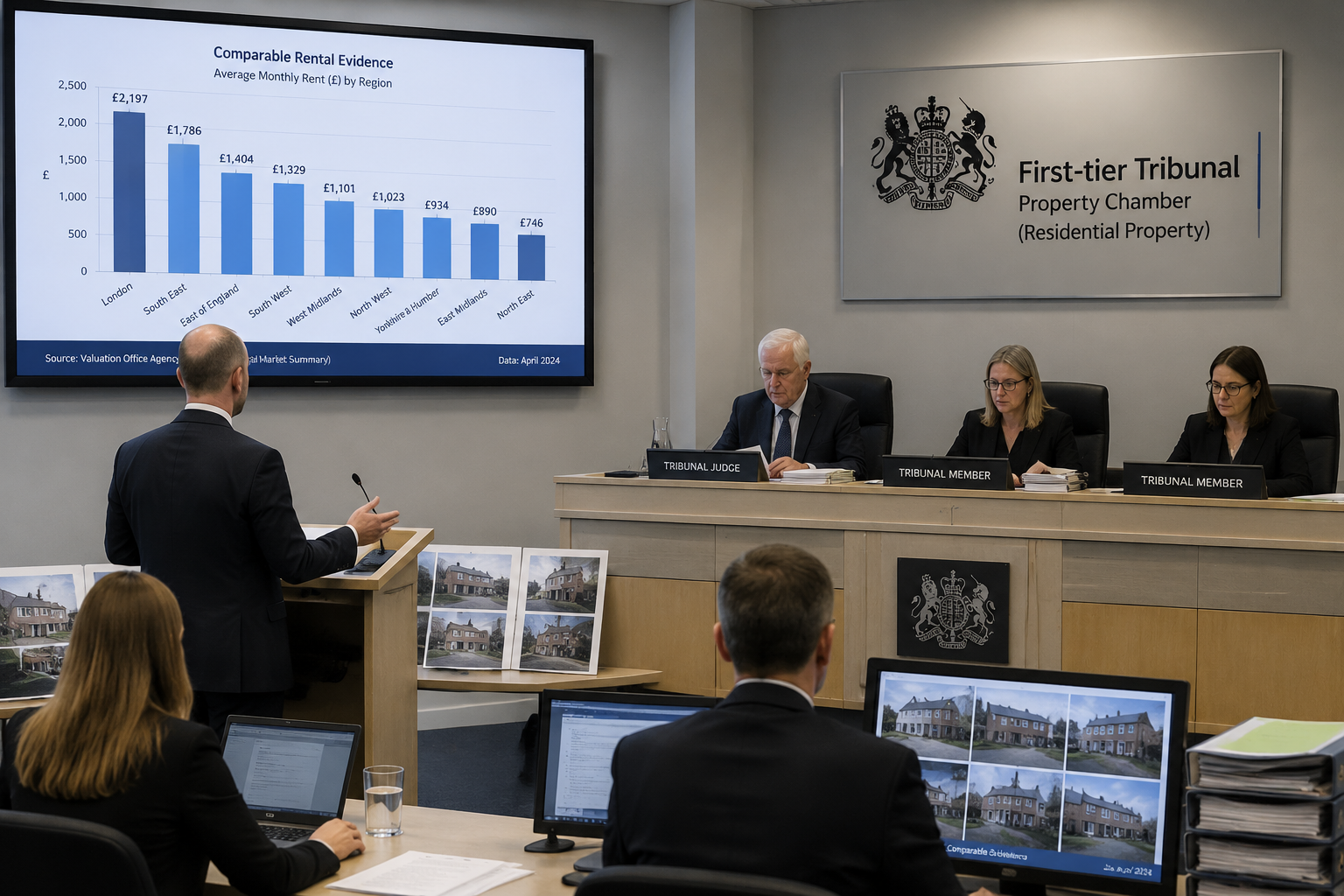
Expert Witness Valuations in Private Rented Sector Ombudsman Disputes: A Step-by-Step Preparation Guide
Both landlords and tenants benefit from a structured approach to case preparation. The following checklist applies to Renters' Rights Act 2026 case preparation at every stage:
✅ Step 1 — Identify the Valuation Question Early
Define precisely what the expert must opine on: market rent, diminution in value, open market sale price, or reinstatement cost. Vague instructions produce vague reports.
✅ Step 2 — Instruct a Qualified, Independent Expert
The expert must hold RICS membership, carry professional indemnity insurance, and have no material connection to either party. Check their experience in PRS dispute work specifically.
✅ Step 3 — Provide a Comprehensive Property Pack
Supply the expert with: tenancy agreement, rent history, correspondence, maintenance records, photographs, EPC, gas safety certificates, and any previous survey reports. The new landlord database records will increasingly form part of this pack [2].
✅ Step 4 — Commission the Report Before Escalation
Operators and landlords are advised to "plan possession strategies well in advance" and "gather and retain evidence carefully" [2]. A valuation commissioned at the first sign of dispute is far stronger than one prepared under time pressure.
✅ Step 5 — Review the Draft Report for CPR Compliance
Before submission, confirm the report contains: a CPR Part 35 declaration, a clear methodology statement, identified comparable evidence, and an unambiguous opinion. Legal advisers should review the report before it is filed.
✅ Step 6 — Prepare for Cross-Examination
In complex ombudsman cases, the expert may be required to defend their opinion. They should be able to explain every comparable, every adjustment, and every assumption in plain language accessible to a non-specialist panel.
The Role of Block Management and Professional Landlords
For portfolio landlords and block management operators, the ombudsman framework creates systemic risk if property standards are inconsistent across a portfolio. Regular professional inspections, documented maintenance programmes, and RICS-compliant periodic valuations all reduce exposure to adverse determinations.
The benefits of professional block management are particularly relevant in this context — structured management creates the paper trail that expert witnesses rely on.
Inheritance Tax and Investment Valuations: Ancillary Considerations
Where a disputed property forms part of an estate or investment portfolio, ombudsman proceedings may intersect with other valuation needs. Inheritance tax valuations and investment property assessments may need to be coordinated with expert witness reports to ensure consistency across all formal proceedings.
Common Mistakes That Undermine Expert Witness Evidence
Even well-intentioned experts make errors that damage their credibility in ombudsman proceedings. The most common failures include:
| Mistake | Impact |
|---|---|
| Using stale comparable evidence (>6 months old) | Opinion discounted as not reflecting current market |
| Failing to inspect the property in person | Report treated as desktop exercise, not expert evidence |
| Expressing opinion outside area of expertise | Entire report credibility questioned |
| Omitting CPR Part 35 declaration | Report may be inadmissible |
| Advocacy tone — arguing for the client | Duty to tribunal breached; expert may be disqualified |
| Inconsistent figures between sections | Suggests careless preparation; undermines all conclusions |
🔑 Key Principle: The expert witness's value lies in their independence. The moment a report reads like a submission rather than an objective assessment, it loses the authority that makes it useful [1].
Conclusion: Acting Now on Renters' Rights Act 2026 Case Preparation
The mandatory PRS Ombudsman, the abolition of Section 21, and the tribunal-based rent review process have collectively created a dispute resolution environment where evidence quality determines outcomes. Expert Witness Valuations in Private Rented Sector Ombudsman Disputes: Renters' Rights Act 2026 Case Preparation is not a niche specialism — it is a core competency for anyone operating in the private rented sector in 2026.
Actionable Next Steps 🚀
- Register with an approved ombudsman scheme immediately if not already done — non-compliance has direct legal consequences [2].
- Audit your property portfolio for condition, maintenance records, and compliance documentation before a dispute arises.
- Identify a RICS-accredited expert witness with PRS dispute experience and establish a relationship before you need them urgently.
- Commission market rent valuations annually for every tenancy where a rent review may be anticipated — contemporaneous evidence is always stronger.
- Brief your letting agent or block manager on the evidential standards required under the new framework, ensuring inspection reports and maintenance records are dispute-ready.
- Seek legal advice on CPR Part 35 compliance requirements before filing any expert report in ombudsman or tribunal proceedings.
The new rental landscape rewards preparation and penalises complacency. Landlords and tenants who invest in high-quality expert witness evidence now will be significantly better positioned when disputes inevitably arise.
References
[1] The New Landlord Ombudsman How To Protect Your Reputation And Your Yield In 2026 – country-properties.co.uk
[2] What The Renters Rights Act Means For Living Sector Investors And Operators – gowlingwlg.com
[3] A Complete Guide To The Renters Rights Act 2026 – boxallbrownandjones.co.uk
[5] Renter Rights Act 2026 – wace-morgan.co.uk
[6] Renters Rights – nrla.org.uk