

{"cover":"Professional landscape format (1536x1024) hero image with bold text overlay 'Expert Witness Roles in Northern vs Southern UK Valuation Disputes 2026' in extra large 72pt white sans-serif font with dark gradient shadow, positioned in upper third. Background shows split-screen composition: left side depicts Northern UK industrial cityscape with regeneration projects and Victorian architecture, right side shows Southern UK London skyline with modern glass towers and prime residential areas. Center features RICS professional logo subtly integrated. Foreground includes transparent overlay of legal documents, valuation reports, and tribunal courtroom elements. Color scheme: deep navy blue, gold accents, professional grey tones. High contrast, editorial magazine cover quality, sophisticated business aesthetic with geographical market divergence theme clearly visible through architectural contrast.", "content":["Landscape format (1536x1024) detailed infographic showing UK map divided into Northern and Southern regions with color-coded property value heat maps. Northern section displays Manchester, Leeds, Newcastle with lower price gradients in cool blues and greens, showing £150k-£350k ranges. Southern section shows London, Oxford, Cambridge in warm reds and oranges displaying £400k-£1.2M ranges. Overlay includes bar charts comparing average property values, percentage growth rates, and dispute frequency statistics for 2026. RICS logo watermark in corner. Professional data visualization style with clear legends, annotations pointing to key cities, and transparent statistical overlays. Clean, authoritative financial presentation aesthetic with grid layout and precise typography.", "Landscape format (1536x1024) professional courtroom scene showing expert witness testimony setup. Central focus on RICS-qualified surveyor in business attire standing at witness box with architectural plans and valuation reports displayed on modern digital screens. Judge's bench visible in background, legal representatives at tables with laptops and documents. Foreground shows detailed close-up of RICS Expert Witness Standard 5th edition document with highlighted sections on independence, tribunal duty, and digital evidence protocols. Side panel displays checklist of expert witness requirements: independence verification, methodology transparency, AI disclosure statements. Serious, authoritative legal environment with natural courtroom lighting, professional photography style, documentary quality composition emphasizing credibility and expertise.", "Landscape format (1536x1024) strategic comparison diagram showing two parallel workflows for Northern versus Southern UK valuation dispute protocols. Left column labeled 'Northern Markets' shows flowchart with regeneration area considerations, industrial heritage assessments, lower value threshold triggers, and regional tribunal procedures specific to Manchester, Liverpool, Leeds. Right column labeled 'Southern Markets' shows parallel workflow with prime location premiums, conservation area constraints, high-value dispute escalation, and London tribunal protocols. Center section highlights RICS unified standards bridging both approaches: CPD requirements, methodology consistency, digital evidence handling, AI integration guidelines. Modern infographic style with icons representing different property types, color-coded process steps, connecting arrows showing decision points, and statistical annotations showing dispute resolution timeframes. Professional business intelligence aesthetic with clean typography and structured visual hierarchy."]}

The UK property market has never been more geographically divided. As valuations in London and the South East continue to soar while Northern cities experience regeneration-driven volatility, property disputes requiring expert witness testimony have surged across both regions—but for vastly different reasons. Understanding how Expert Witness Roles in Northern vs Southern UK Valuation Disputes 2026: RICS Strategies for Divergent Markets differ is critical for surveyors, legal professionals, and property stakeholders navigating tribunal proceedings in 2026.
With RICS launching its updated 5th edition Expert Witness Standard in 2025—the first major revision since 2014—professionals must adapt to new protocols addressing digital evidence, artificial intelligence integration, and regional market complexities [1]. This comprehensive guide examines how expert witnesses must tailor their approaches to the distinct challenges presented by Northern and Southern UK property markets.
Key Takeaways
- Regional price divergence between Northern and Southern UK markets requires expert witnesses to apply different valuation methodologies and comparable evidence strategies when preparing tribunal testimony
- RICS 5th edition Expert Witness Standard introduces mandatory protocols for AI disclosure, digital evidence handling, and enhanced independence requirements that apply across all UK jurisdictions [1]
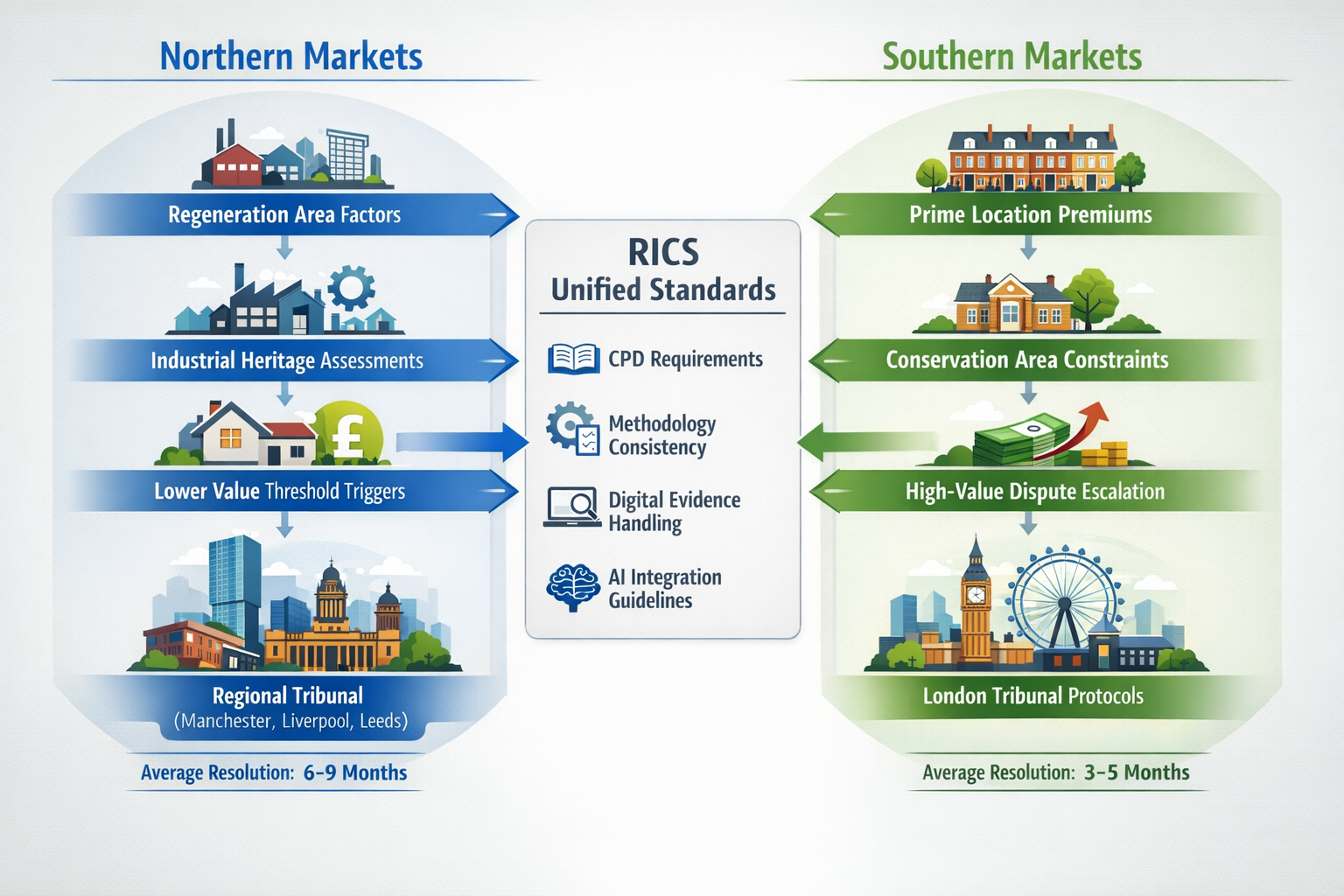
- Northern disputes increasingly focus on regeneration area valuations, industrial heritage conversions, and lower-value threshold triggers, while Southern disputes center on prime location premiums and high-value residential conflicts
- Tribunal duty supersedes client interests under updated RICS standards, requiring expert witnesses to maintain complete independence regardless of regional market pressures
- 2026 commercial disputes are projected to increase significantly, particularly regarding rights of light, party wall issues, and nuisance claims as development density intensifies [2]
Understanding Regional Market Divergence in UK Property Valuations
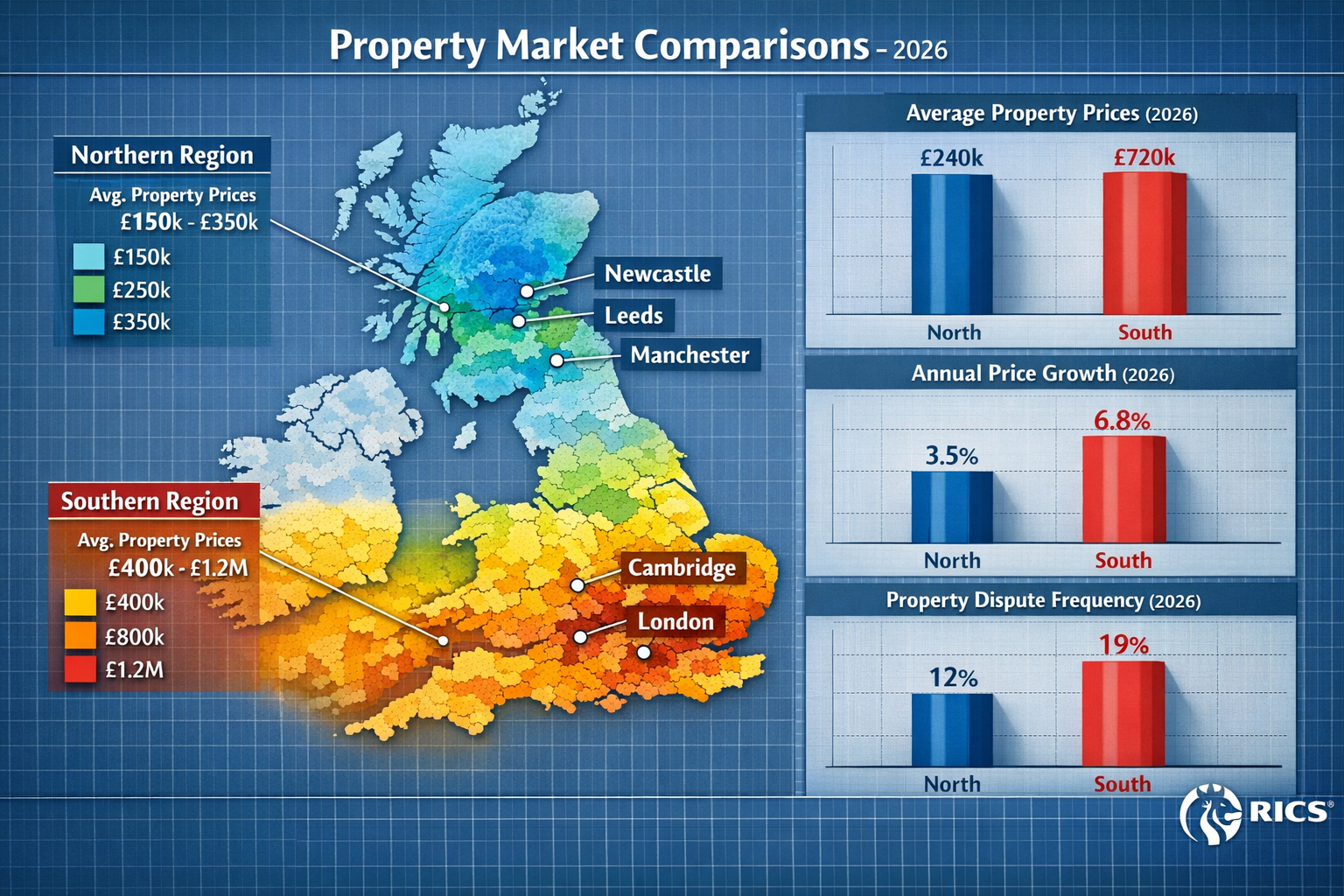
The North-South Property Divide in 2026
The geographical split in UK property values has reached unprecedented levels in 2026. Southern markets, particularly London and the South East, continue to command premium valuations driven by limited supply, international investment, and proximity to financial centers. Average property values in prime London locations frequently exceed £1.2 million, with some boroughs reaching £2 million median prices.
Conversely, Northern markets including Manchester, Leeds, Liverpool, and Newcastle present a contrasting picture. While these cities have experienced significant regeneration and investment, average property values typically range between £150,000 and £350,000. This four-fold price differential creates fundamentally different contexts for valuation disputes.
| Region | Average Property Value | Common Dispute Types | Typical Claim Values |
|---|---|---|---|
| London & South East | £650,000 – £1,200,000 | Leasehold disputes, conservation areas, prime location disagreements | £100,000 – £500,000+ |
| Northern Cities | £150,000 – £350,000 | Regeneration area valuations, industrial conversions, right-to-buy challenges | £20,000 – £150,000 |
| South West | £350,000 – £550,000 | Coastal property disputes, second home valuations, rural access rights | £50,000 – £250,000 |
| Midlands | £200,000 – £400,000 | Mixed-use development conflicts, suburban expansion disputes | £30,000 – £200,000 |
How Regional Economics Impact Expert Witness Testimony
Expert witnesses must recognize that valuation methodologies cannot be uniformly applied across these divergent markets. Southern disputes often involve sophisticated financial instruments, international comparable evidence, and complex leasehold arrangements requiring matrimonial valuations or SIPP pension valuations.
Northern disputes frequently center on:
- Regeneration area uncertainty – Valuing properties in rapidly changing urban renewal zones
- Industrial heritage conversions – Assessing former manufacturing buildings transformed into residential or mixed-use developments
- Comparable evidence scarcity – Limited transaction data in emerging markets
- Regional economic volatility – Employment fluctuations affecting local demand
Southern disputes typically involve:
- Prime location premiums – Quantifying value attributable to prestigious addresses
- Conservation area restrictions – Assessing impact of planning constraints on value
- Leasehold complexities – Ground rent disputes and lease extension valuations
- International comparable evidence – Cross-referencing global luxury property markets
For professionals working in chartered surveyors North London versus chartered surveyors South West London, these distinctions require fundamentally different approaches to expert evidence preparation.
RICS 5th Edition Expert Witness Standard: New Protocols for 2026
Core Principles and Independence Requirements
The RICS 5th edition Expert Witness Standard, launched for consultation in August 2025, represents the most significant update to expert witness protocols in over a decade [1]. The standard reinforces a fundamental principle: an expert witness's primary duty is to the tribunal, not to the instructing client.
This independence requirement takes on particular importance in regional valuation disputes where local market knowledge might create perceived conflicts of interest. Expert witnesses must now:
✅ Declare all potential conflicts including previous work in the same geographical area
✅ Document methodology independence showing valuation approaches weren't influenced by client preferences
✅ Maintain tribunal-first duty even when findings may disadvantage the instructing party
✅ Provide unbiased evidence regardless of regional market pressures or local relationships
Digital Evidence and AI Integration Guidelines
One of the most significant updates in the 5th edition addresses modern technological challenges that didn't exist in 2014 [1]. Expert witnesses in 2026 must now:
Disclose AI usage – Any artificial intelligence tools used in valuation analysis, comparable property searches, or report preparation must be explicitly identified in expert reports. This includes:
- Automated valuation models (AVMs)
- Machine learning comparable property algorithms
- AI-assisted market trend analysis
- Natural language processing for document review
Validate digital evidence – Electronic records, digital photographs, online property listings, and virtual inspection data require authentication protocols demonstrating:
- Source verification and timestamp accuracy
- Metadata preservation for digital photographs
- Screenshot authentication for online comparable evidence
- Virtual inspection technology calibration records
Maintain data transparency – Expert witnesses must provide access to underlying data sources, allowing opposing experts to verify:
- Comparable property selection criteria
- Market adjustment calculations
- Depreciation and obsolescence assessments
- Location premium quantification methods
These requirements apply equally to disputes in commercial valuations and residential matters, though the specific technologies may vary by property type.
Regional Application of RICS Standards
While RICS standards apply uniformly across the UK, their practical application differs between Northern and Southern markets. Expert witnesses must balance:
🏛️ Consistent methodology – Using RICS-approved valuation approaches regardless of location
📍 Regional market reality – Acknowledging genuine geographical differences in market dynamics
⚖️ Tribunal expectations – Understanding that Northern and Southern courts may have different levels of property market sophistication
For example, a tribunal in Manchester may require more detailed explanation of comparable evidence selection from limited local transactions, while a London tribunal might expect sophisticated analysis of prime location premiums and international investment impacts.
Expert Witness Roles in Northern vs Southern UK Valuation Disputes 2026: Strategic Approaches
Northern UK Dispute Strategies
Expert witnesses working on Northern UK valuation disputes must develop specialized approaches addressing the region's unique characteristics:
Regeneration Area Valuation Protocols
Northern cities have experienced significant urban regeneration, creating valuation challenges when properties sit in transitional zones. Expert witnesses must:
Establish temporal baselines – Clearly define the valuation date and market conditions at that specific time, as regeneration areas can experience rapid value changes within months.
Quantify regeneration premiums – Separate speculative value from realized improvements by analyzing:
- Infrastructure investment timelines
- Planning permission grant dates
- Comparable sales before and after regeneration announcements
- Transport connectivity improvements
Address comparable evidence gaps – When similar properties are scarce, experts must justify alternative approaches such as:
- Residual valuation methods for development sites
- Depreciated replacement cost for unique properties
- Income capitalization for investment properties
- Cross-regional comparables with documented adjustments
Industrial Heritage Conversion Assessments
The North's industrial legacy creates unique valuation scenarios when former factories, warehouses, and mills undergo conversion to residential or mixed-use developments. Expert witnesses must evaluate:
- Structural adaptation costs – Assessing the impact of heritage building constraints on conversion viability
- Character premiums – Quantifying value attributable to exposed brickwork, high ceilings, and industrial aesthetics
- Planning restrictions – Evaluating limitations on alterations to locally listed or significant buildings
- Market absorption rates – Analyzing demand for unconventional property types in specific Northern submarkets
For those preparing RICS building surveys, understanding these conversion complexities is essential when disputes arise over valuation accuracy.
Lower-Value Threshold Considerations
With average Northern property values significantly below Southern equivalents, disputes may involve smaller absolute amounts while representing proportionally significant percentages of property value. Expert witnesses must:
Justify proportionate investigation – Demonstrate that the depth of analysis matches the dispute value, avoiding excessive costs that exceed potential recovery.
Maintain professional standards – Ensure that lower claim values don't result in reduced analytical rigor or abbreviated reporting.
Address cost-benefit concerns – Help tribunals understand when detailed expert analysis provides value even in modest-value disputes, particularly when establishing precedent or principle.
Southern UK Dispute Strategies
Southern UK valuation disputes, particularly in London and the South East, require expert witnesses to navigate sophisticated property markets with international influences:
Prime Location Premium Quantification
Southern expert witnesses frequently face challenges in quantifying the specific value attributable to prestigious addresses. This requires:
Micro-location analysis – Demonstrating value differentials between properties on opposite sides of the same street when one side falls within a more desirable postcode or school catchment area.
Comparable evidence hierarchy – Establishing which transactions provide the most reliable evidence:
- Same street transactions within 6 months
- Same postcode sector within 12 months
- Adjacent prestigious areas with documented adjustments
- Cross-regional prime location comparables (e.g., comparing Kensington to Mayfair)
International investment impact – Assessing how foreign buyer demand influences values in prime Central London locations, including:
- Currency fluctuation effects on international buyer activity
- Safe haven premium during global uncertainty
- Pied-à-terre demand versus primary residence markets
For capital gains tax disputes, these premium quantifications become particularly critical.
Conservation Area and Listed Building Constraints
Southern regions contain disproportionately high concentrations of conservation areas and listed buildings, creating valuation complexity when restrictions limit alterations or extensions. Expert witnesses must:
Quantify restriction impact – Demonstrate the specific value reduction attributable to planning constraints by comparing:
- Restricted properties versus unrestricted equivalents
- Properties with planning permission versus those without
- Conservation area properties versus similar properties outside designated zones
Assess enhancement potential – Evaluate whether sensitive, approved alterations might increase value despite restrictions, particularly for:
- Basement extensions in prime London locations
- Loft conversions in conservation areas
- Rear extensions within permitted development rights
Navigate planning uncertainty – Address valuation implications when planning permission outcomes remain uncertain at the valuation date.
Understanding property market legislation changes helps expert witnesses anticipate how regulatory shifts affect these assessments.
High-Value Dispute Escalation Protocols
Southern disputes frequently involve claim values exceeding £500,000, requiring enhanced protocols:
Extended comparable analysis – Providing comprehensive transaction evidence spanning multiple years to demonstrate market trends and value stability.
Multiple valuation approaches – Employing comparative, income, and cost methods to triangulate value conclusions and demonstrate consistency.
Sensitivity analysis – Showing how different assumptions (discount rates, rental growth, depreciation rates) affect final valuations, helping tribunals understand uncertainty ranges.
Enhanced CPD documentation – Demonstrating specialized expertise in high-value property sectors through continuing professional development records and previous tribunal experience.
Tribunal Procedures and Evidence Presentation Across UK Regions

Pre-Trial Expert Collaboration Requirements
Modern tribunal procedures increasingly require expert witnesses from opposing parties to collaborate before trial, identifying areas of agreement and narrowing disputed issues. This process differs subtly between regions:
Joint expert meetings – RICS standards mandate that experts meet without legal representatives present to discuss:
- Agreed comparable evidence
- Methodology differences
- Factual disputes versus opinion differences
- Areas requiring tribunal determination
Joint statements – Experts must produce written statements identifying:
- ✅ Points of agreement
- ⚠️ Points of disagreement with brief reasons
- 📊 Numerical differences in valuations
- 🎯 Key issues for tribunal determination
Regional tribunal expectations – Northern tribunals may expect more detailed explanation of methodology given potentially less frequent exposure to complex valuation disputes, while Southern tribunals might focus more on comparable evidence selection and adjustment justification.
Cross-Examination Preparation Strategies
Expert witnesses must prepare for rigorous cross-examination that tests both technical competence and regional market knowledge:
Northern Market Cross-Examination Challenges
Opposing counsel in Northern disputes frequently challenge:
Comparable evidence sufficiency – "You've only identified three comparable sales in 18 months—how can you claim this provides reliable evidence?"
Expert response strategy: Demonstrate comprehensive search methodology, explain market-specific transaction volumes, and show how quality of evidence compensates for quantity limitations.
Regeneration speculation – "Isn't your valuation based on speculative future improvements rather than current market reality?"
Expert response strategy: Clearly distinguish between realized improvements at valuation date versus future expectations, providing documentary evidence of infrastructure completion and planning permissions granted.
Regional bias – "As a surveyor based in [location], don't you have a vested interest in promoting higher valuations in this regeneration area?"
Expert response strategy: Reference RICS independence requirements, demonstrate objective methodology application, and show consistent approach across different client instructions.
Southern Market Cross-Examination Challenges
Southern tribunal cross-examinations often focus on:
Prime location premium justification – "You've added £200,000 for location premium—what objective evidence supports this specific figure?"
Expert response strategy: Present paired sales analysis showing identical properties in different micro-locations, provide regression analysis of location variables, and reference published location premium studies.
Comparable adjustment transparency – "You've made 15 different adjustments to comparable evidence—how can the tribunal verify each adjustment's accuracy?"
Expert response strategy: Provide detailed adjustment schedules with supporting evidence for each modification, show sensitivity analysis demonstrating adjustment impact, and offer alternative valuation approaches reaching similar conclusions.
International market influence – "How do you account for international buyer demand that may be temporary or politically influenced?"
Expert response strategy: Present long-term transaction data showing sustained international demand, analyze currency-adjusted price trends, and demonstrate market depth beyond international buyers alone.
Digital Evidence Presentation Standards
The 2026 tribunal environment increasingly relies on digital evidence presentation, requiring expert witnesses to master:
Virtual hearing technology – Presenting evidence effectively via video conference, including:
- High-resolution property photographs and plans
- Interactive comparable evidence maps
- Real-time valuation calculation demonstrations
- Screen-shared inspection reports with annotation capabilities
Electronic bundle preparation – Organizing expert evidence in searchable, hyperlinked digital formats allowing tribunals to navigate quickly between:
- Main expert report sections
- Comparable evidence appendices
- Supporting photographs and plans
- Calculation worksheets and assumptions
Authentication protocols – Demonstrating digital evidence integrity through:
- Metadata preservation for photographs
- Screenshot timestamp verification
- Website archive captures for online listings
- Digital signature verification for electronic documents
Case Studies: Regional Dispute Resolution in Practice
Northern Case Study: Manchester Regeneration Zone Dispute
Background: A property owner challenged a local authority's compulsory purchase valuation of a Victorian warehouse in Manchester's Northern Quarter regeneration area, claiming the £450,000 offer undervalued the property's development potential.
Expert witness challenges:
- Limited comparable evidence for similar warehouse conversions
- Rapid market changes during 18-month valuation period
- Uncertainty about planning permission for proposed residential conversion
- Competing valuations differing by £200,000
RICS strategy applied:
The appointed expert witness employed multiple valuation approaches:
- Comparative method – Identified four warehouse conversions within 2km, applying documented adjustments for size, condition, and location
- Residual valuation – Calculated development value assuming planning permission, deducting conversion costs and developer's profit
- Investment method – Assessed existing commercial rental value capitalized at appropriate yield
Outcome: The tribunal accepted the expert's middle-ground valuation of £550,000, finding the residual approach overly speculative but recognizing genuine development potential above the authority's initial offer. The expert's transparent methodology and acknowledgment of uncertainty ranges proved decisive.
Key lesson: Northern disputes benefit from multiple valuation approaches when comparable evidence is limited, with clear documentation of assumptions and sensitivity analysis.
Southern Case Study: Kensington Conservation Area Dispute
Background: A divorce settlement required valuation of a £2.8 million Kensington townhouse, with parties disputing whether conservation area restrictions reduced value by £200,000 or enhanced it through character preservation.
Expert witness challenges:
- Quantifying intangible conservation area "prestige" value
- Assessing restriction impact on extension potential
- Evaluating international buyer preferences for heritage properties
- Competing experts with £400,000 valuation difference
RICS strategy applied:
The expert witness conducted paired comparison analysis:
- Conservation vs. non-conservation – Compared similar properties inside and outside the conservation area boundary
- Restricted vs. permitted – Analyzed properties with and without basement extension planning permissions
- Heritage premium – Assessed period feature retention impact on values
Outcome: The tribunal accepted the expert's conclusion that conservation area designation created a net neutral effect—restrictions on alterations offset by prestige and character premiums. The final valuation of £2.75 million fell between competing expert opinions, with the tribunal praising the appointed expert's objective analysis of both positive and negative factors.
Key lesson: Southern high-value disputes require sophisticated paired comparison analysis isolating specific value influences, with particular attention to intangible prestige factors.
Future Trends: Expert Witness Roles in Evolving UK Property Markets
Anticipated Dispute Increases in 2026
Commercial real estate disputes are projected to increase significantly in 2026, particularly regarding rights of light, party wall issues, and nuisance claims as UK development density intensifies [2]. Expert witnesses must prepare for:
Rights of light disputes – Increased high-density development in both Northern regeneration zones and Southern infill sites creates more frequent daylight obstruction claims requiring:
- Technical daylight and sunlight assessments
- Valuation of light loss impact on property values
- Damage quantification for affected properties
- Expert collaboration with specialist rights of light surveyors
Party wall conflicts – Understanding party wall surveyor requirements becomes essential as urban intensification increases boundary development. Expert witnesses must value:
- Structural damage from adjacent construction
- Diminution in value from party wall encroachments
- Compensation for temporary loss of amenity during works
Climate change valuation impacts – Flood risk, energy efficiency requirements, and sustainability considerations increasingly affect property values, requiring expert witnesses to quantify:
- EPC rating impact on marketability and value
- Flood zone designation effects on insurance and saleability
- Retrofit cost implications for older properties
- Green premium for sustainable buildings
For those conducting RICS homebuyer reports, these emerging factors require enhanced attention during inspections.
Technology Integration in Expert Evidence
The RICS 5th edition standard's emphasis on AI and digital evidence reflects accelerating technology adoption [1]. Expert witnesses in 2026 must master:
Automated Valuation Models (AVMs) – Understanding when AVMs provide reliable evidence versus when human expertise remains essential, particularly:
- AVMs work well for standard properties with abundant comparable evidence (typical Southern suburban markets)
- AVMs struggle with unique properties, regeneration areas, and limited transaction markets (common Northern scenarios)
- Expert witnesses must explain AVM limitations when challenging opposing evidence
Virtual inspection technology – COVID-19 accelerated remote inspection adoption, now becoming standard practice for preliminary assessments:
- 360-degree photography and virtual tours
- Drone imagery for roof and external assessments
- Thermal imaging for building defect identification
- LiDAR scanning for precise measurements
Blockchain property records – Emerging distributed ledger technology for property transactions creates new authentication opportunities and challenges:
- Verifiable transaction history without registry delays
- Smart contract completion evidence
- Cryptocurrency transaction valuation complexities
Big data market analysis – Access to comprehensive transaction databases enables sophisticated market analysis:
- Regression analysis identifying value drivers
- Predictive modeling for market trends
- Sentiment analysis from property listing descriptions
- Social media location desirability metrics
Regional CPD Requirements and Expert Witness Accreditation
RICS Continuing Professional Development Standards
Expert witnesses must demonstrate ongoing competence through structured CPD, with regional specialization becoming increasingly important:
Minimum CPD requirements:
- 20 hours annually of formal CPD activities
- At least 10 hours directly related to expert witness practice
- Regional market update training for areas of practice
- Tribunal procedure and legal framework updates
Regional specialization CPD:
📍 Northern market specialists should pursue:
- Regeneration area valuation methodologies
- Industrial heritage conversion analysis
- Regional economic trend interpretation
- Northern tribunal procedure familiarization
📍 Southern market specialists should pursue:
- Prime location premium quantification techniques
- Conservation area and listed building valuation
- International investment impact assessment
- London tribunal expectations and procedures
Building Expert Witness Credibility
Tribunal acceptance of expert evidence depends heavily on demonstrated expertise and credibility. Expert witnesses should:
Maintain detailed practice records showing:
- Number and types of valuations completed
- Geographical areas of practice
- Property types and value ranges
- Previous tribunal appearances and outcomes
Develop specialized knowledge in specific property sectors:
- Period properties and heritage buildings
- New build developments and right-to-buy valuations
- Commercial and investment properties
- Specialized residential (student accommodation, care homes, etc.)
Build tribunal experience through:
- Starting with lower-value disputes to gain courtroom familiarity
- Observing experienced expert witnesses during hearings
- Seeking feedback from instructing solicitors on performance
- Participating in RICS expert witness training programs
Maintain professional insurance with adequate coverage for:
- Professional indemnity limits appropriate to dispute values
- Geographic coverage matching practice areas
- Retroactive coverage for historical instructions
- Tribunal attendance and cross-examination coverage
Conclusion
Expert Witness Roles in Northern vs Southern UK Valuation Disputes 2026: RICS Strategies for Divergent Markets require sophisticated understanding of regional property dynamics, rigorous application of updated professional standards, and adaptable methodologies addressing distinct market characteristics. The four-fold price differential between Northern and Southern UK markets creates fundamentally different dispute contexts—from regeneration area uncertainty in Manchester and Leeds to prime location premium quantification in Kensington and Mayfair.
The RICS 5th edition Expert Witness Standard introduces critical protocols for AI disclosure, digital evidence handling, and enhanced independence requirements that apply uniformly across all UK jurisdictions [1]. However, successful expert witnesses must balance these consistent standards with regional market realities, recognizing that Northern disputes often involve comparable evidence scarcity and regeneration volatility while Southern disputes center on sophisticated financial analysis and international investment impacts.
As commercial real estate disputes increase in 2026, particularly regarding rights of light, party wall issues, and climate change considerations [2], expert witnesses must continuously develop specialized knowledge through targeted CPD and tribunal experience. The integration of technology—from AVMs to virtual inspections—creates both opportunities and challenges requiring transparent disclosure and validation protocols.
Actionable Next Steps
For surveyors seeking to develop or enhance expert witness capabilities:
✅ Complete RICS expert witness training and familiarize yourself with the 5th edition standard requirements
✅ Develop regional specialization through focused practice in either Northern or Southern markets, building deep comparable evidence databases
✅ Invest in technology competence including AVM validation, digital evidence authentication, and virtual hearing presentation skills
✅ Build tribunal experience starting with lower-value disputes and progressing to complex, high-value cases
✅ Maintain rigorous independence by documenting methodology transparency and tribunal-first duty compliance
✅ Pursue targeted CPD addressing regional market dynamics, emerging dispute types, and evolving legal frameworks
✅ Network with legal professionals in your practice areas to understand tribunal expectations and instructing solicitor requirements
The divergent Northern and Southern UK property markets will continue creating distinct valuation dispute challenges throughout 2026 and beyond. Expert witnesses who master regional nuances while maintaining RICS professional standards will provide invaluable service to tribunals, clients, and the broader property profession.
References
[1] Rics Launches Global Consultation On Updated Expert Witness Standard – https://www.rics.org/news-insights/rics-launches-global-consultation-on-updated-expert-witness-standard
[2] Commercial Real Estate Disputes In 2026 Whats Coming Into View – https://www.ashurst.com/en/insights/commercial-real-estate-disputes-in-2026-whats-coming-into-view/