

A national headline that says house prices are "stabilising" can be deeply misleading when a dispute turns on what a property in Guildford was worth compared to one in Glasgow. In 2026, that gap between national narrative and local reality is precisely where valuation disputes are being won and lost. Expert witness preparation for regional price stabilisation disputes: using RICS Q1 2026 data in court has become one of the most technically demanding tasks a chartered surveyor can undertake, requiring a command of granular market intelligence that goes far beyond headline figures.
The RICS UK Residential Market Survey for January 2026 recorded a national net balance for house prices of -10%, an apparent improvement from -19% in October 2025 [3]. On the surface, that looks like recovery. But beneath that single number lie sharply divergent regional stories that courts are increasingly being asked to adjudicate. This article sets out how expert witnesses can build defensible, court-ready valuations using the full body of RICS Q1 2026 evidence.
Key Takeaways
- National price stabilisation data from RICS Q1 2026 masks significant North-South regional divergence that is directly relevant to valuation disputes.
- The RICS Expert Witness Accreditation Service (EWAS) is increasingly expected by instructing solicitors and enhances credibility under cross-examination.
- Credit conditions in the commercial sector collapsed to a net balance of -44% in Q1 2026, creating a separate wave of commercial valuation disputes.
- Expert witnesses must demonstrate impartiality to the tribunal above all else; the duty is to the court, not the instructing client.
- Structured report writing, robust comparable evidence, and thorough cross-examination preparation are the three pillars of effective expert witness work in 2026.
Why National Stabilisation Data Masks Regional Dispute Risk
The phrase "price stabilisation" carries legal weight. When one party to a dispute argues that a property was overvalued at the point of sale, and the other argues it reflected prevailing market conditions, the battleground is almost always regional comparables rather than national averages.
The North-South Divergence in Q1 2026
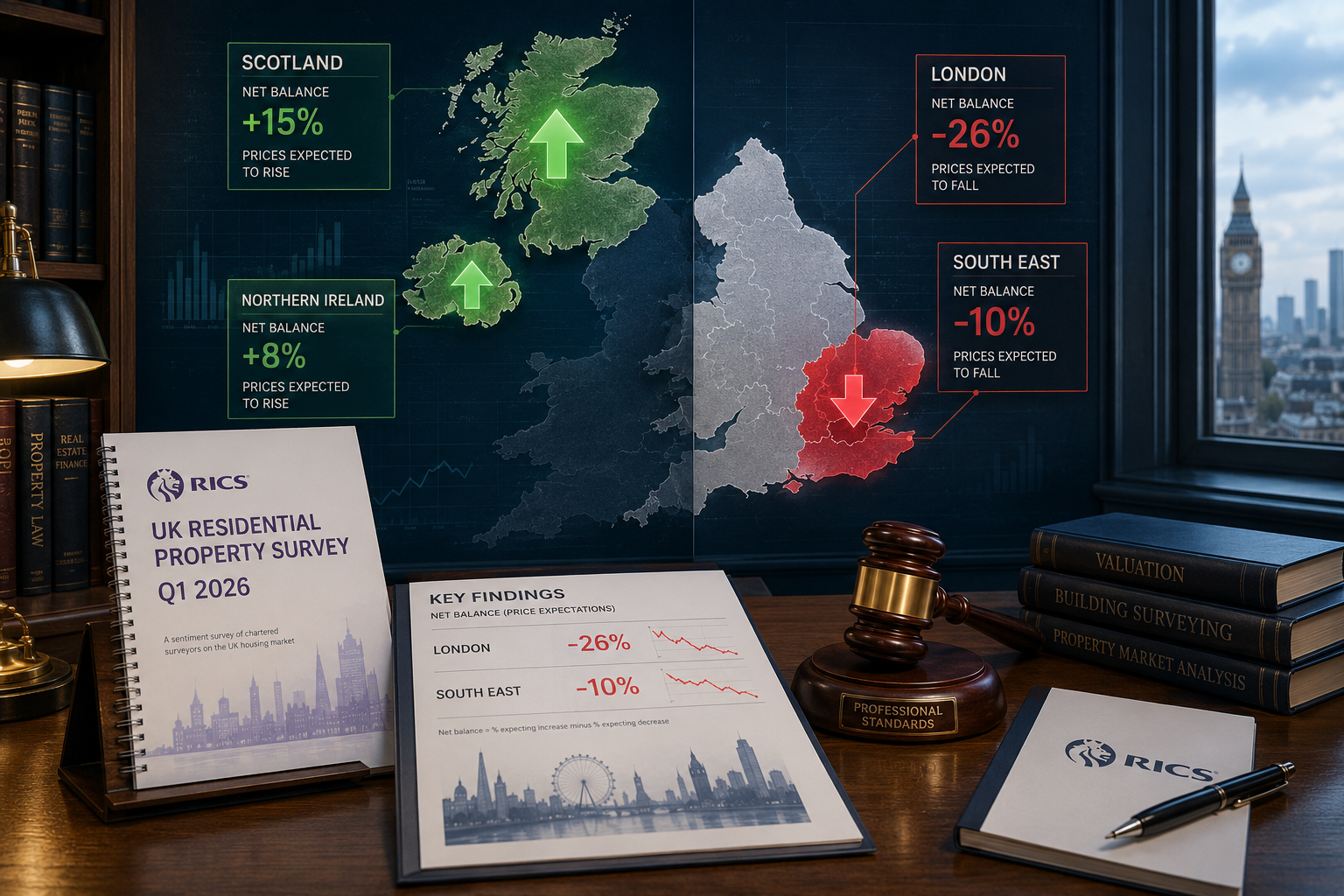
RICS data for early 2026 confirms a pattern that has been building for several quarters. Scotland and Northern Ireland are recording positive price momentum, while London and the South East continue to face downward pressure [3]. This divergence is not marginal. It is structural, driven by affordability constraints in southern markets, the residual effects of higher mortgage rates on premium-priced stock, and stronger employment dynamics in certain northern cities.
For an expert witness instructed in a dispute about a London residential property, citing a national net balance of -10% without disaggregating the regional data would be methodologically indefensible. Opposing counsel will have access to the same RICS publications. Any expert who relies on blended national figures when region-specific data is available risks having their evidence dismissed as insufficiently granular.
Key regional indicators from RICS Q1 2026 data relevant to court preparation:
| Region | Price Trend Direction | Dispute Implication |
|---|---|---|
| Scotland | Positive growth | Supports higher comparable values |
| Northern Ireland | Positive growth | Supports higher comparable values |
| London | Downward pressure | Supports lower comparable values |
| South East | Downward pressure | Supports lower comparable values |
| Midlands / North West | Mixed, stabilising | Requires sub-regional analysis |
Buyer Enquiry Data as Corroborating Evidence
The RICS UK Residential Market Survey for February 2026 recorded a net balance of -26% in new buyer enquiries, the sharpest single-month decline since mid-2023 [2]. By April 2026, that figure had worsened to -34% [6]. These are not abstract statistics. In a dispute where the question is whether a property could realistically have achieved a certain price at a certain date, demand-side data of this severity directly undermines arguments for optimistic valuations.
Expert witnesses should present buyer enquiry data as part of a layered evidential picture: price trends, demand levels, and transaction volumes together tell a more convincing story than any single metric. Courts respond well to expert evidence that demonstrates methodological rigour and a willingness to test conclusions against multiple data sources.
"The overriding duty of an expert witness is to the tribunal, not the instructing client. Courts strictly enforce this principle, and any appearance of advocacy will damage credibility under cross-examination." [1]
For expert witnesses dealing with matrimonial valuations or leasehold extension and enfranchisement valuations, the regional dimension is equally critical. A leasehold flat in South East London sits in a very different market from one in Edinburgh, and RICS Q1 2026 data provides the evidential foundation to articulate that difference precisely.
Structuring Expert Witness Reports Using RICS Q1 2026 Evidence

Effective expert witness preparation for regional price stabilisation disputes: using RICS Q1 2026 data in court depends on how that data is structured within the report itself. A well-organised report does three things simultaneously: it educates the tribunal on market context, it applies that context to the specific property in dispute, and it anticipates the opposing expert's likely arguments.
The Five-Layer Report Structure
1. Market Context Section
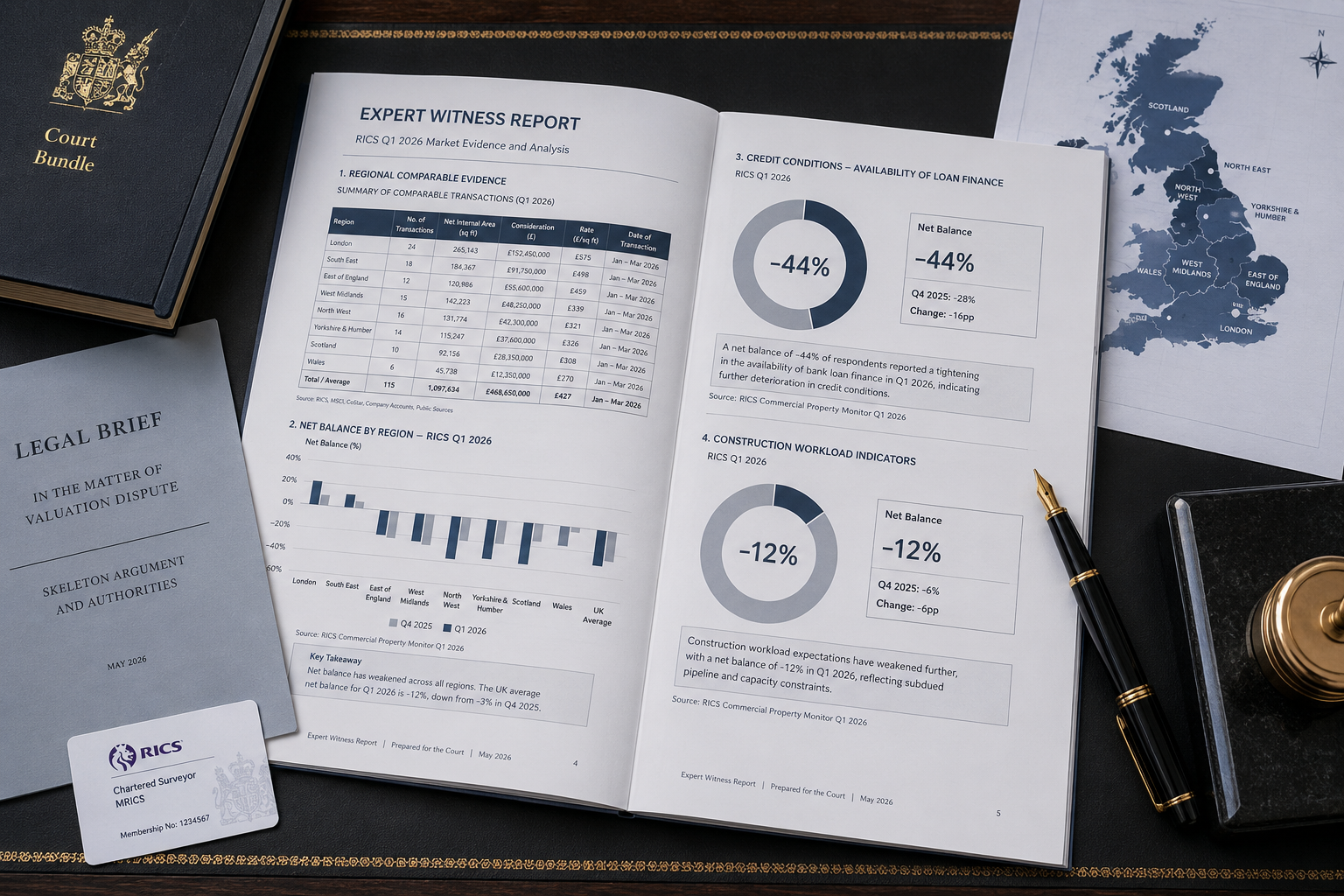
Open with a clear summary of the national picture, then immediately drill into the relevant regional data. Use RICS Q1 2026 residential survey figures for residential disputes and the RICS UK Commercial Property Monitor Q1 2026 for commercial matters. The commercial monitor recorded a collapse in credit conditions to a net balance of -44%, down from +9% in Q4 2025, representing the weakest reading since Q3 2023 [4]. This is highly material evidence in any dispute involving commercial property valuations from early 2026.
2. Regional Comparable Analysis
Select comparables from within the same RICS-defined regional market. Where comparables are scarce, explain the methodology used to adjust cross-regional evidence. Courts accept methodological transparency far better than they accept unexplained assumptions.
3. Demand and Supply Indicators
Incorporate buyer enquiry net balances, new instructions data, and agreed sales figures from the relevant RICS survey period. These indicators contextualise why a property may or may not have achieved a particular price.
4. External Macroeconomic Factors
The RICS UK Commercial Property Monitor Q1 2026 specifically identifies geopolitical tensions, rising bond yields, energy cost pressures, and inflation concerns as factors weakening confidence in the commercial property market [4]. For disputes involving commercial assets valued in early 2026, these factors are legitimate and necessary components of the expert's analysis.
5. Valuation Conclusion and Sensitivity Analysis
State the opinion of value clearly, then provide a sensitivity analysis showing how the valuation changes under different assumptions. This demonstrates intellectual honesty and significantly strengthens credibility under cross-examination.
Construction Cost Evidence in Dilapidations and Reinstatement Disputes
The RICS UK Construction Monitor Q1 2026 reported a headline workloads indicator of -12%, down from -6% in the previous quarter, with 66% of respondents citing financial constraints as a limiting factor [5]. For expert witnesses instructed in dilapidations disputes or insurance reinstatement cost valuations, this data is directly relevant to the cost of works arguments that frequently define liability.
A declining construction workload environment typically exerts downward pressure on tender prices in the short term, but the RICS Global Construction Monitor Q1 2026 simultaneously recorded rising twelve-month cost projections across all components [7]. This apparent contradiction — falling workloads alongside rising projected costs — is exactly the kind of nuanced market condition that requires expert explanation to a tribunal unfamiliar with construction economics.
RICS Accreditation and Its Impact on Courtroom Credibility
In 2026, the RICS Expert Witness Accreditation Service (EWAS) has become an increasingly expected credential rather than an optional enhancement [1]. Instructing solicitors routinely specify EWAS accreditation in their briefs, and opposing counsel will highlight its absence if the expert lacks it.
In April 2026, RICS initiated a major consultation on the fifth edition of its expert witness standard, the first revision since 2014 [1]. This update addresses the use of artificial intelligence in report preparation, conditional fee arrangements, and global applicability. Expert witnesses should monitor the outcome of this consultation closely, as any changes to the standard will affect admissibility arguments and the basis on which reports are challenged.
For surveyors working across commercial valuations or SIPP pension valuations, maintaining EWAS accreditation is not merely a professional nicety — it is a practical requirement for instructability in high-value disputes.
Cross-Examination Preparation and Evidential Robustness
The third pillar of expert witness preparation for regional price stabilisation disputes: using RICS Q1 2026 data in court is cross-examination readiness. A technically sound report can be undermined by an expert who cannot defend their methodology under sustained questioning.
Anticipating Challenges to Regional Data Selection
The most common line of attack against an expert using RICS survey data is the argument that the survey reflects sentiment rather than transactional evidence. Opposing counsel will argue that net balance figures are subjective, based on surveyor opinion rather than completed sales.
The response to this challenge requires preparation on two fronts:
- Acknowledge the limitation openly. RICS survey data is sentiment-based, and courts understand this. The expert who acknowledges this upfront and explains why sentiment data is nonetheless probative will be more credible than one who overstates the precision of the figures.
- Corroborate with transactional data. RICS survey data should always be supported by Land Registry transaction evidence, Nationwide or Halifax house price index data for the relevant region and property type, and where available, local estate agent market reports from the valuation date.
Handling the North-South Divergence Under Cross-Examination
When cross-examined on regional divergence, the expert must be able to explain precisely why the comparables chosen reflect the subject property's market rather than a different regional market. A common trap is the use of comparables from a stronger regional market to support a higher valuation in a weaker one, or vice versa.
Preparation should include:
- A written comparable analysis with explicit regional justification for each comparable selected.
- A clear explanation of any adjustments made for regional market differences.
- Reference to the specific RICS survey period that covers the valuation date, not a later or earlier survey.
The Duty to the Tribunal
Courts in England and Wales apply the principles set out in CPR Part 35 and the associated Practice Direction. The expert's overriding duty is to the court [1]. This means that where the RICS Q1 2026 data undermines the instructing party's position, the expert must say so in the report. Selective use of data that supports only one side's case is a ground for the court to give the expert's evidence little or no weight.
This principle has particular relevance in regional price stabilisation disputes where the data is genuinely mixed. An expert instructed by a seller arguing that a London property was fairly priced in Q1 2026 must acknowledge the downward pressure evidenced by the RICS survey, even if that acknowledgement is uncomfortable for the client.
For surveyors involved in party wall awards or block management legal works where valuation disputes arise as ancillary issues, the same standards of impartiality apply. The expert role is distinct from the advisory role, and conflating the two is a professional risk.
Practical Checklist for RICS Q1 2026 Data Integration
Before filing an expert report in a regional price stabilisation dispute in 2026, the following checklist should be completed:
- Confirm the precise RICS survey period that covers the relevant valuation date.
- Extract both national and regional net balance figures for price trends, buyer enquiries, and agreed sales.
- For commercial disputes, include credit condition data from the RICS UK Commercial Property Monitor.
- For construction or reinstatement disputes, include workload and cost data from the RICS UK Construction Monitor.
- Corroborate all RICS sentiment data with transactional evidence from the same region and period.
- Confirm EWAS accreditation is current and referenced in the report's opening section.
- Prepare a written response to the anticipated challenge that RICS survey data is opinion-based rather than transactional.
For those requiring a professional valuation to underpin an expert report, the chartered surveyor valuations service provides the evidential foundation that courts expect.
Conclusion
National price stabilisation is a statistical artefact that conceals the regional dynamics driving the majority of valuation disputes in 2026. Expert witness preparation for regional price stabilisation disputes: using RICS Q1 2026 data in court demands a disciplined, layered approach that moves from national context to regional specifics, corroborates sentiment data with transactional evidence, and presents conclusions with methodological transparency.
The RICS Q1 2026 data set is unusually rich in evidential material. The residential surveys document a deteriorating demand picture alongside tentative price stabilisation. The commercial property monitor records a credit conditions collapse that directly affects commercial asset values. The construction monitor highlights cost pressures that are material to reinstatement and dilapidations disputes. Each of these data streams has a role in well-prepared expert evidence.
Actionable next steps for expert witnesses and instructing solicitors:
- Review the RICS Q1 2026 residential, commercial, and construction monitor publications in full before drafting or commissioning any expert report relating to this period.
- Ensure the expert holds current RICS EWAS accreditation and is familiar with the forthcoming fifth edition of the RICS expert witness standard.
- Structure reports to address regional divergence explicitly, with a clear methodology for comparable selection that can withstand cross-examination.
- Engage a chartered surveyor with demonstrable experience in the specific regional market at issue, not simply a nationally accredited expert with no local market knowledge.
For professional guidance on valuation disputes or to commission an expert-quality property valuation, contact a qualified chartered surveyor to discuss the specific requirements of the case.
References
[1] Expert Witness Preparation For 2026 UK Valuation Disputes RICS Standards In A Recovering Market – canterburysurveyors.com
[2] Valuation Challenges From RICS February 2026 Survey Expert Witness Strategies For 26 Buyer Enquiry Dip Disputes – wimbledonsurveyors.com
[3] UK Resi Survey Jan 2026 Report Shows Early Signs Market Recovery Despite Caution – rics.org
[4] RICS UK Commercial Property Monitor Q1 2026 – rics.org
[5] RICS UK Construction Monitor Q1 2026 – rics.org
[6] UK Residential Survey April 2026 – rics.org
[7] Q1 2026 Global Construction Monitor – rics.org