

The UK property market in 2026 presents an unprecedented challenge for valuation professionals. Regional markets are moving in opposite directions, creating a perfect storm for disputes. While London and the Southeast experience price resilience, Northern regions face corrections. Affordability debates intensify as interest rates fluctuate and economic uncertainty persists. For chartered surveyors, this environment means one thing: increased scrutiny in the courtroom.
Expert witness preparation for 2026 valuation disputes requires more than technical expertise. With conflicting price signals across regions, defending your valuation methodology has never been more critical. Surveyors are increasingly called upon to testify in legal proceedings where opposing parties present vastly different property values based on selective market data. The question isn't whether you're qualified—it's whether you can communicate your findings persuasively under cross-examination.
This comprehensive guide explores how surveyors can build credibility and defensibility in their expert reports using 2026 market data, navigate the complexities of conflicting price signals, and prepare effectively for testimony that withstands rigorous legal scrutiny.
Key Takeaways
- 🎯 Early preparation is essential: Expert witness preparation should begin 60-90 days before trial, not in the final weeks before testimony[1]
- 📊 Credentials don't guarantee performance: Qualifications alone are insufficient for persuasive testimony; behavioral coaching and communication skills are equally critical[1]
- 🗣️ Clear communication trumps jargon: Experts must translate complex valuation methodologies into language that judges, juries, and opposing counsel can understand
- 📈 2026 market complexity demands robust methodology: Conflicting regional price signals require comprehensive comparable analysis and transparent reconciliation processes
- ⚖️ Credibility is observable: Defense teams focus on witness demeanor, emotional control, and consistency under cross-examination rather than credentials alone[1]
Understanding the 2026 Valuation Landscape: Why Disputes Are Increasing
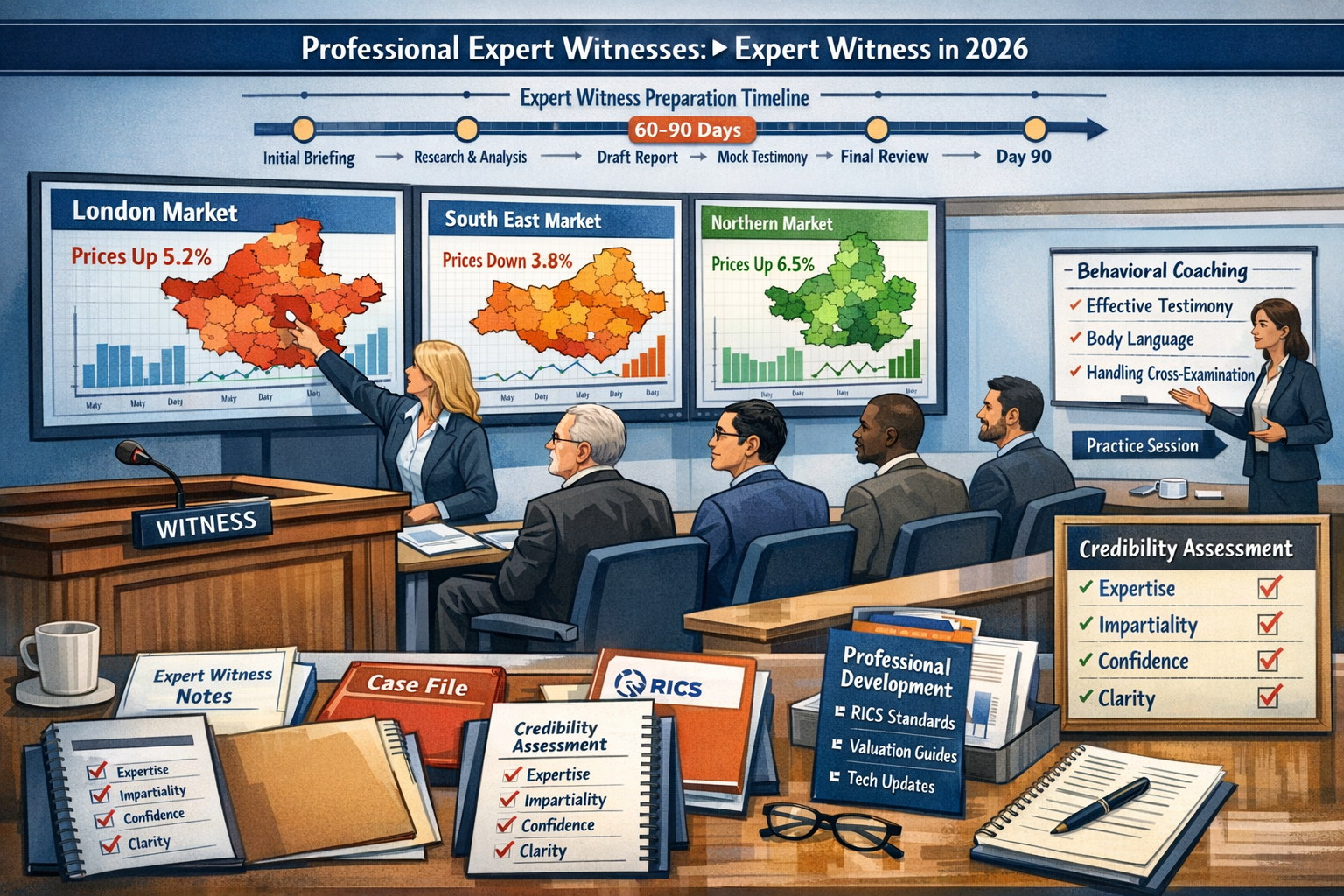
The property market in 2026 has created unprecedented challenges for valuation professionals. Unlike previous years where market trends moved relatively uniformly across the UK, current conditions show stark regional divergence. This fragmentation creates fertile ground for valuation disputes.
Regional Market Fragmentation
London and the Southeast continue to demonstrate price resilience, supported by limited supply and sustained demand from international buyers. Meanwhile, Northern regions and certain suburban markets experience price corrections as affordability constraints and economic uncertainty impact buyer behavior. This divergence means that comparable sales data can tell dramatically different stories depending on which transactions are selected.
For surveyors providing independent property valuations, this creates a methodological challenge. Traditional approaches that relied on relatively stable market conditions now require more sophisticated analysis to account for:
- Interest rate volatility affecting mortgage availability
- Economic uncertainty impacting buyer confidence
- Regional employment patterns creating localized demand variations
- Infrastructure investment driving value in specific corridors
- Affordability thresholds limiting price growth in certain segments
Common Dispute Scenarios in 2026
Valuation disputes in 2026 typically arise in several contexts:
Divorce proceedings where parties seek favorable valuations for asset division. One spouse may commission a valuation emphasizing recent comparable sales in declining areas, while the other focuses on premium transactions in resilient neighborhoods.
Tax assessments including annual tax valuations where property owners seek lower valuations to minimize liability, while tax authorities argue for higher values based on peak market data.
Commercial lease disputes involving commercial property valuations where rent reviews or lease renewals hinge on market value assessments in volatile sectors.
Pension fund valuations such as SIPP pension property valuations where trustees require defensible values for regulatory compliance and member equity.
Development appraisals where property development valuations determine viability, with developers and lenders often holding opposing views on achievable sales values.
The Credibility Gap: When Qualifications Aren't Enough
Research demonstrates a critical insight for expert witnesses: credentials alone do not ensure persuasive testimony[1]. Defense teams increasingly recognize that an expert's qualifications—no matter how impressive—don't guarantee effective performance under cross-examination.
The "credibility gap" emerges when highly qualified experts fail to communicate clearly, become defensive under questioning, or struggle to maintain composure when their methodology is challenged. In 2026's complex market environment, this gap widens as opposing counsel exploit conflicting price signals to undermine expert opinions.
"Qualifications get you in the door, but credibility keeps you there. Juries and judges evaluate experts based on observable behaviors, not just credentials." – Courtroom Sciences Research[1]
Expert Witness Preparation for 2026 Valuation Disputes: Building a Defensible Methodology
Effective expert witness preparation for 2026 valuation disputes begins long before the courtroom. The foundation lies in developing a robust, transparent, and defensible methodology that can withstand scrutiny when market data appears contradictory.
Establishing Your Valuation Framework
A defensible valuation in 2026's fragmented market requires a comprehensive framework that addresses conflicting price signals head-on. This framework should include:
1. Comprehensive Market Analysis
Begin with a thorough analysis of the relevant market segment, documenting:
- Regional economic indicators (employment, income levels, population trends)
- Local supply and demand dynamics
- Recent transaction volumes and velocity
- Price trends over multiple time periods (3-month, 6-month, 12-month, 3-year)
- Mortgage availability and financing conditions
- Competing properties currently on the market
2. Transparent Comparable Selection Criteria
Document your comparable selection process explicitly. In 2026's market, this transparency is critical. Establish clear criteria:
- Geographic boundaries (with justification for inclusion/exclusion)
- Time period parameters (addressing market timing issues)
- Property characteristics (size, condition, features)
- Transaction types (arm's length sales vs. distressed transactions)
- Adjustments methodology (with supporting data)
3. Reconciliation of Conflicting Data
When comparable sales suggest different value conclusions, address this directly in your report. Don't ignore inconvenient data—explain it:
- Identify outliers and explain why they're less relevant
- Weight comparables based on similarity and reliability
- Address temporal differences (older vs. newer transactions)
- Explain regional variations affecting comparables
- Document adjustments with supporting evidence
Structuring Your Expert Report
Your expert report serves as the foundation for your testimony. In valuation disputes involving conflicting price signals, structure matters:
Executive Summary: Present your conclusion clearly, followed by a concise explanation of your methodology and key findings.
Scope of Work: Define precisely what you were asked to value, the purpose of the valuation, and any limiting conditions.
Market Context: Provide the 2026 market backdrop, acknowledging complexity and regional variations. This demonstrates awareness rather than ignorance of market challenges.
Methodology: Detail your approach, including standards followed (RICS Red Book, IVS), valuation methods employed, and rationale for method selection.
Data Analysis: Present your comparable sales analysis, adjustments, and reconciliation process with supporting documentation.
Conclusion: State your value opinion with appropriate qualifications and effective date.
Appendices: Include supporting documentation, comparable property details, photographs, maps, and data sources.
Anticipating Challenges to Your Methodology
Opposing counsel in 2026 valuation disputes will exploit conflicting price signals to challenge your conclusions. Prepare for common attacks:
"Cherry-picking" accusations: Counsel may argue you selected only favorable comparables while ignoring contrary data. Counter this by documenting your selection criteria and explaining why certain transactions were excluded.
Temporal relevance challenges: In a rapidly changing market, opposing experts may argue your comparables are outdated or that you ignored more recent (but less favorable) transactions.
Geographic boundary disputes: Expect challenges to your market area definition, particularly if expanding or contracting boundaries would significantly alter value conclusions.
Adjustment methodology questions: Your adjustment calculations will face scrutiny. Ensure every adjustment is supported by market data or recognized methodology.
Alternative valuation approaches: Be prepared to explain why you weighted certain valuation methods over others, particularly if opposing experts reached different conclusions using different approaches.
Behavioral Preparation and Communication Skills for Expert Witnesses
Technical expertise represents only half of effective expert witness preparation for 2026 valuation disputes. The other half involves behavioral coaching and communication skills that enable you to present your findings persuasively under pressure[1].
The Psychology of Credibility
Research in jury psychology reveals that credibility assessments occur rapidly and are based largely on observable behaviors rather than credentials. Jurors and judges evaluate experts based on:
- Confidence without arrogance: Projecting certainty in your conclusions while remaining respectful and open to legitimate questions
- Composure under pressure: Maintaining emotional control when challenged or confronted with contrary evidence
- Clear communication: Explaining complex concepts without jargon or condescension
- Consistency: Providing answers that align with your written report and previous statements
- Authenticity: Appearing genuine and unbiased rather than hired advocates
Structured Behavioral Coaching
Effective expert witness preparation requires multiple training sessions, not a single pre-trial briefing[1]. Professional programs such as the AICPA Expert Witness Skills Workshop provide hands-on training with mock trials and personalized feedback from lawyers, judges, and financial experts[7].
Key components of behavioral preparation include:
Mock Cross-Examinations: Practice sessions where attorneys simulate aggressive questioning, helping you develop responses to hostile examination without becoming defensive.
Video Review: Recording practice sessions allows you to observe your own body language, verbal tics, and communication patterns that may undermine credibility.
Trigger Identification: Recognizing questions or topics that provoke emotional responses, then developing strategies to maintain composure.
Jargon Translation: Practicing explanations of technical valuation concepts in plain language accessible to non-experts.
Pause Techniques: Learning to pause before answering, allowing time to formulate clear responses rather than rushing into problematic answers.
Communication Strategies for Complex Valuation Concepts
In 2026 valuation disputes involving conflicting price signals, your ability to explain complexity clearly becomes paramount. Effective strategies include:
Use Analogies: Compare valuation adjustments to familiar concepts. For example, "Adjusting for property size is like comparing car prices—a larger vehicle costs more, all else being equal."
Visual Aids: Prepare clear charts, graphs, and maps that illustrate your comparable selection, adjustments, and value conclusion. Visual communication often resonates more effectively than verbal explanations alone.
The "Three-Point Rule": When explaining methodology, limit explanations to three key points. Additional detail can be provided if requested, but initial responses should be concise and memorable.
Acknowledge Uncertainty: In a market with conflicting signals, acknowledging appropriate uncertainty enhances rather than undermines credibility. "Given market volatility, there's a reasonable range of value" sounds more credible than claiming false precision.
Avoid Absolutes: Words like "always," "never," and "impossible" create vulnerabilities. Opposing counsel will seek exceptions that undermine your testimony.
Managing Cross-Examination
Cross-examination represents the most challenging aspect of expert testimony. Preparation for this phase should begin 60-90 days before trial[1], not in the final week.
Listen Carefully: Many experts stumble by answering the question they expected rather than the question actually asked. Listen completely before responding.
Answer Only What's Asked: Resist the temptation to over-explain or volunteer additional information. Concise, direct answers limit opportunities for follow-up attacks.
Don't Speculate: If you don't know an answer, say so. Speculation provides ammunition for opposing counsel.
Maintain Professionalism: When faced with aggressive questioning, maintain composure. Becoming defensive or argumentative damages credibility more than any substantive answer.
Refer to Your Report: Your written report is your anchor. When challenged, refer back to your documented methodology and conclusions.
Request Clarification: If a question is unclear, compound, or misleading, politely request clarification rather than attempting to answer a problematic question.
Professional Development Resources
Several organizations offer specialized training for expert witnesses in 2026:
- SEAK: Offers "How to Be an Effective Expert Witness at Deposition & Trial" scheduled for September 24-25, 2026[5]
- Appraisal Institute: Provides "The Appraiser as an Expert Witness" running through September 2026[6]
- PLI: Hosts an Expert Witness program scheduled for May 20, 2026[8]
- AICPA: Delivers the Expert Witness Skills Workshop with hands-on mock trial experience[7]
These programs provide structured environments to develop testimony skills, receive feedback from legal professionals, and practice under realistic conditions.
Navigating Conflicting Price Signals: Practical Strategies for 2026
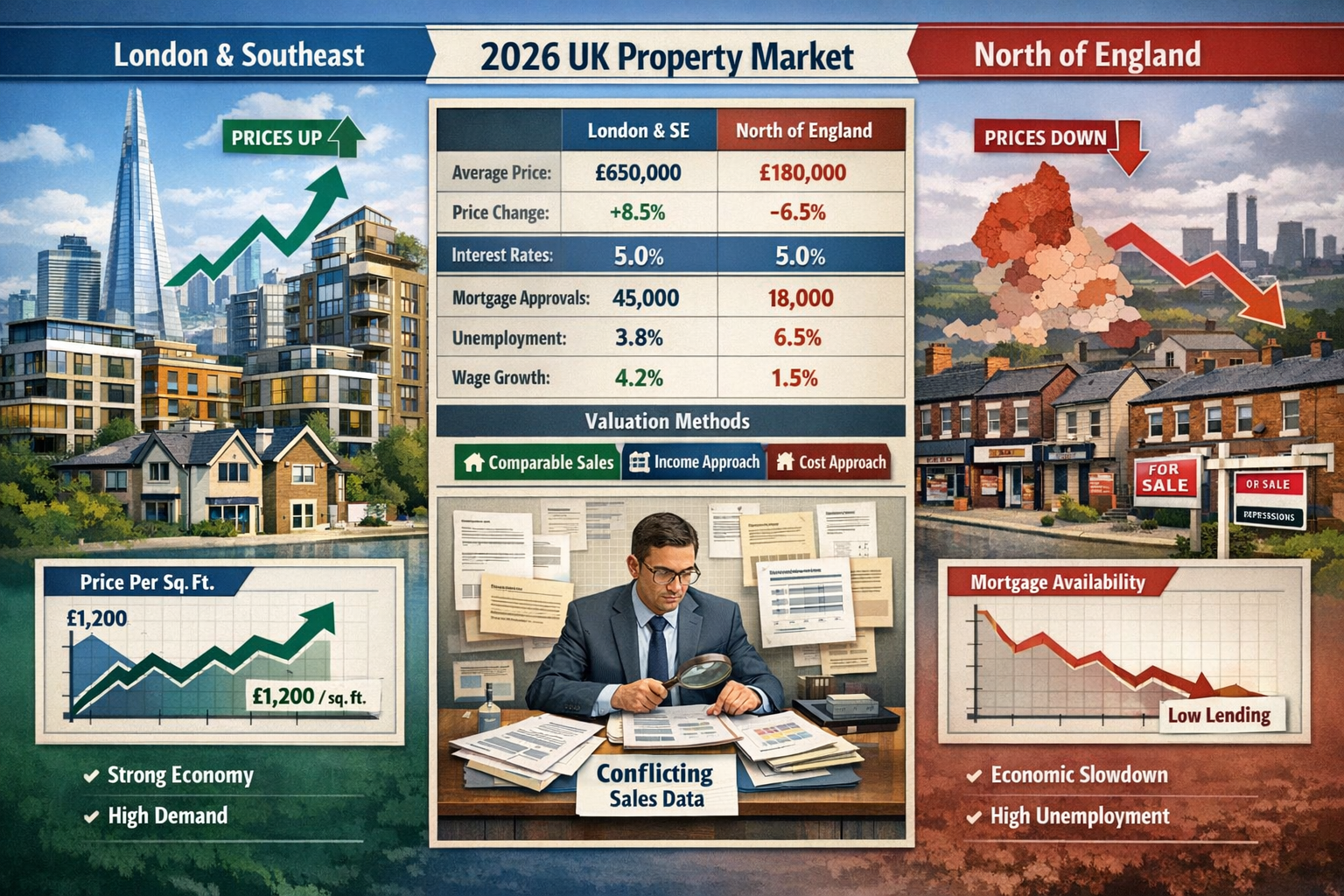
The hallmark of 2026's property market is conflicting price signals that create genuine uncertainty about value. Rather than viewing this as a weakness, expert witnesses can leverage comprehensive analysis to demonstrate superior methodology.
Understanding the Sources of Conflict
Price signals conflict in 2026 for several identifiable reasons:
Regional Economic Divergence: London's economy may strengthen while Northern manufacturing regions struggle, creating legitimate value differences that affect comparable selection.
Transaction Type Variations: Distressed sales, portfolio transactions, and arm's length sales occur simultaneously, each suggesting different value levels.
Temporal Market Shifts: Rapid changes in interest rates or economic conditions mean transactions from six months ago may reflect different market conditions than current listings.
Property-Specific Factors: Unique characteristics, condition issues, or location advantages create value variations that may appear as conflicting signals when not properly analyzed.
Buyer Motivation Differences: Investor purchases, owner-occupier transactions, and developer acquisitions reflect different value perspectives.
Developing a Comprehensive Comparable Analysis
In markets with conflicting signals, comprehensive analysis becomes your strongest defense. This requires:
Expanded Comparable Search: Cast a wider net initially, then document why certain transactions were excluded. This demonstrates thoroughness rather than selective analysis.
Temporal Stratification: Organize comparables by transaction date, showing how values have trended over time. This addresses temporal conflicts directly.
Adjustment Grid Transparency: Create detailed adjustment grids showing how you accounted for differences between comparables and the subject property. Document the basis for each adjustment percentage.
Market Condition Adjustments: In 2026's volatile environment, time-based market condition adjustments may be necessary. Support these with market indices, transaction volume data, or days-on-market trends.
Multiple Valuation Approaches: When feasible, employ multiple valuation methods (sales comparison, income capitalization, cost approach) and reconcile the results. Convergence of different methods strengthens credibility.
Addressing Opposing Expert Opinions
In valuation disputes, you'll likely face opposing expert opinions that reach different conclusions. Effective strategies include:
Analyze Their Methodology: Obtain the opposing expert's report early and identify methodological differences. Are they using different comparables? Different adjustments? Different valuation dates?
Identify Weaknesses: Look for unsupported assumptions, inappropriate comparables, or calculation errors in the opposing opinion.
Prepare Rebuttal Points: Document specific areas where the opposing methodology deviates from professional standards or market reality.
Maintain Professional Respect: Criticize methodology, not the opposing expert personally. Professional disagreement enhances credibility; personal attacks undermine it.
Acknowledge Reasonable Differences: If the opposing expert's conclusion falls within a reasonable range, acknowledge this while explaining why your analysis is more reliable.
Documenting Your Decision Process
In 2026 valuation disputes, documentation becomes critical evidence. Maintain comprehensive records of:
- Initial instructions and scope definition
- Market research and data collection
- Comparable property selection and rejection decisions
- Adjustment calculations and supporting data
- Consultations with market participants
- Revisions to your analysis and reasons for changes
- Communications with retaining counsel (subject to privilege)
This documentation serves multiple purposes: it demonstrates thoroughness, provides reference material for testimony preparation, and offers evidence of your professional process.
Leveraging Technology and Data
Modern valuation practice in 2026 benefits from sophisticated technology:
Market Data Platforms: Utilize comprehensive databases that provide transaction data, market trends, and statistical analysis tools.
Geographic Information Systems (GIS): Map comparables and visualize market areas, helping explain geographic boundaries and market segmentation.
Automated Valuation Models (AVMs): While not substitutes for professional judgment, AVMs can provide supporting evidence or help identify appropriate comparable ranges.
Statistical Analysis: Regression analysis and other statistical tools can support adjustment calculations and demonstrate market relationships.
Presentation Technology: Develop clear, professional visual presentations that communicate your analysis effectively in depositions and trial testimony.
Building Long-Term Credibility as an Expert Witness
Success as an expert witness in valuation disputes extends beyond individual cases. Building long-term credibility requires consistent professional development and ethical practice.
Maintaining Professional Standards
Adherence to professional standards provides the foundation for credible expert testimony:
RICS Standards: Follow the RICS Red Book for valuation assignments, documenting compliance in your reports.
Independence: Maintain genuine independence from the outcome. Your role is to provide objective opinion, not to advocate for the retaining party's desired result.
Competence: Only accept assignments within your area of expertise. Declining cases outside your competence enhances rather than diminishes your reputation.
Continuing Education: Participate in professional development programs, including expert witness training, market analysis courses, and methodology updates.
Peer Review: Subject your work to peer review when appropriate, demonstrating confidence in your methodology.
Developing Your Expert Profile
Establishing yourself as a credible expert witness requires strategic professional development:
Publish: Write articles on valuation methodology, market analysis, or expert witness practice. Publications demonstrate expertise and thought leadership.
Present: Speak at professional conferences on valuation topics, building recognition within the professional community.
Teach: Instruct courses on valuation methodology or expert witness practice, reinforcing your expertise while contributing to the profession.
Professional Memberships: Maintain active involvement in professional organizations such as RICS, demonstrating commitment to professional standards.
Specialization: Develop recognized expertise in specific property types or market segments, becoming the go-to expert for particular valuation challenges.
Ethical Considerations
Expert witness practice raises unique ethical challenges:
Advocacy vs. Objectivity: Your role is to provide objective opinion, not to advocate for your client's position. Maintain this distinction clearly.
Fee Structures: Avoid contingency fees or compensation tied to case outcomes, which compromise independence.
Report Accuracy: Never misrepresent data, omit material information, or overstate the certainty of your conclusions.
Disclosure: Disclose any relationships, interests, or circumstances that might affect your independence or objectivity.
Professional Courtesy: Treat opposing experts with professional respect, even when disagreeing with their methodology or conclusions.
Learning from Each Assignment
Every expert witness assignment provides learning opportunities:
Post-Case Review: After each case, review your performance, identifying areas for improvement in methodology, communication, or testimony.
Feedback Collection: Seek feedback from retaining counsel on your report quality, deposition performance, and trial testimony.
Methodology Refinement: Incorporate lessons learned into your standard methodology, continuously improving your practice.
Documentation Improvement: Enhance your documentation practices based on questions encountered during cross-examination.
Training Needs: Identify skills requiring additional development, then pursue targeted training.
Preparing for Deposition and Trial Testimony in 2026
The culmination of expert witness preparation for 2026 valuation disputes comes during deposition and trial testimony. Success requires specific preparation for each phase.
Pre-Deposition Preparation
Depositions serve multiple purposes: opposing counsel evaluates your credibility, locks in your testimony, and searches for weaknesses to exploit at trial. Preparation should include:
Report Review: Re-read your expert report thoroughly, ensuring complete familiarity with every statement, calculation, and conclusion.
Document Review: Review all documents you considered in forming your opinion, as you may be questioned about specific items.
Counsel Consultation: Meet with retaining counsel to discuss likely questioning topics, case strategy, and potential challenges to your methodology.
Anticipated Questions: Prepare for predictable questions about qualifications, methodology, assumptions, and conclusions.
Exhibit Preparation: Organize exhibits, reports, and supporting documents for easy reference during testimony.
Practice Sessions: Conduct mock depositions with retaining counsel, practicing responses to challenging questions.
Deposition Testimony Strategies
During deposition, employ these strategies:
Listen Carefully: Ensure you understand each question before answering. Request clarification if needed.
Pause Before Answering: Take a moment to formulate clear, concise responses rather than rushing to fill silence.
Answer Only What's Asked: Avoid volunteering additional information that may open new lines of questioning.
Admit Limitations: Acknowledge the limits of your analysis rather than overstating certainty.
Reference Your Report: Ground answers in your written report, maintaining consistency.
Stay Professional: Remain courteous and professional regardless of the tone of questioning.
Take Breaks: Request breaks when needed to maintain focus and composure during lengthy depositions.
Trial Preparation
Trial testimony requires additional preparation beyond deposition:
Courtroom Familiarization: If possible, visit the courtroom in advance to become comfortable with the physical environment.
Direct Examination Preparation: Work with retaining counsel to structure direct examination that presents your opinion clearly and persuasively.
Visual Aids: Develop professional exhibits, charts, and demonstratives that communicate your analysis visually.
Cross-Examination Anticipation: Based on deposition questioning and opposing expert reports, anticipate cross-examination topics and prepare responses.
Jury Considerations: Adapt your communication style for jury trials, using plain language and relatable examples.
Redirect Preparation: Discuss potential redirect examination topics with retaining counsel to address cross-examination challenges.
Trial Testimony Best Practices
During trial testimony, observe these practices:
Dress Professionally: Appearance matters. Dress in conservative business attire appropriate for courtroom proceedings.
Address the Decision-Maker: In jury trials, direct your answers to the jury rather than the questioning attorney. In bench trials, address the judge.
Use Plain Language: Avoid technical jargon, or explain it clearly when necessary.
Maintain Composure: Stay calm and professional, even during aggressive cross-examination.
Admit Uncertainty: Acknowledge appropriate uncertainty rather than claiming false precision.
Don't Argue: Answer questions directly without arguing with opposing counsel.
Take Your Time: There's no prize for speed. Take time to provide thoughtful, accurate answers.
Stay Consistent: Maintain consistency with your report and deposition testimony.
Post-Testimony Reflection
After testimony concludes, engage in reflection and learning:
Performance Assessment: Evaluate your testimony performance, identifying strengths and areas for improvement.
Counsel Feedback: Discuss your testimony with retaining counsel, obtaining their perspective on effectiveness.
Documentation: Document lessons learned for application in future expert witness assignments.
Continuing Education: Identify any knowledge gaps or skill deficiencies revealed during testimony, then pursue targeted education.
Conclusion: Mastering Expert Witness Preparation in an Uncertain Market
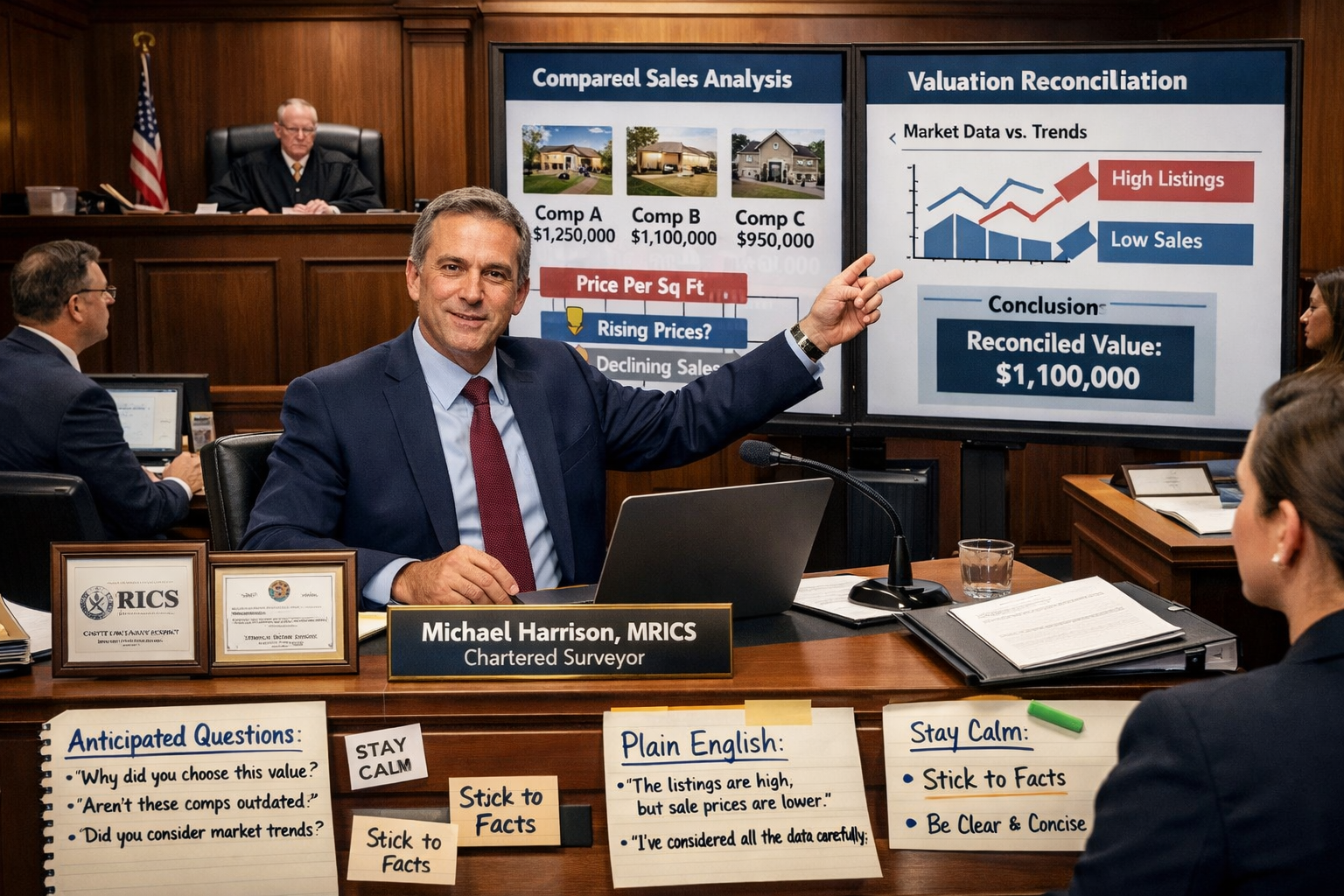
Expert witness preparation for 2026 valuation disputes navigating disagreements in a market with conflicting price signals represents both a challenge and an opportunity for chartered surveyors. The complexity of current market conditions creates increased demand for credible, well-prepared experts who can communicate sophisticated analysis clearly and defend their methodology under scrutiny.
Success requires a multi-faceted approach:
Technical Excellence: Develop robust, transparent valuation methodologies that address conflicting price signals comprehensively and document your analysis thoroughly.
Behavioral Preparation: Invest in structured behavioral coaching and communication skills development, beginning 60-90 days before trial rather than in the final weeks[1].
Professional Development: Pursue specialized training through programs offered by SEAK[5], the Appraisal Institute[6], AICPA[7], and other professional organizations.
Ethical Practice: Maintain independence, objectivity, and adherence to professional standards throughout every assignment.
Continuous Improvement: Learn from each expert witness assignment, refining your methodology and testimony skills based on experience.
The fragmented property market of 2026 will continue generating valuation disputes as parties exploit conflicting price signals to support opposing positions. Surveyors who master expert witness preparation will find themselves in high demand, serving a critical role in resolving these disputes fairly and efficiently.
Actionable Next Steps
For Surveyors New to Expert Witness Work:
- Enroll in specialized expert witness training such as the SEAK program scheduled for September 2026[5]
- Observe experienced expert witnesses in deposition or trial to learn effective testimony techniques
- Develop a standardized report template that addresses common challenges and ensures comprehensive documentation
- Seek mentorship from experienced expert witnesses in your market
- Start with smaller, less complex cases to build experience before accepting high-stakes assignments
For Experienced Expert Witnesses:
- Review and update your methodology to address 2026's conflicting price signals comprehensively
- Schedule behavioral coaching sessions to refine testimony skills and address any credibility gaps[1]
- Develop enhanced visual aids and demonstratives that communicate complex analysis clearly
- Expand your professional network to include attorneys who regularly retain expert witnesses
- Consider publishing or presenting on valuation methodology in uncertain markets to enhance your expert profile
For Firms Building Expert Witness Capabilities:
- Invest in staff training through professional development programs[5][6][7]
- Develop quality control processes for expert reports, including peer review
- Create comprehensive documentation standards that support defensible testimony
- Build relationships with law firms that handle valuation disputes
- Establish internal mock deposition and trial preparation protocols
The property market's complexity in 2026 demands excellence in expert witness preparation. Those who invest in developing both technical expertise and testimony skills will find themselves well-positioned to serve this critical professional role effectively.
For surveyors seeking to enhance their valuation practice and expert witness capabilities, professional valuation services that maintain rigorous standards and comprehensive methodologies provide the foundation for credible expert testimony. Whether you're preparing for your first expert witness assignment or refining your approach after years of practice, the principles outlined in this guide will help you navigate the challenges of 2026's uncertain market with confidence and credibility.
References
[1] Expert Witness Credibility Gap When Qualifications Dont Equal Performance – https://www.courtroomsciences.com/litigation-consulting-1/expert-witness-credibility-gap-when-qualifications-dont-equal-performance/
[2] Wdexperttestimony – https://www.nacva.com/wdexperttestimony
[3] Conference Couse – https://www.isa-appraisers.org/annual-conference/conference-couse
[4] Expert Witness Testimony – https://steinsperling.com/areas-of-interest/expert-witness-testimony/
[5] How To Be An Effective Expert Witness At Deposition Trial September 24 25 2026 Live Via Zoom – https://store.seak.com/how-to-be-an-effective-expert-witness-at-deposition-trial-september-24-25-2026-live-via-zoom/
[6] appraisalinstitute – https://www.appraisalinstitute.org/education/search/appraiser-as-expert-witness-preparation-and-testimony/525990
[7] Aicpa Cima Expert Witness Skills Workshop – https://www.aicpa-cima.com/cpe-learning/conference/aicpa-cima-expert-witness-skills-workshop
[8] pli.edu – https://www.pli.edu/programs/expert-witness/442840
[9] Expert Witness Civil Trials Effective Preparation And Presentation Sub 13504883 – https://store.legal.thomsonreuters.com/en-us/products/expert-witness-civil-trials-effective-preparation-and-presentation-sub-13504883