

}
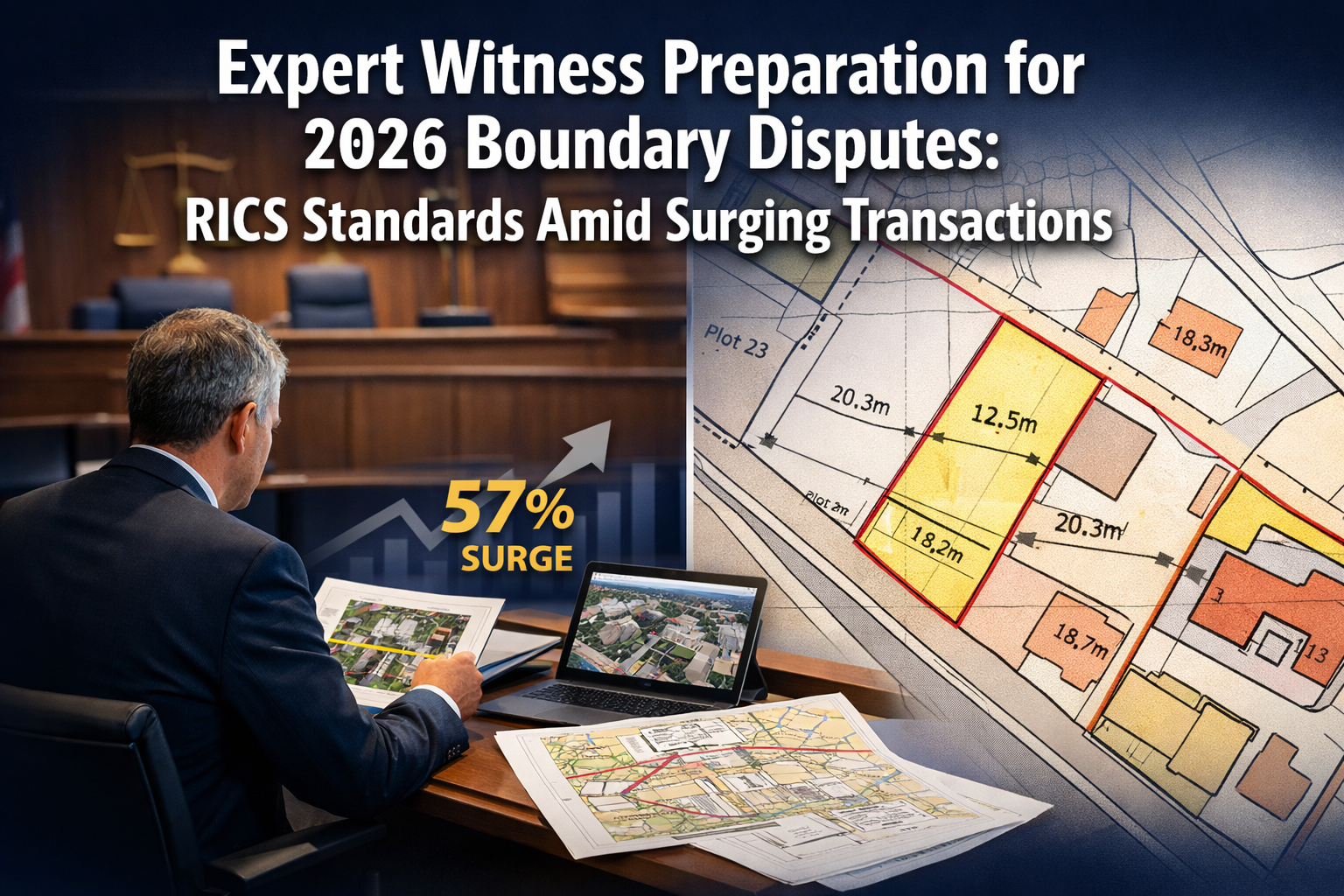
The property market is experiencing unprecedented activity in early 2026, with buyer demand surging by an astonishing 57% compared to the previous year. This dramatic increase has triggered a corresponding rise in boundary disputes, placing expert witnesses at the forefront of resolving complex property conflicts. As transactions multiply and property values stabilize after years of volatility, Expert Witness Preparation for 2026 Boundary Disputes: RICS Standards Amid Surging Transactions has become a critical competency for chartered surveyors navigating this challenging landscape.
The convergence of heightened market activity, evolving digital evidence presentation methods, and updated Royal Institution of Chartered Surveyors (RICS) professional standards creates a unique environment where expert witnesses must refine their testimony techniques. Modern boundary dispute resolution increasingly relies on sophisticated digital visuals, comprehensive historical data analysis, and unwavering adherence to professional conduct principles that prioritize the court's interests above all else.
Key Takeaways
✅ Market surge drives disputes: The 57% increase in buyer demand during early 2026 has generated a proportional rise in boundary conflicts requiring expert witness testimony
✅ RICS certification essential: The 12-week RICS Expert Witness Certificate program establishes competency standards for report writing, evidence presentation, and professional conduct [6]
✅ Digital evidence transformation: Expert witnesses now leverage advanced visual technologies including drone surveys, 3D modeling, and interactive mapping to present compelling boundary evidence
✅ Impartiality paramount: Updated RICS standards emphasize that expert witnesses must prioritize assisting the court over promoting either party's case, maintaining strict independence [2]
✅ Specialized qualifications required: Boundary dispute experts need demonstrated experience in land surveying, aerial photograph interpretation, mapping expertise, and civil procedure rule familiarity [1]
Understanding the 2026 Property Transaction Surge and Boundary Dispute Implications
The remarkable 57% increase in buyer demand during the first quarter of 2026 represents a watershed moment for the UK property market. This surge follows several years of price stabilization, creating ideal conditions for property transactions but simultaneously increasing the likelihood of boundary-related conflicts. When property changes hands more frequently, previously dormant boundary uncertainties surface, requiring expert resolution.
Why Boundary Disputes Increase During Transaction Peaks
Several interconnected factors explain the correlation between transaction volume and boundary disputes:
📊 Enhanced scrutiny during conveyancing: Solicitors and buyers conduct more thorough due diligence during active markets, uncovering historical boundary ambiguities that might otherwise remain unnoticed.
🏘️ Property development pressure: Increased demand encourages property owners to maximize land use, leading to encroachments, fence disputes, and disagreements over precise boundary locations.
💰 Higher property values: Stabilized yet elevated property prices mean even small boundary adjustments can represent significant financial implications, motivating parties to pursue formal dispute resolution.
📋 Historical documentation gaps: Many properties lack precise boundary demarcation in historical deeds, creating interpretation challenges when ownership transfers occur.
The role of chartered surveyors across various locations has expanded significantly to address these challenges, with professionals increasingly called upon to provide expert witness testimony in boundary dispute proceedings.
The Economic Context of 2026 Boundary Conflicts
The current property market environment differs markedly from previous transaction peaks. Price stabilization following the volatility of 2022-2024 provides expert witnesses with more reliable comparable evidence when assessing boundary-related property value impacts. This stability enables more accurate testimony regarding financial consequences of disputed boundaries.
| Market characteristic | Impact on boundary disputes | Expert witness consideration |
|---|---|---|
| 57% demand increase | Higher transaction volume | More dispute cases requiring testimony |
| Price stabilization | Reliable valuation data | Stronger comparable evidence |
| Digital documentation | Enhanced evidence quality | Advanced presentation capabilities |
| Buyer scrutiny | Earlier dispute identification | Preventative expert consultation |
RICS Standards for Expert Witness Preparation in Boundary Disputes
The Royal Institution of Chartered Surveyors maintains rigorous professional standards governing expert witness conduct, recently updated to address emerging challenges in the modern property landscape. Understanding and implementing these standards represents the foundation of competent Expert Witness Preparation for 2026 Boundary Disputes: RICS Standards Amid Surging Transactions.
Core Professional Obligations Under RICS Guidelines
RICS professional standards establish unambiguous expectations for expert witnesses involved in boundary disputes. The fundamental principle centers on impartiality and court assistance rather than partisan advocacy [2]. This distinction separates expert witnesses from other professionals engaged in property transactions.
Key obligations include:
🎯 Primary duty to the court: Expert witnesses must prioritize assisting the tribunal in reaching accurate conclusions, even when findings may disadvantage the instructing party [2]
⚖️ Absolute impartiality: Personal opinions, financial interests, or party relationships cannot influence expert testimony or report conclusions
📝 Transparent methodology: All analytical processes, data sources, and reasoning must be clearly documented and defensible under cross-examination
🔍 Scope limitation: Experts must only provide opinions within their demonstrated areas of competence and experience [1]
💼 Professional conduct compliance: Adherence to mandatory RICS professional practice statements governs all aspects of expert witness engagement [2]
These obligations extend beyond courtroom testimony to encompass all written reports, preliminary opinions, and communications related to boundary dispute cases. Party wall services often intersect with boundary disputes, requiring similar professional standards.
Updated RICS Expert Witness Standards for 2026
Recent updates to RICS expert witness guidance address contemporary challenges including conditional fee arrangements and technology integration [3]. The revised standards emphasize integrity and independence while acknowledging the evolving landscape of evidence presentation.
Notable updates include:
Enhanced technology guidance: Recognition of digital evidence presentation methods including drone surveys, 3D boundary modeling, and interactive mapping systems
Conditional fee prohibitions: Stricter limitations on fee arrangements that might compromise expert independence or create perceived bias
Expanded competency frameworks: More detailed specifications regarding required qualifications for specialized dispute types, particularly boundary conflicts
Modern communication protocols: Guidelines addressing electronic report submission, video testimony, and digital evidence exchange
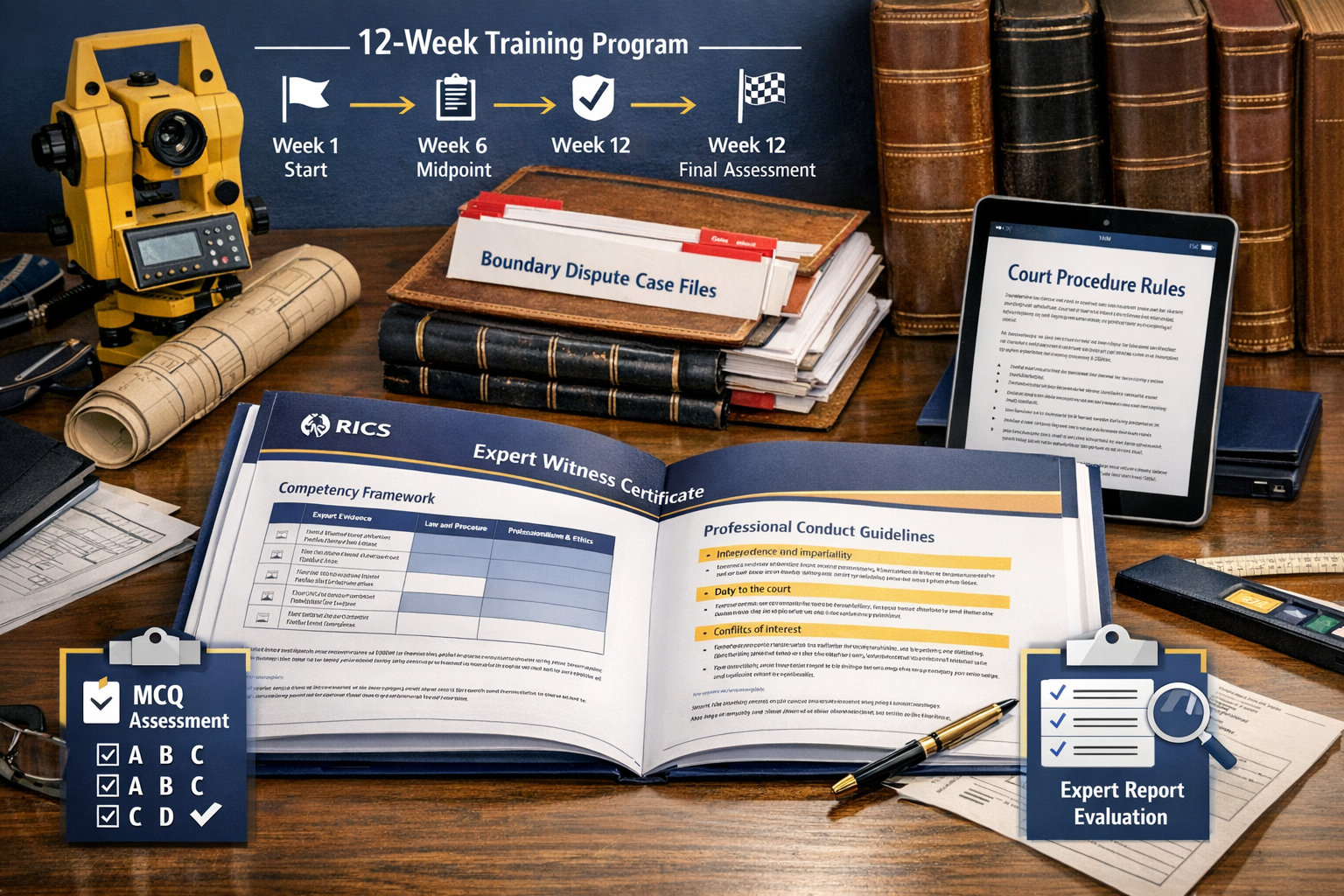
The RICS Expert Witness Certificate program provides structured training aligned with these updated standards [6]. This 12-week practical learning program includes multiple-choice assessments and expert report evaluation, specifically designed to recognize competence in expert report writing, evidence presentation, and professional conduct.
The RICS Expert Witness Certificate: Structured Competency Development
For professionals seeking to establish or enhance their expert witness credentials, the RICS Expert Witness Certificate represents the gold standard qualification [6]. This comprehensive program addresses the specific demands of boundary dispute testimony within the broader context of expert witness practice.
The certificate program structure includes:
Duration: 12 weeks of intensive practical learning
Assessment methods: Multiple-choice examinations and expert report evaluation
Core competencies: Report writing, evidence presentation, professional conduct
Practical application: Real-world case study analysis and report development
Professional recognition: RICS-certified competency verification
Participants develop skills directly applicable to boundary dispute cases, including:
- Analyzing complex land registry documentation and historical deeds
- Interpreting aerial photographs and cadastral survey data
- Preparing defensible expert reports meeting civil procedure requirements
- Presenting technical boundary evidence to non-specialist tribunals
- Maintaining impartiality under adversarial cross-examination
The program's emphasis on practical learning ensures participants can immediately apply acquired skills to active boundary dispute cases, making it particularly valuable for professionals serving areas with high transaction volumes like chartered surveyors in West London.
Essential Qualifications and Skills for Boundary Dispute Expert Witnesses
Beyond general expert witness competency, boundary dispute specialists require specific technical knowledge and demonstrable experience. The unique challenges of boundary conflicts demand expertise that combines surveying precision, historical research capabilities, and legal procedural understanding.
Technical Competencies Required for Boundary Dispute Testimony
Boundary dispute expert witnesses must demonstrate mastery across multiple technical domains [1]:
🗺️ Mapping and Land Survey Expertise
Comprehensive understanding of:
- Ordnance Survey mapping conventions and historical changes
- Cadastral survey principles and boundary demarcation methods
- Geodetic coordinate systems and measurement accuracy standards
- Survey equipment operation including total stations and GPS receivers
- Digital mapping software and GIS applications
📸 Aerial Photograph Interpretation Skills
Proficiency in:
- Historical aerial photograph analysis spanning multiple decades
- Photogrammetric measurement techniques for boundary determination
- Temporal change detection using sequential imagery
- Stereoscopic photograph interpretation for topographic analysis
- Integration of aerial evidence with ground-level survey data
📚 Historical Documentation Research
Capability to:
- Analyze historical deeds, conveyances, and land registry documents
- Interpret archaic measurement units and boundary descriptions
- Research tithe maps, enclosure awards, and estate plans
- Evaluate documentary evidence hierarchy and reliability
- Construct chronological boundary evolution narratives
⚖️ Legal and Procedural Knowledge
Familiarity with:
- Civil Procedure Rules governing expert evidence
- Land Registration Act provisions affecting boundary disputes
- Limitation Act implications for adverse possession claims
- Party Wall Act intersections with boundary conflicts
- Court protocols for expert witness conduct and testimony
These technical competencies must be supported by documented experience demonstrating successful application in previous boundary dispute cases [1]. Many professionals develop this expertise through roles with building survey specialists before transitioning to expert witness practice.
Demonstrating Court Appearance Experience
Theoretical knowledge proves insufficient without practical courtroom experience. Expert witnesses must demonstrate comfort and competence when:
✅ Presenting complex technical evidence to non-specialist judges and juries
✅ Maintaining composure and clarity under aggressive cross-examination
✅ Explaining technical concepts using accessible language
✅ Responding to unexpected questions without preparation time
✅ Defending methodology and conclusions against opposing expert criticism
Building court experience typically progresses through:
- Preliminary involvement: Preparing reports for cases that settle before trial
- Observation: Attending hearings as a learning observer
- Minor testimony: Providing evidence in small claims or preliminary hearings
- Full trial experience: Serving as primary expert witness in contested boundary trials
- Complex cases: Handling multi-party disputes with competing expert testimony
This progressive experience development ensures expert witnesses can maintain the professional demeanor and technical precision required when substantial property interests depend on their testimony.
Specialized Knowledge for Different Boundary Dispute Types
Not all boundary disputes present identical challenges. Expert witnesses should develop specialized knowledge relevant to common dispute categories:
Residential fence line disputes: Understanding typical garden boundary practices, historical fencing conventions, and suburban property development patterns
Rural land boundaries: Expertise in agricultural land use, hedgerow and ditch ownership conventions, and large-scale cadastral surveying
Commercial property boundaries: Knowledge of industrial estate layouts, access rights, and commercial property development history
Adverse possession claims: Detailed understanding of limitation periods, factual possession requirements, and documentary evidence evaluation
Registered versus unregistered land: Familiarity with different evidentiary standards and Land Registry boundary determination principles
Professionals offering commercial valuations often encounter boundary disputes requiring this specialized expertise, particularly in commercial property contexts.
Digital Evidence Presentation: Modern Tools for Boundary Dispute Testimony
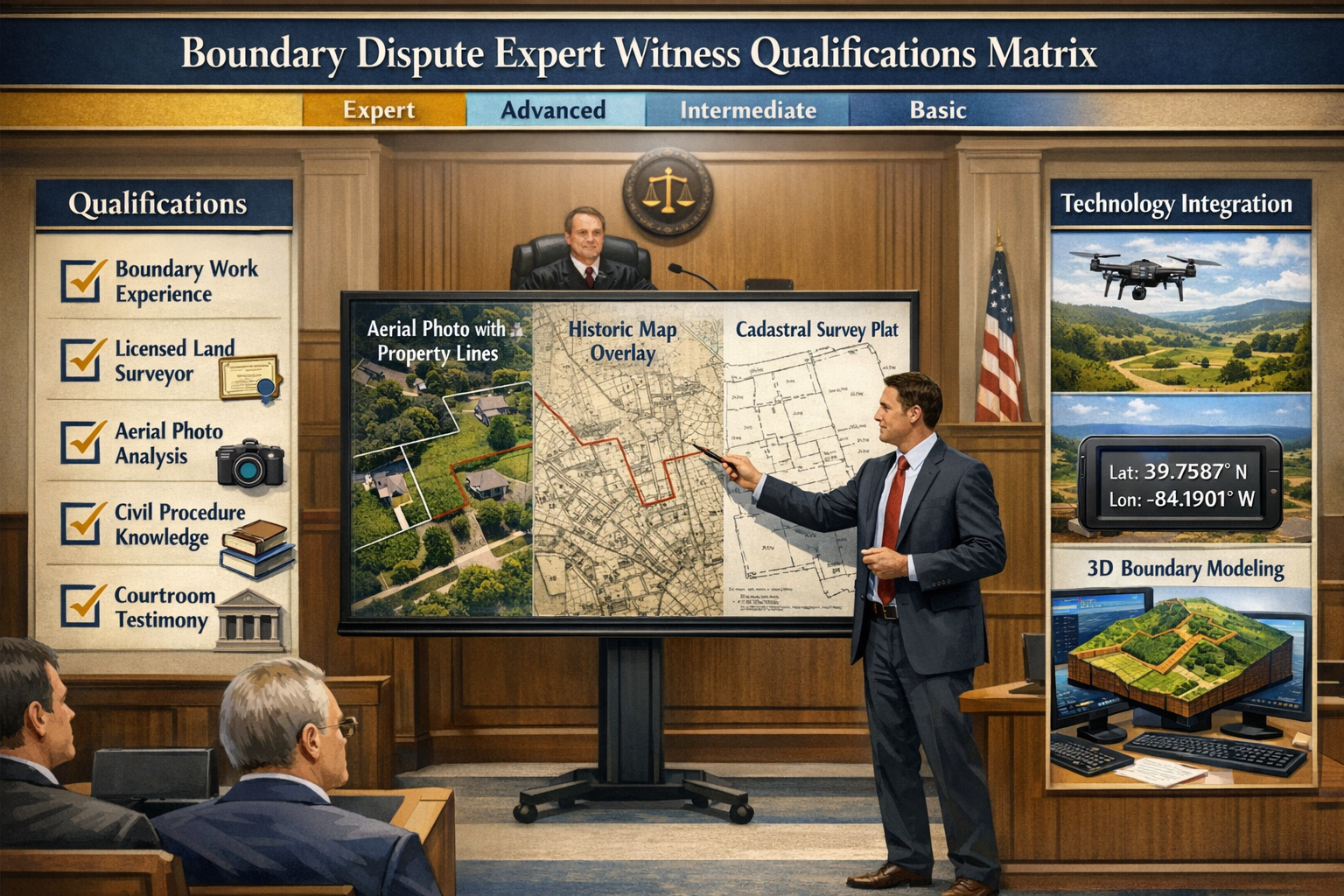
The transformation of evidence presentation represents one of the most significant developments in Expert Witness Preparation for 2026 Boundary Disputes: RICS Standards Amid Surging Transactions. Traditional paper maps and photographs have given way to sophisticated digital visualizations that enhance tribunal understanding while maintaining evidentiary rigor.
Advanced Visual Technologies Transforming Boundary Evidence
Modern expert witnesses leverage multiple digital technologies to present compelling boundary evidence:
🚁 Drone Survey Integration
Unmanned aerial vehicles provide unprecedented perspective on disputed boundaries:
- High-resolution orthophotography showing current boundary conditions
- Oblique imagery revealing three-dimensional property relationships
- Temporal comparison sequences documenting boundary changes
- Precise photogrammetric measurements from calibrated aerial platforms
- Cost-effective site documentation without physical access requirements
Premium drone survey services have become standard tools for expert witnesses preparing boundary dispute evidence, offering visual clarity impossible to achieve through traditional methods.
🖥️ 3D Boundary Modeling and Visualization
Three-dimensional representations help non-specialist tribunals understand complex spatial relationships:
- Interactive 3D models allowing virtual site exploration
- Overlay comparisons showing disputed versus claimed boundaries
- Topographic modeling revealing drainage and access implications
- Historical reconstruction showing boundary evolution over time
- Virtual reality presentations for immersive evidence experience
📊 Interactive Mapping and GIS Applications
Geographic Information Systems enable sophisticated spatial analysis:
- Multi-layer mapping combining historical and contemporary data
- Precision measurement tools with documented accuracy standards
- Spatial analysis revealing boundary line probability zones
- Integration of survey data, aerial imagery, and documentary evidence
- Dynamic presentations allowing real-time tribunal questions
📱 Digital Report Presentation Platforms
Modern expert reports transcend static PDF documents:
- Hyperlinked reports enabling easy reference navigation
- Embedded high-resolution imagery and interactive diagrams
- Video annotations explaining complex technical concepts
- Tablet-optimized formats for courtroom presentation
- Cloud-based access enabling remote tribunal participation
These technologies must be deployed while maintaining evidentiary standards and ensuring all digital evidence meets admissibility requirements under civil procedure rules.
Balancing Technology with Traditional Evidentiary Standards
While digital tools enhance presentation quality, expert witnesses must ensure technological sophistication doesn't compromise fundamental evidentiary principles:
⚠️ Authenticity verification: All digital evidence requires documented provenance and chain of custody
⚠️ Methodology transparency: Digital analysis processes must be fully explained and reproducible
⚠️ Technology accessibility: Tribunals must be able to understand and evaluate digital evidence without specialized training
⚠️ Backup documentation: Traditional paper documentation should supplement digital presentations
⚠️ Cross-examination readiness: Experts must defend digital methodology under adversarial questioning
The integration of traditional surveying expertise with modern presentation technology creates the most persuasive boundary dispute evidence. Professionals conducting building inspections and surveys increasingly adopt this hybrid approach.
Creating Compelling Visual Narratives for Boundary Disputes
Effective expert witness testimony transforms technical data into comprehensible narratives. Digital tools facilitate this transformation through:
Sequential visualization: Showing boundary evolution chronologically using historical maps, aerial photographs, and contemporary surveys
Comparative analysis: Side-by-side presentations highlighting differences between competing boundary interpretations
Uncertainty representation: Visual depiction of measurement accuracy ranges and documentary ambiguity zones
Impact demonstration: Clear illustration of practical consequences resulting from alternative boundary determinations
Simplified complexity: Progressive disclosure techniques introducing technical concepts incrementally
These narrative techniques help tribunals grasp boundary dispute complexities without requiring specialized surveying knowledge, fulfilling the expert witness's fundamental obligation to assist the court.
Preparing Expert Reports for Boundary Disputes: Best Practices for 2026
The written expert report forms the cornerstone of boundary dispute testimony. RICS standards and civil procedure rules establish specific requirements that expert witnesses must satisfy when preparing these critical documents [3].
Structural Requirements for Compliant Expert Reports
Boundary dispute expert reports must include specific elements mandated by civil procedure rules and professional standards:
📋 Executive Summary
- Concise statement of instructions received
- Summary of key opinions and conclusions
- Clear identification of disputed boundary location
- Brief methodology overview
🎓 Expert Qualifications and Experience
- Detailed CV emphasizing relevant boundary dispute experience
- Professional memberships and certifications (particularly RICS designation)
- Specific experience with similar property types and dispute contexts
- Confirmation of expert witness training completion [6]
📍 Property Description and Context
- Comprehensive description of subject property and surroundings
- Historical ownership and development chronology
- Relevant planning history and property modifications
- Current use and physical characteristics
📚 Documentary Evidence Analysis
- Systematic review of title deeds and land registry documents
- Historical mapping and aerial photograph interpretation
- Previous survey reports and boundary determinations
- Correspondence and agreements between parties
🔬 Site Investigation and Survey Work
- Detailed description of site inspection methodology
- Survey measurements and coordinate data
- Photographic documentation of current conditions
- Physical evidence observations (fence posts, walls, hedgerows)
⚖️ Opinion and Conclusions
- Clear statement of boundary location opinion
- Reasoning supporting conclusions with reference to evidence
- Assessment of alternative interpretations
- Acknowledgment of uncertainties and limitations
✍️ Declaration of Truth and Independence
- Confirmation that opinions represent genuine professional judgment
- Statement of understanding regarding duties to the court [2]
- Disclosure of any conflicts of interest or limiting factors
- Signature and date confirming report accuracy
This structured approach ensures reports meet both RICS professional standards [3] and civil procedure requirements, providing defensible foundation for testimony.
Common Pitfalls to Avoid in Boundary Dispute Expert Reports
Even experienced professionals sometimes produce reports containing deficiencies that undermine credibility:
❌ Advocacy tone: Using language that promotes one party's position rather than neutral analysis
❌ Selective evidence: Highlighting supporting evidence while minimizing contradictory information
❌ Unsupported conclusions: Stating opinions without adequate evidentiary foundation
❌ Technical jargon: Excessive use of specialized terminology without plain language explanation
❌ Methodology opacity: Failing to explain analytical processes clearly enough for replication
❌ Qualification overreach: Offering opinions beyond demonstrated areas of expertise [1]
❌ Independence concerns: Accepting conditional fees or other arrangements suggesting bias [3]
Avoiding these pitfalls requires conscious adherence to RICS standards emphasizing integrity and impartiality [3]. Professionals providing property inspection services develop the systematic documentation habits that translate well to expert report preparation.
Integrating Stabilized Price Data into Boundary Dispute Analysis
The 2026 market environment provides expert witnesses with valuable stabilized price data for assessing boundary dispute financial implications. Unlike volatile markets where comparable evidence proves unreliable, current conditions enable robust valuation analysis.
Applications of stabilized price data include:
💷 Diminution in value calculations: Quantifying property value reduction resulting from adverse boundary determinations
📈 Enhancement value assessment: Evaluating value increase if disputed land is awarded to one party
🏘️ Comparable transaction analysis: Using recent sales of similar properties to establish baseline values
📊 Market impact evaluation: Assessing how boundary uncertainty affects marketability and transaction prospects
This financial analysis complements technical boundary determination, providing tribunals with comprehensive understanding of dispute stakes. Experts offering inheritance tax valuations possess relevant valuation skills applicable to boundary dispute contexts.
Quality Assurance and Peer Review Processes
Before submitting expert reports, rigorous quality assurance ensures compliance with professional standards:
Internal review checklist:
✓ All civil procedure requirements satisfied
✓ RICS professional standards compliance verified [3]
✓ Technical accuracy confirmed through calculation review
✓ Photographic and documentary evidence properly referenced
✓ Plain language accessibility for non-specialist readers
✓ Logical flow and coherent narrative structure
✓ Proper declaration and signature included
Peer review benefits:
- Independent verification of technical conclusions
- Identification of potential cross-examination vulnerabilities
- Confirmation of methodology appropriateness
- Detection of inadvertent advocacy language
- Fresh perspective on evidence interpretation
Establishing formal quality assurance processes demonstrates professional diligence and reduces risk of report deficiencies undermining testimony credibility.
Maintaining Impartiality and Professional Conduct Throughout Boundary Disputes
The principle of impartiality distinguishes expert witnesses from all other professionals involved in property transactions. RICS standards unambiguously establish that expert witnesses serve the court rather than the instructing party [2], creating unique professional obligations.
Understanding the Duty to the Court Versus the Instructing Party
This fundamental distinction creates practical challenges that expert witnesses must navigate carefully:
Primary duty to the court [2]:
- Providing honest opinions regardless of impact on instructing party's case
- Acknowledging evidence weaknesses and alternative interpretations
- Correcting errors or changing opinions when new evidence emerges
- Resisting pressure to modify conclusions for tactical advantage
- Maintaining independence from litigation strategy decisions
Obligations to the instructing party:
- Delivering competent professional services within agreed scope
- Meeting deadlines and procedural requirements
- Communicating clearly regarding evidence limitations
- Providing preliminary opinions to inform settlement discussions
- Maintaining confidentiality regarding privileged information
Balancing these sometimes competing obligations requires clear communication with instructing solicitors regarding the non-negotiable nature of expert independence. Professionals experienced in party wall awards understand similar impartiality requirements when serving as party wall surveyors.
Identifying and Managing Conflicts of Interest
Boundary dispute expert witnesses must proactively identify potential conflicts compromising independence:
Relationship conflicts:
- Previous professional services for either party
- Personal relationships with parties, solicitors, or opposing experts
- Financial interests in dispute outcome
- Employment relationships creating loyalty pressures
Financial conflicts:
- Conditional fee arrangements linking payment to case outcome [3]
- Disproportionate income dependence on single instructing firm
- Equity interests in properties affected by boundary determination
- Future work expectations influencing current testimony
Professional conflicts:
- Membership in organizations with policy positions on dispute issues
- Public statements or publications creating appearance of predetermined views
- Concurrent roles as advocate and expert witness
- Supervisory relationships with opposing experts
When conflicts exist, expert witnesses must either decline the engagement or obtain informed consent from all parties after full disclosure. RICS updated standards specifically address these conflict scenarios [3], emphasizing transparency and independence preservation.
Handling Pressure to Modify Expert Opinions
Expert witnesses occasionally face pressure—subtle or explicit—to adjust conclusions favoring the instructing party. Maintaining professional integrity requires recognizing and resisting these pressures:
Common pressure scenarios:
- Solicitors suggesting "reconsideration" of unfavorable conclusions
- Requests to emphasize certain evidence while minimizing contradictory information
- Hints that future instructions depend on "helpful" testimony
- Aggressive questioning during report preparation seeking desired answers
- Suggestions to qualify opinions creating ambiguity favoring one party
Professional responses:
✅ Reaffirming duty to the court and RICS obligations [2]
✅ Documenting pressure attempts and communications
✅ Consulting RICS ethics guidance and professional support
✅ Withdrawing from engagement if pressure continues
✅ Reporting serious professional misconduct to appropriate authorities
The RICS Expert Witness Certificate program specifically addresses these ethical challenges [6], preparing professionals to maintain independence under adversarial pressures.
Cross-Examination Preparation: Maintaining Composure and Clarity
Cross-examination represents the ultimate test of expert witness impartiality and competence. Opposing counsel attempts to undermine credibility, expose methodology weaknesses, and create doubt regarding conclusions.
Effective cross-examination strategies include:
🎯 Thorough preparation: Reviewing all evidence, calculations, and report statements until completely familiar
📝 Anticipating challenges: Identifying potential weaknesses and preparing clear explanations
🗣️ Clear communication: Answering questions directly without evasion or unnecessary complexity
⏸️ Measured responses: Taking time to consider questions fully before answering
🧘 Emotional control: Maintaining professional demeanor regardless of questioning tone
📊 Evidence focus: Redirecting attention to documentary and physical evidence supporting opinions
❌ Avoiding speculation: Acknowledging knowledge limits rather than guessing
These preparation techniques ensure expert witnesses can withstand vigorous cross-examination while maintaining credibility and advancing the court's understanding of boundary dispute issues. Professionals handling legal works develop similar adversarial communication skills.
Practical Case Studies: Expert Witness Preparation in Action

Examining real-world boundary dispute scenarios illustrates how expert witnesses apply RICS standards and professional competencies to resolve complex conflicts.
Case Study 1: Residential Garden Boundary Dispute with Historical Mapping Ambiguity
Scenario: Two adjoining residential properties in Hampstead disputed the location of their shared garden boundary. Historical deeds described the boundary using obsolete landmarks no longer existing, while aerial photographs from different decades showed fence positions varying by up to 2 meters.
Expert witness approach:
- Documentary analysis: Systematic review of title deeds dating to 1890, identifying original boundary description referencing demolished outbuilding
- Historical mapping research: Comparison of Ordnance Survey maps from 1896, 1935, 1975, and 2010 showing boundary evolution
- Aerial photograph interpretation: Analysis of sequential aerial imagery from 1947 forward documenting fence position changes
- Site survey: Precision GPS survey of current fence location and property corners
- Probability assessment: Determination of most likely original boundary location with documented uncertainty range
Key evidence: 1947 aerial photograph showing original fence position before subsequent modifications, correlated with 1935 OS map boundary depiction
Outcome: Expert report identified probable original boundary location within 0.5-meter accuracy range, enabling parties to reach negotiated settlement without trial
RICS standards application: Expert maintained impartiality by acknowledging evidence limitations and presenting probability ranges rather than false certainty [2]
Case Study 2: Commercial Property Boundary Affecting Development Rights
Scenario: Industrial estate boundary dispute in Berkshire where 3-meter boundary discrepancy affected planning permission for warehouse extension worth £500,000.
Expert witness approach:
- Land Registry analysis: Detailed examination of registered title plans and filed boundary agreements
- Planning history review: Investigation of previous planning applications and approved site plans
- Cadastral survey: Professional boundary survey using total station equipment with millimeter accuracy
- 3D modeling: Creation of interactive 3D model showing alternative boundary scenarios and development implications
- Financial impact assessment: Valuation analysis quantifying development value affected by boundary location
Digital evidence: Interactive 3D model presented on tablet during testimony, allowing judge to visualize boundary alternatives and warehouse positioning
Outcome: Court accepted expert's boundary determination based on registered title plan interpretation, awarding disputed strip to developer and enabling project continuation
RICS standards application: Expert used modern digital presentation technology while maintaining traditional evidentiary rigor and methodology transparency [3]
Case Study 3: Rural Land Adverse Possession Claim
Scenario: Farmer claimed adverse possession of 0.5-hectare field strip in Oxfordshire based on 15 years of continuous use, contested by registered owner citing different historical boundary location.
Expert witness approach:
- Historical deed research: Analysis of conveyances dating to 1820 with archaic measurement descriptions
- Tithe map examination: Review of 1840s tithe apportionment maps showing original field boundaries
- Agricultural use evidence: Assessment of farming patterns, drainage systems, and hedgerow management
- Limitation period analysis: Evaluation of factual possession evidence against legal requirements
- Drone survey documentation: Aerial photography showing current field usage patterns and boundary features
Key evidence: Combination of tithe map boundary depiction and continuous agricultural use evidence supporting adverse possession claim
Outcome: Expert testimony regarding historical boundary location and factual possession evidence contributed to successful adverse possession claim
RICS standards application: Expert acknowledged competing interpretations and presented evidence supporting both parties before offering balanced opinion [2]
These case studies demonstrate how expert witnesses combine technical competencies, RICS professional standards, and modern evidence presentation methods to assist tribunals in resolving boundary disputes fairly and accurately.
Future Trends: Expert Witness Practice Evolution Beyond 2026
The landscape of Expert Witness Preparation for 2026 Boundary Disputes: RICS Standards Amid Surging Transactions continues evolving as technology advances and professional standards adapt to emerging challenges.
Artificial Intelligence and Automated Boundary Analysis
Emerging AI technologies promise to transform boundary dispute evidence preparation:
Machine learning applications:
- Automated historical document analysis identifying boundary references
- Pattern recognition in aerial photograph sequences detecting boundary changes
- Predictive modeling estimating probable boundary locations from incomplete evidence
- Natural language processing extracting boundary descriptions from archaic deeds
Expert witness implications:
- AI tools augment rather than replace professional judgment
- Methodology transparency becomes even more critical when using algorithmic analysis
- Cross-examination will increasingly focus on AI tool validation and limitations
- RICS standards will need updating to address AI-assisted expert opinions
Blockchain and Immutable Evidence Documentation
Distributed ledger technology offers potential for enhanced evidence integrity:
Blockchain applications:
- Tamper-proof documentation of survey measurements and site observations
- Timestamped evidence collection creating verifiable chronology
- Smart contracts automating expert appointment and fee arrangements
- Decentralized evidence repositories accessible to all parties
Professional considerations:
- Technology must enhance rather than compromise transparency
- Blockchain evidence requires judicial acceptance and procedural integration
- Expert witnesses need technical literacy regarding distributed ledger systems
- RICS guidance will address blockchain evidence authentication
Virtual Reality Courtroom Presentations
Immersive technologies may revolutionize how tribunals experience boundary evidence:
VR capabilities:
- Virtual site visits allowing judges to "walk" disputed boundaries
- Temporal visualization showing boundary evolution through immersive historical recreation
- Scale manipulation enabling detailed examination of technical features
- Collaborative virtual environments for expert conferences
Implementation challenges:
- Ensuring VR presentations don't create misleading impressions
- Maintaining accessibility for tribunals without specialized equipment
- Balancing immersive experience with evidentiary accuracy
- Developing professional standards for VR evidence creation
Climate Change and Boundary Stability Issues
Environmental changes create new boundary dispute categories requiring specialized expertise:
Emerging dispute types:
- Coastal erosion affecting registered land boundaries
- Flood plain migration changing riparian boundaries
- Subsidence and ground movement displacing physical boundary markers
- Climate adaptation infrastructure creating new boundary conflicts
Expert witness preparation:
- Environmental science knowledge integration
- Long-term boundary stability assessment capabilities
- Climate projection interpretation skills
- Interdisciplinary collaboration with environmental specialists
These evolving trends will require continuous professional development and RICS standard updates, ensuring expert witnesses maintain competency amid technological and environmental changes affecting boundary dispute resolution.
Conclusion: Excellence in Expert Witness Preparation for 2026 and Beyond
The unprecedented 57% surge in buyer demand during early 2026 has elevated boundary dispute resolution to critical importance within the property sector. Expert witnesses who master RICS Standards while leveraging modern digital evidence presentation methods position themselves as invaluable resources for tribunals navigating complex boundary conflicts.
Success in this specialized field requires a multifaceted approach combining:
🎓 Rigorous professional qualification through programs like the RICS Expert Witness Certificate [6]
⚖️ Unwavering commitment to impartiality and court assistance above party interests [2]
🔧 Technical mastery spanning surveying, mapping, aerial photograph interpretation, and legal procedure [1]
💻 Digital competency enabling compelling evidence presentation using modern visualization technologies
📊 Market awareness leveraging stabilized 2026 price data for comprehensive dispute analysis
✍️ Report excellence producing compliant, defensible expert reports meeting RICS standards [3]
🗣️ Courtroom confidence maintaining composure and clarity under cross-examination
The evolution of expert witness practice continues as technology advances and professional standards adapt. Staying current with RICS guidance updates, emerging digital tools, and evolving legal frameworks ensures continued competence and professional relevance.
Actionable Next Steps for Aspiring and Practicing Expert Witnesses
For professionals seeking to establish expert witness credentials:
- Enroll in the RICS Expert Witness Certificate program to develop structured competency in report writing, evidence presentation, and professional conduct [6]
- Build specialized boundary dispute experience through involvement in surveying, mapping, and property dispute cases
- Develop digital evidence skills including drone operation, 3D modeling, and GIS applications
- Observe court proceedings to understand tribunal dynamics and expert witness testimony in practice
- Establish peer review relationships with experienced expert witnesses for mentorship and quality assurance
For established expert witnesses refining their practice:
- Review updated RICS standards regarding technology integration and conditional fee prohibitions [3]
- Invest in advanced presentation technologies including interactive mapping and 3D visualization platforms
- Document court appearance experience systematically to demonstrate growing expertise
- Participate in continuing professional development addressing emerging boundary dispute challenges
- Contribute to professional knowledge through publications and training programs advancing expert witness practice
For property professionals engaging expert witnesses:
- Verify RICS certification and relevant experience before appointing boundary dispute experts [1]
- Respect expert independence and avoid pressure to modify opinions [2]
- Provide comprehensive instructions including all relevant documentary and physical evidence
- Allow adequate preparation time for thorough site investigation and analysis
- Understand expert witness duties differ from other professional consultants
The convergence of market surge, technological advancement, and professional standard evolution creates both challenges and opportunities for expert witnesses in 2026. Those who embrace rigorous preparation, maintain unwavering impartiality, and leverage modern evidence presentation methods will continue serving as essential resources for fair and accurate boundary dispute resolution.
By adhering to RICS professional standards while adapting to contemporary practice demands, expert witnesses fulfill their fundamental obligation: assisting tribunals in reaching just conclusions based on comprehensive technical evidence and impartial professional judgment.
References
[1] How To Boundary Disputes – https://www.ricsfirms.com/residential/legal-issues/boundaries/how-to-boundary-disputes/
[2] Ever Changing Role Duties Expert Witness – https://www.rics.org/dispute-resolution-service/drs-information-hub/ever-changing-role-duties-expert-witness
[3] Surveyors Acting As Expert Witnesses – https://www.rics.org/profession-standards/rics-standards-and-guidance/sector-standards/dispute-resolution-standards/surveyors-acting-as-expert-witnesses
[6] Expert Witness Certificate – https://www.rics.org/training-events/training-courses/expert-witness-certificate