

Courts have excluded engineers with 30 years of experience from testifying about components they never designed, worked with, or published on—a stark reminder that credentials alone cannot overcome the rigorous scrutiny of modern expert witness standards. As building safety disputes intensify in 2026, surveyors and technical experts face unprecedented challenges in preparing defensible evidence for tribunal proceedings, particularly in cases involving cladding failures and structural defects that have reshaped the construction litigation landscape.
The convergence of reformed building safety regulations, heightened Daubert admissibility standards, and increased scrutiny of expert methodology has transformed how professionals approach Expert Witness Challenges in Building Safety Disputes: Preparing Evidence for 2026 Tribunal Cases. This evolution demands not only technical competence but also rigorous documentation practices, transparent methodologies, and the ability to withstand intensive cross-examination.
Key Takeaways
- Specific expertise trumps general credentials: Courts now require experts to demonstrate direct experience with the exact technical issues in dispute, not just years of general practice[1]
- Methodology must be transparent and testable: Expert opinions require documented factual foundations and clear connections between evidence and conclusions to survive admissibility challenges[4]
- Early engagement prevents evidence degradation: Delayed expert involvement increases investigation costs and reduces the quality of preserved evidence critical to tribunal success[1]
- Digital documentation standards have evolved: Contemporary evidence capture using advanced tools and real-time site documentation significantly strengthens claim outcomes in 2026 disputes[2]
- Regulatory compliance forms the foundation: Understanding reformed building safety regulations and demonstrating compliance methodology is essential for credible expert testimony
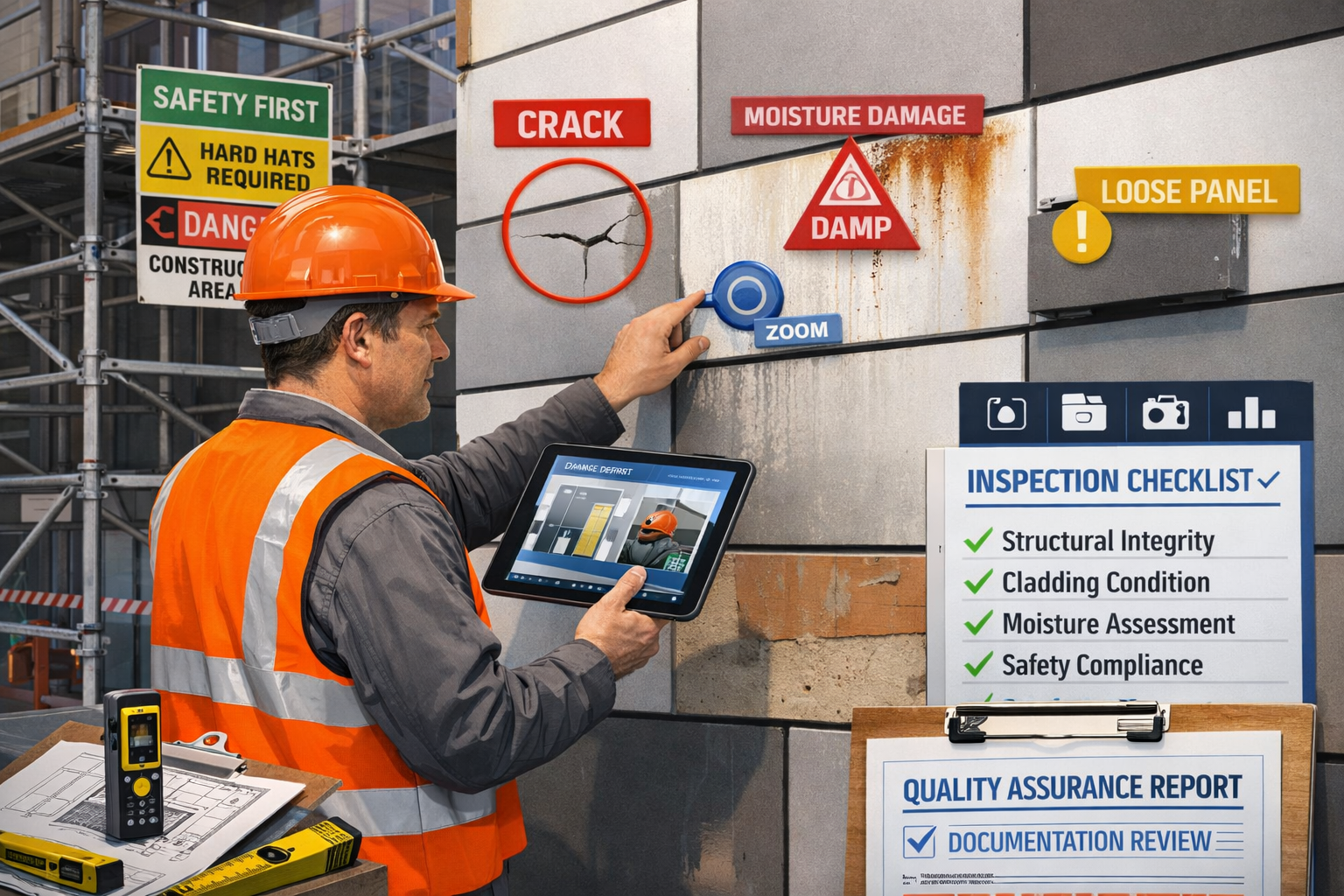
Understanding the Expert Witness Landscape in Building Safety Disputes
The Evolution of Admissibility Standards
The 2023 amendments to Federal Rule of Evidence 702 fundamentally changed the evidentiary threshold for expert testimony. These amendments established that proponents must prove each admissibility element by a preponderance of the evidence, addressing decades of inconsistent application across federal circuits[1]. For building safety disputes in 2026, this means surveyors serving as expert witnesses must prepare evidence packages that clearly demonstrate:
✅ Recognized field of expertise with knowledge beyond ordinary understanding
✅ Factual foundation rooted in admissible evidence
✅ Substantial connection between expertise and opinion conclusions
The practical impact cannot be overstated. Expert opinions that once passed muster under more lenient standards now face rigorous scrutiny. A comprehensive building survey conducted without documented methodology or clear connection to the disputed issues may be excluded entirely, regardless of the surveyor's qualifications.
Specific Expertise Requirements for Building Safety Cases
General credentials no longer suffice in tribunal proceedings. Courts have consistently excluded experts who lack specific, relevant experience with the technical components at issue[1]. For building safety disputes involving cladding systems, structural failures, or fire safety compliance, experts must demonstrate:
- Direct experience with the specific building materials, systems, or construction methods in question
- Published research or documented project work related to the disputed technical issues
- Professional licensure appropriate to the jurisdiction and technical domain
- Continuing education in relevant building safety regulations and standards
Professional Engineer (PE) licensure remains foundational for many technical experts. The National Council of Examiners for Engineering and Surveying (NCEES) requires an ABET-accredited degree, passage of the Fundamentals of Engineering exam, four years of progressive experience under a licensed PE, and completion of the Principles and Practice exam[1]. Many experts maintain licensure in multiple states to serve clients across jurisdictions—a strategic consideration for complex building safety disputes spanning multiple locations.
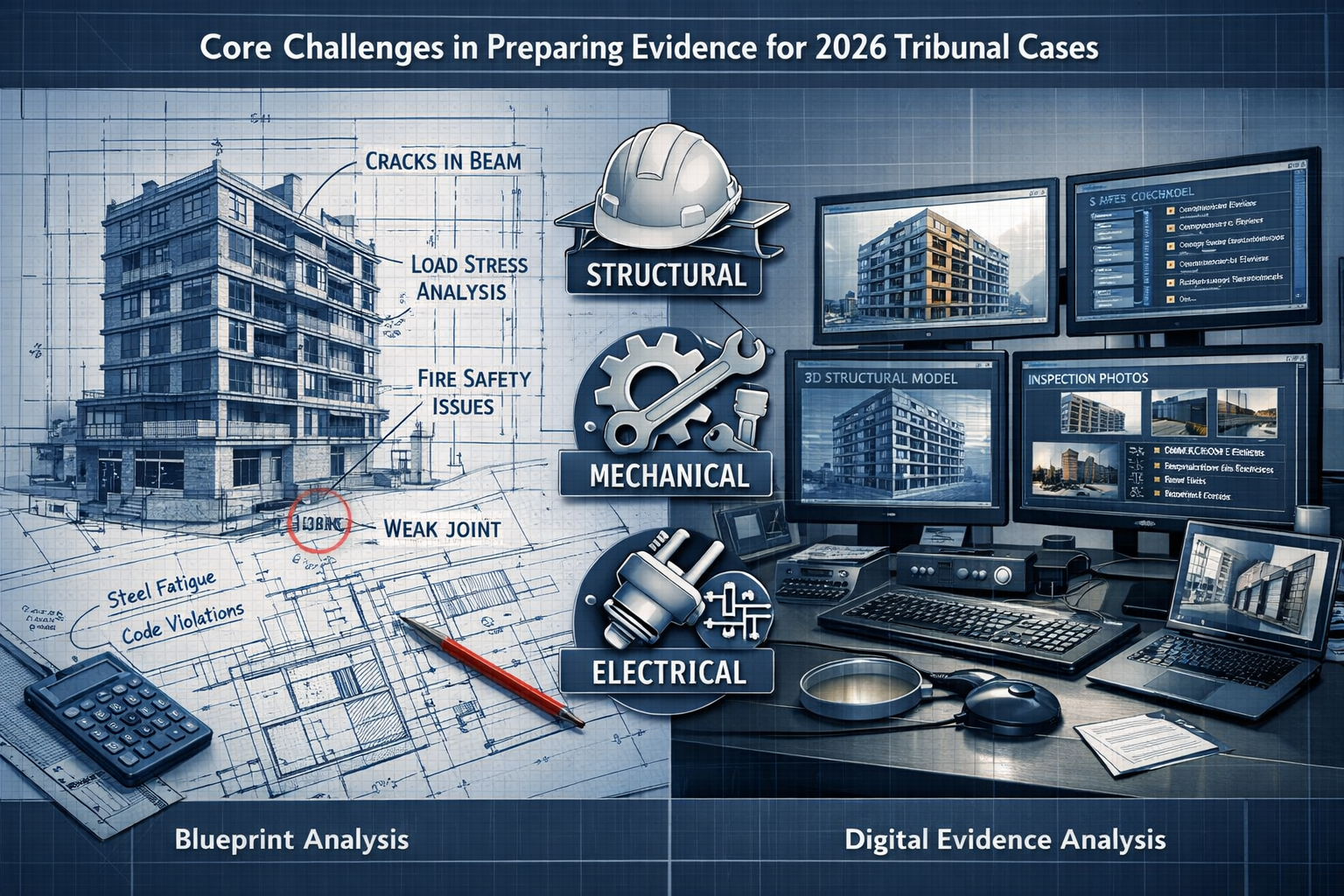
Core Challenges in Preparing Evidence for 2026 Tribunal Cases
Challenge 1: Establishing Defensible Methodology
Expert Witness Challenges in Building Safety Disputes: Preparing Evidence for 2026 Tribunal Cases center increasingly on methodology rather than credentials. The "black box" problem—where experts present conclusions without transparent reasoning—has become a primary target for opposing counsel[4].
Effective evidence preparation requires:
| Methodology Component | Required Documentation | Purpose |
|---|---|---|
| Investigation Protocol | Detailed site inspection procedures, equipment used, environmental conditions | Demonstrates systematic approach |
| Data Collection | Contemporaneous field notes, photographic evidence with metadata, measurements | Creates verifiable factual foundation |
| Analysis Framework | Calculation methods, software tools, industry standards applied | Shows reliability and acceptance |
| Alternative Considerations | Rejected methodologies and reasons why | Proves thoroughness and objectivity |
Mock deposition sessions simulating hostile questioning have become essential preparation steps. These exercises expose weaknesses in methodology documentation and help experts articulate their reasoning under pressure[1]. For surveyors preparing evidence in building safety disputes, this preparation phase often determines whether testimony survives Daubert challenges.
Challenge 2: Data Integrity and Contemporary Documentation
Construction disputes in 2026 focus increasingly on data integrity, credibility, and how convincingly the story of a project can be told[3]. The shift toward digital safety tools and real-time documentation has raised the bar for evidence quality.
Contemporary documentation protects claim outcomes by:
🔍 Capturing site conditions before degradation or remediation
📸 Preserving witness accounts while memories remain fresh
📋 Documenting safety compliance in real-time
💰 Reducing disputed liability and lowering settlement costs[2]
The adoption of digital safety tools and training programs that measurably reduce serious injuries has created new documentation standards[2]. Experts who rely on reconstructed timelines or post-hoc analyses face credibility challenges when opposing parties present contemporaneous digital records. Understanding building inspections and surveys conducted with modern documentation standards becomes critical for establishing baseline conditions.
Challenge 3: Navigating Cladding and Fire Safety Regulations
Building safety disputes in 2026 frequently involve cladding failures and fire safety compliance—areas where regulatory frameworks have undergone significant reform. Expert witnesses must demonstrate comprehensive understanding of:
- Building Safety Act 2022 requirements and compliance pathways
- Fire safety engineering principles specific to external wall systems
- Material testing standards for combustibility and fire resistance
- Remediation methodologies that meet current regulatory standards
The complexity of these regulations creates opportunities for expert testimony but also increases the risk of exclusion if the expert cannot demonstrate specific expertise. A surveyor with extensive experience in Level 3 building surveys may still lack the specialized knowledge required for cladding fire safety analysis unless they have documented experience with fire engineering assessments and material testing protocols.
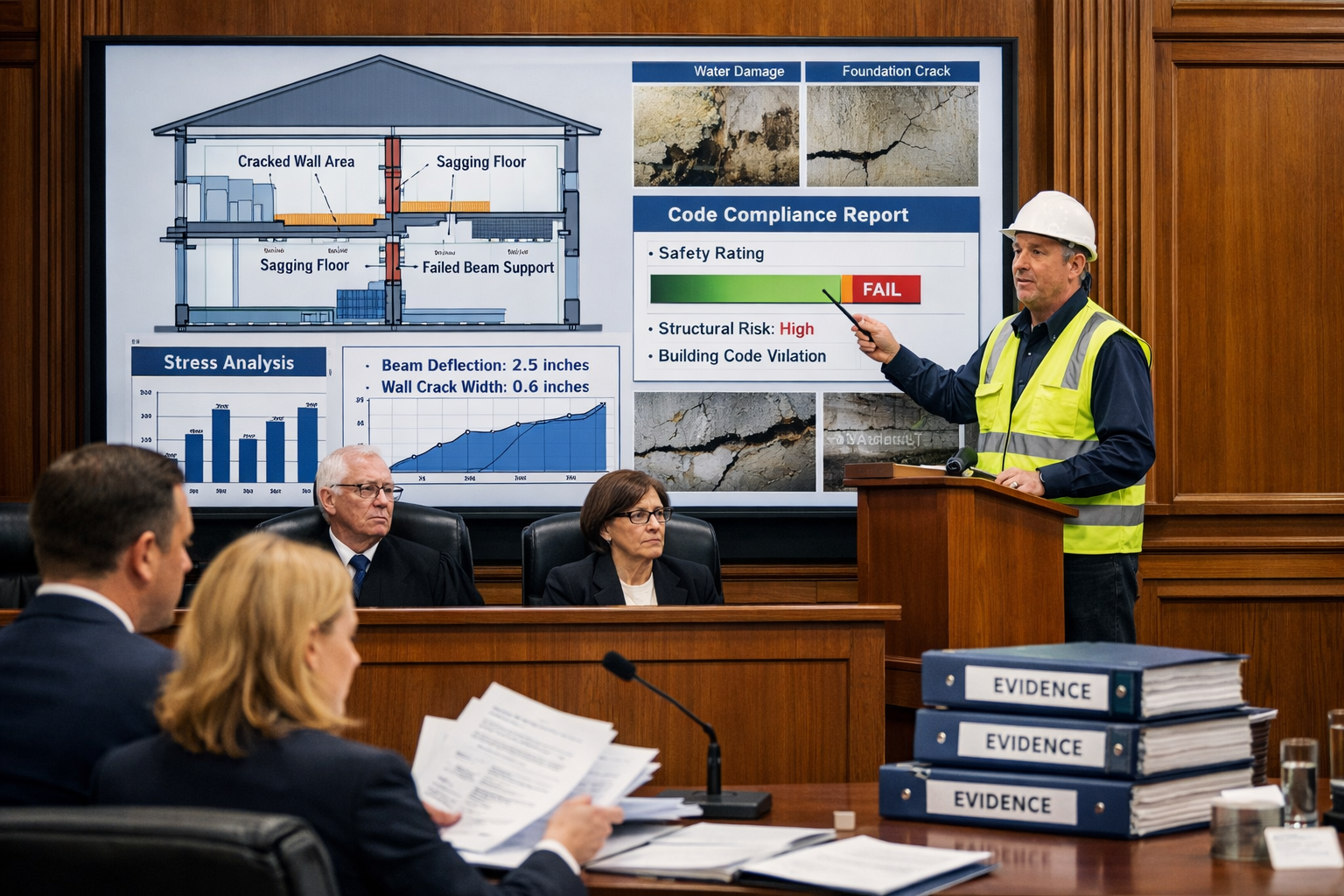
Practical Evidence Preparation Strategies
Strategy 1: Early Expert Engagement
Late expert engagement creates compounding problems that undermine tribunal success. Early involvement—ideally during the investigation phase rather than litigation preparation—enables experts to:
✔️ Direct evidence preservation efforts before site conditions change
✔️ Identify critical documentation gaps while remediation remains possible
✔️ Establish contemporaneous baselines for condition assessments
✔️ Develop investigation protocols tailored to specific technical issues
The cost implications are significant. Delayed involvement increases investigation expenses and reduces evidence preservation quality[1]. For building safety disputes involving structural defects or party wall disputes, early expert engagement often determines whether sufficient evidence exists to support causation theories.
Strategy 2: Implementing Robust Documentation Protocols
Professional documentation protocols form the backbone of defensible expert evidence. These protocols must address:
Site Investigation Documentation:
- Comprehensive photographic records with consistent metadata
- Detailed field notes recorded contemporaneously
- Measurement data with equipment calibration records
- Environmental condition documentation (weather, lighting, access constraints)
Analysis Documentation:
- Calculation worksheets showing all intermediate steps
- Software input files and output reports with version information
- Reference standards and code provisions applied
- Peer review records when applicable
Opinion Development Documentation:
- Evolution of opinions as new evidence emerges
- Consideration of alternative explanations
- Limitations and uncertainties acknowledged
- Factual assumptions clearly stated
This level of documentation enables experts to withstand cross-examination and demonstrate that opinions rest on solid foundations rather than speculation. When conducting RICS building surveys, these documentation standards should be integrated from the outset to support potential future expert testimony.
Strategy 3: Mastering Critical Path and Delay Analysis
For building safety disputes involving construction delays or defect remediation timelines, understanding Critical Path Method (CPM) distinctions is essential. Experts must distinguish between:
- Critical path delays: Impact activities that directly affect project completion dates
- Float-consuming delays: Affect non-critical activities without extending overall duration
Courts generally hold that only critical path delays warrant time extensions or damage awards[1]. Recognized methodologies include:
- Time Impact Analysis: Inserts delay events into the schedule to measure impact
- Windows Analysis: Compares planned versus actual progress in defined time periods
- As-Planned vs. As-Built: Compares original schedule against actual completion
- Collapsed As-Built: Removes delay events to determine completion without delays
Expert witnesses must not only apply these methodologies correctly but also explain why the chosen approach is appropriate for the specific circumstances. This requires understanding project-specific constraints, contract provisions, and industry standards applicable to the dispute.
Strategy 4: Addressing Credibility Through Methodology
Testimony credibility rests on methodology, not credentials. Preparation should confirm that experts:
🎯 Personally conducted critical analyses rather than delegating to junior staff
📝 Documented investigation steps contemporaneously rather than reconstructing later
🔬 Can explain why alternative methodologies were rejected
⚖️ Maintain objectivity and acknowledge limitations in available evidence
Mock deposition sessions should specifically target these credibility factors. Opposing counsel will probe for inconsistencies, delegation of critical work, and gaps in methodology. Experts who cannot articulate their reasoning or who appear to advocate for their client rather than provide objective analysis face devastating cross-examination.
For surveyors working on building surveyor projects in London, maintaining this objectivity while serving client needs requires careful boundary management and clear communication about the expert's role versus the surveyor's advisory function.
Regulatory Compliance and Safety Standards in 2026
OSHA Enforcement and Safety Documentation
Annual OSHA penalty increases in 2026 have raised the stakes for compliance failures, making proactive safety practices critical to avoiding reactive claims handling[2]. For expert witnesses addressing building safety disputes, understanding current enforcement priorities and penalty structures provides context for evaluating whether safety protocols met reasonable standards.
Key enforcement areas include:
- Fall protection in residential and commercial construction
- Scaffolding safety and inspection documentation
- Electrical safety during construction and renovation
- Hazard communication for construction materials
Expert testimony regarding whether safety practices met industry standards must account for these enforcement priorities and demonstrate knowledge of applicable OSHA standards. Failure to address regulatory compliance undermines credibility and may result in excluded testimony.
Building Safety Act Implementation
The Building Safety Act 2022 continues to reshape building safety disputes in 2026. Expert witnesses must demonstrate familiarity with:
- Gateway regime for higher-risk buildings
- Building Safety Regulator oversight and enforcement powers
- Competence requirements for building control professionals
- Golden thread information management requirements
These regulatory changes affect both the substantive standards applied to building safety disputes and the procedural requirements for evidence presentation. Experts who cannot articulate how current regulations differ from historical standards risk appearing outdated or uninformed.
Preparing for Cross-Examination and Daubert Challenges
Anticipating Common Attack Vectors
Opposing counsel typically challenge expert testimony through several predictable vectors:
Qualification Challenges:
- Lack of specific experience with disputed technical issues
- Insufficient continuing education in relevant areas
- Professional discipline or licensure issues
- Publication record not supporting claimed expertise
Methodology Challenges:
- Reliance on untested or novel techniques
- Failure to follow industry-standard protocols
- Inconsistent application of stated methodology
- Inadequate factual foundation for opinions
Bias Challenges:
- Financial incentives tied to case outcomes
- History of testifying exclusively for one side
- Advocacy rather than objective analysis
- Selective consideration of evidence
Effective preparation requires addressing these challenges proactively. Documentation should demonstrate specific relevant experience, transparent methodology, and objective analysis. When conducting construction and condition surveys, experts should maintain records that could later support testimony if disputes arise.
The Three-Part Admissibility Framework
Expert witnesses must satisfy three fundamental requirements for evidence admissibility[4]:
- Identify an accepted field of expertise with knowledge not possessed by ordinary people
- Establish a factual basis rooted in admissible evidence
- Expose how expertise connects the factual foundation to opinions
Without satisfying all three elements, expert testimony cannot be effectively tested on cross-examination and risks exclusion[4]. This framework applies regardless of the expert's credentials or experience.
For building safety disputes, this means:
- Field identification: Structural engineering, fire safety engineering, building surveying, or construction management—with clear boundaries
- Factual basis: Site inspection data, testing results, construction documents, or other admissible evidence—not speculation
- Connection: Clear explanation of how professional knowledge transforms factual observations into technical conclusions
Technology and Digital Evidence in Building Safety Disputes
Digital Documentation Tools
Construction employers are increasingly adopting digital safety tools and training programs that measurably reduce serious injuries across jobsites[2]. These tools also generate documentation that becomes critical evidence in building safety disputes:
- Drone photography for roof and facade inspections
- 3D laser scanning for dimensional verification
- Thermal imaging for moisture and insulation analysis
- Digital project management platforms preserving contemporaneous communications
- Building Information Modeling (BIM) for as-built condition documentation
Expert witnesses must understand these technologies and their limitations. Testimony about building conditions increasingly relies on digital evidence, requiring experts to explain data collection methods, accuracy limitations, and proper interpretation.
Data Integrity Verification
As disputes focus increasingly on data integrity and credibility[3], experts must address:
✓ Metadata verification: Confirming dates, times, and locations of digital evidence
✓ Chain of custody: Documenting evidence handling from collection through analysis
✓ Software validation: Demonstrating reliability of analysis tools and calculation methods
✓ Quality control: Showing systematic checks for errors and inconsistencies
These verification steps strengthen testimony credibility and help experts withstand challenges to evidence authenticity. For surveyors preparing evidence packages, integrating these verification protocols from the investigation phase forward creates defensible documentation.
Cost Considerations and Value Optimization
Balancing Thoroughness with Efficiency
Building safety disputes often involve significant expert witness costs. Optimizing value requires:
Strategic Investigation Planning:
- Prioritize critical technical issues most likely to determine case outcomes
- Identify minimum evidence necessary to support key opinions
- Avoid duplicative testing or analysis
- Coordinate with legal counsel on discovery priorities
Efficient Documentation:
- Use standardized templates for routine documentation
- Implement quality control checkpoints to catch errors early
- Leverage technology for efficient data collection and analysis
- Maintain organized evidence files accessible for testimony preparation
Phased Engagement:
- Initial assessment phase to identify key technical issues
- Detailed investigation phase focused on critical disputes
- Report preparation phase with iterative review
- Testimony preparation phase with mock depositions
Understanding the cost of party wall surveyors and similar professional services helps establish reasonable fee expectations and budget planning for expert witness engagement.
Return on Investment for Quality Expert Testimony
Quality expert testimony delivers measurable value through:
💰 Improved settlement outcomes: Strong expert opinions supported by defensible evidence increase settlement leverage
⚖️ Reduced litigation risk: Well-prepared experts reduce the likelihood of testimony exclusion
📊 Enhanced case credibility: Thorough documentation and transparent methodology strengthen overall case presentation
⏱️ Time efficiency: Early expert engagement prevents costly evidence gaps and investigation delays
The investment in comprehensive evidence preparation typically pays dividends through better outcomes and reduced overall litigation costs.
Conclusion: Building a Defensible Expert Witness Strategy
Expert Witness Challenges in Building Safety Disputes: Preparing Evidence for 2026 Tribunal Cases demand a sophisticated approach that integrates technical expertise, rigorous methodology, and comprehensive documentation. The evolution of admissibility standards, coupled with reformed building safety regulations and heightened scrutiny of expert testimony, has fundamentally changed the landscape for surveyors and technical experts.
Success in tribunal proceedings requires:
🎯 Early engagement to preserve critical evidence before site conditions change
📋 Transparent methodology that can withstand intensive cross-examination
🔬 Specific relevant experience matched to disputed technical issues
📸 Contemporary documentation using modern digital tools and protocols
⚖️ Objective analysis that acknowledges limitations and considers alternatives
The stakes are significant. Expert testimony can determine case outcomes, influence settlement values, and establish precedents for future disputes. Surveyors who invest in developing defensible evidence preparation practices position themselves as valuable tribunal resources while protecting their professional credibility.
Actionable Next Steps
For surveyors and technical professionals preparing for expert witness roles in building safety disputes:
- Assess current documentation protocols against the standards outlined in this article
- Invest in continuing education specific to building safety regulations and expert witness requirements
- Develop relationships with legal counsel experienced in construction litigation to understand tribunal expectations
- Implement digital documentation tools that support contemporaneous evidence capture
- Participate in mock deposition training to prepare for cross-examination challenges
- Review recent case law on expert witness admissibility in your jurisdiction
- Consider professional liability insurance specific to expert witness services
The complexity of building safety disputes will continue to increase as regulations evolve and construction methods advance. Professionals who adapt their evidence preparation practices to meet these challenges will find growing opportunities to provide valuable expert testimony in tribunal proceedings.
For comprehensive building safety assessments that could support future expert testimony, consider engaging qualified professionals for thorough building surveys that document conditions using defensible methodologies and contemporary standards.
References
[1] Expert Witness Construction Dispute – rimkus.com
[2] Construction Claims Prevention A Safety Guide For 2026 – frasco.com
[3] Choosing The Right Construction Dispute Resolution Expert In 2026 – precisionschedulingconsultants.com
[4] Watch – youtube.com