

A single poorly structured expert report can unravel a six-figure construction claim before the first day of trial. Courts at every level — from the County Court to the Technology and Construction Court (TCC) — rely on building surveyors to translate raw site observations into clear, impartial, and legally compliant opinions. Yet the gap between a competent site inspection and a persuasive expert witness report is wider than many practitioners expect.
This guide provides a nuts-and-bolts framework for surveyors navigating expert witness building surveys in County Court and TCC disputes, covering instructing terms, CPR Part 35 compliance, joint statements, and the practical techniques that turn defect evidence into findings that judges and opposing experts respect.
Key Takeaways
- Expert witness reports must comply with CPR Part 35 and the accompanying Practice Direction, placing the duty to the court above the client's commercial interests.
- Instructing terms should define scope, access arrangements, and the precise issues the expert is asked to address before any site visit takes place.
- Site evidence must be methodically recorded, referenced, and linked to causation arguments within the report structure.
- Joint statements between opposing experts are a critical procedural step; preparation for them should begin at the point of instruction, not after reports are exchanged.
- Clarity of language, logical structure, and transparent methodology are the qualities that distinguish persuasive reports from those that are challenged or disregarded.
The Legal Framework: CPR Part 35 and the Expert's Overriding Duty
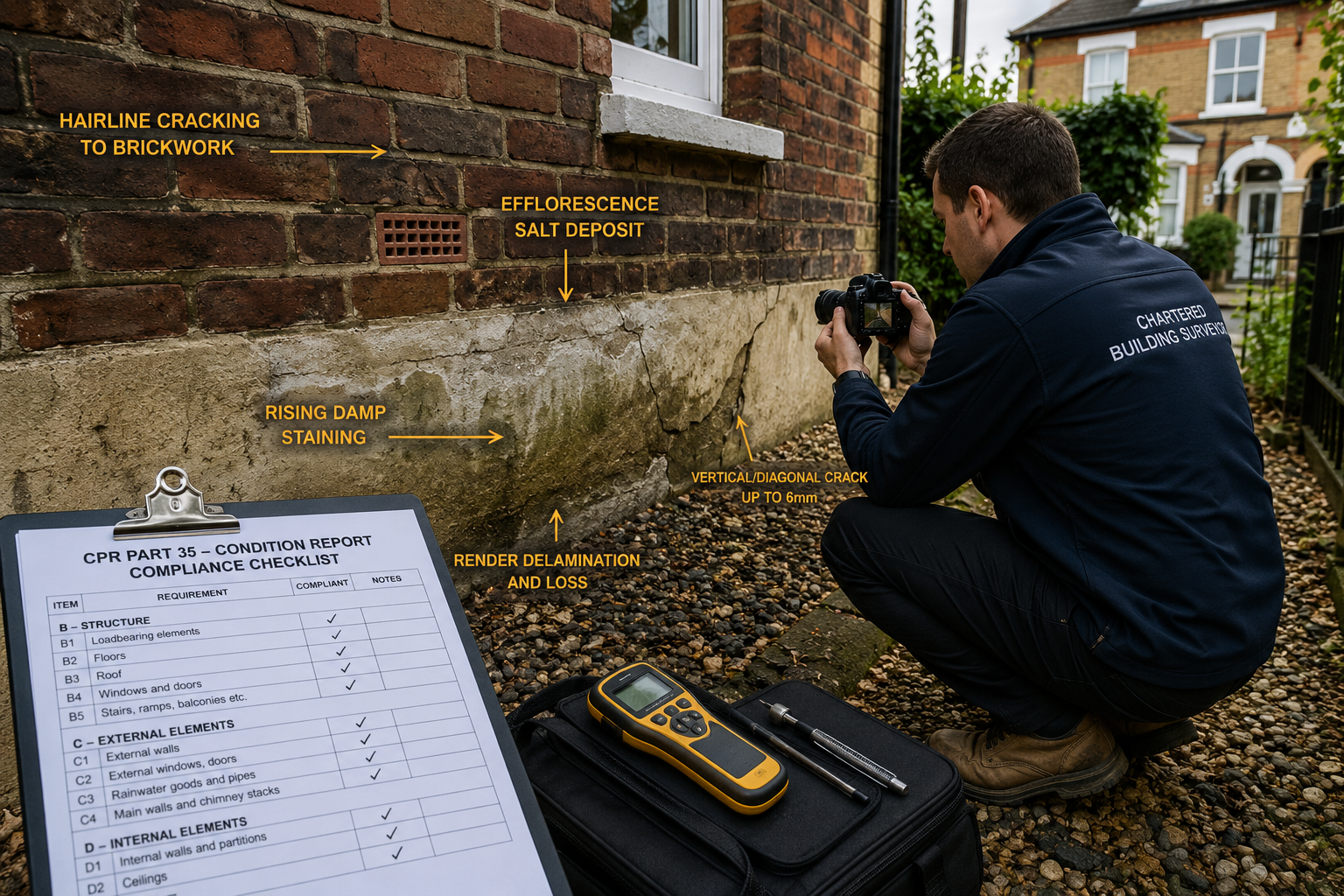
Every expert witness building survey produced for use in litigation is governed by Part 35 of the Civil Procedure Rules (CPR) and its associated Practice Direction. The rules are unambiguous: the expert's primary duty is to the court, not to the party that pays the fee. This principle is not merely procedural formality — judges in the TCC in particular are experienced in identifying reports that read as advocacy rather than independent analysis, and they discount them accordingly.
What CPR Part 35 Requires
The rules impose several concrete obligations on every expert report:
- A statement of the expert's qualifications and the basis of their expertise
- A clear statement of the facts and instructions on which the opinion is based
- A summary of the range of opinion on each issue, where opinion is not unanimous
- Reasons for the expert's own opinion
- A declaration that the expert understands their duty to the court and has complied with it
- A statement of truth
Firms such as Expert Witness Building Surveyor have formalised this compliance into their service offering, ensuring that reports adhere to CPR Part 35 so that opinions are impartial and professionally defensible for both litigation and arbitration purposes [3].
Surveyors instructed in TCC matters should also be familiar with the TCC Guide (the Admiralty and Commercial Courts Guide equivalent for construction disputes), which sets out expectations around expert evidence in high-value or technically complex cases. The TCC handles disputes from roughly £250,000 upwards, though jurisdiction can extend lower where technical complexity warrants it.
Single Joint Experts vs. Party-Appointed Experts
In lower-value County Court claims, the court frequently directs that a single joint expert (SJE) be appointed rather than allowing each party to instruct their own. Richard Jackson Limited's chartered building surveyors and engineers have built a reputation for acting as SJEs in construction and property disputes precisely because this role demands demonstrable impartiality and technical authority [2]. Where an SJE is appointed, the report must address the concerns of both parties with equal rigour — a discipline that sharpens analytical thinking regardless of which role the surveyor ultimately fills.
In higher-value TCC matters, party-appointed experts are more common. Each side instructs its own expert, reports are exchanged simultaneously, and the experts are then required to produce a joint statement identifying areas of agreement and disagreement.
Instructing Terms, Scope, and Pre-Survey Preparation
The quality of an expert witness building survey is largely determined before the surveyor sets foot on site. Poorly defined instructions are one of the most common causes of reports that fail to address the live issues in dispute.
Defining the Issues at the Outset
Before accepting instructions, the surveyor should obtain or prepare a document that sets out:
| Item | Detail Required |
|---|---|
| Parties | Claimant, defendant, and their legal representatives |
| Dispute summary | Nature of the claim and the factual background |
| Issues to address | Specific questions the expert is asked to answer |
| Access arrangements | Dates, contact persons, and any restrictions |
| Documents to review | Contracts, specifications, previous surveys, photographs |
| Timetable | Report deadline, exchange date, and trial window |
This scope document protects the surveyor as much as it serves the litigation. If instructions expand mid-instruction — a common occurrence — the surveyor can demonstrate what was and was not within the original brief.
For residential disputes involving complex defect histories, reviewing an existing Level 3 full building survey or construction and condition survey obtained at purchase can provide invaluable baseline data against which current conditions can be compared.
Conflicts of Interest and Independence
Before accepting instructions, the surveyor must confirm there is no prior relationship with either party or the property that could compromise independence. This check should be documented. In TCC disputes particularly, opposing counsel will scrutinise any prior involvement with the property, the contractor, or the client.
Conducting the Site Survey: Turning Observations into Evidence
The site visit is where the expert's technical knowledge does its most important work. The challenge is not simply identifying defects — it is recording them in a manner that will withstand cross-examination months or years later.
Systematic Recording Methodology
A defensible site record requires:
- Dated and timestamped photographs with a scale reference where relevant
- Written contemporaneous notes made on site, not reconstructed afterwards
- Instrument readings (moisture meter readings, thermal imaging data, crack gauge measurements) with the instrument type, calibration date, and reading location recorded
- Sketch plans showing the location of each defect relative to the building's grid
- Third-party access records confirming who was present and what access was granted or refused
Understanding the underlying causes of defects is as important as recording their symptoms. For example, moisture intrusion is frequently misattributed in litigation. A thorough understanding of what causes moisture in buildings — whether rising damp, penetrating damp, interstitial condensation, or plumbing failure — directly affects the causation opinion the expert will need to provide.
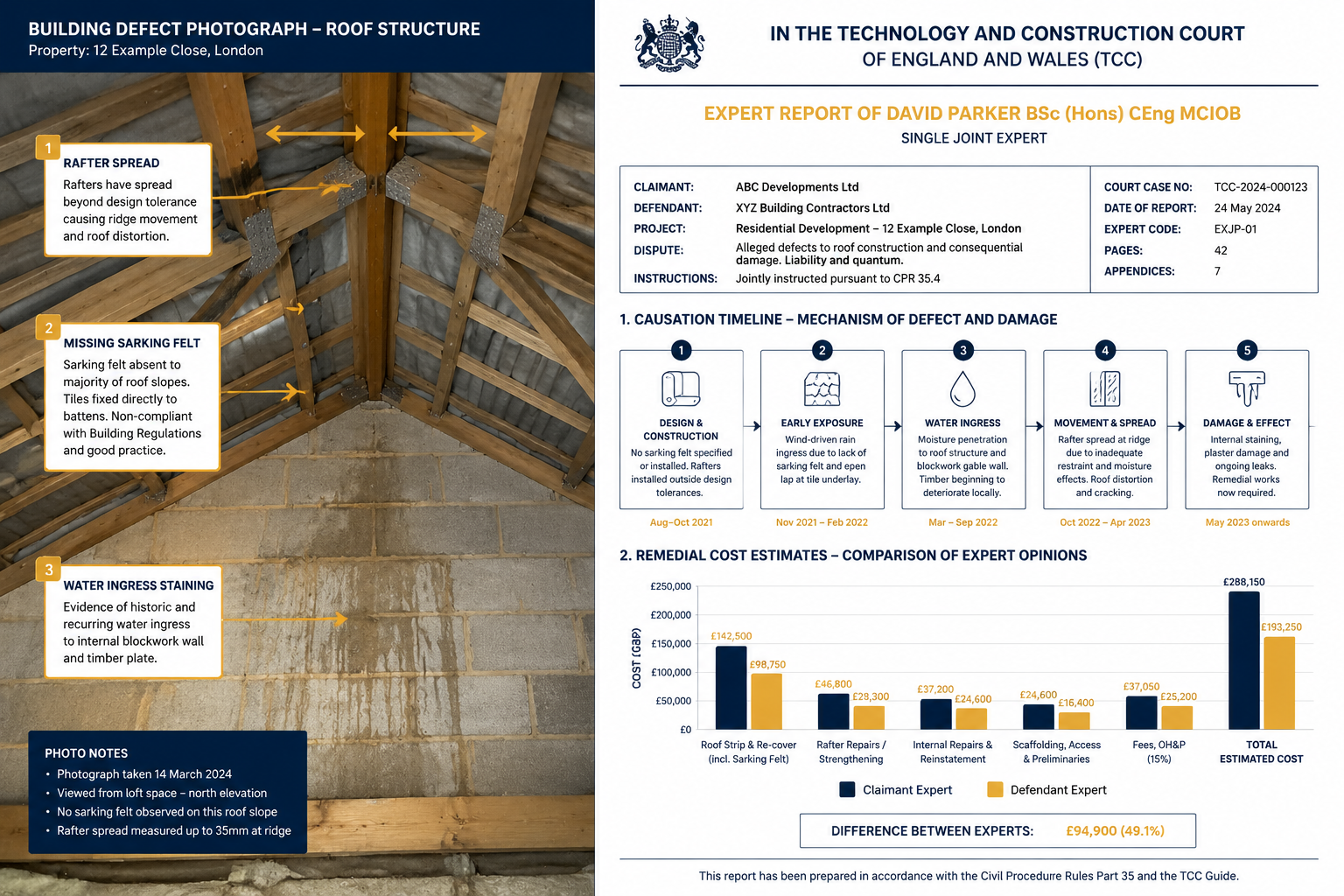
Similarly, disputes involving roof defects benefit from a structured approach to common pitched roof defects, since the distinction between design failure, workmanship failure, and maintenance neglect carries significant weight in apportioning liability.
Causation: The Critical Link
Courts do not simply want to know that a defect exists. They want to know:
- What caused it?
- When did it arise?
- Was it caused or contributed to by the defendant's works?
- What is the reasonable cost of remediation?
Each of these questions requires the expert to reason from the physical evidence to a conclusion, and to express that conclusion with appropriate confidence. The language of probability matters: "on the balance of probabilities" is the civil standard, and experts should use phrases such as "it is more likely than not" rather than hedging so heavily that no clear opinion emerges.
Veritas Surveying Limited's recent involvement in a £1.5 million TCC claim arising from water escape illustrates the complexity that causation analysis can reach — tracing the source of water ingress through multiple building elements, contractor interfaces, and maintenance histories to identify the primary cause [1].
Structuring the Expert Witness Report for Maximum Persuasion
A technically sound site investigation is wasted if the report that emerges from it is poorly structured, verbose, or unclear. Judges in the TCC read expert reports in volume; clarity and logical organisation are not merely desirable — they are professionally expected.
Recommended Report Structure
A well-structured expert witness building survey report typically follows this sequence:
- Title page — identifying the expert, the parties, the property, and the date
- Executive summary — a concise statement of the key findings and opinions (one to two pages)
- Instructions and scope — verbatim or summarised instructions, and any limitations on access or information
- Expert's qualifications — relevant experience and professional memberships (RICS, CIOB, etc.)
- Documents reviewed — a full list with dates
- Site inspection record — dates, attendees, conditions, and methodology
- Factual findings — what was observed, supported by photographic references
- Analysis and opinion — causation, liability, and remediation
- Summary of opinions — a numbered list for easy reference by the court
- Statement of truth and CPR declaration
- Appendices — photographs, instrument readings, relevant extracts from documents
The executive summary deserves particular attention. Judges often read this section first and may form preliminary impressions from it. It should state the expert's conclusions clearly and without qualification that is not necessary at that stage.
Language and Tone
Avoid technical jargon where plain English serves equally well. Where technical terms are necessary, define them on first use. Avoid expressions of certainty that the evidence does not support, but equally avoid the kind of excessive qualification that renders an opinion useless. The goal is to be the most credible voice in the room — which means being precise, not cautious to the point of evasiveness.
"The expert's role is to inform the court's understanding of technical matters, not to advocate for the instructing party. Reports that read as advocacy are identified quickly and lose credibility rapidly."
Joint Statements and Without-Prejudice Meetings
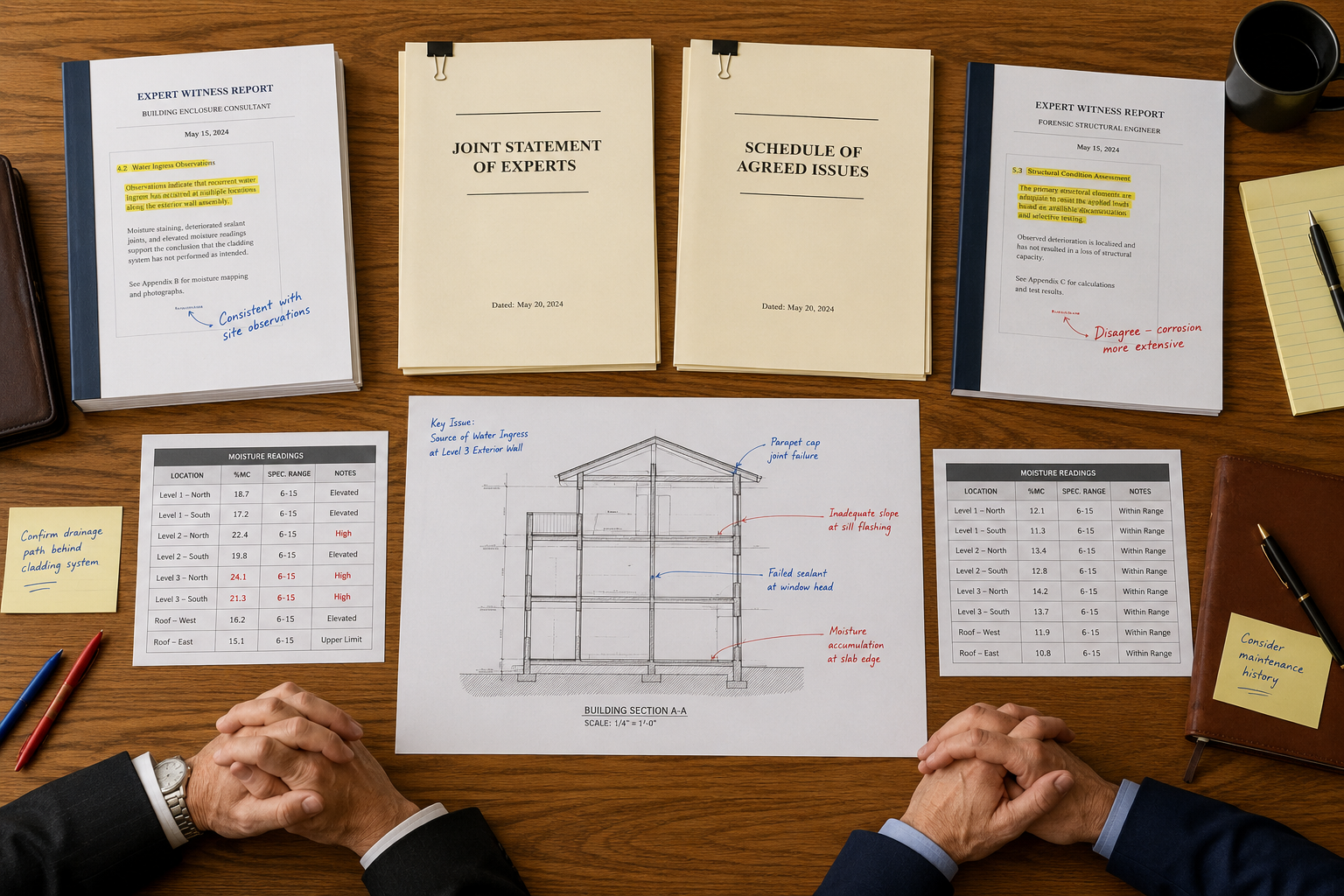
Once reports have been exchanged, the court will typically direct the experts to meet, discuss their respective findings, and produce a joint statement. This is one of the most consequential stages of expert evidence, and many surveyors underestimate its importance.
Preparing for the Joint Meeting
Preparation should begin at the point of instruction, not after reports are exchanged. The surveyor should:
- Maintain a running schedule of the issues they have been asked to address
- Note, as the report is drafted, which findings are likely to be agreed and which are contentious
- Identify the factual assumptions underlying each opinion, since factual disputes are for the court to resolve, not the experts
Ball & Co Chartered Surveyors, who provide expert witness services across building disputes, boundary disagreements, and dilapidations, emphasise the value of detailed reports and professional assessments as the foundation for efficient dispute resolution — a principle that applies equally to the joint statement process [4].
The Joint Statement Document
The joint statement must:
- Identify each issue in dispute
- State clearly whether the experts agree or disagree on that issue
- Where they disagree, summarise the reason for the disagreement concisely
- Not contain argument or advocacy
A well-prepared joint statement narrows the issues for trial, reduces hearing time, and often prompts settlement. A poorly prepared one — where experts have failed to engage genuinely with each other's reasoning — frustrates the court and reflects badly on both.
For disputes involving structural elements such as stresses in structural members of commercial buildings, the joint statement process may require the experts to agree on the engineering principles involved before addressing whether those principles were applied correctly in the specific case.
Presenting Evidence in High-Value TCC Disputes
The TCC handles some of the most technically complex construction litigation in England and Wales. Claims involving basement remedial works, cladding failures, or large-scale water ingress regularly reach six or seven figures. Veritas Surveying Limited's involvement in a £600,000 basement remedial works claim [1] and the forensic construction consulting work undertaken by firms such as Coe & Company — active in defect investigation since 1983 [5] — illustrate the depth of technical analysis these cases demand.
Handling Competing Remediation Cost Estimates
One of the most contested areas in TCC expert evidence is the cost of remediation. Claimant experts tend to price the most thorough solution; defendant experts tend to price the minimum necessary intervention. Courts expect experts to:
- Identify the scope of works that a reasonable contractor would undertake to achieve a durable repair
- Price that scope on a transparent basis, with reference to current market rates
- Acknowledge where a range of costs is reasonable, rather than presenting a single figure as the only defensible answer
Surveyors involved in expert witness reports for property disputes should ensure their remediation cost analysis is supported by contractor quotations, schedule of rates references, or both — not simply professional judgment expressed without evidential foundation.
Cross-Examination Preparation
The expert who has conducted a thorough site survey, maintained meticulous records, and structured their report logically is well-positioned for cross-examination. The most effective preparation involves:
- Re-reading the opposing expert's report critically and identifying every point of factual or methodological difference
- Being able to explain every instrument reading, photograph, and calculation in the report from memory or from the contemporaneous notes
- Understanding the limits of the expert's own expertise and being willing to acknowledge them
Common Pitfalls and How to Avoid Them
Even experienced surveyors make avoidable errors in expert witness work. The most frequent include:
- Exceeding the scope of instructions — offering opinions on issues not asked, which invites challenge
- Failing to distinguish fact from opinion — the report must be clear about which statements are observations and which are inferences
- Inadequate site records — photographs without dates, locations, or scale references undermine the factual foundation of the report
- Overconfident causation opinions — attributing a defect to a single cause when the evidence supports only a probability
- Ignoring the opposing case — failing to address alternative explanations for the defects observed
- Late disclosure of material — any documents relied upon must be disclosed; reliance on undisclosed material at trial is a serious procedural failure
For surveyors seeking to understand the full scope of what a comprehensive building survey should cover before entering the expert witness arena, reviewing what types of building surveys are available provides useful context on the different levels of inspection and their respective methodologies.
Conclusion
Expert witness building surveys in County Court and TCC disputes represent one of the most demanding applications of a chartered surveyor's skills. The work requires technical depth, methodological rigour, procedural literacy, and the ability to communicate complex findings to a non-specialist audience under adversarial conditions.
The surveyors who perform this role most effectively treat every stage — from receiving instructions to attending the joint meeting — as an opportunity to strengthen the integrity and persuasiveness of their evidence. They define scope precisely, record site evidence meticulously, structure their reports for judicial readability, and engage with opposing experts honestly rather than defensively.
Actionable next steps for surveyors entering expert witness work:
- Obtain a copy of CPR Part 35, its Practice Direction, and the TCC Guide and read them in full before accepting the first instruction.
- Develop a standard site inspection protocol that produces dated, located, and scaled photographic evidence as a matter of routine.
- Build a report template that incorporates all mandatory CPR declarations and a numbered summary of opinions.
- Seek mentorship from an experienced expert witness or consider the RICS Expert Witness training pathway.
- Contact a specialist practice to discuss expert witness report services and the scope of support available for complex disputes.
The difference between evidence that settles a case and evidence that loses one often comes down to preparation, structure, and the discipline to remain the court's expert rather than the client's champion.
References
[1] Expert Witness – veritassurveying.co.uk
[2] Expert Witness – richardjackson.uk.com
[3] Services – expertwitnessbuildingsurveyor.co.uk
[4] Expert Witness – ballandcocardiff.com
[5] About – coeandcompany.info