

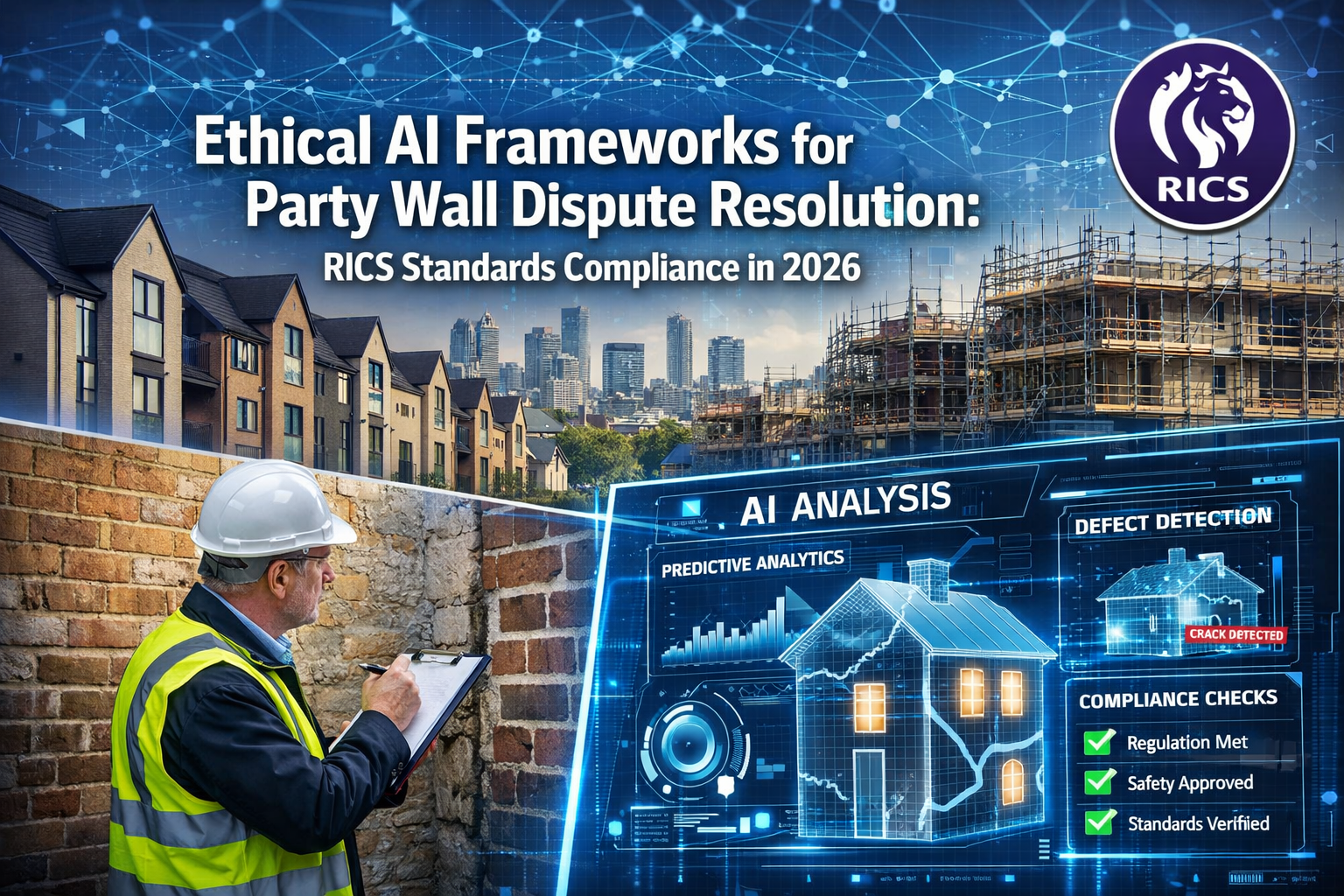
As of March 9, 2026, every RICS member and regulated firm operating in property surveying must now comply with the profession's first-ever global standard on responsible artificial intelligence use—a watershed moment that fundamentally reshapes how party wall disputes are predicted, assessed, and resolved in increasingly crowded urban environments. This mandatory framework arrives precisely when high-density development projects face unprecedented scrutiny over construction impacts on adjacent properties, positioning Ethical AI Frameworks for Party Wall Dispute Resolution: RICS Standards Compliance in 2026 High-Density Projects at the intersection of technological innovation and professional accountability.
The convergence of AI-powered defect prediction tools and stringent regulatory oversight creates both opportunities and obligations for surveyors navigating complex party wall scenarios in urban retrofit and extension works. Understanding how to leverage machine learning algorithms while maintaining professional judgment has become essential for practitioners working in densely populated areas where construction activity inevitably affects neighbouring properties.
Key Takeaways
- RICS' mandatory AI standard (effective March 2026) establishes four core governance areas that all surveyors must implement when using AI tools in party wall dispute resolution
- Professional accountability remains non-negotiable: AI assists but never replaces the surveyor's judgment, with practitioners maintaining full responsibility for all advice regardless of technological tools used
- Predictive defect detection using AI can identify potential party wall issues before construction begins, enabling proactive dispute prevention in high-density projects
- Transparency requirements mandate clear client communication about AI tool usage, limitations, and how algorithms inform professional recommendations
- Risk management frameworks must include AI-specific registers, procurement due diligence, and continuous monitoring protocols
Understanding the RICS AI Standard Framework for Party Wall Practice
The Royal Institution of Chartered Surveyors has established a comprehensive governance structure that directly impacts how party wall surveyors can ethically deploy artificial intelligence technologies. The standard explicitly recognizes that while AI offers valuable analytical capabilities—particularly in predicting structural defects and assessing construction risks—it must operate within clearly defined professional boundaries.[1]
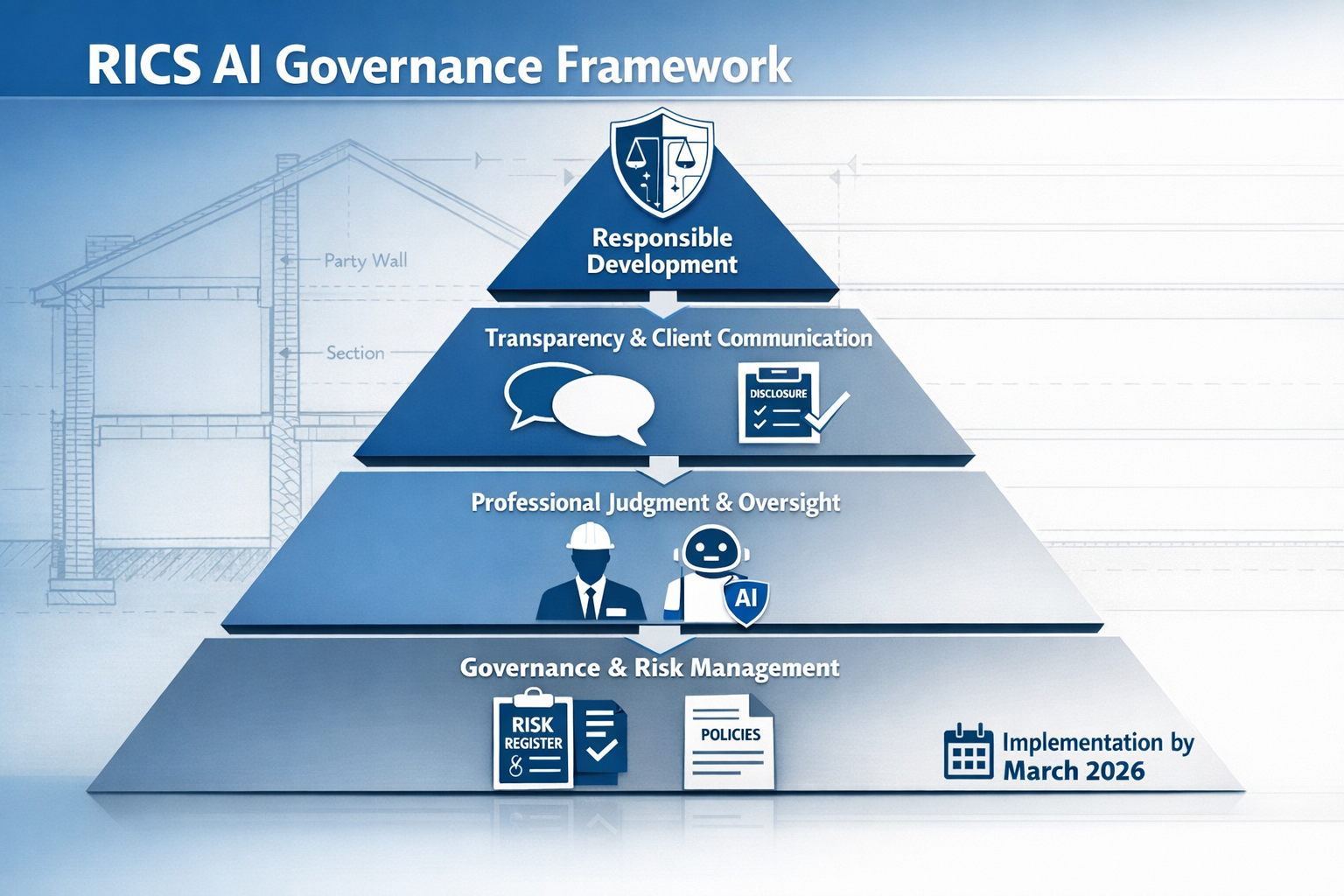
The Four Pillars of RICS AI Governance
The mandatory framework requires firms to implement structured approaches across four interconnected domains:
1. Governance and Risk Management 🏛️
Every firm using AI tools for party wall assessments must establish:
- Risk registers documenting potential AI-related failures or biases
- Responsible use policies defining acceptable applications and prohibited uses
- Procurement due diligence ensuring third-party AI vendors meet ethical standards
- Regular audits of AI system performance and decision-making patterns
For party wall surveyors, this means documenting how AI tools analyze structural data, identify potential defects, or predict dispute likelihood. Firms must assess whether algorithms might systematically underestimate risks in certain building types or overlook cultural considerations in heritage properties.
2. Professional Judgement and Oversight 👨💼
The standard establishes an unambiguous principle: "AI assists professional practice; it does not replace it."[3] This requirement has profound implications for party wall dispute resolution, where nuanced judgment about construction impacts, neighbourly relationships, and proportionate remedies cannot be fully automated.
RICS member Nella Pang describes AI as "a valuable second perspective" that helps practitioners sense-check their thinking rather than substitute for professional expertise.[3] When evaluating whether basement excavation might damage an adjacent Victorian terrace's foundations, AI can process historical subsidence data and soil mechanics calculations, but the surveyor must interpret results within the specific project context.
3. Transparency and Client Communication 📢
Surveyors must clearly disclose:
- Which AI tools are being used in assessments
- What data these systems analyze
- How AI outputs inform professional recommendations
- Limitations and potential biases in algorithmic analysis
This transparency obligation is particularly important when serving party wall awards, where both building owners and adjoining owners need to understand the basis for surveyor decisions. If AI-powered defect prediction suggests heightened monitoring requirements, clients deserve clear explanation of how the algorithm reached that conclusion.
4. Responsible Development of AI 🔧
For firms developing proprietary AI tools or customizing commercial solutions, the standard requires:
- Ethical design principles preventing discriminatory outcomes
- Robust testing across diverse building types and scenarios
- Continuous performance monitoring and improvement cycles
- Documentation of training data sources and algorithmic logic
This pillar aligns with parallel standards established by the American Arbitration Association, which emphasizes that AI systems must "allow staff and participants to understand and trust their outputs" through explainability and human oversight.[2]
Practical Application in High-Density Projects
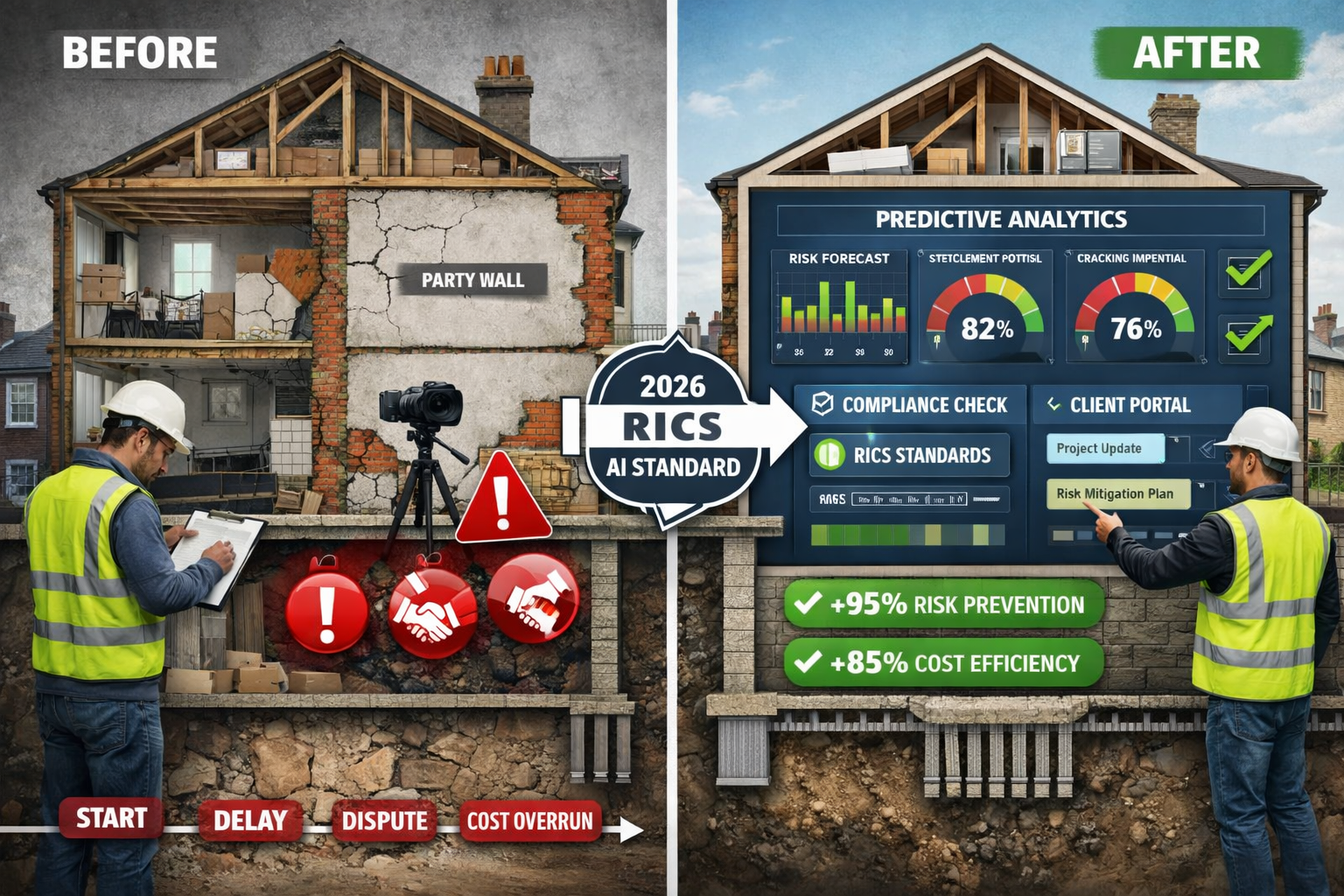
Consider a typical 2026 scenario: A developer plans to convert a four-storey Victorian building into eight residential units, requiring structural alterations affecting multiple party walls. Traditional surveying approaches would involve:
- Manual condition surveys of adjacent properties
- Physical measurement of existing defects
- Subjective assessment of construction risk levels
- Reactive dispute resolution if damage occurs
With ethical AI implementation under RICS standards, surveyors can now:
✅ Deploy predictive algorithms analyzing historical data from similar conversions to forecast likely dispute triggers
✅ Use computer vision systems to identify micro-cracks or structural weaknesses that might worsen during construction
✅ Model vibration impacts from excavation equipment on neighbouring foundations with greater precision
✅ Generate risk-weighted monitoring schedules prioritizing properties most vulnerable to construction effects
However, the surveyor must still personally verify AI findings, apply professional judgment to anomalous results, and take full accountability for recommendations—even when informed by sophisticated algorithms.
Ethical AI Implementation in Party Wall Dispute Prediction and Resolution
The updated RICS guidance on party wall practice, currently under consultation through May 2026, strengthens requirements around regulatory compliance and professional conduct.[1] When combined with the AI standard, these frameworks create specific obligations for surveyors using machine learning tools to predict disputes or assess construction impacts in high-density environments.
Predictive Analytics for Dispute Prevention
Modern AI systems can analyze vast datasets to identify patterns that human surveyors might miss. For party wall work, this capability offers several applications:
Pre-Construction Risk Assessment 📊
Machine learning algorithms trained on thousands of historical party wall cases can evaluate project characteristics—building age, construction methods, soil conditions, work scope—to predict dispute likelihood. A 2026 retrofit project involving basement excavation beneath a terraced house might receive a risk score based on:
- Previous dispute rates for similar Victorian terraces
- Soil settlement patterns in that geographic area
- Typical foundation depths for that construction period
- Seasonal groundwater level variations
This predictive insight allows surveyors to recommend enhanced precautionary measures before work begins, potentially preventing disputes entirely. However, RICS standards require that these AI-generated risk scores serve as decision support rather than determinative conclusions.[3]
Automated Defect Detection 🔍
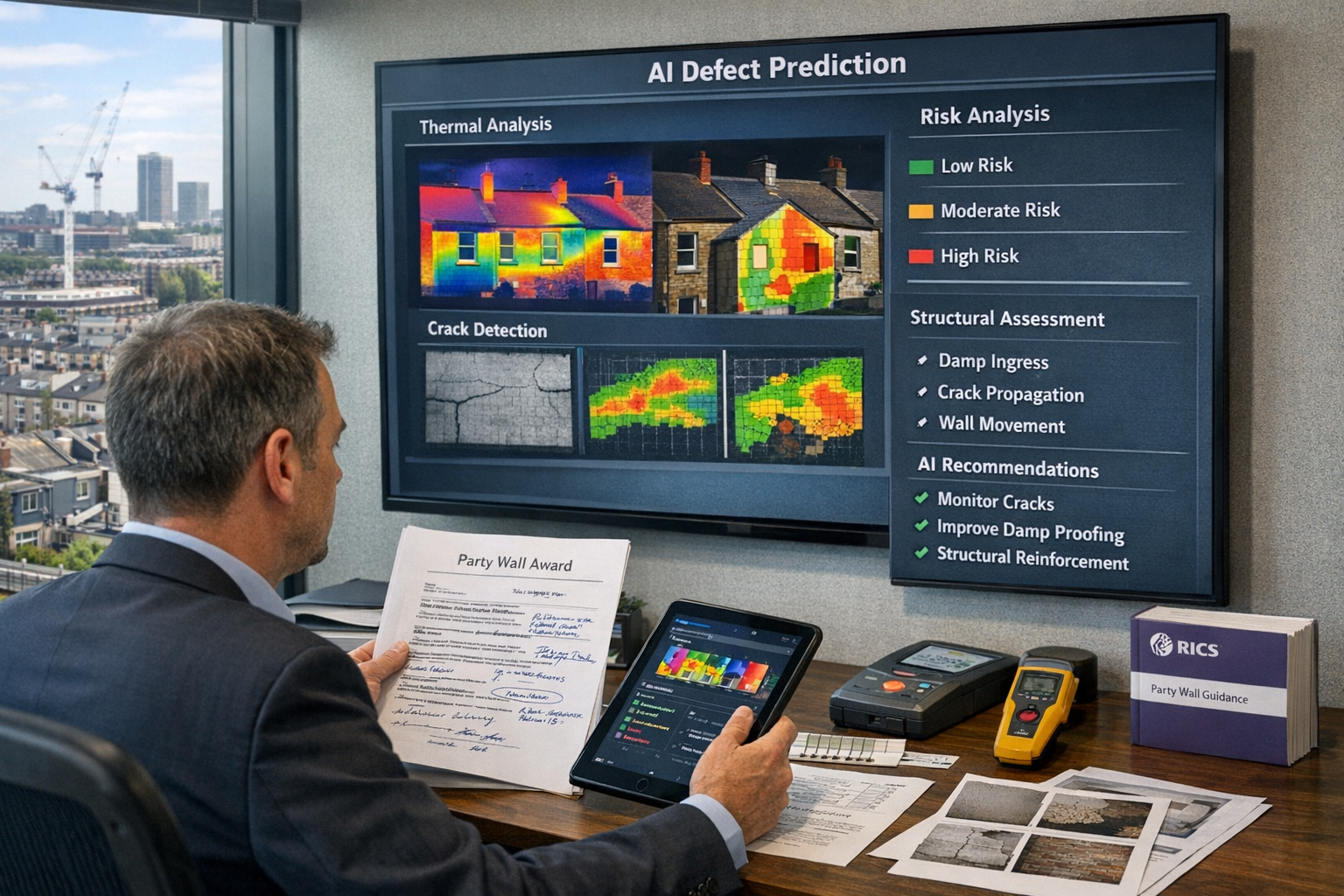
Computer vision systems can process photographs and thermal imaging to identify existing defects in party walls with remarkable accuracy. When conducting pre-construction condition surveys—a critical step in party wall agreements—AI tools can:
- Detect hairline cracks invisible to casual inspection
- Measure crack widths with millimeter precision
- Identify moisture penetration patterns suggesting structural issues
- Compare current conditions against historical survey data
The ethical framework requires surveyors to validate these AI findings through physical inspection and professional judgment. An algorithm might flag a thermal anomaly as potential moisture ingress, but the surveyor must determine whether it represents a genuine defect or merely reflects differential heating from internal room layouts.
Maintaining Human Oversight in Automated Systems
The RICS standard explicitly states that "the surveyor remains accountable for every piece of professional advice, regardless of the tools used to produce it."[3] This principle prevents dangerous over-reliance on AI outputs, particularly in complex party wall scenarios involving multiple stakeholders.
Case Study: Loft Conversion in Dense Urban Terrace
A building owner proposes converting unused attic space into habitable rooms, requiring:
- Steel beam installation through party walls
- Additional load on shared foundations
- Potential vibration impacts during construction
- Changed drainage patterns affecting adjoining properties
An AI system analyzes the project and predicts a 73% probability of structural damage claims from neighbours. The algorithm bases this assessment on:
- Historical damage rates for similar loft conversions (68% in dataset)
- Building age factor (Victorian construction = +5% risk)
- Soil type adjustment (London clay = +8% risk)
- Mitigation measures (steel beam support = -8% risk reduction)
Under RICS standards, the surveyor cannot simply relay this percentage to clients. Instead, they must:
- Critically evaluate whether the training dataset represents comparable scenarios
- Consider factors the algorithm cannot assess (e.g., existing relationship between neighbours, quality of proposed contractor)
- Apply professional judgment about whether 73% probability warrants specific precautions
- Communicate transparently that the figure represents algorithmic estimation, not deterministic prediction
- Take full responsibility for final recommendations, even if informed by AI analysis
This human oversight requirement protects against algorithmic bias and ensures that professional expertise remains central to party wall practice.[4]
Transparency Obligations in Client Communications
When surveyors use AI tools to inform their party wall assessments, RICS standards mandate clear disclosure to all parties. This transparency serves multiple purposes:
Building Trust 🤝
Clients who understand how AI contributes to professional recommendations are more likely to trust surveyor conclusions. When explaining why enhanced monitoring is necessary during basement excavation work, surveyors might state:
"Our assessment incorporates predictive analytics that analyzed 2,400 similar basement projects. The algorithm identified soil settlement as the primary risk factor for your property type. However, based on my site inspection and professional judgment, I believe the risk can be effectively managed through weekly monitoring and immediate response protocols."
This explanation acknowledges AI's role while emphasizing human professional oversight.
Managing Expectations ⚖️
AI predictions carry inherent uncertainty that clients must understand. A machine learning model might forecast construction noise complaints with 85% confidence, but this doesn't mean complaints will definitely occur—nor does it specify their severity or resolution difficulty.
Ethical practice requires surveyors to explain:
- What the AI system can and cannot predict
- Confidence levels and their practical meaning
- How algorithmic outputs informed (but didn't dictate) recommendations
- Why professional judgment sometimes overrides AI suggestions
Documenting Decision-Making 📝
The RICS framework requires firms to maintain records showing how AI tools influenced professional decisions. For party wall work, this documentation might include:
- AI risk assessment reports with surveyor annotations
- Comparison of algorithmic predictions versus surveyor's independent judgment
- Rationale for accepting or overriding AI recommendations
- Client communications explaining AI tool usage
This documentation proves particularly valuable if disputes escalate to Third Surveyor involvement or legal proceedings, demonstrating that surveyors followed ethical AI practices while maintaining professional accountability.
Integrating Ethical AI Frameworks for Party Wall Dispute Resolution: RICS Standards Compliance in 2026 High-Density Projects
High-density urban development presents unique challenges for party wall practice. Multiple adjacent properties, complex structural interdependencies, and intensive construction activity create environments where disputes can cascade rapidly. Ethical AI frameworks offer powerful tools for managing these complexities—provided surveyors implement them within RICS compliance parameters.
AI Applications Specific to High-Density Environments
Multi-Property Impact Modeling 🏘️
Traditional party wall assessments typically focus on immediately adjacent properties. However, in dense urban areas, construction effects can propagate through interconnected structures. AI systems can model these complex interactions:
- Vibration transmission through continuous terrace rows during piling operations
- Cumulative settlement effects when multiple properties undergo simultaneous basement excavations
- Drainage pattern changes affecting entire building blocks
- Noise propagation through shared structural elements
Machine learning algorithms trained on sensor data from previous high-density projects can predict which properties face greatest risk, enabling surveyors to prioritize condition surveys and monitoring resources effectively.
Real-Time Construction Monitoring 📡
Internet-of-Things (IoT) sensors combined with AI analytics enable continuous monitoring during construction:
- Vibration sensors on party walls triggering alerts when thresholds exceed safe levels
- Crack width monitors detecting structural movement in real-time
- Tilt sensors identifying foundation settlement as it occurs
- Acoustic monitors documenting noise levels for dispute evidence
AI systems can distinguish between normal construction variations and genuine problems requiring immediate intervention. However, RICS standards require that surveyors—not algorithms—make decisions about stopping work or implementing additional protections.[5]
Automated Compliance Checking ✅
The updated RICS party wall guidance emphasizes proper notice service, fee practices, and Third Surveyor protocols.[1] AI tools can assist with compliance by:
- Verifying that statutory notices contain all required information
- Checking that timelines meet Party Wall Act requirements
- Flagging potential conflicts of interest in surveyor appointments
- Ensuring draft awards address all necessary matters
These automated checks reduce administrative errors but cannot replace surveyor understanding of statutory obligations and professional conduct requirements.
Addressing Algorithmic Bias in Party Wall Assessments
AI systems learn from historical data, potentially perpetuating existing biases. For party wall work, this creates specific risks:
Property Type Bias 🏠
If training datasets predominantly feature Victorian terraces, algorithms might perform poorly when assessing:
- Modern steel-frame constructions
- Heritage listed buildings with unique structural systems
- Non-traditional construction methods (timber frame, concrete systems)
- Properties with previous undocumented alterations
RICS governance requirements mandate that firms identify these limitations and supplement AI analysis with appropriate professional expertise when working outside the algorithm's validated scope.[3]
Geographic Bias 🗺️
Machine learning models trained primarily on London construction projects might not accurately predict dispute patterns in:
- Different soil conditions (chalk, sandstone, granite bedrock)
- Alternative building traditions (stone construction in Scotland, cob in Devon)
- Varying local construction practices and contractor capabilities
- Different legal interpretations across jurisdictions
Ethical AI implementation requires surveyors to recognize when algorithmic predictions reflect training data limitations rather than genuine risk assessment.
Socioeconomic Bias 💷
Historical dispute data might show correlation between property values and dispute rates—not because expensive properties face greater construction risks, but because affluent owners more readily engage legal representation. AI systems might incorrectly learn that high-value properties inherently require enhanced precautions.
RICS standards require surveyors to critically evaluate whether AI predictions reflect genuine technical factors or spurious correlations in training data.[4]
Practical Implementation Framework for Surveying Firms
Firms seeking to implement ethical AI for party wall work while maintaining RICS compliance should follow this structured approach:
Phase 1: Governance Establishment (Months 1-2)
- Appoint an AI governance lead responsible for RICS standard compliance
- Develop responsible use policy specific to party wall applications
- Create risk register documenting potential AI-related failures
- Establish procurement criteria for third-party AI vendors
Phase 2: Tool Selection and Validation (Months 3-4)
- Evaluate AI tools against RICS governance requirements
- Conduct due diligence on vendor data practices and algorithmic transparency
- Test tools on diverse property types and project scenarios
- Document validation results and identified limitations
Phase 3: Professional Training (Months 5-6)
- Train surveyors on AI tool capabilities and limitations
- Develop protocols for validating AI outputs through professional judgment
- Create client communication templates explaining AI usage
- Establish escalation procedures when AI recommendations conflict with surveyor assessment
Phase 4: Pilot Implementation (Months 7-9)
- Deploy AI tools on selected party wall projects
- Maintain detailed records of AI usage and decision-making
- Gather feedback from surveyors and clients
- Refine processes based on practical experience
Phase 5: Full Deployment and Monitoring (Months 10+)
- Roll out AI tools across party wall practice
- Conduct regular audits of AI system performance
- Update risk registers based on operational experience
- Continuously improve responsible use policies
This phased approach ensures firms build robust governance frameworks before widespread AI deployment, reducing compliance risks and maintaining professional standards.
Integration with Existing Party Wall Procedures
Ethical AI frameworks must complement rather than disrupt established party wall practices. The statutory process under the Party Wall Act 1996 remains unchanged:
- Notice service by building owner to adjoining owner
- Consent or dissent by adjoining owner
- Surveyor appointment if dissent occurs
- Award preparation documenting agreed works and protections
- Condition surveys recording pre-construction state
- Construction monitoring ensuring compliance with award terms
- Dispute resolution if damage or non-compliance occurs
AI tools can enhance each stage without altering fundamental procedures:
- Notice stage: Automated compliance checking ensures notices meet statutory requirements
- Surveyor appointment: AI risk assessment informs scope of necessary precautions
- Award preparation: Predictive analytics suggest appropriate monitoring frequencies
- Condition surveys: Computer vision assists defect detection and documentation
- Construction monitoring: IoT sensors provide real-time data on structural impacts
- Dispute resolution: Historical data analysis supports damage causation arguments
However, RICS standards require that surveyors maintain personal accountability throughout, with AI serving as decision support rather than decision-maker.[3]
When handling complex projects involving renovation work or property purchases, the integration of ethical AI frameworks ensures that technological capabilities enhance rather than compromise professional judgment.
Future Developments in AI-Enabled Party Wall Practice
The 2026 RICS standards represent the beginning rather than the endpoint of AI integration in party wall dispute resolution. Several emerging trends will shape how ethical frameworks evolve:
Enhanced Predictive Capabilities 🔮
Next-generation machine learning models will incorporate:
- Climate change impacts on building movement and subsidence
- Long-term settlement predictions for new basement excavations
- Lifecycle analysis of party wall structures under various loading scenarios
- Probabilistic modeling of dispute escalation pathways
These advanced capabilities will require correspondingly sophisticated governance frameworks ensuring predictions remain grounded in professional judgment.
Blockchain for Transparent Record-Keeping 🔗
Distributed ledger technology could create immutable records of:
- AI system versions and training data used for specific assessments
- Surveyor decisions accepting or overriding algorithmic recommendations
- Client communications about AI tool usage and limitations
- Construction monitoring data from IoT sensors
This transparency would support RICS governance requirements while providing robust evidence for dispute resolution.
Standardized AI Performance Metrics 📈
Industry-wide benchmarks for AI tool performance in party wall applications might include:
- Defect detection accuracy rates across different property types
- False positive/negative rates for dispute risk predictions
- Calibration quality (whether 70% predictions prove accurate 70% of time)
- Bias assessment scores across property values, ages, and locations
These metrics would help surveyors evaluate AI tools against RICS responsible development requirements.
Collaborative AI Platforms 🤖
Shared industry platforms could enable:
- Pooled training data improving prediction accuracy across diverse scenarios
- Peer review of AI-informed recommendations by surveyor networks
- Standardized reporting templates for AI-assisted party wall assessments
- Continuous learning from outcomes across thousands of projects
Such platforms would need robust governance ensuring data privacy, intellectual property protection, and compliance with RICS ethical standards.
Ongoing Consultation and Standards Evolution
The RICS consultation on updated party wall guidance continues through May 2026, seeking feedback on regulatory matters, conduct requirements, and professional competence.[1] This consultation provides opportunity for surveyors to shape how AI integration aligns with party wall practice expectations.
Key consultation areas relevant to ethical AI frameworks include:
- Fee practices: How should AI tool costs be reflected in surveyor fees?
- Third Surveyor protocols: What role should AI play in dispute resolution between appointed surveyors?
- Professional competence: What AI literacy should party wall surveyors demonstrate?
- Public engagement: How should the profession communicate about AI usage to property owners?
Surveyors working with project management teams on high-density developments should actively participate in this consultation, ensuring standards reflect practical realities of AI-enabled construction monitoring and dispute prevention.
Conclusion
The convergence of RICS' mandatory AI governance standard and evolving party wall practice guidance creates a defining moment for surveyors working in high-density urban environments. Ethical AI Frameworks for Party Wall Dispute Resolution: RICS Standards Compliance in 2026 High-Density Projects represents not merely a regulatory obligation but an opportunity to enhance professional practice through responsible technology adoption.
The core principles remain clear: AI assists but never replaces professional judgment; transparency in tool usage builds client trust; robust governance frameworks prevent algorithmic bias; and surveyors maintain full accountability regardless of technological sophistication. When implemented ethically, AI-powered defect prediction, risk assessment, and construction monitoring can significantly reduce party wall disputes while improving outcomes for all stakeholders.
Actionable Next Steps for Surveyors
Immediate Actions (Next 30 Days):
✅ Review your firm's current AI tool usage against RICS governance requirements
✅ Identify gaps in responsible use policies, risk registers, or procurement processes
✅ Participate in the RICS party wall guidance consultation before the May deadline
✅ Assess surveyor training needs around AI literacy and ethical implementation
Short-Term Actions (Next 90 Days):
✅ Develop or update AI governance framework aligned with RICS four-pillar structure
✅ Establish validation protocols for AI outputs in party wall assessments
✅ Create client communication templates explaining AI tool usage and limitations
✅ Conduct pilot projects testing AI integration with existing party wall procedures
Long-Term Actions (Next 12 Months):
✅ Build continuous monitoring systems for AI tool performance and bias detection
✅ Contribute to industry knowledge-sharing about effective AI implementation
✅ Invest in professional development ensuring surveyors maintain expertise alongside technological capabilities
✅ Engage with technology vendors advocating for transparency and explainability in party wall AI tools
The future of party wall dispute resolution lies not in choosing between human expertise and artificial intelligence, but in ethically integrating both within robust professional frameworks. Surveyors who embrace this balanced approach—leveraging AI's analytical power while maintaining professional judgment—will deliver superior outcomes for clients navigating the complexities of high-density urban development.
For guidance on specific party wall scenarios involving AI-assisted assessments, consult with qualified professionals who understand both the technical capabilities and ethical obligations shaping modern surveying practice. The standards are now in place; the opportunity is now available; the responsibility remains firmly with the profession.
References
[1] Rics Launches Consultation On Updated Party Wall Practice Guidance – rics.org
[2] Aaa Ai Governance – adr.org
[3] Rics First Ever Standard On Responsible Ai Use Now In Effect – rics.org
[4] Responsible Ai Implementation In Building Defect Detection Rics Professional Standard Compliance For Surveyors Adopting Automated Hazard Identification – nottinghillsurveyors.com
[5] Rics Introduces Mandatory Ai Standard For Surveyors What Insurers And Their Clients Need To Know – cms.law