

As energy bills continue to climb and regulatory frameworks tighten across the United States, property owners face mounting pressure to improve building efficiency. Energy Performance Surveys in 2026: Retrofit Advice to Combat Rising Costs and New Regulations has become a critical topic for homeowners, investors, and commercial property managers alike. These comprehensive assessments now serve as the foundation for strategic decision-making, helping property owners navigate complex compliance requirements while identifying cost-effective improvements that deliver measurable returns.
The landscape of building performance has fundamentally shifted from voluntary disclosure to mandatory enforcement. What was once a simple reporting exercise has evolved into a sophisticated regulatory framework with significant financial implications. Property owners who fail to understand and act on energy performance data now face substantial penalties, while those who embrace strategic retrofits position themselves for enhanced property values and reduced operating costs.
Key Takeaways
⚡ Regulatory enforcement is expanding rapidly: Building Performance Standards have transitioned from "report and disclose" to "report and improve" mandates, with jurisdictions like Washington D.C., Oregon, Seattle, and Philadelphia implementing strict compliance deadlines and daily penalties up to $100 for non-compliance.[1]
🏠 Energy surveys reveal hidden savings opportunities: Modern assessments use thermal imaging and detailed analysis to identify insulation deficiencies, heating inefficiencies, and air leakage that can cost property owners thousands annually in wasted energy.
💰 Strategic retrofits boost property values: Targeted improvements based on survey findings can elevate Energy Performance Certificate (EPC) ratings from poor grades (E-G) to excellent ratings (A-B), significantly increasing marketability and sale prices while reducing operational costs.
📊 Compliance pathways offer flexibility: Multiple routes to compliance exist, including implementing cost-effective efficiency measures, conducting energy audits, and demonstrating performance through EPA ENERGY STAR Portfolio Manager benchmarking.[2]
🎯 Early action provides competitive advantages: Jurisdictions like Oregon are offering incentive payments for early and voluntary compliance starting in 2026, rewarding proactive property owners who address performance gaps ahead of mandatory deadlines.[2]
Understanding Energy Performance Surveys and Their Growing Importance
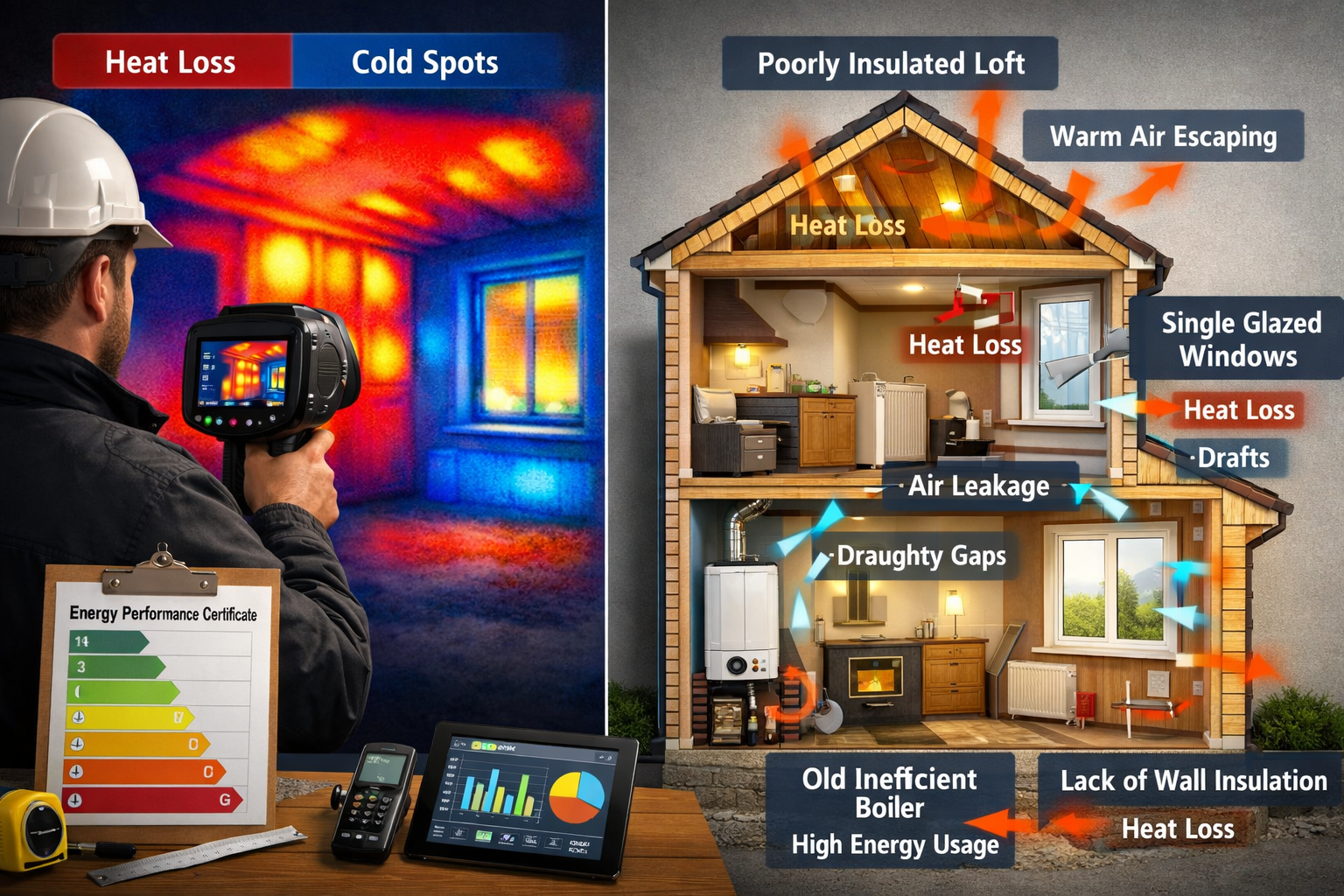
Energy performance surveys represent comprehensive assessments of how buildings consume, waste, and manage energy resources. Unlike basic building inspections and surveys for homeowners, these specialized evaluations focus specifically on thermal efficiency, heating system performance, insulation quality, and overall energy consumption patterns.
What Modern Energy Surveys Assess
Today's energy performance surveys employ advanced diagnostic tools and methodologies to create detailed profiles of building efficiency:
Thermal Imaging Analysis 📸
Professional surveyors use infrared cameras to detect heat loss patterns invisible to the naked eye. These thermal images reveal:
- Missing or inadequate insulation in walls, ceilings, and floors
- Air leakage around windows, doors, and structural joints
- Thermal bridging through structural elements
- Moisture intrusion that compromises insulation effectiveness
Heating System Efficiency Evaluation
Surveyors assess the performance of existing heating equipment including:
- Boiler age, efficiency rating, and operational condition
- Distribution system losses through ductwork or piping
- Control system effectiveness and programmability
- Heat pump performance and coefficient of performance (COP) ratings
Building Envelope Assessment
The survey examines all elements that separate conditioned interior spaces from the external environment:
- Window and door quality, glazing specifications, and air sealing
- Wall construction and insulation R-values
- Roof and attic insulation depth and coverage
- Foundation and basement insulation and moisture barriers
Energy Consumption Analysis
Detailed review of utility data provides baseline performance metrics:
- Historical electricity and gas consumption patterns
- Seasonal variation and peak demand periods
- Energy Use Intensity (EUI) calculations per square foot
- Comparison against similar building benchmarks
The Shift from Voluntary to Mandatory Compliance
The regulatory environment surrounding building energy performance has undergone dramatic transformation. According to a January 2025 Department of Energy and Pacific Northwest National Laboratory report, jurisdictions across the United States are transitioning from simple "report and disclose" benchmarking requirements to comprehensive "report and improve" Building Performance Standards that mandate actual efficiency improvements.[1]
This fundamental shift means property owners can no longer simply acknowledge poor performance—they must take corrective action within specified timeframes or face escalating penalties.
Washington D.C.'s Expanded Coverage
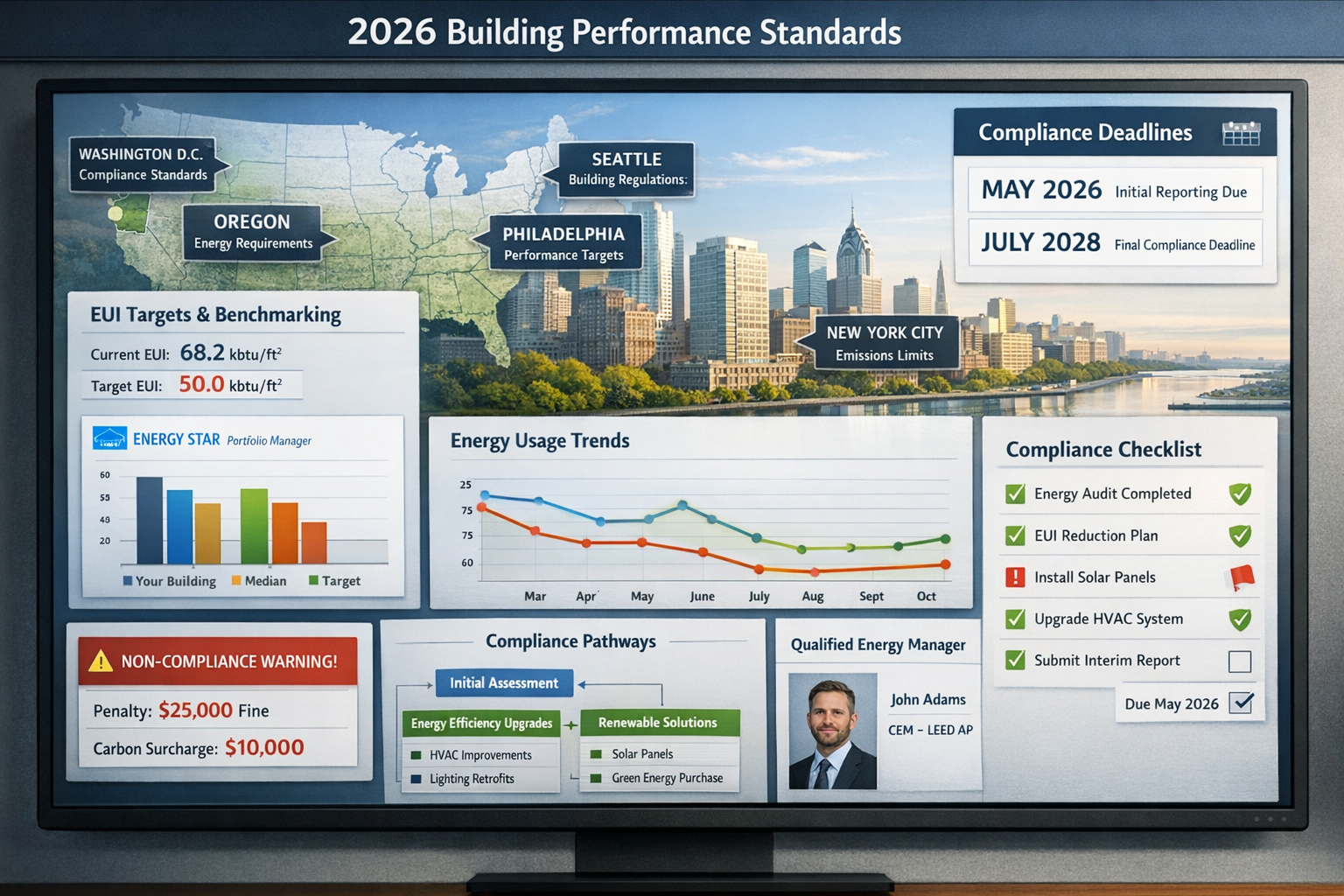
Starting in calendar year 2025, all privately-owned buildings exceeding 10,000 square feet must participate in annual benchmarking, with the first comprehensive report due May 1, 2026. Non-compliance carries penalties up to $100 per day, creating substantial financial exposure for property owners who delay action.[1]
Oregon's Performance-Based Approach
Oregon established its Building Performance Standard through House Bill 3409 in 2023, requiring Tier 1 and Tier 2 buildings larger than 20,000 square feet to meet specific energy use targets. The program adopts ASHRAE Standard 100, which establishes performance metrics based on building type, with compliance deadlines beginning July 2028 for the largest covered buildings.[2][4]
Buildings failing to meet energy targets must conduct comprehensive energy audits and implement all cost-effective efficiency measures identified through the assessment process.[2]
Energy Performance Surveys in 2026: Retrofit Advice to Combat Rising Costs and New Regulations Through Strategic Assessment
Understanding how energy performance surveys translate into actionable retrofit strategies requires examining the specific deficiencies these assessments uncover and the improvement pathways they illuminate.
Insulation Deficiencies: The Hidden Energy Drain
Inadequate insulation represents one of the most common and costly deficiencies revealed through energy performance surveys. Thermal imaging consistently identifies these problem areas:
Loft and Attic Spaces
- Common finding: Insulation depth below current standards (less than 270mm)
- Energy impact: Up to 25% of heat loss occurs through poorly insulated roofs
- Retrofit solution: Top-up insulation to 300mm+ using mineral wool, blown cellulose, or spray foam
- Typical cost: £400-£1,200 for average residential property
- Annual savings: £200-£350 on heating bills
Wall Insulation Gaps
- Common finding: Cavity walls with no insulation or solid walls with no external/internal insulation
- Energy impact: 35% of heat loss in uninsulated properties
- Retrofit solution: Cavity wall insulation injection or external/internal wall insulation systems
- Typical cost: £750-£2,500 for cavity walls; £4,000-£14,000 for solid wall insulation
- Annual savings: £150-£450 depending on property size
Floor Insulation Oversights
- Common finding: Uninsulated suspended floors or solid floors with no insulation layer
- Energy impact: 10-15% of heat loss through ground floors
- Retrofit solution: Underfloor insulation boards or spray foam application
- Typical cost: £800-£2,000 for accessible suspended floors
- Annual savings: £100-£200 annually
Heating System Inefficiencies and Upgrade Pathways
Energy performance surveys frequently identify aging or inefficient heating systems as primary contributors to excessive energy consumption. The assessment process evaluates multiple factors:
Boiler Efficiency Analysis
Modern condensing boilers achieve efficiency ratings of 90-95%, while older non-condensing units may operate at just 60-70% efficiency. Survey findings typically reveal:
| Boiler Type | Typical Efficiency | Annual Fuel Cost (3-bed home) | Upgrade Priority |
|---|---|---|---|
| Non-condensing (pre-2005) | 60-70% | £1,200-£1,400 | Immediate |
| Early condensing (2005-2010) | 80-85% | £900-£1,100 | High |
| Modern condensing (2010-2020) | 88-92% | £750-£850 | Medium |
| High-efficiency condensing (2020+) | 92-95% | £650-£750 | Low |
Heat Pump Opportunities
As regulations increasingly favor electrification, surveys now assess heat pump suitability:
- Property insulation quality (must meet minimum standards)
- Available space for outdoor units
- Existing radiator sizing and compatibility
- Electrical service capacity
Smart Control Integration
Modern surveys evaluate control system sophistication:
- Programmable thermostats with zoning capabilities
- Weather compensation features
- Remote access and monitoring through smartphone apps
- Integration with time-of-use electricity tariffs
Window and Glazing Performance Assessment
Windows represent critical thermal performance elements that surveys scrutinize carefully. The progression of glazing technology offers clear upgrade pathways:
Single Glazing (Pre-1980s)
- U-value: 5.0-5.8 W/m²K (very poor)
- Heat loss: Accounts for up to 25% of total building heat loss
- Retrofit recommendation: Urgent replacement
- Upgrade cost: £400-£800 per window for double glazing
- Energy savings: £150-£300 annually for typical home
Double Glazing (1980s-2000s)
- U-value: 2.8-3.0 W/m²K (moderate)
- Heat loss: Significant improvement but below current standards
- Retrofit recommendation: Consider replacement during major renovations
- Upgrade cost: £500-£1,000 per window for triple glazing
- Energy savings: £80-£150 annually
Modern Double/Triple Glazing (2010+)
- U-value: 1.2-1.8 W/m²K (excellent)
- Heat loss: Minimal with proper installation
- Retrofit recommendation: Maintain and ensure proper sealing
- Upgrade cost: Not typically necessary
- Energy savings: Already optimized
Air Leakage and Ventilation Balance
Energy performance surveys employ blower door testing to quantify air infiltration rates. This diagnostic reveals:
Common Air Leakage Points
- Gaps around window and door frames
- Service penetrations (electrical, plumbing, HVAC)
- Attic hatches and access points
- Junction between walls and floors/ceilings
Sealing Strategies
- Weatherstripping for movable components
- Caulking and sealant for fixed gaps
- Spray foam for larger cavities and penetrations
- Gaskets for attic hatches and access panels
Ventilation Considerations
While reducing air leakage improves efficiency, adequate ventilation remains essential for indoor air quality. Surveys assess whether mechanical ventilation systems are necessary after air sealing improvements, particularly in tightly sealed modern retrofits.
Navigating 2026 Compliance Requirements and Building Performance Standards
The regulatory framework governing building energy performance has become increasingly complex and consequential. Understanding specific requirements across different jurisdictions helps property owners develop compliant retrofit strategies.
Federal Building Energy Efficiency Requirements
While most aggressive Building Performance Standards emerge at state and local levels, federal requirements establish baseline expectations. The Department of Energy's Federal Energy Management Program (FEMP) sets standards for federal buildings that often influence private sector regulations.[7]
Federal facilities must:
- Reduce energy intensity by 2.5% annually through fiscal year 2025
- Achieve at least 30% energy intensity reduction by fiscal year 2030
- Meet specific energy efficiency standards outlined in 10 CFR Part 433[8]
These federal mandates demonstrate the regulatory trajectory affecting all building sectors.
State and Local Building Performance Standards
Washington D.C.'s Comprehensive Framework
The District's expanded benchmarking requirements, effective for calendar year 2025, represent one of the nation's most aggressive programs. All privately-owned buildings over 10,000 square feet must:
✅ Establish and maintain active EPA ENERGY STAR Portfolio Manager accounts
✅ Submit complete 12-month energy consumption data annually
✅ Report by May 1, 2026 for calendar year 2025 data
✅ Ensure data accuracy and completeness to avoid penalties
Non-compliance penalties reach $100 per day, creating potential annual exposure of $36,500 for properties that ignore requirements.[1]
Oregon's Tiered Performance Targets
Oregon's Building Performance Standard establishes specific Energy Use Intensity (EUI) targets based on building type and size. The program divides covered buildings into tiers:
Tier 1 Buildings (Largest facilities)
- Size threshold: Varies by type, generally 50,000+ square feet
- Compliance deadline: July 1, 2028
- Performance target: Meet ASHRAE Standard 100 EUI for building type
- Penalty structure: Up to $5,000 plus per-violation amounts after compliance date[2]
Tier 2 Buildings (Medium facilities)
- Size threshold: 20,000-50,000 square feet (varies by type)
- Compliance deadline: July 1, 2030
- Performance target: Meet ASHRAE Standard 100 EUI for building type
- Penalty structure: Same as Tier 1[2]
Compliance Pathways
Oregon offers flexibility in demonstrating compliance:
- Direct Performance Compliance: Achieve target EUI through any combination of improvements
- Conditional Compliance: Implement all cost-effective efficiency measures identified in a qualified energy audit before the compliance deadline, then collect one year of post-implementation data to verify target achievement[2]
- Alternative Compliance: Demonstrate equivalent performance through approved alternative methods
Seattle's Established Program
Seattle's benchmarking ordinance covers 3,700+ properties representing over 330 million square feet. Buildings greater than 20,000 square feet must:
- Maintain active Portfolio Manager accounts
- Submit complete 12-month energy consumption data annually by July 1
- Ensure data quality and completeness[1]
Philadelphia's Requirements
Commercial and multifamily properties of 50,000+ square feet must report annual energy and water use through EPA ENERGY STAR Portfolio Manager, establishing baseline performance data that may inform future performance requirements.[1]
The EPA ENERGY STAR Portfolio Manager Platform
Across jurisdictions, EPA ENERGY STAR Portfolio Manager has emerged as the standardized compliance platform. This free online tool enables property owners to:[1]
📊 Track and assess energy and water consumption across entire portfolios
📈 Benchmark performance against similar buildings nationwide using 75+ property type categories
🎯 Generate ENERGY STAR scores (1-100 scale) indicating relative performance
📋 Create compliance reports meeting specific jurisdictional requirements
🔄 Monitor progress over time as retrofits are implemented
Understanding Portfolio Manager functionality is essential for compliance, as jurisdictions increasingly require data submission through this platform.
Oregon's 2026 Compliance Support Initiatives
Recognizing the complexity of compliance, Oregon's Department of Energy is launching several support programs in 2026:
Online Compliance Management System
A streamlined digital platform will enable building owners to:
- Register covered buildings
- Submit performance data
- Track compliance status
- Access technical resources
- Communicate with program administrators[2]
Qualified Professional Credentialing
ODOE is establishing credential programs for:
- Qualified Energy Managers: Professionals who can oversee compliance strategies
- Qualified Persons: Individuals authorized to certify compliance documentation
- Qualified Energy Auditors: Specialists who conduct compliant energy audits[2]
Early Compliance Incentives
Oregon will begin making incentive payments in 2026 for building owners who achieve compliance ahead of mandatory deadlines, rewarding proactive efficiency improvements.[2]
Cost-Benefit Analysis: Investing in Energy Retrofits for Maximum Return
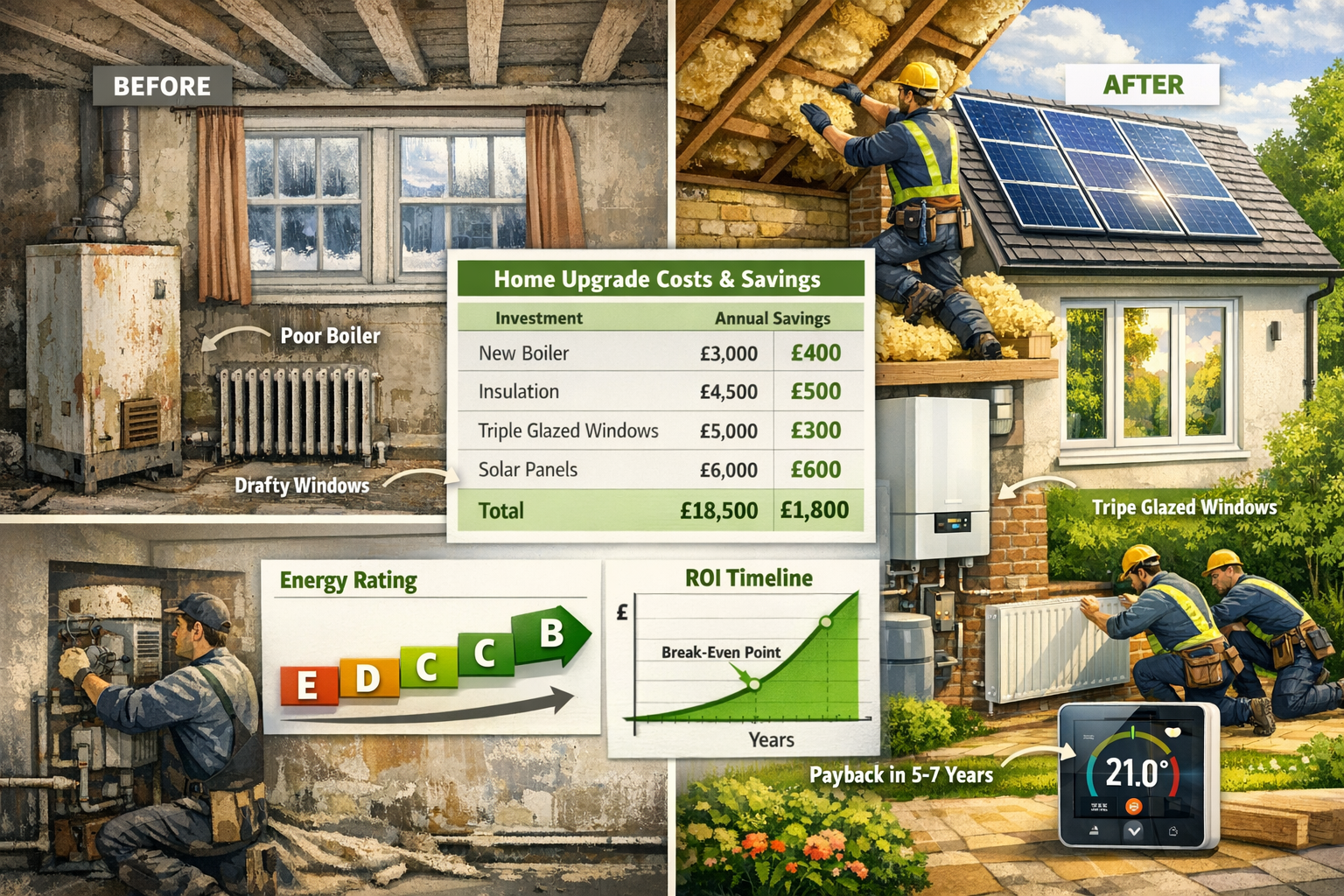
Understanding the financial implications of energy retrofits requires examining both immediate costs and long-term returns. When approached strategically based on energy performance survey findings, retrofits deliver compelling returns on investment.
Typical Retrofit Costs and Payback Periods
High-Priority, Quick-Payback Improvements
| Retrofit Measure | Typical Cost | Annual Savings | Simple Payback | EPC Rating Impact |
|---|---|---|---|---|
| Loft insulation top-up | £400-£800 | £200-£300 | 2-3 years | +1 to +2 bands |
| Cavity wall insulation | £750-£1,500 | £150-£300 | 3-5 years | +1 band |
| LED lighting upgrade | £200-£500 | £100-£200 | 2-3 years | +0.5 band |
| Heating controls/smart thermostat | £200-£400 | £150-£250 | 1-2 years | +0.5 band |
| Draught proofing | £100-£300 | £50-£100 | 1-3 years | +0.5 band |
Medium-Term Investment Improvements
| Retrofit Measure | Typical Cost | Annual Savings | Simple Payback | EPC Rating Impact |
|---|---|---|---|---|
| Boiler replacement (condensing) | £2,000-£3,500 | £300-£500 | 5-8 years | +1 to +2 bands |
| Double glazing replacement | £4,000-£8,000 | £150-£300 | 15-25 years | +1 band |
| Floor insulation | £800-£2,000 | £100-£200 | 5-10 years | +0.5 to +1 band |
| Solar PV panels (4kW system) | £5,000-£7,000 | £400-£600 | 10-15 years | +1 to +2 bands |
Long-Term Strategic Investments
| Retrofit Measure | Typical Cost | Annual Savings | Simple Payback | EPC Rating Impact |
|---|---|---|---|---|
| Air source heat pump | £8,000-£14,000 | £300-£700 | 15-25 years | +2 to +3 bands |
| Ground source heat pump | £14,000-£25,000 | £500-£900 | 20-30 years | +2 to +3 bands |
| External wall insulation | £8,000-£14,000 | £300-£450 | 20-30 years | +2 to +3 bands |
| Triple glazing (whole house) | £8,000-£15,000 | £100-£200 | 40-75 years | +0.5 to +1 band |
Beyond Simple Payback: Total Value Considerations
While simple payback periods provide useful benchmarks, comprehensive cost-benefit analysis must consider additional value factors:
Property Value Enhancement 🏡
Research consistently demonstrates that improved EPC ratings correlate with higher property values. Properties with EPC ratings of A or B command premium prices compared to similar properties rated E, F, or G. The value differential typically ranges from 5-15% depending on market conditions and property type.
Rental Income Optimization
For investment properties, energy efficiency improvements enable:
- Higher rental rates due to lower tenant utility costs
- Improved tenant retention and satisfaction
- Compliance with minimum EPC requirements (currently E rating minimum for new tenancies in many jurisdictions)
- Future-proofing against anticipated stricter rental property standards
Avoided Compliance Penalties
As Building Performance Standards proliferate, the cost of non-compliance increasingly factors into retrofit decisions. In Washington D.C., avoiding the $100 daily penalty represents $36,500 in annual savings—often exceeding the cost of necessary improvements.[1]
Enhanced Comfort and Health
While difficult to quantify financially, improved thermal comfort, reduced drafts, better air quality, and consistent temperatures throughout properties deliver significant quality-of-life benefits that occupants value highly.
Future Energy Cost Protection
With energy prices trending upward over time, efficiency improvements provide increasing returns as utility rates rise. A retrofit saving £500 annually at current rates may save £750-£1,000 annually within 5-10 years as energy costs escalate.
Financing Options for Energy Retrofits
Multiple financing mechanisms help property owners fund efficiency improvements:
Green Mortgages and Remortgaging
Specialized mortgage products offer:
- Higher loan-to-value ratios for energy-efficient properties
- Reduced interest rates for properties meeting efficiency thresholds
- Additional borrowing capacity specifically for energy improvements
Government Grants and Incentive Programs
Various programs provide financial support:
- Boiler upgrade schemes offering grants for heat pump installations
- Local authority grants for insulation improvements
- Energy company obligation (ECO) funding for qualifying households
- Oregon's early compliance incentive payments starting in 2026[2]
Commercial Property Assessed Clean Energy (C-PACE)
For commercial properties, C-PACE programs enable:
- Long-term financing (15-25 years) matching improvement lifespans
- Repayment through property tax assessments
- Transferability to new owners upon property sale
Energy Efficiency Loans
Specialized loan products offer competitive rates for efficiency projects, often with terms aligned to payback periods.
Practical Tips for Property Buyers and Owners: Maximizing Value Through Strategic Energy Improvements
Whether purchasing a property or improving an existing building, strategic approaches to energy performance optimization deliver maximum returns.
For Property Buyers: Due Diligence and Negotiation Strategies
Request Comprehensive Energy Performance Data
Beyond the basic EPC certificate, request:
- Recent utility bills covering at least 12 months
- Previous EPC certificates showing performance trends
- Documentation of any energy improvements already completed
- Thermal imaging reports if available
- Heating system service records and efficiency ratings
Commission Independent Energy Surveys
Similar to obtaining a Level 3 full building survey for structural assessment, consider commissioning an independent energy performance survey for properties with poor EPC ratings or high energy consumption. The £500-£1,500 survey cost often reveals issues worth thousands in negotiation leverage or future savings.
Calculate Total Cost of Ownership
When comparing properties, factor energy costs into affordability calculations:
- Property A: £300,000 purchase price + £1,500 annual energy costs (EPC rating E)
- Property B: £315,000 purchase price + £800 annual energy costs (EPC rating B)
Over a 10-year ownership period, Property B costs £8,000 less despite the higher purchase price, while also offering superior comfort and higher resale value.
Negotiate Based on Survey Findings
Use energy performance deficiencies to negotiate:
- Purchase price reductions reflecting retrofit costs
- Seller-funded improvements before completion
- Retention of funds to complete specific upgrades
- Warranty coverage for heating systems and insulation
Prioritize Properties with Retrofit Potential
Properties with poor current performance but good retrofit potential often represent excellent value:
- Solid construction with space for insulation upgrades
- Adequate space for modern heating systems
- Roof orientation suitable for solar panels
- Structural capacity for additional insulation weight
For Current Property Owners: Strategic Improvement Planning
Start with Professional Assessment
Invest in a comprehensive energy performance survey before planning improvements. The assessment identifies:
- Highest-impact improvements for your specific property
- Optimal sequencing of multiple improvements
- Potential conflicts between different upgrade approaches
- Cost-effective measures versus low-value investments
Prioritize Based on Cost-Effectiveness
Follow the energy efficiency hierarchy:
- Reduce demand: Insulation, air sealing, efficient windows
- Improve efficiency: High-efficiency heating systems, LED lighting, smart controls
- Generate renewable energy: Solar PV, solar thermal, heat pumps
This sequence ensures renewable energy systems are appropriately sized for reduced demand, maximizing return on investment.
Bundle Improvements Strategically
Combine related improvements to reduce overall costs:
- Install wall insulation when re-rendering or re-cladding
- Upgrade windows during major renovations requiring scaffolding
- Replace heating systems when boilers fail rather than emergency repairs
- Add loft insulation when re-roofing
Leverage Professional Project Management
For complex multi-measure retrofits, consider professional project management services to:
- Coordinate multiple contractors efficiently
- Ensure proper sequencing of improvements
- Maintain quality standards throughout
- Manage budgets and timelines effectively
Document All Improvements
Maintain comprehensive records of energy upgrades:
- Contractor invoices and warranties
- Before-and-after photos
- Updated EPC certificates
- Energy consumption data showing improvements
- Product specifications and performance ratings
This documentation proves valuable for:
- Property sales demonstrating value-added improvements
- Compliance reporting for Building Performance Standards
- Insurance claims and valuations
- Future improvement planning
Avoiding Common Retrofit Mistakes
Mistake 1: Improving in Wrong Sequence
Installing a new heating system before improving insulation results in an oversized, inefficient system. Always reduce demand through insulation and air sealing before upgrading heating equipment.
Mistake 2: Creating Moisture Problems
Adding insulation or air sealing without addressing ventilation can trap moisture, leading to condensation, mold, and structural damage. Ensure adequate ventilation accompanies all envelope improvements.
Mistake 3: Ignoring Whole-House Approach
Addressing only one deficiency while ignoring others delivers suboptimal results. A comprehensive strategy addressing multiple deficiencies simultaneously achieves better performance and cost-effectiveness.
Mistake 4: Choosing Lowest-Cost Contractors
Energy retrofit quality significantly impacts performance. Poorly installed insulation, incorrectly sized heating systems, or substandard air sealing wastes money while delivering minimal benefits. Invest in qualified, experienced contractors with verifiable track records.
Mistake 5: Neglecting Maintenance
Even the most efficient systems underperform without proper maintenance. Establish regular maintenance schedules for heating systems, clean or replace filters, check insulation condition, and address air sealing degradation promptly.
Future Outlook: Preparing for Evolving Standards and Market Demands
The trajectory of energy performance regulation and market expectations continues toward stricter requirements and higher efficiency standards. Property owners who anticipate these trends position themselves advantageously.
Anticipated Regulatory Developments
Expanding Geographic Coverage
Building Performance Standards currently concentrated in progressive jurisdictions are spreading nationwide. Additional states and municipalities are expected to adopt similar frameworks by 2027-2028, following the models established in Washington D.C., Oregon, Seattle, and other early adopters.[3]
Stricter Performance Targets
Initial performance targets represent starting points that will tighten over time. Oregon's framework, for example, includes provisions for periodic target updates reflecting technological advancement and market conditions.[2]
Lower Size Thresholds
Current programs typically cover buildings above 10,000-50,000 square feet. Future iterations will likely extend requirements to smaller commercial buildings and potentially residential properties, expanding coverage to encompass the majority of building stock.
Enhanced Enforcement Mechanisms
As programs mature, enforcement will intensify. Expect:
- Automated penalty assessment systems
- Public disclosure of non-compliant properties
- Restrictions on property transactions for non-compliant buildings
- Integration with building permit and occupancy systems
Market-Driven Efficiency Demands
Beyond regulatory requirements, market forces increasingly reward energy efficiency:
Tenant Expectations
Commercial and residential tenants increasingly prioritize energy efficiency:
- Lower operating costs in triple-net lease structures
- Corporate sustainability commitments driving tenant requirements
- Employee and resident comfort and wellness considerations
- Environmental, social, and governance (ESG) reporting obligations
Investor Requirements
Institutional investors and lenders increasingly screen properties based on energy performance:
- ESG investment criteria excluding poor-performing assets
- Climate risk assessments factoring energy efficiency
- Portfolio-wide performance targets requiring efficient buildings
- Green financing terms contingent on efficiency metrics
Insurance Considerations
Energy efficiency increasingly factors into property insurance:
- Premium discounts for efficient, resilient buildings
- Coverage restrictions for properties vulnerable to climate impacts
- Insurance reinstatement cost valuations accounting for efficiency features
- Risk assessments incorporating energy performance data
Emerging Technologies and Approaches
Advanced Building Monitoring
Internet of Things (IoT) sensors and smart building platforms enable:
- Real-time energy consumption monitoring
- Predictive maintenance identifying efficiency degradation
- Automated optimization of heating, cooling, and ventilation
- Granular data supporting Portfolio Manager reporting
Heat Pump Technology Evolution
Heat pump efficiency and performance continue improving:
- Higher efficiency ratings reducing operating costs
- Better low-temperature performance expanding climate suitability
- Hybrid systems combining heat pumps with backup heating
- Integration with thermal storage for demand flexibility
Building-Integrated Renewable Energy
Solar and other renewable technologies become increasingly cost-effective:
- Building-integrated photovoltaics (BIPV) replacing traditional materials
- Community solar enabling efficiency for properties without suitable roofs
- Battery storage optimizing renewable energy utilization
- Vehicle-to-grid integration supporting building energy needs
Advanced Insulation Materials
New insulation technologies deliver superior performance in limited space:
- Vacuum insulated panels achieving R-values 5-10x traditional materials
- Aerogel insulation providing exceptional performance in thin profiles
- Phase-change materials storing and releasing thermal energy
- Smart insulation with variable thermal properties
Conclusion: Taking Action on Energy Performance in 2026
Energy Performance Surveys in 2026: Retrofit Advice to Combat Rising Costs and New Regulations represents far more than regulatory compliance—it embodies a strategic approach to property ownership that delivers financial returns, enhanced comfort, reduced environmental impact, and future-proofed assets.
The convergence of rising energy costs, tightening regulations, and increasing market demands for efficiency creates both challenges and opportunities. Property owners who approach energy performance proactively through comprehensive surveys, strategic retrofit planning, and systematic implementation position themselves to:
✅ Avoid costly compliance penalties reaching hundreds of dollars daily in some jurisdictions
✅ Reduce operating costs by hundreds to thousands of pounds annually through targeted improvements
✅ Enhance property values through improved EPC ratings and demonstrated efficiency
✅ Improve tenant satisfaction and retention through superior comfort and lower utility costs
✅ Future-proof assets against anticipated stricter standards and market expectations
Actionable Next Steps
For Property Buyers:
- Request comprehensive energy data for all properties under consideration, including EPC certificates, utility bills, and improvement documentation
- Commission independent energy surveys for properties with poor ratings or high consumption before finalizing purchases
- Factor total cost of ownership into affordability calculations, accounting for energy costs over expected ownership periods
- Negotiate strategically using survey findings to secure price reductions or seller-funded improvements
- Prioritize retrofit potential when comparing properties, recognizing that poor current performance with good improvement potential often represents excellent value
For Current Property Owners:
- Schedule a professional energy performance survey to establish baseline performance and identify cost-effective improvements
- Review applicable compliance requirements for your jurisdiction and property type, noting relevant deadlines and penalty structures
- Develop a multi-year improvement plan prioritizing high-impact, cost-effective measures while planning for longer-term strategic investments
- Establish Portfolio Manager account if subject to benchmarking requirements, beginning data collection immediately
- Investigate available financing and incentive programs including grants, green mortgages, and early compliance incentives like Oregon's 2026 program[2]
- Engage qualified professionals including energy auditors, chartered surveyors, and specialized contractors with verified energy retrofit experience
- Document all improvements thoroughly maintaining records that demonstrate compliance, support property valuations, and inform future planning
For All Stakeholders:
- Stay informed about evolving regulations in your jurisdiction, as requirements continue expanding and tightening
- Consider early action to avoid the rush as compliance deadlines approach and contractor availability tightens
- Think holistically about energy performance as part of overall property strategy rather than isolated compliance exercise
- Engage professional guidance from experienced surveyors who can integrate energy performance with broader property assessments
The transition to high-performance buildings represents one of the most significant property market shifts in decades. Those who recognize energy performance surveys as strategic tools rather than regulatory burdens will find themselves well-positioned to thrive in the evolving landscape of 2026 and beyond.
For professional guidance on energy performance surveys, building assessments, and strategic property improvement planning, contact experienced chartered surveyors who can provide comprehensive advice tailored to your specific property and circumstances.
References
[1] Energy Benchmarking – https://rimkus.com/article/energy-benchmarking/
[2] 2026 Building Performance Standard Annual Report – https://www.oregon.gov/energy/Data-and-Reports/Documents/2026-Building-Performance-Standard-Annual-Report.pdf
[3] facilitiesdive – https://www.facilitiesdive.com/news/map-tracking-building-performance-standards-across-the-us/743214/
[4] Oregons New Oregon Legislature Building Performance Standards Bps – https://smartbuildingscenter.org/oregons-new-oregon-legislature-building-performance-standards-bps/
[5] Hvac Standards What New Regulations Mean For Your Home – https://www.dixielandenergy.com/hvac-standards-what-new-regulations-mean-for-your-home
[6] Epc Ratings How Are They Changing In 2026 And What Does That Mean For Home Heating – https://ecostrad.com/blog/epc-ratings-how-are-they-changing-in-2026-and-what-does-that-mean-for-home-heating/
[7] Federal Building Energy Efficiency Rules And Requirements – https://www.energy.gov/femp/federal-building-energy-efficiency-rules-and-requirements
[8] Part 433 – https://www.ecfr.gov/current/title-10/chapter-II/subchapter-D/part-433
[9] Understanding Energy Benchmarking Ordinances Local Energy Efficiency Regulations A State By State Guide – https://www.cim.io/blog/understanding-energy-benchmarking-ordinances-local-energy-efficiency-regulations-a-state-by-state-guide
[10] Viewcompdocument.action;jsessionid Oard=68ettzie7vcpfghlsktdl51drax9wa3j8qvxrdjgixf7npna E8m!1679948853 – https://secure.sos.state.or.us/oard/viewCompDocument.action;JSESSIONID_OARD=68etTzie7VCpfgHLsKtdl51DrAX9WA3J8qvxRdjgixf7NPNa_E8M!1679948853?compDocRsn=1532