

Properties with an EPC rating of A or B now sell for up to 14% more than equivalent homes rated D or below — and in 2026, that gap is widening fast. For surveyors, valuers, and property owners alike, understanding Energy Performance Standards in Valuations: Surveyor Checklists for EPC Upgrades and 2026 Market Premiums has shifted from a regulatory checkbox exercise into a core professional competency that directly shapes market outcomes.
This article provides RICS-aligned protocols for assessing insulation, renewables, and efficiency during surveys, and connects those findings to the property price uplifts emerging in current market data.
Key Takeaways 📋
- EPC ratings are now a material valuation factor — lenders, buyers, and regulators all scrutinise energy performance data.
- RICS guidance requires surveyors to flag energy efficiency deficiencies as part of a thorough building survey.
- A structured EPC upgrade checklist helps prioritise works by cost-to-value ratio, maximising market premiums.
- 2026 market data shows measurable price uplifts for EPC-upgraded properties, particularly in London and the South East.
- Proactive energy assessments reduce the risk of post-sale renegotiations and support accurate capital gains calculations.
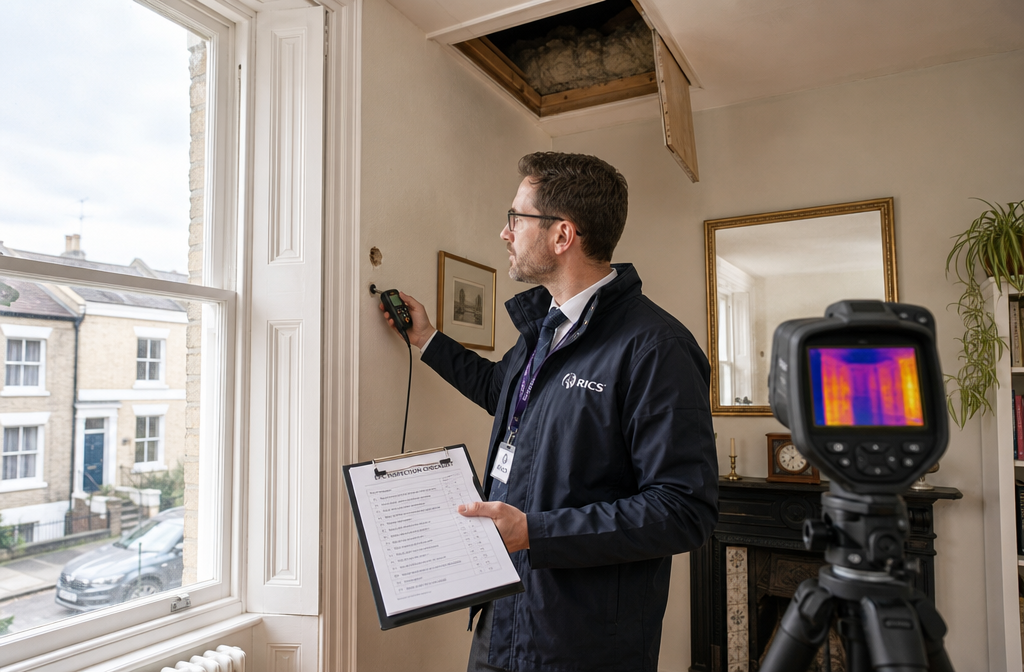
Why Energy Performance Standards Now Drive Property Valuations
The UK's trajectory toward net zero has fundamentally restructured how surveyors and valuers approach residential and commercial property assessments. The Minimum Energy Efficiency Standards (MEES) regulations, originally introduced for the private rented sector, have created a cascading effect across the entire property market. In 2026, the pressure is no longer theoretical — it is transactional.
Three forces are converging simultaneously:
- 🏦 Lender scrutiny — major mortgage providers now apply "green mortgage" incentives and, in some cases, apply higher risk weightings to sub-C rated properties.
- 🏠 Buyer behaviour — rising energy bills have made running costs a front-of-mind factor during property searches.
- ⚖️ Regulatory trajectory — proposed legislative changes signal that EPC C will become a minimum standard for owner-occupied sales in the near future.
For chartered surveyors, this means that energy performance standards in valuations are no longer a footnote. They belong in the core narrative of every RICS building survey report.
💬 "An EPC rating is no longer just an administrative document — it is a market signal that can shift a valuation by tens of thousands of pounds."
The RICS Framework: What Surveyors Must Consider
RICS guidance on residential valuations and building surveys explicitly requires practitioners to consider energy efficiency as a material factor. The Red Book and associated professional statements direct valuers to:
- Note the current EPC rating and its expiry date
- Identify visible deficiencies in insulation, glazing, and heating systems
- Flag recommended improvements from the EPC advisory report
- Assess the cost-to-upgrade relative to the property's market value
- Consider comparables that have undergone energy improvements
Surveyors operating across Central London and West London are already reporting that buyers routinely request EPC upgrade cost estimates before exchanging contracts — a trend that underlines the need for structured surveyor protocols.
The Surveyor's EPC Upgrade Checklist: A RICS-Aligned Protocol
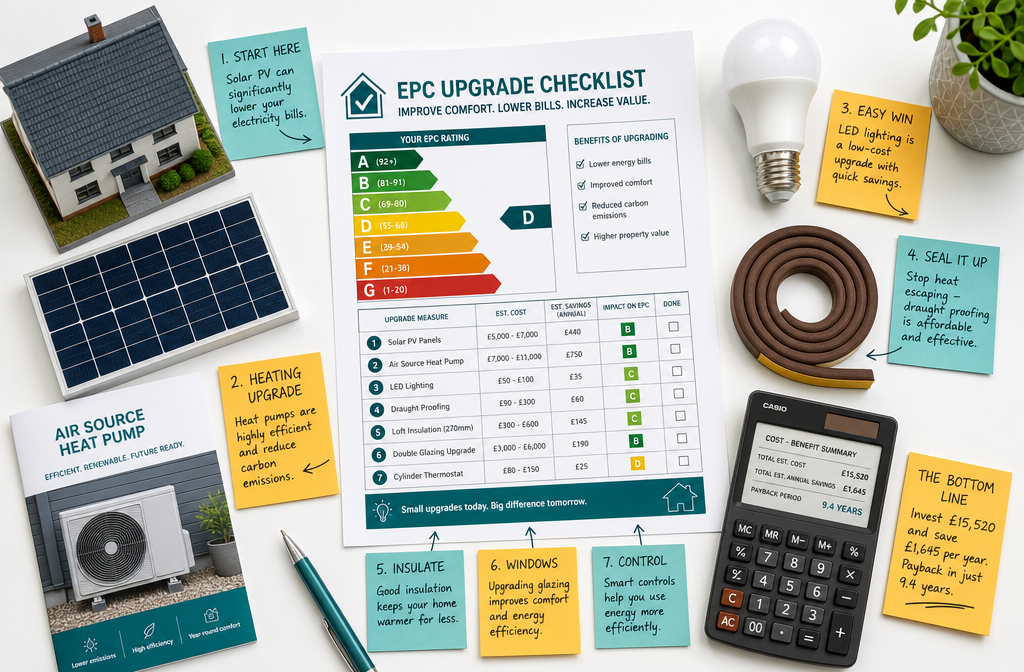
Implementing Energy Performance Standards in Valuations: Surveyor Checklists for EPC Upgrades and 2026 Market Premiums requires a systematic approach. The following checklist is structured around the four primary domains that influence an EPC score: fabric, heating, renewables, and controls.
🏗️ Domain 1: Building Fabric
The building envelope accounts for the largest proportion of heat loss in most UK properties. Surveyors should assess:
| Element | What to Check | Upgrade Potential |
|---|---|---|
| Loft insulation | Depth (target: 270mm+), coverage, condition | High — low cost, high impact |
| Wall insulation | Cavity fill, external/internal wall insulation | High — significant EPC uplift |
| Floor insulation | Suspended timber floors, solid floor insulation | Medium |
| Windows & doors | Double/triple glazing, draught seals, frame condition | Medium-High |
| Air tightness | Draught-proofing at junctions, letterboxes, loft hatches | Medium |
⚠️ Important: For older or listed properties, fabric interventions require careful consideration. A building survey for an Edwardian or period property should assess whether insulation upgrades are compatible with the building's construction method and any conservation constraints.
🔥 Domain 2: Heating Systems
Heating system efficiency is a major EPC scoring factor. The checklist should include:
- Boiler age and efficiency rating — condensing boilers rated A or B are standard; older G-rated systems significantly depress EPC scores
- Heat pump suitability — assess fabric readiness (insulation levels, radiator sizing) before recommending air source or ground source heat pumps
- Heating controls — programmer, room thermostat, and thermostatic radiator valves (TRVs) all contribute to the SAP calculation
- Hot water cylinder — insulation jacket, immersion heater efficiency
- District heating connections — relevant in urban areas and large developments
☀️ Domain 3: Renewable Energy Systems
Renewables can deliver significant EPC score improvements, but their suitability depends on the property's orientation, roof condition, and structural capacity. Surveyors should check:
- Roof condition and orientation — south-facing pitches at 30–45° are optimal for solar PV; a roofing survey should precede any PV installation recommendation
- Solar PV system — existing installation size (kWp), inverter age, feed-in tariff status
- Solar thermal — hot water contribution, system condition
- Battery storage — increasingly relevant for maximising self-consumption
- EV charging infrastructure — now a buyer expectation in many market segments
🎛️ Domain 4: Smart Controls and Monitoring
Modern energy management systems contribute to both EPC scores and occupant behaviour. Assess:
- Smart thermostats (e.g., Nest, Hive, Honeywell)
- Zoned heating controls
- Smart meters (SMETS2)
- Mechanical ventilation with heat recovery (MVHR) in new builds or deep retrofits
Prioritising Upgrades: The Cost-to-Value Matrix
Not all upgrades deliver equal returns. The table below guides surveyors and clients on prioritisation:
| Upgrade | Typical Cost | EPC Score Uplift | Value Premium (2026 est.) |
|---|---|---|---|
| Loft insulation | £300–£600 | +5–10 pts | £2,000–£8,000 |
| Cavity wall insulation | £500–£1,500 | +5–15 pts | £3,000–£12,000 |
| New condensing boiler | £2,000–£4,000 | +10–20 pts | £5,000–£15,000 |
| Double glazing | £5,000–£10,000 | +5–10 pts | £4,000–£10,000 |
| Air source heat pump | £8,000–£15,000 | +15–30 pts | £10,000–£25,000 |
| Solar PV (4kWp) | £6,000–£9,000 | +10–20 pts | £8,000–£18,000 |
Estimates based on 2026 market data for South East England. Figures vary by property type, location, and baseline EPC rating.
2026 Market Premiums: What the Data Shows
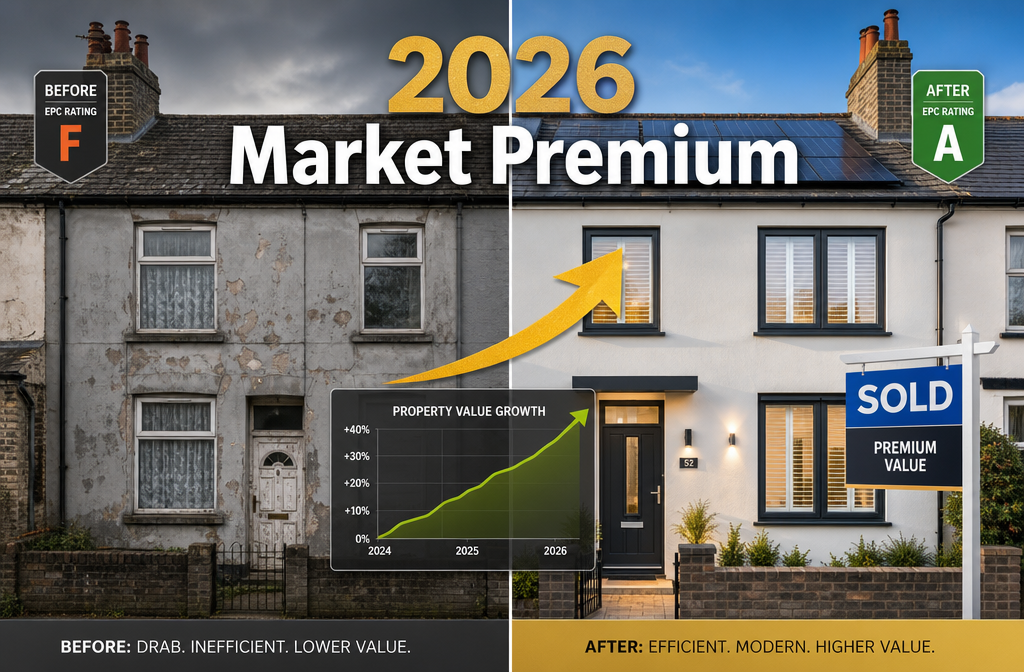
The connection between Energy Performance Standards in Valuations: Surveyor Checklists for EPC Upgrades and 2026 Market Premiums and real-world transaction prices is now well-evidenced. In 2026, several market dynamics are amplifying the premium for energy-efficient homes.
📈 The Green Premium in Numbers
Research consistently demonstrates that:
- EPC A/B properties command a 5–14% premium over equivalent EPC D properties in comparable transactions
- The premium is most pronounced in London and the South East, where energy costs are a larger proportion of household outgoings relative to income
- Properties that move from EPC E to EPC C through targeted upgrades typically see value uplifts of £8,000–£20,000 depending on location and property type
- Rental yields for EPC C+ properties are higher due to reduced void periods and stronger tenant demand
Surveyors working across markets such as Guildford, Richmond, and Islington are reporting that energy efficiency has become a standard buyer negotiation point — and that low EPC ratings are increasingly used to justify post-survey price reductions.
The "Brown Discount" — A Growing Risk
The inverse of the green premium is the brown discount: the measurable reduction in value applied to energy-inefficient properties. In 2026, this discount is accelerating due to:
- Mortgage lender risk-weighting — some lenders now restrict loan-to-value ratios on EPC F and G properties
- Buyer negotiation leverage — a poor EPC provides documented grounds for price reduction
- Insurance implications — some insurers are beginning to factor energy performance into premium calculations
- Resale risk — buyers are increasingly aware that sub-C properties may face regulatory restrictions
💬 "The brown discount is no longer a theoretical risk. In active markets, a D-rated property can sit on the market weeks longer than its C-rated equivalent — and ultimately sell for less."
Capital Gains Implications
For property investors and second-home owners, EPC upgrades carry direct capital gains tax implications. Improvement costs that enhance the asset's value — including energy efficiency works — may be treated as allowable expenditure when calculating capital gains. Investors should consult a chartered surveyor familiar with capital gains valuations to ensure upgrade costs are properly documented and attributed.
Integrating EPC Assessment into the Building Survey Process
A thorough building survey should seamlessly incorporate energy performance assessment. The full building survey — the most comprehensive inspection available — provides the ideal framework for integrating EPC analysis alongside structural, fabric, and services assessment.
Practical Steps for Surveyors
Before the inspection:
- Obtain the current EPC certificate and advisory report
- Review the SAP calculation inputs if available
- Note the property age, construction type, and any known heritage constraints
During the inspection:
- Visually verify insulation provisions against EPC assumptions
- Check heating system age, controls, and efficiency ratings
- Identify any renewable energy systems and assess their condition
- Note discrepancies between the EPC certificate and actual site conditions
In the report:
- Clearly state the current EPC rating and its market implications
- Itemise recommended upgrades in order of cost-effectiveness
- Provide indicative cost ranges for each improvement
- Reference the potential EPC score improvement and associated value uplift
- Flag any fabric or structural issues that must be resolved before energy upgrades (e.g., roof repairs before solar PV)
⚠️ Note for period properties: Older buildings require specialist knowledge. Surveyors should understand the interaction between traditional building materials and modern insulation systems to avoid condensation, moisture, and structural damage. Understanding what to look out for when buying an old house is essential context for any energy upgrade recommendation.
Regional Considerations for 2026 Valuations
The impact of energy performance on valuations is not uniform across the UK. Regional market conditions, property stock age, and buyer demographics all influence the scale of the premium or discount.
Key Regional Insights
| Region | EPC Premium Strength | Primary Driver | Common Upgrade Need |
|---|---|---|---|
| Central London | High (10–14%) | Buyer sophistication, lender pressure | Glazing, controls, heat pumps |
| South East (Surrey, Herts) | High (8–12%) | Commuter buyer expectations | Insulation, solar PV |
| East London | Medium-High (6–10%) | Regeneration areas, younger buyers | Boiler replacement, insulation |
| Home Counties | Medium (5–9%) | Older stock, rural properties | Heat pumps, fabric upgrades |
Surveyors covering areas such as Hertfordshire, Watford, and Putney are well-positioned to advise clients on the specific upgrade pathways that deliver the strongest returns in their local markets.
Common Pitfalls to Avoid ⚠️
Even well-intentioned EPC upgrade programmes can underperform or create new problems. Surveyors should alert clients to the following risks:
- Over-insulating without adequate ventilation — can lead to condensation, mould, and poor air quality
- Installing heat pumps in poorly insulated properties — reduces system efficiency and may not deliver expected EPC uplift
- Relying on an outdated EPC — certificates are valid for 10 years but may not reflect recent improvements or changes
- Ignoring the EPC advisory report — this document contains the assessor's specific recommendations and should be the starting point for any upgrade plan
- Failing to document improvements — without proper records, upgrade costs cannot be claimed as allowable expenditure for tax purposes or used to justify a revised valuation
Conclusion: Actionable Next Steps for Surveyors and Property Owners
Energy Performance Standards in Valuations: Surveyor Checklists for EPC Upgrades and 2026 Market Premiums represent one of the most significant shifts in property assessment practice of the past decade. In 2026, energy performance is a primary valuation driver — not a secondary consideration.
Actionable Next Steps ✅
For surveyors:
- Embed the four-domain EPC checklist (fabric, heating, renewables, controls) into every building survey instruction
- Develop a working knowledge of current upgrade costs and EPC score impacts for your regional market
- Clearly communicate the financial implications of energy performance to clients in every report
For property owners and investors:
- Commission a full building survey that includes explicit energy performance commentary before listing or purchasing
- Prioritise high-impact, low-cost improvements (loft and cavity wall insulation) before tackling larger capital expenditure
- Document all upgrade works meticulously for tax, valuation, and resale purposes
For buyers:
- Request the EPC advisory report alongside the certificate — it contains the roadmap for improvement
- Factor upgrade costs into your offer price and financing calculations
- Use a chartered surveyor's assessment to validate the EPC rating against actual site conditions
The property market of 2026 rewards energy efficiency — and penalises those who ignore it. A structured, RICS-aligned approach to energy performance assessment is no longer optional; it is the professional standard.
For expert guidance on energy performance assessments and property valuations across London and the South East, contact Prince Surveyors for free advice.