

Fewer than 14% of UK homes currently hold an EPC rating of A or B — yet by 2030, every privately rented property must reach at least band C. That gap sits at the centre of one of the most consequential shifts in UK property valuation practice right now.
Against a backdrop of flat price growth and heightened buyer caution — reflected in RICS sentiment data from early 2026 — chartered surveyors are no longer treating energy performance as a footnote. Energy Performance Certificates in cautious 2026 valuations: surveyor strategies for EPC band upgrades have become a core discipline, reshaping how professionals assess, report, and advise on residential and commercial property. This article unpacks the regulatory framework, the new multi-metric EPC methodology, and the step-by-step protocols surveyors are embedding into Level 3 surveys to deliver retrofit-aware valuations.
Key Takeaways 📋
- EPC reform is structural, not cosmetic: The single A–G rating is being replaced by a four-metric framework covering energy cost, fabric performance, heating efficiency, and smart readiness [1][2].
- The 2030 rental deadline is firm: All privately rented homes must reach EPC C by 2030, with MEES standards activating from 2027 [2][6].
- Landlord spending caps matter: The government has revised the maximum retrofit spending cap to £10,000, with early improvements from October 2025 counting toward that limit [1].
- Incremental upgrades deliver measurable SAP gains: Targeted interventions — insulation, LED lighting, solar panels — can move a property from band E to band C without full refurbishment [2].
- Surveyors add direct value: Embedding EPC analysis into Level 3 building surveys produces retrofit roadmaps that directly influence negotiation, pricing, and investment decisions.
Why 2026 Is a Turning Point for EPC-Integrated Valuations
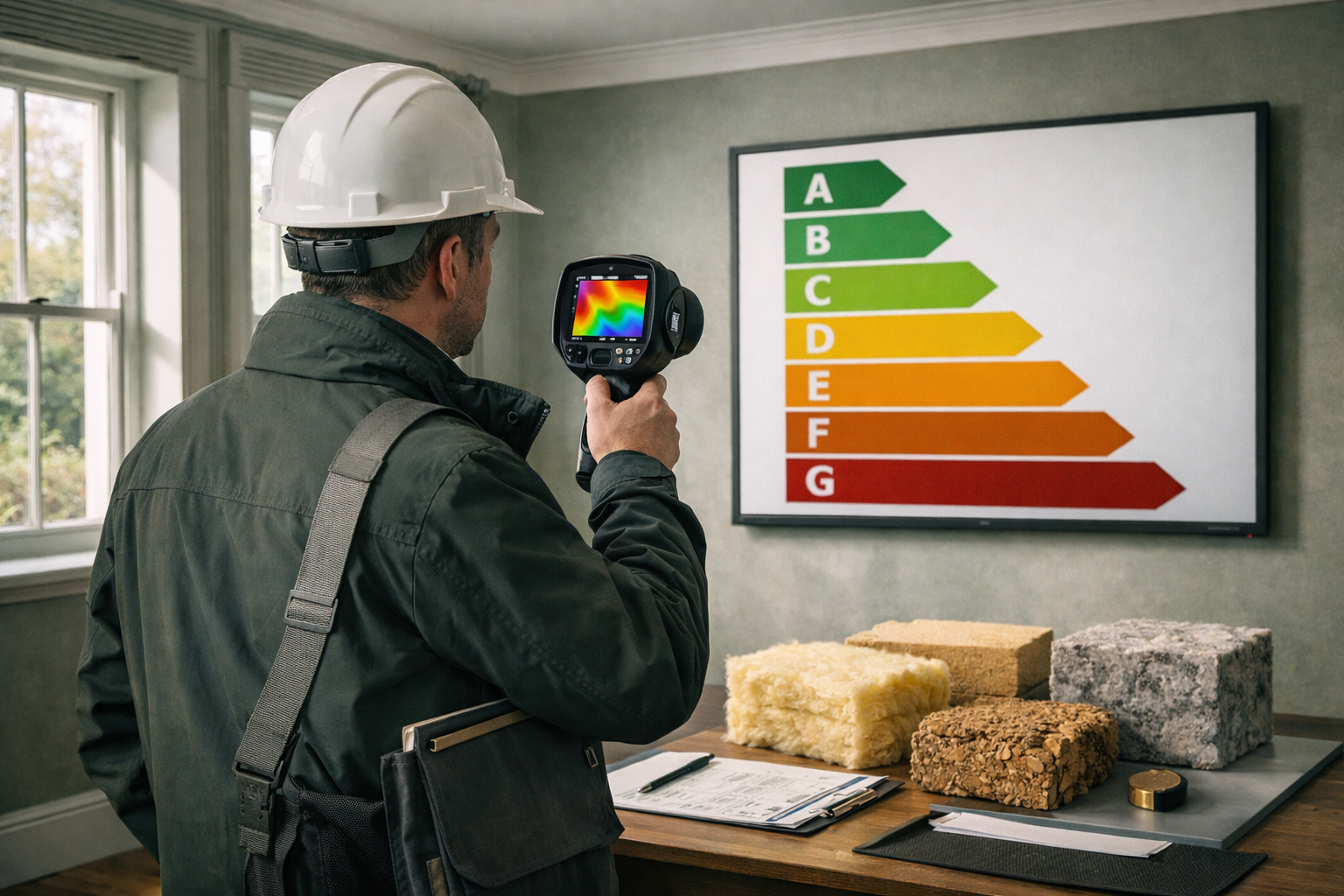
The UK property market entered 2026 in a cautious mood. RICS February 2026 data pointed to subdued buyer demand, modest price adjustments in key commuter corridors, and a growing tendency for buyers to use survey findings as negotiation leverage. In that environment, energy efficiency has moved from a "nice to have" to a hard pricing variable.
Two forces are converging simultaneously:
- Regulatory pressure from below — MEES requirements tighten from 2027, and the 2030 EPC C rental deadline creates a compliance countdown that lenders, insurers, and buyers are already pricing in.
- Buyer sophistication from above — Purchasers in 2026 are acutely aware of energy bills. A property rated EPC D or E carries an implied future cost — retrofit spend — that informed buyers now factor into offers.
For surveyors, this means that a building survey that ignores energy performance data is increasingly incomplete. The question is no longer whether to integrate EPC analysis but how to do it systematically.
💡 Pull Quote: "In a cautious market, the gap between an EPC D and an EPC C is not just a compliance issue — it is a measurable valuation discount."
The New Four-Metric EPC Framework: What Surveyors Must Understand
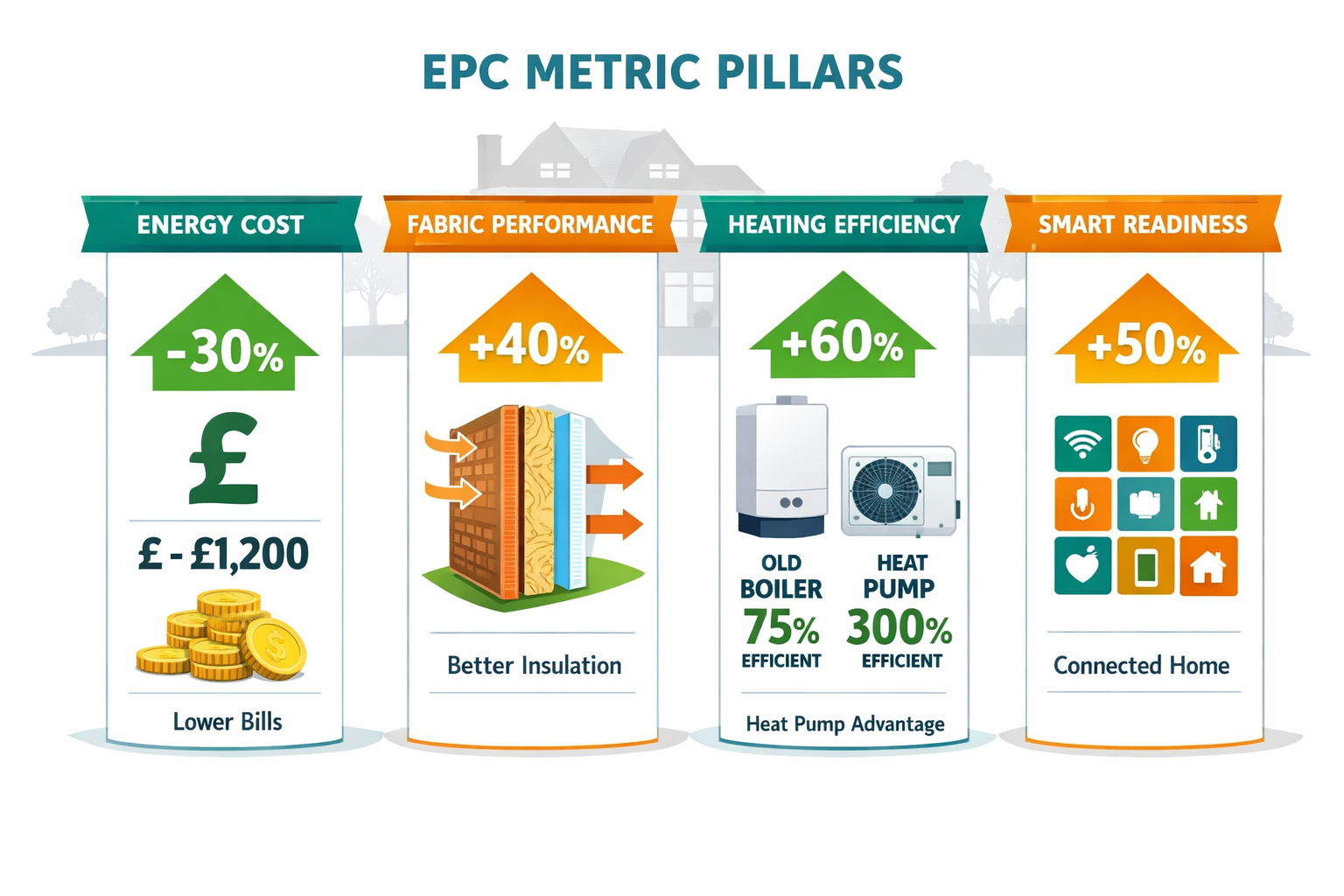
The most significant structural change underpinning Energy Performance Certificates in cautious 2026 valuations is the replacement of the single A–G rating with a four-component assessment model [1][2]. Understanding each metric is essential for surveyors advising clients on upgrade pathways.
1. 💷 Estimated Annual Energy Bill
Rather than an abstract SAP score, the reformed EPC will display a concrete estimated annual energy bill in pounds sterling [1][2]. This single change transforms EPC from a technical document into a consumer-facing financial tool. Surveyors should reference this figure explicitly in valuation reports, particularly when advising buyers on the true cost of ownership.
2. 🧱 Fabric Performance
This metric assesses how well a building retains heat through its construction — walls, roof, floors, windows, and doors [1][2]. It is the component most directly influenced by retrofit interventions and the one surveyors can most reliably assess during a Level 3 inspection. Key indicators include:
- Wall construction type (solid, cavity, or insulated)
- Roof insulation depth (current standard: 270mm)
- Window glazing specification (single, double, or triple)
- Floor insulation presence
3. 🔥 Heating System Performance
The efficiency and carbon intensity of the heating system receives its own separate score [1][2]. This covers boilers (gas, oil, LPG), heat pumps (air source and ground source), district heating connections, and hybrid systems. Surveyors assessing older properties should note that a G-rated boiler can suppress the overall EPC score even when fabric performance is strong.
4. 📡 Smart Readiness
A newer addition to the framework, this metric evaluates a building's capacity to integrate with smart energy technologies — smart meters, demand-response systems, EV charging infrastructure, and battery storage [1][2]. While this component currently carries less weight in the overall assessment, it signals the direction of travel for future compliance requirements.
SAP Points Reference Table
| EPC Band | SAP Point Range | Typical Annual Bill Implication |
|---|---|---|
| A | 92–100 | Very low — high efficiency |
| B | 81–91 | Low |
| C | 69–80 | Moderate — 2030 target |
| D | 55–68 | Above average |
| E | 39–54 | Current rental minimum |
| F | 21–38 | High — MEES non-compliant |
| G | 1–20 | Very high — unlettable |
Source: [2]
Surveyor Strategies for EPC Band Upgrades: A Step-by-Step Protocol

The practical value of Energy Performance Certificates in cautious 2026 valuations: surveyor strategies for EPC band upgrades lies in the protocols surveyors apply during inspection and reporting. The following framework is designed for Level 3 building surveys but applies principles relevant to any valuation context.
For context on what a comprehensive Level 3 inspection entails and when to seek additional specialist input, see this guidance on sourcing extra advice during a full building survey.
Step 1: Pre-Inspection EPC Review
Before arriving on site, download the existing EPC from the government register. Note:
- Current SAP score and band
- Recommended improvements listed in the EPC
- Date of the certificate (EPCs are valid for 10 years — an outdated certificate may not reflect recent upgrades)
- The four-metric breakdown if a reformed certificate has been issued
Cross-reference with the top three factors assessed during a property valuation to ensure energy performance is integrated alongside structural condition and location.
Step 2: On-Site Fabric Assessment
During the Level 3 inspection, systematically record:
- Loft insulation depth — measure physically where accessible. Upgrading from zero to 270mm can improve SAP scores by 10–15 points [2].
- Wall construction — identify cavity walls eligible for insulation injection (cost: £350–£500; SAP gain: 5–10 points) [2].
- Hot water cylinder — check for insulation jacket. Adding one contributes 1.5–2 SAP points [2].
- Lighting — note the proportion of low-energy LED fittings. Full LED installation adds 1–2 points [2].
Use thermal imaging where available. Premium drone surveys can identify roof-level heat loss patterns that are invisible from ground level, particularly on flat roofs and complex roof geometries.
Step 3: Heating System Evaluation
Document the heating system in full:
- Boiler make, model, and approximate age
- Estimated SEDBUK efficiency rating
- Controls specification (programmer, room thermostat, TRVs)
- Presence of heat pump or renewable heating
Note that replacing an old G-rated boiler with a modern A-rated condensing boiler can deliver significant SAP gains without touching the fabric. Heat pump installation, while more expensive, typically pushes properties into band B or A territory.
Step 4: Renewable Energy Assessment
A 16-panel solar PV system adds approximately 10 SAP points on average, while a large wind turbine contributes around 7 points [2]. During inspection, assess:
- Roof orientation and pitch (south-facing, 30–45° ideal for solar)
- Roof structural capacity for panel loading
- Existing electrical infrastructure for battery storage compatibility
Step 5: Retrofit Roadmap in the Report
The survey report should include a dedicated EPC Upgrade Pathway section, structured as follows:
Quick wins (under £1,000 total investment):
- Loft insulation top-up to 270mm
- Hot water cylinder jacket
- LED lighting throughout
Medium interventions (£1,000–£5,000):
- Cavity wall insulation
- Heating controls upgrade
- Smart meter installation
Major upgrades (£5,000–£10,000):
- Boiler replacement or heat pump installation
- Solar PV system (partial)
- Window upgrades (secondary or replacement glazing)
This tiered approach helps clients understand the £10,000 landlord spending cap in context [1], and reinforces that improvements made from October 2025 onwards already count toward that limit — making early action strategically valuable [1].
EPC Compliance, Valuations, and the Landlord Spending Cap
For landlords and investment buyers, the financial architecture of EPC compliance is as important as the technical pathway. The government's revised spending cap of £10,000 — reduced from the earlier £15,000 proposal — acknowledges rising construction costs while setting a firm ceiling [1].
Critically, if £10,000 represents 10% or more of a property's value, the cap may be set lower [1]. This creates a direct link between property valuation and compliance cost assessment — precisely the territory where a chartered surveyor adds irreplaceable value.
Surveyors working on right-to-buy valuations or inheritance tax valuations should note that EPC band status is now a material factor in determining market value, particularly for properties in bands E, F, or G. A property that cannot be economically upgraded to band C within the spending cap carries a genuine valuation discount that must be reflected in the assessment.
For a deeper understanding of how EPC ratings interact with MEES regulations and building survey findings, the EPC, MEES, and building survey guide provides useful context.
Regional Considerations: Where EPC Upgrades Matter Most
EPC compliance challenges are not evenly distributed across the UK. Older housing stock — Victorian terraces, Edwardian semis, pre-war solid-wall properties — is concentrated in specific regions and presents the steepest upgrade challenges.
Surveyors operating across central London, north London, and east London regularly encounter solid-wall Victorian stock where cavity wall insulation is not an option. In these cases, the retrofit pathway shifts toward:
- External wall insulation (EWI) — expensive but effective, typically £8,000–£15,000 for a mid-terrace
- Internal wall insulation (IWI) — more affordable but reduces floor area
- Fabric-first plus renewables — combining partial fabric improvement with solar PV to reach band C
In suburban and commuter-belt markets — including Hertfordshire, Essex, and Buckinghamshire — post-war cavity wall properties offer more straightforward upgrade routes, and the cost-benefit case for early intervention is stronger.
The Price Negotiation Dimension
In a cautious 2026 market, EPC data has become a negotiation tool. Buyers who commission a Level 3 survey and receive a detailed retrofit roadmap are equipped to make evidence-based price reduction requests. Research on average price reductions after a survey consistently shows that documented defects and compliance costs translate into measurable reductions at the point of exchange.
An EPC E property with a credible £8,000 upgrade pathway to band C is not simply a compliance risk — it is a negotiating data point. Surveyors who quantify this clearly in their reports provide clients with actionable intelligence that goes well beyond the traditional structural condition assessment.
Conclusion: Actionable Next Steps for Surveyors and Property Owners
Energy Performance Certificates in cautious 2026 valuations: surveyor strategies for EPC band upgrades represent the convergence of regulatory compliance, financial planning, and professional practice. The market is no longer rewarding passivity on energy performance.
For Surveyors 🔍
- Integrate the four-metric EPC framework into every Level 3 report as standard practice, not an optional addendum.
- Use SAP point mapping to quantify the gap between current performance and band C, and identify the most cost-effective interventions to close it.
- Reference the £10,000 spending cap explicitly when advising landlord clients, and flag the October 2025 start date for qualifying expenditure.
- Deploy thermal imaging and drone survey technology to identify fabric deficiencies that standard visual inspection may miss.
For Property Owners and Landlords 🏠
- Commission an updated EPC if the existing certificate is more than five years old — the reformed methodology may produce a different result.
- Prioritise fabric improvements first: loft insulation, cavity wall insulation, and hot water cylinder jackets deliver the highest SAP gains per pound spent.
- Plan solar PV early: a 16-panel system adds approximately 10 SAP points and generates long-term bill savings that enhance rental yield [2].
- Document all improvements from October 2025 onwards to maximise the benefit of the £10,000 spending cap allowance [1].
The 2030 deadline is four years away. In property terms, that is not long. The surveyors and landlords who act in 2026 will be better positioned — financially and competitively — than those who wait for the deadline to force their hand.
References
[1] EPC Changes Explained – assessmenthive.co.uk
[2] New EPC Regulations – blog.goodlord.co
[3] PRS Homes Energy Performance Government Response – assets.publishing.service.gov.uk
[4] Energy Performance Certificate Methodology Shift in 2026: Building Surveyors Role in Multi-Metric EPC Assessments – nottinghillsurveyors.com
[5] Reforms to the Energy Performance of Buildings Regime – gov.uk
[6] MEES and EPC Standards Video Resource – youtube.com
[7] CIH EPC Guidance Resource – web.cih.org