

Nearly 18% of UK commercial properties currently carry an EPC rating of F or G — making them unlettable under existing Minimum Energy Efficiency Standards and, increasingly, unmortgageable under tightening lender criteria [1]. That single statistic captures the scale of the compliance challenge now reshaping property markets across England and Wales. Energy Performance Certificate compliance and valuation impact: MEES targets and 2026 surveyor responsibilities are no longer a peripheral concern for property professionals — they sit at the heart of every letting decision, every loan assessment, and every investment appraisal.
Key Takeaways 📋
- The government confirmed a single domestic MEES compliance deadline of October 1, 2030, replacing the previous 2028 interim milestone [2].
- EPCs are transitioning from a single A-G rating to a multi-metric framework covering fabric performance, heating efficiency, energy costs, and smart readiness — launching October 2026 [2].
- Commercial MEES requirements are set to rise from Band E to Band B by 2030, with EPC validity dropping from 10 to 5 years [3].
- EPC ratings directly affect property valuations, lender decisions, and rental yields — surveyors must integrate compliance risk into every assessment.
- A grandparenting clause protects properties achieving EPC C under the current system before October 1, 2029, until that certificate expires [2].

The Shifting Landscape of EPC Reform: What Changes in 2026 and Beyond
The Energy Performance Certificate system that UK property professionals have worked with for over a decade is undergoing its most significant overhaul since introduction. Understanding the timeline and scope of these changes is essential for any surveyor advising clients in 2026.
From Single Rating to Multi-Metric Assessment
From October 2026, domestic EPCs will transition away from the familiar single Energy Efficiency Rating (EER) on an A-G scale. In its place, the government is introducing a multi-metric framework that reports four primary indicators [2]:
| Metric | What It Measures |
|---|---|
| Fabric Performance | Insulation quality, wall and roof U-values, air tightness |
| Heating System Efficiency | Boiler, heat pump, or other heating technology performance |
| Energy Costs | Estimated annual running costs for occupants |
| Smart Readiness | Capacity to integrate smart controls and demand response |
Secondary metrics — including Energy Demand and Carbon emissions — will also appear on the certificate, providing a richer picture of a property's environmental footprint [2].
💡 Pull Quote: "The shift to multi-metric EPCs means a property can no longer 'pass' on the strength of one good attribute masking poor performance elsewhere — every dimension must meet the standard."
Critically, compliance under the new domestic framework requires meeting both a fabric standard AND either a heating system standard or a smart readiness standard [2]. This dual-condition approach means that simply installing a heat pump without addressing wall insulation, for example, will not be sufficient for compliance. Surveyors advising on property development projects must factor this layered requirement into retrofit planning from the outset.
The Home Energy Model Replaces SAP
Underpinning the new multi-metric EPC is the Home Energy Model (HEM), which replaces the long-standing Standard Assessment Procedure (SAP) methodology. HEM is designed to provide more granular energy performance data, though its implementation timeline has faced delays [1]. The shift matters practically: properties that currently score well under SAP may perform differently when assessed under HEM, creating valuation uncertainty during the transition period.
The Grandparenting Clause: A Critical Window
Properties that achieve an EPC C rating under the existing EER system before October 1, 2029 will be treated as compliant until that certificate expires or is replaced [2]. This grandparenting provision creates a defined window for landlords and investors to act under familiar rules before the new multi-metric regime takes full effect. Surveyors should be highlighting this window to clients now — it is a genuine strategic advantage for those who move early.
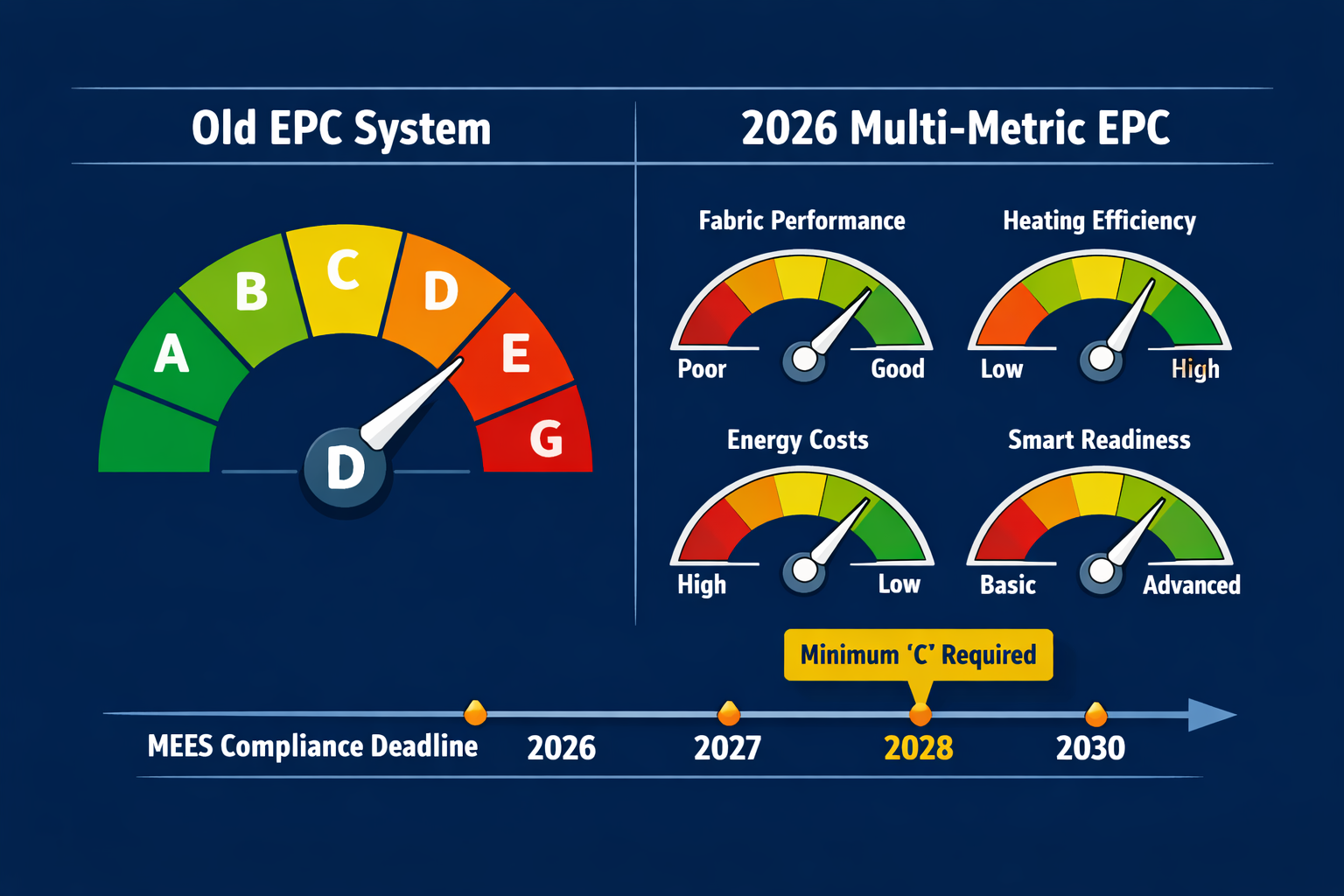
Understanding Energy Performance Certificate Compliance and Valuation Impact: MEES Targets and 2026 Surveyor Responsibilities for Domestic Properties
The October 2030 Deadline: What It Means in Practice
Following consultation responses published on January 21, 2026, the Ministry of Housing, Communities and Local Government (MHCLG) confirmed a single domestic MEES compliance deadline of October 1, 2030 for privately rented residential properties [2][6]. The previous 2028 interim milestone has been removed, consolidating the timeline.
This matters for valuations in several interconnected ways:
- Lenders are already pricing in compliance risk. Mortgage products for sub-standard properties are becoming more restrictive, with some lenders applying haircuts to loan-to-value ratios for properties below EPC C.
- Rental yields on non-compliant stock are under pressure. Properties that cannot be legally let after 2030 carry a latent liability that must be reflected in current valuations.
- Retrofit costs affect residual value. A surveyor who fails to quantify the cost of bringing a property to compliance is providing an incomplete valuation.
For clients purchasing buy-to-let properties, the top factors considered during a property valuation now include EPC rating as a material consideration alongside location, condition, and comparable evidence.
Budgeting for Staged Compliance Works
The cost of EPC uplift varies enormously depending on property type, age, and current rating. A Victorian terraced house upgrading from EPC E to EPC C may require:
- 🏠 Solid wall insulation (external or internal): £8,000–£22,000
- 🔥 Heat pump installation: £7,000–£15,000 (before grant support)
- 🪟 Double or triple glazing upgrades: £3,000–£8,000
- 💡 LED lighting and smart controls: £500–£2,000
Surveyors should direct clients to budgeting resources for repairs and restoration to ensure retrofit costs are properly modelled before purchase or refinancing decisions are made.
A Level 3 Full Building Survey is the appropriate vehicle for identifying the structural and fabric conditions that will determine the scope and cost of EPC improvement works. Without this level of investigation, retrofit cost estimates are unreliable.
How EPC Ratings Influence Lender Decisions
Lenders are increasingly using EPC data as a credit risk variable. The Bank of England's climate stress testing framework has accelerated this trend, with several major high-street lenders now:
- Offering green mortgage discounts (typically 0.1–0.25% rate reduction) for EPC A or B properties
- Applying enhanced scrutiny to buy-to-let mortgage applications on properties rated D or below
- Requiring retrofit roadmaps as a condition of lending on sub-standard commercial stock
For surveyors producing commercial valuations, EPC compliance status must now be explicitly addressed in the valuation report, with any compliance risk quantified as a deduction from market value or flagged as a special assumption.
Commercial Property: Energy Performance Certificate Compliance and Valuation Impact: MEES Targets and 2026 Surveyor Responsibilities Under the New Regime
The Band B by 2030 Target: A Seismic Shift
The domestic compliance picture is challenging — but the commercial sector faces an even steeper climb. Current proposals would raise the minimum EPC standard for commercial lettings from Band E (the current minimum) to Band B by 2030 [3]. This applies to all commercial lettings, not merely new leases, meaning existing tenants and landlords will both be affected.
To put this in context:
| Current Standard | Proposed 2030 Standard | Gap |
|---|---|---|
| Band E | Band B | Three full rating bands |
| ~18% of stock at F/G | Majority of stock below B | Enormous retrofit pipeline |
With approximately 18% of UK commercial properties rated F or G [1], and a far larger proportion sitting below Band B, the compliance retrofit pipeline represents one of the largest property improvement programmes in UK history.
EPC Validity: From 10 Years to 5 Years
A less-discussed but highly significant change is the proposed reduction in non-domestic EPC validity from 10 years to 5 years [3]. Under the new regime, commercial EPCs must be renewed every five years and maintained for the property's lifetime — meaning renewal will be mandatory upon expiry regardless of whether a lease transaction triggers it.
For surveyors advising commercial landlords, this creates a rolling compliance monitoring obligation that did not previously exist. Property management strategies must be updated to include EPC renewal tracking as a standard asset management task.
The SBEM Methodology Review
The Simplified Building Energy Model (SBEM) — used to generate non-domestic EPCs — is undergoing a significant methodology review, with gradual rollout expected from mid to late 2026 [3]. Key improvements include:
- 📊 Dynamic operational data from smart meters replacing purely theoretical modelling
- 🏢 Improved granularity for mixed-use buildings, addressing a long-standing criticism of SBEM
- 🔧 Tailored improvement recommendations rather than generic upgrade suggestions
New commercial EPC metrics will report fabric efficiency (insulation and glazing performance), building services performance (HVAC and lighting), operational energy use based on real-world consumption data, carbon emissions, and energy costs to occupiers [3]. This shift toward operational data makes commercial EPCs significantly more useful as a compliance and investment tool — but also means that properties with poor real-world performance can no longer hide behind favourable theoretical modelling.
Surveyor Responsibilities in Commercial EPC Compliance
For chartered surveyors working in the commercial sector, the expanded EPC framework creates specific professional responsibilities:
- Pre-acquisition due diligence must include EPC compliance risk assessment, with costs to Band B modelled as part of the investment appraisal.
- Lease advisory work must account for the fact that sub-Band B properties may become unlettable by 2030 — affecting rent review evidence and lease renewal negotiations.
- Dilapidations assessments will increasingly intersect with EPC compliance — understanding dilapidation protocols in the context of energy improvement obligations is essential.
- Insurance reinstatement valuations for commercial properties must reflect the cost of rebuilding to current energy standards — a factor that affects insurance reinstatement cost assessments materially.
💡 Pull Quote: "A commercial property surveyor who ignores EPC compliance risk in 2026 is producing an incomplete report — full stop. The regulatory direction of travel is unambiguous."
The Valuation Discount for Non-Compliant Stock
Market evidence is beginning to crystallise around a "brown discount" — a measurable reduction in value for energy-inefficient properties relative to compliant equivalents. While the quantum varies by sector and location, surveyors should be aware of:
- Void risk premium: Non-compliant properties face higher void periods as tenants increasingly specify EPC requirements in search criteria.
- Reduced purchaser pool: Institutional investors with ESG mandates are systematically excluding sub-Band C stock from acquisition targets.
- Financing constraints: As noted above, lenders are tightening criteria for non-compliant assets, reducing the available buyer pool further.
For investors considering property as a long-term asset class, understanding investment property compliance obligations is now inseparable from understanding investment returns.

Practical Steps for Surveyors: Integrating EPC Compliance Into Every Instruction
A Compliance Checklist for 2026 🗒️
Regardless of instruction type — residential or commercial, purchase or letting — surveyors should now apply the following EPC compliance checks as standard:
- ✅ Obtain current EPC and note rating, expiry date, and recommended improvements
- ✅ Identify applicable MEES threshold (domestic: EPC C by Oct 2030; commercial: Band B by 2030)
- ✅ Quantify retrofit cost using current market rates for identified improvement measures
- ✅ Check grandparenting eligibility for domestic properties approaching EPC C under current EER system
- ✅ Note EPC expiry date — particularly for commercial properties approaching the new 5-year renewal threshold
- ✅ Flag lender implications for any property rated D or below in residential, or below Band C in commercial
- ✅ Report compliance risk explicitly in valuation or survey report with quantified impact on value
Staying Current With Regulatory Change
The pace of EPC reform means that surveyors must maintain active professional development in this area. The MHCLG's partial government response of January 21, 2026 [6] confirmed the broad direction of travel but noted that further refinements are underway — particularly regarding renewal triggers for private rented buildings. Surveyors should monitor RICS guidance updates and government consultations throughout 2026.
Clients — whether landlords, investors, or owner-occupiers — rely on surveyors to translate complex regulatory change into practical, actionable advice. That role has never been more important than it is in 2026.
Conclusion: Actionable Next Steps for Property Professionals
Energy Performance Certificate compliance and valuation impact: MEES targets and 2026 surveyor responsibilities represent a convergence of regulatory, financial, and environmental pressures that are permanently reshaping the UK property market. The direction of travel is clear — minimum standards will rise, assessment methodologies will become more rigorous, and non-compliant properties will face measurable value penalties.
Here are the immediate actions every property professional should take:
- Audit your existing portfolio or client base for EPC compliance gaps against the October 2030 domestic deadline and the commercial Band B target.
- Integrate EPC compliance risk as a standard line item in all valuation reports — quantify the cost of uplift works and reflect this in market value assessments.
- Advise clients on the grandparenting window — properties that can achieve EPC C under the existing EER system before October 2029 should prioritise doing so.
- Update commercial property management protocols to track the new 5-year EPC renewal cycle from mid-2026 onwards.
- Commission Level 3 building surveys on any property where EPC improvement works are being planned — fabric condition determines retrofit feasibility and cost.
- Engage with lenders early on any transaction involving sub-standard stock — understanding their EPC requirements before proceeding avoids abortive costs.
The surveyors who will add the most value to their clients in the years ahead are those who treat EPC compliance not as a box-ticking exercise, but as a fundamental dimension of property analysis — as important as location, condition, and comparable evidence.
References
[1] Retails 2027 Epc Crunch Why 2026 Is The Year To Act – retail-insight-network.com
[2] January 2026 Epc Reform Update – meessolutions.co.uk
[3] 2026 Epc Reforms And Mees Changes What They Mean For Commercial Property Owners – vitaldirect.co.uk
[4] Epcs And Mees Is 2026 The Year For Reform – reedsmith.com
[5] Whats Happening With The Non Domestic Minimum Energy Efficiency Standards – energyadvicehub.org
[6] Reforms To The Energy Performance Of Buildings Regime Partial Government Response – gov.uk