

UK energy bills have risen by over 60% since 2021, and properties rated EPC Band D or below now face a measurable market discount — in some regions, as much as 14% below equivalent Band C homes. For homebuyers, landlords, and surveyors alike, energy performance is no longer a footnote in a building report — it is a core valuation driver.
Energy Performance and Thermal Efficiency Assessments in 2026 Building Surveys: Surveyor Protocols for Retrofit Valuation Adjustments have become one of the most technically demanding areas of the RICS Level 3 Full Building Survey. With the UK government confirming sweeping EPC reforms, a new four-metric Home Energy Model (HEM), and an October 2030 compliance deadline for rented properties, surveyors must now embed detailed insulation, ventilation, and heating evaluations directly into their reports — complete with costed upgrade pathways and valuation impact analysis.
This article explains exactly how that process works in 2026, what the new standards mean for buyers and sellers, and how professional surveyors translate thermal data into actionable financial advice.
Key Takeaways 📋
- EPC reform is underway: The new Home Energy Model (HEM) replaces the single A–G rating with four distinct metrics from H2 2027, but surveyors must prepare clients for the transition now.
- Fabric performance is the new priority: U-values, thermal bridging, and airtightness are now assessed independently of heating technology, changing how retrofit costs are scoped.
- October 2030 is the hard deadline: All privately rented properties must meet EPC C (or HEM equivalent) — creating urgent retrofit valuation pressure on purchase decisions made today.
- Valuation adjustments are quantifiable: A property requiring £15,000–£25,000 in energy upgrades should reflect that liability in the agreed purchase price.
- Heritage exemptions are gone: Listed buildings are no longer exempt from EPC requirements, expanding the scope of thermal assessments significantly.
Why 2026 Is a Turning Point for Thermal Assessments in Building Surveys
The regulatory landscape shifted decisively in early 2026. On 10 March 2026, the UK government confirmed that the reformed domestic EPC system using the Home Energy Model will launch in the second half of 2027, with all new assessments required to use HEM methodology by 1 October 2029 [1]. The final compliance deadline for privately rented properties — EPC Band C or its HEM equivalent — falls on 1 October 2030 [1].
These dates matter enormously for surveyors conducting assessments today. A buyer purchasing a Band E property in 2026 is acquiring a building that will need significant retrofit investment within four years. That liability must be reflected in the survey report and, critically, in the negotiated purchase price.
The Four-Metric System Replacing the Single A–G Band
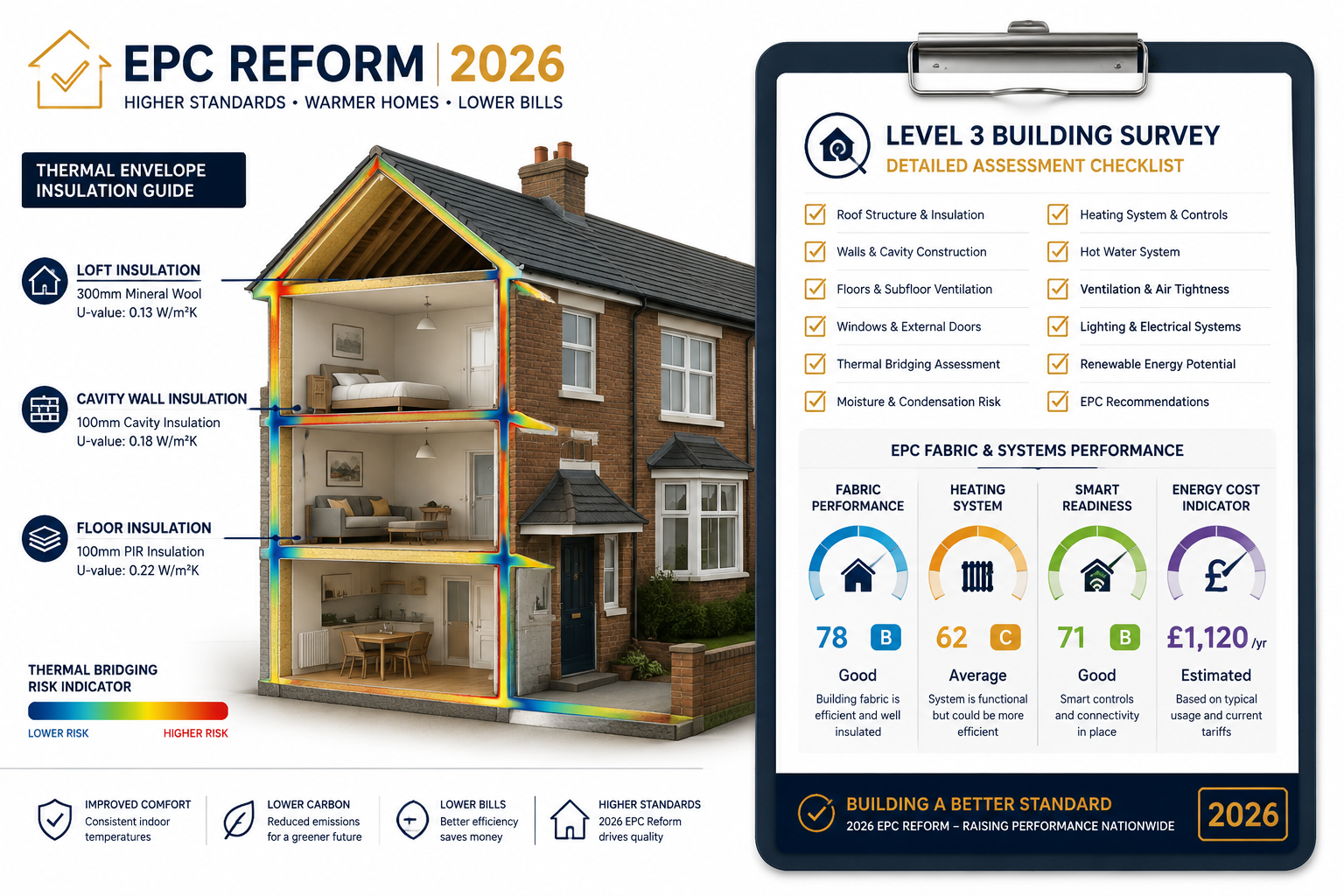
The most significant technical change for surveyors is the replacement of the familiar A–G single rating with four headline metrics under HEM [1]:
| Metric | What It Measures |
|---|---|
| 🏠 Fabric Performance | U-values, thermal bridging, airtightness of the building envelope |
| 🔥 Heating System | Efficiency of installed heating technology |
| 📡 Smart Readiness | Capacity for smart technology integration |
| 💷 Energy Cost | Estimated annual running costs based on actual building data |
For surveyors, this disaggregation is genuinely useful. The Fabric Performance metric — which measures heat transmission through walls, roof, floor, and windows, plus thermal bridging at junctions — now provides a standalone assessment of the building envelope independent of whatever heating system happens to be installed [1]. This means a property with poor insulation cannot mask its deficiencies behind a recently fitted heat pump.
💡 Pull Quote: "A property with poor fabric performance cannot hide behind a modern boiler. The new HEM system forces full transparency on the building envelope — and surveyors must be ready to interpret it."
Dual-Metric Compliance for Landlords
Under the new regime, landlords must satisfy two standards simultaneously: a primary fabric performance standard and a secondary standard for either smart readiness or heating system efficiency [1]. This replaces the single EPC C requirement and creates a more complex compliance picture that surveyors must communicate clearly in their reports.
The £10,000 cost cap for landlord compliance improvements applies regardless of which metric pathway is followed, and spending from 1 October 2025 already counts toward that cap [1]. For surveyors advising landlord-buyers, this means any retrofit expenditure since that date should be documented and factored into the compliance cost calculation.
Surveyor Protocols for Energy Performance and Thermal Efficiency Assessments in 2026 Building Surveys
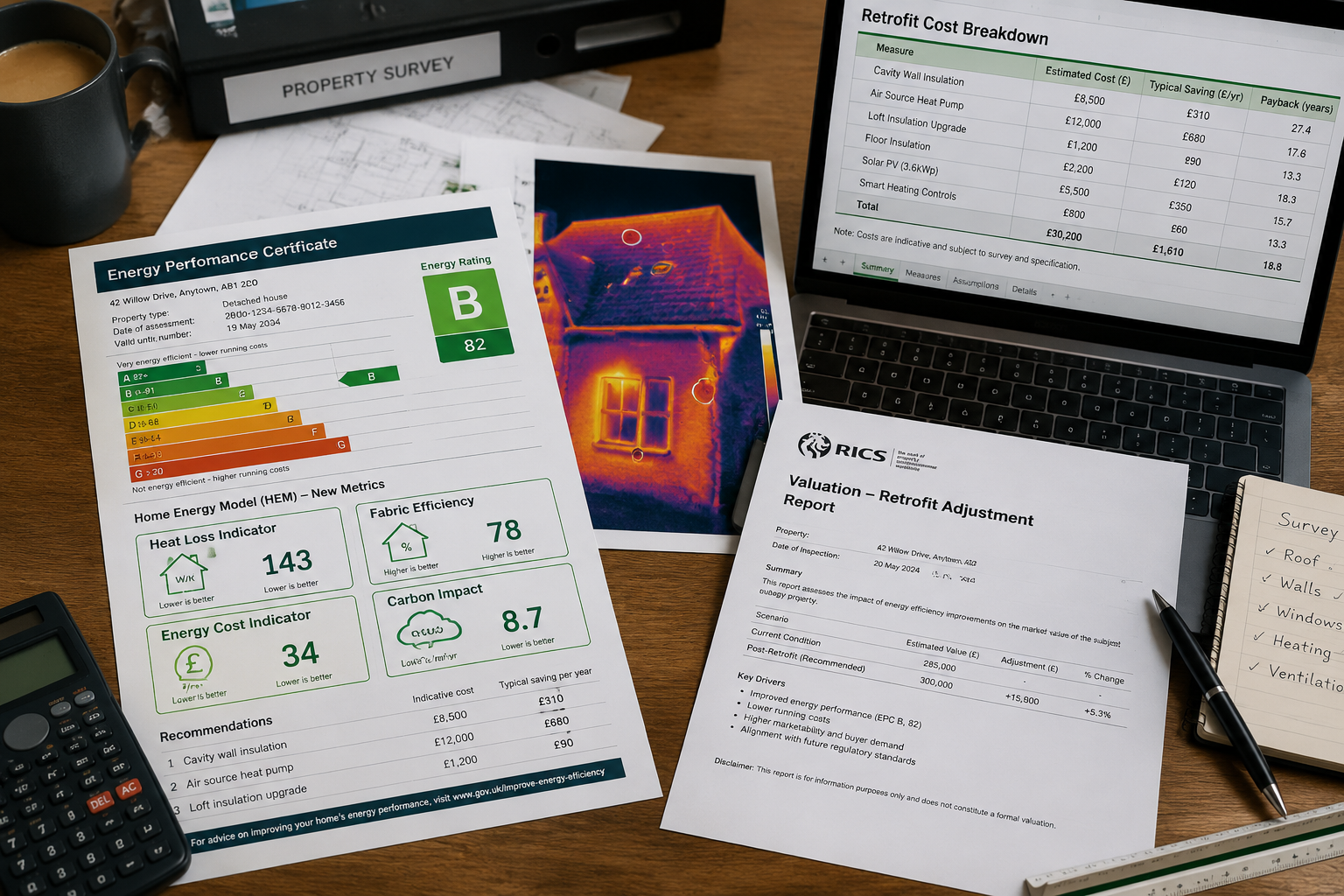
A Level 3 Full Building Survey in 2026 must go well beyond a visual inspection of insulation. The protocols now expected by RICS-regulated surveyors encompass thermal performance data collection, cross-referencing with EPC records, identification of defects that compromise thermal efficiency, and a structured approach to costing remedial works.
Step 1: Pre-Survey EPC and HEM Data Review
Before attending the property, surveyors should retrieve the existing EPC from the MEES register and note:
- Current SAP/RdSAP rating and band
- Date of issue (EPCs retain their 10-year validity [2], so a 2016 certificate may not reflect current conditions)
- Recommended improvements listed on the existing certificate
- Whether the property is subject to MEES compliance obligations as a rental
The relationship between EPC ratings, MEES regulations, and building survey findings is now a core competency for any surveyor advising on residential or commercial property.
⚠️ Important: A valid EPC must now be commissioned at the point of marketing — not prior to exchange or completion [2]. This tightened timing protocol means surveyors may encounter properties where the EPC is very recently issued and worth scrutinising for accuracy.
Step 2: On-Site Thermal Envelope Assessment
The on-site inspection should systematically evaluate the building fabric against the four components that will form the HEM Fabric Performance metric:
Wall construction and insulation:
- Identify wall type (solid, cavity, timber frame)
- Probe for presence and condition of cavity wall insulation
- Check for external or internal wall insulation systems
- Note any thermal bridging at lintels, reveals, and party wall junctions
Roof and loft:
- Measure or estimate loft insulation depth (current standard: 270mm mineral wool)
- Inspect for gaps, compression, or moisture damage in insulation
- Assess flat roof construction for insulation continuity
Floor:
- Identify floor type (suspended timber, solid concrete, beam and block)
- Note presence of underfloor insulation where accessible
Windows and doors:
- Record glazing type (single, double, triple)
- Check frame condition and draught-sealing quality
- Note any secondary glazing on heritage properties
Airtightness indicators:
- Draught gaps around skirtings, service penetrations, and loft hatches
- Chimney stacks without closeable dampers or balloons
A thorough building materials assessment provides the foundation for accurate U-value estimation and thermal bridging identification.
Step 3: Heating System Evaluation
The heating system assessment should capture:
- Boiler type, age, and efficiency rating (condensing vs. non-condensing; ErP rating if available)
- Heat emitter type (radiators, underfloor heating, fan coils) and compatibility with low-temperature heat sources
- Controls sophistication (smart thermostats, TRVs, zoning)
- Hot water system (stored vs. combi; cylinder insulation quality)
- Renewable energy installations (solar PV, solar thermal, heat pumps)
This directly feeds the Heating System metric under HEM and allows surveyors to flag whether the installed system is compatible with the fabric upgrade pathway the buyer is likely to pursue.
Step 4: Ventilation Assessment
Ventilation is frequently overlooked but critically important. As buildings are made more airtight through retrofit, inadequate ventilation creates condensation, mould, and indoor air quality problems — all of which represent building problems requiring specific solutions.
Surveyors should note:
- Background ventilation (trickle vents in windows, airbricks)
- Extract ventilation in kitchens and bathrooms (intermittent fans vs. continuous)
- Whole-house mechanical ventilation with heat recovery (MVHR) if present
- Signs of existing condensation or mould that indicate current ventilation deficiency
Retrofit Valuation Adjustments: Protocols and Costed Examples
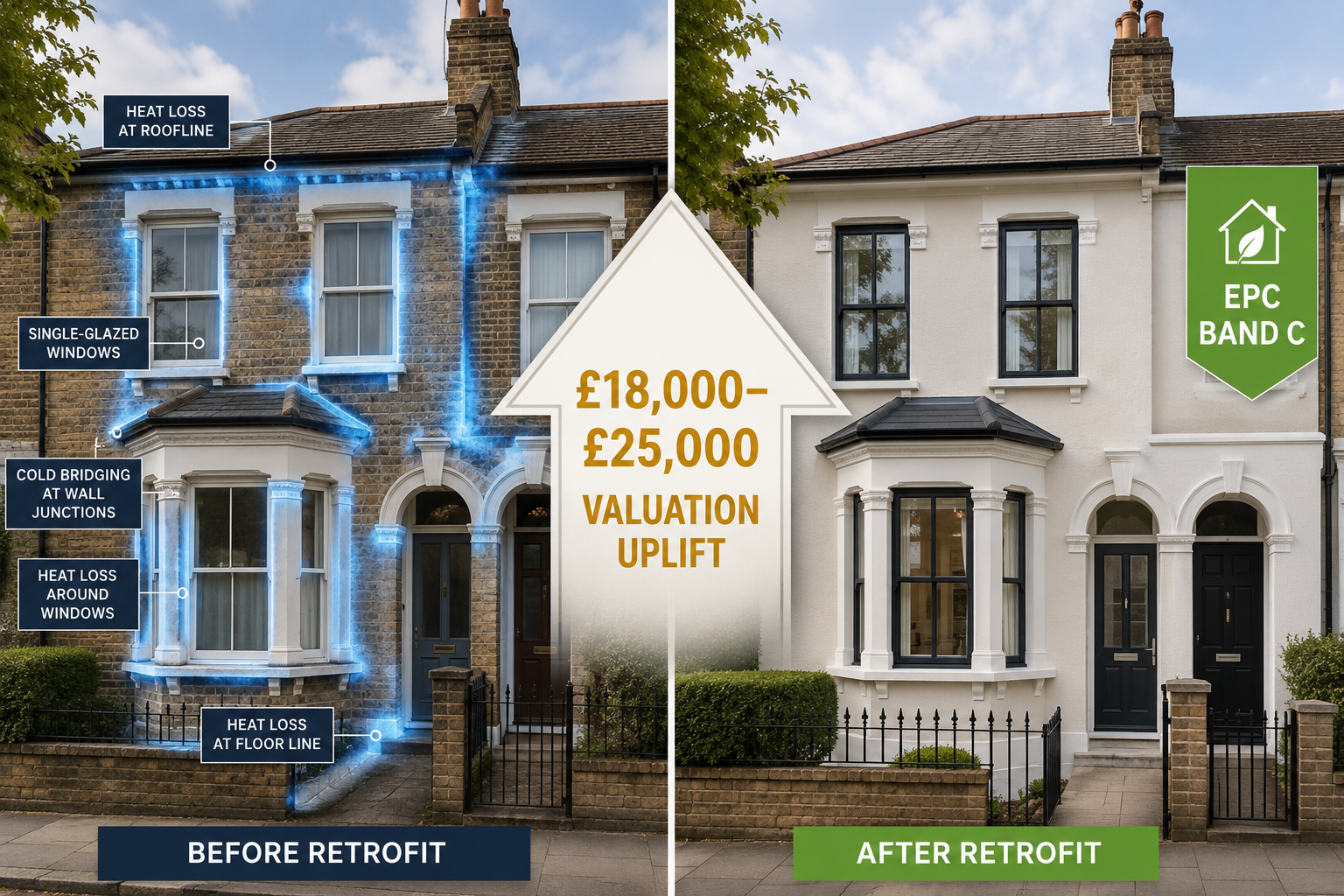
Translating thermal assessment findings into a valuation adjustment is where surveyor expertise becomes most commercially valuable. The process involves three components: estimating the cost of required works, assessing the market impact of current energy performance, and providing a net adjustment recommendation.
Costing the Retrofit Pathway
The table below provides 2026 benchmark costs for common retrofit measures. Surveyors should use these as indicative ranges, noting that actual costs vary by property size, location, and contractor market conditions.
| Retrofit Measure | Typical Cost Range (2026) | EPC Impact |
|---|---|---|
| Loft insulation (top-up to 270mm) | £300–£600 | Significant |
| Cavity wall insulation | £1,500–£3,500 | Significant |
| External wall insulation (solid wall) | £8,000–£22,000 | High |
| Internal wall insulation (solid wall) | £5,500–£14,000 | High |
| Double glazing replacement | £4,000–£12,000 | Moderate |
| Triple glazing replacement | £6,000–£18,000 | Moderate–High |
| Air source heat pump (installed) | £8,000–£15,000 | High (heating metric) |
| MVHR system | £3,000–£7,000 | Ventilation compliance |
| Smart heating controls | £500–£1,500 | Smart readiness metric |
| Draught-proofing and airtightness | £200–£800 | Moderate |
💡 Surveyor Tip: Always distinguish between measures that improve the Fabric Performance metric (insulation, glazing, airtightness) and those that improve the Heating System metric (boiler replacement, heat pump). Under the new dual-metric compliance regime, landlord-buyers may need to invest in both pathways.
Valuation Adjustment Examples
Example 1: Victorian Terraced House, Band E
A 1890s solid-wall terraced property in Band E requires:
- External wall insulation: £14,000
- Loft insulation top-up: £400
- Double-to-triple glazing upgrade: £9,000
- ASHP installation: £11,000
- Smart controls: £800
Total estimated retrofit cost: ~£35,200
A surveyor might recommend a purchase price reduction of £20,000–£28,000, reflecting the retrofit liability discounted for the energy cost savings the buyer will realise over the compliance period. The approach to negotiating price reductions after survey findings is a critical skill in this context.
Example 2: 1970s Semi-Detached, Band D
A cavity-wall property in Band D requires:
- Cavity wall insulation (if not already present): £2,500
- Loft insulation top-up: £450
- Boiler replacement (non-condensing to A-rated): £2,800
- Smart thermostat: £600
Total estimated retrofit cost: ~£6,350
Here, a modest price adjustment of £4,000–£6,000 may be appropriate, as the property is closer to compliance and the works are less disruptive.
Heritage and Listed Buildings: The Exemption Is Gone
A significant change for 2026 is the confirmed removal of the heritage exemption. Landlords of listed buildings must now produce a valid EPC when properties are marketed, sold, or let [2]. This creates a new category of challenging thermal assessments where traditional retrofit measures (cavity fill, external insulation, replacement glazing) may be restricted by planning consent requirements.
Surveyors working on listed buildings should cross-reference planning constraints and permitted development rights before scoping retrofit costs, as heritage-compatible solutions (secondary glazing, internal insulation with appropriate vapour management, breathable insulation systems) typically cost 30–60% more than standard equivalents.
HMOs and Short-Term Lets: Extended Scope
Regulations now require a valid EPC for the whole building whenever a single room is rented in an HMO [2]. Properties used for short-term and holiday lets also require valid EPCs regardless of who pays the energy bills [2]. Surveyors advising on HMO purchases or conversions must factor whole-building thermal performance into their assessments from the outset.
The Energy Cost Metric and Realistic Running Cost Estimates
The new Energy Cost metric under HEM aims to provide more realistic annual running cost estimates by incorporating building orientation, local climate data, and occupancy patterns — rather than the standardised occupancy model used in current SAP assessments [1]. For surveyors, this means retrofit valuation adjustments can be grounded in more accurate energy cost projections, strengthening the financial case for upgrade investment.
For buyers considering properties with poor thermal performance, understanding the top factors assessed during a property valuation — including energy efficiency — helps frame the retrofit adjustment as a legitimate and quantifiable negotiation tool, not merely a subjective preference.
The Transitional Period: Navigating Dual EPC Formats
From H2 2027 to October 2029, both the legacy SAP/RdSAP format (single A–G rating) and the new HEM four-metric format will coexist in the market [1]. Legacy EPCs remain valid for their full 10-year term. This creates a period of complexity for surveyors, who must be able to interpret both formats and advise clients on which standard applies to their specific transaction.
Surveyors should flag in their reports whether an existing EPC was issued under the legacy or HEM methodology, and note any material differences in the retrofit implications between the two systems.
Conclusion: Actionable Next Steps for Buyers, Landlords, and Surveyors
Energy Performance and Thermal Efficiency Assessments in 2026 Building Surveys: Surveyor Protocols for Retrofit Valuation Adjustments represent a fundamental shift in how buildings are evaluated and priced. The convergence of rising energy costs, the October 2030 compliance deadline, and the incoming HEM four-metric system means that thermal performance is now inseparable from market value.
For homebuyers:
- ✅ Commission a Level 3 Full Building Survey that explicitly includes thermal envelope assessment and costed retrofit recommendations
- ✅ Use the retrofit cost estimate to negotiate a price reduction before exchange
- ✅ Request that your surveyor distinguish between Fabric Performance and Heating System improvement costs, as these represent different investment priorities
For landlords:
- ✅ Audit your portfolio against the dual-metric compliance standard now — not in 2029
- ✅ Track all retrofit expenditure from October 2025 onward against the £10,000 cost cap
- ✅ Commission fresh EPCs on any listed buildings previously assumed to be exempt
For surveyors:
- ✅ Integrate the four HEM metrics into Level 3 report templates immediately
- ✅ Develop benchmark costing tables for your local market to support valuation adjustment recommendations
- ✅ Build familiarity with heritage-compatible retrofit solutions as listed building instructions increase
The buildings being surveyed today will be subject to the HEM compliance regime within the decade. Surveyors who embed rigorous thermal assessment protocols into their practice now will deliver measurably better outcomes for their clients — and position themselves as indispensable advisors in an increasingly energy-conscious property market.
References
[1] New EPC Rules 2026 – epccertificate.uk
[2] 2026 EPC Reform Technical Update – buildingenergyexperts.co.uk
[3] CXC Whole Building Assessment for Energy Efficiency and Zero Direct Emissions Heat in Multi-Owner and Mixed-Use Buildings (September 2023) – era.ed.ac.uk
[5] Home Energy Assessment: Improve UK Property Efficiency – homeenergymodel.co.uk
[8] Government Reforms Energy Performance Buildings Regime and Raises Minimum Energy – osborneclarke.com