

Fewer than 15% of UK homes currently meet the proposed EPC C rating that will become mandatory for rental properties by 2030 — yet millions of transactions are completing right now without buyers fully understanding the retrofit costs they are inheriting. Energy Performance and Fire Safety in Building Surveys: 2026 Regulatory Updates and Retrofit Strategies is no longer a niche technical concern; it sits at the heart of property value, legal compliance, and long-term affordability.
This guide breaks down the stricter cladding, balcony, and insulation standards introduced in 2026, explains what surveyors must now check, and gives buyers and property owners a practical roadmap for cost-effective upgrades.
Key Takeaways 📋
- 🏛️ UK EPC reform (March 2026) replaces the single headline score with a multi-metric approach covering energy cost, fabric, heating system, and smart readiness.
- 🔥 Approved Document B update (April 2026) introduces stricter guidance on external wall systems, cladding, and balconies.
- 🇺🇸 US federal compliance date for new clean-energy building provisions has been extended to 1 September 2026.
- 🏠 California's 2025 Energy Code, live from January 2026, targets nearly $5 billion in consumer savings over 30 years.
- 🔧 Retrofit integration into building surveys is now a buyer expectation, not an optional add-on — and it directly affects negotiation leverage.
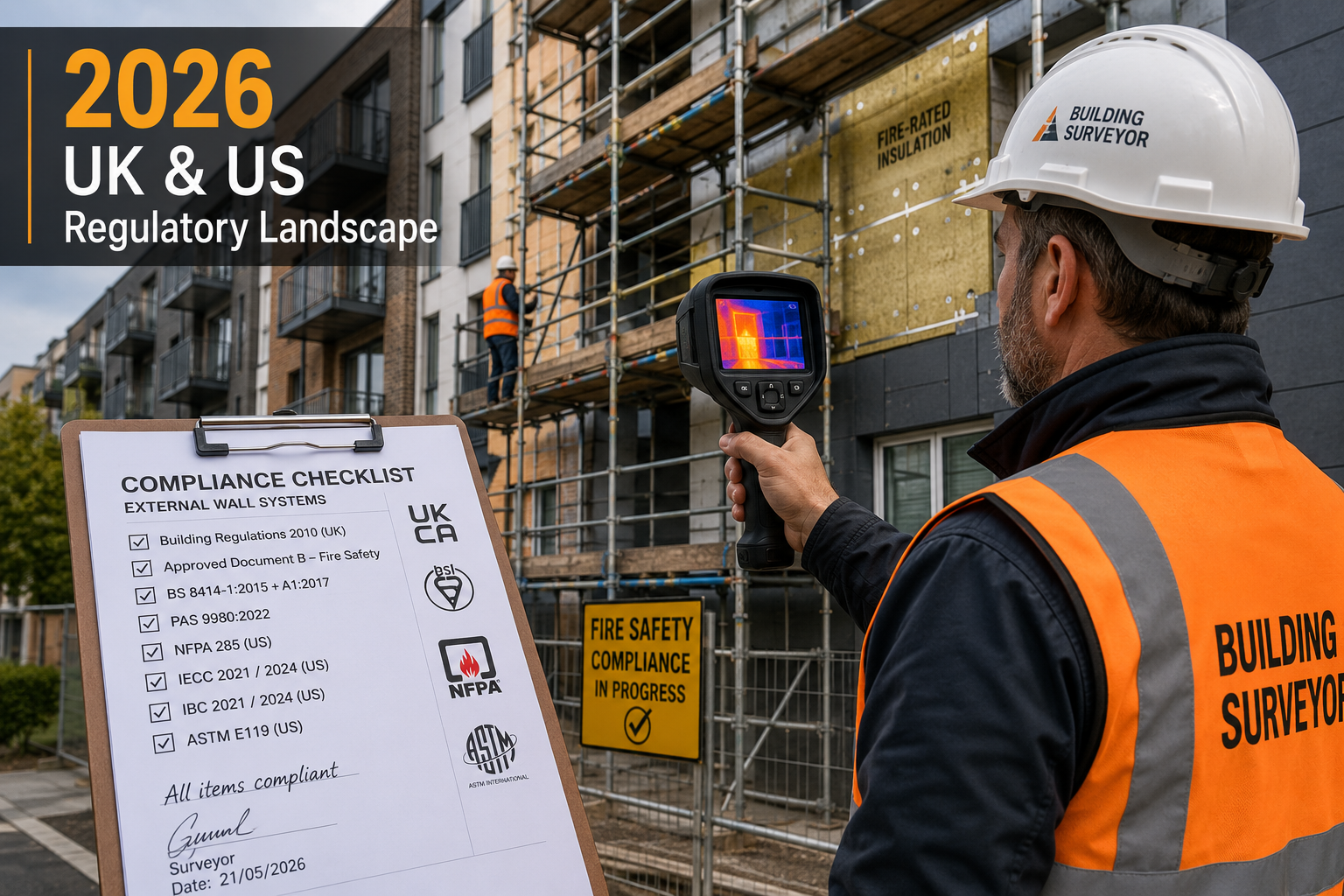
The 2026 Regulatory Landscape: What Has Changed and Why It Matters
UK: EPC Reform and the Multi-Metric Revolution
On 9 March 2026, the UK government published its partial response to the consultation on reforming the Energy Performance of Buildings regime [4]. The headline change is significant: the familiar single A–G letter grade is being replaced by a multi-metric framework that assesses four distinct dimensions:
| Metric | What It Measures |
|---|---|
| Energy Cost | Estimated annual running costs for heating, cooling, and hot water |
| Fabric Performance | Insulation quality, air tightness, and thermal bridging |
| Heating System Performance | Efficiency and carbon intensity of the primary heat source |
| Smart Readiness | Ability to respond to grid signals and integrate renewables |
This matters enormously for building surveys. A property with a gas boiler and excellent fabric insulation could score well on fabric but poorly on heating system performance — something the old EPC would have obscured behind a single letter. Surveyors must now understand and communicate all four dimensions clearly [8].
The UK government has also confirmed that Minimum Energy Efficiency Standards (MEES) for residential tenancies will rise to a C rating by 2030 [5]. Landlords who fail to comply face significant financial penalties. For buyers purchasing rental properties today, understanding the gap between current and required performance is a direct financial risk.
UK: Approved Document B — Stricter Cladding, Balcony, and External Wall Rules
On 15 April 2026, the UK government updated its consultation on Approved Document B, the primary fire safety guidance for buildings in England [6]. The proposed amendments represent the most substantive revision since the post-Grenfell reforms and include:
- Consolidated guidance for existing buildings, reducing ambiguity between new-build and retrofit scenarios
- Updated provisions for external wall systems (EWS), including clearer combustibility classifications for insulation materials used in cladding assemblies
- Specific balcony guidance, addressing fire spread risks from combustible decking materials and the interface between balconies and external walls
- Clarified responsibilities for building owners and duty holders under the Building Safety Act 2022
💬 "The 2026 Approved Document B update closes loopholes that allowed ambiguous materials to pass EWS1 assessments. Surveyors can no longer treat cladding as a visual inspection — it requires documented evidence of compliance."
For surveyors conducting Level 3 full building surveys, these changes mean fire safety and energy performance are now deeply intertwined. Many insulation products that improve thermal performance can compromise fire safety if not correctly specified and installed.
US Federal and State Updates
In the United States, the Department of Energy (DOE) has further stayed the compliance date for new clean-energy provisions in the Code of Federal Regulations for federal buildings and major renovations, moving the deadline to 1 September 2026 [2]. Simultaneously, on 4 May 2026, the DOE issued a request for information to update its methodology for assessing the affordability and cost-effectiveness of building energy codes — a move aimed at reducing construction costs while delivering measurable value [1].
At state level, California's updated 2025 Energy Code came into force on 1 January 2026 [3]. Key mandates include:
- Increased energy efficiency thresholds for all new construction and major renovations
- Prioritisation of heat pump technology over gas-fired systems
- Demand flexibility requirements to shift energy use away from peak grid periods
- Projected consumer savings of nearly $5 billion over 30 years and greenhouse gas reductions equivalent to over half a million homes
State and local governments across the US are also adopting more aggressive building codes tied to resilience and electrification, reflecting a broader policy shift [9].
Surveyor Checklists: Compliance Reporting for Cladding, Balconies, and Insulation
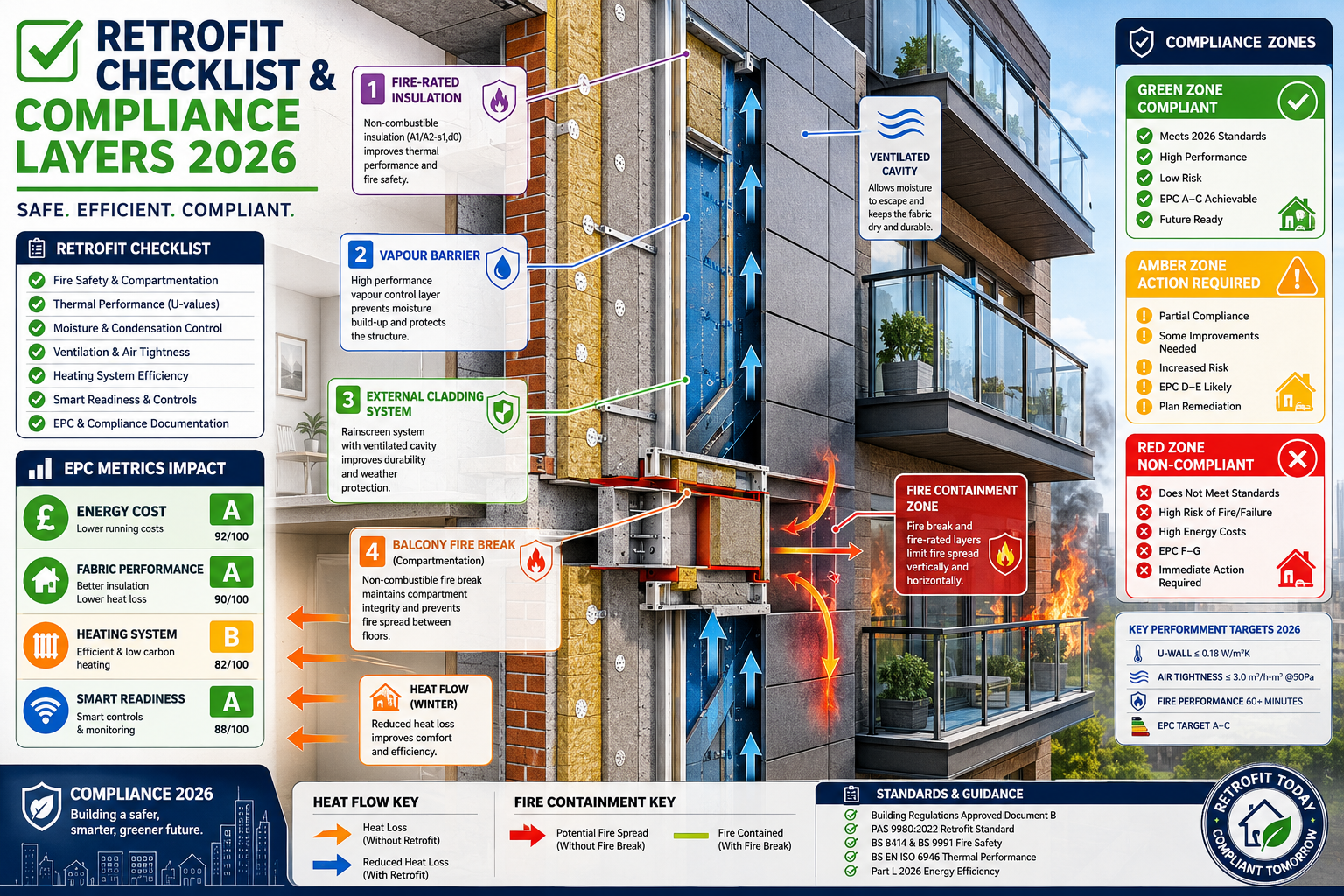
Why the Survey Must Go Beyond the Visual
Modern property buyers expect detailed thermal performance data and realistic retrofit cost projections integrated into comprehensive building surveys [8]. This is not simply a market preference — it is increasingly a legal and professional obligation. Understanding building pathology is essential because defects in insulation, cladding, and ventilation systems interact in ways that affect both fire risk and energy loss simultaneously.
For example, poorly installed cavity wall insulation can cause moisture bridging that degrades thermal performance and creates conditions for structural decay. Surveyors who understand what causes moisture in buildings are better placed to identify these compound risks.
🔍 Surveyor Compliance Checklist: External Wall Systems and Cladding
Use this checklist when assessing buildings with external cladding, particularly those over 11 metres in height:
- EWS1 form status — Is a valid EWS1 certificate in place? Has it been reviewed post-April 2026 guidance?
- Combustibility classification — Are insulation materials within the cladding assembly classified as A1 or A2-s1,d0?
- Cavity barriers — Are fire-stopping cavity barriers present at each floor level and around openings?
- Balcony construction — Is decking material non-combustible or low-combustibility? Is the balcony-to-wall interface fire-rated?
- Documentation trail — Are installation records, product data sheets, and as-built drawings available?
- Remediation status — If the building is on the government's cladding remediation register, what is the current programme status?
🔍 Surveyor Compliance Checklist: Energy Performance
- EPC validity and metric breakdown — Is the EPC current? Does it reflect the new multi-metric framework or the legacy single score?
- Fabric performance — U-values for walls, roof, and floor; evidence of air tightness testing
- Heating system type and age — Gas boiler, heat pump, or district heating? Efficiency rating and remaining service life
- Glazing specification — Double or triple glazing? Frame material and condition
- Ventilation system — Mechanical ventilation with heat recovery (MVHR) or natural ventilation? Mechanical ventilation is increasingly essential in well-insulated buildings to maintain air quality
- Smart readiness — Smart meter installed? EV charger provision? Battery storage compatibility?
- Retrofit gap analysis — What measures are needed to reach EPC C? Estimated cost and disruption level?
Battery Energy Storage Systems: A New Fire Safety Frontier
An often-overlooked intersection of energy performance and fire safety is the growing installation of battery energy storage systems (BESS). The sixth edition of ANSI/CAN/UL 9540A, published on 11 May 2026, introduces a 'passive-first' safety philosophy for outdoor ground-mounted BESS installations [7]. This requires validation of thermal runaway containment without reliance on active systems such as HVAC or fire suppression. For surveyors assessing properties with solar-plus-storage installations, checking whether the BESS installation complies with the latest UL 9540A standard is now part of due diligence.
Retrofit Strategies: Cost-Effective Upgrades for Buyers and Owners
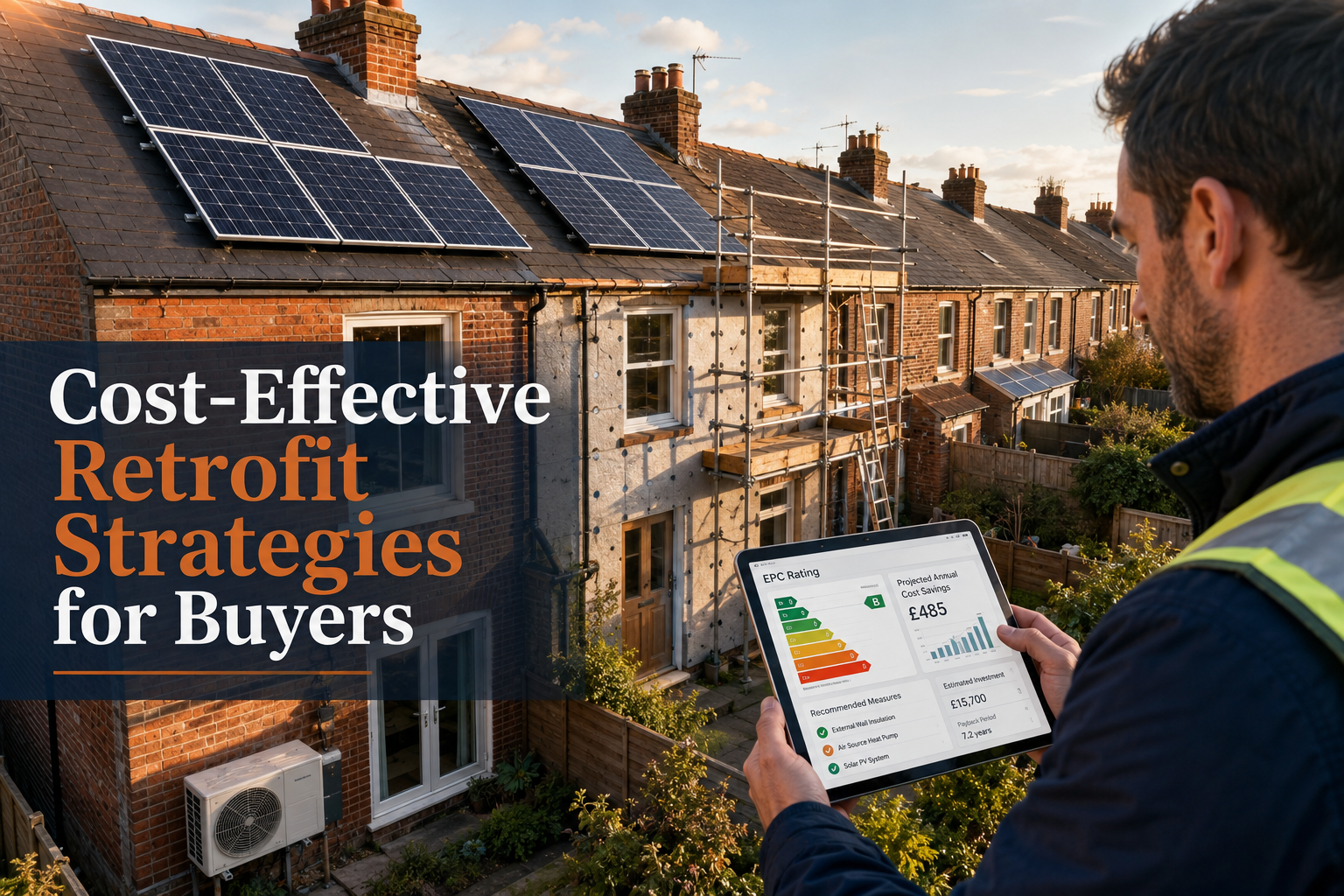
Prioritising Retrofit: The Performance Gap Framework
Not every retrofit measure delivers equal value. The key is to prioritise interventions based on the performance gap identified in the survey — the difference between current measured performance and the target standard. Retrofit opportunities represent the fastest and least capital-intensive pathway to reducing carbon emissions and operational costs when correctly sequenced [8].
A useful framework is fabric first, then systems:
- Fabric first — Address air tightness, insulation, and thermal bridging before upgrading heating systems. Heating a leaky building with a heat pump is wasteful and expensive.
- Systems second — Once the fabric is improved, right-size the heating and ventilation system to the reduced heat demand.
- Renewables third — Solar PV and battery storage deliver the best return on a well-insulated, efficiently heated building.
Common Retrofit Measures and Indicative Costs (2026)
| Measure | Typical Cost (UK) | EPC Impact | Fire Safety Consideration |
|---|---|---|---|
| External Wall Insulation (EWI) | £8,000–£20,000 | High | Must use A1/A2 rated materials on buildings over 11m |
| Cavity Wall Insulation | £500–£1,500 | Medium | Low risk; check for moisture bridging |
| Loft Insulation (top-up) | £300–£600 | Medium | Ensure fire-stopping around penetrations |
| Air Source Heat Pump | £7,000–£13,000 | High | Low fire risk; check electrical installation |
| Triple Glazing | £5,000–£15,000 | Medium | Egress compliance for ground-floor windows |
| MVHR System | £3,000–£8,000 | Medium | Fire dampers required at compartment boundaries |
| Solar PV + Battery Storage | £8,000–£15,000 | Medium | UL 9540A compliance for battery units |
AI-Assisted Retrofit Decision-Making
A study published in February 2026 developed a domain-specific large language model to help homeowners make informed decisions about residential energy retrofits [10]. The model uses accessible descriptions of dwelling characteristics to generate optimal retrofit recommendations, aiming to close the expertise gap between professional assessors and property owners. While this technology is still emerging, it signals a direction of travel: retrofit advice is becoming more personalised, data-driven, and accessible.
Surveyors and buyers can now use digital tools alongside professional assessments to model different retrofit scenarios and their impact on running costs, EPC ratings, and carbon footprint.
Negotiation Leverage: Using Survey Data Effectively
A comprehensive building survey that quantifies the retrofit gap gives buyers real negotiating power. Understanding the average price reduction after a survey shows that documented evidence of required works — including energy performance upgrades and fire safety remediation — routinely justifies price reductions or seller contributions to remediation costs.
For buyers unsure which survey level is appropriate, a complete guide to choosing the right property survey can help determine whether a Level 2 or Level 3 assessment is needed. Properties with cladding concerns, older heating systems, or known energy performance issues almost always warrant a Level 3 full building survey to capture the full scope of risk.
Compliance Testing: Closing the Loop
Once retrofit works are completed, formal compliance testing confirms that the improvements have delivered the expected performance. Building regulation compliance testing — including air pressure testing, thermographic surveys, and fire compartmentation checks — provides the documentary evidence needed for updated EPCs, mortgage lender requirements, and future sale transactions.
Conclusion: Actionable Next Steps for Buyers, Owners, and Surveyors
The convergence of stricter energy performance standards and enhanced fire safety requirements in 2026 has fundamentally changed what a building survey must deliver. A tick-box inspection is no longer sufficient — buyers, landlords, and building owners need surveys that quantify the performance gap, identify fire safety compliance status, and map a realistic, costed retrofit pathway.
Actionable next steps:
- ✅ Commission a Level 3 survey for any property with cladding, older insulation systems, or a legacy EPC — especially if it is a leasehold flat or a building over 11 metres.
- ✅ Request a multi-metric EPC assessment that reflects the 2026 framework, not just the legacy A–G score.
- ✅ Check EWS1 status and Approved Document B compliance for any property with external wall insulation or cladding installed before 2023.
- ✅ Use the retrofit gap analysis from the survey to negotiate on price or request seller contributions to remediation.
- ✅ Sequence retrofit works fabric-first to maximise the return on heating system and renewable energy investments.
- ✅ Verify BESS installations against UL 9540A 6th edition requirements if battery storage is present.
- ✅ Complete compliance testing after works to secure updated documentation for lenders and future buyers.
The regulatory direction in both the UK and the US is clear: buildings must perform better and be safer. Buyers and owners who act on this data now will be better protected financially, legally, and physically in the years ahead.
References
[1] 2026 08646 – regulations.justia.com
[2] Federal Building Energy Efficiency Rules And Requirements – energy.gov
[3] Californias Energy Code Update Guides Construction Cleaner Healthier Buildings – energy.ca.gov
[4] Reforms To The Energy Performance Of Buildings Regime Partial Government Response – gov.uk
[5] Government Reforms Energy Performance Buildings Regime And Raises Minimum Energy – osborneclarke.com
[6] Review Of Approved Document B Fire Safety Guidance – gov.uk
[7] Safeguards 06826 Navigating The Shift Key Technical Updates In Ul 9540a 6th Edition – sgs.com
[8] Energy Performance And Retrofit Guidance In Building Surveys Meeting 2026 Buyer Expectations For Long Term Cost Clarity – wimbledonsurveyors.com
[9] Codewatch April 2026 Energy Building Codes – smartbrief.com
[10] arxiv – arxiv.org