

A study of 6.8 million housing transactions between 2014 and 2024 revealed something that challenges conventional wisdom: EPC B and C-rated properties actually trade at modest discounts compared to the D-rated baseline, while only EPC A-rated homes command a meaningful premium [5]. For surveyors and property professionals navigating Energy Efficiency Valuations in 2026: RICS Standards for Assessing EPC Ratings and Net Zero Retrofit Impact on Property Worth, this finding fundamentally reshapes how retrofit investments should be assessed and communicated to clients.
The regulatory landscape is shifting fast. A major overhaul of the EPC methodology is expected from October 2026, the government is targeting Band C as the minimum rental standard by 2030, and RICS-aligned valuation protocols must keep pace [6]. This article equips surveyors, landlords, and property investors with a clear, evidence-based framework for understanding what energy efficiency really means for property values right now.
Key Takeaways 📌
- Only EPC A-rated properties show a positive price premium (approximately 2.9% per square metre); B and C ratings offer no significant uplift and may even reduce value slightly [5].
- A new multi-metric EPC framework rolls out from October 2026, replacing the outdated single-score SAP system with four headline performance indicators [2].
- 52% of rental properties currently sit below Band C, creating widespread compliance risk ahead of the 2030 deadline [2].
- Non-compliance carries fines up to £5,000 per property and introduces serious liquidity risk at the point of sale or letting [1].
- Surveyors must integrate EPC data and retrofit evidence into formal valuations to meet evolving RICS standards and client expectations.
The 2026 EPC Revolution: What's Changing and Why It Matters
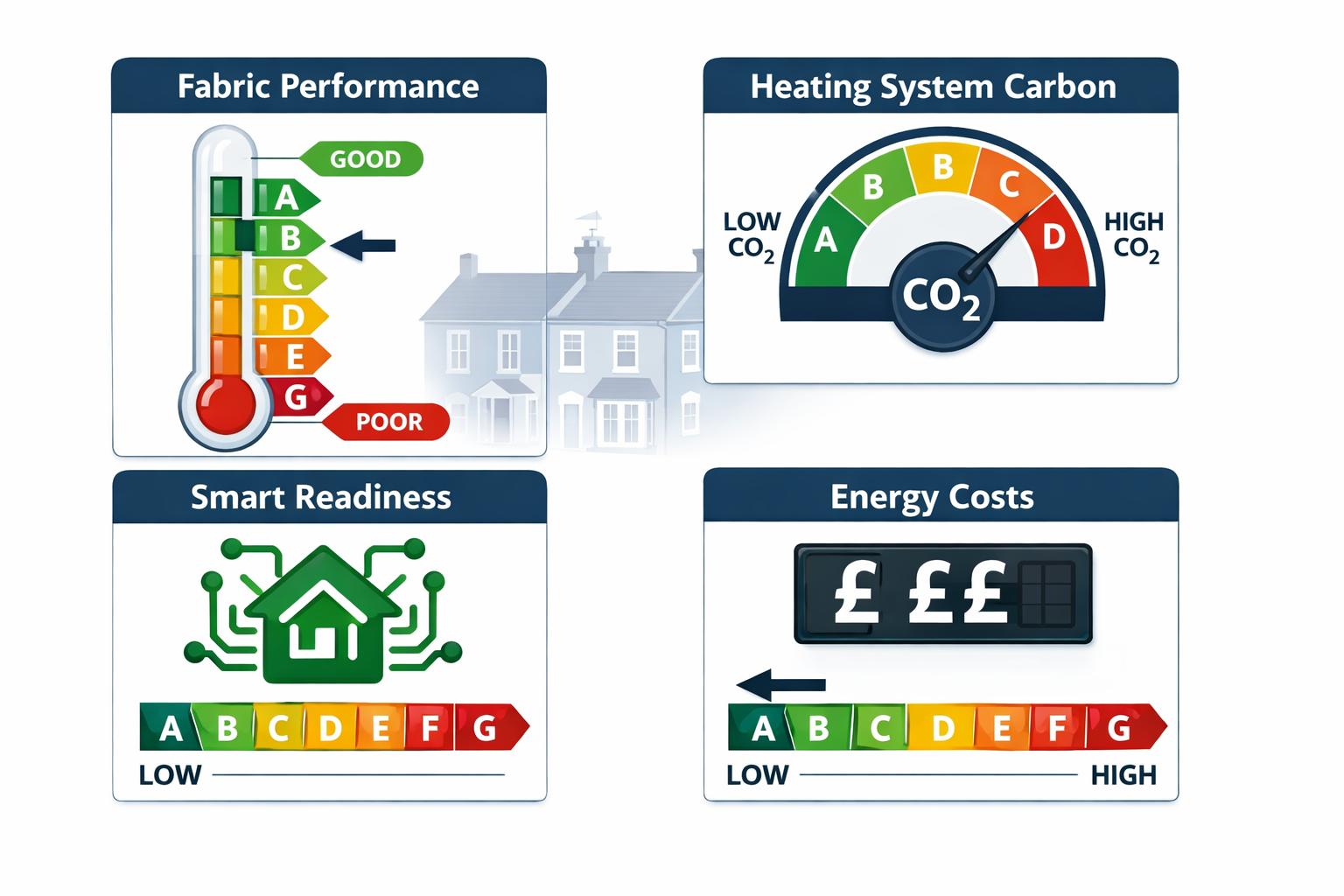
From a Single Score to Four Headline Metrics
The current Energy Performance Certificate system was built on the Standard Assessment Procedure (SAP), a methodology developed in the 1990s. While functional for its time, SAP relies on a single composite score that blends factors partially outside a building owner's control — including grid carbon intensity and fluctuating energy prices [3]. This has long frustrated surveyors trying to make like-for-like comparisons.
From October 2026, the replacement framework will present four distinct headline metrics [2]:
| Metric | What It Measures |
|---|---|
| Fabric Performance | How well the building retains heat (insulation, windows, airtightness) |
| Heating System Performance | Carbon impact and efficiency of the heating source |
| Smart Readiness | Capacity to integrate smart technology and demand-side flexibility |
| Energy Cost | Estimated annual energy bill for a standard occupancy |
Additional sub-metrics will cover carbon emissions, energy source mix, and home automation efficiency [3]. The intent is to give homeowners, tenants, landlords, and valuers a far clearer picture of where a property's performance strengths and weaknesses actually lie.
💡 Pull Quote: "The shift from a single EPC score to four headline metrics is not just a technical update — it is a fundamental change in how energy performance evidence will be used in property valuations."
The Transition Window: What Surveyors Need to Know
EPCs commissioned before October 2029 will remain compliant under the old methodology even after the new system launches [2]. This creates a three-year transition window that has significant implications for valuation evidence. Surveyors should note that:
- Comparable evidence may be drawn from properties assessed under two different EPC methodologies during this period.
- Clients may need guidance on whether to commission a new-format EPC or rely on an existing certificate.
- Valuation reports should clearly identify which EPC version underpins any energy efficiency assessment.
Understanding the EPC, MEES, and building survey relationship is essential during this transitional phase, particularly when advising clients on compliance risk.
RICS Standards for Energy Efficiency Valuations in 2026: Assessing EPC Ratings and Retrofit Impact
The Valuation Evidence Problem
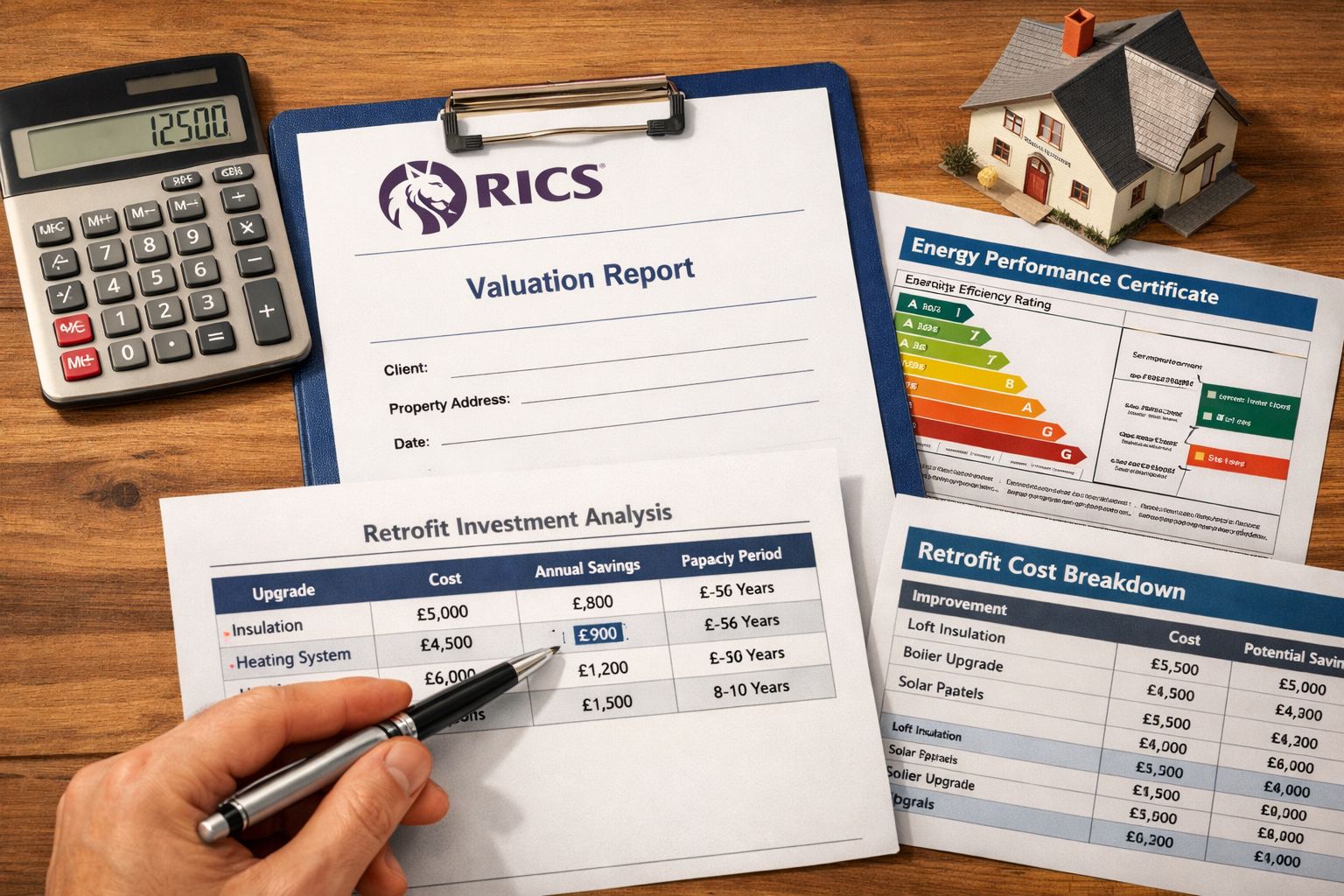
One of the most persistent challenges in Energy Efficiency Valuations in 2026 is the lack of robust comparable market evidence for retrofit-enhanced properties. The 6.8 million transaction study cited by RICS is instructive: it shows that the market currently prices energy efficiency in a non-linear, counterintuitive way [5].
Key findings from RICS research:
- 🟢 EPC A: +2.9% price premium per square metre vs. EPC D baseline
- 🔴 EPC B: –2.3% modest price discount
- 🔴 EPC C: –1.2% modest price discount
- ⚪ EPC D: Baseline reference point
- 🔴 EPC E and below: Increasing discount, plus compliance and liquidity risk [5]
This data strongly suggests that half-measures do not pay. Investors and landlords who spend money upgrading from G to D, or from D to C, may not recoup that investment through market value uplift. Only the journey to EPC A appears to be positively priced by buyers.
RICS-Aligned Protocols for Retrofit Assessment
For surveyors preparing valuations that involve retrofit works, a structured assessment approach is essential. The following framework aligns with current RICS guidance and the direction of travel for 2026 standards [4]:
Step 1 — Establish the Baseline EPC Rating
Confirm the current EPC rating and its expiry date. Identify whether it was produced under the old or new methodology (post-October 2026). Note any exemptions registered on the PRS Exemptions Register.
Step 2 — Identify Proposed or Completed Retrofit Works
Review documentation for any completed works: insulation certificates, boiler replacement records, solar panel installation warranties, window replacement schedules. Incomplete or unverified retrofit claims should not be reflected in the valuation without supporting evidence.
Step 3 — Assess Market Evidence for Energy Premium
Search for comparable sales of similar properties with equivalent or higher EPC ratings in the same locality. Given the counterintuitive pricing data above, surveyors should be cautious about applying a blanket "green premium" without local evidence to support it.
Step 4 — Quantify Compliance Risk for Sub-Band C Properties
For rental properties, non-compliance with MEES regulations carries fines of up to £5,000 per property [1]. F and G-rated properties cannot currently be let without a registered exemption. This compliance risk must be reflected in the valuation, either as a deduction from the market value or as a specific advisory note.
Step 5 — Apply the Cost Cap Framework
The government has established a £10,000 cost cap for compliance upgrades. For lower-value properties, this is proportionally reduced — for example, an £80,000 property would have an £8,000 cap if the standard cap exceeds 10% of property value [2]. Surveyors should factor this cap into advice on retrofit viability.
The Liquidity Risk Factor
Beyond headline value, non-compliant properties face a growing liquidity risk that RICS-aligned valuations must address [5]. A property that cannot legally be let, or that buyers perceive as a compliance liability, will:
- Sit on the market longer
- Attract fewer mortgage offers (lenders are increasingly applying green criteria)
- Face renegotiation at the point of survey
For clients considering property valuations for tax, insurance, or other purposes, energy efficiency status is now a material consideration — not an afterthought.
Understanding what surveyors look at during a property valuation has expanded significantly to include energy performance data alongside traditional factors like location, condition, and comparable sales.
Net Zero Retrofit Impact on Property Worth: Navigating the 2030 Deadline
The Scale of the Challenge
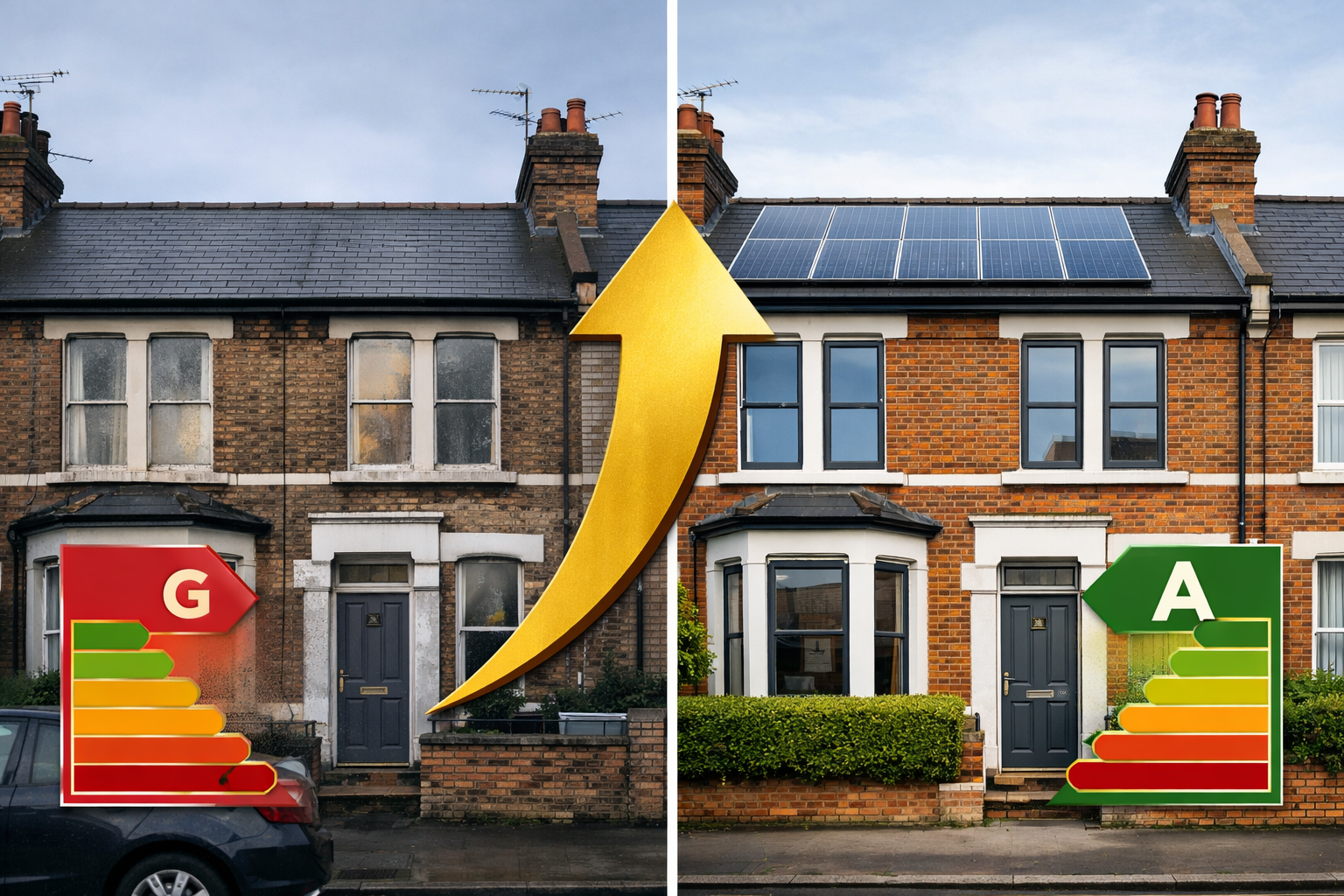
The numbers are stark. 52% of privately rented properties currently sit below Band C [2]. With the government targeting Band C as the minimum rental standard by 2030, the sector faces a massive wave of retrofit activity over the next four years. This creates both risk and opportunity for property professionals.
The current minimum rental standard of Band E under MEES will tighten progressively [5]. Properties rated F or G are already unlettable without exemption, and the direction of travel is clear: the floor is rising.
What Retrofit Works Actually Deliver Value?
Not all retrofit investments are equal in their impact on property worth. Based on the market evidence and RICS guidance, the following hierarchy applies:
High-Value Retrofit Investments ✅
- External wall insulation (particularly for solid-wall properties)
- Heat pump installation (where appropriate for the property type)
- Solar PV panels with battery storage
- Triple-glazed window replacement
- Loft insulation to current standards
Moderate-Value Retrofit Investments ⚠️
- Cavity wall insulation
- High-efficiency gas boiler replacement
- Smart heating controls and thermostats
- LED lighting upgrades
Lower-Value for Valuation Purposes ❌ (though still beneficial for compliance)
- Draft proofing alone
- Hot water cylinder insulation
- Basic energy monitoring systems
The key insight from the RICS research is that only the combination of measures that achieves EPC A is clearly rewarded by the market [5]. Surveyors advising clients on retrofit sequencing should reference the recommended order for property renovation works to ensure fabric-first approaches are prioritised before mechanical system upgrades.
Landlord and Investor Strategy for 2026 and Beyond
For landlords managing portfolios, the compliance timeline creates a clear decision framework:
- Audit the portfolio now — Identify all properties below Band C and commission updated EPCs where certificates are more than five years old.
- Prioritise the worst performers — F and G-rated properties carry immediate legal risk and should be addressed first.
- Plan for the cost cap — Budget retrofit programmes within the £10,000 cap per property, and document all expenditure carefully for exemption applications if the cap is reached [2].
- Aim for A, not just C — Given the market evidence, if a property can realistically achieve EPC A with a reasonable investment, this is the target that delivers genuine value uplift [5].
For block management contexts, energy efficiency compliance across multiple units requires coordinated planning. Property inspection services can help identify the baseline condition of each unit before retrofit programmes begin.
The Role of Building Surveys in Energy Efficiency Assessment
A thorough building survey is increasingly the first step in any serious retrofit planning exercise. Before investing in insulation, heat pumps, or solar panels, it is essential to understand the underlying fabric condition of the property. Issues such as damp, mould, and moisture ingress can undermine the effectiveness of retrofit measures if not addressed first.
A Level 3 Full Building Survey provides the most comprehensive assessment of a property's fabric condition, identifying defects that could compromise retrofit performance or void warranties on new installations. For properties where significant energy efficiency investment is planned, this level of survey is strongly recommended before works commence.
Conclusion: Actionable Steps for Surveyors and Property Professionals in 2026
Energy Efficiency Valuations in 2026: RICS Standards for Assessing EPC Ratings and Net Zero Retrofit Impact on Property Worth represent one of the most significant shifts in mainstream property valuation practice in a generation. The convergence of regulatory change, EPC methodology reform, and evolving market pricing creates both complexity and opportunity.
The core message from the evidence is clear: energy efficiency is now a valuation-critical factor, but its impact on property worth is more nuanced than simple "green premium" narratives suggest. Only EPC A-rated properties show a consistent positive price effect. Non-compliant properties face real liquidity and legal risk. And the new four-metric EPC framework from October 2026 will demand a more sophisticated analytical approach from all valuation professionals.
Actionable Next Steps ✅
- Commission updated EPCs for any rental properties with certificates older than five years, especially those likely to fall below Band C under the new methodology.
- Integrate EPC data formally into all valuation reports as a material consideration, not an optional appendix.
- Advise retrofit clients to target EPC A where financially viable, rather than settling for Band C compliance alone.
- Document all retrofit expenditure carefully to support cost cap exemption applications and future valuation evidence.
- Stay current with RICS guidance updates as the new EPC framework rolls out through 2026 and beyond.
- Commission a building survey before major retrofit works to identify fabric defects that could undermine energy performance improvements.
The property professionals who build expertise in energy efficiency valuation now will be best positioned to serve clients as the 2030 compliance deadline approaches and the market matures.
References
[1] Epc Rental Property 2026 – cribsestates.co.uk
[2] New Epc Regulations – blog.goodlord.co
[3] Epc Ratings How Are They Changing In 2026 And What Does That Mean For Home Heating – ecostrad.com
[4] Mitigation Strategies Mees Epcs Business Rates – ww3.rics.org
[5] Future Property Valuation Influence Esg Criteria Residential Buildings – rics.org
[6] Epcs And Mees Is 2026 The Year For Reform – reedsmith.com
[7] Building Survey Quality Standards 2026 Navigating Rics Updates And Enhanced Home Inspection Requirements – nottinghillsurveyors.com