

Only 14% of UK homes currently hold an EPC rating of A or B — yet regulatory pressure, rising energy bills, and shifting buyer priorities are forcing the entire property sector to confront energy performance as a core valuation variable. When headline house prices are broadly flat and buyer sentiment is cautious, the challenge of energy efficiency retrofit valuations in flat markets: assessing EPC improvements when buyer demand softens becomes genuinely complex. Comparable transaction data thins out, green premiums become harder to isolate, and surveyors must work harder to justify retrofit-driven value adjustments. This article provides a structured, evidence-based framework for doing exactly that.
Key Takeaways 📋
- EPC C is fast becoming the market baseline — properties below this threshold face measurable value discounts, even in flat markets.
- Retrofit investment payback periods of 2–4 years are achievable for residential properties when reduced void periods and rental uplifts are factored in. [1]
- 2026 EPC reforms have replaced the single energy score with four headline metrics, changing how surveyors must interpret and communicate energy performance. [3]
- Comparable evidence is scarce in flat markets, making methodology — not just data — the critical differentiator in retrofit valuations.
- Buyer caution amplifies the green discount, meaning poorly rated properties face greater stigma when overall demand is weak.
Why Flat Markets Change the Retrofit Valuation Equation
In a rising market, energy efficiency improvements can be absorbed into general price growth, making their specific contribution difficult to measure but easy to overlook. In a flat or softening market, that luxury disappears. Every percentage point of value must be justified, and buyers — armed with more negotiating power — scrutinise running costs far more carefully.
💬 "In a flat market, the green premium doesn't disappear — it becomes more visible, because everything else stops moving." — A recurring observation among RICS-registered valuers in 2026.
This dynamic creates a two-sided pressure on valuers. On one hand, owners who have invested in retrofits expect those costs to be reflected in the assessed value. On the other, the absence of recent comparable sales with matching EPC profiles makes direct evidence-based adjustments difficult to defend. Understanding how to respond when a home valuation falls short of expectations is increasingly relevant in this context, particularly where retrofit investments have not yet translated into buyer premiums.
The EPC Reform Factor 🔄
The picture is further complicated by the 2026 overhaul of the EPC framework. Rather than a single A–G score, the reformed certificate now presents four headline metrics: fabric performance (heat retention), heating system performance (carbon impact), smart readiness (capacity for smart energy technologies), and energy cost (estimated annual bills). [3]
This shift matters enormously for retrofit valuations. A property that scores well on fabric performance but poorly on heating system performance tells a very different story than one with the reverse profile. Surveyors must now interpret a richer — but more complex — data set when assessing the value contribution of energy improvements.
Understanding Retrofit Costs and Value Uplift Potential
Before a valuer can assess the impact of EPC improvements, the underlying cost-to-benefit relationship must be understood. Retrofit investments are not homogeneous — they range from modest insulation upgrades to full deep retrofits integrating renewable energy systems.
Retrofit Cost Tiers at a Glance 💰
| Retrofit Type | Typical Cost Range | Expected Energy Saving | Payback Period |
|---|---|---|---|
| Basic (LED, loft insulation, draught-proofing) | £1,500–£5,000 | 10–20% | 1–3 years |
| Mid-range (cavity wall insulation, new boiler) | £5,000–£15,000 | 20–35% | 3–6 years |
| Deep retrofit (heat pump, solar PV, battery, full insulation) | £15,000–£40,000+ | 40–70% | 5–12 years |
In April 2025, a London Victorian terrace was retrofitted with solar panels, a heat pump, battery storage, and full insulation for approximately £15,000, qualifying for Octopus Energy's zero-bills tariff — a replicable model that demonstrates how deep residential retrofits can achieve meaningful running cost reductions. [2]
For commercial properties, the figures scale considerably. Deep commercial retrofits typically cost the equivalent of £400,000–£1.6 million but can deliver 30–60% energy cost savings with payback periods of 5–10 years. [2] While residential valuers rarely operate at this scale, understanding the commercial precedent helps contextualise the direction of travel for institutional landlords and mixed-use assets.
The Rental Market as a Leading Indicator 📈
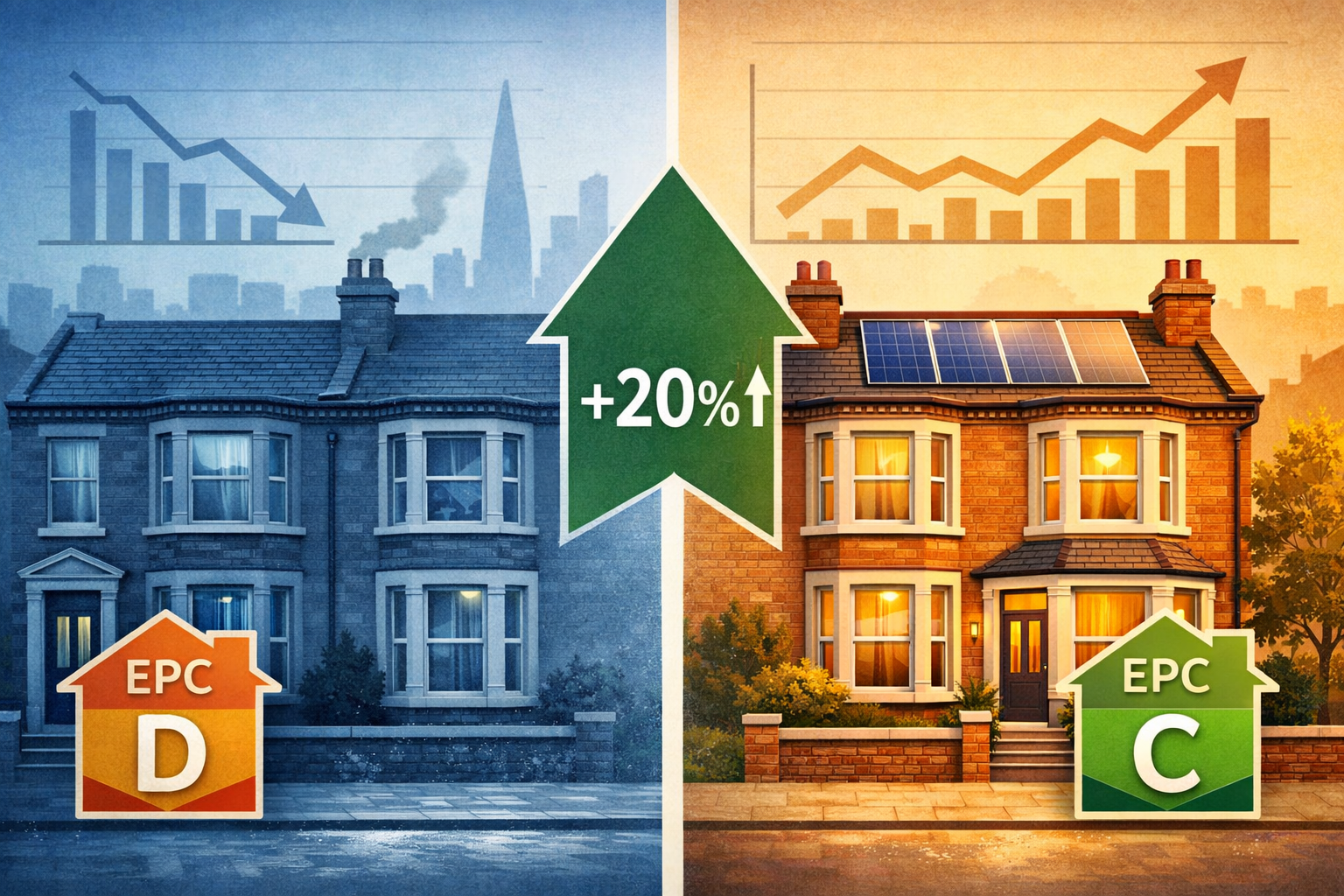
Rental markets often price in energy efficiency faster than the owner-occupier sales market, making them a useful leading indicator for valuers. In active rental markets, properties rated EPC C or above are letting faster and commanding measurable rent premiums. A two-bedroom Victorian conversion rated D averages around £1,550/month, while the same property upgraded to EPC C commands £1,700–£1,750/month — a differential of roughly 10%. [1]
When void periods are also reduced through improved marketability, retrofit costs can be recovered within 2–4 years for larger flats and family homes. [1] This rental evidence is directly relevant to investment property valuations, where income capitalisation methods can translate rental uplifts into capital value increases even when comparable sales data is thin.
Methodology for Energy Efficiency Retrofit Valuations in Flat Markets: Assessing EPC Improvements When Buyer Demand Softens

The core methodological challenge in energy efficiency retrofit valuations in flat markets — assessing EPC improvements when buyer demand softens — is that traditional comparable analysis breaks down. There simply may not be enough recent transactions involving retrofitted properties in the same location to draw statistically robust conclusions. Here is a structured approach to navigate this.
Step 1: Establish the EPC Baseline and Improvement Profile
The starting point is always a clear understanding of the property's current EPC position under the 2026 framework. Eligible improvements that qualify as retrofit upgrades now include: Solar PV panels (with Smart Export Guarantee access), Air Source Heat Pumps, electric storage heaters, and multiple insulation options including loft, cavity, internal, and external solid wall insulation. [3]
Each improvement should be mapped against the four new EPC metrics to identify which headline scores are affected. A heat pump installation, for example, will significantly improve the heating system performance metric but may have limited impact on fabric performance if wall insulation has not been addressed.
Step 2: Apply a Tiered Evidence Hierarchy
When local comparable evidence is scarce, valuers should work through a tiered evidence hierarchy:
- Tier 1 — Direct comparables: Recent sales of properties with matching EPC profiles in the same postcode or immediate vicinity.
- Tier 2 — Adjusted comparables: Sales of similar properties with different EPC ratings, adjusted using published green premium research (e.g., UCL and RICS studies on EPC-linked price differentials).
- Tier 3 — Income evidence: Rental data demonstrating EPC-linked rent premiums, capitalised at an appropriate yield for the asset type.
- Tier 4 — Cost-based adjustment: The depreciated cost of retrofit works as a floor value contribution, particularly relevant where the improvement is recent and verifiable.
Step 3: Quantify the Green Discount Risk
In flat markets, the absence of a retrofit can represent a negative value signal as much as its presence represents a positive one. Properties rated E or below face growing stigma among mortgage lenders, some of whom now apply more conservative lending criteria to low-rated properties. [5] This creates a measurable downside risk that should be reflected in valuations of unimproved properties, not just an upside for retrofitted ones.
Valuers working in property development contexts should pay particular attention to this dynamic, as development appraisals for older stock increasingly need to factor in mandatory improvement costs before a viable exit value can be established.
Step 4: Consider Legislation and Compliance Trajectory
Property market legislation changes are accelerating the mandatory minimum EPC standards for rental properties. Valuers must factor in the cost of compliance — not just the value of voluntary improvements — when assessing investment properties. A property currently rated F that requires £8,000 of work to reach EPC C is not simply worth £8,000 less than its compliant equivalent; it also carries letting restriction risk, void period risk, and potential enforcement costs.
Step 5: Stress-Test the Valuation Against Market Softness
In a flat market, the green premium is real but fragile. A useful stress-test is to model the valuation under three scenarios:
- 🟢 Optimistic: Full green premium is recognised by the market; comparable evidence supports a 5–8% uplift for EPC C vs. EPC D.
- 🟡 Base case: Partial premium is recognised; 2–4% uplift, reflecting cautious buyer sentiment.
- 🔴 Pessimistic: No premium is achievable in the current market; retrofit investment is treated as cost-neutral to value but positive for marketability and time-to-sale.
This three-scenario approach is consistent with best practice in professional property valuations and provides clients with a transparent picture of the uncertainty range.
Practical Considerations for Surveyors and Property Owners
What Surveyors Should Document 📝
When carrying out retrofit-related valuations, thorough documentation is essential to defend the assessment:
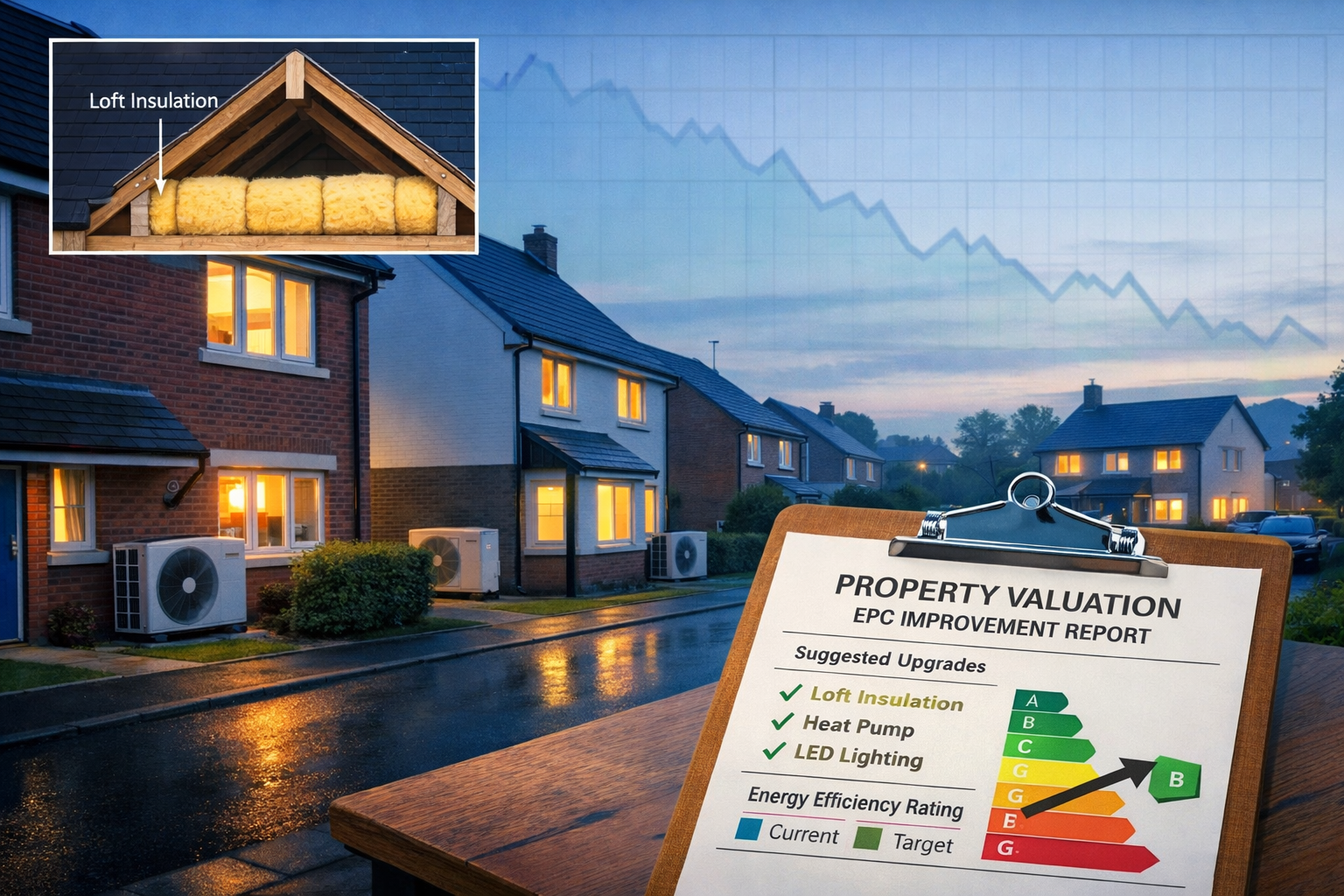
- Copies of the updated EPC certificate under the 2026 four-metric framework [3]
- Installation invoices and warranties for all retrofit works
- Evidence of any government incentive or grant funding received (e.g., Great British Insulation Scheme, Boiler Upgrade Scheme)
- Rental evidence from the local lettings market showing EPC-linked differentials
- Lender guidance on EPC thresholds, where relevant to mortgage valuation
A Level 3 full building survey can also provide critical context for retrofit valuations, particularly where the condition of the existing fabric affects the performance of new installations — for example, where damp penetration undermines the effectiveness of internal wall insulation.
What Property Owners Should Know 🏠
For owners considering retrofit investment ahead of a sale in a flat market, the strategic calculus is nuanced:
- Timing matters: Completing retrofit works at least 6–12 months before sale allows the improved EPC to be reflected in marketing materials and gives time for the market to recognise the improvement.
- Not all retrofits are equal: Improvements that directly reduce visible running costs (solar PV, heat pump, insulation) tend to be more valued by buyers than smart controls or battery storage, which are harder to quantify at point of sale.
- Partial retrofits can backfire: A property with a new heat pump but no insulation upgrade may score poorly on fabric performance under the 2026 EPC framework, undermining the value signal of the heating system improvement.
- Seek professional valuation advice early: Understanding the likely value impact before committing to retrofit expenditure is far more useful than discovering a mismatch after the work is complete.
Government Incentives and Market Signals 🌍
Government incentives are actively accelerating residential retrofit adoption in 2026. [2] In the US, the HUD Green Resilient Retrofit Program — updated in March 2026 — now focuses on energy and water efficiency and natural disaster resilience, with Comprehensive Awards providing funding for full property assessments. [4] In the UK, the trajectory of mandatory minimum EPC standards for rental properties is creating a compliance-driven retrofit wave that will, over time, generate the comparable evidence that valuers currently lack.
Internationally, major technology partnerships are reshaping the retrofit landscape. Johnson Controls launched its OpenBlue Retrofit Intelligence platform in April 2025, using AI and IoT to monitor building energy performance in real-time. [2] Siemens and ENGIE partnered in March 2025 on large-scale European government building retrofits using performance-based energy contracts. [2] These developments signal that data-driven retrofit assessment is becoming the norm — a trajectory that residential valuers should monitor closely.
For those navigating inheritance tax valuations of estates containing older, energy-inefficient properties, the compliance cost trajectory is increasingly relevant to accurate estate valuation, particularly where properties may require significant retrofit investment before they can be let or sold at full market value.
Energy Efficiency Retrofit Valuations in Flat Markets: Assessing EPC Improvements When Buyer Demand Softens — Common Pitfalls to Avoid
Even experienced valuers can fall into traps when assessing retrofit-driven value in a soft market. The most common include:
- ❌ Over-relying on cost as a proxy for value: The cost of retrofit works does not automatically translate into an equivalent increase in market value, particularly in flat markets where buyers may not yet price in the full benefit.
- ❌ Ignoring the four-metric EPC framework: Continuing to assess energy performance as a single score misses the nuance of the 2026 reforms and can lead to inaccurate value adjustments. [3]
- ❌ Applying national green premium averages to local markets: Green premiums vary significantly by location, property type, and buyer demographic. A 6% average national premium may be 2% in a particular postcode and 10% in another.
- ❌ Failing to account for the compliance cost floor: In investment properties, the cost of achieving minimum EPC compliance is a hard floor on the value discount — it cannot be less than the cost of mandatory works.
- ❌ Treating buyer caution as permanent: Flat markets are cyclical. Retrofit improvements that are not fully valued today will be when market conditions improve, meaning the long-term case for energy efficiency investment remains strong even when short-term premiums are compressed.
Conclusion: Actionable Next Steps for Retrofit Valuations in 2026
Energy efficiency retrofit valuations in flat markets — assessing EPC improvements when buyer demand softens — demand a more rigorous, multi-layered approach than standard comparable analysis allows. The evidence base is growing, the regulatory framework is tightening, and the financial case for retrofit investment is becoming clearer with each passing year. But in a flat market, the gap between investment and recognised value can be frustrating for property owners and challenging for valuers.
Here are the key actionable steps for 2026:
- ✅ Update EPC assessments under the new four-metric framework before any retrofit valuation is undertaken.
- ✅ Build a tiered evidence file combining sales comparables, rental data, and cost evidence to support value adjustments.
- ✅ Model three valuation scenarios (optimistic, base, pessimistic) to communicate uncertainty transparently to clients.
- ✅ Factor in compliance cost trajectory for investment properties, particularly as mandatory minimum EPC standards tighten.
- ✅ Commission a full building survey where retrofit works interact with existing fabric condition, to avoid performance shortfalls undermining the EPC improvement.
- ✅ Monitor rental market evidence as a leading indicator of where sales market premiums are heading.
The flat market environment is not a reason to discount the value of energy efficiency improvements — it is a reason to measure them more carefully. Surveyors and property owners who develop robust, evidence-based approaches to retrofit valuation now will be well-positioned when market conditions shift and green premiums become easier to realise.
References
[1] Future Proofing Ha7 The 2026 Landlord Guide To Epc Compliance And Energy Efficient Rental Returns – hunters.com
[2] Energy Retrofit Market 5982 – coherentmarketinsights.com
[3] New Epc Regulations – blog.goodlord.co
[4] Hud Makes Significant Changes To The Green Resilient Retrofit Program Effective March 2026 – nelsonmullins.com
[5] Reforms To The Energy Performance Of Buildings Regime – gov.uk