

Do You Need a Survey on a New Build? The Complete 2026 Guide

Purchasing a brand-new home is an exciting milestone, but the gleaming facades and modern finishes can sometimes mask underlying issues that won’t become apparent until years down the line. Many buyers assume that new construction comes with ironclad guarantees, making professional surveys unnecessary—yet thousands of homeowners discover costly defects after moving in. Understanding whether do you need a survey on a new build is crucial to protecting what may be the largest investment of your life.
The question of whether to commission a survey on new construction isn’t straightforward. While new builds typically come with warranties and building regulation approvals, these safeguards don’t always provide the comprehensive protection buyers expect. In 2026, with evolving construction standards and increasing complexity in building techniques, the decision requires careful consideration of multiple factors including warranty coverage, lender requirements, and your own risk tolerance.
Key Takeaways
✅ New build warranties don’t replace professional surveys – NHBC and similar warranties have limitations and exclusions that may leave significant issues uncovered
✅ Mortgage lenders increasingly require surveys – Many lenders now mandate professional inspections on new builds, particularly for higher-value properties or non-standard construction
✅ Snagging surveys identify cosmetic and minor defects – These specialized inspections catch finishing issues before completion, giving you leverage with developers
✅ Full building surveys provide comprehensive protection – For properties over £500,000 or with complex designs, a detailed structural survey offers peace of mind beyond warranty coverage
✅ Timing matters significantly – Conducting surveys at different construction stages (pre-completion and post-completion) maximizes defect detection and resolution opportunities
Understanding New Build Warranties and Their Limitations
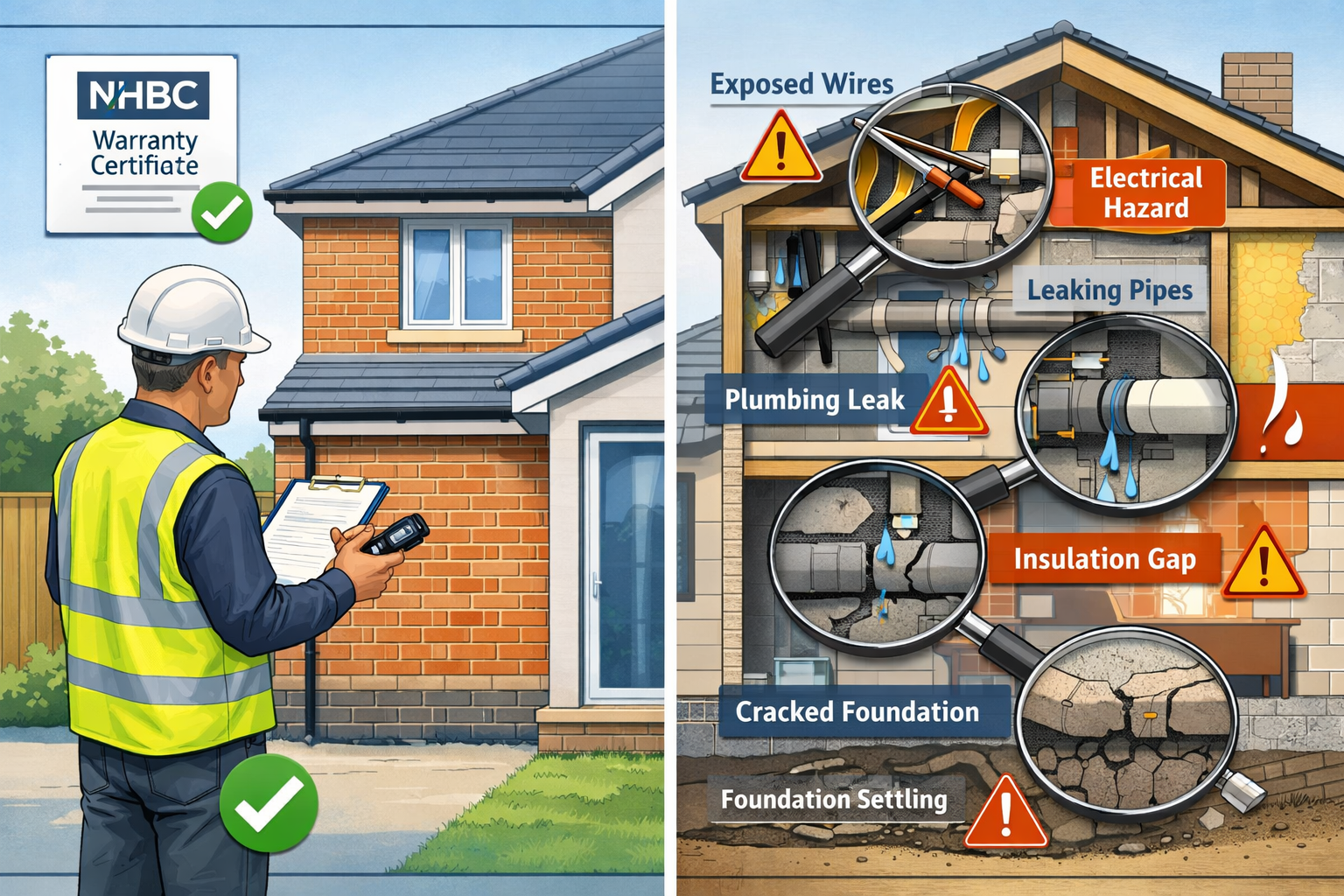
New build properties in the UK typically come with a 10-year structural warranty, most commonly provided by the National House Building Council (NHBC) or similar organizations like Premier Guarantee or LABC Warranty. These warranties create a false sense of security for many buyers who assume comprehensive coverage against all potential defects.
What New Build Warranties Actually Cover
The standard NHBC warranty operates in three distinct phases:
Years 1-2: The builder remains responsible for fixing defects in materials and workmanship. This includes issues with plastering, joinery, kitchens, bathrooms, and other finishing elements.
Years 3-10: Coverage shifts to major structural defects only, including damage to the roof, walls, foundations, and load-bearing elements that affect the property’s stability.
Critical Warranty Exclusions
Understanding what warranties don’t cover is essential when considering whether you need a survey on a new build:
- Design defects that don’t affect structural integrity
- Poor workmanship that becomes apparent after year two
- Cosmetic issues like paint quality, minor cracks, or squeaky floors
- External works including driveways, paths, and landscaping
- Mechanical and electrical systems beyond initial installation defects
- Condensation and mold unless caused by structural failure
A comprehensive building survey can identify these non-covered issues before you complete your purchase, potentially saving thousands in remedial costs.
Do You Need a Survey on a New Build? Key Factors to Consider
The decision about whether to commission a survey on new construction depends on several interconnected factors. Understanding these elements helps you make an informed choice based on your specific circumstances.
Property Value and Investment Protection
Higher-value properties warrant greater scrutiny. For new builds exceeding £500,000, the cost of a comprehensive survey (typically £800-£1,500) represents a minimal percentage of the purchase price while providing substantial protection. The potential cost of undiscovered defects far outweighs the survey expense.
Mortgage Lender Requirements
Many mortgage providers now require professional valuations or surveys on new builds, particularly when:
- The property uses non-standard construction methods (timber frame, steel frame, or innovative materials)
- The development is incomplete with surrounding plots still under construction
- The property represents high-value lending (typically above £500,000)
- The buyer is purchasing off-plan before construction completion
Your lender’s valuation survey serves their interests, not yours. It confirms the property provides adequate security for the loan but doesn’t comprehensively assess condition or identify all defects.
Construction Stage and Access Opportunities
The timing of your survey significantly impacts its effectiveness:
| Construction Stage | Survey Type | Benefits | Limitations |
|---|---|---|---|
| Pre-plastering | Structural inspection | Views framework, insulation, services | Requires developer cooperation |
| Pre-completion | Snagging survey | Identifies finishing defects | Limited structural access |
| Post-completion | Full building survey | Comprehensive assessment | Some elements already covered |
| Post-occupation | Defect survey | Documents emerging issues | May miss construction-phase problems |
Developer Reputation and Track Record
Research your developer’s history thoroughly. Established builders with strong reputations may deliver higher-quality construction, but even reputable firms experience quality control issues. Smaller developers or those with limited track records warrant additional scrutiny through professional surveys.
Building Regulation Compliance
While Building Control approval confirms compliance with minimum standards, it doesn’t guarantee quality workmanship or identify all potential issues. Building Control inspectors conduct periodic site visits but cannot inspect every aspect of construction. Understanding which building survey you need helps match the inspection level to your property’s complexity.
Types of Surveys Available for New Build Properties
Different survey types serve distinct purposes when assessing new construction. Selecting the appropriate survey level depends on your concerns, budget, and the property’s characteristics.
Snagging Surveys (New Build Inspections)
Purpose: Identify cosmetic defects and finishing issues before completion
Cost: £300-£600 for typical properties
What’s Included:
- Paintwork quality and coverage
- Door and window fitting and operation
- Kitchen and bathroom installation standards
- Flooring installation and finish
- Electrical fittings and switches
- Plumbing fixtures and operation
- External finishes and drainage
Snagging surveys provide leverage with developers to rectify issues before you complete. Most builders expect snagging lists and will address reasonable concerns to ensure customer satisfaction and protect their reputation.
RICS Level 2 Survey (HomeBuyer Report)
Purpose: Assess condition and highlight significant issues requiring attention
Cost: £400-£800 depending on property value
What’s Included:
- Visual inspection of accessible areas
- Assessment of major building elements
- Identification of urgent defects
- Advice on necessary repairs
- Valuation (if requested)
The Level 2 survey offers more depth than a snagging inspection while remaining cost-effective. It’s suitable for new builds of standard construction in good apparent condition. For detailed comparisons, review our guide on Level 2 vs Level 3 surveys.
RICS Level 3 Survey (Full Building Survey)
Purpose: Comprehensive assessment of construction quality, materials, and structural integrity
Cost: £800-£1,500+ depending on property size and complexity
What’s Included:
- Detailed inspection of all accessible areas
- Assessment of construction methods and materials
- Identification of defects with severity ratings
- Guidance on repairs and maintenance
- Analysis of potential future issues
- Recommendations for specialist investigations
A Level 3 full building survey provides the most thorough assessment available. It’s particularly valuable for:
- Complex or non-standard construction (timber frame, steel frame, innovative designs)
- High-value properties where investment protection justifies the cost
- Properties with visible concerns or unusual features
- Buyers seeking comprehensive understanding of their purchase
The survey identifies building problems and solutions, providing detailed guidance on addressing any issues discovered.
Specialist Surveys and Investigations
Certain circumstances warrant additional specialist surveys:
🔍 Drone Surveys: For properties with complex roof designs or difficult access areas, premium drone surveys provide detailed roof condition assessment without scaffolding costs.
🏗️ Structural Engineering Assessment: When concerns exist about foundation design, load-bearing capacity, or structural calculations.
🧪 Environmental Surveys: For sites with potential contamination, flooding risks, or ecological concerns.
Common Defects Found in New Build Properties
Despite building regulations and warranty coverage, new builds frequently exhibit defects ranging from minor cosmetic issues to significant structural problems. Understanding common issues helps you appreciate the value of professional surveys.
Structural and Foundation Issues
Settlement cracks: New buildings naturally settle as materials cure and ground compacts. However, excessive or uneven settlement indicates foundation problems requiring investigation.
Inadequate foundations: Insufficient depth, poor concrete quality, or inadequate reinforcement can cause long-term structural movement.
Subsidence risks: Building on unsuitable ground without proper investigation or remediation creates ongoing stability concerns.
Building Envelope Defects
Water penetration: Poor detailing around windows, doors, and roof junctions allows water ingress, causing internal damage and potential mold growth.
Thermal bridging: Gaps in insulation or poor installation reduce energy efficiency and create cold spots prone to condensation.
Air leakage: Inadequate sealing increases heating costs and reduces comfort while potentially allowing moisture migration within building elements.
Services and Systems Problems
Plumbing defects: Incorrectly installed pipework, inadequate pressure, or poor drainage design cause ongoing operational issues.
Electrical installation errors: Non-compliant wiring, inadequate circuit protection, or poor workmanship create safety hazards.
Heating system issues: Undersized systems, poor controls, or installation errors result in inadequate comfort and high running costs.
Finishing and Cosmetic Defects
While less serious than structural issues, finishing defects affect enjoyment and may indicate broader quality control problems:
- Uneven paintwork and poor surface preparation
- Poorly fitted doors and windows with operational issues
- Damaged or poorly installed flooring
- Kitchen and bathroom installation defects
- Cracked tiles or poorly finished grouting
A professional survey documents these issues, providing evidence for negotiations with developers or warranty claims. Understanding building defects helps you recognize when professional assessment is necessary.
The Financial Case: Survey Costs vs. Potential Savings
Evaluating whether you need a survey on a new build requires weighing upfront costs against potential savings and risk mitigation.
Survey Investment Analysis
| Survey Type | Typical Cost | Value Proposition | Best For |
|---|---|---|---|
| Snagging Survey | £300-£600 | Identifies 50-200+ finishing defects | All new builds |
| Level 2 Survey | £400-£800 | Highlights significant issues | Standard construction |
| Level 3 Survey | £800-£1,500+ | Comprehensive protection | Complex/high-value properties |
| Specialist Surveys | £500-£2,000+ | Targeted investigation | Specific concerns |
Potential Cost Savings and Risk Mitigation
Pre-completion defect identification: Discovering issues before completion gives you maximum leverage with developers. Rectification costs them significantly less during construction than post-completion remediation.
Warranty claim evidence: Professional survey reports provide documented evidence supporting warranty claims, increasing success rates and reducing disputes.
Negotiation power: Identified defects strengthen your position to negotiate price reductions or require repairs before completion.
Future maintenance planning: Understanding your property’s condition enables budgeting for repairs and restoration, preventing financial surprises.
Real-World Cost Examples
Consider these scenarios illustrating potential survey value:
💷 Case 1: A £450,000 new build with undiscovered drainage defects requiring £8,500 in excavation and repairs after completion. A £600 survey would have identified the issue when the developer could rectify it at minimal cost.
💷 Case 2: A £750,000 property with poor roof detailing allowing water penetration, causing £15,000 in internal damage and remediation costs. A £1,200 Level 3 survey identified the risk before completion.
💷 Case 3: A £350,000 new build with 147 snagging items identified by a £400 survey, all rectified by the developer before handover, saving the buyer thousands in remediation costs.
When You Definitely Need a Survey on a New Build
Certain circumstances make professional surveys essential rather than optional, regardless of warranty coverage or developer reputation.
Non-Standard Construction Methods
Properties using innovative or non-standard construction techniques warrant comprehensive assessment:
- Timber frame construction requires careful moisture barrier and insulation inspection
- Steel frame buildings need assessment of fire protection and thermal performance
- Modular or prefabricated construction demands verification of module connections and weatherproofing
- Innovative materials or experimental techniques require specialist evaluation
High-Value Properties
For new builds exceeding £500,000, the survey cost represents minimal financial exposure relative to the investment. The potential for undiscovered defects justifies comprehensive professional assessment.
Complex Architectural Designs
Properties with unusual features require enhanced scrutiny:
- Large glazed areas or curtain walling systems
- Complex roof designs with multiple junctions
- Basement or underground accommodation
- Integrated renewable energy systems
- Smart home technology integration
Development Site Concerns
Incomplete developments: Properties on partially completed sites face risks from ongoing construction, including:
- Damage from adjacent works
- Delayed completion of shared facilities
- Developer financial difficulties affecting completion
Site history issues: Properties built on previously developed land (brownfield sites) may face contamination risks requiring environmental assessment.
Lender Requirements
When your mortgage provider mandates a survey or enhanced valuation, compliance is non-negotiable. Understanding their requirements early prevents completion delays.
Timing Your New Build Survey for Maximum Effectiveness
Strategic timing maximizes survey value and defect identification opportunities. Different construction stages offer distinct advantages for inspection.
Pre-Plastering Stage Inspection
Optimal timing: After first-fix services installation, before plasterboard and plastering
Advantages:
- ✅ Clear visibility of structural framework
- ✅ Inspection of insulation installation and coverage
- ✅ Assessment of electrical and plumbing first-fix work
- ✅ Verification of damp-proofing and vapor barriers
- ✅ Early identification of structural concerns
Challenges:
- ⚠️ Requires developer cooperation and site access
- ⚠️ Additional visit needed for finishing assessment
- ⚠️ May not be practical for off-plan purchases
Pre-Completion Snagging Survey
Optimal timing: 2-4 weeks before scheduled completion
Advantages:
- ✅ Developer remains motivated to address issues
- ✅ Comprehensive finishing defect identification
- ✅ Creates documented list for developer rectification
- ✅ Delays completion until satisfactory resolution
Challenges:
- ⚠️ Limited structural element visibility
- ⚠️ Rushed timeline if completion date is imminent
- ⚠️ May not identify latent defects
Post-Completion Full Survey
Optimal timing: Within first 6 months of occupation
Advantages:
- ✅ Identifies issues emerging during early occupation
- ✅ Provides comprehensive condition documentation
- ✅ Supports warranty claims with professional evidence
- ✅ Informs maintenance planning
Challenges:
- ⚠️ Developer less motivated to address issues
- ⚠️ May require warranty claim process
- ⚠️ Some defects already causing damage
Multi-Stage Inspection Strategy
For maximum protection, consider surveys at multiple stages:
- Pre-plastering inspection (if accessible): Structural and services verification
- Pre-completion snagging: Finishing defect identification
- Year-end survey: Document condition before builder warranty expires
This comprehensive approach provides layered protection throughout the construction and early occupation phases.
How to Choose the Right Surveyor for New Build Assessment
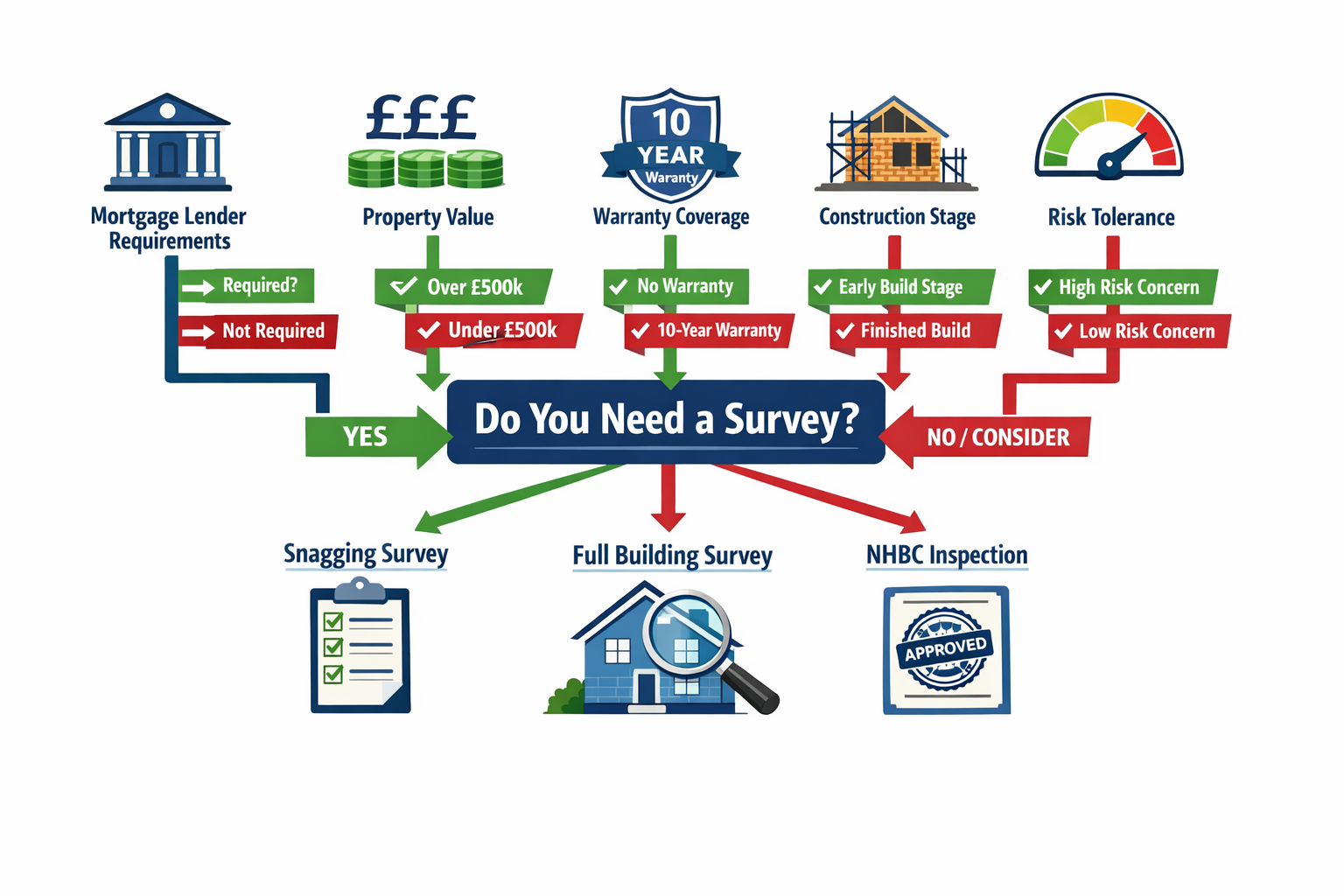
Selecting a qualified, experienced surveyor ensures you receive accurate, actionable advice tailored to new construction assessment.
Essential Qualifications and Accreditations
RICS Membership: Ensure your surveyor is a Member or Fellow of the Royal Institution of Chartered Surveyors (MRICS or FRICS), indicating professional competence and adherence to ethical standards.
Relevant Experience: Seek surveyors with specific new build assessment experience, understanding modern construction methods, building regulations, and common defects.
Professional Indemnity Insurance: Verify adequate coverage protecting you against negligent advice or missed defects.
Questions to Ask Potential Surveyors
📋 Experience and expertise:
- How many new build surveys do you conduct annually?
- What experience do you have with this construction type?
- Can you provide recent new build survey examples?
📋 Survey scope and methodology:
- What exactly will your survey include?
- How long will the inspection take?
- What equipment and technology do you use?
- Will you identify areas requiring further investigation?
📋 Reporting and follow-up:
- When will I receive the report?
- What format and detail level does the report provide?
- Do you offer follow-up consultations to discuss findings?
- Can you recommend specialists for identified issues?
Red Flags to Avoid
⚠️ Unusually low fees: Quality surveys require time and expertise; significantly discounted services may indicate rushed inspections or inexperienced surveyors.
⚠️ Guaranteed pass/fail promises: Professional surveyors provide objective assessments, not predetermined outcomes.
⚠️ Limited availability: Rushed surveys scheduled at the surveyor’s convenience rather than optimal timing may miss critical issues.
⚠️ Vague scope descriptions: Clear, detailed scope definitions prevent misunderstandings about what the survey includes.
For guidance on working effectively with your surveyor, review our article on building surveyor access to ensure smooth inspection processes.
Alternative Approaches: Self-Inspection and Developer Inspections
While professional surveys provide optimal protection, understanding alternative approaches helps you make informed decisions based on your circumstances and budget.
Developer-Provided Inspections
Most developers offer pre-completion inspections, allowing buyers to view the property and identify obvious issues before handover.
Advantages:
- ✅ No additional cost
- ✅ Familiarization with the property
- ✅ Opportunity to raise immediate concerns
Limitations:
- ⚠️ No independent professional assessment
- ⚠️ Limited time and scope
- ⚠️ Buyers often lack technical expertise to identify subtle defects
- ⚠️ No formal documentation for future reference
Self-Inspection Approaches
Knowledgeable buyers may attempt their own assessments using checklists and guidance materials.
What you can reasonably assess:
- Obvious finishing defects (paintwork, damaged fixtures)
- Door and window operation
- Visible plumbing and electrical issues
- Floor levelness and finish quality
- External drainage and landscaping
What you’ll likely miss:
- Structural adequacy and construction quality
- Hidden services installation standards
- Building regulation compliance issues
- Thermal performance and insulation adequacy
- Subtle indicators of significant problems
NHBC and Warranty Provider Inspections
Warranty providers conduct periodic inspections during construction, but these serve their interests rather than yours.
Purpose: Verify compliance with warranty standards and building regulations
Frequency: Typically at foundation, frame, and pre-completion stages
Limitations: Inspections confirm minimum standards rather than assess quality or identify all defects
The Independent Professional Advantage
Professional surveyors provide:
✅ Objective assessment without conflicts of interest
✅ Technical expertise identifying subtle indicators of problems
✅ Comprehensive documentation supporting negotiations and claims
✅ Risk prioritization distinguishing serious issues from minor concerns
✅ Actionable recommendations for addressing identified defects
The investment in professional expertise typically delivers significant returns through defect identification, negotiation leverage, and peace of mind.
Understanding 2026 Survey Standards and Regulations
The surveying profession continues evolving with updated standards and methodologies enhancing assessment quality and consistency. While much discussion focuses on land title surveys in commercial contexts, residential building surveys also benefit from advancing professional standards.
Current RICS Standards for Building Surveys
The Royal Institution of Chartered Surveyors maintains rigorous standards for residential surveys, ensuring consistency and quality across the profession. These standards define:
- Inspection scope and methodology for each survey level
- Reporting requirements including format, content, and detail
- Professional conduct and ethical obligations
- Continuing professional development requirements for practitioners
Building Regulation Compliance Verification
Professional surveys assess compliance with current building regulations, identifying potential non-compliance issues that may affect:
- Safety: Fire protection, structural stability, electrical safety
- Energy efficiency: Insulation standards, heating system efficiency, ventilation
- Accessibility: Disabled access provisions where applicable
- Sustainability: Water efficiency, waste management, sustainable materials
Understanding building regulation compliance helps you appreciate the value professional surveys provide beyond cosmetic defect identification.
Technology Integration in Modern Surveys
Contemporary surveying increasingly incorporates advanced technology:
Thermal imaging: Identifies insulation gaps, thermal bridging, and moisture penetration invisible to visual inspection.
Moisture meters: Quantifies dampness levels in building elements, distinguishing construction moisture from defect-related water penetration.
Drone technology: Enables detailed roof and chimney inspection without expensive scaffolding or access equipment.
Digital reporting: Provides clear, illustrated reports with photographs and annotations enhancing understanding.
Future Developments in Survey Standards
The surveying profession continues advancing through:
- Enhanced competency requirements for surveyors
- Standardized digital reporting formats
- Integration of building information modeling (BIM) data
- Advanced diagnostic equipment and methodologies
- Improved consumer protection measures
Making Your Decision: Do You Need a Survey on a New Build?
After examining the factors, benefits, and considerations, you can now make an informed decision based on your specific circumstances.
Decision Framework
Consider these questions to guide your choice:
Financial considerations:
- What is the property value and your total investment?
- Can you afford the potential cost of undiscovered defects?
- Does the survey cost represent reasonable insurance against risk?
Property characteristics:
- Is the construction standard or non-standard?
- Does the design include complex features or systems?
- What is the developer’s reputation and track record?
Risk tolerance:
- How comfortable are you accepting warranty coverage alone?
- What financial reserves do you have for unexpected repairs?
- How important is comprehensive peace of mind to you?
Lender requirements:
- Does your mortgage provider mandate a survey?
- What level of assessment do they require?
Recommended Approaches by Scenario
| Scenario | Recommended Survey | Rationale |
|---|---|---|
| Standard new build, reputable developer, value <£400k | Snagging survey minimum | Cost-effective defect identification with warranty backup |
| Standard new build, value £400k-£600k | Level 2 survey + snagging | Balanced protection with reasonable cost |
| High-value property >£600k | Level 3 full survey | Comprehensive protection justified by investment size |
| Non-standard construction | Level 3 survey + specialists | Enhanced scrutiny for complex building methods |
| Complex design or features | Level 3 survey | Detailed assessment of unusual elements |
| Uncertain developer reputation | Level 3 survey | Maximum protection against quality concerns |
| Lender-mandated survey | As required + snagging | Compliance plus buyer-focused assessment |
The Minimum Recommendation
At absolute minimum, commission a professional snagging survey for any new build purchase. The modest cost (£300-£600) provides:
- Documentation of finishing defects for developer rectification
- Professional assessment of obvious issues
- Baseline condition record for future reference
- Increased confidence in your purchase
For properties exceeding £500,000 or involving non-standard construction, upgrade to a comprehensive Level 3 survey for maximum protection.
Taking Action: Next Steps for New Build Buyers
Armed with comprehensive understanding of whether you need a survey on a new build, you can now take concrete steps to protect your investment.
Immediate Actions
- Assess your specific situation using the decision framework above
- Research qualified surveyors in your area with new build expertise
- Request quotes from 2-3 surveyors, comparing scope and pricing
- Review your mortgage offer to understand lender requirements
- Check your purchase timeline to identify optimal survey timing
Questions to Discuss with Your Solicitor
Your conveyancing solicitor can provide valuable guidance on:
- Survey recommendations based on the specific property
- Developer reputation and previous buyer experiences
- Warranty coverage details and limitations
- Contractual provisions for defect rectification
- Completion delay options if surveys identify issues
Coordinating with Your Developer
Communicate your intentions: Inform the developer you’re commissioning a professional survey, establishing expectations for access and defect rectification.
Request documentation: Obtain building regulation certificates, warranty documentation, and any available inspection reports.
Establish rectification processes: Understand how the developer handles identified defects and what timeframes apply.
Negotiate strategically: Use survey findings to negotiate price adjustments or require repairs before completion.
Planning for Long-Term Property Management
Beyond the initial survey, establish good property management practices:
📅 Schedule regular inspections: Annual reviews identify emerging issues before they become serious
📋 Maintain comprehensive records: Document all surveys, warranties, repairs, and correspondence
🔧 Address issues promptly: Early intervention prevents minor problems escalating into major defects
📚 Understand your warranties: Know what’s covered, exclusions, and claim procedures
For ongoing property care, explore resources on building inspections and surveys for homeowners to maintain your investment’s condition and value.
Conclusion: Protecting Your New Build Investment
The question “do you need a survey on a new build?” doesn’t have a universal answer—it depends on your specific circumstances, risk tolerance, and the property’s characteristics. However, the evidence overwhelmingly supports professional assessment for most buyers.
New build warranties, while valuable, contain significant limitations and exclusions that leave buyers exposed to potentially costly defects. The modest investment in professional surveys—ranging from £300 for basic snagging inspections to £1,500 for comprehensive Level 3 assessments—provides substantial protection relative to the financial commitment of property purchase.
Key principles to remember:
✅ Warranties complement but don’t replace surveys: Professional assessment identifies issues warranties may not cover
✅ Prevention costs less than cure: Discovering defects before completion maximizes your leverage and minimizes costs
✅ Knowledge empowers negotiation: Professional survey reports strengthen your position with developers
✅ Investment protection justifies survey costs: For most buyers, the survey expense represents prudent insurance against significant risk
Your Action Plan
For all new build purchases: Commission at minimum a professional snagging survey to identify finishing defects and establish baseline condition documentation.
For properties exceeding £500,000 or involving complex construction: Invest in a comprehensive Level 3 full building survey providing detailed structural and systems assessment.
For optimal protection: Consider multi-stage inspections at pre-plastering, pre-completion, and year-end stages.
The peace of mind, negotiation leverage, and defect identification professional surveys provide typically deliver value far exceeding their cost. Your new build represents a significant financial and emotional investment—protect it with professional expertise that ensures you move into your dream home with confidence rather than costly surprises.
Take the first step today by researching qualified building surveyors in your area and requesting quotes tailored to your specific property and circumstances. Your future self will thank you for the diligence and foresight.
References
[1] Understanding The 2026 Alta Nsps Land Survey Standards Whats New And Why It Matters – https://millmanland.com/company-news/understanding-the-2026-alta-nsps-land-survey-standards-whats-new-and-why-it-matters/
[2] New 2026 Minimum Standard Detail 3684174 – https://www.jdsupra.com/legalnews/new-2026-minimum-standard-detail-3684174/
[8] What 2026 Alta Nsps Updates Mean For Cre Professionals – https://www.partneresi.com/resources/articles/what-2026-alta-nsps-updates-mean-for-cre-professionals/
[9] What The 2026 Altansps Updates Mean For Cre Professionals – https://www.globest.com/2025/12/22/what-the-2026-altansps-updates-mean-for-cre-professionals/