

Dilapidations Survey: The Complete Professional Guide for 2026
When a commercial lease ends, the final inspection can reveal repair costs running into hundreds of thousands of pounds—costs that could devastate an unprepared tenant or landlord. A dilapidations survey serves as the critical tool that protects both parties from financial surprises, documenting property condition and determining fair repair obligations. In 2026, with nearly 400 industry experts gathering at the RICS Dilapidations Conference and over half of practitioners investing in new technology, this specialized field is evolving rapidly to meet modern commercial property challenges[1][5].
Understanding what a dilapidations survey entails, when it’s needed, and how it protects your interests can mean the difference between a smooth lease transition and a costly legal dispute.
Key Takeaways
- 📋 A dilapidations survey documents property condition to establish repair obligations between landlords and tenants at lease end or during tenancy
- 💰 Accurate surveys prevent financial overpayment by providing evidence-based assessments of actual repair costs and responsibilities[2][4]
- ⚖️ Professional documentation resolves disputes by creating clear, objective records that support negotiation and mediation[3]
- 🔍 Early detection through regular surveys identifies maintenance issues before they become expensive problems requiring major repairs[3]
- 🤖 Technology integration in 2026 is transforming dilapidations practice, with AI and digital tools complementing professional surveyor judgment[1]
What Is a Dilapidations Survey?
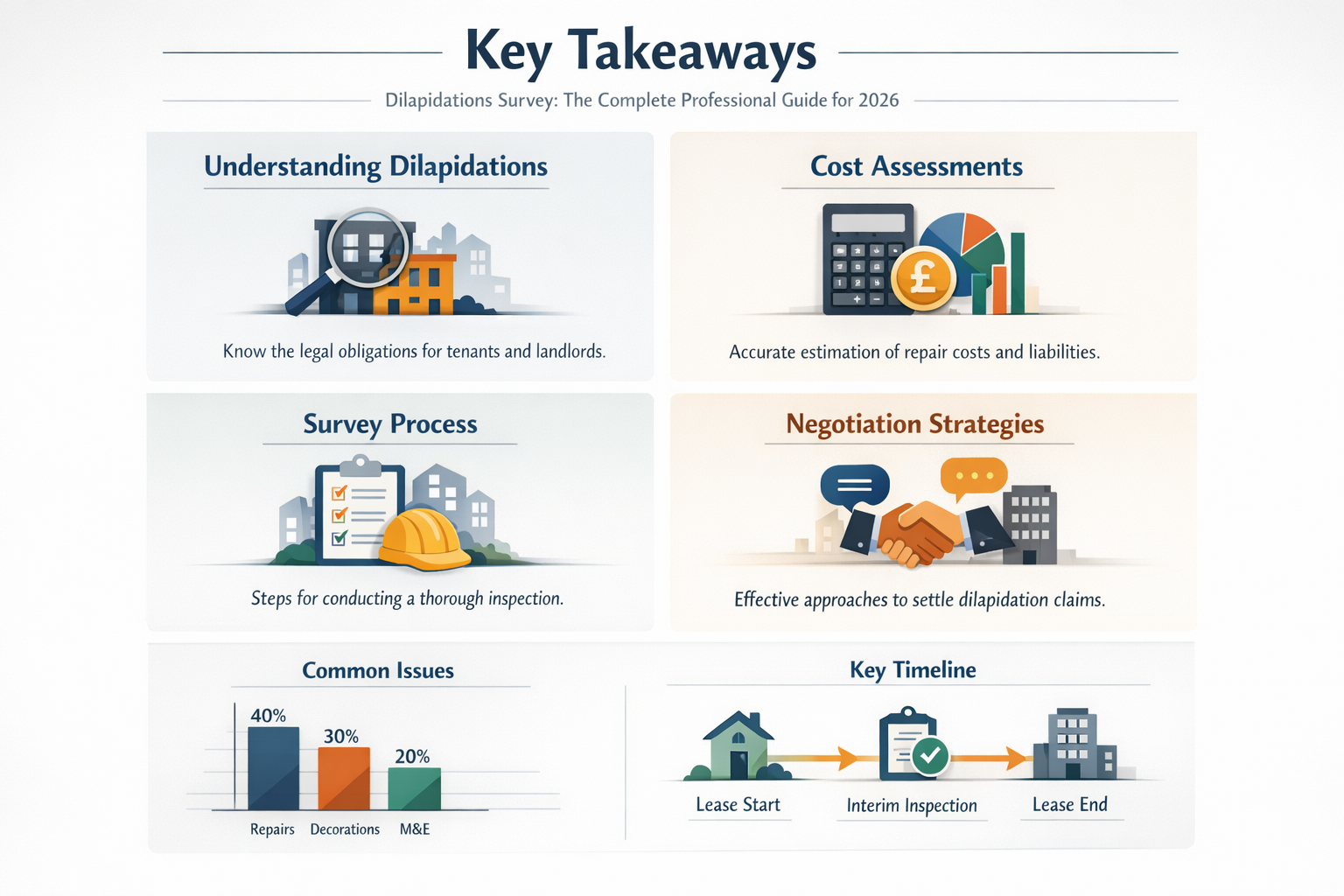
A dilapidations survey is a professional property inspection that identifies and documents the condition of a building, specifically focusing on breaches of lease covenants related to repair, decoration, and reinstatement obligations. This specialized assessment creates an objective record of property condition at critical lease milestones.
The survey examines every aspect of the property against the lease agreement terms, noting:
- Structural defects and building fabric deterioration
- Decorative condition including paintwork, flooring, and finishes
- Mechanical and electrical systems performance and maintenance
- Alterations or modifications made during the tenancy
- Compliance issues with building regulations and safety standards
Unlike standard building surveys that assess overall property condition, a dilapidations survey specifically measures the property against lease obligations to determine repair responsibilities and associated costs.
Types of Dilapidations Surveys
Professional surveyors conduct different types of dilapidations assessments depending on the lease stage and purpose:
| Survey Type | Timing | Primary Purpose |
|---|---|---|
| Schedule of Condition | Lease commencement | Baseline documentation limiting tenant liability |
| Interim Schedule | During lease term | Identify ongoing repair obligations |
| Terminal Schedule | Lease end | Document breaches and calculate repair costs |
| Scott Schedule | Dispute resolution | Compare landlord and tenant positions item-by-item |
Each type serves a distinct function in managing dilapidations obligations throughout the lease lifecycle[6][7].
Why Dilapidations Surveys Are Essential
The importance of professional dilapidations surveys extends far beyond simple property documentation. These assessments provide critical protection and financial benefits for all parties involved in commercial property transactions.
1. Preventing Financial Overpayment
Dilapidations surveys prevent financial overpayment by establishing accurate, evidence-based repair costs rather than inflated estimates[2][4]. Without professional documentation, landlords may claim excessive repair costs, while tenants lack the evidence to challenge unreasonable demands.
A properly conducted survey provides:
- ✅ Photographic evidence of actual property condition
- ✅ Detailed costings based on current market rates
- ✅ Clear differentiation between fair wear and tear versus tenant damage
- ✅ Professional assessment of betterment issues
This objective documentation creates a fair basis for negotiation, typically reducing final settlement amounts significantly compared to initial landlord claims.
2. Resolving Disputes Through Clear Documentation
Clear documentation resolves disputes by providing objective evidence that helps mediate disagreements between tenants, landlords, and contractors regarding repair responsibilities[3]. When both parties have access to professional survey findings, negotiations become fact-based rather than adversarial.
“Professional judgment remains essential—the profession is united in viewing technology as a complementary tool rather than a replacement for surveyor expertise.” – RICS Dilapidations Conference 2025[1]
The survey creates a shared understanding of property condition, making settlement discussions more productive and reducing the likelihood of costly litigation.
3. Early Detection and Cost Savings
Early detection through regular surveys can extend building lifespan and save significant long-term repair costs[3]. Identifying maintenance issues during interim inspections allows tenants to address problems before they escalate into major defects.
For example:
- 🔧 Small roof leaks detected early prevent extensive water damage
- 🔧 Minor HVAC maintenance avoids complete system replacement
- 🔧 Surface repairs to flooring prevent structural substrate damage
- 🔧 Timely redecoration maintains protective finishes
This proactive approach benefits both landlords (who receive properties in better condition) and tenants (who face lower terminal dilapidations claims).
4. Ensuring Compliance and Standards
Professional dilapidations services ensure compliance with lease covenants, building regulations, and industry standards. Chartered surveyors understand the technical requirements and legal frameworks governing commercial property maintenance.
The survey identifies:
- Building regulation compliance issues
- Health and safety violations
- Energy efficiency requirements in 2026
- Accessibility standards
- Environmental considerations
This comprehensive approach protects both parties from potential regulatory penalties and ensures properties meet current market expectations.
5. Supporting Negotiation and Settlement
A well-prepared dilapidations survey provides the foundation for effective negotiation. The detailed schedule of works and associated costs creates a starting point for discussions, with professional surveyors often facilitating settlement without court intervention.
Settlement negotiations typically consider:
- Diminution in value – the actual reduction in property value versus repair costs
- Section 18 Valuation – limiting claims to actual landlord losses
- Supersession – planned refurbishment that makes repairs unnecessary
- Betterment – improvements beyond original condition
Understanding why property owners hire surveyors for these complex assessments helps parties appreciate the value of professional expertise in achieving fair outcomes.
The Dilapidations Survey Process
Understanding the dilapidations survey process helps landlords and tenants prepare effectively and maximize the value of professional assessments.
Initial Consultation and Lease Review
The process begins with a thorough review of the lease agreement to understand specific repair covenants, permitted alterations, and reinstatement obligations. The surveyor examines:
- Repairing obligations – full repairing and insuring (FRI) versus internal repairing only
- Decoration schedules – required frequency and standards
- Alterations clauses – what changes require reinstatement
- Yield-up conditions – the required state at lease end
This lease analysis determines the scope of the inspection and establishes the baseline against which property condition will be measured.
Property Inspection and Documentation
The physical inspection involves a comprehensive examination of all accessible areas within the demised premises. Professional surveyors document:
📸 Photographic evidence of all defects and condition issues
📏 Measurements and specifications for repair works
🔍 Detailed descriptions of breaches and their locations
📊 Condition ratings for different building elements
The inspection quality directly impacts the survey’s effectiveness. Quality and consistency of Schedules of Condition remain a significant challenge across the industry[1], making experienced surveyor selection critical.
Schedule Preparation and Costing
Following the inspection, the surveyor prepares a detailed schedule listing all dilapidations items with associated repair costs. This document includes:
- Item description – specific defect or breach identified
- Lease clause reference – the covenant being breached
- Scope of works – detailed repair specification
- Cost estimate – based on current market rates
- Supporting evidence – photographs and measurements
Professional cost estimates reflect realistic market pricing, avoiding both underestimation and excessive claims that undermine negotiation credibility.
Technology Integration in 2026
Over half of surveyed attendees at the 2025 RICS Conference plan to invest in technology within their dilapidations practice[1]. Modern surveys increasingly incorporate:
- 🤖 AI-powered defect detection from photographic analysis
- 📱 Mobile survey apps for real-time documentation
- 🚁 Drone technology for roof and facade inspections
- 💾 Cloud-based reporting for instant client access
- 📊 Digital measurement tools for accurate quantification
While AI and digital tools are reshaping the profession, they will not replace surveyors; instead, those who fail to adapt to technological change risk becoming irrelevant[1]. The most effective surveys in 2026 combine technological efficiency with irreplaceable professional judgment.
Key Considerations for Landlords and Tenants
Both landlords and tenants benefit from understanding their respective positions and responsibilities within the dilapidations process.
For Tenants: Proactive Management
Tenants should adopt a proactive approach to dilapidations management:
At Lease Commencement:
- Commission a Schedule of Condition to limit liability
- Photograph all existing defects and wear
- Understand repair obligations clearly
- Plan for terminal dilapidations costs
During the Lease:
- Maintain the property according to covenant requirements
- Address repairs promptly to prevent escalation
- Keep records of all maintenance and improvements
- Consider interim surveys to assess exposure
Before Lease End:
- Instruct a surveyor 6-12 months before expiry
- Negotiate repairs versus cash settlement
- Challenge unreasonable landlord claims
- Understand tax relief opportunities
For Landlords: Protecting Asset Value
Landlords should focus on protecting property value while maintaining fair relationships with tenants:
Strategic Considerations:
- Commission terminal schedules promptly after lease end
- Ensure claims reflect actual losses (diminution in value)
- Consider future refurbishment plans (supersession)
- Maintain professional, evidence-based approaches
Common Pitfalls to Avoid:
- ❌ Claiming for betterment or improvements
- ❌ Ignoring Section 18 Valuation limitations
- ❌ Delaying claims beyond reasonable timeframes
- ❌ Failing to mitigate losses through prompt action
Understanding dilapidation protocols helps landlords navigate the legal framework effectively and maintain defensible positions.
Industry Trends and Future Developments
The dilapidations profession is experiencing significant evolution in 2026, driven by technological advancement and changing market priorities.
Sustainability and Circular Economy Focus
The RICS Dilapidations Conference 2026 will emphasize sustainability and circular economy principles, marking a shift toward environmentally conscious repair and reuse strategies[5]. This reflects broader industry recognition that traditional “make good” approaches may conflict with environmental objectives.
Key sustainability considerations include:
- ♻️ Reusing existing materials and fixtures where possible
- 🌱 Specifying low-carbon repair materials
- ⚡ Improving energy efficiency during reinstatement
- 🔄 Designing for future adaptability and circularity
These principles influence both repair specifications and negotiation discussions, with parties increasingly considering environmental impact alongside financial costs.
Emerging Focus Areas for 2026
Emerging focus areas for 2026 include commercial property market trends, circular fit-out design, energy efficiency requirements, and advanced negotiation strategies[5]. Professional surveyors must stay current with:
- EPC and MEES requirements affecting commercial properties
- Net zero commitments influencing repair specifications
- Flexible workspace trends changing fit-out expectations
- Digital documentation standards improving consistency
The profession continues adapting to these evolving requirements while maintaining core principles of fairness and evidence-based assessment.
Professional Development and Standards
Nearly 400 industry experts attended the RICS Dilapidations Conference 2025, demonstrating significant professional engagement with the field[1][5]. This commitment to continuous learning ensures surveyors maintain expertise in:
- Current case law and legal precedents
- Building technology and construction methods
- Valuation principles and cost estimation
- Negotiation and dispute resolution techniques
Engaging experienced chartered surveyors ensures access to this specialized knowledge and professional standards.
Common Dilapidations Issues and Solutions
Understanding frequent dilapidations challenges helps parties anticipate and address potential problems effectively.
Fair Wear and Tear Disputes
One of the most contentious areas involves distinguishing between:
- Tenant damage or neglect (tenant responsibility)
- Fair wear and tear (landlord responsibility)
- Inherent defects (typically landlord responsibility)
Professional surveys provide objective assessments based on property age, lease duration, and expected deterioration rates, removing subjectivity from these determinations.
Alterations and Reinstatement
Tenants often make alterations during occupancy, creating reinstatement obligations at lease end. Common issues include:
- Unauthorized alterations requiring removal
- Permitted alterations with reinstatement clauses
- Improvements the landlord wishes to retain
- Ambiguous lease provisions regarding reinstatement
Clear documentation through measured surveys and photographic records helps resolve these disputes by establishing what alterations occurred and when.
Timing and Procedural Requirements
Dilapidations claims must follow specific procedural requirements:
- Reasonable timeframes for serving schedules
- Proper notice under lease provisions
- Compliance with protocols including the Dilapidations Protocol
- Evidence of actual losses within limitation periods
Failure to follow proper procedures can invalidate otherwise legitimate claims, making professional guidance essential.
Quantified Demands and Section 18 Valuations
The Landlord and Tenant Act 1927 Section 18 limits dilapidations claims to the actual diminution in property value. This means:
- Repair costs exceeding value reduction are unrecoverable
- Planned refurbishment may eliminate repair claims
- Market conditions affect recoverable amounts
- Professional valuation expertise becomes critical
Understanding these limitations helps both parties establish realistic settlement expectations and avoid protracted disputes over unrecoverable amounts.
Selecting the Right Dilapidations Surveyor
Choosing an experienced, qualified surveyor significantly impacts dilapidations outcomes for both landlords and tenants.
Essential Qualifications and Experience
Look for surveyors with:
✅ RICS Chartered status – demonstrating professional competence and ethical standards
✅ Specialist dilapidations experience – understanding the technical and legal complexities
✅ Local market knowledge – providing accurate cost estimates for your area
✅ Relevant sector expertise – whether retail, office, industrial, or other commercial property types
✅ Strong negotiation skills – facilitating settlement without litigation
Professional firms offering comprehensive building survey services often have the breadth of expertise needed for complex dilapidations assessments.
Questions to Ask Prospective Surveyors
When selecting a dilapidations surveyor, consider asking:
- How many dilapidations cases do you handle annually?
- What is your typical settlement rate versus initial claims?
- How do you incorporate technology into your surveys?
- Can you provide references from similar cases?
- What is your fee structure and likely total cost?
- How quickly can you complete the survey and schedule?
These questions help identify surveyors with the experience and approach suited to your specific needs.
Understanding Fee Structures
Dilapidations surveyor fees typically follow one of several structures:
- Fixed fee – agreed price for defined scope
- Hourly rate – time-based charging for complex cases
- Percentage of claim – aligned with settlement outcomes
- Hybrid approaches – combining different methods
Understanding the fee basis and likely total costs helps budget appropriately and avoid surprises. Remember that professional fees represent a small fraction of potential dilapidations liabilities, making quality expertise a worthwhile investment.
Cost Implications and Financial Planning
Understanding the financial aspects of dilapidations helps both parties plan effectively and make informed decisions.
Typical Dilapidations Claim Values
Dilapidations claims vary enormously based on:
- Property size and type
- Lease duration and repair covenants
- Property condition and maintenance history
- Market conditions and location
Claims can range from a few thousand pounds for small retail units to millions for large commercial buildings with extensive repair obligations. Professional assessment provides realistic cost expectations early in the process.
Budgeting for Dilapidations
Tenants should:
- Set aside dilapidations provisions throughout the lease
- Factor costs into lease renewal decisions
- Consider repair versus settlement options
- Understand potential commercial valuation impacts
Landlords should:
- Budget for enforcement and survey costs
- Consider diminution in value realistically
- Account for void periods during repairs
- Plan refurbishment strategies affecting claims
Tax and Accounting Considerations
Both parties should understand tax implications:
- Tenants may claim tax relief on dilapidations payments
- Landlords face tax on dilapidations receipts
- Capital versus revenue treatment affects tax positions
- Professional advice optimizes tax efficiency
Consulting tax specialists alongside surveyors ensures optimal financial outcomes and compliance with current regulations.
Conclusion: Protecting Your Interests Through Professional Dilapidations Surveys
A dilapidations survey represents far more than a simple property inspection—it’s a critical financial and legal tool that protects both landlords and tenants from unfair costs, resolves disputes through objective evidence, and facilitates fair settlements based on actual property condition. In 2026, as technology transforms survey practices and sustainability considerations reshape repair approaches, professional expertise becomes more valuable than ever.
Whether you’re a tenant approaching lease end, a landlord protecting asset value, or a property professional managing commercial portfolios, understanding dilapidations surveys and engaging qualified surveyors ensures you navigate this complex area effectively.
Next Steps
If you’re a tenant:
- Review your lease repair obligations carefully
- Commission a Schedule of Condition at lease commencement
- Maintain photographic records of property condition
- Engage a surveyor 6-12 months before lease expiry
- Consider interim surveys for long leases
If you’re a landlord:
- Instruct a terminal schedule promptly after lease end
- Ensure claims reflect realistic repair costs
- Consider diminution in value and supersession
- Follow proper procedural requirements
- Seek professional negotiation support
For both parties:
- Engage RICS Chartered Surveyors with dilapidations expertise
- Maintain open communication and evidence-based discussions
- Consider technology-enhanced survey approaches
- Understand sustainability implications for 2026 and beyond
- Seek early professional advice to maximize favorable outcomes
The investment in professional dilapidations surveys typically returns many times its cost through reduced liabilities, avoided disputes, and fair settlements based on objective evidence. Don’t leave this critical aspect of commercial property management to chance—protect your interests through expert professional guidance.
References
[1] Dilapidations In 2025 – https://goreport.com/dilapidations-in-2025/
[2] Surveys – https://www.dilapsolutions.com/services/surveys/
[3] 5 Reasons Why Dilapidation Surveys Are Important – https://www.giromax.co.uk/blog/5-reasons-why-dilapidation-surveys-are-important/
[4] Dilapidation Assessment Reports – https://horde.group/blog/dilapidation-assessment-reports/
[5] Dilapidations Conference – https://www.rics.org/training-events/conferences/dilapidations-conference
[6] Dilapidations Explained A Strategic Guide For Landlords Tenants And Property Managers – https://hfwjsurveyors.com/advice-insights/dilapidations-explained-a-strategic-guide-for-landlords-tenants-and-property-managers/
[7] Dilapidation Surveyors A Complete Guide To Dilapidations – https://www.simonlevy.net/dilapidation-surveyors-a-complete-guide-to-dilapidations/