

Fewer than 3% of tribunal-contested property valuations in the UK currently involve a qualified surveyor being cross-examined on why they chose not to rely on an automated valuation model. That number is rising fast. As property markets across England and Wales enter a measurable recovery phase in 2026, the collision between proptech-driven AI AVMs and RICS-compliant manual valuations is no longer theoretical — it is playing out in courtrooms, arbitration panels, and mortgage dispute hearings. Defending manual valuations vs AI AVMs in 2026 recovery markets requires more than professional confidence; it demands a structured, evidence-led approach grounded in RICS guidance for expert witness credibility.
Key Takeaways
- RICS guidance explicitly requires professional judgment to govern any valuation, including those supported by AI or AVM tools, particularly in high-stakes legal and lending contexts [1]
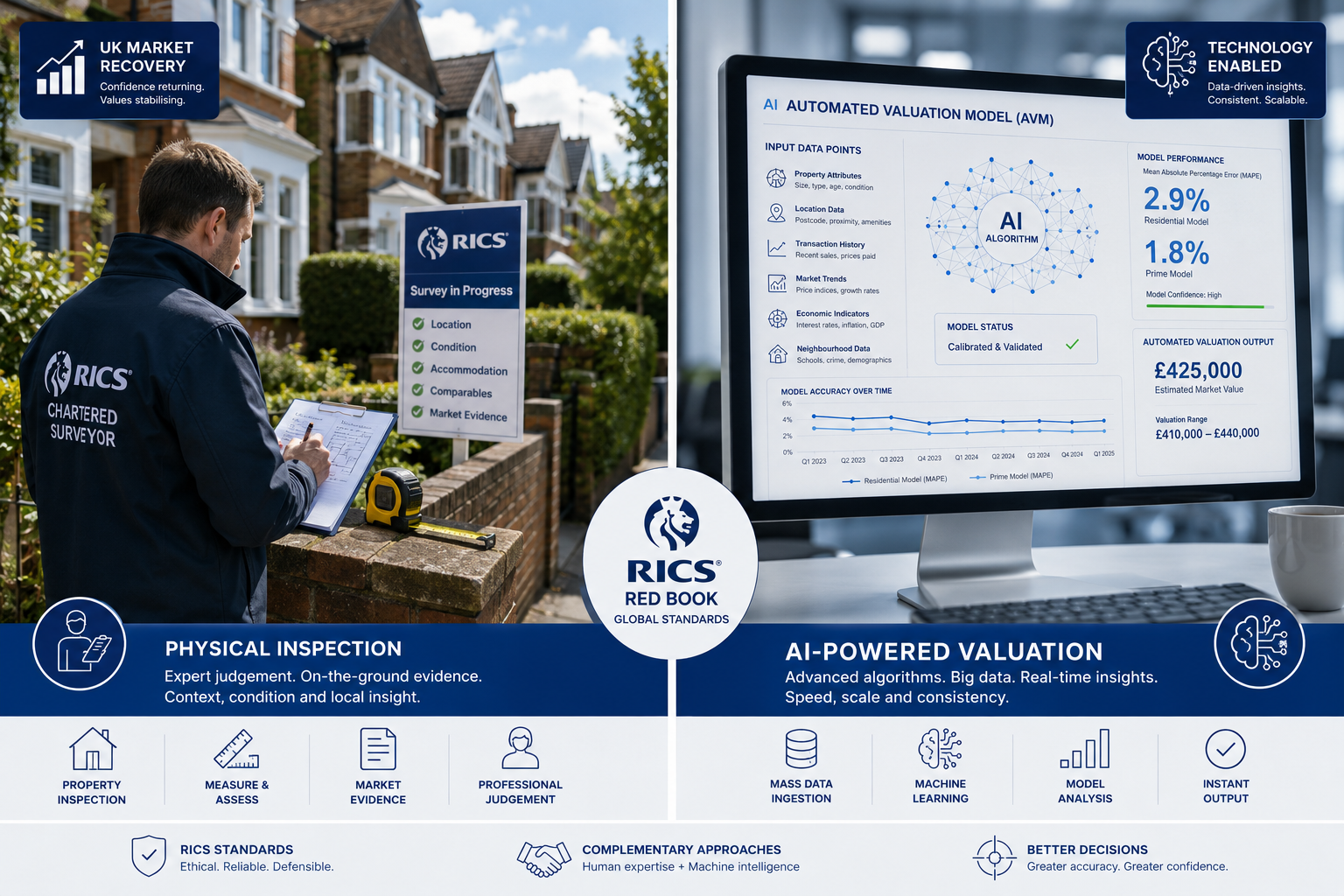
- Modern AI AVMs can achieve median error rates as low as 1.8%, but each carries critical blind spots that manual valuers are uniquely positioned to identify [4]
- The RICS Red Book Global Standards have been updated to address automation and AI integration, setting the compliance baseline for expert witness testimony [5]
- In recovery markets, rapidly shifting comparables and thin transaction volumes expose AVM limitations most acutely, strengthening the case for manual oversight
- A structured evidence strategy — combining methodology transparency, comparable selection rationale, and RICS Red Book compliance — is the cornerstone of expert witness credibility
Why 2026 Recovery Markets Create a Perfect Storm for Valuation Disputes
Property markets recovering from correction cycles share a defining characteristic: transaction volumes are low, price movements are uneven across micro-locations, and historical data — the backbone of any AVM — lags behind real-time conditions. This is precisely the environment in which automated valuation models are most likely to produce figures that diverge significantly from what a qualified surveyor observes on the ground.
In a stable, high-volume market, an AVM trained on large datasets can perform impressively. ATTOM's AI-powered AVM, launched in May 2026 and built on over 30 years of property intelligence across 98 million US properties, reports a median error rate of 2.9% [3]. Some contemporary models have achieved median accuracy rates as low as 1.8% [4]. These are genuinely impressive figures under normal market conditions.
Recovery markets, however, are not normal. Consider the following dynamics that undermine AVM reliability in 2026:
| Market Condition | AVM Vulnerability | Manual Valuer Advantage |
|---|---|---|
| Low transaction volume | Sparse comparables distort algorithms | Surveyor can weight and adjust limited evidence |
| Rapid price movement | Training data lags current pricing | On-site inspection captures real-time signals |
| Uneven micro-location recovery | Postcode-level data masks street-level variation | Local knowledge identifies genuine comparables |
| Distressed or atypical stock | Algorithm cannot assess condition or unique features | Physical inspection reveals material factors |
| Regulatory or planning changes | Data feeds may not reflect new policy impacts | Surveyor integrates current property market legislation changes |
RICS has consistently noted that while AVMs offer genuine speed and cost benefits, they lack the nuanced understanding of property conditions and unique features that human valuers provide [2]. In a recovery market, those nuances are not marginal — they can represent tens or hundreds of thousands of pounds in valuation difference.
Understanding RICS Guidance on AI and AVM Integration
RICS has not taken an adversarial position toward AI or automated valuation tools. The institution's framework is one of responsible integration, not prohibition. Understanding this distinction is essential for any surveyor preparing to defend a manual valuation in a dispute context.
The RICS guidance on AI in real estate valuation emphasises three core principles: professional judgment, transparency, and accountability [1]. These principles do not disappear when an AVM is involved — they become more demanding, because the surveyor must be able to explain not only what the AVM produced but why they accepted, modified, or rejected that output.
The RICS Red Book position
The RICS Red Book Global Standards have been updated to address the integration of automation and AI in valuations [5]. The updated standards make clear that:
- Any valuation must comply with professional standards regardless of the tools used
- The application of professional judgment by a qualified valuer is mandatory
- Transparency about methodology — including any AI or AVM inputs — is required [7]
What this means for expert witnesses
When a surveyor appears as an expert witness, the court or tribunal is not simply asking for a number. It is asking for a reasoned, defensible opinion formed by a qualified professional. RICS is explicit that AVMs can support valuations but cannot replace the valuation process, particularly in complex cases [6]. A valuation that defers entirely to an AVM output, without documented professional oversight, is vulnerable to challenge on RICS compliance grounds alone.
This is a significant point. An opposing party's legal team that understands RICS guidance can argue that an AVM-only valuation fails the professional standards test — regardless of the AVM's technical accuracy. Conversely, a surveyor defending a manual valuation can anchor their credibility directly to Red Book compliance and the responsible AI use framework.
Building an Evidence Strategy: Defending Manual Valuations vs AI AVMs in 2026 Recovery Markets
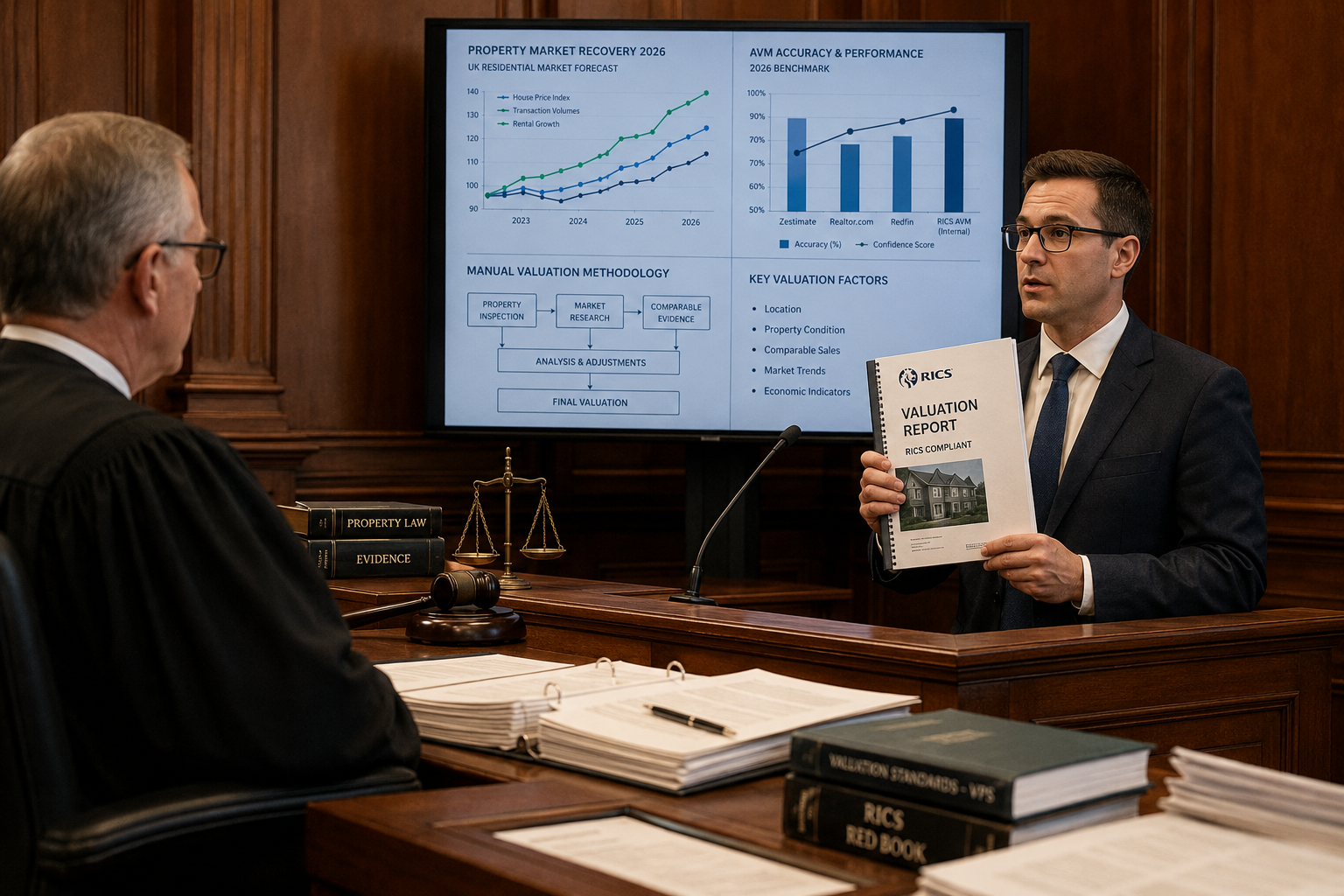
Defending manual valuations vs AI AVMs in 2026 recovery markets requires a proactive evidence strategy assembled before the dispute hearing, not improvised during cross-examination. The following framework draws on RICS guidance for expert witness credibility and current best practice.
Step 1: Document the Methodology Comprehensively
The single most effective defence against an AVM-based challenge is a valuation report that leaves no methodological gap unexplained. This means:
- Comparable selection rationale: Explain why each comparable was chosen, adjusted, or excluded. In a thin recovery market, this is especially important where the AVM may have used comparables from a different market phase.
- Inspection findings: Record all material factors observed during the physical inspection that would not appear in any dataset — condition, layout, access, environmental factors, and any defects identified. An independent property valuation derives its authority precisely from this on-the-ground evidence base.
- Market conditions analysis: Document the specific recovery-phase dynamics affecting the subject property's micro-location at the date of valuation.
- AVM cross-reference (where used): If an AVM was consulted, record the output, note any divergence from the manual opinion, and explain the professional judgment applied to reconcile or override it.
Step 2: Anchor to RICS Red Book Compliance
Every expert witness report should contain an explicit statement of RICS Red Book compliance. This is not boilerplate — it is a substantive claim that the valuation meets the professional standard against which courts and tribunals measure credibility. The updated Red Book standards addressing AI integration [5] mean that a 2026 valuation report should also address how AI tools were or were not used, and why.
Step 3: Identify and Articulate AVM Limitations Specific to the Subject Property
A powerful element of expert witness testimony is the ability to demonstrate, with specificity, why an AVM would produce an unreliable figure for this particular property in this particular market. Consider:
- Data quality issues: RICS highlights that AVM effectiveness is heavily dependent on the quality of data they are trained on, and that incomplete or biased data can lead to inaccurate valuations [2]. In a recovery market with sparse recent transactions, this risk is amplified.
- Property-specific factors: Unusual tenure, access rights, structural issues, or planning constraints that an algorithm cannot assess. For properties with complex physical characteristics, a commercial valuation or specialist assessment adds a layer of credibility that no AVM can replicate.
- Temporal mismatch: Show that the AVM's training data predates the recovery upturn, making its output a reflection of a different market phase.
Step 4: Address the AVM's Output Directly
Ignoring an opposing AVM figure is a tactical error. Courts expect expert witnesses to engage with all material evidence. The preferred approach is to:
- Acknowledge the AVM's technical capabilities and published accuracy metrics
- Demonstrate why those general accuracy metrics do not apply to the specific property and market context
- Show the specific adjustments a qualified surveyor makes that no algorithm currently replicates
"RICS mandates that any valuation, including those supported by AVMs, must comply with professional standards and be subject to the application of professional judgment by a qualified valuer." [7]
This quotation, properly sourced to RICS guidance, is a legitimate and powerful tool in expert witness testimony. It reframes the debate: the question is not whether the AVM is technically capable, but whether it meets the professional standard required for the purpose.
The Specific Contexts Where Manual Valuations Are Most Defensible
RICS guidance identifies high-risk valuation activities where professional oversight is not merely preferable but essential [2]. These include:
- Valuations informing lending decisions — mortgage security valuations where an AVM error directly affects credit risk
- Legal disputes — litigation, arbitration, and tribunal proceedings where the valuation is contested evidence
- Investment decisions — where material reliance on a valuation figure creates fiduciary or professional liability
For capital gains tax valuations, right to buy valuations, and insurance reinstatement cost valuations, the stakes of an inaccurate figure are immediate and quantifiable. In each of these contexts, the manual valuer's ability to inspect, assess, and apply professional judgment is not a legacy practice — it is the professional standard.
Recovery markets add a further dimension. When prices are moving quickly and transaction evidence is thin, the key factors examined during a property valuation — location micro-factors, physical condition, comparable selection — require the kind of real-time, on-the-ground assessment that no algorithm currently delivers with consistent reliability.
Practical Guidance for Surveyors Preparing Expert Witness Reports in 2026
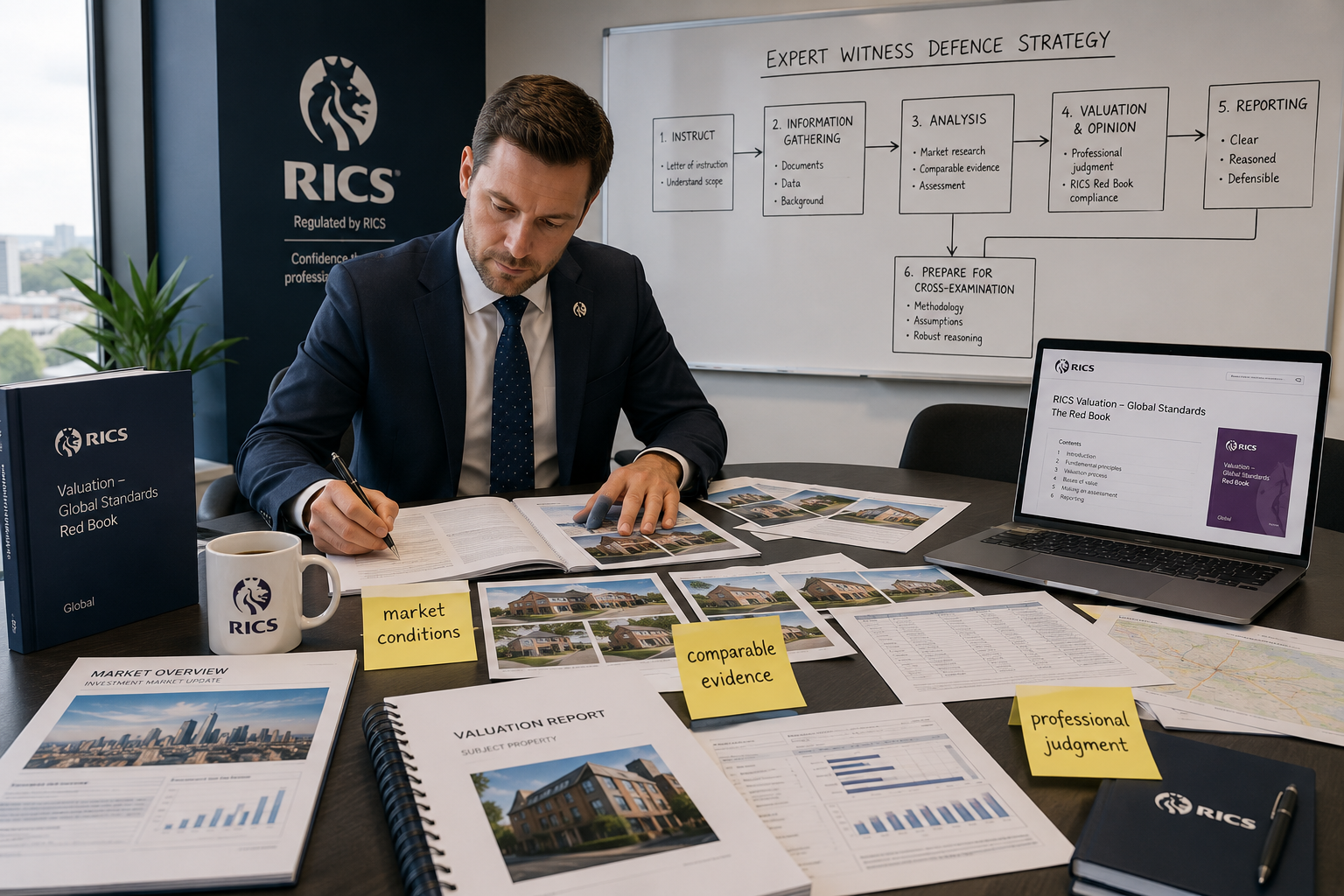
The following checklist reflects current RICS guidance and best practice for surveyors defending manual valuations in dispute contexts during 2026:
Report structure and content
- State the purpose of the valuation and the basis of value clearly
- Confirm RICS Red Book compliance and identify the applicable standards
- Disclose any AI or AVM tools consulted and the professional judgment applied
- Provide a detailed comparable evidence schedule with adjustment rationale
- Include a section addressing market conditions at the date of valuation
Expert witness conduct
- Maintain independence — the duty is to the court, not the instructing party
- Be prepared to explain and defend every methodological choice
- Anticipate AVM-based challenges and address them proactively in the report
- Avoid overstating certainty; a well-reasoned opinion with acknowledged limitations is more credible than an unqualified assertion
Staying current with RICS guidance
- Monitor updates to the RICS Red Book Global Standards [5]
- Engage with RICS responsible AI use guidance as it evolves [1]
- Participate in CPD covering AI and AVM developments in the valuation profession
The property market's increasing adoption of AVMs for speed and cost efficiency [6] means that surveyors who cannot articulate the limitations of these tools — and the value of their own professional judgment — will face growing challenges in dispute contexts. The answer is not to dismiss AI but to demonstrate mastery of both the tools and their boundaries.
Conclusion
Defending manual valuations vs AI AVMs in 2026 recovery markets is not a rearguard action against technological progress. It is a professional responsibility grounded in RICS guidance for expert witness credibility. The evidence is clear: modern AVMs are powerful, increasingly accurate, and genuinely useful in many valuation contexts. They are also structurally limited in precisely the conditions that define a recovery market — thin transaction volumes, rapid price movement, and property-specific factors that no dataset fully captures.
RICS guidance provides a robust framework for surveyors navigating this landscape. The Red Book standards, the responsible AI use principles, and the explicit requirement for professional judgment in high-stakes valuations collectively create a strong foundation for expert witness credibility. The surveyor who understands this framework, documents their methodology rigorously, and engages directly with AVM outputs rather than ignoring them will be well-positioned in any dispute context.
Actionable next steps for surveyors:
- Review your current report templates against the updated RICS Red Book standards and ensure AI/AVM disclosure is addressed
- Build a recovery-market comparable evidence library for your practice areas, documenting the market conditions context at each valuation date
- Develop a standard methodology section that explains the professional judgment applied when AVM outputs are consulted or rejected
- Seek CPD specifically covering AI in valuation and expert witness best practice under current RICS guidance
- For complex or high-value instructions, consider whether specialist input — such as a property development valuation — adds a layer of evidential robustness that strengthens the overall opinion
The 2026 recovery market is creating both opportunity and risk for property professionals. Those who can defend their valuations with clarity, evidence, and RICS-compliant methodology will not only survive cross-examination — they will define the professional standard.
References
[1] Ai In Real Estate Valuation – rics.org
[2] Ruai Case Studies 02 – rics.org
[3] Attom Launches Ai Powered Avm Built On 30 Years Of Property Intelligence – attomdata.com
[4] Property Valuation Ai Accuracy Vs Manual – get-scala.com
[5] Red Book Global – rics.org
[6] Automated Valuation Models A Property Market Perspective – rics.org
[7] Ai Or Automated Valuation Model – community.rics.org