

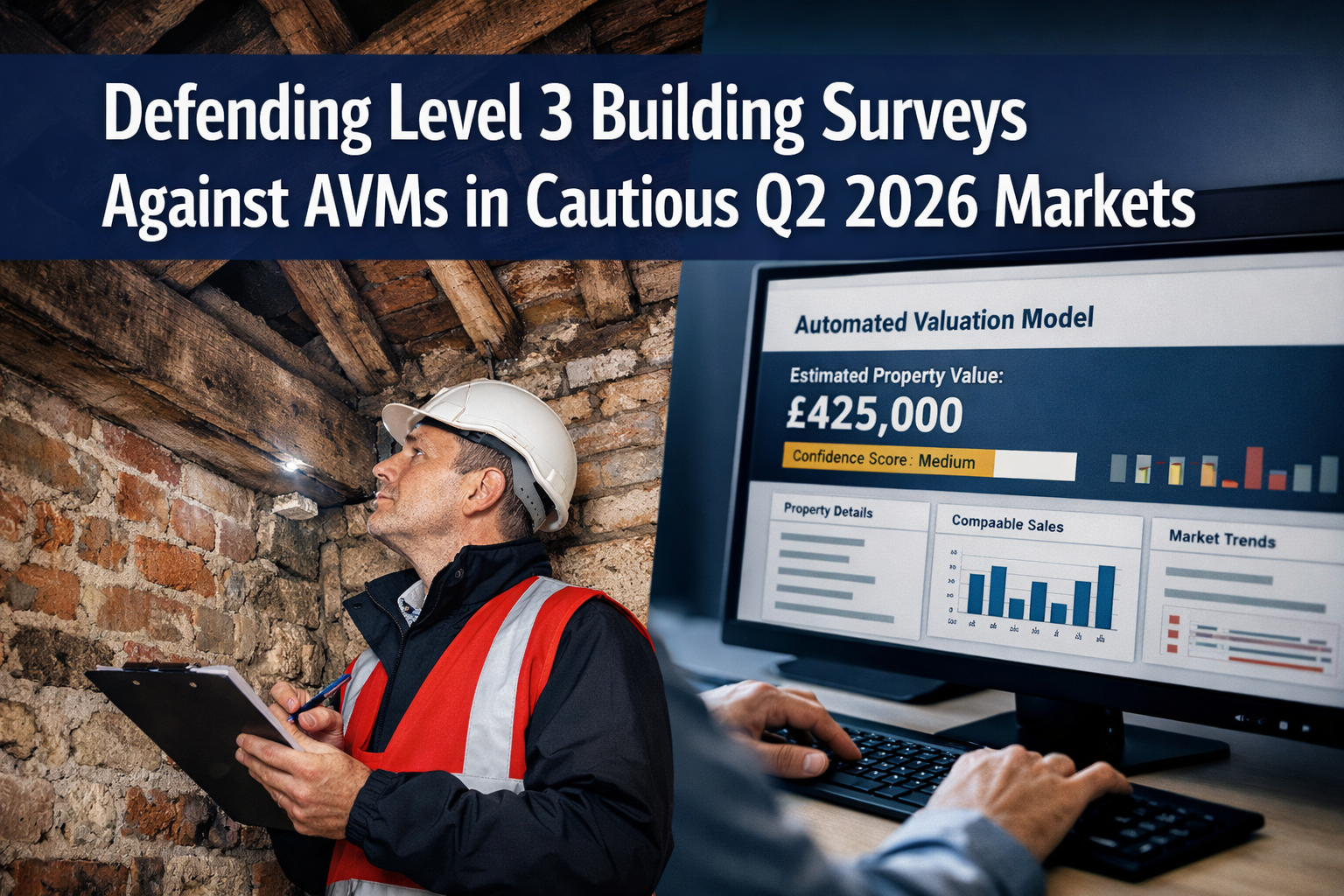
February 2026 RICS survey data reveals a stark reality: geopolitical uncertainty has frozen UK property prices while buyer caution reaches unprecedented levels[3]. In this climate where one in five construction firms never measure productivity and no single assessment method commands more than 30% adoption, the battle between human expertise and automated valuation models (AVMs) has never been more critical for property professionals.
As we navigate Q2 2026, defending Level 3 Building Surveys against AVMs in cautious Q2 2026 markets requires chartered surveyors to articulate their irreplaceable value proposition. While algorithms promise speed and cost savings, they fundamentally cannot replicate the nuanced, context-aware analysis that protects buyers from catastrophic purchasing decisions in uncertain economic conditions.
Key Takeaways
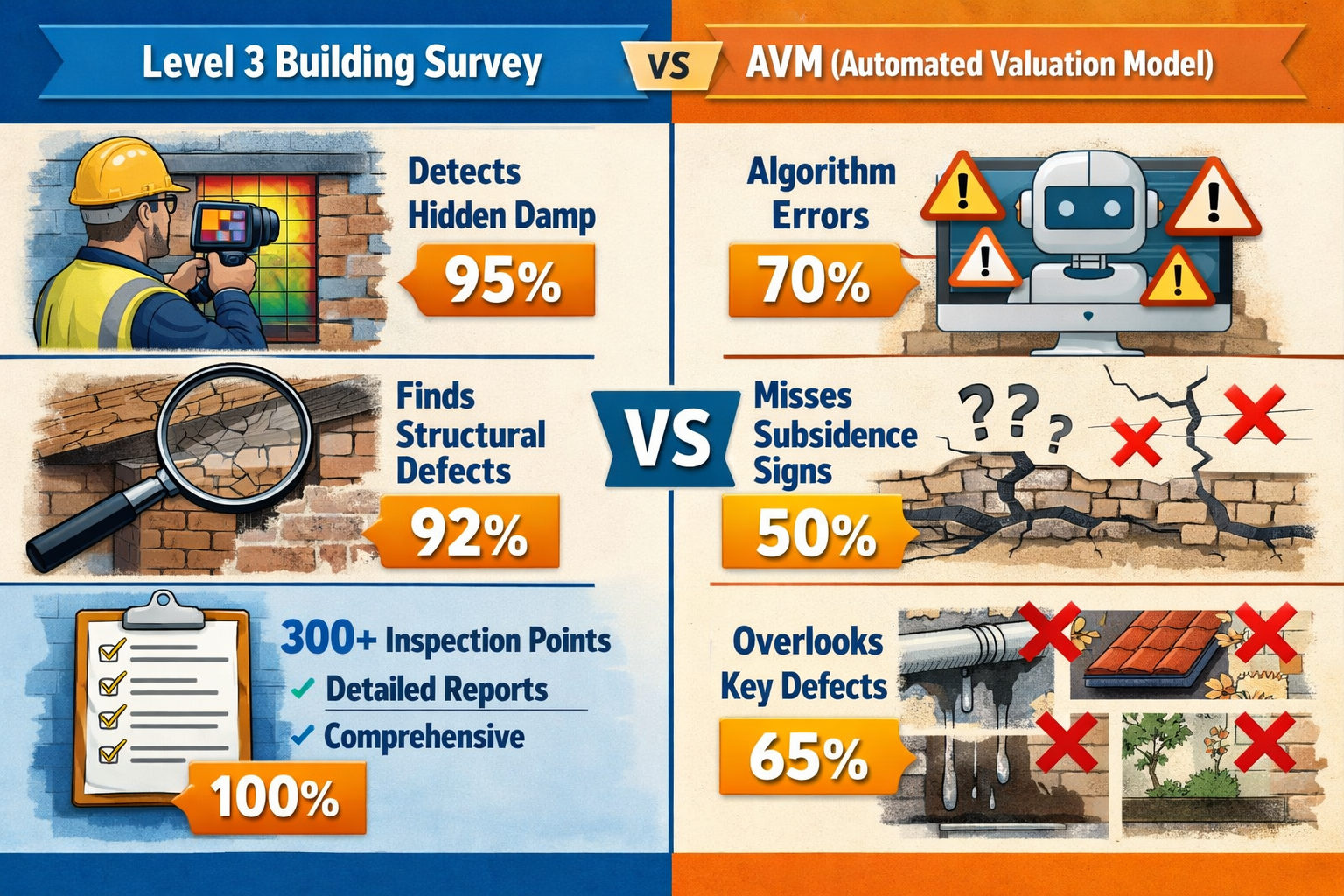
- Human expertise trumps algorithms: Level 3 surveys detect hidden defects that AVMs systematically miss, protecting buyers from properties with subsidence, damp, and structural issues worth tens of thousands in repairs
- Market caution demands thoroughness: Q2 2026's geopolitical uncertainty makes comprehensive property assessments essential, with buyers requiring detailed risk analysis that only chartered surveyors provide
- RICS standards evolve: Enhanced 2026 inspection requirements deliver substantially more thorough examinations specifically designed to uncover hidden issues[1]
- AVMs create false confidence: Automated models rely on comparable sales data and cannot assess actual property condition, leading to overvaluations in cautious markets
- Professional surveys offer negotiation power: Detailed defect reports enable buyers to renegotiate prices or withdraw from problematic purchases, saving average reductions of £15,000-£25,000
Understanding the AVM Threat to Professional Building Surveys
Automated Valuation Models have gained traction in recent years, promising instant property valuations at a fraction of traditional survey costs. These computer algorithms analyze comparable sales data, property characteristics, and market trends to generate price estimates within seconds. Lenders and online property platforms have embraced AVMs for their efficiency and scalability.
However, the fundamental limitation remains unchanged: AVMs cannot physically inspect properties. They operate entirely on historical transaction data, postcode analysis, and basic property attributes like square footage and bedroom count. This creates a dangerous knowledge gap in cautious markets where property condition directly impacts value.
What AVMs Cannot Detect
The limitations of automated systems become glaringly apparent when compared to comprehensive Level 3 building surveys:
- 🏚️ Structural defects: Subsidence, settlement cracks, roof timber decay, wall tie failure
- 💧 Hidden moisture issues: Rising damp, penetrating damp, condensation problems, concealed leaks
- 🪲 Pest infestations: Woodworm, dry rot, wet rot in concealed timbers
- ⚡ Building services failures: Outdated electrical systems, defective plumbing, heating inefficiencies
- 🧱 Construction defects: Poor workmanship, non-compliant alterations, dangerous materials
- 📋 Regulatory non-compliance: Building regulation breaches, planning permission issues, fire safety defects
A property valued at £500,000 by an AVM might require £75,000 in structural repairs—information only discoverable through physical inspection by qualified professionals. In Q2 2026's cautious market environment, this discrepancy represents unacceptable risk for buyers.
The False Economy of Cheap Valuations
Property buyers facing tight budgets often view AVMs as cost-effective alternatives to professional surveys. A typical AVM report costs £50-£150, while a Level 3 full building survey ranges from £800-£1,500 depending on property size and complexity.
This apparent saving evaporates when hidden defects emerge post-purchase. Consider these real-world scenarios from Q2 2026:
| Defect Type | AVM Detection | Level 3 Detection | Average Repair Cost |
|---|---|---|---|
| Subsidence | ❌ Not detected | ✅ Identified with monitoring recommendations | £15,000-£50,000 |
| Roof timber decay | ❌ Not detected | ✅ Detected via loft inspection | £8,000-£25,000 |
| Rising damp | ❌ Not detected | ✅ Identified with moisture meter readings | £3,000-£12,000 |
| Electrical rewiring needed | ❌ Not detected | ✅ Flagged as urgent safety concern | £5,000-£10,000 |
| Defective drainage | ❌ Not detected | ✅ Identified through external inspection | £2,000-£8,000 |
The mathematics are compelling: spending £1,200 on a professional survey that identifies £30,000 in previously unknown defects delivers a 2,400% return on investment through price renegotiation or purchase withdrawal.
Defending Level 3 Building Surveys Against AVMs in Cautious Q2 2026 Markets: The RICS Quality Advantage
The Royal Institution of Chartered Surveyors has responded to market challenges with enhanced standards for 2026. These updates reflect the profession's commitment to delivering substantially more thorough examinations specifically designed to uncover hidden issues that threaten property transactions[1].
Enhanced 2026 RICS Building Survey Standards
Professional surveyors operating under RICS guidance now provide:
Expanded inspection scope: Modern Level 3 surveys examine over 300 individual building elements, from foundation indicators to roof coverings. This comprehensive approach contrasts sharply with AVMs' reliance on external characteristics and comparable sales data.
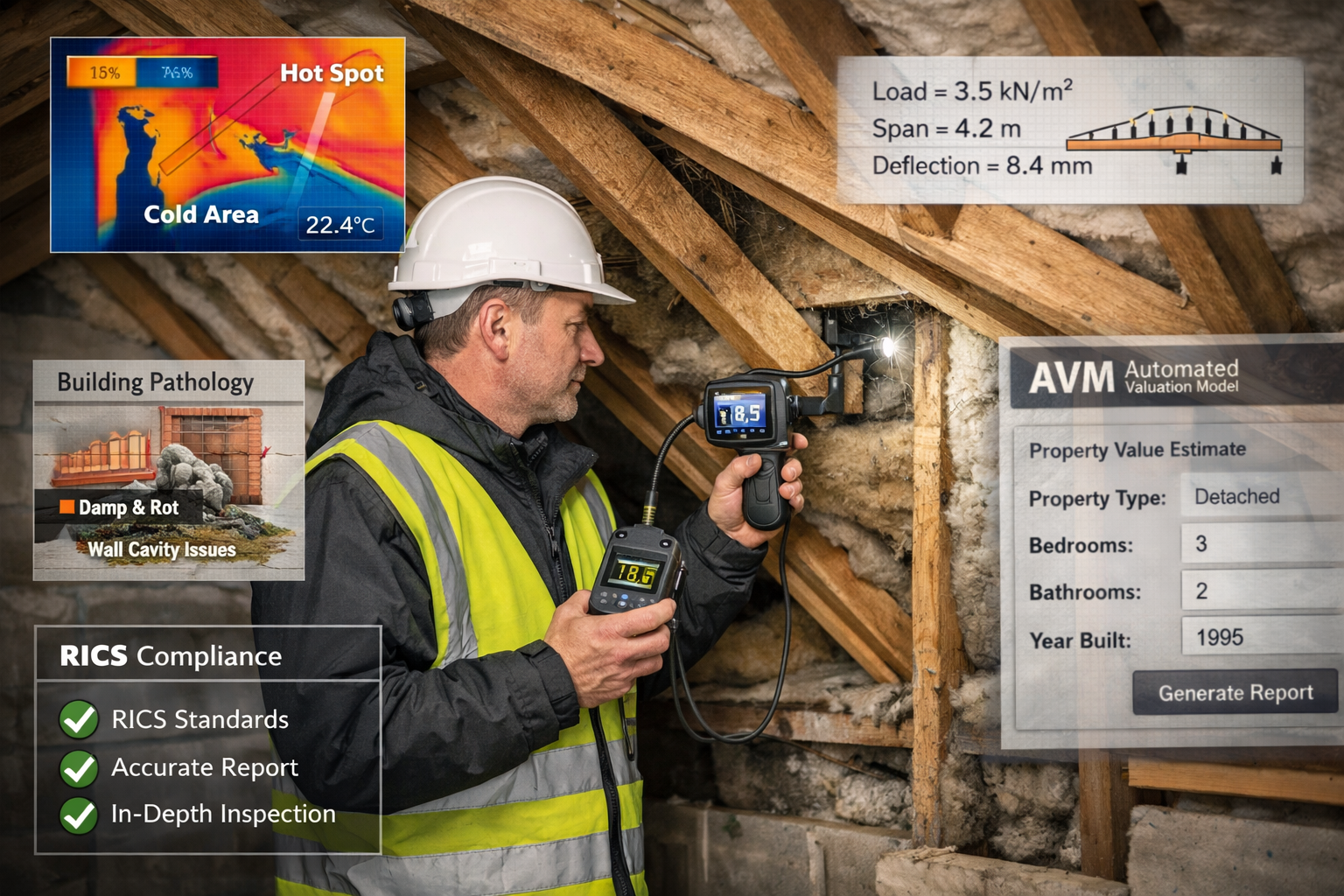
Advanced diagnostic technology: Chartered surveyors employ thermal imaging cameras, moisture meters, borescopes, and other specialist equipment to detect concealed defects. These tools reveal problems invisible to both the naked eye and algorithmic analysis.
Context-aware assessment: Experienced surveyors understand how building age, construction type, local geology, and maintenance history interact to create specific risk profiles. A Victorian terrace in clay soil areas requires different scrutiny than a 1990s detached house—nuance that AVMs cannot replicate.
Regulatory compliance verification: Building regulation compliance testing forms a critical component of modern surveys, identifying alterations completed without proper approval or certification.
Building Pathology Expertise
The science of building pathology represents perhaps the clearest distinction between human expertise and automated systems. Chartered surveyors trained in pathology can:
- Diagnose the root causes of defects, not merely symptoms
- Distinguish between cosmetic issues and serious structural concerns
- Predict future deterioration patterns based on current condition
- Recommend proportionate remedial strategies with cost estimates
- Identify interdependencies between multiple defects
"An algorithm can tell you a property's estimated value based on comparables. Only a chartered surveyor can tell you whether that property will still be standing in five years without major intervention." — RICS Building Survey Specialist, 2026
This expertise proves invaluable when defending Level 3 Building Surveys against AVMs in cautious Q2 2026 markets where buyers demand certainty before committing to purchases.
Maintenance Planning and Long-Term Value
Professional surveys extend beyond immediate defect identification to provide strategic maintenance planning guidance. Surveyors categorize issues by urgency:
- Urgent (immediate action required): Safety hazards, active water ingress, structural instability
- Short-term (within 12 months): Deteriorating elements requiring prompt attention to prevent escalation
- Medium-term (1-5 years): Planned maintenance items for budgeting purposes
- Long-term (5+ years): Lifecycle replacement considerations for major building components
This forward-looking approach helps buyers understand total cost of ownership—information completely absent from AVM reports. Understanding building survey timeframes allows buyers to plan inspections strategically within transaction schedules.
Q2 2026 Market Caution: Why Buyers Need Human Expertise More Than Ever
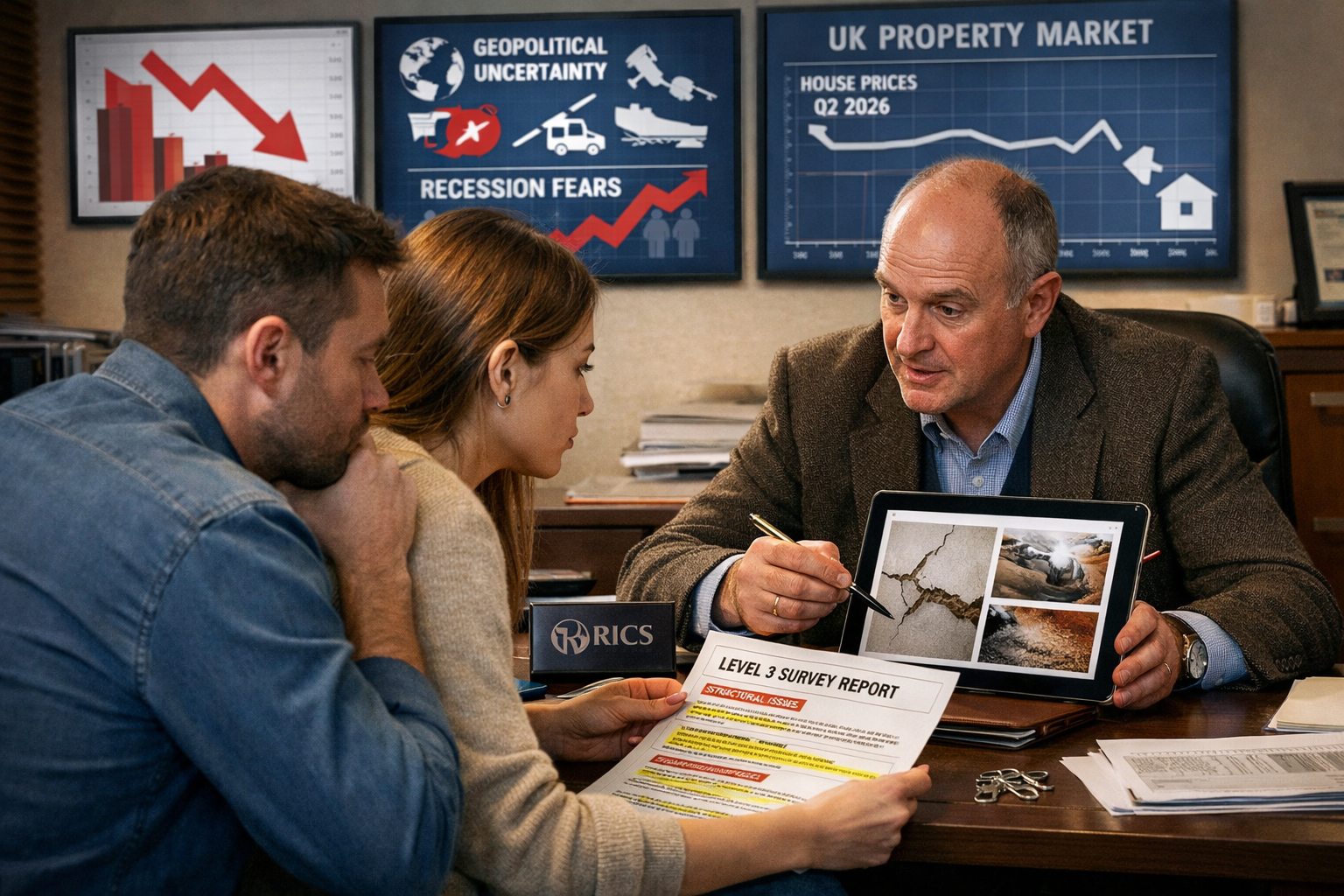
The geopolitical landscape of early 2026 has created unprecedented buyer caution in UK property markets. RICS data from February 2026 shows flat price growth and heightened uncertainty among both buyers and sellers[3]. This environment fundamentally changes the risk calculation for property transactions.
The Psychology of Cautious Markets
When buyers feel uncertain about economic stability, employment security, or future property values, they naturally become more risk-averse. Thorough due diligence transforms from optional extra to essential requirement. In this context, the comprehensive assurance provided by Level 3 surveys becomes psychologically valuable beyond the technical information delivered.
Buyers in Q2 2026 are asking different questions:
- "What could go wrong with this property?"
- "How much will I need to spend beyond the purchase price?"
- "Are there hidden problems that justify walking away?"
- "Can I use survey findings to negotiate a better price?"
AVMs cannot answer these questions. They provide a number—a valuation estimate—without context, caveats, or actionable intelligence. Professional surveys deliver detailed narratives that address buyer concerns directly.
Proposed Homebuying Reforms and Survey Timing
The proposed shift to mandatory upfront property condition assessments represents a significant change to the UK homebuying process[2]. While implementation details remain under discussion in Q2 2026, the direction is clear: comprehensive property condition information will move earlier in transactions.
This reform recognizes what professional surveyors have long advocated: early identification of defects prevents wasted time, aborted transactions, and buyer disappointment. When defending Level 3 Building Surveys against AVMs in cautious Q2 2026 markets, this regulatory trend provides powerful validation of the professional survey model.
Regional Variations and Local Knowledge
Another critical advantage of chartered surveyors over automated systems lies in local expertise. Different regions face distinct property challenges:
- London and Southeast: Subsidence in clay soil areas, Victorian property defects, complex lease arrangements
- Northern regions: Stone property maintenance, cavity wall insulation issues, mining subsidence legacy
- Coastal areas: Salt damage, flood risk, accelerated weathering of building materials
- Rural locations: Septic tank systems, agricultural building conversions, access and services challenges
Professional surveyors understand these regional patterns and adjust their inspection focus accordingly. AVMs apply uniform algorithms regardless of local conditions, missing critical context that affects property condition and value.
Articulating Value: How Surveyors Can Defend Their Professional Role
With AVMs aggressively marketed as modern alternatives to traditional surveys, chartered surveyors must clearly communicate their unique value proposition. This requires both technical excellence and effective client education.
The Communication Challenge
Many property buyers lack the technical knowledge to distinguish between an AVM valuation and a professional building survey. They may genuinely believe these services are interchangeable, differing only in price. Education becomes essential to defending professional surveys in competitive markets.
Effective communication strategies include:
Clear service differentiation: Explain that AVMs provide estimated market value only, while Level 3 surveys assess physical condition, identify defects, estimate repair costs, and provide maintenance guidance. These are fundamentally different services addressing different needs.
Visual evidence: Modern survey reports incorporate extensive photography, thermal imaging, and annotated diagrams that make defects tangible to non-technical clients. This visual documentation demonstrates value in ways that AVM algorithms cannot match.
Case study examples: Sharing anonymized examples of properties where surveys identified major defects missed by initial valuations helps buyers understand real-world implications. Stories resonate more powerfully than abstract explanations.
Cost-benefit analysis: Presenting the mathematics of survey investment versus potential repair costs frames the decision in financial terms buyers understand. A £1,200 survey that saves £25,000 through price renegotiation is an obvious bargain.
Leveraging RICS Credibility
The RICS brand carries significant weight in UK property markets. Chartered surveyors should emphasize their professional qualifications, ongoing training requirements, and regulatory oversight as distinguishing factors from unregulated automated systems.
Key credibility markers include:
- ✅ RICS membership and chartership demonstrating rigorous qualification standards
- ✅ Professional indemnity insurance protecting clients against negligent advice
- ✅ Continuing Professional Development ensuring current knowledge of building technology and regulations
- ✅ Ethical standards and complaints procedures providing client recourse
- ✅ Specialist expertise in areas like construction law advice when disputes arise
These professional safeguards simply don't exist for automated valuation systems, which operate without regulatory oversight or accountability for errors.
Addressing the Speed Argument
One legitimate advantage AVMs offer is instant results. Buyers receive valuations within minutes rather than waiting days for survey appointments and report preparation. Surveyors can counter this by:
Streamlining scheduling: Offering flexible appointment times, including evenings and weekends, reduces delays in transaction timelines.
Rapid report turnaround: Modern survey software enables faster report production without compromising quality. Many firms now deliver comprehensive reports within 48 hours of inspection.
Preliminary findings: Providing verbal feedback immediately after inspection gives buyers urgent information while awaiting the detailed written report.
Realistic timeframe education: Explaining that a few extra days for proper inspection represents minimal delay in a transaction typically spanning 8-12 weeks helps contextualize the timeline.
Understanding which building survey you need helps buyers make informed decisions about survey level and associated timeframes.
The Technology Integration Opportunity
Rather than viewing technology as a threat, forward-thinking surveyors are integrating advanced tools to enhance their service delivery. This positions professional surveys as technologically sophisticated rather than outdated.
Modern surveying technology includes:
- 📷 High-resolution photography documenting every defect with precise location references
- 🌡️ Thermal imaging revealing hidden moisture, insulation defects, and air leakage
- 📊 Moisture mapping creating visual representations of damp distribution
- 🎥 Borescope cameras inspecting concealed spaces without destructive opening-up
- 📱 Cloud-based reporting enabling real-time updates and client portal access
- 🗺️ 3D modeling for complex properties requiring detailed spatial analysis
This technology-enhanced approach delivers the speed and visual appeal of digital solutions while maintaining the irreplaceable element of professional judgment.
Practical Strategies for Defending Professional Surveys
1. Educate Early in the Transaction Process
Engage with buyers before they commit to purchase decisions. Many buyers only consider surveys after making offers, when pressure to minimize costs intensifies. Early education about the risks of inadequate property assessment creates demand for professional surveys.
Strategies include:
- Publishing educational content comparing Level 2 vs Level 3 surveys
- Partnering with estate agents to include survey information in property marketing materials
- Offering free initial consultations to discuss appropriate survey levels
- Creating buyer guides explaining common defects and their financial implications
2. Demonstrate Negotiation Power
One of the most compelling arguments for professional surveys is their impact on purchase price negotiations. Detailed defect reports provide objective evidence supporting price reduction requests.
Research shows that properties with significant defects identified in surveys typically achieve price reductions averaging £15,000-£25,000. This negotiation leverage alone often exceeds survey costs by 10-20 times. Understanding average price reductions after surveys helps buyers appreciate this benefit.
3. Highlight Lender Requirements
While some lenders accept AVMs for valuation purposes, they increasingly require independent condition assessments for older properties, non-standard construction, or higher-value mortgages. Surveyors should clearly communicate when professional surveys are mandatory rather than optional.
4. Offer Flexible Service Tiers
Not every buyer needs the most comprehensive survey level. By offering different survey types tailored to property characteristics and buyer risk tolerance, surveyors can compete more effectively on price while maintaining professional standards.
5. Build Relationships with Conveyancers and Mortgage Brokers
These professionals influence buyer decisions at critical moments. Regular communication, educational seminars, and referral partnerships ensure surveyors remain top-of-mind when clients need property assessment advice.
The Future of Building Surveys in an Automated World
As we progress through 2026 and beyond, the relationship between human expertise and automated systems will continue evolving. Rather than viewing this as an existential threat, professional surveyors should recognize opportunities to enhance their value proposition through strategic adaptation.
Hybrid Models Emerging
Some progressive firms are developing hybrid assessment models that combine AVM data with targeted professional inspection. This approach uses algorithms to identify properties requiring enhanced scrutiny while applying human expertise where it delivers maximum value.
For example, AVMs might flag properties with unusual price-to-condition ratios, triggering recommendations for comprehensive Level 3 surveys. This data-driven triage helps buyers allocate resources efficiently while ensuring high-risk properties receive appropriate professional attention.
Specialization as Competitive Advantage
As basic valuation services become increasingly commoditized, surveyors can differentiate through specialized expertise in complex property types:
- Historic and listed buildings requiring conservation knowledge
- Non-standard construction (timber frame, steel frame, concrete systems)
- Properties with known defect patterns (concrete cancer, pyrite contamination)
- Commercial-to-residential conversions
- Properties in high-risk locations (flood zones, subsidence areas, coastal erosion)
These specialized assessments require deep technical knowledge that algorithms cannot replicate, creating defensible market niches.
Professional Standards as Market Differentiator
The construction industry's productivity challenges highlighted in the RICS Construction Productivity Report 2026 reveal significant measurement fragmentation, with one in five UK firms never measuring productivity[3]. This lack of standardization creates quality concerns that professional surveyors can address through rigorous adherence to RICS standards.
By consistently delivering high-quality, standardized assessments, chartered surveyors build reputations that transcend price competition. Buyers seeking certainty in uncertain markets will pay premiums for proven reliability.
Conclusion: Human Expertise Remains Irreplaceable in Cautious Markets
Defending Level 3 Building Surveys against AVMs in cautious Q2 2026 markets requires chartered surveyors to articulate their unique value with clarity and confidence. While automated systems offer speed and low cost, they fundamentally cannot replicate the comprehensive, context-aware analysis that protects buyers from catastrophic purchasing decisions.
The geopolitical uncertainty and market caution characterizing Q2 2026 actually strengthens the case for professional surveys. When buyers feel uncertain about broader economic conditions, thorough property due diligence becomes psychologically essential. The detailed assurance provided by RICS-qualified surveyors addresses this need in ways that algorithms never can.
Key Action Steps for Surveyors
To effectively defend professional surveys in competitive markets:
- Educate buyers early about the fundamental differences between valuations and condition assessments
- Leverage RICS credibility and professional standards as quality differentiators
- Demonstrate financial value through negotiation power and defect cost analysis
- Integrate technology to enhance service delivery without sacrificing professional judgment
- Specialize strategically in complex property types requiring deep expertise
- Build referral networks with conveyancers, mortgage brokers, and estate agents
- Communicate visually using photography, thermal imaging, and annotated diagrams
The Path Forward
The proposed homebuying reforms emphasizing upfront property condition assessments validate the professional survey model[2]. As these changes progress through 2026 and beyond, chartered surveyors are positioned to play increasingly central roles in property transactions.
Rather than viewing AVMs as existential threats, professional surveyors should recognize them as complementary tools that handle basic valuation tasks while highlighting properties requiring expert human assessment. This division of labor allows surveyors to focus their expertise where it delivers maximum value.
For buyers navigating cautious Q2 2026 markets, the choice is clear: algorithmic estimates provide numbers, but professional surveys provide knowledge, protection, and peace of mind. In uncertain times, that human expertise remains irreplaceable.
Ready to protect your property investment with a comprehensive Level 3 survey? Contact RICS-qualified chartered surveyors who understand the nuances of 2026 market conditions and deliver the thorough assessments that automated systems simply cannot match.
References
[1] Building Survey Quality Standards 2026 Navigating Rics Updates And Enhanced Home Inspection Requirements – nottinghillsurveyors.com
[2] Homebuying Process Reforms 2026 Impact On Early Building Surveys And Valuation Timing – nottinghillsurveyors.com
[3] Rics Construction Productivity Report 2026 – rics.org