

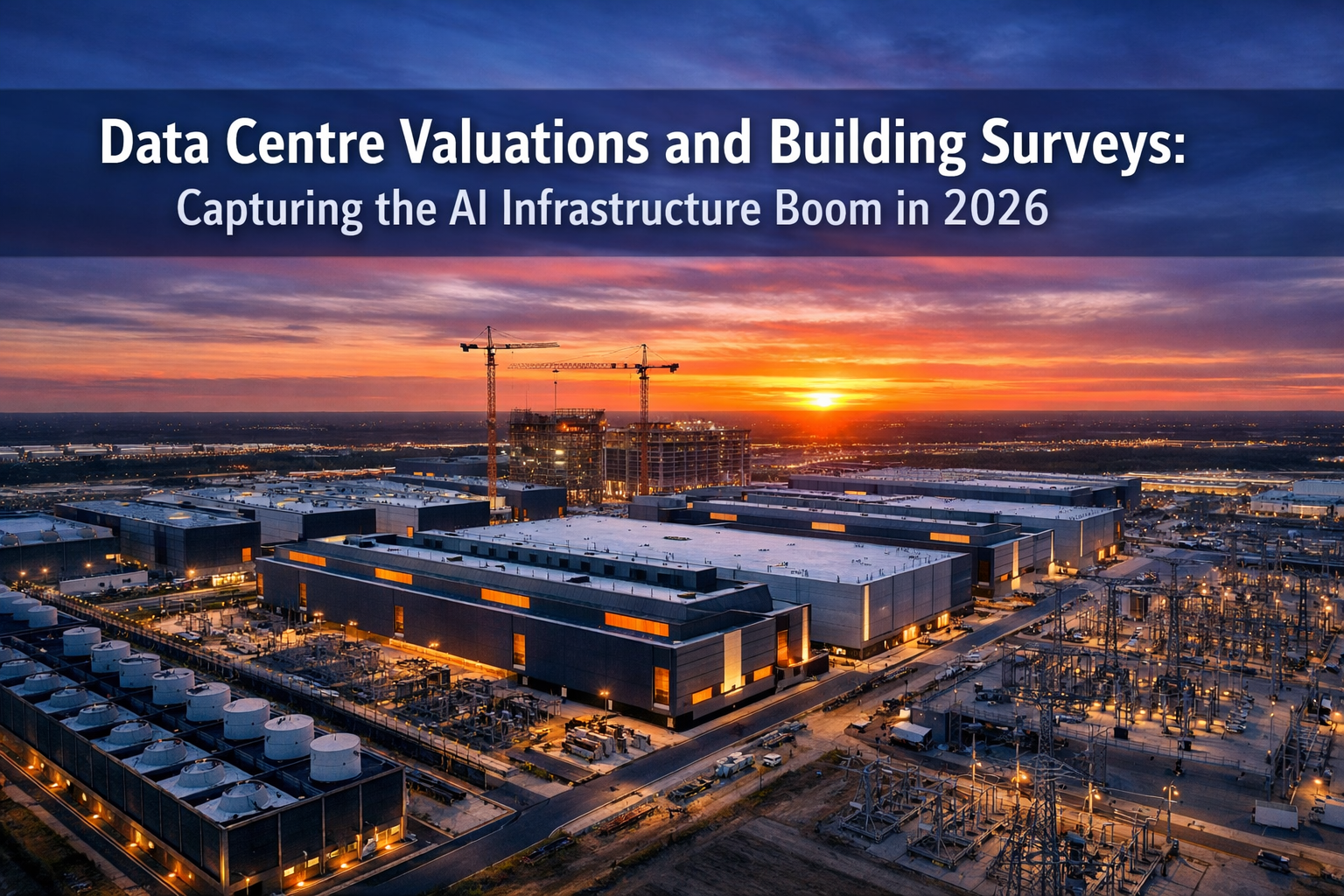
The artificial intelligence revolution is reshaping the global property landscape in ways few predicted. As 2026 unfolds, data centres have become the most sought-after infrastructure assets in commercial real estate, with hyperscalers pouring nearly $750 billion into new facilities this year alone.[2] For chartered surveyors and valuation professionals, understanding Data Centre Valuations and Building Surveys: Capturing the AI Infrastructure Boom in 2026 has transformed from a niche specialization into an essential competency.
The numbers tell a remarkable story: over 23 gigawatts of data centre capacity is currently under construction across 831 sites worldwide, with three-quarters concentrated in the United States.[2] This unprecedented expansion demands specialized surveying expertise, sophisticated valuation methodologies, and deep understanding of the unique technical requirements that separate data centres from conventional commercial properties.
Key Takeaways
- 💰 Record capital expenditure: The 14 largest data centre operators are projected to spend close to $750 billion in 2026, nearly double the $450 billion spent in 2025[2]
- 🏗️ Massive construction pipeline: Over 23.1 gigawatts of IT capacity is under construction globally across 831 sites, representing unprecedented supply creation[2]
- 📊 Specialized valuation requirements: Data centre assets require unique assessment methodologies that account for power capacity, cooling infrastructure, and technical specifications beyond traditional property metrics
- 🔍 Critical survey protocols: Building surveys must evaluate structural capacity for heavy equipment loads, power distribution systems, and environmental control infrastructure
- 🌍 Geographic expansion: Nearly two-thirds of new capacity is being developed outside established hubs, creating opportunities in emerging markets[6]
Understanding the 2026 Data Centre Investment Landscape
The Scale of AI-Driven Infrastructure Spending
The artificial intelligence boom has catalyzed an infrastructure investment wave unlike anything the property sector has witnessed. Amazon leads the charge with $200 billion in projected 2026 spending, up from $131 billion in 2025, while Google follows closely with estimates between $175 billion and $185 billion.[1] Meta's announcement of a $600 billion U.S. infrastructure investment through 2028 underscores the long-term commitment hyperscalers are making to data centre capacity.[1]
This spending acceleration reflects fundamental shifts in computational requirements. GPU-powered data centres, essential for AI training and inference workloads, demand substantially more power and cooling capacity than traditional facilities. Survey respondents indicate that 65% believe GPU-powered data centres are in a growth stage, with 60% agreeing that trillions of dollars will be spent on AI infrastructure development.[8]
Geographic Distribution and Market Dynamics
The data centre construction boom extends far beyond traditional hubs. While Northern Virginia and Silicon Valley remain significant markets, nearly two-thirds of new capacity is being developed in emerging locations.[6] This geographic diversification creates opportunities for surveyors and valuers in regions previously underserved by hyperscale infrastructure.
North American vacancy rates have stabilized at approximately 1% for a second consecutive year, indicating sustained demand despite aggressive supply creation.[6] The Americas region hosts 17 GW of capacity across 311 locations, representing the largest concentration globally.[2]
International markets are also experiencing rapid expansion. Adani announced a $100 billion AI infrastructure plan targeting 5 GW by 2035 across the Asia-Pacific region, partnering with Google to create India's largest gigawatt-scale data centre campus in Visakhapatnam.[6]
Investment Projections and Market Confidence
Long-term projections suggest this infrastructure boom will continue well beyond 2026. Moody's projects $3 trillion in global spending over the next five years for data centre expansion and AI capacity, while broader estimates indicate nearly $7 trillion will be spent on building and upgrading data centres over five years.[3][5]
Market confidence remains robust: 80% of survey respondents agree that data centre asset valuations will remain high over the next two years.[8] However, less than 50% have full visibility into demand over the next 12 months, suggesting potential volatility ahead and emphasizing the importance of rigorous valuation methodologies.
Data Centre Valuations and Building Surveys: Specialized Assessment Methodologies
Unique Valuation Challenges in Data Centre Assets
Data centre valuations require fundamentally different approaches compared to conventional commercial property assessments. The value proposition extends far beyond square footage and location—power capacity, cooling infrastructure, and network connectivity often represent the primary value drivers.
Traditional valuation metrics like price per square foot provide limited insight. Instead, data centres are frequently valued on a per-kilowatt or per-megawatt basis, reflecting the critical importance of power capacity. A facility with 50 MW of available power capacity commands significantly higher valuations than a structurally identical building with only 20 MW, regardless of physical size.
Key valuation considerations include:
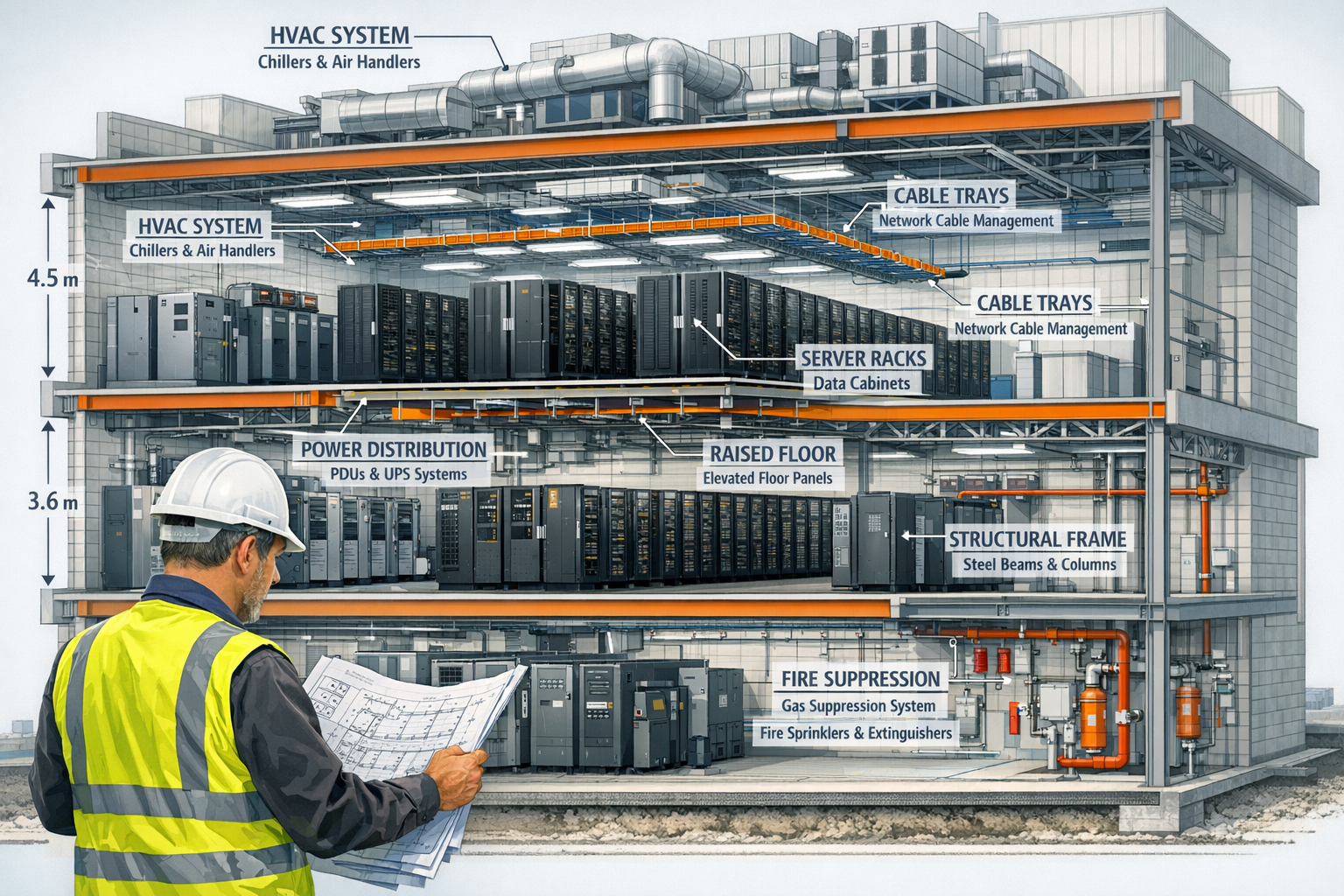
- Power infrastructure: Available capacity, redundancy levels (N, N+1, 2N), utility agreements, and backup generation capabilities
- Cooling systems: Efficiency ratings (PUE – Power Usage Effectiveness), cooling technology type, and scalability
- Network connectivity: Carrier-neutral status, number of network providers, fiber connections, and latency characteristics
- Certification levels: Tier ratings (Tier I-IV), compliance certifications (ISO 27001, SOC 2), and security standards
- Land availability: Expansion potential for additional buildings and power infrastructure
Professional valuers must also consider the technical obsolescence risk inherent in data centre assets. Cooling technologies, power distribution systems, and even structural designs can become outdated as computational requirements evolve. The shift toward GPU-powered AI workloads, for example, has rendered some older facilities less competitive despite their physical condition.
Building Survey Protocols for Data Centre Acquisitions
Building surveys for data centres demand specialized expertise beyond standard commercial property assessments. A comprehensive Level 3 full building survey must evaluate not only structural integrity but also the technical systems that define operational capacity.
Structural Assessment Priorities:
-
Floor loading capacity: Data centres house exceptionally heavy equipment. Server racks, UPS systems, and battery arrays can impose loads of 250-350 pounds per square foot, far exceeding typical office specifications. Structural engineers must verify that floor slabs, support columns, and foundations can accommodate current and future equipment densities.
-
Raised floor systems: Most data centres utilize raised access floors for cable management and air distribution. Surveys must assess the condition, load rating, and configuration of these systems, including pedestal stability and panel integrity.
-
Ceiling and roof capacity: Cable tray systems, HVAC ducting, and fire suppression infrastructure impose significant ceiling loads. Roof structures must support cooling equipment, emergency generators, and potential future solar installations.
-
Seismic considerations: In seismically active regions, equipment anchoring, structural bracing, and foundation design require specialized evaluation to ensure operational continuity during seismic events.
Mechanical and Electrical Systems Evaluation:
Beyond structural elements, surveys must thoroughly assess the technical infrastructure that enables data centre operations. This includes:
- Power distribution: Switchgear condition, transformer capacity, UPS systems, battery backup duration, and power distribution unit (PDU) configurations
- Cooling systems: CRAC/CRAH unit performance, chiller capacity and efficiency, cooling tower condition, and hot/cold aisle containment effectiveness
- Fire suppression: System type (water-based, gas-based), coverage adequacy, and compliance with current standards
- Environmental monitoring: Temperature and humidity control systems, leak detection, and building management system (BMS) integration
Professional surveyors should also evaluate building materials assessments to identify potential issues with insulation, vapor barriers, and materials that could impact thermal performance or pose contamination risks.
Due Diligence and Risk Assessment
Comprehensive due diligence for data centre acquisitions extends beyond physical condition to operational and regulatory factors. Surveyors should coordinate with specialists to assess:
- Environmental compliance: EPC ratings and MEES compliance, environmental permits, noise ordinances, and water usage restrictions
- Utility agreements: Power purchase agreements, capacity reservations, future availability, and rate structures
- Planning permissions: Existing use rights, expansion approvals, and zoning compliance for data centre operations
- Hazardous materials: Asbestos surveys, PCB-containing equipment, and lead paint assessments
When areas of further investigation are identified during initial surveys, specialized testing and analysis should be commissioned promptly to avoid transaction delays.
Data Centre Valuations and Building Surveys: Expert Witness and Advisory Roles in 2026

Expert Witness Services in Data Centre Disputes
As data centre transactions and developments multiply, so too do disputes requiring expert witness testimony. Chartered surveyors with specialized data centre knowledge provide invaluable services in litigation, arbitration, and dispute resolution proceedings.
Common dispute scenarios include:
Construction defect claims: Disputes arise when data centre facilities fail to meet performance specifications, experience premature system failures, or cannot achieve promised power densities. Expert witnesses evaluate whether construction quality, design specifications, or operational practices caused the deficiencies.
Valuation disputes: Disagreements over asset valuations occur in partnership dissolutions, eminent domain proceedings, tax assessments, and purchase price disputes. Experts must defend their valuation methodologies and demonstrate how data centre-specific factors influenced their conclusions.
Lease disputes: Data centre lease agreements often contain complex performance guarantees, power allocation provisions, and service level agreements. Experts interpret technical specifications and assess whether parties fulfilled their contractual obligations.
Insurance claims: Business interruption claims, equipment damage disputes, and liability determinations require expert analysis of causation, appropriate repair methodologies, and financial impacts.
Expert witnesses must communicate highly technical concepts to judges, arbitrators, and juries who may lack specialized knowledge. The ability to translate power usage effectiveness ratios, cooling redundancy configurations, and network topology considerations into understandable terms proves essential.
Advisory Services for Development Projects
Surveyors also serve as trusted advisors throughout the data centre development lifecycle. From site selection through commissioning, professional guidance helps clients navigate the complex technical and regulatory landscape.
Site Selection and Feasibility Analysis:
Identifying optimal data centre locations requires evaluating numerous factors beyond traditional real estate considerations:
- Power availability: Proximity to substations, available utility capacity, and potential for renewable energy sources
- Fiber connectivity: Existing fiber routes, carrier presence, and latency to major internet exchange points
- Natural disaster risk: Flood zones, seismic activity, tornado/hurricane exposure, and wildfire risk
- Climate considerations: Ambient temperature ranges, humidity levels, and opportunities for free cooling
- Water availability: Cooling tower water supply and wastewater discharge capacity
- Regulatory environment: Data sovereignty requirements, tax incentives, and permitting timelines
Surveyors with data centre expertise help clients assess these variables and provide realistic feasibility assessments before significant capital commitments.
Development Monitoring and Quality Assurance:
During construction, surveyors provide independent verification that facilities are being built according to specifications. This includes:
- Progress monitoring and milestone verification
- Quality control inspections of critical systems
- Coordination with specialized commissioning agents
- Documentation for lender draw requests
- Identification of deviations from approved plans
These services protect investor interests and help ensure facilities will perform as designed when operational.
Budgeting and Cost Management
Accurate cost forecasting is critical for data centre projects given their technical complexity and capital intensity. Surveyors specializing in budgeting repairs and restoration provide detailed cost estimates for:
- Retrofit and modernization projects: Upgrading cooling systems, increasing power density, or implementing new technologies
- Expansion projects: Adding capacity to existing facilities while maintaining operations
- Deferred maintenance: Addressing accumulated maintenance backlogs that could impact reliability
- Compliance upgrades: Modifications required to meet evolving regulatory standards
Understanding the cost of measured building surveys and comprehensive assessments helps clients budget appropriately for due diligence activities.
Emerging Trends and Future Considerations
Sustainability and Environmental Imperatives
Environmental performance has become a critical valuation factor as hyperscalers commit to carbon neutrality goals. Data centres with superior PUE ratings, renewable energy access, and water efficiency command premium valuations. Surveyors must understand sustainability metrics and their impact on long-term asset value.
Key sustainability considerations include:
- Renewable energy procurement: On-site generation, power purchase agreements, and renewable energy credit strategies
- Water consumption: Cooling tower usage, water recycling systems, and drought-resistant cooling technologies
- Waste heat recovery: Opportunities to repurpose waste heat for district heating or industrial processes
- Circular economy principles: Equipment refurbishment, material recycling, and end-of-life planning
Modular and Prefabricated Construction
The urgent demand for capacity has accelerated adoption of modular data centre designs. Prefabricated modules can reduce construction timelines from 24-36 months to 12-18 months, providing faster time-to-revenue.
Surveyors must adapt assessment methodologies to evaluate modular facilities, considering:
- Manufacturing quality: Factory construction standards versus site-built quality
- Transportation and installation: Potential damage during shipping and crane operations
- Integration challenges: Connections between modules and site infrastructure
- Expansion flexibility: Ease of adding capacity through additional modules
Edge Computing and Distributed Infrastructure
While hyperscale facilities dominate 2026 headlines, edge computing represents a parallel growth opportunity. Smaller facilities located closer to end users support latency-sensitive applications like autonomous vehicles, augmented reality, and real-time analytics.
Edge data centres present unique surveying challenges:
- Urban locations: Space constraints, noise restrictions, and aesthetic requirements
- Repurposed buildings: Converting retail, office, or industrial spaces to data centre use
- Distributed portfolios: Assessing multiple small facilities rather than single large sites
- Operational complexity: Remote management requirements and limited on-site staffing
Understanding both hyperscale and edge facility requirements positions surveyors to serve the full spectrum of data centre investors and operators.
Practical Guidance for Surveyors Entering the Data Centre Market
Building Specialized Expertise
Surveyors seeking to capitalize on the data centre boom should pursue targeted professional development:
Technical Knowledge Development:
- Study data centre design standards (Uptime Institute Tier Classifications, TIA-942)
- Learn power and cooling fundamentals through industry certifications
- Understand network infrastructure and connectivity requirements
- Familiarize with operational metrics (PUE, WUE, CUE)
Industry Engagement:
- Join professional organizations like the Uptime Institute or Data Centre Alliance
- Attend industry conferences and exhibitions
- Develop relationships with data centre operators, developers, and service providers
- Follow market intelligence sources tracking capacity additions and transactions
Collaborative Approach:
- Partner with mechanical and electrical engineers specializing in data centres
- Develop relationships with commissioning agents and testing specialists
- Coordinate with environmental consultants and utility experts
- Build networks with data centre brokers and investment advisors
Marketing Specialized Services
Effectively communicating data centre expertise to potential clients requires targeted marketing strategies:
- Case studies: Document successful data centre survey and valuation projects (respecting confidentiality requirements)
- Thought leadership: Publish articles and insights on data centre market trends and technical developments
- Targeted outreach: Identify data centre developers, operators, and investors active in your geographic market
- Service differentiation: Clearly articulate how your data centre expertise differs from general commercial property services
Surveyors should also consider whether to position as generalists with data centre capabilities or specialists focusing exclusively on data centre and mission-critical facilities.
Regulatory and Compliance Considerations
Planning and Zoning Challenges
Data centre developments often face planning obstacles due to their unique characteristics:
Power consumption concerns: Local authorities may resist projects that strain electrical grid capacity or conflict with renewable energy goals. Understanding planning considerations helps clients navigate approval processes.
Noise generation: Cooling equipment and backup generators produce significant noise that may violate local ordinances or disturb neighboring properties.
Water usage: Evaporative cooling systems consume substantial water, raising concerns in drought-prone regions.
Aesthetic impacts: Large, windowless buildings may conflict with architectural guidelines or community character objectives.
Surveyors advising on site selection and development feasibility must assess these regulatory risks early in the process.
Data Sovereignty and Security Requirements
International data centre investments face additional regulatory complexity around data sovereignty, privacy regulations, and security requirements. Different jurisdictions impose varying requirements for:
- Data localization (requirements to store certain data within national borders)
- Privacy compliance (GDPR, CCPA, and similar regulations)
- Security certifications and audits
- Government access and surveillance considerations
These regulatory factors influence site selection, facility design, and ultimately asset valuations.
Financial Modeling and Investment Analysis
Valuation Methodologies
Professional valuers employ multiple approaches when assessing data centre assets:
Income Approach: Discounted cash flow analysis based on projected revenues from colocation services, wholesale leases, or hyperscale operations. Key variables include:
- Absorption rates (pace of capacity leasing)
- Pricing per kilowatt or per cabinet
- Operating expense ratios
- Capital expenditure requirements
- Terminal capitalization rates
Cost Approach: Replacement cost analysis accounting for land, site improvements, building construction, and technical infrastructure. Adjustments for physical deterioration, functional obsolescence, and economic obsolescence prove critical.
Sales Comparison Approach: Analysis of comparable data centre transactions, adjusted for differences in power capacity, location, age, and technical specifications. The limited number of comparable sales and unique characteristics of each facility make this approach challenging.
Hybrid Methodologies: Many valuers employ weighted combinations of approaches, recognizing that data centres exhibit characteristics of both real estate and infrastructure assets.
Investment Metrics and Performance Indicators
Investors evaluate data centre opportunities using specialized metrics:
- Price per megawatt: Total acquisition cost divided by available IT power capacity
- Stabilized yield: Net operating income as a percentage of total investment at full occupancy
- Development yield: Projected stabilized NOI as a percentage of total development cost
- Absorption timeline: Expected duration to achieve full occupancy
- Retention rates: Percentage of customers renewing leases (typically very high for data centres)
Understanding these metrics and how they compare across markets and facility types enables surveyors to provide more valuable advisory services.
Conclusion
Data Centre Valuations and Building Surveys: Capturing the AI Infrastructure Boom in 2026 represents one of the most significant opportunities in commercial property services today. With nearly $750 billion in capital expenditure flowing into the sector this year alone, and projections suggesting trillions more over the coming decade, the demand for specialized surveying and valuation expertise will only intensify.[2]
Chartered surveyors who develop deep technical knowledge, build collaborative professional networks, and adapt traditional methodologies to address data centre-specific factors will find themselves well-positioned to serve this dynamic market. The unique characteristics of data centre assets—where power capacity often matters more than square footage, and cooling efficiency directly impacts investment returns—demand a fundamentally different approach to assessment and valuation.
Actionable Next Steps
For surveyors seeking to enter or expand their data centre practice:
- Invest in education: Pursue specialized training in data centre design standards, power and cooling systems, and industry-specific valuation methodologies
- Build strategic partnerships: Develop relationships with M&E engineers, commissioning agents, and other specialists essential to comprehensive data centre assessments
- Study the market: Follow capacity additions, transaction activity, and emerging trends in your target geographic markets
- Develop case studies: Document your data centre projects (within confidentiality constraints) to demonstrate expertise to potential clients
- Engage with the industry: Join professional organizations, attend conferences, and network with data centre operators and investors
The AI infrastructure boom transforming 2026 will continue reshaping the property landscape for years to come. Surveyors who recognize this transformation and position themselves accordingly will capture significant opportunities in one of commercial real estate's most dynamic sectors.
For comprehensive building survey services across all property types, including specialized data centre assessments, professional chartered surveyors provide the expertise necessary to navigate complex transactions and development projects in this rapidly evolving market.
References
[1] Billion Dollar Infrastructure Deals Ai Boom Data Centers Openai Oracle Nvidia Microsoft Google Meta – techcrunch.com
[2] Ai Data Center Build Advances At Full Speed Five Things To Know – about.bnef.com
[3] constructiondive – constructiondive.com
[4] Building Surveys For Data Centre Expansions Structural Assessments Amid 2026 Ai Infrastructure Boom – nottinghillsurveyors.com
[5] Data Center Statistics – programs.com
[6] New Data Center Developments March 2026 – datacenterknowledge.com
[7] Construction In 2026 A Boon For Data Centers But Uncertainty Elsewhere – smartbrief.com
[8] Global Data Center Market Outlook – alixpartners.com