

Up to 27% of homes in England are currently affected by damp — a figure that carries serious consequences for indoor air quality, occupant health, and structural integrity [1]. Yet one of the most persistent problems in the property sector is not damp itself, but the widespread misdiagnosis of its cause. A building surveyor who cannot distinguish between rising damp, penetrating damp, and condensation driven by lifestyle habits may send a buyer down a costly remediation path that solves nothing. Understanding damp, mould and condensation: how building surveyors diagnose causes versus lifestyle and what it means for value is therefore one of the most practically important topics for any buyer, seller, landlord, or property professional in 2026.
Key Takeaways
- Damp in UK homes falls into three main categories: rising damp, penetrating damp, and condensation — each with distinct causes, locations, and remedies.
- Condensation is the most common type and is frequently linked to lifestyle factors such as poor ventilation and indoor drying of clothes, but building fabric failures can also be responsible.
- Qualified building surveyors use a structured diagnostic process, including moisture meters, thermal imaging, and environmental monitoring, to distinguish structural damp from lifestyle-driven moisture.
- Misdiagnosis is a documented problem that leads to unnecessary and expensive remediation work [6].
- Damp findings in a survey report can directly affect mortgageability, insurance, and negotiated purchase price.
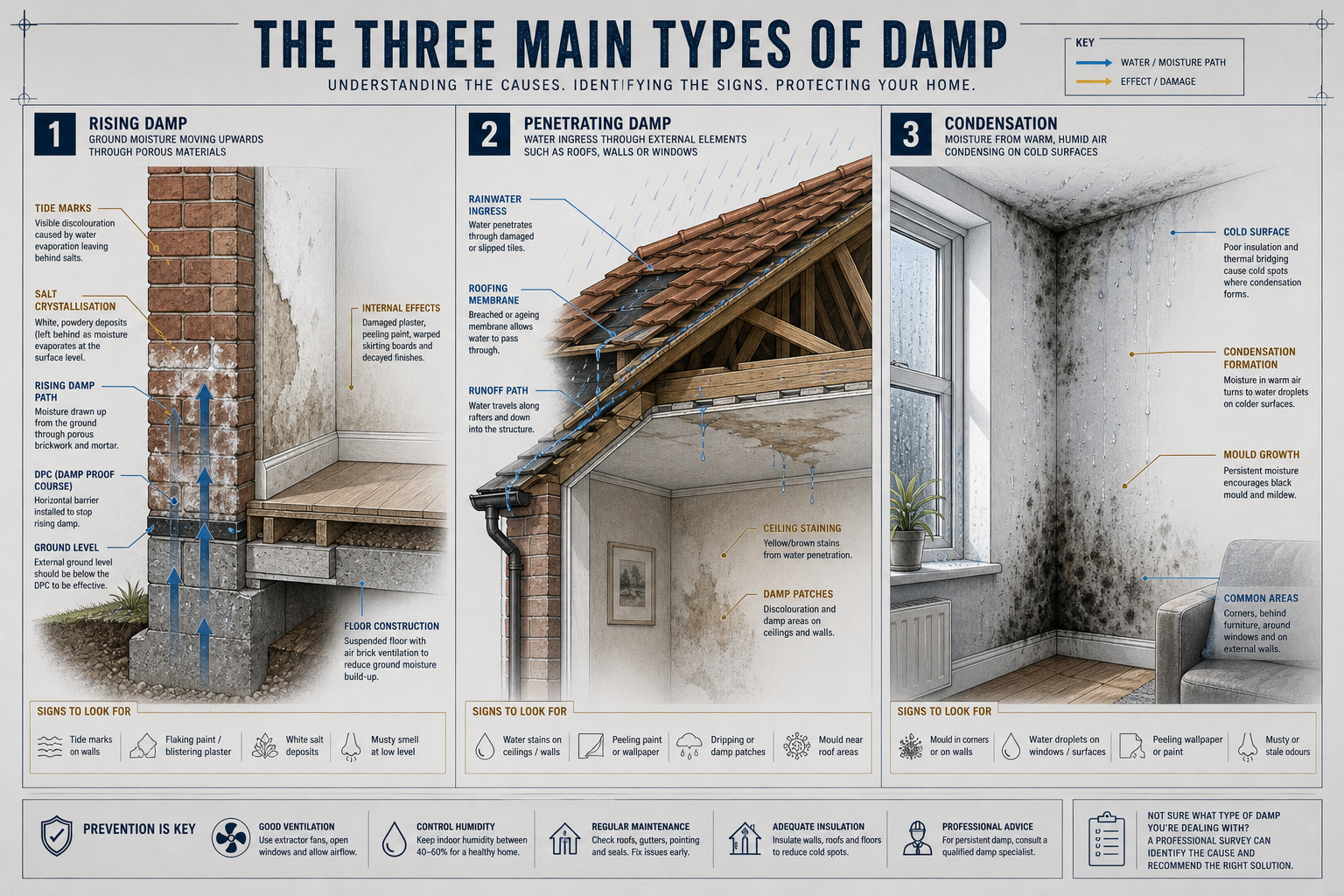
The Three Types of Damp and Why the Distinction Matters
Before examining how surveyors investigate moisture problems, it is essential to understand what they are actually looking for. The term "damp" covers three structurally distinct phenomena, and conflating them is the root cause of most misdiagnosis errors.
Rising Damp
Rising damp occurs when groundwater travels upward through masonry via capillary action. It is typically identified by a characteristic "tide mark" — a horizontal band of discolouration, salt crystallisation (efflorescence), and deteriorating plaster that appears at low level, usually no higher than one metre from the floor. A failed or absent damp-proof course (DPC) is the most common underlying cause.
Rising damp is relatively rare compared to how often it is diagnosed. Experts in the field have long noted that many cases attributed to rising damp are in fact condensation or penetrating damp presenting at low level [6].
Penetrating Damp
Penetrating damp results from water entering a building through defects in the external fabric — failed pointing, cracked render, damaged roofing, faulty guttering, or poorly sealed window frames. Unlike rising damp, it tends to appear in localised patches that correlate directly with an external defect. It can occur at any height and is often worse during or after heavy rainfall.
For a detailed look at how roof defects contribute to penetrating damp, the guide to what roof surveyors do provides useful context on how inspections of the building envelope are carried out.
Condensation and Mould
Condensation damp is the most prevalent type found in UK homes and is primarily caused by poor ventilation, insufficient heating, and activities such as drying clothes indoors without adequate airflow [2]. Warm, moisture-laden air meets a cold surface — typically an external wall, window reveal, or cold corner — and deposits water. Over time, this creates the conditions for mould growth, most commonly the black mould species Aspergillus niger or Cladosporium.
Critically, condensation can be driven by:
- Lifestyle factors — cooking without extraction, showering without ventilation, overcrowding, or drying laundry indoors
- Building fabric failures — inadequate insulation creating cold bridges, blocked or absent ventilation, or single-glazed windows in an otherwise well-insulated envelope
The distinction between these two drivers is central to the surveyor's diagnostic task.
How Building Surveyors Diagnose Causes Versus Lifestyle: The Professional Process
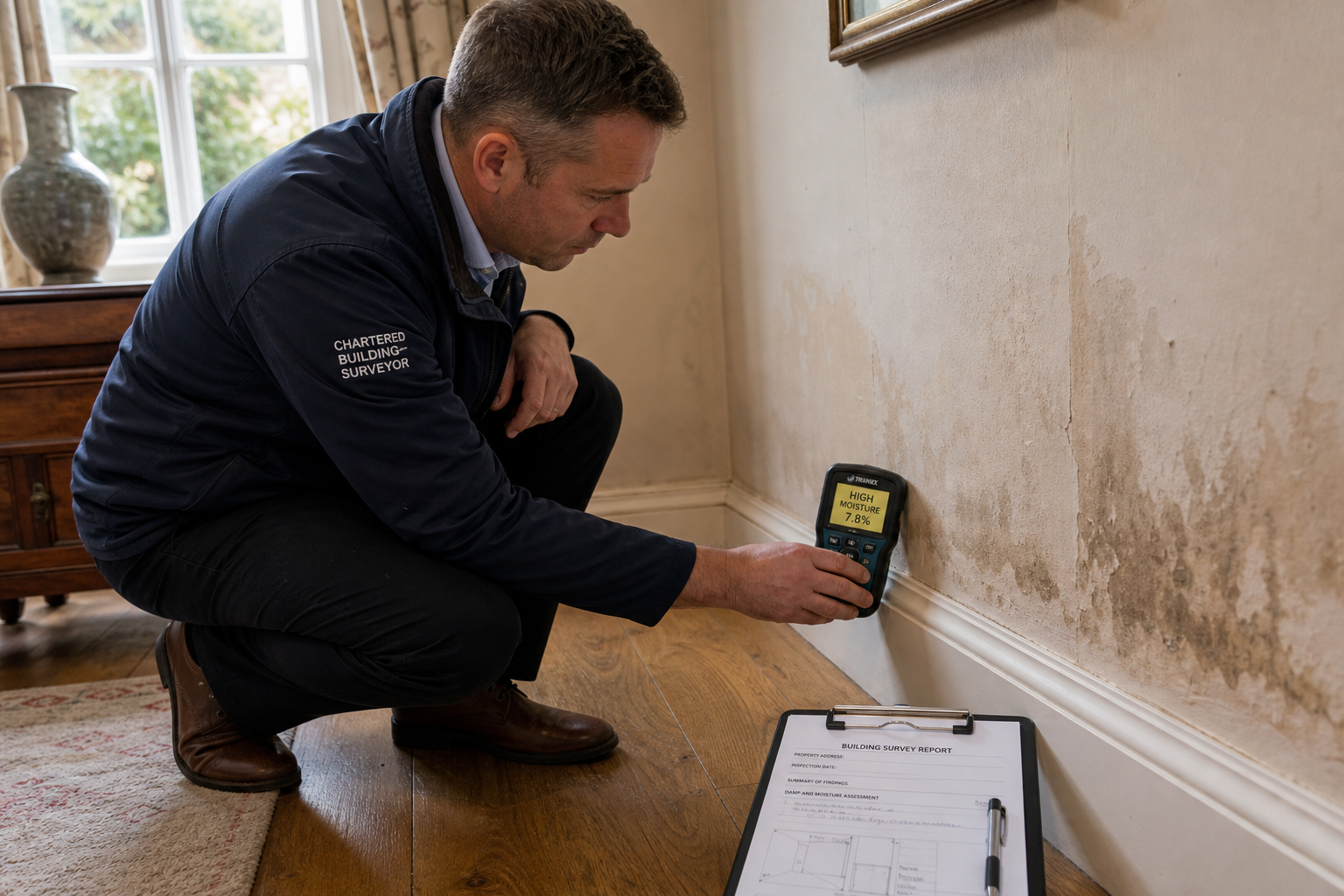
Understanding damp, mould and condensation: how building surveyors diagnose causes versus lifestyle and what it means for value requires a clear picture of the professional methodology surveyors apply. This is not a single-tool process. It is a structured, evidence-led investigation.
Visual Inspection and Pattern Recognition
The first stage is a thorough visual inspection. A qualified surveyor examines the location, height, shape, and colour of any staining or mould growth. Patterns are highly informative:
| Pattern | Likely Cause |
|---|---|
| Horizontal tide mark at low level | Rising damp |
| Localised patch near window or roof | Penetrating damp |
| Mould in corners, on north-facing walls, or around window reveals | Condensation |
| Staining that worsens after rain | Penetrating damp |
| Staining consistent across multiple walls | Condensation or ventilation failure |
Surveyors are trained to assess damp and mould claims without overstating certainty, recognising that visual evidence alone is rarely conclusive [7]. A dark patch on a wall could indicate any of the three types, and a responsible surveyor will not commit to a diagnosis without corroborating evidence.
Moisture Meters and Readings
Electronic moisture meters are standard tools. They measure the electrical resistance of a material, which correlates with moisture content. However, surveyors are trained to interpret readings critically. Salt contamination from previous damp episodes can produce false-positive readings even in dry walls. A high reading in isolation does not confirm active rising damp.
For a comprehensive assessment, surveyors may use:
- Carbide meters — which test actual moisture content by chemical reaction, providing more reliable readings than resistance meters
- Thermal imaging cameras — which identify cold spots and thermal bridges where condensation is likely to form
- Environmental monitoring systems — which track indoor temperature, relative humidity, and outdoor conditions over days or weeks to build an evidence base [5]
Distinguishing Lifestyle from Structural Causes
This is arguably the most professionally demanding part of the diagnosis. A surveyor inspecting a property where a tenant has been drying laundry indoors, cooking without extraction, and keeping windows permanently closed may find mould growth that is entirely attributable to those behaviours. The same property, occupied differently, might show no mould at all.
Surveyors look for contextual clues:
- Is ventilation provision adequate? Are trickle vents present and open? Is there mechanical extraction in kitchen and bathroom?
- Are there cold bridges created by inadequate insulation, particularly around window frames and in corners?
- Does the mould pattern match areas of lowest surface temperature, or does it appear on warm internal walls where condensation is unlikely?
- Is there evidence of previous remediation that has not resolved the problem — suggesting a structural cause rather than a lifestyle one?
Environmental monitoring tools, such as the Condensation and Mould Diagnostic System developed by the Property Care Association, place data loggers in the property to record temperature and humidity over a monitoring period [5]. This produces an impartial technical report that removes subjectivity from the diagnosis and is particularly useful in landlord-tenant disputes.
For buyers considering a detailed inspection of an older or complex property, a Level 3 full building survey provides the most thorough assessment of damp and moisture-related issues.
When Specialist Surveys Are Recommended
A general building surveyor conducting a Level 2 or Level 3 survey will flag damp as a finding and may recommend further investigation by a specialist. RICS-certified specialist damp surveys provide expert diagnosis for rising damp, condensation, and mould, with reports that are accepted by mortgage lenders and solicitors [8].
Independent specialist surveyors — those operating without a remediation sales agenda — are particularly valuable. Companies offering impartial damp surveys provide clear diagnoses and unbiased recommendations, meaning they have no financial incentive to recommend unnecessary chemical injection or tanking [4]. This independence is important because the damp-proofing industry has historically been criticised for over-diagnosing rising damp to generate remediation contracts.
For properties with complex or urgent moisture-related structural issues, the building pathology service offered by specialist chartered surveyors provides the depth of investigation needed to identify root causes accurately.
Real-World Case Types: How Diagnosis Plays Out in Practice
The following case types illustrate how the diagnostic process works in practice and why the outcome matters so much.
Case Type 1: The Victorian Terrace with "Rising Damp"
A buyer commissions a Level 3 survey on a Victorian mid-terrace. The surveyor identifies tide marks at low level on the front elevation, salt deposits on the plaster, and elevated moisture readings. The seller's estate agent has already obtained a quote from a damp-proofing company recommending full chemical DPC injection and replastering at a cost of £4,500.
The surveyor, however, notes that the external render has been painted with a non-breathable masonry paint, trapping moisture within the wall. The internal readings are high, but the pattern does not match true rising damp — the tide mark is inconsistent, and moisture readings are elevated across the full wall height rather than concentrated at low level. The recommendation is for a specialist independent survey before any remediation. The specialist confirms the cause is trapped moisture from impermeable render, not a failed DPC. The remedy — stripping and replacing with breathable lime render — costs £1,200.
Case Type 2: The Flat with Mould "Caused by the Building"
A landlord receives a complaint from a tenant about extensive black mould in the bedroom corners and bathroom. The tenant attributes it to poor insulation and inadequate heating. The landlord commissions an independent survey with environmental monitoring.
The data loggers record indoor relative humidity consistently above 70% throughout the monitoring period, even when outdoor humidity is low. The kitchen has no mechanical extraction and the bathroom extractor fan is non-functional. The surveyor's report concludes that while the building's insulation could be improved, the primary driver is inadequate ventilation combined with high-moisture lifestyle activities. The recommendation is fan replacement, trickle vent installation, and occupant guidance — not structural remediation.
This type of diagnosis is critical in the context of the Homes (Fitness for Human Habitation) Act 2018 and the Decent Homes Standard, where landlords and tenants have distinct legal responsibilities depending on the cause of damp.
Case Type 3: Penetrating Damp Masked as Condensation
A buyer's survey on a 1970s detached house identifies mould growth on the inner face of an external wall in the living room. The seller argues it is "just condensation" caused by the previous occupants' lifestyle. The surveyor uses a thermal imaging camera and identifies a clear cold spot corresponding to a section of failed cavity wall insulation that has slumped, creating a thermal bridge. Rainwater has also been tracking through a cracked window lintel above.
The diagnosis is penetrating damp combined with a thermal bridge — both structural issues. The surveyor flags these under the areas requiring further investigation section of the report, recommending specialist assessment before exchange.
What Damp Findings Mean for Property Value and Mortgageability
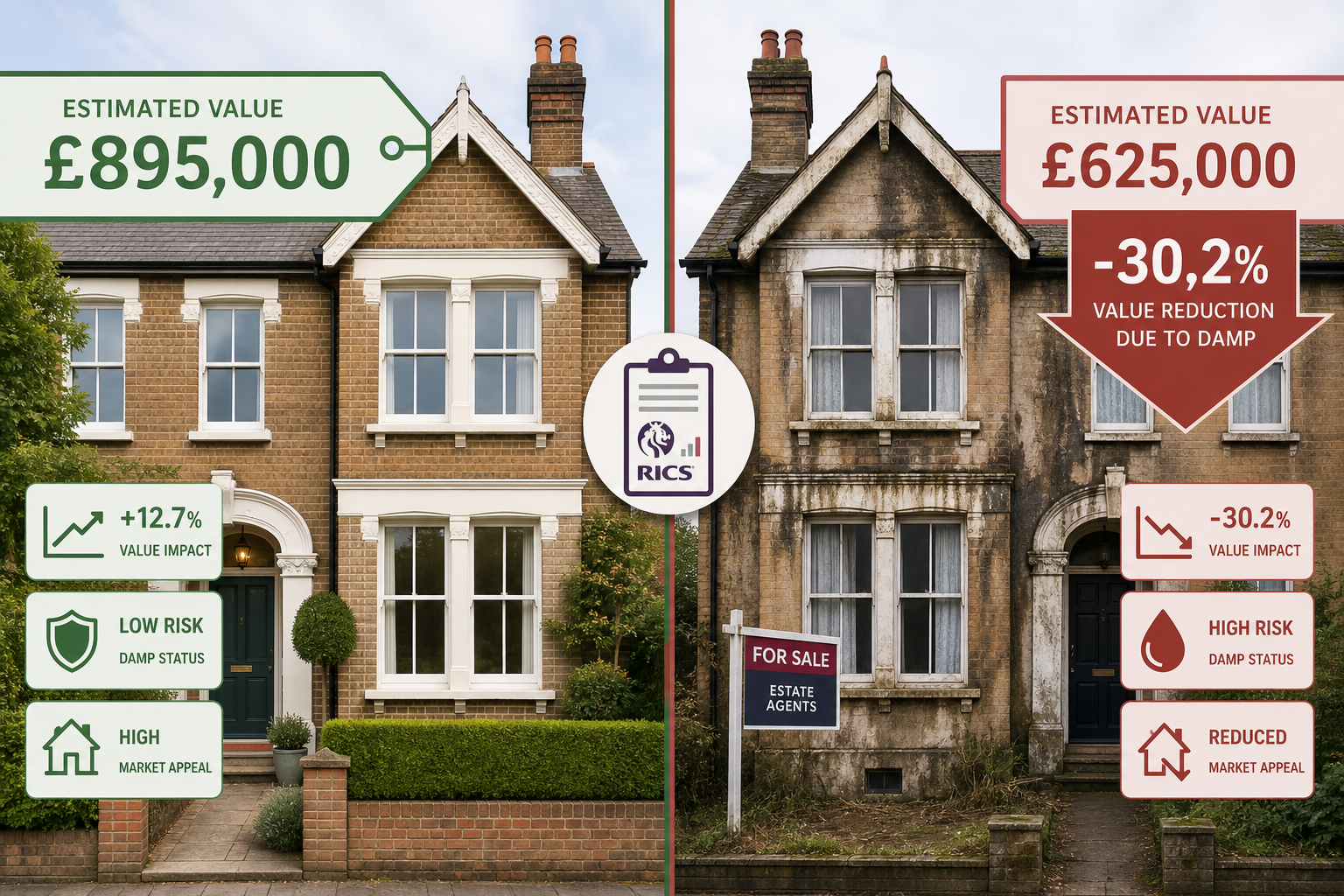
The impact of damp, mould and condensation: how building surveyors diagnose causes versus lifestyle and what it means for value extends directly into the financial transaction.
Impact on Mortgage Lending
Mortgage lenders rely on the valuer's assessment. If a surveyor flags active rising damp or significant penetrating damp, lenders may:
- Retain a portion of the mortgage offer until remediation is complete
- Decline to lend until a specialist report confirms the issue has been resolved
- Require an indemnity insurance policy in certain circumstances
Condensation attributed purely to lifestyle is less likely to trigger a mortgage retention, but structural condensation caused by inadequate insulation or ventilation may still be flagged as a condition deficiency.
Price Negotiation
Survey reports detailing damp problems provide buyers with documented evidence to negotiate the purchase price downward to reflect the cost of remediation [3]. This is one of the most tangible financial benefits of commissioning a thorough survey. The average price reduction achievable after a building survey can be significant, particularly where damp issues require structural remediation.
Insurance Implications
Untreated damp can affect buildings insurance. Insurers may exclude claims related to gradual deterioration caused by long-standing moisture ingress. For landlords, the block management insurance considerations around damp-related damage are particularly relevant where multiple units are affected.
Long-Term Value Erosion
Beyond the immediate transaction, untreated damp causes progressive damage to timber, plaster, and masonry. The relationship between damp and wood rot is well established — sustained moisture creates the conditions for both wet rot and dry rot, the latter of which can spread rapidly through a building's structural timbers and is extremely expensive to eradicate.
Practical Steps for Buyers, Sellers, and Landlords
For buyers:
- Always commission at minimum a Level 2 survey; for older or complex properties, a Level 3 survey is strongly recommended.
- If damp is flagged, request an independent specialist survey before exchange — not a quote from a remediation company.
- Use the surveyor's findings to negotiate the purchase price or request that remediation is completed before completion.
For sellers:
- Address known damp issues before marketing where possible, and obtain a specialist report confirming the cause and remedy.
- Be transparent about previous damp problems and any remediation carried out — concealment can create legal liability.
For landlords:
- Ensure all ventilation systems are functional and that tenants are informed about condensation management.
- Commission independent environmental monitoring where damp complaints arise, to establish whether the cause is structural or lifestyle-related before committing to remediation.
For further practical guidance on preventing and managing moisture in residential properties, the detailed resource on how to prevent and remove damp and mould growth covers both occupant actions and building fabric improvements.
Conclusion
Damp, mould and condensation: how building surveyors diagnose causes versus lifestyle and what it means for value is not an abstract professional question — it has direct consequences for health, property condition, and financial outcomes. The diagnostic process demands more than a moisture meter reading. It requires pattern recognition, environmental evidence, knowledge of building physics, and the professional discipline to distinguish between what the building is doing and what its occupants are doing.
Actionable next steps:
- Commission a Level 3 building survey for any property that is older, has a complex construction history, or shows any visible signs of moisture.
- Where damp is flagged, seek an independent specialist survey from a surveyor with no remediation sales interest.
- Request environmental monitoring data where lifestyle versus structural cause is disputed — particularly in landlord-tenant contexts.
- Use survey findings as a structured basis for price negotiation, supported by remediation cost estimates from independent contractors.
- Address ventilation deficiencies proactively — many condensation problems are resolved at low cost through improved extraction and airflow before they escalate into structural issues.
A well-diagnosed damp problem is manageable. A misdiagnosed one is expensive, recurring, and potentially damaging to both the building and the transaction.
References
[1] S41598 025 96396 7 – nature.com
[2] Damp Vs Mould Whats The Difference And Why Getting It Right Matters – disastercarecapital.co.uk
[3] Do House Surveyors Check For Damp – samconveyancing.co.uk
[4] Surveys – thedampologists.co.uk
[5] Maple Diagnostics Brochure – property-care.org
[6] damp-logic.co.uk – damp-logic.co.uk
[7] How Surveyors Assess Damp And Mould Claims Without Overstating Certainty – canterburysurveyors.com
[8] hendersonwood.co.uk – hendersonwood.co.uk