

Roughly 4.5 million privately rented homes in England were brought under mandatory damp and mould compliance obligations on 1 May 2026 — the date the Renters' Rights Act 2025 extended Awaab's Law beyond social housing for the first time [5]. For building surveyors, landlords, and property professionals, this shift is not a minor administrative update. It is a fundamental change to how damp and mould detection in building surveys must be conducted, documented, and actioned across the entire private rental sector. This article provides a deep dive into the advanced detection methodologies, legal timelines, hazard classification requirements, and surveyor liability considerations that now define post-Awaab's Law protocols for private rental properties in 2026.
Key Takeaways
- Awaab's Law was extended to all private rented properties in England from 1 May 2026 under the Renters' Rights Act 2025, making compliance mandatory for private landlords.
- Landlords must investigate significant damp and mould hazards within 10 working days of a tenant report, make the property safe within 5 working days of the investigation, and provide written findings within 3 working days.
- Professional surveys must go beyond visual inspection, using calibrated tools including thermal imaging cameras, moisture meters, and hygrometers to identify root causes.
- Hazards are classified by severity; Category 1 hazards require urgent action and carry the highest enforcement risk for non-compliant landlords.
- Surveyors who integrate Awaab's Law compliance checklists into pre-tenancy and condition reports significantly reduce landlord liability exposure.
Why Visual Inspection Alone No Longer Meets the Standard
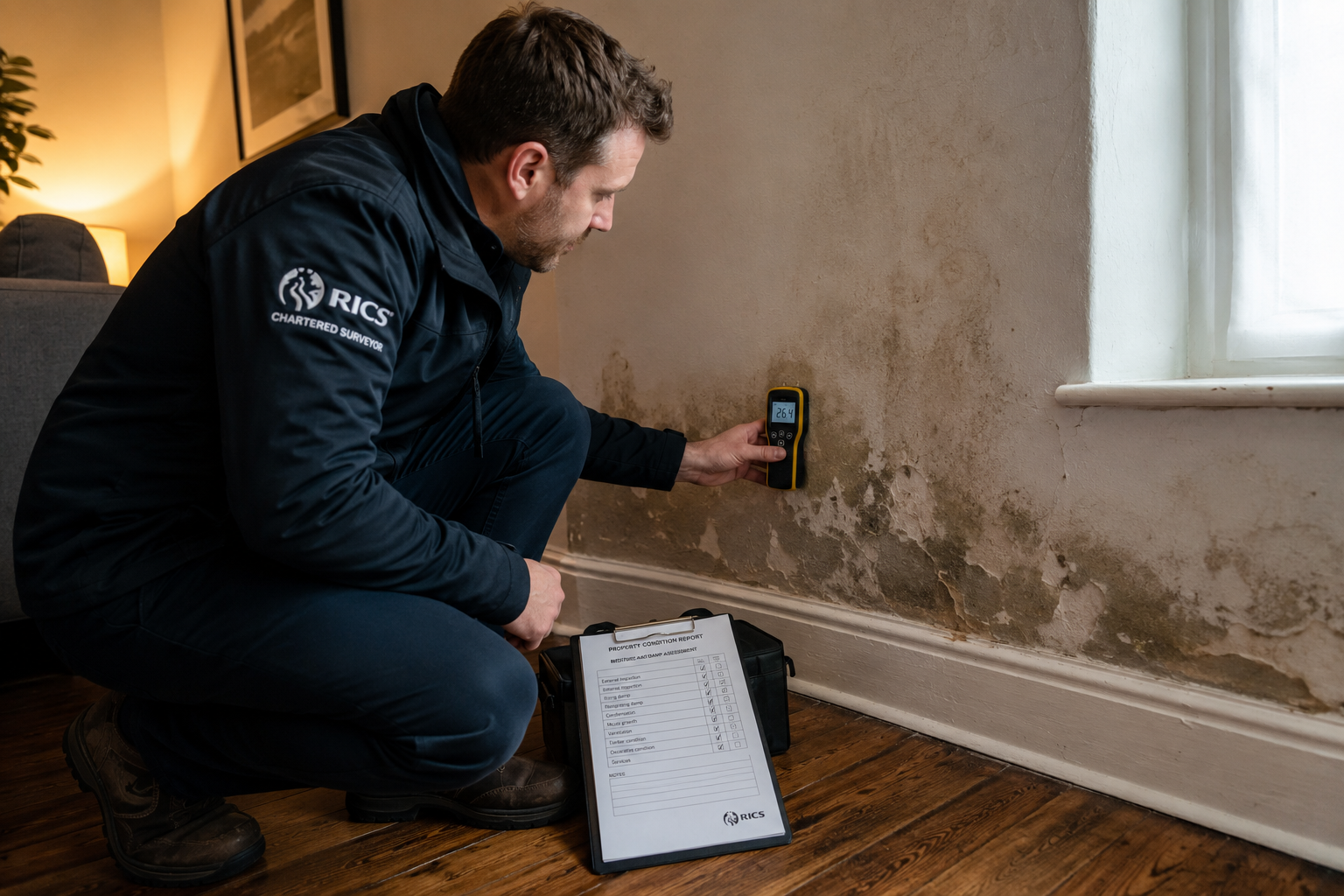
The era of a surveyor tapping a wall, noting "some staining present," and moving on is over. Under the post-Awaab's Law protocols now governing damp and mould detection in building surveys for private rental properties in 2026, a surface-level visual assessment is legally and professionally insufficient.
The law demands that surveys identify the root cause of any damp or mould — not merely its presence. This requires distinguishing between four fundamentally different moisture pathways:
- Rising damp — groundwater migrating upward through porous masonry due to a failed or absent damp-proof course
- Penetrating damp — rainwater ingress through defective roofing, pointing, window surrounds, or external walls
- Condensation — warm, moisture-laden air cooling on cold surfaces, the most common cause of black mould in residential properties
- Plumbing leaks — internal water escape from pipes, overflows, or appliances [2]
Each cause demands a different remediation strategy. Misidentifying condensation as rising damp, for example, can lead to expensive and ineffective treatment while the actual problem — inadequate ventilation — remains unresolved. The building defects survey process now requires surveyors to document their diagnostic reasoning, not just their findings.
Advanced Detection Tools Required in 2026 Surveys
Professional compliance under Awaab's Law requires the use of calibrated instruments. Relying solely on sight and touch exposes surveyors to professional liability if a hazard is missed and a tenant suffers harm. The following tools are now considered standard practice [2][6]:
| Tool | Primary Use | Detection Capability |
|---|---|---|
| Pin-type moisture meter | Timber and plaster moisture content | Quantifies moisture percentage in building materials |
| Non-invasive (capacitance) moisture meter | Scanning beneath surface finishes | Detects moisture without damaging decorations |
| Thermal imaging camera | Identifying cold bridges and hidden moisture | Reveals temperature differentials indicating damp behind walls |
| Hygrometer / psychrometer | Measuring relative humidity | Identifies condensation risk zones |
| Borescope camera | Inspecting cavities and voids | Visual access to hidden structural areas |
| Calcium carbide test kit | Confirming rising damp diagnosis | Measures actual moisture content of masonry samples |
Thermal imaging deserves particular emphasis. An infrared camera can reveal moisture patterns invisible to the naked eye — water tracking along roof joists, cold bridging at steel lintels, or leaks from concealed pipework. When used alongside a moisture meter, it provides a diagnostic picture that is both comprehensive and defensible in enforcement proceedings.
Surveyors are also advised to record ambient temperature, relative humidity, and dew point during inspections, as these readings contextualise moisture meter data and support or refute a condensation diagnosis. For properties with persistent issues, understanding the role of mechanical ventilation in buildings is increasingly relevant to the remediation recommendations surveyors must now provide.
The Awaab's Law Enforcement Timeline: What Private Landlords Must Now Meet
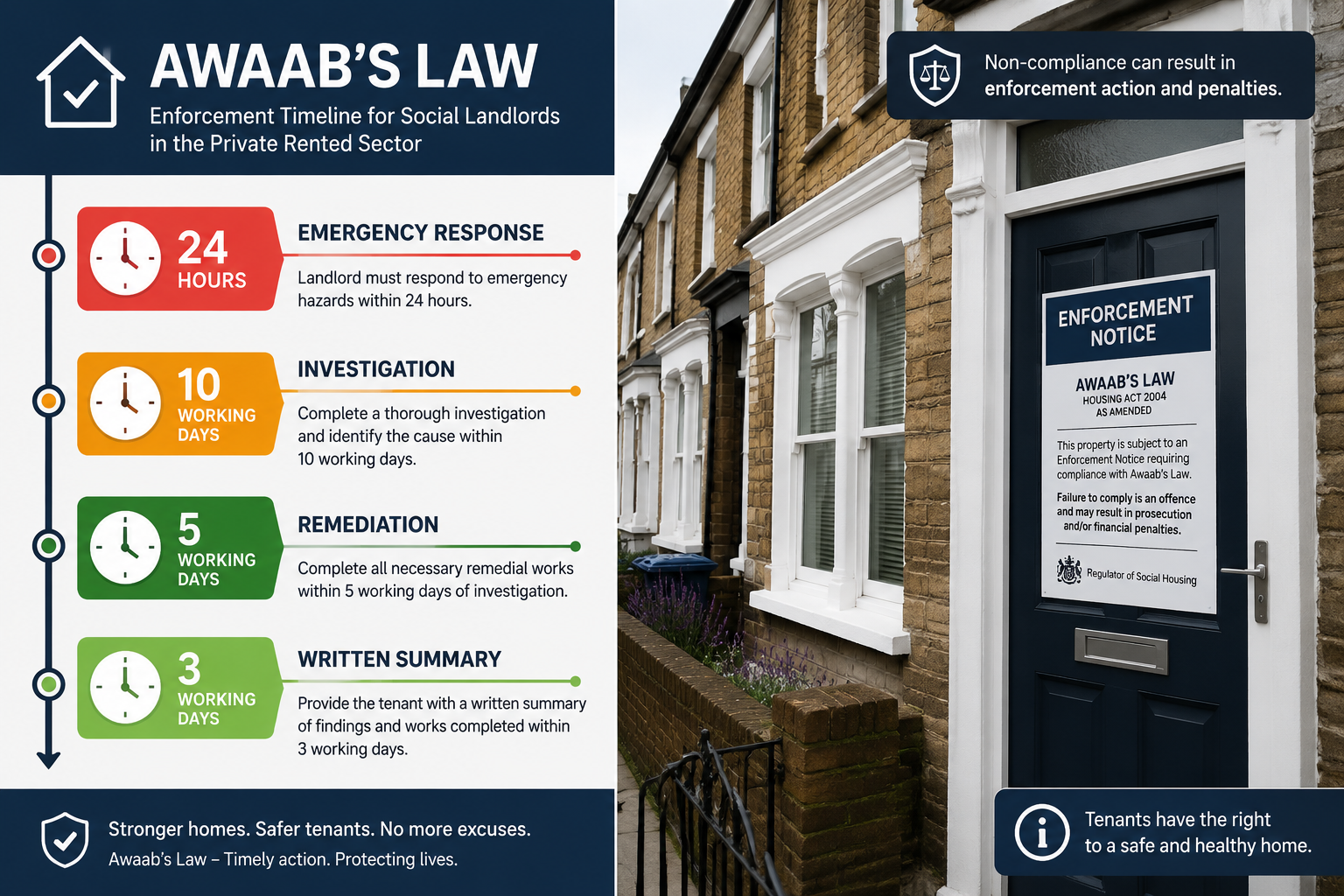
The mandatory timelines introduced by Awaab's Law are precise, non-negotiable, and now apply in full to the private rented sector [5]. Understanding these deadlines is critical for both landlords commissioning surveys and surveyors writing reports that will inform compliance decisions.
The Core Timeline at a Glance
Step 1 — Tenant Report
The clock starts the moment a tenant formally reports a damp or mould hazard. Landlords are strongly advised to create a written record of every report, including the date received.
Step 2 — Investigation (10 Working Days)
The landlord must arrange a professional investigation of any significant damp or mould hazard within 10 working days of the tenant's report [1]. This is where a qualified surveyor's role becomes central. The investigation must identify the root cause and assess the severity of the hazard.
Step 3 — Written Summary (3 Working Days Post-Investigation)
Within 3 working days of the investigation concluding, the landlord must provide the tenant with a written summary of findings and a clear statement of planned remedial actions [1].
Step 4 — Remediation (5 Working Days Post-Investigation)
The property must be made safe within 5 working days of the investigation completing [1]. This does not necessarily mean full remediation is complete within that window — but all immediate risks to health must be addressed.
Step 5 — Emergency Hazards (24 Hours)
Where a hazard is classified as an emergency — posing an immediate risk to life or serious injury — the landlord must act within 24 hours [4]. This applies to severe mould infestations affecting vulnerable occupants, particularly children or those with respiratory conditions.
"The 10-working-day investigation window is not a grace period — it is a maximum. Landlords who delay commissioning a survey until day nine are already operating at the edge of compliance."
Category 1 vs Category 2 Hazards
Surveyors must classify identified hazards using the Housing Health and Safety Rating System (HHSRS), which underpins Awaab's Law enforcement [3]:
- Category 1 Hazards: Pose a serious and immediate risk to health. Extensive black mould covering sleeping areas, or damp so severe it affects structural integrity, typically falls here. Local authorities have powers — and duties — to take enforcement action.
- Category 2 Hazards: Less severe but still requiring attention. These include minor mould patches in low-risk areas or early-stage penetrating damp that has not yet affected living spaces.
The distinction matters enormously for surveyor reports. A Category 1 classification triggers mandatory enforcement timelines and can expose a landlord to civil penalties if ignored. Surveyors who under-classify a hazard to avoid difficult conversations with a landlord client face significant professional liability if a tenant is subsequently harmed.
For landlords who have not yet acted on previous survey findings, the consequences of failing to act on identified defects are now considerably more serious than they were before May 2026.
Integrating Awaab's Law Compliance into Building Survey Protocols
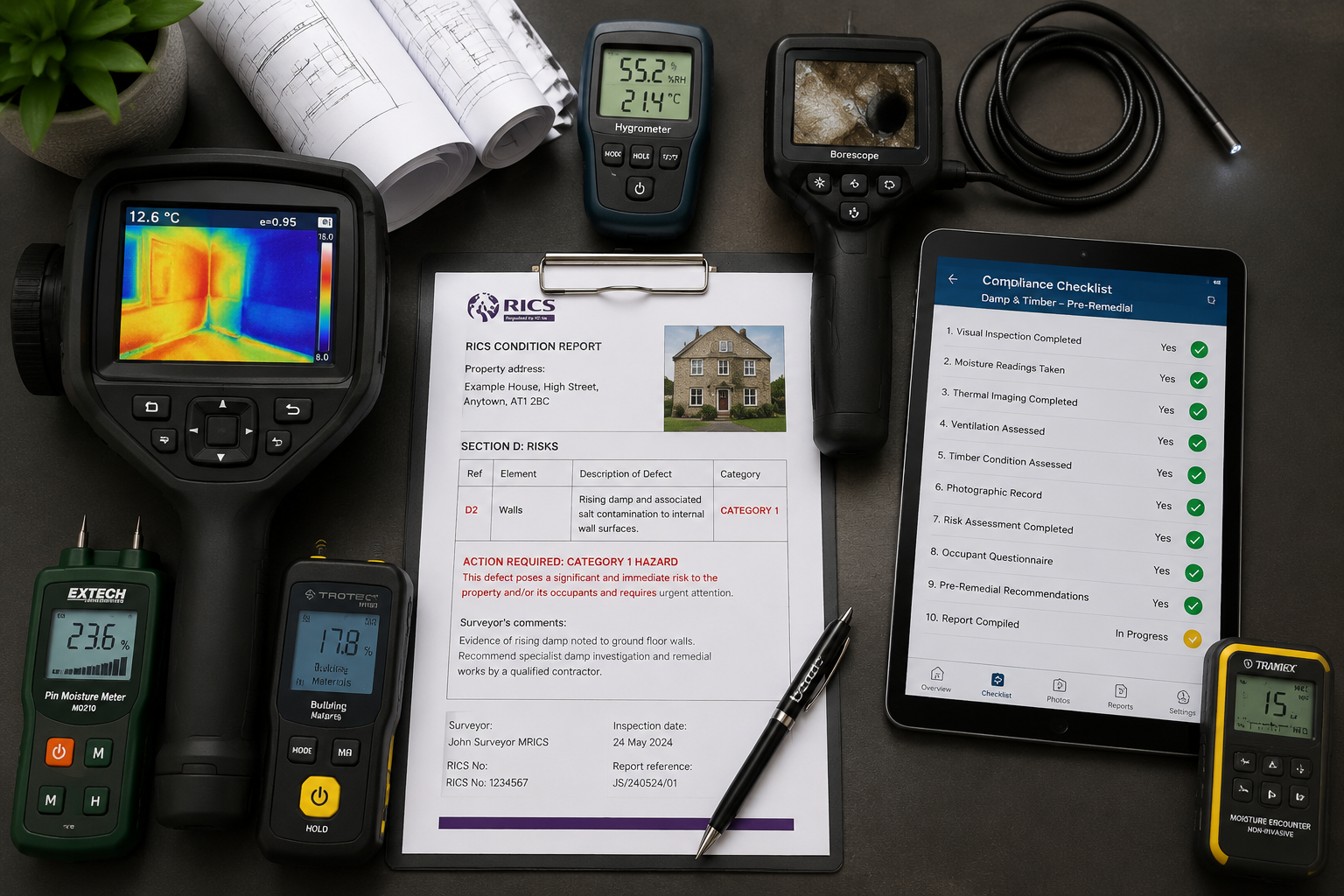
The most effective approach to damp and mould detection in building surveys under post-Awaab's Law protocols for private rental properties in 2026 is a proactive, structured compliance framework built into every survey from the outset — not retrofitted as an afterthought.
Pre-Tenancy Survey Checklist
Surveyors advising private landlords should integrate the following into pre-tenancy and condition reports [6]:
- Moisture baseline readings — record moisture content in walls, floors, and ceilings at multiple points throughout the property
- Ventilation adequacy assessment — check that extract fans in kitchens and bathrooms meet minimum flow rates, that trickle vents are present and unobstructed, and that habitable rooms have adequate air changes
- Heating system functionality — confirm that all rooms can be heated to at least 18°C (21°C in rooms used by children or elderly occupants)
- Building fabric integrity — inspect roof coverings, gutters, downpipes, external render, pointing, window seals, and threshold details for potential water ingress points
- Thermal performance — identify cold bridges at junctions, reveals, and lintels where condensation is most likely to form
- Previous damp history — review any prior survey reports, maintenance records, or tenant complaints for recurring issues
This structured approach does more than satisfy legal requirements. It creates a defensible record that protects both the surveyor and the landlord if a dispute arises later.
What a Compliant Survey Report Must Include
A survey report produced under Awaab's Law compliance standards should contain [2][6]:
- Photographic evidence of all damp and mould findings, with date and location stamps
- Instrument readings — moisture meter percentages, relative humidity levels, and thermal imaging screenshots where applicable
- Root cause diagnosis — a clear statement of the probable cause(s) with supporting evidence
- HHSRS hazard classification — Category 1 or Category 2, with justification
- Remediation recommendations — specific, actionable steps listed in priority order
- Timeline guidance — explicit reference to the landlord's legal obligations under Awaab's Law timelines
- Referral recommendations — where specialist investigation is needed (e.g., structural engineer for suspected rising damp, plumber for concealed leaks)
A Level 3 full building survey provides the most comprehensive framework for this level of investigation, particularly in older properties where multiple damp causes may be present simultaneously. For landlords uncertain about which level of survey is appropriate, the complete guide to choosing the right property survey provides a useful starting point.
Surveyor Liability Under the New Regime
The extension of Awaab's Law to private rentals has sharpened the professional liability landscape for surveyors considerably. A surveyor who fails to identify a Category 1 damp hazard using available technology — particularly when thermal imaging or non-invasive moisture testing would have revealed it — may face claims of professional negligence if a tenant suffers health consequences.
Key liability management steps include:
- Documenting limitations — always state clearly in the report what areas were inaccessible and why, and recommend further investigation where access was restricted
- Using calibrated equipment — instruments should be regularly calibrated and records kept; uncalibrated readings are difficult to defend
- Maintaining professional indemnity insurance — ensure cover is adequate for the scope of surveys being undertaken
- Keeping up with RICS guidance — the Royal Institution of Chartered Surveyors continues to update its practice standards in response to legislative changes
For landlords managing multiple properties or blocks, integrating damp survey requirements into a broader building survey programme is both cost-effective and legally prudent. Those managing leasehold blocks should also consider how service charge structures can accommodate planned damp remediation works — a topic addressed in detail within service charge management guidance.
Tenant Rights and the Reporting Process
Tenants in private rented properties now have the same rights as social housing tenants under Awaab's Law [1][5]. They are entitled to:
- A formal investigation within 10 working days of reporting a significant hazard
- A written summary of findings within 3 working days of the investigation
- Remediation of immediate risks within 5 working days
- Emergency action within 24 hours for life-threatening hazards
Tenants who believe their landlord is not complying can escalate to the local authority, which has enforcement powers including improvement notices, prohibition orders, and civil penalties. Surveyors producing reports for tenants — rather than landlords — should be aware that their findings may form the basis of enforcement action and should be prepared to defend their methodology and conclusions accordingly.
Conclusion
The extension of Awaab's Law to private rental properties from May 2026 has permanently raised the bar for damp and mould detection in building surveys. Surface-level visual inspections are no longer fit for purpose. Compliant surveys now require calibrated instruments, root-cause diagnosis, HHSRS hazard classification, and reports structured to support landlords in meeting precise legal timelines.
Actionable next steps for landlords and surveyors in 2026:
- Commission a pre-tenancy condition survey for every rental property that includes baseline moisture readings and ventilation assessments before a new tenancy begins
- Ensure the surveyor engaged is RICS-accredited and uses thermal imaging alongside standard moisture meters
- Establish a written damp and mould reporting procedure for tenants and train any managing agents on the 10-working-day investigation trigger
- Review existing tenancies for any outstanding damp complaints and assess whether they now trigger Awaab's Law obligations
- Where a Category 1 hazard is identified, act immediately — do not wait for the investigation window to expire before commissioning remediation quotes
The legal, financial, and reputational risks of non-compliance are now substantial. A proactive, instrument-led approach to damp and mould surveys is not just good practice — in 2026, it is a legal requirement.
References
[1] Awaabs Law Guidance For Tenants In Social Housing – gov.uk
[2] Damp And Mould Surveys Under Awaabs Law Pre May 2026 Protocols For Private Sector Landlords – Damp and mould surveys under awaabs law pre may 2026 protocols for private sector landlords
[3] Awaabs Law Compliance In Rental Surveys Detecting And Reporting Damp Mould And Housing Hazards – wimbledonsurveyors.com
[4] Damp Mould Enforcement Timeline – prscheck.co.uk
[5] Awaabs Law Landlord Guide 2026 – letsafeuk.co.uk
[6] Awaabs Law Extensions 2026 Building Survey Protocols For Damp Mould And New Hazards In Private Rentals – kingstonsurveyors.com
[7] Mould Surveys – idealresponse.co.uk