

Council Property Surveyor: Your Complete Guide to This Essential Public Service Role
When local councils across the UK manage thousands of properties worth billions of pounds, who ensures these valuable public assets remain safe, compliant, and fit for purpose? The answer lies with the council property surveyor—a specialist professional responsible for maintaining and protecting the extensive property portfolios that serve communities nationwide. In 2026, as housing demands intensify and building regulations evolve, understanding the role of a council property surveyor has never been more critical for both public sector professionals and residents alike.
Key Takeaways
- Council property surveyors manage and maintain public sector property portfolios, ensuring safety, compliance, and value for taxpayers
- These professionals require specialized qualifications including RICS accreditation and extensive knowledge of building regulations and local authority procedures
- The role encompasses diverse responsibilities from condition surveys and maintenance planning to budget management and community engagement
- Career prospects in council property surveying remain strong in 2026, with competitive salaries and opportunities for professional development
- Understanding when to engage a council property surveyor helps property owners, tenants, and neighboring residents navigate public sector property matters effectively
What Is a Council Property Surveyor?
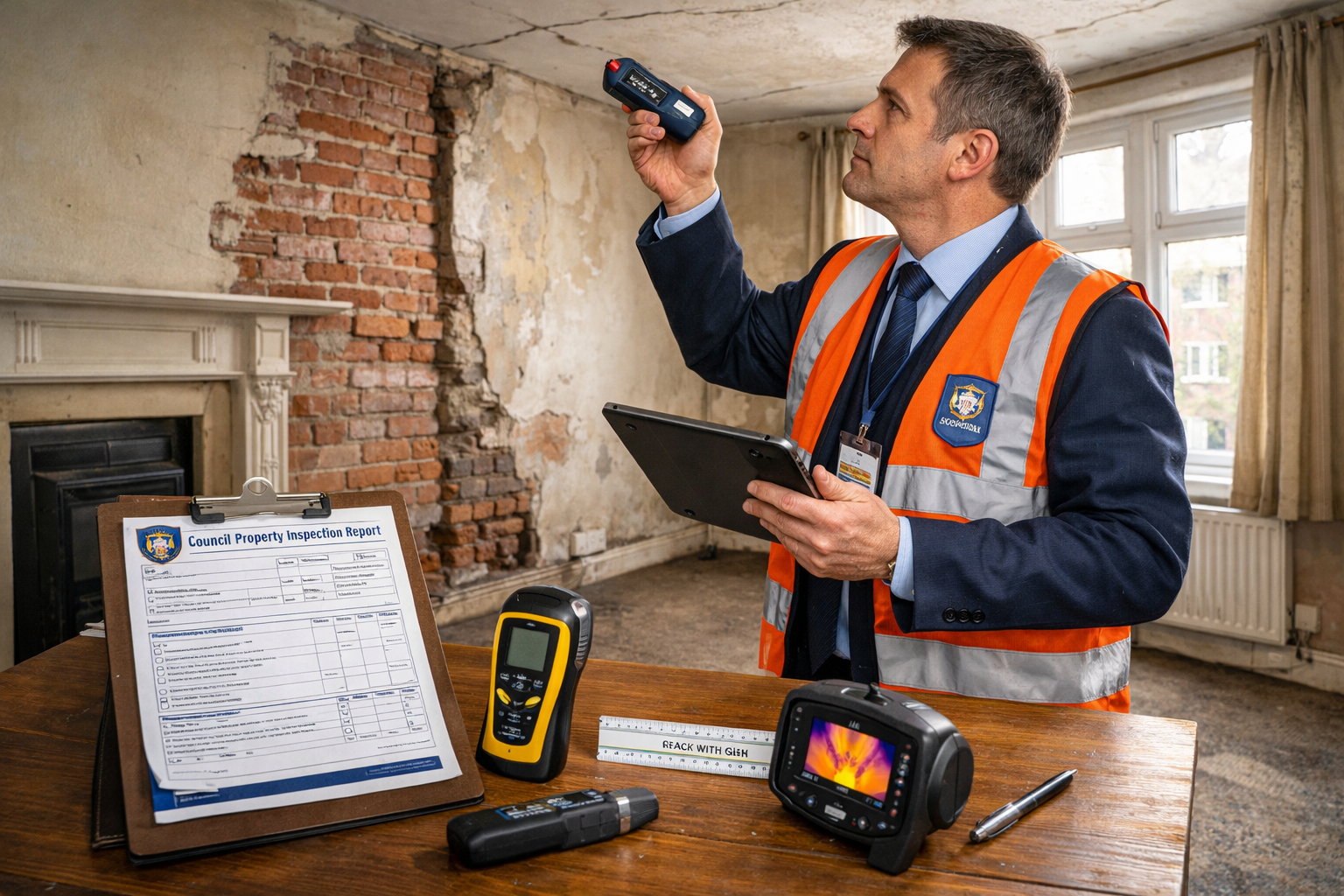
A council property surveyor is a chartered professional employed by local authorities to oversee the management, maintenance, and strategic development of publicly-owned properties. Unlike private sector surveyors who work for individual clients or commercial firms, council property surveyors serve the public interest by ensuring that municipal buildings, social housing, community facilities, and other council-owned assets meet required standards.
These specialists operate at the intersection of property management, public service, and community development. Their work directly impacts thousands of residents who live in council housing, use community facilities, or interact with local government buildings daily.
Core Responsibilities
The duties of a council property surveyor extend far beyond simple property inspections. Their comprehensive role includes:
- 🏢 Asset Management: Maintaining detailed records of all council-owned properties and their condition
- 📋 Compliance Monitoring: Ensuring buildings meet health and safety regulations, fire safety standards, and accessibility requirements
- 💰 Budget Planning: Managing maintenance budgets and prioritizing repair work based on urgency and available resources
- 🔍 Condition Surveys: Conducting regular inspections to identify defects, deterioration, and necessary improvements
- 📊 Strategic Planning: Advising council leadership on property acquisition, disposal, and long-term estate management
- 👥 Stakeholder Engagement: Working with tenants, community groups, and contractors to coordinate property-related activities
For property owners seeking to understand the broader context of professional surveying services, exploring why property owners hire surveyors provides valuable insights into the profession.
Qualifications and Skills Required for Council Property Surveyors
Becoming a council property surveyor demands a rigorous combination of formal education, professional certification, and practical experience. The pathway to this career reflects the significant responsibility these professionals carry in managing public assets.
Educational Requirements
Academic Foundation:
- Degree in Building Surveying, Property Management, or related field (typically BSc or MSc)
- RICS-accredited university program preferred
- Strong foundation in construction technology, building pathology, and property law
Professional Accreditation:
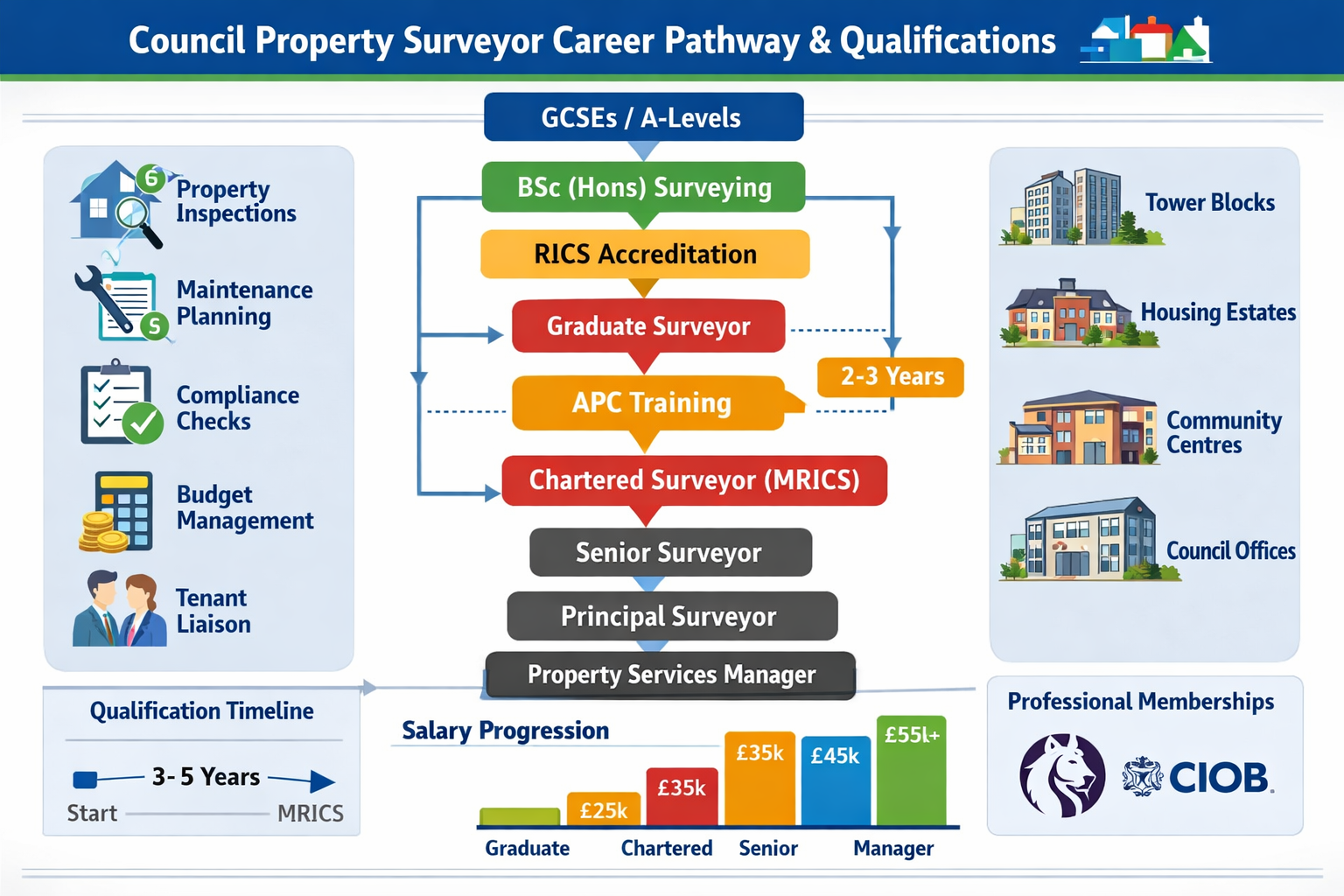
- Royal Institution of Chartered Surveyors (RICS) membership (AssocRICS or MRICS)
- Completion of Assessment of Professional Competence (APC)
- Continuing Professional Development (CPD) requirements maintained annually
Essential Skills and Competencies
| Skill Category | Specific Competencies |
|---|---|
| Technical Knowledge | Building construction, defect diagnosis, building regulations, health and safety legislation |
| Analytical Abilities | Risk assessment, condition analysis, cost-benefit evaluation, priority setting |
| Communication | Report writing, stakeholder engagement, public speaking, negotiation |
| Technology | CAD software, building information modeling (BIM), asset management systems |
| Financial | Budget management, cost estimation, value engineering, procurement |
| Regulatory | Planning law, environmental regulations, accessibility standards, fire safety |
The complexity of modern building standards means council property surveyors must stay current with evolving regulations. Understanding common defects in older homes becomes particularly relevant when managing historic council properties.
The Day-to-Day Work of a Council Property Surveyor
Understanding what a council property surveyor actually does on a daily basis reveals the diverse and dynamic nature of this public service role. Each day presents unique challenges across the council’s property portfolio.
Typical Daily Activities
Morning: Reviewing overnight emergency reports, prioritizing urgent repair requests, and planning site visits across multiple council properties. The surveyor might examine a reported structural issue in a 1960s tower block, assess water damage in a community center, or evaluate a tenant’s maintenance complaint.
Midday: Conducting on-site inspections with contractors, meeting with council housing officers to discuss planned maintenance programs, and reviewing quotations for upcoming repair work. Documentation forms a crucial part of every inspection, with detailed photographs, measurements, and notes recorded systematically.
Afternoon: Preparing condition reports, updating asset management databases, attending budget meetings with finance teams, and responding to queries from elected council members about property matters affecting their constituents.
Seasonal Variations
The workload of council property surveyors fluctuates throughout the year:
- Winter: Increased focus on heating system failures, weather damage assessments, and emergency repairs
- Spring: Planning annual maintenance programs, scheduling external decoration work, conducting post-winter condition surveys
- Summer: Implementing major refurbishment projects, external building work, and estate improvement schemes
- Autumn: Preparing properties for winter, completing pre-budget condition assessments, and finalizing annual reports
Types of Properties Managed by Council Property Surveyors
The portfolio overseen by a council property surveyor encompasses remarkable diversity, requiring adaptability and broad technical knowledge across multiple building types and eras.
Residential Properties
Social Housing Stock:
- High-rise tower blocks (1960s-1970s construction)
- Low-rise housing estates and terraced properties
- Sheltered accommodation for elderly residents
- Temporary housing and emergency accommodation
- Mixed-use developments with ground-floor commercial units
Special Considerations:
Council housing often includes buildings with unique challenges such as non-traditional construction methods, asbestos management requirements, and the need to balance maintenance with minimal disruption to residents. Building inspections and surveys for homeowners shares principles that council surveyors apply when assessing residential properties.
Non-Residential Council Assets
Community and Public Buildings:
- Libraries and community centers
- Sports facilities and leisure centers
- Council offices and administrative buildings
- Museums, galleries, and cultural venues
- Parks infrastructure and public toilets
- Depots, workshops, and storage facilities
Commercial Properties:
- Retail units owned by the council
- Industrial estates and business parks
- Market buildings and trading spaces
- Car parks and transport facilities
Each property type presents distinct surveying challenges, from heritage conservation in listed buildings to modern accessibility standards in newly constructed facilities.
How Council Property Surveyors Differ from Private Sector Surveyors
While all chartered surveyors share fundamental professional standards, the council property surveyor operates within a unique context that distinguishes their work from private practice colleagues.
Key Differences
1. Client and Accountability
- Council Surveyors: Serve the public interest and are accountable to elected officials and taxpayers
- Private Surveyors: Work for individual clients or commercial organizations with specific business objectives
2. Budget Constraints
Council property surveyors must work within strict public sector budgets, often prioritizing essential safety work over aesthetic improvements. Financial decisions undergo scrutiny through democratic processes and public accountability mechanisms.
3. Property Portfolio Scale
A single council surveyor might oversee hundreds or thousands of properties simultaneously, requiring sophisticated asset management systems and prioritization frameworks that differ from the focused approach possible in private practice.
4. Regulatory Environment
Public sector property management involves additional layers of regulation, including public procurement rules, freedom of information requirements, and political oversight that private surveyors rarely encounter.
5. Social Objectives
Beyond technical property management, council surveyors contribute to broader social goals such as reducing fuel poverty, improving community wellbeing, and supporting vulnerable residents—objectives that extend beyond pure property economics.
For those considering structural engineering needs, understanding the distinction between council and private sector approaches helps clarify which professional pathway best suits specific property challenges.
When and Why You Might Interact with a Council Property Surveyor
Residents, property owners, and businesses encounter council property surveyors in various circumstances, each requiring different approaches and understanding of public sector processes.
Common Scenarios
As a Council Tenant:
- Reporting significant property defects requiring professional assessment
- Requesting adaptations for disability or medical needs
- Disputing responsibility for repairs between tenant and landlord
- Participating in planned improvement programs for your estate
As a Neighboring Property Owner:
- Addressing boundary disputes with council-owned land
- Coordinating construction work that might affect council property
- Understanding party wall matters involving council buildings
- Reporting concerns about the condition of adjacent council properties
As a Community Organization:
- Seeking lease arrangements for council-owned community spaces
- Requesting property improvements to facilities you use
- Participating in consultation about estate regeneration projects
- Reporting safety concerns about public buildings
As a Contractor or Consultant:
- Tendering for council maintenance or refurbishment contracts
- Coordinating access for utility work affecting council properties
- Providing specialist services commissioned by the council’s property team
How to Engage Effectively
✅ Prepare Documentation: Gather relevant photographs, previous correspondence, and specific details about the property concern
✅ Use Official Channels: Contact the council’s property services department through established reporting systems rather than informal approaches
✅ Be Patient: Public sector processes involve multiple approvals and budget considerations that may extend timelines
✅ Understand Priorities: Emergency safety issues receive immediate attention, while cosmetic concerns may be scheduled within planned maintenance cycles
Career Prospects and Salary Expectations for Council Property Surveyors in 2026
The employment landscape for council property surveyors in 2026 reflects both challenges and opportunities within the public sector property management field.
Salary Ranges
Entry Level (Graduate/Trainee):
- £25,000 – £32,000 annually
- Typically includes APC support and study leave
- Opportunity to gain diverse experience across property types
Qualified Surveyor (MRICS):
- £35,000 – £48,000 annually
- Managing specific portfolio areas or specialist functions
- Increased responsibility for budget management and team coordination
Senior/Principal Surveyor:
- £48,000 – £65,000 annually
- Strategic oversight of major property programs
- Leadership of surveying teams and policy development
Head of Property Services:
- £65,000 – £85,000+ annually
- Executive-level responsibility for entire council estate
- Strategic advisor to senior council leadership
Benefits Beyond Salary
Council employment typically includes:
- 💼 Pension: Generous Local Government Pension Scheme (LGPS) with employer contributions
- 🏖️ Annual Leave: 25-30 days plus bank holidays
- 📚 Professional Development: Funded CPD, conference attendance, and qualification support
- ⚖️ Work-Life Balance: Generally better than private sector equivalents
- 🔒 Job Security: Greater stability than commercial practice
Market Demand
The 2026 employment market for council property surveyors remains robust due to:
- Aging public sector workforce creating succession planning needs
- Expanding regulatory requirements demanding specialist expertise
- Government investment in social housing and building safety
- Increased focus on sustainability and net-zero carbon targets for public buildings
Those interested in broader property management careers can explore professional property management habits to understand complementary skills.
Challenges Facing Council Property Surveyors
The role of council property surveyor comes with significant challenges that test professional expertise and personal resilience in equal measure.
Budget Constraints and Competing Priorities
Public sector austerity has dramatically reduced council budgets since 2010, forcing property surveyors to make difficult decisions about maintenance priorities. With limited funds, surveyors must balance:
- Immediate safety requirements versus long-term preventative maintenance
- Statutory compliance obligations versus tenant comfort improvements
- Emergency reactive repairs versus planned maintenance programs
- Political pressure for visible improvements versus essential but hidden infrastructure work
Building Safety and Regulatory Complexity
Post-Grenfell, building safety has become paramount, particularly for high-rise residential buildings. Council property surveyors face:
- Implementing complex fire safety assessments and remediation programs
- Managing cladding replacement projects with uncertain funding
- Navigating evolving Building Safety Act requirements
- Balancing resident safety with the practical challenges of major works in occupied buildings
Aging Housing Stock
Much of the UK’s council housing dates from the 1950s-1970s, presenting unique challenges:
- Non-traditional construction methods requiring specialist knowledge
- Asbestos management in older properties
- Outdated building services reaching end of life simultaneously
- Energy efficiency improvements needed to meet climate targets
Political and Public Scrutiny
Unlike private sector surveyors, council professionals work under constant public and political oversight:
- Freedom of Information requests requiring detailed justification of decisions
- Media interest in property-related controversies
- Political pressure to prioritize certain areas or property types
- Balancing professional judgment with democratic accountability
Technology and Innovation in Council Property Surveying
Modern council property surveyors increasingly leverage technology to manage complex portfolios more efficiently and effectively in 2026.
Digital Asset Management Systems
Advanced software platforms now enable:
- Real-time tracking of all council properties and their condition status
- Predictive maintenance scheduling based on building lifecycle data
- Mobile inspection tools allowing on-site data capture and instant reporting
- Integration with financial systems for accurate budget forecasting
Building Information Modeling (BIM)
Progressive councils adopt BIM for:
- Creating detailed digital twins of major council buildings
- Planning refurbishment work with greater accuracy
- Coordinating multi-disciplinary projects more effectively
- Maintaining comprehensive as-built records for future reference
Sustainability and Energy Assessment Tools
With net-zero carbon targets, surveyors utilize:
- Thermal imaging cameras to identify heat loss and insulation deficiencies
- Energy Performance Certificate (EPC) databases to prioritize improvement work
- Carbon accounting software to measure environmental impact
- Renewable energy feasibility assessment tools
Drone and Remote Inspection Technology
Unmanned aerial vehicles (UAVs) enable:
- Safe inspection of high-level building elements without scaffolding
- Rapid damage assessment after severe weather events
- Detailed roof surveys on large buildings
- Cost-effective monitoring of extensive estates
These technological advances complement rather than replace the professional judgment and expertise that define effective council property surveying.
The Future of Council Property Surveying
Looking ahead, the council property surveyor profession faces transformation driven by policy changes, technological advancement, and evolving social expectations.
Emerging Trends
Increased Focus on Sustainability:
Government commitments to net-zero carbon by 2050 will require massive retrofitting programs for council housing. Surveyors will lead:
- Deep energy efficiency upgrades across entire estates
- Installation of renewable energy systems
- Sustainable material selection for refurbishment projects
- Circular economy approaches to construction waste
Enhanced Building Safety Regime:
The Building Safety Act 2022 continues to reshape how high-risk buildings are managed, with council surveyors taking on:
- Accountable Person responsibilities for high-rise residential buildings
- Mandatory occurrence reporting systems
- Resident engagement duties
- Comprehensive safety case documentation
Data-Driven Decision Making:
Artificial intelligence and machine learning will increasingly support:
- Predictive maintenance forecasting
- Automated defect detection from inspection imagery
- Optimization of repair scheduling and resource allocation
- Risk assessment and priority setting across large portfolios
Community-Centered Approaches:
Modern council property management emphasizes:
- Co-design of improvement programs with residents
- Transparency in decision-making processes
- Social value considerations beyond pure property economics
- Integration of property management with wider community development goals
Skills for Tomorrow’s Council Property Surveyors
Future professionals will need:
- Enhanced digital literacy and data analysis capabilities
- Sustainability and environmental assessment expertise
- Strong stakeholder engagement and communication skills
- Understanding of social policy and community development
- Adaptability to rapidly changing regulatory environments
For those exploring the surveying profession more broadly, visiting the Prince Surveyors blog offers insights into industry developments and best practices.
How to Find and Work with Council Property Surveyors
Whether you’re a resident, neighboring property owner, or professional seeking to engage with council property services, understanding the proper channels ensures effective communication.
For Council Tenants
Reporting Property Issues:
- Contact your council’s housing repairs service (usually 24/7 for emergencies)
- Provide detailed information about the problem, including photographs if possible
- Reference your tenancy number and property address
- For complex structural issues, request a surveyor’s assessment
- Keep records of all correspondence and reference numbers
Requesting Improvements:
- Submit formal requests through your tenancy officer
- Participate in tenant consultation processes
- Join tenant and resident associations to advocate collectively
- Understand the council’s planned maintenance schedule for your area
For Neighboring Property Owners
Boundary and Party Wall Matters:
When your property adjoins council land or buildings, professional guidance becomes essential. Understanding party wall agreements and common misconceptions helps navigate these situations effectively.
Formal Communication:
- Write to the council’s property services department with specific concerns
- Include property addresses, photographs, and clear description of issues
- Request confirmation of receipt and expected response timeframe
- Escalate through formal complaints process if necessary
For Professionals and Contractors
Procurement Opportunities:
- Register on council supplier databases
- Monitor public sector tender portals
- Attend supplier engagement events
- Ensure appropriate insurance, qualifications, and references
Working Effectively with Council Surveyors:
- Understand public sector procurement rules and timelines
- Provide detailed, compliant quotations and documentation
- Maintain clear communication throughout contract delivery
- Recognize the accountability framework within which council surveyors operate
Comparing Council Property Surveyor Services Across the UK
The structure and delivery of council property surveyor services varies significantly across different local authorities, reflecting diverse approaches to public sector property management.
In-House vs. Outsourced Models
In-House Teams:
Many larger councils maintain dedicated surveying departments with employed professionals who:
- Develop deep knowledge of the local property portfolio
- Provide continuity and institutional memory
- Integrate closely with other council services
- Offer greater direct accountability to elected members
Outsourced Services:
Some authorities contract property surveying to private firms or housing associations, which can:
- Provide specialist expertise not available in-house
- Offer flexibility to scale services up or down
- Potentially reduce overhead costs
- Bring private sector innovation and efficiency
Hybrid Approaches:
Most councils use a combination, retaining core strategic functions in-house while outsourcing specialist or capacity work.
Regional Variations
London Boroughs:
- Manage some of the UK’s largest and most valuable public property portfolios
- Face unique challenges with high-rise buildings and diverse housing stock
- Often employ larger surveying teams with greater specialization
Metropolitan Authorities:
- Typically oversee substantial social housing estates
- Balance regeneration priorities with maintenance of existing stock
- Frequently collaborate across neighboring authorities on shared challenges
Rural and County Councils:
- Manage geographically dispersed property portfolios
- Often cover smaller populations but larger geographic areas
- May share surveying services with neighboring authorities
Understanding these variations helps set realistic expectations when engaging with your local council’s property services.
Conclusion: The Vital Role of Council Property Surveyors
The council property surveyor stands at the frontline of public service, managing billions of pounds worth of community assets that directly impact millions of lives. From ensuring the safety of high-rise housing to planning sustainable improvements that will serve future generations, these professionals balance technical expertise with social responsibility in ways that few other careers demand.
As we navigate 2026 and beyond, the importance of skilled council property surveyors will only increase. Climate change adaptation, building safety enhancement, housing quality improvement, and sustainable community development all depend on the professional judgment and dedicated service of these public sector specialists.
Next Steps
If you’re a council tenant or resident:
- Familiarize yourself with your council’s property services contact information
- Understand the proper channels for reporting concerns and requesting improvements
- Engage constructively with consultation processes about your estate
- Learn about essential things every homeowner should know to better understand property matters
If you’re considering a career as a council property surveyor:
- Research RICS-accredited degree programs in building surveying
- Seek graduate trainee positions with local authorities
- Join professional networks and attend industry events
- Develop both technical skills and understanding of public service values
If you need surveying services:
Whether for council or private properties, professional surveying expertise ensures informed decisions about property matters. Explore comprehensive surveying services to find qualified professionals who can assist with your property needs.
The council property surveyor profession offers a unique opportunity to combine technical expertise with meaningful public service, making tangible differences in communities every day. As housing challenges intensify and building standards evolve, these professionals will continue to play an indispensable role in maintaining the built environment that supports our society.