

The Grenfell Tower tragedy changed everything. Since 2017, the UK property market has been rocked by revelations about dangerous cladding, crumbling concrete, and hidden structural defects that have left thousands of homeowners trapped in unsellable properties. In 2026, understanding Cladding, RAAC and Hidden Defects: What a Modern UK Building Survey Must Cover in 2026 isn't just about protecting your investment—it's about protecting lives.
Recent government data reveals that as of September 2025, RAAC has been permanently removed from 62 schools across England, with over 42,000 pupils now learning in safer classrooms.[1] Seven NHS hospitals have completely eradicated RAAC with government support reaching £440 million.[1] Yet thousands of residential buildings remain at risk, and many property buyers remain unaware of the dangers lurking behind walls and above ceilings.
This comprehensive guide explains exactly what a thorough building survey must include in 2026, particularly for properties built between the 1960s and 1990s—the danger decades for both cladding and RAAC construction.
Key Takeaways
✅ Any building constructed between 1950 and 1990 requires RAAC assessment if no prior survey has been completed, as recent failures show RAAC can collapse without adequate visual warning.[2]
✅ Modern building surveys must include cladding identification, fire safety assessments, and thermal imaging to detect hidden defects that standard visual inspections miss.
✅ RAAC remediation timelines are government-mandated: all NHS buildings by 2035 and all schools by 2029, but residential property owners bear their own costs.[1]
✅ Duty holders—including building owners, landlords, and facilities managers—are legally responsible for identifying RAAC, assessing structural risk, and implementing appropriate safety measures.[1]
✅ Qualified surveyors with specific RAAC and cladding expertise are essential to ensure correct identification and compliance with current safety regulations.[1]
Understanding RAAC: The Hidden Concrete Crisis
What Is RAAC and Why Is It Dangerous?
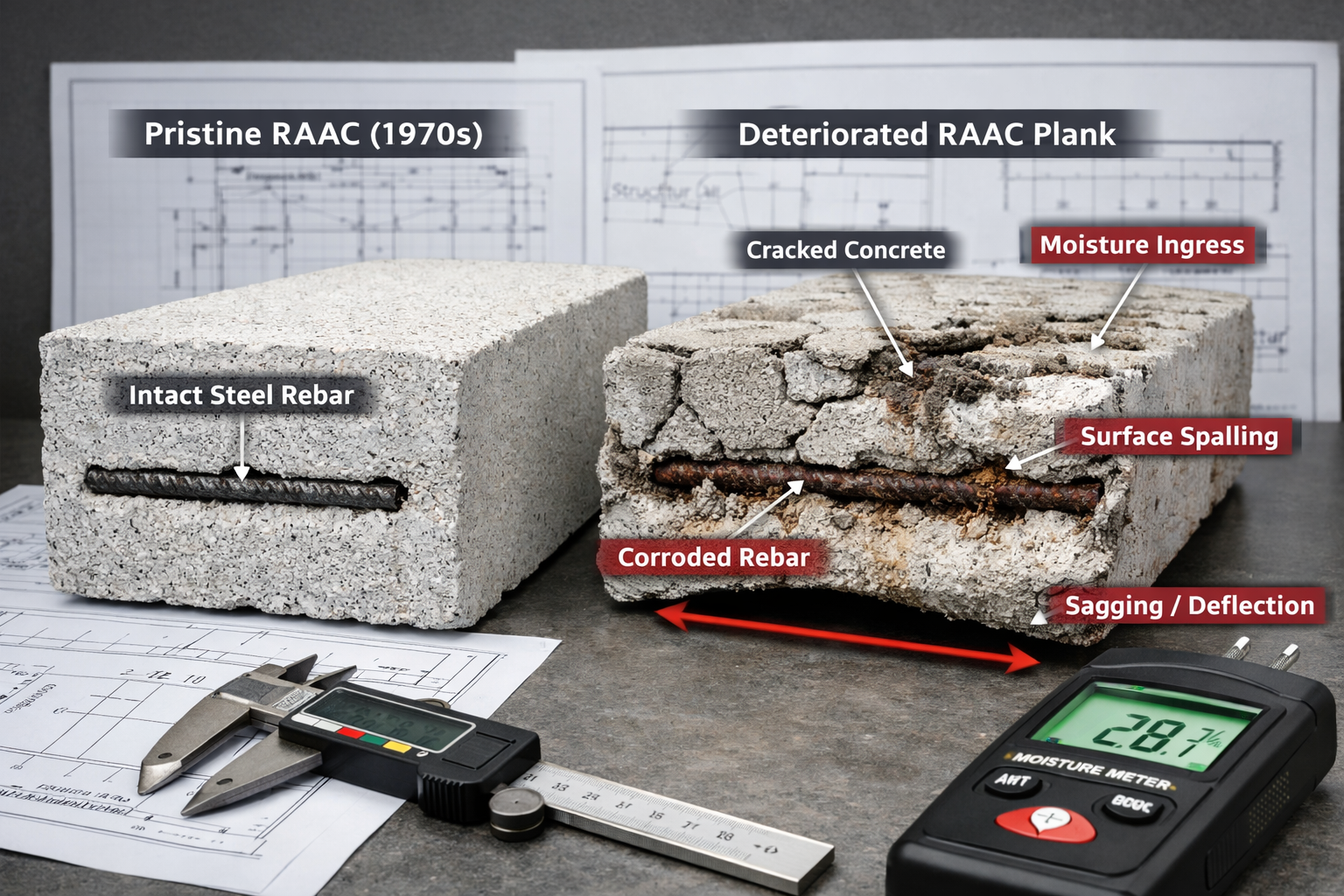
Reinforced Autoclaved Aerated Concrete (RAAC) is a lightweight concrete material used extensively in UK construction between 1950 and the mid-1990s. Unlike traditional concrete, RAAC contains air bubbles that make it lighter and cheaper to install—but also significantly weaker and more prone to deterioration.
RAAC was commonly used for:
- 🏫 Roof and floor planks in schools
- 🏥 Hospital ceiling panels
- 🏢 Commercial building structures
- 🏘️ Some residential developments
The material has a design life of approximately 30 years. Given that many RAAC buildings are now at least 38 years old, the risk of structural failure has dramatically increased.[3]
The Failure Pattern That Changed Everything
For decades, structural engineers believed that RAAC planks would provide adequate warning through visible deterioration—sagging, cracking, or surface damage—before catastrophic failure. This assumption was based on Building Research Establishment (BRE) investigations conducted in the 1990s and 2002.[3]
However, recent failures have shattered this confidence. Buildings have experienced sudden RAAC collapses without the expected visual warning signs, prompting urgent reassessment of safety protocols across the UK.[3]
In September 2023, the Institution of Structural Engineers (IStructE) reviewed their guidance following three RAAC failures and concluded that while existing guidance remained valid, continued monitoring is absolutely essential.[3]
Which Buildings Require RAAC Assessment?
According to current guidance, any building constructed between 1950 and 1990 should be assessed if no prior RAAC survey has been completed.[2] RAAC is particularly common in:
| Building Type | Risk Level | Priority |
|---|---|---|
| Educational facilities (schools, colleges) | High | Immediate |
| NHS hospitals and healthcare facilities | High | Immediate |
| Public sector buildings | Medium-High | Urgent |
| Commercial properties (offices, warehouses) | Medium | Priority |
| Emergency services buildings | Medium | Priority |
| Residential blocks (flats, apartments) | Medium | Important |
Understanding building defects and their implications is crucial when purchasing any property from this era.
Cladding Safety: What Every Building Survey Must Check
The Cladding Crisis Explained
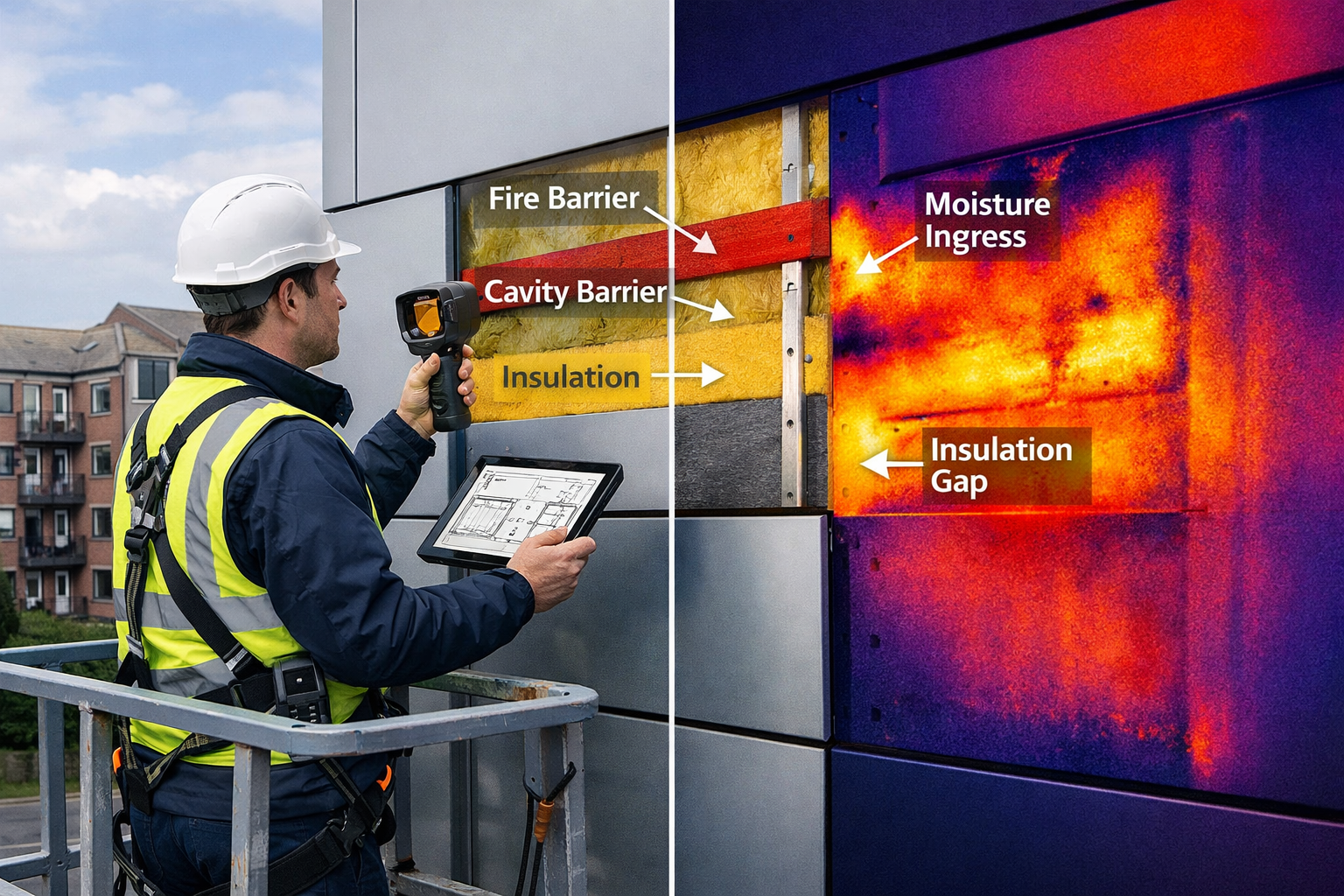
The Grenfell Tower fire in June 2017 exposed catastrophic failures in building safety regulations, particularly concerning aluminium composite material (ACM) cladding with combustible polyethylene cores. Since then, comprehensive cladding reviews have identified thousands of buildings with dangerous external wall systems.
In 2026, a competent building survey must thoroughly assess:
External Wall Materials:
- ACM cladding type and fire rating
- High-pressure laminate (HPL) panels
- Expanded polystyrene (EPS) insulation
- Timber cladding systems
- Render and insulation combinations
Fire Safety Features:
- Cavity barriers and fire breaks
- Compartmentation integrity
- Means of escape compliance
- Sprinkler system presence
- Fire door specifications
The EWS1 Form and Property Valuation
The External Wall System (EWS1) form was introduced to provide lenders with assurance about cladding safety. While the form has been revised and its use limited to buildings over 18 metres, cladding concerns continue to affect property values and mortgageability.
Buildings requiring remediation may face:
- 🚫 Unmortgageable status
- 💰 Significant service charge increases
- 📉 Property value reductions of 20-50%
- ⏳ Years-long remediation delays
- 🔥 Increased building insurance costs
When considering what questions to ask during a building survey, cladding safety should be at the top of the list for any flat or apartment building.
Thermal Imaging and Hidden Defects
Modern building surveys must go beyond visual inspection. Thermal imaging technology can reveal:
- Hidden moisture ingress behind cladding
- Insulation gaps and cold bridging
- Air leakage points
- Structural movement indicators
- Water penetration pathways
These hidden defects can cause progressive deterioration, structural damage, and health hazards from damp and mould growth. Understanding what causes moisture in buildings helps property buyers appreciate the importance of comprehensive moisture surveys.
What a Modern UK Building Survey Must Cover in 2026
Essential Components of a RAAC and Cladding Survey
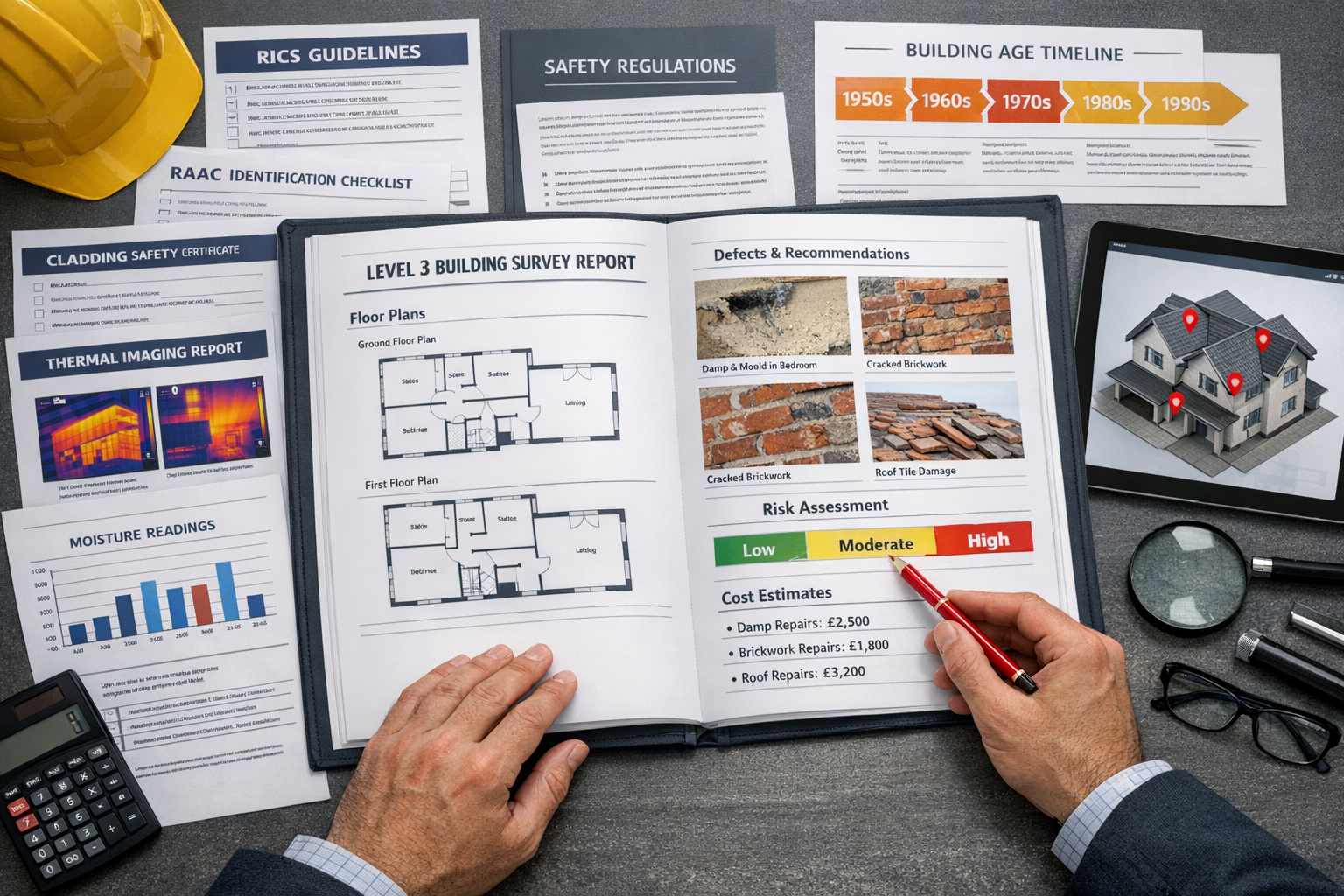
A compliant survey addressing Cladding, RAAC and Hidden Defects: What a Modern UK Building Survey Must Cover in 2026 must include multiple assessment layers:
1. Desktop Review and Historical Analysis
- Building age verification
- Original construction drawings review
- Planning and building control records
- Previous survey and maintenance reports
- Known RAAC or cladding issues in similar buildings
2. Visual Inspection Protocol
- External wall system examination
- Roof structure assessment (where accessible)
- Ceiling void inspection for RAAC planks
- Structural movement indicators
- Deterioration signs and patterns
3. Technical Investigation
- Intrusive investigation where required[2]
- Material sampling and laboratory testing
- Structural load calculations
- Fire safety compliance assessment
- Building regulations compliance review
4. Specialist Equipment Deployment
- Thermal imaging cameras
- Moisture meters and hygrometers
- Endoscopic cameras for cavity inspection
- Laser measuring devices
- Structural monitoring equipment
5. Comprehensive Reporting
The survey must identify the presence, condition, and location of RAAC elements and provide clear reports supporting duty holder compliance with safety regulations.[2]
Reports should include:
- ✅ Executive summary with risk ratings
- ✅ Detailed findings with photographic evidence
- ✅ Structural assessment conclusions
- ✅ Remediation recommendations with priority levels
- ✅ Cost estimates for required works
- ✅ Compliance status with current regulations
For properties requiring extensive investigation, understanding areas requiring further investigation helps buyers prepare for additional costs and timescales.
Risk-Based Remediation Hierarchy
When RAAC or dangerous cladding is identified, action follows a clear hierarchy:[2]
🔴 HIGH RISK (Immediate Action Required)
- Immediate temporary supports installation
- Access restrictions or building closure
- Emergency structural stabilisation
- Occupant evacuation if necessary
🟠 MEDIUM RISK (Programmed Remediation)
- Detailed structural assessment
- Remediation planning and specification
- Phased removal and replacement programme
- Enhanced monitoring protocols
🟡 LOW RISK (Monitoring and Maintenance)
- Regular inspection schedules
- Condition monitoring systems
- Preventative maintenance programmes
- Planned replacement scheduling
Specialist assessment clarifies priority, scope, and timing for each risk category. Properties with urgent or dangerous building issues require immediate professional intervention.
Choosing the Right Survey Level
For properties built between 1950 and 1990, a Level 3 Full Building Survey is strongly recommended. This comprehensive survey provides:
- Detailed inspection of accessible areas
- Specialist investigations where concerns arise
- Comprehensive defect analysis
- Remediation cost guidance
- Future maintenance planning
Understanding the difference between Level 2 and Level 3 surveys helps buyers choose appropriate protection for their circumstances.
Legal Responsibilities and Duty Holder Obligations
Who Is Responsible for RAAC and Cladding Safety?
Duty holders bear legal responsibility for ensuring structural safety. This includes:[1]
- 🏢 Building owners
- 🏘️ Landlords and freeholders
- 🔧 Facilities managers
- ⚖️ Those responsible for health and safety compliance
Duty holders must:
- Identify whether RAAC or dangerous cladding is present
- Assess the risk to building occupants
- Implement appropriate control measures
- Monitor structural condition on an ongoing basis
- Document all assessments and actions taken
Funding and Financial Implications
While government funding may be available for qualifying public buildings, residential property owners generally bear their own remediation costs.[1]
The Building Safety Act 2022 introduced protections for some leaseholders, but many property owners face:
- Remediation costs: £10,000 – £100,000+ per flat
- Interim safety measures: £5,000 – £20,000
- Increased insurance premiums: 200-500% increases
- Service charge increases for ongoing monitoring
- Property value reductions until remediation completes
Understanding budgeting for repairs and restoration becomes essential when purchasing affected properties.
The Importance of Qualified Surveyors
An appropriately-qualified surveyor should be engaged to ensure RAAC is correctly identified and surveys are conducted with appropriate skill and care.[1]
Look for surveyors with:
- ✅ RICS (Royal Institution of Chartered Surveyors) membership
- ✅ Specific RAAC identification training
- ✅ Cladding and fire safety expertise
- ✅ Professional indemnity insurance
- ✅ Experience with similar building types
- ✅ Access to specialist testing facilities
Formal contracts should be required for remedial works to provide additional legal protection.[1] When selecting professionals, consider building surveyor expertise in London and beyond.
Hidden Defects Beyond RAAC and Cladding
Other Critical Survey Considerations for 1960s-1990s Buildings
While RAAC and cladding dominate headlines, comprehensive surveys must also address:
Structural Concerns:
- High alumina cement concrete (HACC)
- Calcium chloride contamination
- Carbonation of concrete
- Steel reinforcement corrosion
- Foundation movement and subsidence
Building Services:
- Asbestos-containing materials (widespread in this era)
- Lead pipes and water supply systems
- Outdated electrical installations
- Inadequate thermal insulation
- Ventilation deficiencies
Environmental Health:
- Damp and condensation issues
- Mould growth and air quality
- Radon gas exposure
- Noise insulation inadequacy
- Energy efficiency deficiencies
Properties from this period often contain asbestos requiring specialist surveys before any renovation or demolition work.
The Value of Specialist Investigations
When surveys identify potential concerns, specialist investigations provide definitive answers:
| Investigation Type | Purpose | Typical Cost |
|---|---|---|
| Concrete core sampling | RAAC/HACC identification | £800 – £2,000 |
| Cladding fire testing | Combustibility assessment | £1,500 – £5,000 |
| Structural calculations | Load capacity verification | £1,000 – £3,000 |
| Asbestos survey | Material identification | £300 – £800 |
| Electrical testing | Safety compliance | £200 – £500 |
| Drainage survey | System condition | £300 – £1,200 |
Understanding how long a building survey takes helps buyers plan their purchase timeline appropriately.
Protecting Yourself as a Property Buyer
Pre-Purchase Due Diligence Checklist
When considering a property built between 1950 and 1990, take these protective steps:
Before Making an Offer:
- ✅ Research building age and construction type
- ✅ Check for known RAAC or cladding issues
- ✅ Review freeholder communications about building safety
- ✅ Confirm EWS1 form status (if applicable)
- ✅ Verify building insurance availability and cost
During Survey Process:
- ✅ Commission Level 3 Full Building Survey
- ✅ Specify RAAC and cladding assessment requirements
- ✅ Request thermal imaging and moisture surveys
- ✅ Obtain specialist investigations for identified concerns
- ✅ Review all documentation thoroughly
Before Exchange:
- ✅ Obtain written confirmation of structural safety
- ✅ Clarify responsibility for any required remediation
- ✅ Negotiate price reductions for identified defects
- ✅ Secure appropriate warranties and indemnities
- ✅ Confirm mortgage lender satisfaction with survey findings
For comprehensive guidance, review building problems and solutions resources.
Negotiating After Survey Findings
Survey findings often provide leverage for price negotiation:
Documented RAAC presence:
- Expected reduction: 15-30% of property value
- Alternative: Vendor completes remediation before completion
- Protection: Retention of funds until safety confirmed
Cladding safety concerns:
- Expected reduction: 20-50% depending on severity
- Alternative: Vendor obtains EWS1 form or remediation plan
- Protection: Indemnity insurance or warranty arrangements
Other significant defects:
- Reduction based on remediation cost estimates
- Typically 100-150% of estimated repair costs
- Reflects inconvenience, risk, and future liability
Understanding average price reductions after surveys provides realistic negotiation expectations.
Insurance and Long-Term Protection
Building insurance for properties with RAAC or cladding issues can be challenging:
- Some insurers refuse cover entirely
- Premium increases of 200-500% are common
- Excess amounts may increase significantly
- Coverage limitations may apply
Verify insurance availability before committing to purchase. Review what is covered under home insurance to understand standard policy limitations.
Future Outlook: Government Timelines and Industry Changes
Official Remediation Deadlines
The UK government has established clear timelines for RAAC removal:[1]
- All NHS buildings: RAAC removal by 2035
- All schools and colleges: RAAC removal by 2029
- Residential buildings: No mandated timeline (owner responsibility)
As of September 2025, significant progress has been made:
- 62 schools now RAAC-free (42,000+ pupils safe)[1]
- 7 NHS hospitals completely remediated[1]
- 12 additional hospitals on track for completion by March 2026[1]
However, thousands of residential and commercial properties remain at risk with no government funding assistance.
Evolving Survey Standards and Regulations
The building survey profession continues to adapt to emerging risks:
Enhanced surveyor training:
- Mandatory RAAC identification modules
- Cladding and fire safety specialisation
- Thermal imaging certification
- Material testing competencies
Improved reporting standards:
- Standardised risk assessment frameworks
- Clear remediation priority guidance
- Cost estimation protocols
- Regulatory compliance checklists
Technology integration:
- 3D laser scanning for structural analysis
- Drone surveys for high-level inspection
- AI-assisted defect identification
- Digital reporting platforms
Staying informed about building pathology advances ensures buyers receive current best-practice assessments.
Market Impact and Property Values
The RAAC and cladding crises continue to reshape the UK property market:
Short-term effects (2026-2028):
- Continued price suppression for affected properties
- Mortgage lending restrictions for high-risk buildings
- Insurance market challenges
- Increased transaction failures
Medium-term outlook (2028-2032):
- Gradual remediation completion for priority buildings
- Market stabilisation as safety clarity improves
- Premium pricing for remediated properties
- Enhanced buyer confidence with comprehensive surveys
Long-term implications (2032+):
- Stricter building regulations for new construction
- Enhanced maintenance requirements for existing buildings
- Improved transparency in property transactions
- Greater professional accountability for surveyors and developers
Conclusion
Understanding Cladding, RAAC and Hidden Defects: What a Modern UK Building Survey Must Cover in 2026 is no longer optional for property buyers—it's essential for safety, financial protection, and peace of mind. The revelations of recent years have fundamentally changed how we assess building safety, particularly for properties constructed between 1950 and 1990.
A comprehensive modern building survey must go far beyond traditional visual inspection. It requires specialist knowledge, technical equipment, intrusive investigation where necessary, and clear reporting that identifies risks and guides remediation decisions. The stakes are simply too high to accept anything less.
Your Action Plan
If you're considering purchasing a property from the danger decades:
- Commission a Level 3 Full Building Survey from a RICS-qualified surveyor with specific RAAC and cladding expertise
- Request specialist investigations for any identified concerns—don't accept uncertainty
- Verify insurance availability before committing to purchase
- Negotiate appropriately based on documented findings and remediation costs
- Seek legal advice regarding duty holder responsibilities and potential liabilities
For properties already owned, duty holders must:
- Arrange professional assessment if no recent survey has been completed
- Implement recommended safety measures without delay
- Document all actions taken to demonstrate compliance
- Monitor structural condition on an ongoing basis
- Plan and budget for necessary remediation works
The building safety landscape continues to evolve, but one principle remains constant: professional, comprehensive assessment is the foundation of safe property ownership. Don't gamble with your investment or your safety—ensure your building survey covers everything that matters in 2026.
For expert guidance on comprehensive building surveys that address all modern safety concerns, consult with qualified professionals who understand the complexities of RAAC, cladding, and hidden defects. Your property's safety—and your financial security—depend on it.
References
[1] Reinforced Autoclaved Aerated Concrete Raac – https://www.brownejacobson.com/insights/2026-horizon-scanning-in-construction/reinforced-autoclaved-aerated-concrete-raac
[2] Raac – https://www.starfishconstruction.com/raac
[3] Information Reinforced Autoclaved Aerated Concrete Raac – https://www.local.gov.uk/topics/housing-and-planning/information-reinforced-autoclaved-aerated-concrete-raac