

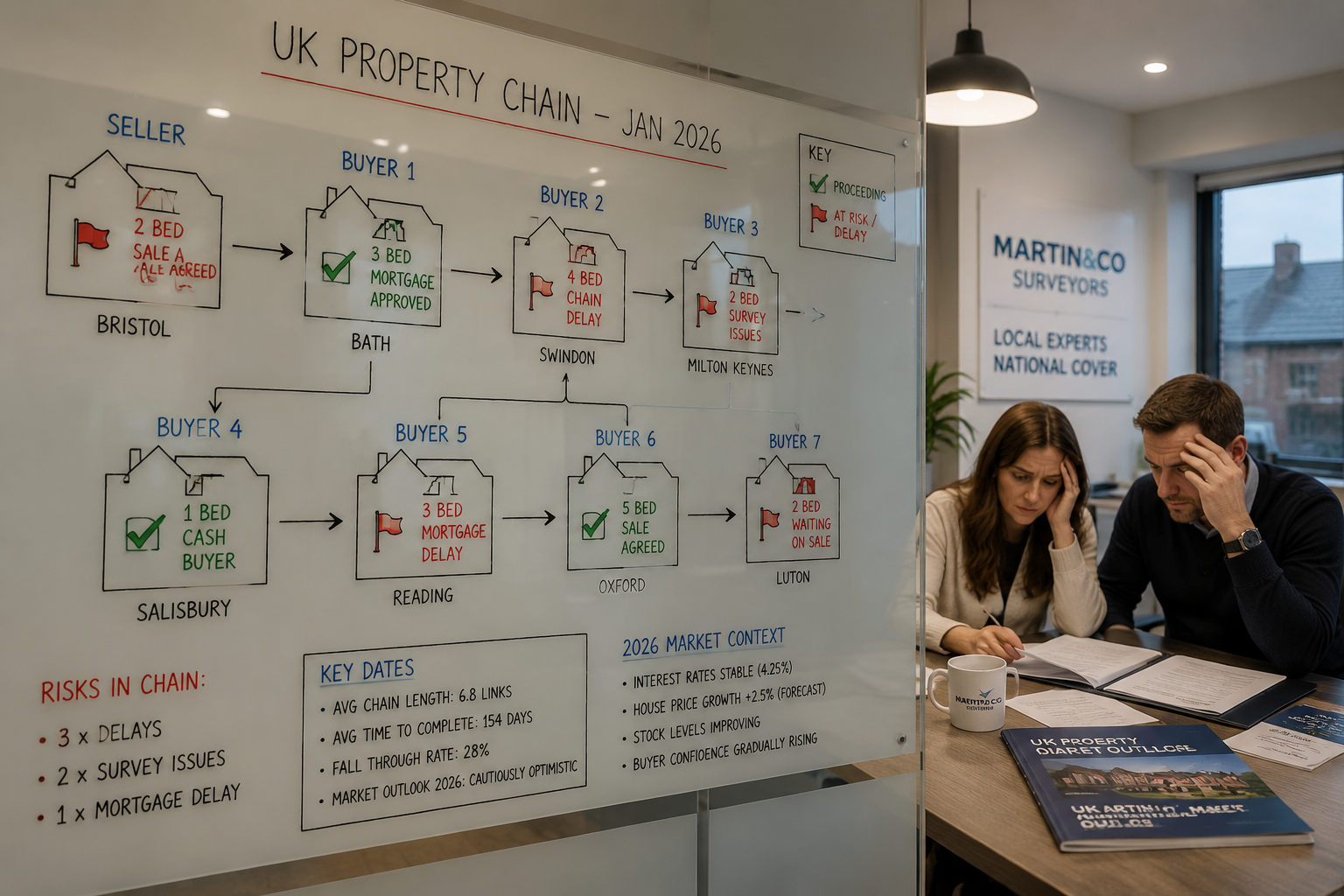
One in three property transactions in the UK collapses before completion — and a significant share of those failures trace back to survey findings that arrived too late, were poorly understood, or were never commissioned at all. In a 2026 market where buyer confidence remains fragile and lenders are scrutinising properties more closely than ever, Chartered Surveyors in 2026 Chains: How Better Surveys Can Cut Delays and Fall‑Throughs in a Cautious Market has become far more than a professional credential story. It is a transaction-certainty story — one where the right survey, delivered clearly and sequenced intelligently, can be the difference between a chain that completes and one that collapses.
Key Takeaways 📋
- Fall-throughs are preventable. Most chain collapses linked to survey findings stem from poor timing, unclear reporting, or choosing the wrong survey level — not from unfixable defects.
- Risk prioritisation matters. A well-structured survey report that separates urgent defects from routine maintenance items empowers buyers to negotiate rather than panic.
- Survey sequencing can compress timelines. Commissioning surveys earlier in the conveyancing process reduces the window for chain-breaking surprises.
- Accessible language saves deals. Reports written in plain English reduce the likelihood of buyers overreacting to technical jargon and withdrawing unnecessarily.
- The right survey level is non-negotiable. Matching survey depth to property age and condition is the single most effective way to avoid costly post-completion discoveries.
Why 2026 Is a Pivotal Year for Property Chains
The 2026 housing market is operating under a distinctive set of pressures. Mortgage affordability remains stretched for many buyers, transaction volumes are below the peaks seen in earlier years, and buyers are exercising greater caution at every stage. Estate agents report longer average times between offer acceptance and exchange, and lenders are increasingly requesting additional structural evidence before releasing funds on older or non-standard properties.
In this environment, abortive costs — the money spent on surveys, legal fees, and searches when a transaction fails — are felt more acutely. The average abortive cost per failed transaction for a buyer can run into several thousand pounds. For sellers, a collapsed chain can mean months of lost time and a property that returns to market with a stigma attached.
This is precisely why the role of chartered surveyors has evolved. Rather than being seen as a regulatory box-ticking exercise, the best surveyors in 2026 are functioning as transaction-certainty specialists — professionals who identify risk early, communicate it clearly, and help all parties make informed decisions before the chain becomes too fragile to survive a shock.
💬 "The surveyor's job is not just to find problems. It is to give buyers and sellers the information they need to keep a deal alive — or to walk away before costs escalate further."
Understanding the Chain: Where Delays and Fall‑Throughs Actually Begin
Before exploring how better surveys help, it is worth understanding where chains actually break down.
The Anatomy of a Chain Collapse
| Trigger | Estimated Contribution to Fall-Throughs |
|---|---|
| Survey findings (unexpected defects) | ~28% |
| Buyer change of mind / financial issues | ~25% |
| Gazumping or seller withdrawal | ~18% |
| Conveyancing delays (searches, legal queries) | ~17% |
| Mortgage valuation problems | ~12% |
Survey-related collapses are the single largest preventable category. Unlike a buyer changing their mind or a seller accepting a higher offer, defect-driven fall-throughs can often be resolved through renegotiation, specialist reports, or remediation quotes — if the information arrives at the right time and is communicated in the right way.
The Timing Problem
A common pattern in failed chains runs like this: an offer is accepted, solicitors are instructed, searches are ordered — and the survey is commissioned weeks later, often only after the buyer has already incurred significant legal costs. When a serious defect then emerges, the buyer faces a difficult choice: absorb the risk, attempt a late renegotiation, or withdraw entirely. At that late stage, withdrawal is far more likely.
Earlier survey commissioning compresses this risk window dramatically. When a survey is completed within the first two weeks of offer acceptance, defects can be addressed while the chain is still forming and before significant sunk costs have accumulated on either side.
How Chartered Surveyors in 2026 Chains: How Better Surveys Can Cut Delays and Fall‑Throughs in a Cautious Market
Choosing the Right Survey Level
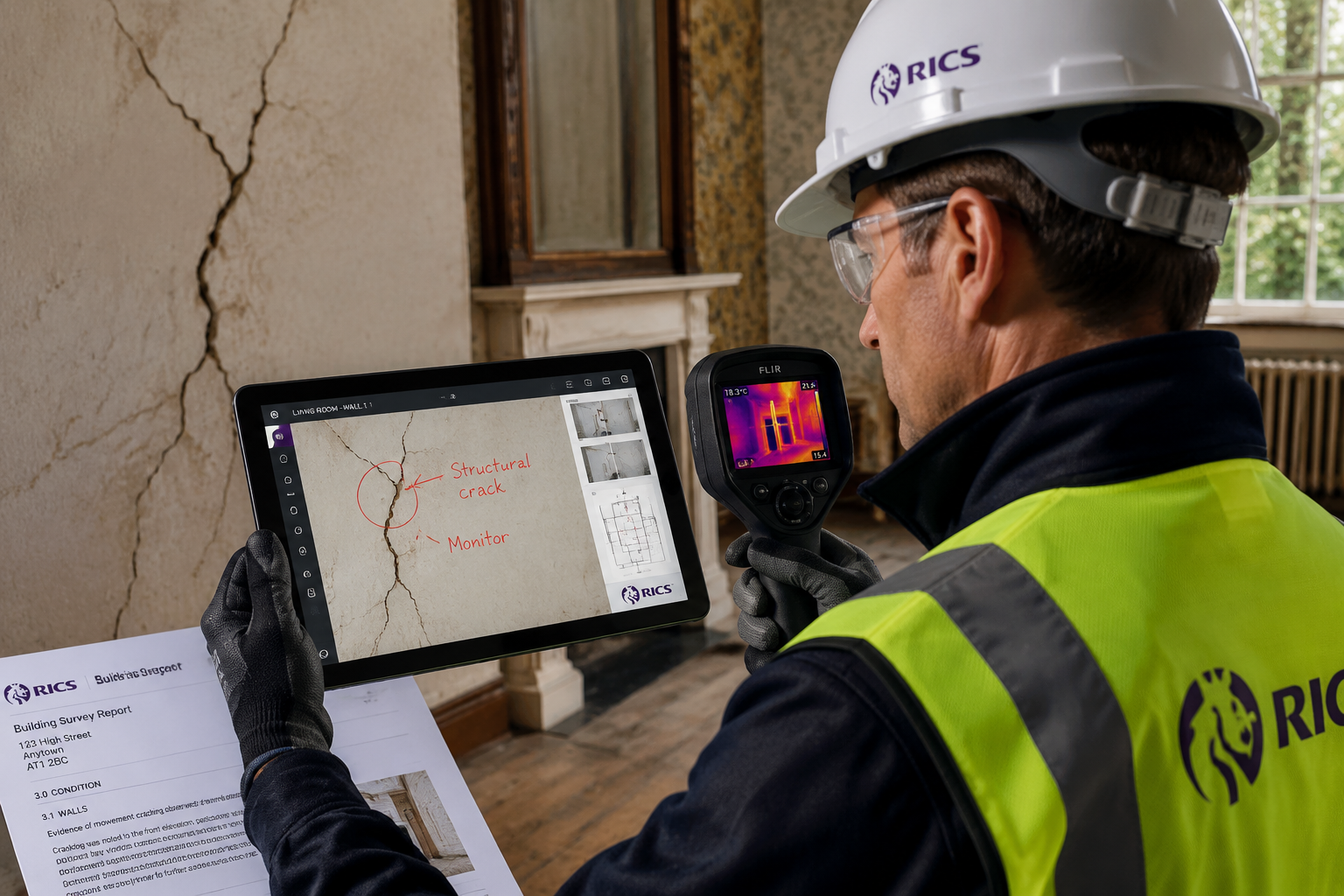
The most fundamental decision a buyer makes is which type of survey to commission. Getting this wrong is expensive in both directions: an under-specified survey misses critical defects, while an over-specified survey on a modern flat wastes money and time.
The three main RICS survey levels in 2026 are:
- Level 1 (Condition Report): Basic traffic-light condition ratings. Suitable only for new-build properties in excellent condition.
- Level 2 (HomeBuyer Report): A more detailed inspection covering visible defects, damp, and structural movement. Appropriate for conventional properties in reasonable condition. See our guide on what's included in a Level 2 survey for a full breakdown.
- Level 3 (Full Building Survey): The most comprehensive inspection available. Essential for older, extended, or non-standard properties. For a detailed overview, explore what's in a Level 3 survey.
For buyers unsure which level applies to their property, the Level 2 vs Level 3 survey comparison guide provides a practical decision framework.
⚠️ Critical point: A Victorian terraced house, a 1930s semi, or any property that has been extended or converted almost always warrants a Level 3 survey. Choosing a Level 2 to save a few hundred pounds on a property worth hundreds of thousands is a false economy that frequently leads to post-completion surprises — and sometimes to litigation.
Understanding the consequences of failing to act on survey findings is essential reading for any buyer tempted to skip or downgrade their survey.
Risk Prioritisation: The Key to Keeping Deals Alive
One of the most common reasons a survey triggers a fall-through is not the severity of the defect — it is the presentation of the defect. When a report lists forty items without distinguishing between a cracked roof tile and active subsidence, buyers panic. Solicitors escalate. Sellers become defensive. Chains collapse.
Effective chartered surveyors in 2026 structure their reports around clear risk prioritisation:
- 🔴 Category 1 — Urgent: Defects requiring immediate action to prevent danger or serious deterioration (e.g., structural failure risk, active water ingress into electrics).
- 🟡 Category 2 — Soon: Defects that need attention in the near term but are not immediately dangerous (e.g., failing flat roof, significant damp penetration).
- 🟢 Category 3 — Routine: Items to monitor or address as part of normal maintenance (e.g., minor repointing, cosmetic cracks).
This three-tier system — aligned with RICS guidance — allows buyers, sellers, and their solicitors to respond proportionately. A Category 2 defect with a £4,000 remediation quote is a negotiation point, not a deal-breaker. Without clear categorisation, it becomes the latter far too often.
Plain English Reporting
Technical jargon is a chain killer. Terms like "spalling brickwork," "interstitial condensation," or "deleterious materials" are professionally accurate but can terrify a buyer who has never encountered them before. In 2026, the best surveyors accompany technical findings with plain-language summaries that explain:
- What the problem is (in simple terms)
- Why it matters (the risk if left unaddressed)
- What to do next (who to call, what questions to ask)
This approach dramatically reduces the likelihood of a buyer misinterpreting a manageable defect as a catastrophic one.
Technology-Enhanced Inspections
Modern surveying tools are improving the accuracy and completeness of inspections in ways that directly reduce post-completion disputes. Premium drone surveys allow surveyors to inspect roofs, chimney stacks, and high-level masonry that would previously have required scaffolding or been left uninspected. Thermal imaging cameras detect moisture and heat loss behind plasterwork without destructive investigation.
These technologies mean fewer "we were unable to inspect" caveats in reports — and fewer nasty surprises after completion.
Smarter Survey Sequencing in the Conveyancing Process
The Traditional Timeline vs. The Optimised Timeline
| Stage | Traditional Approach | Optimised Approach |
|---|---|---|
| Offer accepted | Week 0 | Week 0 |
| Solicitors instructed | Week 1 | Week 1 |
| Survey commissioned | Week 3–5 | Week 1–2 |
| Survey received | Week 5–7 | Week 3–4 |
| Defects addressed / renegotiated | Week 7–10 | Week 4–6 |
| Exchange of contracts | Week 12–16 | Week 8–12 |
Compressing the survey into the earliest phase of conveyancing creates a buffer. If defects are found, there is time to obtain specialist reports, get remediation quotes, and renegotiate — without the pressure of a chain that is already at exchange stage.
Coordinating Surveys Across the Chain
In a chain of three or four properties, survey delays compound. If the buyer at the bottom of the chain is waiting for their survey while the seller at the top is already pressing for exchange, the entire chain is under pressure. Coordinated survey sequencing — where all parties commission surveys simultaneously in the first two weeks — keeps the chain moving in lockstep and dramatically reduces the risk of one delayed report holding everyone else hostage.
Agents and solicitors who understand this dynamic increasingly recommend that all parties in a chain confirm their survey instructions within the first week of offer acceptance.
The Broader Role of Surveyors as Transaction‑Certainty Specialists
Beyond the Inspection: Specialist Referrals and Sourcing Extra Advice
A good Level 3 survey does not just report defects — it directs buyers toward the right specialists. Structural engineers, damp specialists, asbestos surveyors, and environmental consultants all play a role in resolving specific concerns that fall outside the scope of a standard building survey. Understanding when and how to source extra advice after a building survey is a skill that experienced chartered surveyors guide buyers through.
Similarly, properties with environmental concerns — flood risk, contaminated land, proximity to industrial sites — require additional scrutiny. Surveyors who flag environmental issues early allow buyers to make fully informed decisions rather than discovering problems through searches that arrive weeks later.
Valuation Certainty Alongside Structural Certainty
In a cautious 2026 market, lenders are not the only ones scrutinising value. Buyers who have stretched their budgets need confidence that they are paying a fair price for a property in the condition described. Combining a structural survey with an independent valuation — or understanding how survey findings affect the negotiated price — gives buyers a complete picture before they commit.
For buyers navigating more complex situations, specialist valuations such as capital gains tax valuations or inheritance tax valuations may also be relevant, particularly where the property being purchased forms part of an estate or investment portfolio.
The Seller's Perspective: Pre-Sale Surveys as a Chain Stabiliser
One of the most underused tools in the 2026 market is the pre-sale survey. Sellers who commission a Level 2 or Level 3 survey before listing their property gain several advantages:
- They can address significant defects before they become deal-breakers.
- They can price the property accurately, reflecting its true condition.
- They can provide buyers with survey evidence that accelerates the buyer's own due diligence.
- They reduce the likelihood of a late renegotiation derailing the chain.
For sellers preparing to list, preparing your property for market offers practical guidance on how to present a property in its best light while remaining transparent about its condition.
Reducing Abortive Costs: A Financial Case for Better Surveys
The financial argument for investing in a comprehensive, well-sequenced survey is straightforward.
Scenario A — No survey or Level 1 only:
- Buyer discovers major structural defect post-completion.
- Remediation cost: £25,000–£60,000.
- Legal costs to pursue seller: £10,000+.
- Stress, delay, and potential mortgage shortfall: incalculable.
Scenario B — Survey commissioned late (Week 5), defect found at Week 7:
- Buyer has already spent £1,500 in legal fees and searches.
- Renegotiation attempted but seller refuses.
- Buyer withdraws. Total abortive cost: £2,500–£4,000.
- Seller returns to market. Chain collapses.
Scenario C — Level 3 survey commissioned at Week 2, defect found at Week 4:
- Buyer has spent £400 in legal fees.
- Surveyor provides remediation cost estimate: £8,000.
- Buyer renegotiates £6,000 off the asking price.
- Transaction completes. Both parties save time and money.
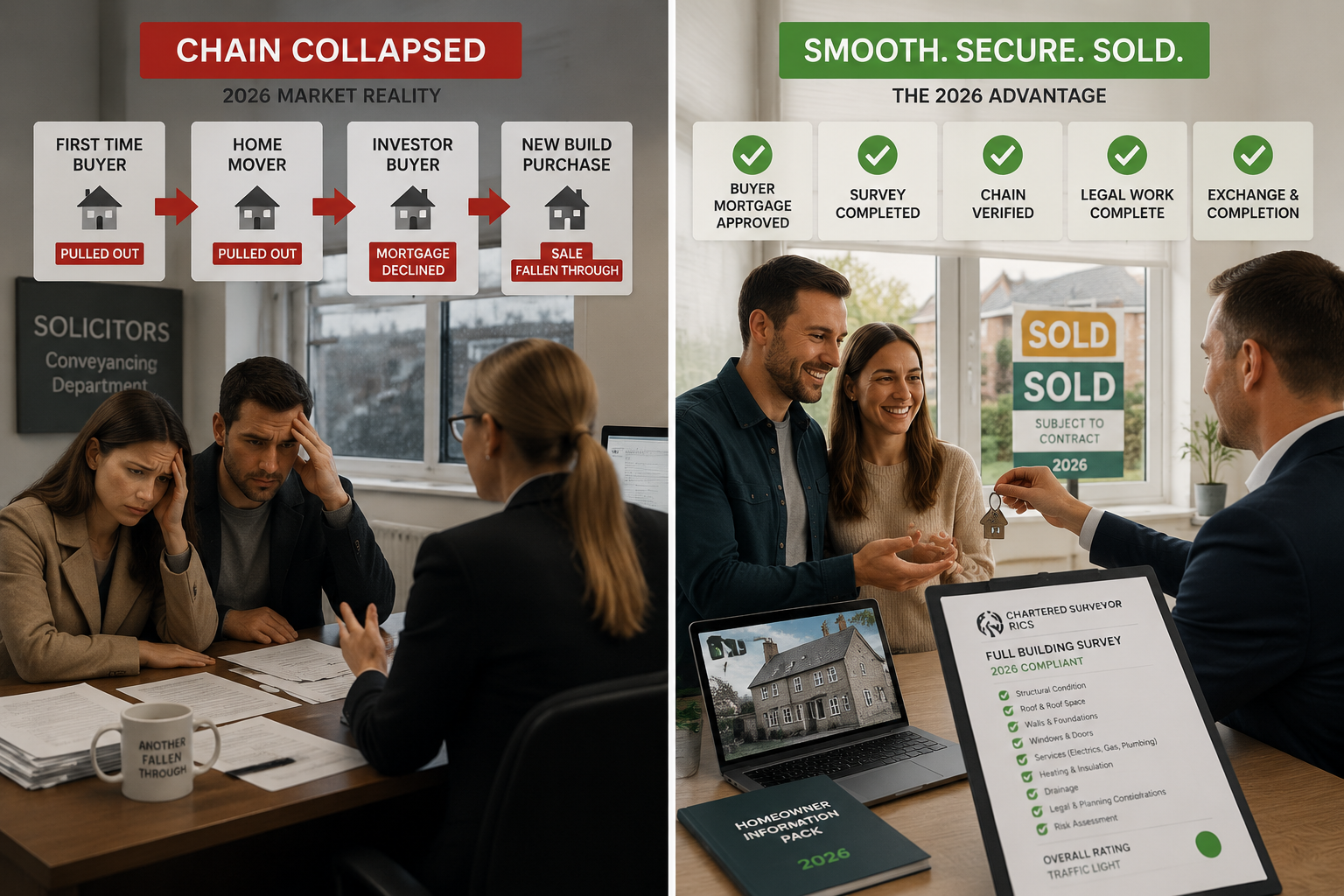
Scenario C is not an idealised outcome — it is the standard outcome when surveys are commissioned early, at the right level, and with clear risk communication.
Conclusion: Actionable Steps for Buyers, Sellers, and Agents in 2026
Chartered Surveyors in 2026 Chains: How Better Surveys Can Cut Delays and Fall‑Throughs in a Cautious Market ultimately comes down to a shift in mindset. Surveys are not a formality to be completed after the real work of conveyancing is done. They are the foundation on which transaction certainty is built.
Actionable Next Steps ✅
For buyers:
- Commission your survey within the first two weeks of offer acceptance — not after searches are returned.
- Use the which building survey do I need guide to choose the right level for your property type.
- Ask your surveyor to walk you through the report verbally before you read it alone — this prevents misinterpretation.
- Treat Category 2 defects as negotiation points, not exit triggers.
For sellers:
- Consider a pre-sale survey to identify and address issues before they derail your chain.
- Be transparent with buyers about known defects — late discovery is the most common chain-breaker.
- Respond promptly to survey-related renegotiations with evidence-based counteroffers rather than emotional reactions.
For agents:
- Recommend simultaneous survey commissioning across the chain at the point of offer acceptance.
- Educate buyers on survey levels during the offer stage, not after.
- Build relationships with RICS-accredited surveyors who communicate clearly and prioritise risk effectively.
In a cautious 2026 market, the surveyors who add the most value are not those who find the most defects — they are those who communicate findings in a way that keeps informed buyers and sellers at the table. That is the definition of a transaction-certainty specialist, and it is the standard every chartered surveyor should be held to.