

Nearly half of all fire fatalities in England occur in properties built before 1965 — many of them converted houses, Victorian terraces, and mixed-use blocks that were never designed with modern fire safety in mind. For chartered surveyors working across everyday residential stock in 2026, the stakes have never been higher.
The regulatory landscape governing Chartered Surveyors and Fire Safety in Converted and Mixed‑Use Properties: What Must Be Flagged in 2026 Reports has shifted dramatically. New enforcement under the Building Safety Act 2022, expanded Awaab's Law protocols, updated RICS cladding standards, and the Fire Safety (Residential Evacuation Plans) (England) Regulations 2025 — effective from 6 April 2026 — have all raised the bar for what must appear in a compliant survey report [2][3][9].
This guide bridges the gap between high-rise rules and the everyday building stock that most surveyors actually encounter: the converted flat above a café, the Edwardian terrace split into four units, the mixed-use block with a gym on the ground floor and twelve apartments above.
Key Takeaways 🔑
- Fire compartmentation, escape routes, and fire doors must be explicitly assessed and reported in all converted and mixed-use properties in 2026 — not just high-rise buildings.
- EWS1 forms are still required for medium-rise blocks with non-masonry cladding or combustible balconies, and their absence must be stated clearly in reports [7].
- The Building Safety Act 2022 now imposes criminal liability on freeholders who fail to maintain a "golden thread" of building information [3].
- Mixed-use properties present unique fire safety challenges — separate occupancy types require coordinated detection systems, proper zoning, and clearly defined evacuation strategies [8].
- Surveyors must document internal alterations, removed compartmentation, and deficient fire stopping — even in smaller blocks outside the higher-risk building regime.
Why 2026 Is a Turning Point for Fire Safety Reporting
The post-Grenfell regulatory wave has finally reached the everyday property market. While much attention focused on high-rise towers, the 2026 enforcement environment means that surveyors inspecting a converted Victorian terrace or a mixed-use retail-residential block face obligations that simply did not exist five years ago.
The Regulatory Stack in 2026
| Regulation / Standard | What Changed | Effective Date |
|---|---|---|
| Building Safety Act 2022 | Golden thread, Building Assessment Certificates, criminal penalties | Fully enforced by 2026 |
| Fire Safety (Residential Evacuation Plans) Regs 2025 | Personal Emergency Evacuation Plans (PEEPs) for residents needing assistance | 6 April 2026 |
| RICS EWS1 Standard (2nd Edition) | Updated guidance on when EWS1 is required for cladding valuations | 1 November 2026 |
| Awaab's Law (expanded) | Fire detection, electrical fire risks, escape routes in private rentals | 2026 protocols active |
Sources: [1][2][3][9]
💬 "The gap between high-rise regulation and everyday converted stock is closing fast. Surveyors who treat fire safety as a footnote in 2026 reports are exposing themselves — and their clients — to serious legal and financial risk."
The Building Safety Act 2022 requires freeholders and building owners of higher-risk residential buildings to register with the Building Safety Regulator and maintain a documented "golden thread" of building information. Non-compliance can result in criminal prosecution [3]. But the ripple effects extend well beyond the formal higher-risk building (HRB) threshold. Lenders, insurers, and buyers are now applying similar scrutiny to smaller converted blocks.
For surveyors working across South East London or Surrey — where converted Victorian and Edwardian stock dominates the market — understanding exactly what must be flagged is now a professional necessity, not an optional extra.
Chartered Surveyors and Fire Safety in Converted and Mixed‑Use Properties: What Must Be Flagged in 2026 Reports — The Core Checklist
1. 🔥 Fire Compartmentation
Compartmentation is the single most critical fire safety element in converted properties — and the most frequently compromised. When a Victorian house is split into flats, original floor-to-ceiling voids, staircase openings, and service penetrations rarely meet modern fire-stopping requirements.
What surveyors must flag:
- Breached compartmentation walls and floors — look for gaps around pipes, cables, and ductwork passing between floors or units
- Missing or inadequate fire stopping around service penetrations (a common finding in older conversions)
- Exposed timber joists in shared ceiling/floor assemblies that provide no meaningful fire resistance
- Loft voids that run continuously across multiple units — a classic compartmentation failure in terraced conversions
- Basement-to-upper-floor openings that could allow rapid fire and smoke spread
⚠️ Tip for surveyors: Even where full destructive investigation is not possible, the report must clearly state that compartmentation could not be confirmed and recommend specialist fire stopping assessment. Vague language is no longer acceptable.
The Level 3 Full Building Survey is the appropriate vehicle for this level of investigation. A Level 2 HomeBuyer Report has limited scope, but surveyors should still flag visible concerns and recommend further investigation.
2. 🚪 Fire Doors
Fire doors are the most visible — and most frequently defective — element of passive fire protection in converted residential blocks.
Key defects to document:
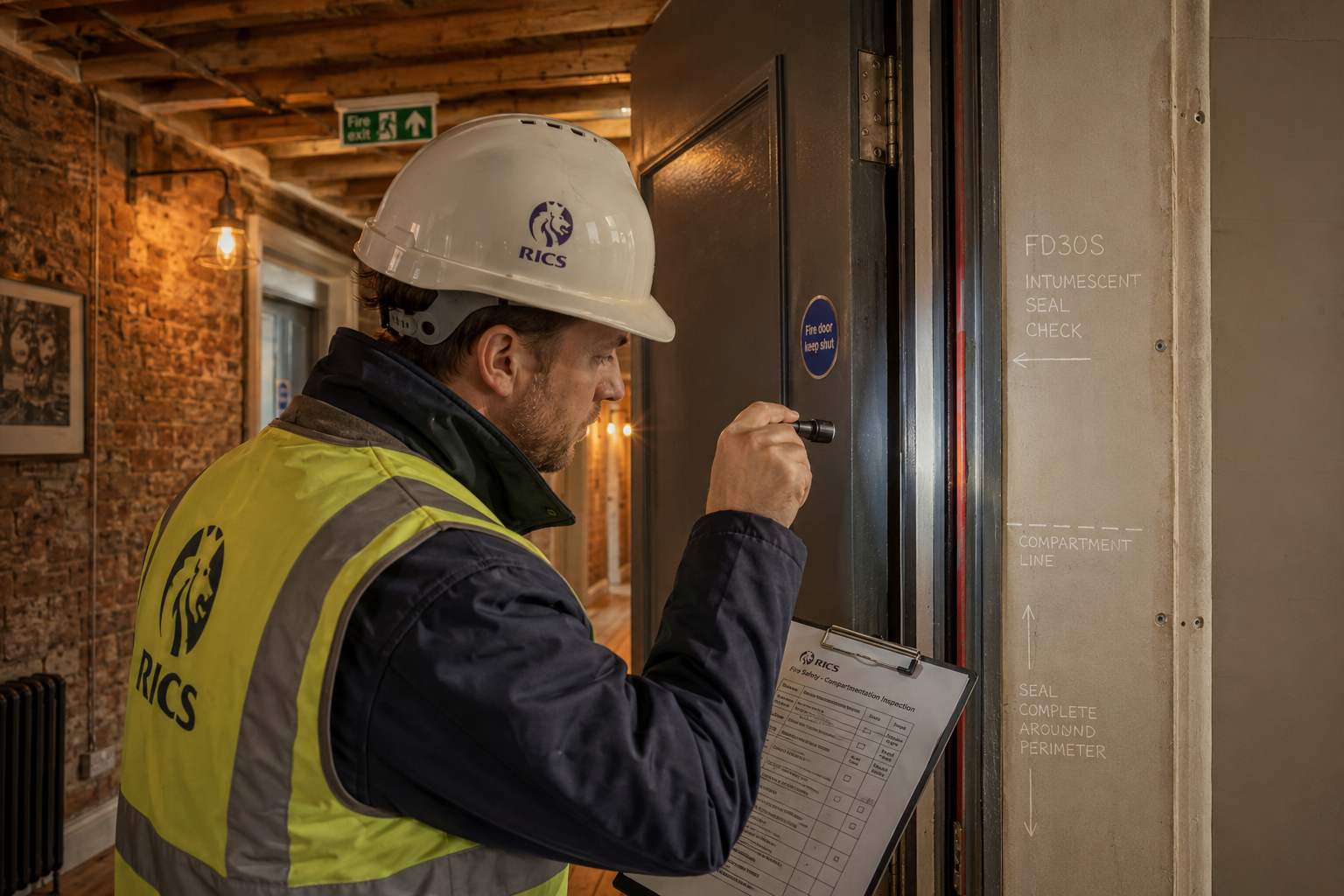
- Missing intumescent strips and smoke seals — these are often absent in older conversions or have been replaced with non-compliant products
- Incorrect door thickness — FD30 (30-minute fire resistance) is the minimum for most residential conversions; FD60 may be required in mixed-use scenarios
- Damaged or missing self-closing devices — propped-open fire doors are a persistent enforcement issue
- Incorrect ironmongery — non-fire-rated hinges, locks, or handles can compromise the door's performance
- Gaps around the door frame exceeding 3mm — a common failure point in older buildings where frames have settled or warped
In mixed-use buildings, the interface between commercial and residential areas demands particular scrutiny. The fire door separating a ground-floor restaurant kitchen from a residential staircase must be treated as a critical life-safety element [8].
3. 🏃 Escape Routes
Escape route assessment is non-negotiable in 2026 reports. The Fire Safety (Residential Evacuation Plans) (England) Regulations 2025, effective 6 April 2026, require building managers to identify residents who need assistance during evacuations and develop personalised evacuation plans [2]. Surveyors must assess whether the physical building can support those plans.
Escape route red flags:
- Single-staircase designs with no alternative escape — common in converted terraces and small blocks
- Obstructed or inadequately lit corridors — storage in communal areas is a persistent issue
- Insufficient headroom or width in escape routes — particularly in basement conversions
- Inadequate signage and emergency lighting
- Roof terrace or external escape routes that are locked, overgrown, or structurally compromised
The building surveyor access available during inspection will affect how thoroughly escape routes can be assessed. Where access is restricted, this must be clearly noted with recommendations for further investigation.
4. 🏗️ Cladding and External Wall Systems
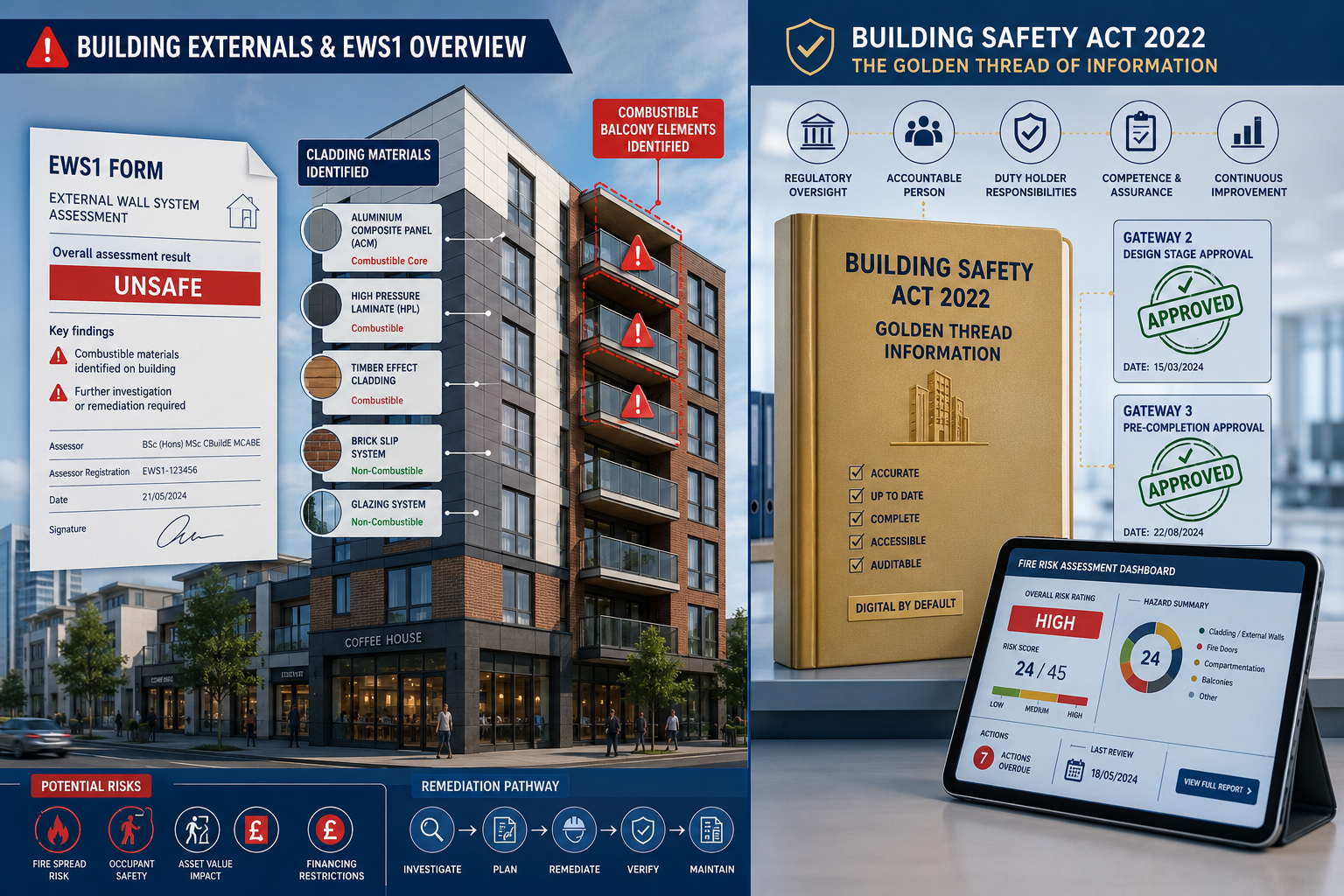
The RICS published the second edition of its UK professional standard for multi-storey residential buildings with cladding, effective from 1 November 2026 [1]. This updated standard provides clearer guidance on when an EWS1 (External Wall System) form should be requested.
In 2026, EWS1 forms are still required for:
- Medium-rise buildings (typically 11–18m) with non-masonry cladding systems
- Buildings with combustible balconies or balcony decking
- Properties where the lender has a specific EWS1 policy
- Any building where the surveyor identifies cladding materials that raise fire safety concerns [7]
Surveyors must clearly state in reports:
- Whether an EWS1 form exists and its current rating (A1, A2, B1, B2)
- If no EWS1 form is available, this must be explicitly flagged — not omitted
- The type of cladding material observed and any visible concerns
- Whether a specialist fire engineer's assessment is recommended
For converted properties with render systems, timber cladding, or composite panels added during refurbishment, the absence of EWS1 documentation can have significant implications for mortgage valuation. Surveyors providing insurance reinstatement cost valuations must also factor in the additional cost of cladding remediation.
5. ⚡ Internal Alterations and Unauthorised Works
Converted properties are particularly vulnerable to fire safety degradation through unauthorised internal alterations. A loft conversion that removes a compartmentation wall, a kitchen extension that blocks an escape route, or a basement conversion that introduces new ignition risks — all must be flagged.
What to look for:
- Evidence of removed or altered fire-rated partitions
- New openings cut through compartmentation walls without fire stopping
- Electrical installations that appear non-compliant or have been added without certification — a significant fire risk [9]
- Altered staircase configurations that compromise escape
- Converted loft spaces without adequate fire separation from the floors below
The questions to ask during a building survey should always include requesting evidence of building regulations approval for any alterations — and flagging the absence of such documentation prominently in the report.
Chartered Surveyors and Fire Safety in Converted and Mixed‑Use Properties: The Mixed-Use Dimension
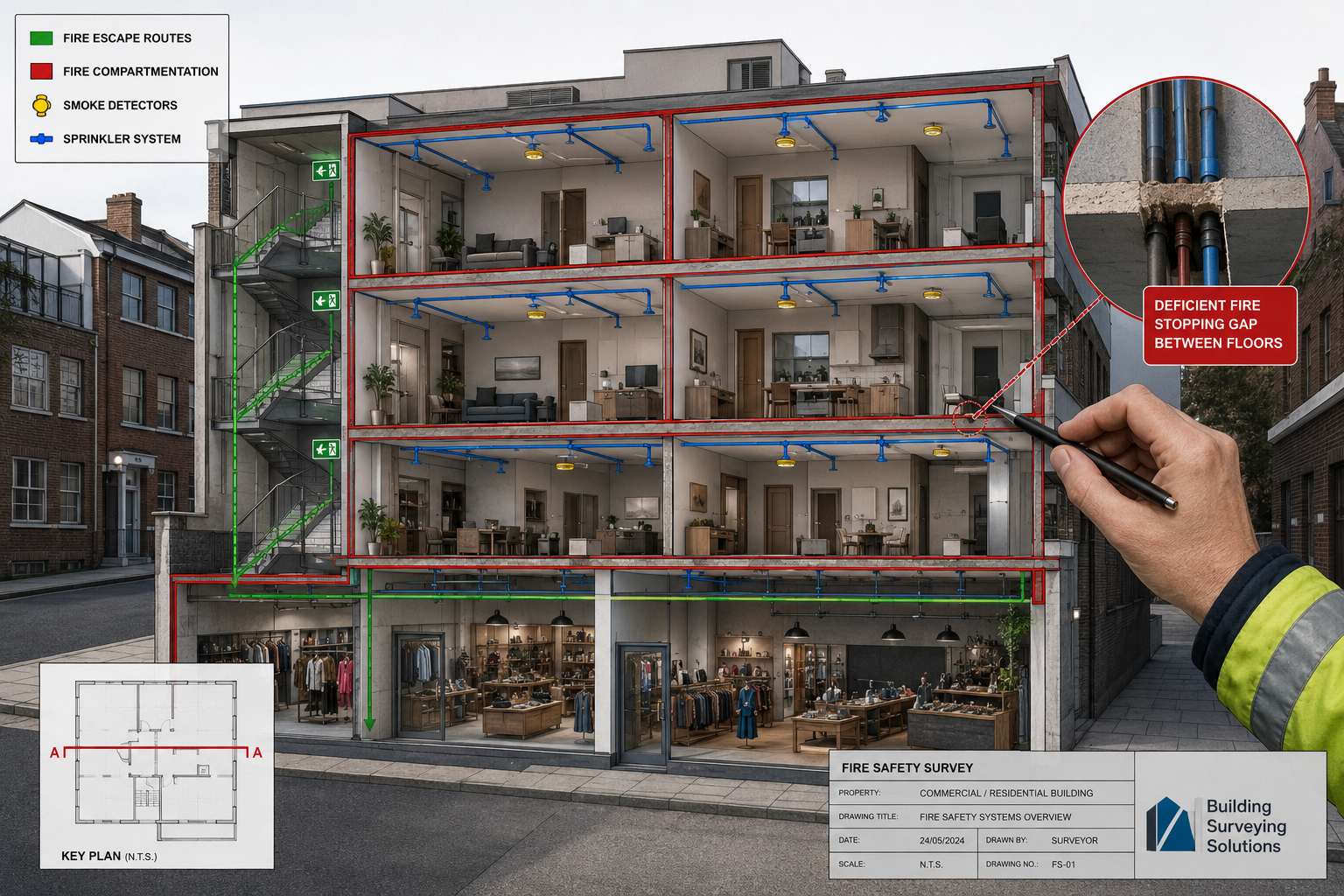
Mixed-use buildings — where residential units sit above commercial premises — present a distinct set of fire safety challenges that go beyond standard residential assessment [8].
Coordinated Detection Systems
A restaurant, gym, or retail unit on the ground floor will have a different fire detection and alarm system to the residential floors above. Surveyors must assess whether these systems are:
- Integrated or coordinated — so that a fire alarm in the commercial unit triggers appropriate alerts in residential areas
- Properly zoned — to allow targeted evacuation rather than blanket building-wide alerts
- Regularly tested and maintained — with evidence of current inspection certificates
Occupancy Interface Risks
The boundary between commercial and residential occupancy is a high-risk zone. Key concerns include:
- Cooking and extraction equipment in ground-floor food businesses — a leading cause of mixed-use building fires
- Fuel storage (gas cylinders, accelerants) in commercial units adjacent to residential escape routes
- Delivery and waste storage areas that obstruct fire exits or create ignition risks
- Shared plant rooms containing electrical switchgear, boilers, or generators
Awaab's Law and Expanded Hazard Protocols
The 2026 Awaab's Law protocols require surveyors to assess fire detection systems, electrical fire risks, structural fire containment, and escape routes in private rentals with detailed documentation [9]. For mixed-use blocks with residential tenancies, this creates a direct reporting obligation that must be reflected in survey documentation.
Surveyors working in areas with high concentrations of mixed-use stock — such as Camden, Battersea, or Hampstead — should ensure their report templates are updated to reflect these expanded obligations.
Building Safety Act 2022: What Surveyors Must Navigate in 2026
For buildings that meet the higher-risk building (HRB) threshold — generally residential buildings of 18m or seven storeys or more — surveyors must navigate detailed checklists for Gateway 2 and 3 approvals [10].
Key documentation surveyors should request and review:
| Document | Purpose |
|---|---|
| Building Assessment Certificate | Confirms BSR registration and compliance |
| Golden Thread Information | Complete record of building design, construction, and changes |
| Mandatory Occurrence Reports | Record of structural and fire safety incidents |
| Fire Risk Assessment | Current, competent-person assessment |
| Residents' Engagement Strategy | Evidence of resident communication on safety |
Source: [10]
Even for buildings below the HRB threshold, the cultural shift driven by the Building Safety Act means that buyers, lenders, and insurers expect surveyors to comment on the availability and quality of building safety documentation. The absence of a current fire risk assessment in a converted block of flats is a material finding that must be flagged.
Practical Reporting Standards for 2026
What "Good" Looks Like in a 2026 Fire Safety Report Section
A compliant, professional fire safety section in a 2026 building survey report should:
✅ Identify the building type, conversion history, and occupancy mix
✅ Assess compartmentation, fire doors, escape routes, cladding, and detection systems
✅ Document specific defects with location references and photographic evidence
✅ State clearly where investigation was limited and what further specialist assessment is needed
✅ Reference applicable regulations (Building Safety Act, Fire Safety Act, Awaab's Law protocols)
✅ Recommend remedial action with urgency ratings
✅ Flag the absence of key documents (EWS1, fire risk assessment, building regulations approvals)
The Drone Advantage 🚁
For properties where external cladding, roof-level fire stopping, or high-level escape routes cannot be assessed from ground level, premium drone survey services provide a practical solution. Drone inspection can identify cladding defects, compromised external fire escape structures, and roof-level compartmentation failures that would otherwise require expensive scaffolding.
Conclusion: Actionable Next Steps for Surveyors in 2026
The regulatory environment in 2026 makes fire safety a central — not peripheral — element of every building survey on converted and mixed-use stock. Chartered Surveyors and Fire Safety in Converted and Mixed‑Use Properties: What Must Be Flagged in 2026 Reports is no longer a specialist niche; it is a core professional competency.
Immediate actions for practicing surveyors:
- Update report templates to include dedicated fire safety sections covering compartmentation, fire doors, escape routes, cladding, and internal alterations
- Familiarise with the RICS EWS1 second edition standard (effective 1 November 2026) and update EWS1 reporting protocols accordingly [1]
- Review Awaab's Law 2026 protocols for private rental inspections and ensure documentation meets enforcement standards [9]
- Build a referral network of specialist fire engineers and fire risk assessors for cases requiring expert investigation beyond the surveyor's scope
- Never omit — if an EWS1 form is absent, if fire risk assessment documentation cannot be produced, or if compartmentation cannot be confirmed, say so explicitly in the report [7]
- Consider drone surveys for properties where external fire safety elements cannot be assessed safely from ground level
For property owners, buyers, and landlords: commissioning a Level 3 Full Building Survey from a RICS-regulated firm is the most effective way to ensure that fire safety risks in converted and mixed-use properties are properly identified and documented before purchase or during ownership.
Fire safety in everyday converted stock is no longer someone else's problem. In 2026, it is every chartered surveyor's professional responsibility.
References
[1] Rics Publishes Updated Standard For Multi Storey Residential Buildings With Cladding – rics.org
[2] Fire Safety Regulations Plain Language – tcl-surveyors.co.uk
[3] Building Safety Act What Freeholders Must Do By 2026 – hampsteadcharteredsurveyors.co.uk
[4] Responsibilities Of Building Owners Under As 1851 2012 – nsw.gov.au
[5] Ontario Fire Alarm Inspection Requirements 2026 – inspectpoint.com
[6] Nfpa 72 – komplyos.com
[7] Fire Safety In Medium Rise Blocks What Building Surveyors Must Now Report Under The Ews And Building Safety Regime – canterburysurveyors.com
[8] Fire Protection For Mixed Use Buildings – dynafire.com
[9] Building Surveys For Expanded Awaabs Law Hazards 2026 Protocols For Excess Temperature And Fire Risks In Private Rentals – wimbledonsurveyors.com
[10] Building Safety Act 2026 Enforcement Surveyor Checklists For Gateway Approvals And Higher Risk Buildings – wimbledonsurveyors.com