

The UK property market stands at a pivotal moment. As government reforms propose making property condition assessments mandatory upfront requirements, chartered surveyors face an unprecedented opportunity—and challenge. The anticipated volume uplift could fundamentally transform how the profession operates, requiring strategic preparation through enhanced Chartered Surveyor CPD for Homebuying Reforms: Digital Tools and Retraining for 2026 Volume Uplift. With RICS launching its revised CPD framework in January 2026, complete with innovative digital tools and mandatory contemporary competencies, surveyors now have the resources needed to meet this transformational moment head-on.

Key Takeaways
- 📱 RICS launched a revised CPD framework in January 2026 with a new member app enabling real-time learning recording and improved digital tracking capabilities
- 📈 Government homebuying reforms could double survey demand by making upfront property condition assessments standard practice across all transactions
- 🎓 Mandatory CPD topics now include AI, data technology, sustainability, and ethics on a three-year cycle, reflecting contemporary industry priorities
- ⏰ RICS requests minimum 24-month implementation period for reforms, providing crucial preparation time for capacity building and workforce development
- 🔧 Enhanced digital tools and streamlined workflows are essential for surveyors to handle anticipated volume increases without compromising quality standards
Understanding the 2026 Homebuying Reform Landscape
The UK Government's consultation on homebuying reforms closed at the end of December 2025, marking a significant milestone in efforts to modernize the property transaction process [4]. While no definitive implementation timeframe has been announced, the proposed changes represent the most substantial overhaul of homebuying practices in decades.
What the Reforms Propose
The core proposal centers on making property condition assessments a standard upfront requirement rather than an optional step undertaken mid-transaction [1]. This fundamental shift would move surveys from their current position—often commissioned after an offer is accepted—to the very beginning of the sales process.
Currently, many property transactions proceed without comprehensive surveys, leading to:
- 🏚️ Unexpected defects discovered late in the process
- 💷 Last-minute price renegotiations causing delays
- 📉 Transaction fall-throughs due to unforeseen issues
- ⚖️ Disputes between buyers and sellers over property condition
The reformed system aims to provide transparent, upfront information about property condition, allowing buyers to make informed decisions from the outset. Sellers would commission surveys before listing properties, creating a more efficient market with fewer surprises.
Industry Predictions for 2026
Market forecasters predict 2026 as a positive growth year for surveying, with lenders anticipating increased volumes and strong activity across both lending and survey operations [1]. This optimism stems from several converging factors:
Economic stabilization following recent volatility has restored confidence in property markets. Interest rates have stabilized, and buyer sentiment has improved considerably compared to 2023-2024.
Institutional investment continues strongly, with professional landlords actively seeking proper surveys and understanding the value of comprehensive property condition assessments [1]. This sophisticated investor segment recognizes that thorough due diligence protects their capital and informs strategic decisions.
The potential implementation of upfront survey requirements could fundamentally change market dynamics. If even a portion of the proposed reforms take effect, surveyors could see demand increases of 50-100% compared to current volumes [3].
For surveyors operating across London and surrounding regions, this represents both tremendous opportunity and the need for careful capacity planning.
RICS Revised CPD Framework: Digital Tools for Professional Development
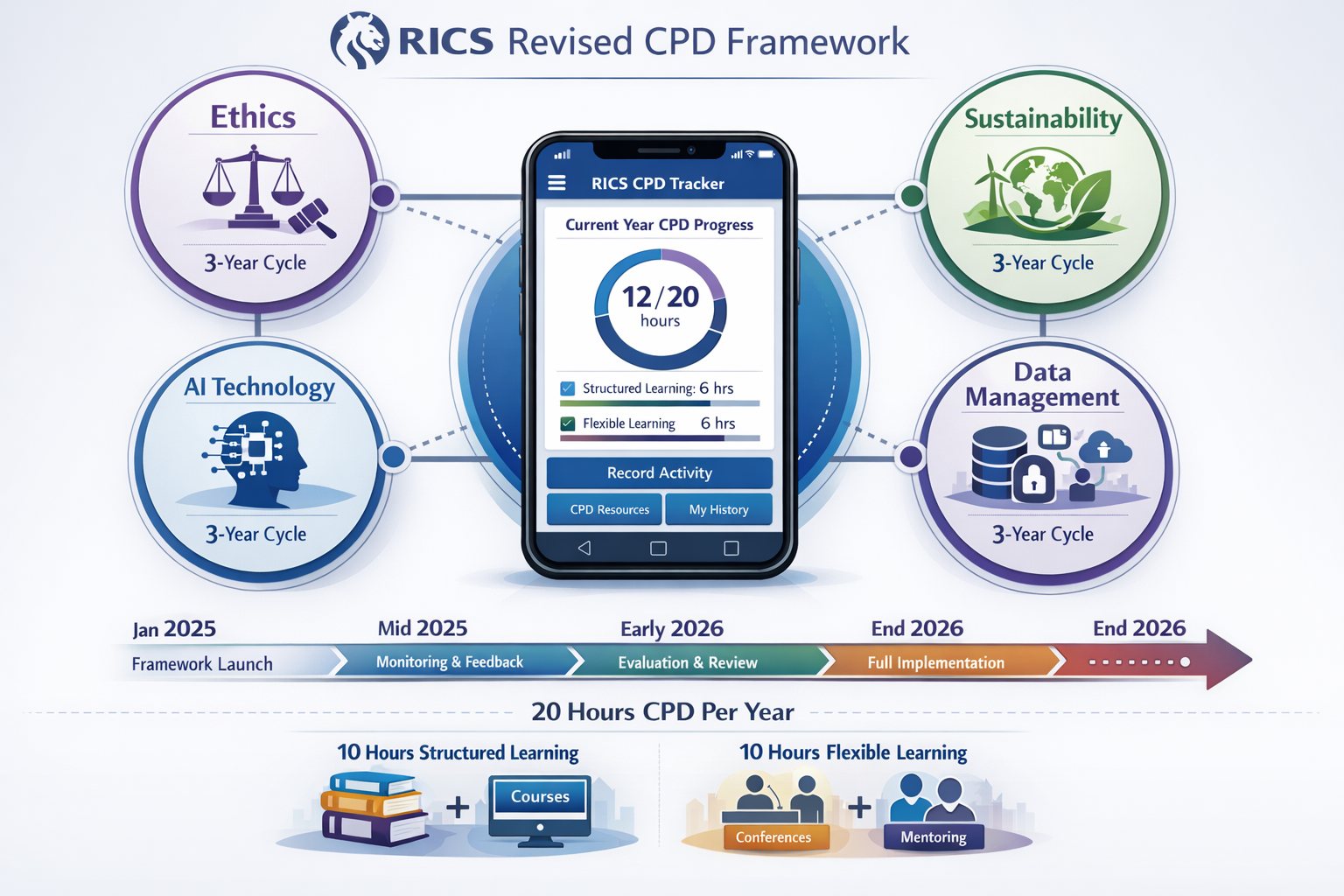
Responding to widespread member feedback, RICS launched its revised CPD framework effective January 2026, featuring improved digital tools and a fundamentally different approach to professional development [2]. This timely update provides chartered surveyors with exactly the resources needed to prepare for anticipated market changes.
Core Requirements and New Mandatory Topics
The core CPD requirements remain unchanged at 20 hours annually, with 10 hours designated as structured learning [2]. This continuity provides stability while new elements address contemporary professional challenges.
However, the revised framework introduces mandatory topics to be covered every three years:
| Mandatory Topic | Why It Matters for 2026 |
|---|---|
| Ethics | Ensures professional standards during high-volume periods |
| Sustainability | Addresses building performance and environmental assessments |
| AI and Technology | Prepares surveyors for digital transformation tools |
| Data Management | Critical for handling increased survey volumes efficiently |
These additions directly reflect the rapid professional changes facing the industry, including AI-driven transformation, housing supply challenges, and the transition to sustainable building practices [2].
The New RICS Member App
Perhaps the most significant practical improvement is the new RICS member app enabling real-time CPD recording [2]. This addresses a consistent pain point where members delayed recording until year-end and couldn't accurately remember details or assess the impact of their learning activities.
Key app features include:
- 📲 Immediate activity logging from mobile devices
- 🎯 Reflection prompts to capture learning outcomes
- 📊 Progress tracking toward annual requirements
- 🔔 Reminders for mandatory topic coverage
- 📈 Visual dashboards showing competency development
The app transforms CPD from an administrative burden into a genuine professional development tool. Surveyors can now capture insights immediately after attending conferences, completing courses, or engaging in mentoring—when the learning is fresh and its impact most apparent.
Enhanced Flexibility and Quality Focus
The revised framework introduces greater flexibility for extended learning programs, allowing members completing substantial programs such as master's degrees to carry forward up to 10 CPD hours into the following year [2]. This recognizes that meaningful professional development doesn't always align neatly with calendar years.
Simultaneously, enhanced quality review measures now apply to CPD audit processes [2]. RICS is auditing a higher proportion of member records and focusing on the quality and relevance of activities undertaken rather than just compliance with hour requirements.
This dual approach—increased flexibility combined with stronger quality oversight—creates an outcome-focused system that supports genuine career growth rather than box-ticking exercises.
For surveyors providing building surveys and Level 3 full building surveys, staying current with technical developments through quality CPD becomes essential for maintaining professional standards.
Chartered Surveyor CPD for Homebuying Reforms: Preparing for Volume Uplift

The intersection of homebuying reforms and enhanced CPD frameworks creates a critical preparation window. Surveyors must strategically develop capabilities now to handle anticipated demand increases while maintaining quality standards.
Understanding the Timeline and Implementation Period
RICS has formally requested a minimum 24-month implementation period for upfront information reforms [4]. This extended timeline allows sufficient time to build capacity, develop standards, and establish clear guidance for the profession.
The implementation period provides crucial breathing room for:
Workforce development through accelerated training programs and qualification pathways for new entrants to the profession.
Process optimization including developing standardized templates, digital workflows, and quality assurance systems that enable efficient high-volume operations.
Technology integration such as implementing AI-assisted defect detection, automated report generation, and digital scheduling systems.
Market education to help sellers, buyers, and estate agents understand new requirements and adjust their expectations accordingly.
However, uncertainty remains about which specific reforms will proceed and whether they'll require further consultation or primary legislation [4]. This ambiguity makes flexible preparation strategies essential.
Building Capacity Through Enhanced Qualification Pathways
RICS is developing clearer qualification pathways for graduate surveyors to build the talent pipeline needed to meet anticipated increases in survey activity [1]. These enhanced pathways address a critical bottleneck: the profession cannot simply double output overnight without expanding its qualified workforce.
Key workforce development strategies include:
🎓 Accelerated APC routes for candidates with relevant experience or qualifications
📚 Structured mentoring programs pairing experienced surveyors with candidates to ensure quality supervision at scale
💻 Digital competency integration throughout qualification pathways, ensuring new entrants are technology-ready from day one
🏢 Practice-based learning opportunities with firms committed to expanding their training capacity
For established practices across regions like Central London, Camden, and South West London, investing in training capacity now positions firms advantageously when demand increases materialize.
Digital Tools and Workflow Optimization
Successfully managing volume uplift requires more than additional surveyors—it demands fundamentally more efficient workflows. Digital transformation becomes not optional but essential.
Critical technology investments include:
AI-powered defect detection systems that analyze photographs and identify potential issues, allowing surveyors to focus on assessment and judgment rather than routine identification tasks.
Automated report generation platforms that populate standard sections based on inspection data, reducing report writing time by 40-60% while maintaining quality and customization where needed.
Digital scheduling and client communication tools that eliminate administrative bottlenecks and provide clients with real-time updates throughout the survey process.
Mobile inspection applications that enable on-site data capture, photograph annotation, and preliminary report drafting, reducing the time between inspection and report delivery.
Quality assurance dashboards that flag inconsistencies, ensure completeness, and maintain standards even during high-volume periods.
Firms that integrate these tools before demand surges will have significant competitive advantages. Those that delay risk being overwhelmed when volume increases arrive.
Strategic CPD Planning for Reform Readiness
Chartered Surveyor CPD for Homebuying Reforms: Digital Tools and Retraining for 2026 Volume Uplift requires strategic, targeted learning investments. Random CPD activities won't adequately prepare professionals for the specific challenges ahead.
Priority CPD areas for 2026 include:
Technology and AI competency development covering digital inspection tools, automated analysis systems, and data management platforms that enable efficient high-volume operations.
Sustainability assessment skills as environmental performance becomes increasingly central to property valuations and buyer decision-making.
Communication and report writing efficiency including training on clear, concise reporting that maintains quality while reducing production time.
Risk management and professional indemnity understanding how upfront surveys change liability profiles and what additional protections may be necessary.
Business process optimization learning lean methodologies and workflow design principles that enable scaling without proportional cost increases.
Surveyors should use the new RICS member app to track progress across these priority areas, ensuring balanced development that addresses all aspects of reform readiness.
When considering what questions to ask during a building survey or choosing between Level 2 and Level 3 surveys, enhanced CPD ensures surveyors can provide expert guidance even as market dynamics shift.
Retraining Priorities: Skills for the Reformed Market

Beyond general CPD requirements, specific retraining priorities emerge from the intersection of homebuying reforms and technological advancement. Surveyors must develop new competencies that weren't central to traditional practice.
Digital Literacy and Technology Integration
The reformed market demands comprehensive digital literacy extending well beyond basic computer skills. Surveyors must become proficient with:
Cloud-based practice management systems that enable seamless collaboration, document sharing, and client communication across distributed teams.
Digital measurement and documentation tools including laser measuring devices, thermal imaging cameras, and drone technology for roof and elevation inspections.
Data analytics platforms that identify patterns across multiple surveys, benchmark findings against regional norms, and provide context for individual property assessments.
Cybersecurity and data protection understanding GDPR compliance, secure data handling, and protecting sensitive client information in increasingly digital workflows.
Many established surveyors trained in an era when these technologies didn't exist. Targeted retraining programs must address this skills gap without diminishing the value of extensive practical experience.
Early-Stage Assessment Techniques
Upfront surveys fundamentally change when in the transaction process surveyors engage with properties. This timing shift creates new technical and practical challenges.
Traditional mid-transaction surveys typically occur after:
- Initial viewings have identified serious interest
- Preliminary negotiations have established price ranges
- Buyers have secured mortgage agreements in principle
- Some due diligence has already occurred informally
Upfront surveys happen before:
- Serious buyer interest has been established
- Price negotiations have begun
- Buyers have invested time and emotion in the property
- Any informal due diligence has occurred
This earlier engagement requires different assessment approaches. Surveyors must provide comprehensive information that serves multiple potential buyers with varying priorities, rather than addressing one buyer's specific concerns.
Retraining should cover:
📋 Comprehensive standardized assessment protocols that address the broadest possible range of buyer concerns without knowing specific buyer profiles
🎯 Risk stratification techniques that clearly categorize issues by severity, urgency, and likely cost implications
📊 Comparative market analysis integration that contextualizes property condition within local market norms
💡 Anticipatory defect identification that predicts likely future issues based on building age, construction type, and maintenance history
Client Communication in the Reformed Process
The upfront survey model changes the surveyor-client relationship fundamentally. Rather than working for a specific buyer, surveyors increasingly work for sellers providing information to multiple potential buyers.
This shift creates new communication challenges:
Neutrality and objectivity become even more critical when reports serve multiple parties with potentially conflicting interests.
Clarity and accessibility matter more when reports must be understandable to diverse audiences with varying levels of property knowledge.
Defensibility and thoroughness increase in importance when reports may influence multiple transaction decisions and face scrutiny from numerous parties.
Professional boundaries must be carefully maintained when sellers, buyers, and agents all have questions about findings.
CPD programs should include communication skills training specifically addressing these reformed market dynamics. Surveyors accustomed to advocacy-oriented communication with their direct clients must adapt to more neutral, informational approaches.
For those providing services across diverse areas from Essex to Chelsea, understanding regional market variations in how reforms might be implemented adds another layer of necessary competency.
Implementation Strategies for Surveying Practices
Individual surveyor development matters, but practice-level implementation strategies ultimately determine whether firms successfully navigate the volume uplift. Forward-thinking practices are already positioning themselves for the reformed market.
Capacity Planning and Resource Allocation
Effective capacity planning requires understanding both current utilization rates and potential demand scenarios under various reform implementation options.
Key planning questions include:
- What percentage increase in survey requests could we handle with current staffing?
- Which process bottlenecks would emerge first under increased demand?
- What technology investments would provide the greatest capacity gains?
- How many additional surveyors would we need under different demand scenarios?
- What lead time is required to recruit, train, and integrate new team members?
Practices should model multiple scenarios—from modest 25% increases to dramatic 100% uplifts—and develop contingency plans for each. The uncertainty around reform implementation makes flexible, scalable approaches essential.
Resource allocation priorities should emphasize:
🔧 Technology infrastructure that enables efficiency gains before hiring additional staff
👥 Training capacity to rapidly onboard new surveyors when demand materializes
📋 Process documentation that allows consistent quality delivery even with expanded teams
💼 Administrative support that prevents surveyors from being overwhelmed by non-technical tasks
Quality Assurance at Scale
Maintaining quality standards during rapid volume growth presents significant challenges. Practices must implement robust quality assurance systems before demand increases arrive.
Effective QA approaches include:
Structured peer review processes where experienced surveyors review a sample of reports from colleagues, providing feedback and identifying training needs.
Standardized checklists and templates that ensure comprehensive coverage of required topics while allowing customization for property-specific issues.
Technical review committees that discuss complex or unusual cases, building collective expertise and ensuring consistent approaches.
Client feedback systems that systematically capture satisfaction data and identify improvement opportunities.
Regular calibration exercises where surveyors assess the same property and compare findings, identifying interpretation variations and aligning standards.
Practices that establish these systems now—while operating at manageable volumes—will maintain quality more successfully when demand surges.
Collaborative Networks and Referral Systems
No single practice can instantly double its capacity. Collaborative networks between firms provide flexibility to handle demand spikes while maintaining quality standards.
Forward-thinking practices are establishing referral partnerships with trusted colleagues who share their quality standards and professional approaches. These networks allow practices to:
✅ Accept more work than they could individually handle
✅ Maintain client relationships even when temporarily at capacity
✅ Ensure clients receive quality service rather than being turned away
✅ Generate reciprocal referrals during quieter periods
✅ Share best practices and learning across the network
Regional networks across areas like Islington, Fulham, and Ealing can collectively serve the market more effectively than isolated individual practices.
The Road Ahead: Preparing for Transformation
The convergence of homebuying reforms and enhanced CPD frameworks creates a unique moment in the surveying profession's evolution. While uncertainty remains about specific reform implementation details, the direction of travel is clear: property condition assessments will become more central to transactions, and surveyors must prepare accordingly.
Monitoring Developments and Staying Informed
Surveyors should actively monitor developments through:
- 📰 RICS communications including the Home Buying and Selling Reform Hub for official updates
- 🏛️ Government consultations and legislative developments affecting property transactions
- 🤝 Professional networks where colleagues share insights and practical experiences
- 📊 Market intelligence from lenders, estate agents, and conveyancers about changing demand patterns
Staying informed allows surveyors to adjust preparation strategies as implementation details emerge, rather than being caught unprepared when changes arrive.
Embracing the Opportunity
While the prospect of doubled demand and fundamental process changes might seem daunting, it represents a tremendous opportunity for the surveying profession. Upfront surveys elevate the surveyor's role from optional due diligence to essential transaction infrastructure.
This enhanced centrality brings:
💪 Greater professional recognition as surveyors become integral to every transaction rather than optional participants
💰 Improved business sustainability with more consistent demand and less dependence on buyer-driven cycles
🎓 Enhanced career pathways as the profession's growth creates opportunities for advancement and specialization
🔬 Increased innovation as technology investment becomes economically justified by higher volumes
Practices that view reforms as opportunity rather than burden—and prepare accordingly—will thrive in the transformed market.
Conclusion
Chartered Surveyor CPD for Homebuying Reforms: Digital Tools and Retraining for 2026 Volume Uplift represents far more than a professional development requirement—it's the foundation for successfully navigating the most significant market transformation in decades. The RICS revised CPD framework, launched in January 2026 with innovative digital tools and mandatory contemporary competencies, provides exactly the resources surveyors need at exactly the right moment.
Government homebuying reforms proposing upfront property condition assessments could fundamentally reshape how surveyors operate, potentially doubling demand while changing the timing, scope, and nature of survey work. The 24-month implementation period RICS has requested provides crucial preparation time, but only for those who use it strategically.
Priority actions for surveyors and practices include:
✅ Adopting the new RICS member app for real-time CPD tracking and ensuring coverage of mandatory topics including AI, technology, sustainability, and ethics
✅ Investing in digital tools and workflow optimization that enable efficient high-volume operations without compromising quality standards
✅ Developing workforce capacity through enhanced training programs, clearer qualification pathways, and structured mentoring relationships
✅ Implementing quality assurance systems that maintain professional standards even during rapid growth periods
✅ Building collaborative networks that provide flexibility to handle demand surges while ensuring clients receive excellent service
✅ Monitoring reform developments and adjusting strategies as implementation details emerge
The surveying profession stands at a pivotal moment. Those who embrace Chartered Surveyor CPD for Homebuying Reforms: Digital Tools and Retraining for 2026 Volume Uplift as strategic preparation rather than administrative obligation will be best positioned to thrive in the transformed market ahead.
The reforms may bring challenges, but they ultimately elevate the profession's importance and create opportunities for growth, innovation, and enhanced recognition. With the right preparation—grounded in quality CPD, digital transformation, and strategic capacity building—chartered surveyors can confidently meet this transformational moment and emerge stronger than ever.
References
[1] Surveying In 2026 Reform Recovery And Renewed Demand – https://www.lrg.co.uk/news-and-insights/surveying-in-2026-reform-recovery-and-renewed-demand/
[2] Revised Cpd Framework Effective 2026 New App – https://www.rics.org/news-insights/revised-cpd-framework-effective-2026-new-app
[3] Homebuying Process Reforms 2026 How Mandatory Upfront Surveys Will Transform Building Surveyor Workloads – https://nottinghillsurveyors.com/blog/homebuying-process-reforms-2026-how-mandatory-upfront-surveys-will-transform-building-surveyor-workloads
[4] Home Buying And Selling Reform Hub – https://www.rics.org/news-insights/current-topics-campaigns/home-buying-and-selling-reform-hub