

The UK lettings market in 2026 faces unprecedented pressure. With tenant demand surging to record highs while property supply remains constrained, landlords and investors need robust assessment strategies more than ever. Chartered Surveyor Checklists for Lettings Market Surveys: Assessing Rental Properties in 2026's Tenant Demand Surge have become essential tools for navigating this competitive landscape, ensuring properties meet stringent safety standards while maximizing rental yields.
Recent data from the Royal Institution of Chartered Surveyors (RICS) confirms what property professionals have witnessed firsthand: tenant demand continues to outstrip available rental stock, creating a seller's market that demands meticulous property assessment. However, this opportunity comes with heightened responsibility. Modern lettings market surveys must address not only traditional structural concerns but also evolving regulatory requirements, including enhanced fire safety protocols and increasingly stringent Energy Performance Certificate (EPC) standards.
For property investors seeking high-yield buy-to-let opportunities, comprehensive surveyor checklists provide the foundation for informed decision-making. These systematic assessment tools help identify properties with genuine rental potential while flagging compliance issues that could derail investment returns or expose landlords to legal liability.
Key Takeaways
✅ Comprehensive checklists are essential for assessing rental properties in 2026's competitive market, covering structural integrity, safety compliance, and rental yield potential
✅ Fire safety and EPC assessments have become non-negotiable elements of lettings market surveys, with regulatory changes demanding higher standards for rental properties
✅ Systematic property evaluation using RICS-compliant methodologies helps investors identify high-yield opportunities while mitigating compliance risks
✅ Digital survey tools and drone technology enhance assessment accuracy, enabling chartered surveyors to provide more detailed market valuations
✅ Tenant demand analysis must be integrated with physical property assessments to accurately forecast rental yields in 2026's dynamic market
Understanding the 2026 Lettings Market Landscape
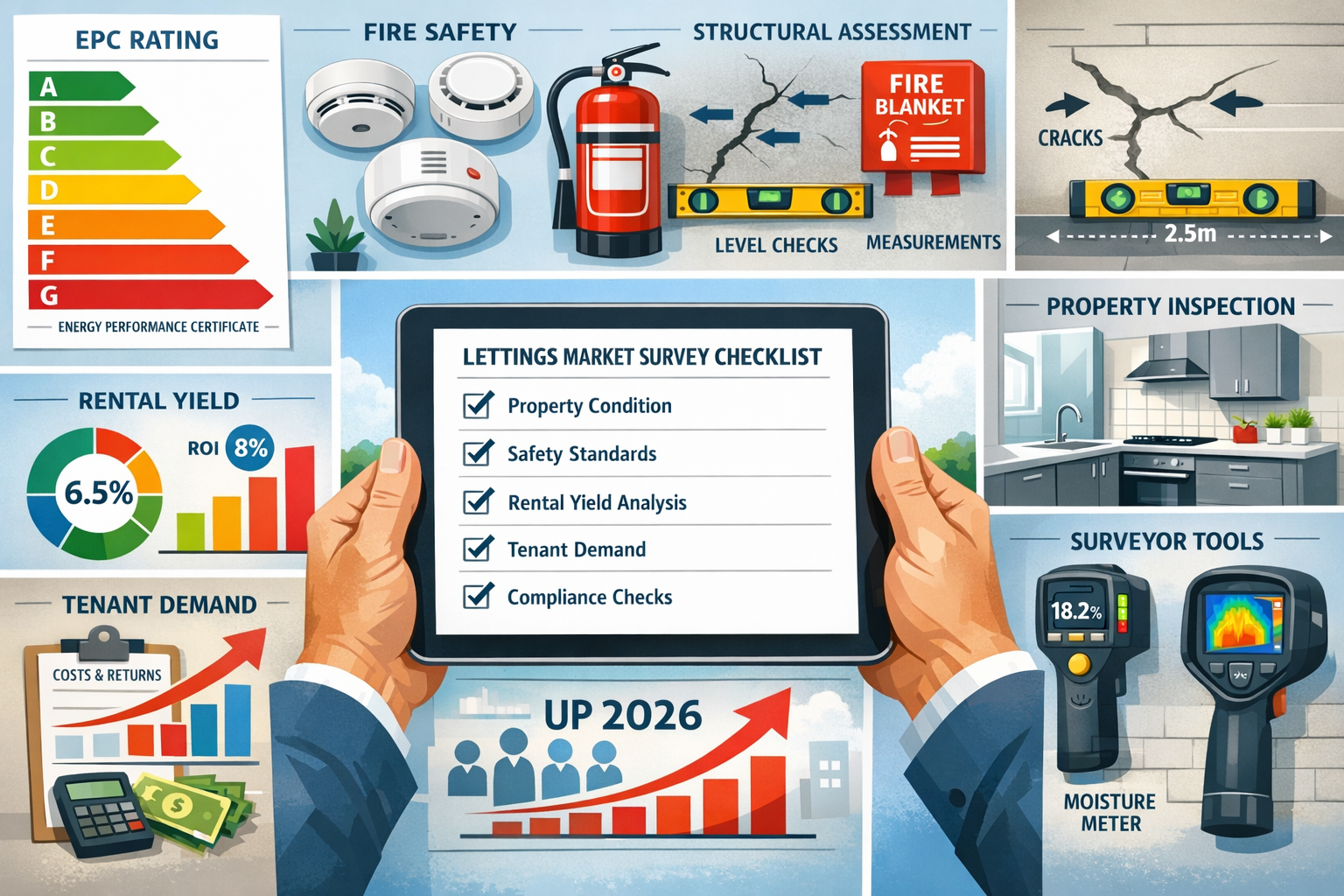
The rental property market in 2026 operates under fundamentally different conditions than previous years. Tenant demand has surged due to multiple converging factors: rising mortgage rates making homeownership less accessible, demographic shifts toward urban rental living, and continued housing supply shortages across key UK markets.
Current Market Dynamics
RICS member surveys throughout late 2025 and early 2026 consistently reported negative landlord instructions, meaning more landlords are exiting the market than entering it. This supply constraint, combined with robust tenant demand, has created a competitive environment where quality rental properties command premium rents and achieve rapid lettings.
For chartered surveyors conducting lettings market assessments, this landscape presents both opportunities and challenges. Properties that meet modern standards can generate exceptional yields, but the bar for compliance has risen significantly. Property market legislation changes have introduced new requirements that directly impact property valuations and rental potential.
Regulatory Framework Changes
The regulatory environment for rental properties has evolved substantially. Key changes affecting 2026 lettings market surveys include:
Energy Performance Requirements: Minimum EPC ratings for rental properties have become more stringent, with properties below certain thresholds requiring significant upgrades before they can be legally let.
Fire Safety Standards: Following comprehensive reviews of residential fire safety, rental properties now face enhanced requirements for fire detection, alarm systems, and emergency egress routes, particularly in multi-occupancy buildings.
Electrical Safety Regulations: Mandatory electrical installation condition reports (EICRs) must be conducted at specified intervals, with all installations meeting current safety standards.
Licensing Requirements: Selective and mandatory licensing schemes have expanded across UK local authorities, adding compliance layers that surveyors must verify during market assessments.
These regulatory changes mean that chartered surveyors conducting property valuations must now incorporate compliance verification as a core component of lettings market surveys, not merely an optional consideration.
Geographic Variations in Demand
Tenant demand in 2026 shows significant geographic variation. Urban centers, particularly London and major regional cities, continue experiencing intense rental pressure. However, suburban and semi-rural locations with good transport links have also seen demand increases as remote working patterns persist.
Chartered surveyors operating in regions like Hertfordshire, Berkshire, and Hampshire report strong rental markets driven by London commuters seeking better value and space. Understanding these regional dynamics is crucial when assessing rental property potential.
Essential Components of Chartered Surveyor Checklists for Lettings Market Surveys: Assessing Rental Properties in 2026's Tenant Demand Surge
A comprehensive lettings market survey checklist must address multiple assessment categories, each critical to determining a property's suitability for the rental market. The following framework provides the foundation for thorough property evaluation.
Structural and Building Condition Assessment
The structural integrity of a rental property forms the baseline for all other considerations. Chartered surveyors must systematically evaluate:
Foundation and Substructure: Inspect for settlement, subsidence, or structural movement that could indicate serious underlying issues. Look for cracks in walls, particularly those wider than 3mm or showing diagonal patterns[1].
External Walls and Facades: Assess condition of brickwork, rendering, cladding, and pointing. Check for dampness penetration, which can lead to significant tenant complaints and property deterioration.
Roof Structure and Covering: Examine roof condition, including tiles, slates, or other coverings. Identify missing or damaged elements, check valley gutters, and assess chimney stacks. Roof defects are among the most costly repairs for landlords[1].
Windows and Doors: Verify that all windows provide adequate security, thermal efficiency, and weatherproofing. Modern rental properties require double glazing in most cases to meet EPC requirements.
Internal Structure: Check floors for levelness and structural soundness, examine ceiling condition, and identify any signs of structural alteration that may lack appropriate building regulation approval.
A Level 3 full building survey provides the most comprehensive structural assessment for properties being considered for buy-to-let investment, particularly older buildings or those with visible defects.
Fire Safety Compliance Checklist
Fire safety has become a paramount concern in 2026's rental market, with landlords facing significant legal obligations. The fire safety component of lettings market surveys must include:
Smoke and Heat Detection Systems:
- Verify smoke alarms are installed on every floor of the property
- Check that alarms are positioned correctly (hallways, landings, near bedrooms)
- Test alarm functionality and battery condition
- Confirm interconnected alarm systems in larger properties
- Document alarm type, age, and compliance with current standards[2]
Fire Escape Routes:
- Assess adequacy of escape routes from all habitable rooms
- Verify windows in upper floors meet emergency egress requirements
- Check that escape routes remain unobstructed
- Evaluate external fire escape provision in multi-story properties
Fire-Resistant Construction:
- Examine fire doors and their condition, including intumescent strips and self-closing mechanisms
- Assess compartmentation in converted properties or HMOs
- Verify fire-resistant materials used in any recent alterations
- Check loft spaces for fire barriers in terraced or semi-detached properties
Fire Safety Equipment:
- Document presence and condition of fire extinguishers (if provided)
- Check fire blanket provision in kitchens
- Verify emergency lighting in common areas of multi-occupancy properties
HMO-Specific Requirements: Properties classified as Houses in Multiple Occupation face additional fire safety standards, including enhanced detection systems, emergency lighting, and fire-resistant construction elements.
For properties in areas like East London or Hampstead, where converted properties and HMOs are common, fire safety assessment requires particular expertise.
Energy Performance Certificate (EPC) Evaluation
Energy efficiency has transitioned from a desirable feature to a legal requirement for rental properties. The EPC assessment within lettings market surveys must address:
Current EPC Rating: Verify the property's existing EPC rating and expiry date. As of 2026, rental properties must achieve minimum EPC ratings, with further improvements anticipated in coming years.
Energy Efficiency Measures Present:
- Insulation: Loft insulation depth, cavity wall insulation, floor insulation
- Heating systems: Boiler efficiency rating, heating controls, radiator condition
- Glazing: Double or triple glazing, frame materials, thermal performance
- Lighting: LED or energy-efficient lighting installation percentage
- Renewable energy: Solar panels, heat pumps, or other renewable installations
Improvement Opportunities: Identify cost-effective improvements that could enhance EPC rating. This analysis should include:
- Estimated costs for each improvement measure
- Projected EPC rating improvement
- Potential rental value increase from higher energy efficiency
- Payback period for improvement investments
Regulatory Compliance Trajectory: Assess whether the property can meet anticipated future EPC requirements without prohibitive investment. Properties requiring extensive upgrades to meet minimum standards may not represent viable buy-to-let investments.
The EPC component directly impacts rental yields, as energy-efficient properties command higher rents and attract quality tenants increasingly concerned about utility costs.
Electrical Safety Assessment
Electrical installations in rental properties must meet rigorous safety standards. The electrical safety checklist includes:
Electrical Installation Condition Report (EICR):
- Verify current EICR exists and remains valid (maximum 5-year validity)
- Review EICR findings, particularly any C1 (danger present) or C2 (potentially dangerous) observations
- Assess cost implications of remedial work required
- Check that previous EICR recommendations have been addressed
Visible Electrical Installation Quality:
- Consumer unit (fuse box) condition and type – modern units should have RCD protection
- Socket and switch condition, quantity, and appropriate positioning
- Lighting fixtures and their condition
- Adequacy of electrical provision for modern tenant needs (charging points, multiple devices)
- Evidence of DIY electrical work or non-compliant installations
Specialized Electrical Considerations:
- Electric heating system condition and efficiency
- Immersion heater safety and functionality
- Outdoor electrical installations and their weatherproofing
- Communal area electrical installations in flats
Electrical defects can present immediate safety hazards and generate significant remediation costs, making this assessment component critical for accurate property valuation.
Plumbing and Water Systems Evaluation
Water system condition affects both property value and tenant satisfaction. Assessment areas include:
Water Supply and Distribution:
- Mains water supply adequacy and pressure
- Internal pipework condition, materials, and potential for leaks
- Stop valve accessibility and functionality
- Water tank condition (if present) and compliance with water regulations
Heating Systems:
- Boiler age, condition, and efficiency rating
- Service history and annual safety certification
- Heating distribution system (radiators, underfloor heating)
- Heating controls adequacy for tenant use and energy efficiency
- System pressure and operational performance
Sanitary Facilities:
- Bathroom and kitchen fixture condition and quality
- Drainage adequacy and signs of blockages
- Ventilation provision in wet rooms
- Shower and bath sealing and waterproofing
Hot Water Provision:
- Hot water system type and capacity
- Recovery time and adequacy for property size
- Temperature control and scalding prevention
- Legionella risk assessment for properties with storage tanks
Modern tenants expect reliable, efficient heating and hot water systems. Properties with aging or inefficient systems may require significant investment before achieving optimal rental returns[3].
Dampness and Ventilation Assessment
Dampness issues generate more tenant complaints than almost any other property defect. Comprehensive assessment includes:
Dampness Detection and Diagnosis:
- Rising damp: Check for tide marks, damaged plaster, salt deposits at low levels
- Penetrating damp: Examine walls for water ingress, particularly around windows and roof junctions
- Condensation dampness: Identify poor ventilation areas prone to condensation
- Use moisture meters to quantify dampness levels in suspect areas
Ventilation Provision:
- Natural ventilation: Window trickle vents, airbricks, passive ventilation
- Mechanical ventilation: Extractor fans in bathrooms and kitchens
- Ventilation adequacy for property size and occupancy
- Compliance with building regulations for ventilation
Drainage Systems:
- Guttering and downpipe condition and capacity
- Surface water drainage adequacy
- Foul drainage system condition
- Signs of drainage defects or blockages
Dampness problems can escalate quickly, damaging property and creating health hazards for tenants. Early identification allows investors to factor remediation costs into acquisition decisions.
Security and Safety Features
Tenant security expectations have increased substantially. Security assessment covers:
Physical Security Measures:
- External door quality and lock specification (5-lever mortice locks minimum)
- Window locks on all accessible windows
- Secure boundary treatments (fences, walls, gates)
- External lighting provision
- Secure storage for bicycles and bins
Safety Installations:
- Carbon monoxide detectors in rooms with fuel-burning appliances
- Gas safety certification (annual landlord gas safety record)
- Stair handrails and balustrade safety
- Glass safety (toughened or laminated glass in critical locations)
- Secure balconies and elevated areas
Access Control (for flats and apartments):
- Entry system functionality
- Communal door security
- Post and parcel security
- CCTV provision in common areas
Properties offering robust security features achieve higher rental values and attract more reliable tenants, particularly in urban markets.
Compliance and Licensing Verification
Regulatory compliance extends beyond physical property condition. Chartered surveyors must verify:
Planning and Building Regulation Compliance:
- Confirm all extensions and alterations have appropriate planning permission
- Verify building regulation approval for structural changes, conversions, and extensions
- Check completion certificates exist for significant works
- Identify unauthorized alterations that could affect property value or lettability
Licensing Requirements:
- Determine if property falls within selective or mandatory licensing schemes
- Verify HMO licensing compliance (if applicable)
- Check additional licensing requirements specific to the local authority
- Assess compliance with license conditions
Tenancy Deposit Protection:
- Verify systems in place for deposit protection compliance
- Check landlord registration requirements (in applicable jurisdictions)
Right to Rent Compliance:
- Confirm procedures exist for right to rent verification
- Document management systems for tenant records
Compliance failures can result in substantial penalties and, in some cases, prevent landlords from serving Section 21 notices, making this assessment component critical for investor protection.
Advanced Assessment Techniques for Chartered Surveyor Checklists for Lettings Market Surveys: Assessing Rental Properties in 2026's Tenant Demand Surge
Modern lettings market surveys benefit from technological advances that enhance assessment accuracy and efficiency. Chartered surveyors in 2026 increasingly deploy sophisticated tools to supplement traditional inspection methods.
Digital Survey Technologies
Thermal Imaging Cameras: These devices detect temperature variations that indicate insulation defects, air leakage, dampness, and heating system inefficiencies. Thermal surveys provide visual evidence of energy efficiency issues affecting EPC ratings[4].
Moisture Detection Equipment: Advanced moisture meters, including non-invasive radio frequency scanners, identify dampness without damaging property finishes. This technology enables precise dampness mapping for accurate remediation costing.
Drone Survey Technology: Premium drone surveys provide detailed roof and chimney inspections without scaffolding or access equipment costs. Drones capture high-resolution imagery of areas difficult or dangerous to access conventionally, enabling thorough assessment of roof condition, chimney stacks, and high-level building elements.
Digital Documentation Systems: Mobile survey applications enable real-time data capture, photograph annotation, and instant report generation. These systems improve survey efficiency and provide clients with comprehensive, illustrated reports[5].
3D Scanning and Modeling: Laser scanning technology creates precise 3D models of properties, enabling accurate floor area measurement, space planning assessment, and remote collaboration with clients and contractors.
Market Valuation Integration
Effective lettings market surveys extend beyond physical property assessment to incorporate market analysis:
Rental Yield Calculation: Surveyors must calculate gross and net rental yields based on current market rents, anticipated void periods, and property management costs. This analysis helps investors compare opportunities and make informed acquisition decisions.
Comparable Market Analysis: Systematic comparison with recently let similar properties provides evidence-based rental value estimates. Factors considered include:
- Property size and configuration
- Condition and specification quality
- Location and transport links
- Local amenities and schools
- Recent rental transactions for comparable properties
Tenant Demand Assessment: Evaluate local tenant demographics, employment centers, educational institutions, and transport infrastructure to forecast sustained rental demand. Properties in areas with excellent transport links typically achieve higher occupancy rates and rental values.
Void Period Forecasting: Estimate realistic void periods based on local market conditions, property type, and seasonal letting patterns. Accurate void forecasting significantly impacts net yield calculations.
Capital Growth Potential: While lettings market surveys focus on rental income, assessing capital appreciation potential provides investors with comprehensive return projections.
Environmental Considerations
Environmental issues increasingly affect property values and lettability. Chartered surveyors must assess:
Flood Risk: Review Environment Agency flood maps and historical flooding data. Properties in flood zones may face insurance difficulties and tenant concerns.
Contaminated Land: Investigate historical land uses that might indicate contamination risks, particularly for properties on former industrial sites.
Environmental Hazards: Assess proximity to noise sources (railways, airports, industrial facilities), air quality concerns, and other environmental factors affecting tenant desirability.
Sustainability Features: Document sustainable design elements (green roofs, rainwater harvesting, renewable energy) that enhance property appeal to environmentally conscious tenants.
Japanese Knotweed and Invasive Species: Check for invasive plant species that can affect property values and mortgage availability.
Environmental factors can significantly impact both rental values and long-term investment returns, warranting thorough assessment in comprehensive lettings market surveys.
Accessibility and Adaptability Assessment
Modern rental markets increasingly value accessible design. Survey checklists should evaluate:
Current Accessibility Features:
- Level or ramped access to entrances
- Door widths and circulation space
- Bathroom and kitchen accessibility
- Stair design and handrail provision
Adaptation Potential: Assess how easily properties could be adapted for tenants with mobility requirements, as this flexibility can expand potential tenant pools.
Future-Proofing: Consider demographic trends toward aging populations and the potential value of accessible design features in long-term rental markets.
Implementing Systematic Property Assessment Protocols
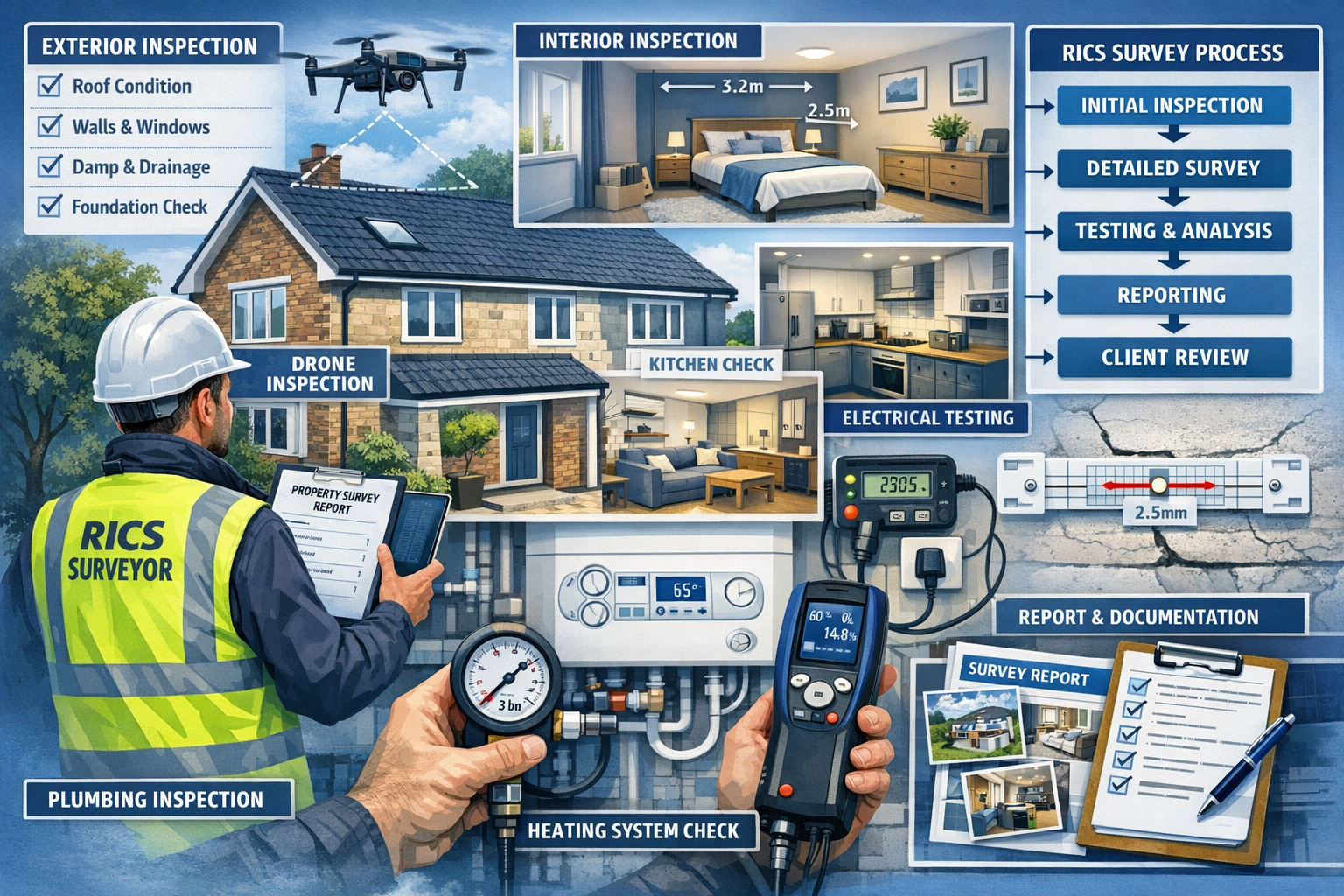
Translating comprehensive checklists into effective survey practice requires systematic implementation. Professional chartered surveyors follow structured protocols to ensure thorough, consistent assessments.
Pre-Inspection Preparation
Effective lettings market surveys begin before site visits:
Desktop Research:
- Review Land Registry records for ownership history and title restrictions
- Examine planning portal for planning history and local development plans
- Check local authority records for licensing requirements and planning constraints
- Research local rental market data and comparable transactions
- Review existing property documentation (EPCs, previous surveys, planning approvals)
Client Brief Clarification: Understand client investment objectives, risk tolerance, target yields, and specific concerns. This ensures survey focus aligns with client priorities.
Survey Scope Definition: Clearly define survey extent, limitations, and deliverables. Distinguish between visual inspections and invasive investigations, and clarify areas excluded from assessment.
Equipment Preparation: Ensure all necessary survey equipment is available and calibrated, including moisture meters, thermal cameras, measuring tools, and documentation systems[6].
Systematic On-Site Inspection
Site inspection methodology should follow consistent patterns to ensure comprehensive coverage:
Exterior-to-Interior Progression: Begin with external assessment, working systematically around the building perimeter before moving to interior spaces. This approach provides context for internal observations.
Room-by-Room Methodology: Inspect each room systematically, following consistent patterns (typically clockwise from entry points). Document:
- Room dimensions and configuration
- Ceiling, wall, and floor condition
- Window and door condition and operation
- Services provision (electrical outlets, heating, lighting)
- Dampness indicators or defects
- Overall decoration and specification quality[7]
Photographic Documentation: Capture comprehensive photographic evidence of:
- Overall property appearance and context
- Specific defects and areas of concern
- Compliance-related installations (smoke alarms, consumer units, boilers)
- Specification and finish quality
- Comparable evidence for valuation support
Measurement and Quantification: Record accurate dimensions for floor area calculation (using RICS measurement standards), identify quantities for remediation cost estimates, and document specific defect measurements.
Services Testing (where appropriate and safe):
- Test smoke alarms and carbon monoxide detectors
- Operate heating controls and check radiator functionality
- Run taps to assess water pressure and drainage
- Test electrical sockets (using socket testers)
- Operate windows and doors to verify functionality
Specialist Referrals and Limitations
Chartered surveyors must recognize when specialist input is required:
Structural Engineering: Significant structural defects, movement, or proposed alterations may require structural engineer assessment beyond general surveyor competence.
Electrical Specialists: While surveyors can identify obvious electrical defects, formal EICR testing requires qualified electricians.
Drainage Surveys: Suspected drainage defects may warrant CCTV drainage surveys to assess condition and identify specific problems.
Asbestos Surveys: Properties built before 2000 may contain asbestos materials requiring specialist identification and management surveys.
Timber and Damp Specialists: Severe dampness or suspected timber decay may require specialist investigation and treatment specifications.
Professional surveyors clearly communicate survey limitations and recommend appropriate specialist investigations to ensure clients receive comprehensive property assessment[8].
Report Compilation and Presentation
Survey findings must be communicated clearly and actionably:
Executive Summary: Provide concise overview of key findings, critical defects, compliance issues, and overall property suitability for lettings market.
Detailed Findings: Present systematic assessment results organized by building element or survey category, with clear descriptions, photographic evidence, and severity ratings.
Compliance Summary: Consolidate all regulatory compliance findings, highlighting areas requiring immediate attention versus longer-term considerations.
Cost Implications: Provide estimated costs for identified remedial works, distinguishing between:
- Essential repairs required for safety or compliance
- Recommended improvements for property condition
- Optional upgrades to enhance rental value or EPC rating
Rental Valuation: Present evidence-based rental value assessment with supporting comparable data and market analysis.
Investment Analysis: Calculate rental yields, payback periods for required improvements, and overall investment viability assessment.
Recommendations: Provide clear, actionable recommendations regarding property acquisition, necessary improvements, and letting strategy.
Modern survey reports increasingly use digital formats with interactive elements, hyperlinked photographs, and embedded data that enhance client understanding and decision-making.
Maximizing Rental Yields Through Strategic Property Assessment
The ultimate purpose of Chartered Surveyor Checklists for Lettings Market Surveys: Assessing Rental Properties in 2026's Tenant Demand Surge is to identify and optimize investment opportunities. Strategic assessment enables investors to maximize returns while managing risks.
Identifying High-Yield Opportunities
Certain property characteristics consistently correlate with superior rental yields:
Location Factors:
- Proximity to employment centers and business districts
- Excellent transport connectivity (rail stations, major roads)
- Strong local amenities (shops, restaurants, leisure facilities)
- Quality schools and educational institutions
- Low crime rates and desirable neighborhood characteristics
Property Configuration:
- Layouts matching tenant demand (e.g., two-bedroom properties often achieve optimal yields)
- Modern, functional kitchens and bathrooms
- Adequate storage and parking provision
- Private outdoor space (gardens, balconies, terraces)
- Home office potential (increasingly important post-pandemic)
Specification Quality:
- Modern, efficient heating and hot water systems
- Contemporary decoration in neutral, appealing schemes
- Quality fixtures and fittings that minimize maintenance
- Energy-efficient installations reducing tenant utility costs
- Smart home features appealing to modern tenants
Condition Considerations:
- Properties requiring cosmetic improvement often offer value-add opportunities
- Avoid properties with significant structural defects unless appropriately priced
- Consider improvement costs versus rental value enhancement
- Assess whether improvements can be completed within acceptable timeframes
Chartered surveyors conducting lettings market surveys must evaluate these factors holistically, identifying properties where modest investment can unlock significant rental value increases.
Value-Add Improvement Strategies
Survey findings should inform targeted improvement strategies:
High-Impact, Low-Cost Improvements:
- Professional decoration in contemporary neutral schemes
- Kitchen and bathroom refreshment (new fixtures, tiles, units)
- Flooring upgrades (quality carpet, laminate, or luxury vinyl)
- Improved lighting (LED installations, modern fixtures)
- Enhanced kerb appeal (front door, garden presentation)
Compliance-Driven Improvements:
- EPC rating enhancement through insulation, heating upgrades, or glazing improvements
- Fire safety installations (interconnected alarms, fire doors)
- Electrical upgrades to meet current standards
- Heating system replacement with efficient modern boilers
Yield-Enhancing Modifications:
- Loft conversions creating additional bedrooms
- Garage or outbuilding conversions to habitable space
- Reconfiguration improving layout functionality
- Adding en-suite facilities to bedrooms
- Creating dedicated home office spaces
Each improvement should be evaluated based on cost, rental value impact, and compliance necessity. Preparing properties for market requires strategic investment focusing on improvements delivering optimal return on investment.
Risk Mitigation Through Thorough Assessment
Comprehensive lettings market surveys protect investors from costly mistakes:
Avoiding Problem Properties: Identifying properties with fundamental issues (severe structural defects, unresolvable compliance problems, environmental hazards) prevents acquisition of assets that cannot achieve viable rental returns.
Accurate Cost Forecasting: Detailed defect identification and remediation cost estimates enable accurate investment appraisal, preventing budget overruns that erode returns.
Compliance Assurance: Verifying regulatory compliance protects investors from penalties, legal challenges, and inability to let properties legally.
Realistic Yield Projections: Evidence-based rental valuations and void period forecasting create realistic financial projections, avoiding over-optimistic assumptions that lead to investment disappointment.
Exit Strategy Planning: Understanding property condition and market positioning informs future exit strategies, whether through sale or continued letting.
Portfolio Strategy Considerations
For investors building rental property portfolios, lettings market surveys inform strategic decisions:
Geographic Diversification: Assess properties across different locations to spread risk and capture varied market opportunities. Surveyors operating across regions like Essex, Oxfordshire, and St Albans can provide comparative market insights.
Property Type Variation: Balance portfolio across property types (houses, flats, studios) and tenant markets (professionals, families, students) to optimize overall returns and reduce vacancy risk.
Yield vs. Capital Growth Balance: Some properties offer superior rental yields while others provide better capital appreciation potential. Portfolio strategy should balance these objectives based on investor goals.
Management Intensity: Consider property management requirements when building portfolios. Properties requiring intensive management (HMOs, short-term lets) may offer higher yields but demand more time investment.
Scalability: Assess whether investment strategies can scale efficiently as portfolios grow, considering financing availability, management capacity, and market depth.
Professional chartered surveyors provide strategic advice extending beyond individual property assessment, helping investors develop coherent portfolio strategies aligned with long-term objectives.
Future-Proofing Rental Property Investments
The lettings market continues evolving, with regulatory changes, tenant expectations, and economic conditions creating ongoing challenges and opportunities. Forward-thinking property assessment considers future trends and requirements.
Anticipated Regulatory Developments
Savvy investors prepare for likely regulatory changes:
EPC Requirements: Further tightening of minimum EPC standards appears likely, with potential requirements for EPC C ratings in the medium term. Properties unable to achieve higher ratings economically may face obsolescence in the rental market.
Decent Homes Standard: Extension of decent homes standards to the private rented sector could introduce minimum property condition requirements affecting older or poorly maintained properties.
Electrical Safety: Ongoing evolution of electrical safety requirements may introduce more frequent inspection intervals or enhanced standards for specific installations.
Fire Safety: Continued fire safety focus, particularly following building safety reviews, may introduce additional requirements for certain property types.
Tenant Protection: Strengthening tenant rights and protections could affect letting processes, deposit requirements, and landlord obligations.
Chartered surveyors conducting lettings market surveys should assess properties against anticipated future requirements, not merely current standards, to protect long-term investment viability.
Sustainability and Environmental Performance
Environmental performance increasingly influences property values and tenant demand:
Carbon Reduction Targets: National carbon reduction commitments will likely drive stricter energy efficiency requirements for rental properties.
Renewable Energy Integration: Properties with solar panels, heat pumps, or other renewable technologies may command rental premiums and attract environmentally conscious tenants.
Sustainable Materials: Use of sustainable, low-carbon building materials in any improvements enhances environmental credentials.
Biodiversity and Green Space: Properties offering green spaces, biodiversity features, or sustainable urban drainage may gain competitive advantages.
Climate Resilience: Properties designed or adapted to cope with climate change impacts (flooding, overheating, extreme weather) will maintain value better than vulnerable properties.
Lettings market surveys should evaluate environmental performance and improvement potential, positioning properties for long-term success in increasingly sustainability-focused markets.
Technological Integration
Modern tenants expect technological sophistication:
Smart Home Features: Smart heating controls, lighting systems, security devices, and energy monitoring appeal to tech-savvy tenants and support energy efficiency.
Connectivity Infrastructure: High-speed broadband capability has become essential, with fiber connectivity increasingly expected.
Electric Vehicle Charging: As electric vehicle adoption accelerates, properties offering EV charging points gain competitive advantages, particularly for houses with parking.
Digital Access Systems: Smart locks, video doorbells, and digital access control enhance security and convenience.
Energy Management Systems: Technologies enabling tenants to monitor and optimize energy consumption align with cost-consciousness and environmental awareness.
Survey checklists should assess technological infrastructure and improvement potential, recognizing that tech-enabled properties increasingly command rental premiums.
Demographic Trends and Tenant Preferences
Understanding evolving tenant demographics informs property assessment:
Remote Working Accommodation: Continued remote and hybrid working patterns increase demand for properties with dedicated office space or work-from-home suitability.
Aging Population: Growing numbers of older renters create demand for accessible, adaptable properties with minimal maintenance requirements.
Urban-Suburban Balance: Flexible working enables tenants to prioritize space and value over proximity to employment centers, affecting location desirability.
Experience-Focused Living: Tenants increasingly value properties offering lifestyle benefits (outdoor space, community amenities, wellness features) beyond basic accommodation.
Flexibility Requirements: Tenant desire for flexibility affects preferred lease lengths, furnished vs. unfurnished preferences, and property features supporting varied lifestyle needs.
Chartered surveyors must understand these demographic shifts when assessing rental properties, evaluating how well properties align with emerging tenant preferences and whether adaptation is feasible.
Case Studies: Applying Chartered Surveyor Checklists in 2026's Market

Practical application of comprehensive lettings market survey checklists demonstrates their value in real-world investment scenarios.
Case Study 1: Victorian Terrace Conversion Opportunity
Property: Three-bedroom Victorian terrace house, Fulham, requiring modernization
Survey Findings:
- Structurally sound with typical Victorian construction characteristics
- Original single-glazed sash windows throughout
- Aging gas central heating system with inefficient boiler
- No loft insulation, limited cavity wall insulation
- Current EPC rating: E
- Electrical installation requiring upgrade (outdated consumer unit, insufficient socket provision)
- Bathroom and kitchen dated but functional
- Damp-proof course showing signs of failure in rear wall
Compliance Issues:
- EPC rating below anticipated future minimum standards
- Electrical installation requiring EICR and remedial works
- Smoke alarm provision inadequate (single battery-operated alarm)
Investment Analysis:
- Purchase price: £725,000
- Required improvements: £45,000 (heating system, insulation, electrical upgrade, damp treatment, decoration)
- Projected rental value post-improvement: £2,800 pcm
- Gross yield: 4.36%
- EPC rating post-improvement: C
Recommendation: Proceed with acquisition. Property offers solid rental demand in desirable location. Required improvements are manageable and will achieve compliance while enhancing rental value. Future-proofed through EPC improvement to C rating.
Case Study 2: Modern Apartment with Hidden Issues
Property: Two-bedroom apartment, Hemel Hempstead, built 2015
Survey Findings:
- Modern construction with contemporary specification
- Current EPC rating: B
- Building regulation compliance certificates available for original construction
- Fire alarm system compliant with current standards
- However: Evidence of water ingress around balcony door
- Cladding system on building of uncertain fire safety compliance
- Service charge history showing escalating costs
- Building management company has poor reputation for maintenance responsiveness
Compliance Issues:
- Potential building safety concerns requiring further investigation
- Unclear responsibility for balcony waterproofing repairs
Investment Analysis:
- Purchase price: £285,000
- Projected rental value: £1,350 pcm
- Apparent gross yield: 5.68%
- However: Service charge £2,400 pa and rising
- Potential cladding remediation costs uncertain but potentially significant
- Balcony repair costs: estimated £3,000-£5,000
Recommendation: Do not proceed without further investigation. While property appears attractive based on headline figures, building safety uncertainties, escalating service charges, and management quality concerns present significant risks. Cladding issues could affect mortgageability and saleability.
Case Study 3: Value-Add HMO Opportunity
Property: Five-bedroom detached house, Enfield, suitable for HMO conversion
Survey Findings:
- Substantial detached property with good room sizes
- Currently configured as family home
- Structurally sound with no significant defects
- Modern boiler and heating system with adequate capacity
- Current EPC rating: D
- Good bathroom provision (two bathrooms)
- Adequate parking for multiple vehicles
- Located within mandatory HMO licensing area
HMO Conversion Requirements:
- Fire safety upgrades: interconnected alarm system, fire doors to all rooms, emergency lighting
- Additional bathroom/shower room required for HMO standards
- Kitchen enlargement or second kitchen provision
- Enhanced security measures
- Furniture and white goods provision
- HMO license application and compliance with standards
Investment Analysis:
- Purchase price: £625,000
- Conversion and compliance costs: £65,000
- Projected rental income (five rooms at £650 pcm each): £3,250 pcm
- Gross yield: 5.65%
- Management intensity: High (HMO properties require active management)
Recommendation: Strong opportunity for experienced HMO investors. Property well-suited to conversion with manageable compliance requirements. Rental yields significantly exceed standard letting returns. Location shows strong demand for professional house shares. Ensure experienced HMO management in place.
These case studies demonstrate how comprehensive lettings market surveys identify opportunities, flag risks, and enable informed investment decisions aligned with investor capabilities and objectives.
Working with Professional Chartered Surveyors
Maximizing the value of lettings market surveys requires selecting appropriately qualified professionals and understanding the service relationship.
Selecting Qualified Chartered Surveyors
Not all surveyors offer equivalent expertise in lettings market assessment. Key selection criteria include:
Professional Qualifications: Verify RICS membership (MRICS or FRICS designation) ensuring surveyors meet professional standards and adhere to ethical requirements.
Lettings Market Specialization: Seek surveyors with specific experience in rental property assessment, understanding regulatory requirements and investment analysis beyond standard residential surveying.
Local Market Knowledge: Surveyors with deep knowledge of target investment areas provide superior market analysis and rental valuations. Local expertise matters significantly in property assessment.
Technology Capabilities: Modern surveyors employing advanced assessment technologies (thermal imaging, drone surveys, digital reporting) provide more comprehensive service.
Professional Indemnity Insurance: Confirm adequate professional indemnity insurance protecting clients against potential negligence or errors.
Client References: Request references from previous buy-to-let investor clients to verify service quality and expertise.
Transparent Fee Structures: Understand fee structures, what services are included, and any additional costs for specialist investigations or extended reports.
Survey Types and Scope Selection
Different survey levels suit different circumstances:
RICS Level 2 Survey (HomeBuyer Report): Suitable for relatively modern properties in reasonable condition. Provides overview of condition but less detailed than Level 3 surveys. May be insufficient for investment property assessment.
RICS Level 3 Survey (Building Survey): Most comprehensive survey option, recommended for older properties, those in poor condition, or where detailed assessment is required for investment decisions. Provides thorough analysis of construction, condition, and defects.
Lettings Market Survey: Specialized survey focusing specifically on rental property assessment, incorporating compliance verification, rental valuation, and investment analysis alongside condition assessment.
Valuation Services: Separate from condition surveys, professional valuations provide market value assessments for purchase, refinancing, or portfolio management purposes.
For most buy-to-let investments, comprehensive Level 3 surveys or specialized lettings market surveys provide the detailed information necessary for confident investment decisions.
Maximizing Survey Value
Clients can enhance survey value through effective engagement:
Clear Brief Communication: Articulate investment objectives, concerns, and specific areas requiring particular attention. Surveyors can tailor assessment focus accordingly.
Documentation Provision: Supply any available property documentation (previous surveys, planning approvals, EPCs, service records) enabling surveyors to provide more informed analysis.
Access Arrangements: Ensure comprehensive property access, including lofts, basements, outbuildings, and all rooms. Restricted access limits survey thoroughness.
Question Preparation: Prepare questions about property condition, improvement priorities, and investment viability for discussion with surveyors.
Follow-Up Engagement: Use survey reports as basis for detailed discussions with surveyors, seeking clarification and additional advice as needed.
Specialist Coordination: Where specialist investigations are recommended, coordinate these promptly to inform investment decisions within transaction timeframes.
Professional chartered surveyors offer valuable expertise extending beyond written reports, providing strategic advice supporting successful buy-to-let investment.
Conclusion
Chartered Surveyor Checklists for Lettings Market Surveys: Assessing Rental Properties in 2026's Tenant Demand Surge represent essential tools for navigating today's competitive rental property market. With tenant demand at unprecedented levels while supply remains constrained, thorough property assessment has never been more critical for investment success.
The comprehensive checklists outlined in this article address the full spectrum of considerations affecting rental property viability: structural condition, fire safety compliance, energy performance, electrical and plumbing systems, dampness and ventilation, security features, and regulatory compliance. Modern lettings market surveys must integrate these technical assessments with market analysis, rental valuations, and investment appraisal to provide actionable intelligence for property investors.
The regulatory landscape for rental properties continues evolving, with enhanced fire safety requirements, stricter EPC standards, and comprehensive compliance obligations creating both challenges and opportunities. Properties meeting or exceeding current standards while offering potential for future-proofing represent the strongest investment prospects. Conversely, properties with fundamental compliance issues or requiring prohibitive improvement costs should be avoided regardless of apparent headline yields.
Technology has transformed property assessment capabilities. Thermal imaging, moisture detection equipment, drone surveys, and digital documentation systems enable chartered surveyors to provide more detailed, accurate, and actionable assessments than ever before. Investors should seek surveyors employing these advanced techniques to maximize assessment value.
Beyond individual property evaluation, effective lettings market surveys inform portfolio strategy, helping investors build diversified, resilient rental property portfolios aligned with long-term objectives. Understanding geographic variations in tenant demand, property type performance, and market dynamics enables strategic acquisition decisions optimizing risk-adjusted returns.
The case studies presented demonstrate how comprehensive survey checklists identify genuine opportunities while flagging properties presenting unacceptable risks. Whether assessing Victorian terraces requiring modernization, apparently attractive modern apartments with hidden issues, or value-add HMO conversion opportunities, systematic evaluation using professional checklists protects investor interests and supports confident decision-making.
Actionable Next Steps
For property investors seeking to capitalize on 2026's tenant demand surge:
-
Engage qualified chartered surveyors with specific lettings market expertise before committing to property acquisitions. The cost of comprehensive surveys represents minimal investment compared to potential costs of acquiring unsuitable properties.
-
Prioritize compliance verification in all property assessments. Fire safety, EPC ratings, electrical safety, and licensing requirements are non-negotiable elements of viable rental investments.
-
Adopt systematic assessment protocols using comprehensive checklists covering structural condition, services, compliance, and market positioning. Avoid shortcuts that could overlook critical issues.
-
Consider future regulatory trends when evaluating properties. Investments should remain viable under anticipated future requirements, not merely current standards.
-
Integrate technology into property assessment processes. Thermal imaging, moisture detection, and drone surveys enhance assessment accuracy and identify issues invisible to conventional inspection.
-
Develop strategic portfolio approaches rather than opportunistic individual acquisitions. Consider geographic diversification, property type variation, and balanced yield/growth objectives.
-
Maintain ongoing market awareness of tenant demand trends, regulatory developments, and investment market conditions. Lettings market dynamics evolve continuously, requiring adaptive strategies.
-
Build relationships with professional advisors including chartered surveyors, letting agents, property managers, and specialist contractors supporting successful buy-to-let investment.
The rental property market in 2026 offers substantial opportunities for informed investors employing rigorous assessment methodologies. Chartered Surveyor Checklists for Lettings Market Surveys: Assessing Rental Properties in 2026's Tenant Demand Surge provide the framework for identifying these opportunities while managing risks effectively. By combining comprehensive technical assessment with market analysis and strategic thinking, property investors can build successful rental portfolios delivering sustainable returns in this dynamic market environment.
The surge in tenant demand creates favorable conditions for landlords offering quality, compliant accommodation. However, success requires professional assessment, strategic investment, and commitment to meeting evolving standards. Chartered surveyors provide the expertise and systematic evaluation essential for navigating this complex landscape, transforming property assessment from a transaction formality into a strategic advantage driving investment success.
References
[1] 2026 Guide Rental Inspection Checklist – https://www.sarents.com/news/2026-guide-rental-inspection-checklist
[2] Rental Property Inspection Forms Best Practices – https://www.form-qr-code-generator.com/blog/rental-property-inspection-forms-best-practices/
[3] Rental Inspection Checklist – https://lula.life/articles/rental-inspection-checklist
[4] Property Inspection App – https://safetyculture.com/checklists/property-inspection-app
[5] Rental Property Inspection Checklist – https://www.rentecdirect.com/blog/rental-property-inspection-checklist/
[6] Rental Property Inspection Checklist – https://socaservicespainting.com/rental-property-inspection-checklist/
[7] Property Routine Visit Checklist – https://www.jotform.com/form-templates/property-routine-visit-checklist
[8] Property Inspection Checklist – https://theindependentlandlord.com/property-inspection-checklist/