

Retail leases signed during the post-2010 recovery period are now reaching their natural end dates in significant numbers. For landlords and tenants alike, that convergence creates one of the most financially consequential moments in commercial property: the dilapidations settlement. Chartered surveyor checklists for dilapidations in retail units navigating 2026 lease expiries have never been more critical, because the stakes — often running into six or seven figures for larger high street and out-of-town stores — demand structured, RICS-compliant preparation rather than reactive scrambling in the final weeks of a tenancy.
Key Takeaways
- Start the dilapidations process at least 12 months before lease expiry, not after the keys are handed back.
- A well-prepared Schedule of Condition, agreed at lease commencement, remains the single most powerful tool for limiting a tenant's terminal liability.
- Section 18(1) of the Landlord and Tenant Act 1927 caps the landlord's recoverable damages at the diminution in the property's value — a critical ceiling that tenants must exploit.
- Retail tenants face unique obligations around de-branding, reinstatement of alterations, and mechanical and electrical systems that generic commercial checklists often overlook.
- Early appointment of a specialist chartered surveyor on both sides reduces dispute costs and accelerates settlement.
Why 2026 Is a Pivotal Year for Retail Dilapidations
The post-pandemic restructuring of retail real estate means that a disproportionate number of 10- and 15-year leases granted between 2011 and 2016 are expiring in 2026. Many of those leases were signed when occupiers had significant bargaining power, resulting in generous fit-out allowances, extensive alteration licences, and sometimes incomplete schedules of condition. That combination creates fertile ground for disputes.
At the same time, the retail property market itself is under structural pressure. Landlords facing voids in challenging locations may inflate dilapidations claims to cross-subsidise re-letting costs. Tenants, squeezed by margin pressure, may attempt to vacate with minimal reinstatement. Neither strategy serves either party well, and both are increasingly scrutinised by the courts and by RICS guidance.
Professional advice in 2026 strongly encourages regular mid-term inspections to reduce terminal claims. A surveyor who has inspected a retail unit at years three, six, and nine of a ten-year lease will have contemporaneous evidence of condition that is invaluable during settlement negotiations [1].
"The dilapidations process is not an event at lease end — it is a discipline that runs for the entire term."
For tenants operating across multiple retail units — supermarkets, fashion chains, food and beverage operators — the aggregate liability across a portfolio of 2026 expiries can be material to the balance sheet. Commissioning a commercial property valuation alongside the dilapidations assessment gives finance teams the full picture of exit costs.
The Core Chartered Surveyor Checklist: Landlord Obligations and Rights
Pre-Expiry Preparation (12 Months Out)
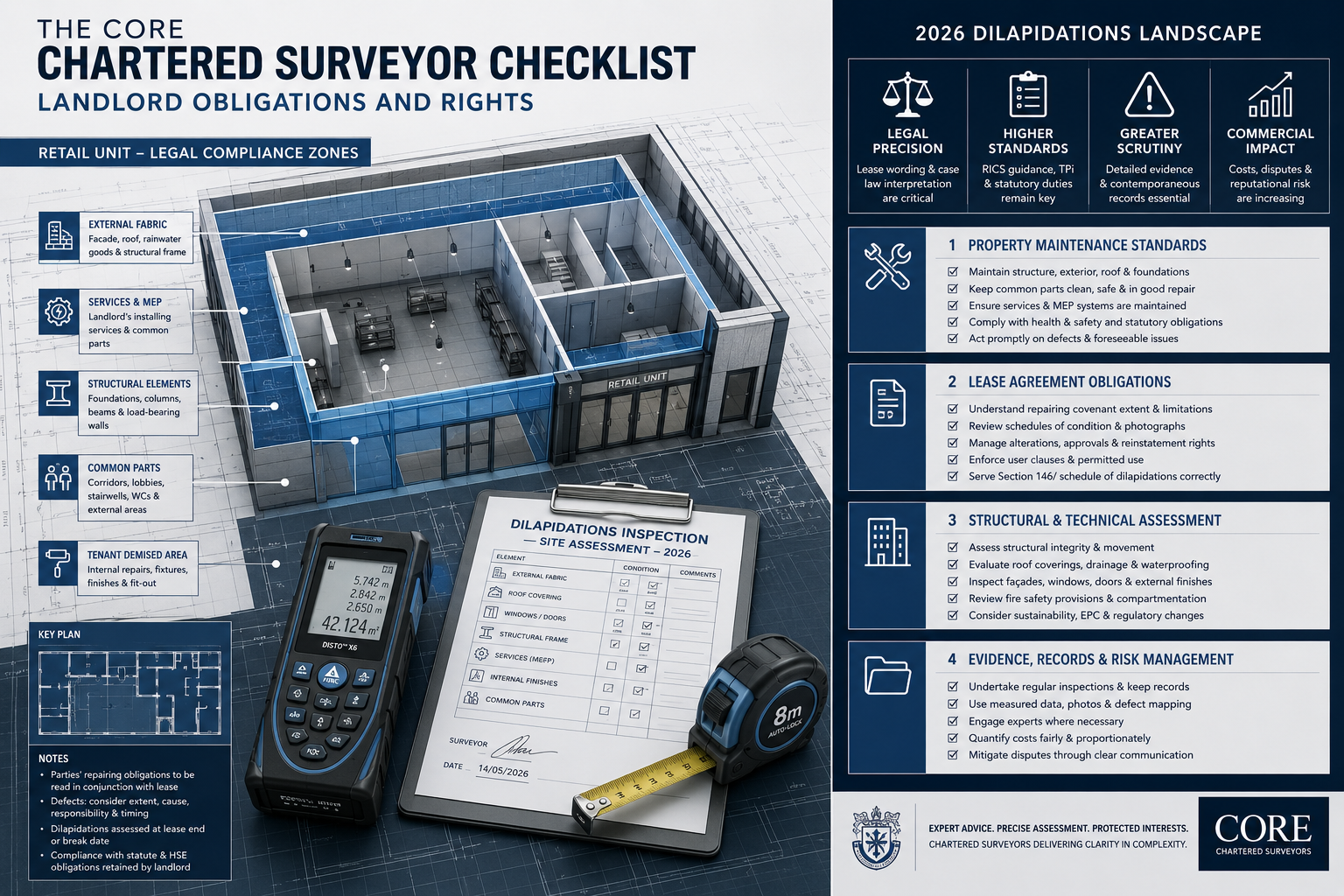
Updated 2026 surveyor checklist structures inspections into four key areas and recommends a 6-to-12-month lead-in [1]. For landlords, the checklist begins well before the lease end date.
1. Review the lease and all ancillary documents
- Identify all repairing, decorating, and yielding-up covenants.
- Locate the original licence for alterations and any subsequent variations.
- Confirm whether a Schedule of Condition was attached at commencement and, if so, obtain a clean copy.
- Check whether the lease contains a Jervis v Harris clause permitting self-help remedies.
2. Commission a terminal schedule inspection
The landlord's surveyor should carry out a detailed inspection of the retail unit, typically between six and nine months before expiry. This allows time for the schedule to be served, negotiated, and — if necessary — litigated before the lease end date [8].
3. Prepare the Schedule of Dilapidations
A Schedule of Dilapidations is a formal document that sets out each alleged breach of covenant, the remedial works required, and the estimated cost [10]. In retail units, this routinely covers:
| Category | Typical Items |
|---|---|
| Structural and fabric | Roof coverings, external walls, shopfront glazing |
| Internal finishes | Floor coverings, suspended ceilings, partitioning |
| Mechanical and electrical | HVAC, sprinkler systems, electrical installations |
| Tenant's alterations | Mezzanine floors, additional partitions, signage fixings |
| Decoration | Internal and external redecoration cycles |
| Statutory compliance | Fire safety, asbestos, legionella |
4. Quantify the claim with a Scott Schedule
The Scott Schedule presents the landlord's claim, the tenant's response, and any agreed items in a side-by-side format that courts and arbitrators find straightforward to assess. Preparing this document early focuses both parties on the real areas of dispute [6].
The Section 18 Cap — A Landlord's Ceiling
Section 18(1) of the Landlord and Tenant Act 1927 limits the landlord's recoverable damages to the lesser of the cost of works or the diminution in the market value of the reversion caused by the disrepair. Where a landlord intends to redevelop or substantially refurbish the unit, the damages may be reduced to nil or near-nil, regardless of the physical condition of the property [4].
Landlords must therefore instruct a surveyor to prepare a Section 18 diminution valuation alongside the Schedule of Dilapidations. Attempting to recover the full cost of works without addressing Section 18 is a common and expensive mistake. For properties in high-value locations, understanding the insurance reinstatement cost valuation is also relevant to ensuring the building is adequately covered during any void period.
Chartered Surveyor Checklists for Dilapidations in Retail Units: The Tenant's Perspective

Tenant-side 2026 checklists now routinely include a formal "dilapidations liability assessment" 12 months before expiry [3]. This is not merely a defensive measure — it is sound financial management.
Twelve Months Before Expiry
- Appoint a specialist surveyor immediately. A surveyor experienced in retail dilapidations will identify the likely heads of claim before the landlord's schedule arrives, allowing the tenant to budget accurately and make informed decisions about reinstatement versus cash settlement.
- Obtain and review the original Schedule of Condition. This document, if properly prepared at lease commencement, defines the baseline condition the tenant must return the property to. Any deterioration pre-dating the lease is excluded from the tenant's liability [9].
- Commission a dilapidations liability assessment. This is a detailed estimate of the likely claim, prepared on the basis of the lease covenants, the current condition of the unit, and comparable settlement data. It should be updated as the lease end approaches.
- Identify all alterations made during the term. Check whether each alteration was licensed, and whether the licence required reinstatement at expiry. Many retail tenants are surprised to find that mezzanine floors, partition walls, and even data cabling must be removed and the original fabric reinstated [7].
For a detailed explanation of how the dilapidations process works from first principles, the dilapidation protocols explained guide provides a useful primer.
Six Months Before Expiry
- Begin physical reinstatement works if the decision has been made to carry out works rather than settle in cash.
- Obtain competitive contractor quotes and retain all invoices — these are critical evidence if the landlord later challenges the standard of works.
- Commission a pre-vacating photographic survey to record the condition at handback. This creates a contemporaneous record that is difficult for a landlord to challenge [1].
- Address statutory compliance items: fire alarm certification, emergency lighting testing, legionella risk assessment, and any outstanding asbestos management obligations.
Retail-Specific Obligations: De-Branding and Reinstatement
Retail tenants face obligations that office or industrial occupiers rarely encounter. Retail tenants' 2026 vacating checklists stress de-branding, reinstatement of alterations, and evidence gathering as priority items [7].
De-branding requirements typically include:
- Removal of all external and internal signage, including fascia signs, projecting signs, and window graphics.
- Removal of all signage fixings and making good the substrate to a smooth, paintable finish.
- Removal of bespoke shopfront elements installed by the tenant, including branded canopies and entrance matting.
- Deletion of the tenant's brand from any digital display screens that remain in situ.
Mechanical and electrical reinstatement:
Retail units often have significantly enhanced M&E installations compared with the base-build specification — additional extract ventilation for food operators, enhanced electrical capacity for high-load tenants, and bespoke refrigeration pipework. The licence for alterations will determine whether these must be removed. Where removal is required, the tenant should obtain a specialist M&E contractor's report to confirm safe disconnection and the cost of making good [1]. The building pathology service can assist in identifying latent defects that may otherwise be attributed to the outgoing tenant.
Negotiation Tactics and Dispute Resolution for 2026 Claims
The RICS Dilapidations Protocol
The RICS Professional Statement on Dilapidations (England and Wales) sets out the framework within which surveyors on both sides are expected to operate. Compliance is not optional for RICS members — it is a professional obligation. The protocol requires:
- The landlord's surveyor to serve the terminal schedule within a reasonable time of lease expiry.
- Both parties' surveyors to meet without prejudice to narrow the areas of dispute before any formal proceedings.
- The use of a Scott Schedule in any litigation or arbitration.
Adherence to the protocol significantly reduces the risk of adverse costs orders in subsequent proceedings [6].
Section 18 Diminution Valuations as a Negotiation Tool
The Section 18 diminution valuation is often the most powerful instrument in a tenant's negotiating armoury. Where a landlord intends to redevelop a retail unit — converting it to residential use, for example, or undertaking a comprehensive refurbishment — the Section 18 cap may reduce the tenant's liability dramatically, regardless of the physical state of the unit [4].
2026 dilapidations survey guides place heavy emphasis on the Schedule of Condition and Section 18 valuation early in the process [6]. Tenants who wait until the landlord's schedule arrives before commissioning a Section 18 valuation are at a significant disadvantage.
Key questions for the Section 18 analysis:
- What are the landlord's intentions for the property post-expiry?
- Has planning permission been sought or obtained for redevelopment?
- What is the current market value of the property in repair versus its current condition?
- Would a hypothetical purchaser pay a premium for a property in full repair, given the current market?
Cash Settlement Versus Carrying Out Works
The decision between carrying out physical reinstatement works and negotiating a cash settlement is one of the most commercially significant choices a retail tenant makes. The analysis depends on:
| Factor | Favours Works | Favours Cash Settlement |
|---|---|---|
| Cost of works vs. claim | Works cost less than claim | Claim likely to be capped by Section 18 |
| Landlord's intentions | Landlord will carry out works | Landlord intends to redevelop |
| Time available | Sufficient time before expiry | Lease end imminent |
| Quality control | Tenant can control standard | Landlord may inflate contractor costs |
| Tax treatment | VAT on works may be recoverable | Cash settlement may be tax-deductible |
Specialist surveyors in Central London and across London regularly advise on this analysis for high street and shopping centre occupiers, where the sums involved justify detailed professional input.
Mid-Term Inspections as a Risk Management Tool
Professional advice in 2026 strongly encourages regular mid-term inspections to reduce terminal claims [1]. A tenant who commissions a condition survey at the midpoint of a long lease can:
- Identify and repair defects before they become more serious and more expensive.
- Create contemporaneous evidence of condition that limits the landlord's ability to attribute historic damage to the current tenancy.
- Demonstrate to the landlord a proactive approach to maintenance that may facilitate a more cooperative settlement at lease end.
The condition survey report service provides a structured approach to mid-term inspections that retail tenants can incorporate into their property management cycle.
Building a Compliant Dilapidations Checklist: A Practical Summary
The following consolidated checklist draws together the key actions for both parties, structured by timeline.
12 Months Before Expiry
- Appoint a specialist chartered surveyor (both parties).
- Obtain and review the lease, licences, and Schedule of Condition.
- Commission a dilapidations liability assessment (tenant) or preliminary inspection (landlord).
- Review Section 18 implications and landlord's intentions.
- Identify all alterations and confirm reinstatement obligations.
6 Months Before Expiry
- Serve or respond to the terminal Schedule of Dilapidations.
- Prepare or challenge the Scott Schedule.
- Commission a Section 18 diminution valuation.
- Begin reinstatement works if proceeding on that basis.
- Obtain contractor quotes and retain all documentation.
At Lease Expiry
- Commission a photographic handback survey.
- Confirm statutory compliance certifications are in order.
- Complete de-branding and reinstatement of alterations.
- Attend without-prejudice surveyor meeting to narrow disputes.
- Agree heads of settlement or escalate to formal dispute resolution.
For retail occupiers with properties across the South East, specialist surveyors in Hertfordshire and Watford are well-placed to manage multi-site dilapidations programmes efficiently.
Conclusion
Chartered surveyor checklists for dilapidations in retail units navigating 2026 lease expiries are not bureaucratic formalities — they are the operational backbone of a sound exit strategy. The retail sector's structural challenges in 2026 mean that both landlords and tenants face heightened financial exposure at lease end, and the gap between a well-managed dilapidations process and a poorly managed one can be measured in hundreds of thousands of pounds.
Actionable next steps for retail occupiers and landlords:
- Act now if lease expiry falls in 2026. The 12-month lead-in recommended by updated surveyor checklists means that time is already short for leases expiring in the second half of the year.
- Appoint a RICS-accredited chartered surveyor with specific retail dilapidations experience — not a generalist.
- Locate and review the Schedule of Condition from lease commencement before the landlord's surveyor does.
- Commission a Section 18 diminution valuation early, particularly where the landlord has development intentions.
- Document everything. Photographic surveys, contractor invoices, maintenance records, and correspondence are all potential evidence in a dispute.
- Consider mid-term inspections for any remaining leases with three or more years to run, to reduce future terminal liability.
The dilapidations process rewards preparation and penalises delay. With the right chartered surveyor checklist in place, retail tenants and landlords can navigate 2026 lease expiries with clarity, confidence, and significantly reduced dispute risk.
References
[1] Dilapidations Survey Checklist – timgreenwood-associates.co.uk
[3] A Tenants Guide To Dilapidation Surveys – commercialbuildingsurveyors.co.uk
[4] Surveying for Dilapidations – extnag.tacc.utexas.edu
[6] Dilapidations Valuations In Commercial Leases Expert Witness Tactics For Terminal Schedule Negotiations 2026 – canterburysurveyors.com
[7] A Tenants Checklist Before Vacating A Commercial Property Lease – fourthwallbc.com
[8] Dilapidations Survey – kingstonsurveyors.com
[9] Tenant Checklist Dilapidations – lindsays.co.uk
[10] Schedule Of Dilapidations – lexisnexis.com