

In the wake of tragic housing failures, the rental property landscape in 2026 faces its most significant regulatory transformation in decades. Building Surveys Under Awaab's Law Enhancements: Damp and Mould Protocols for 2026 Rental Compliance represent a fundamental shift in how landlords must approach tenant safety, moving from reactive repairs to proactive hazard prevention. With private rental sector compliance now mandatory from May 2026, property owners face strict investigation timelines, substantial financial penalties, and the urgent need for comprehensive building surveys that can identify damp and mould risks before they become life-threatening hazards.
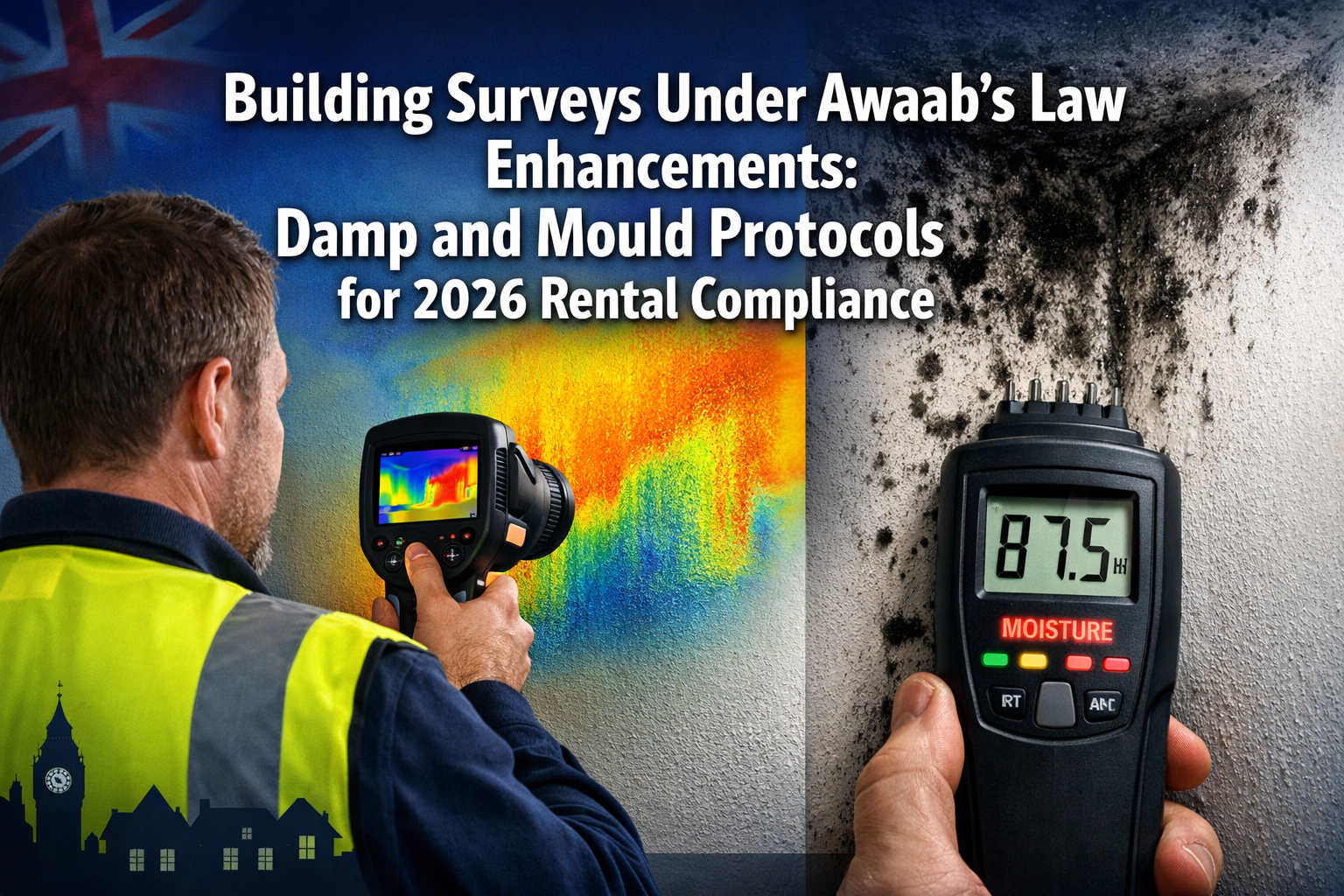
The extension of Awaab's Law to approximately 9% of private rented properties marks a critical moment for landlords who must now implement detailed survey protocols or face penalties reaching £30,000[1]. This comprehensive guide provides landlords, property managers, and surveyors with actionable checklists and compliance strategies to navigate these enhanced regulations while protecting both tenants and investment portfolios.
Key Takeaways
✅ Private rental compliance begins 1 May 2026, requiring landlords to investigate serious damp and mould hazards within 7 days and commence repairs within 14 days[1]
✅ Professional building surveys cost £200-£500 for specialist moisture assessments using thermal imaging and advanced detection equipment[1]
✅ Financial penalties reach £30,000 for serious breaches, with tenants able to reclaim up to 12 months' rent through repayment orders[1]
✅ Level 3 building surveys provide comprehensive damp assessment necessary for legal defence and proactive hazard identification
✅ Emergency hazards require 24-hour investigation response, creating urgent compliance obligations for landlords across all rental sectors[5]
Understanding Awaab's Law: Timeline and Regulatory Framework
The Legislative Journey from Tragedy to Enforcement
Awaab's Law emerged from the preventable death of two-year-old Awaab Ishak, who died from prolonged exposure to severe mould in his family's social housing property. This tragedy catalyzed legislative action that fundamentally reshaped housing safety standards across England.
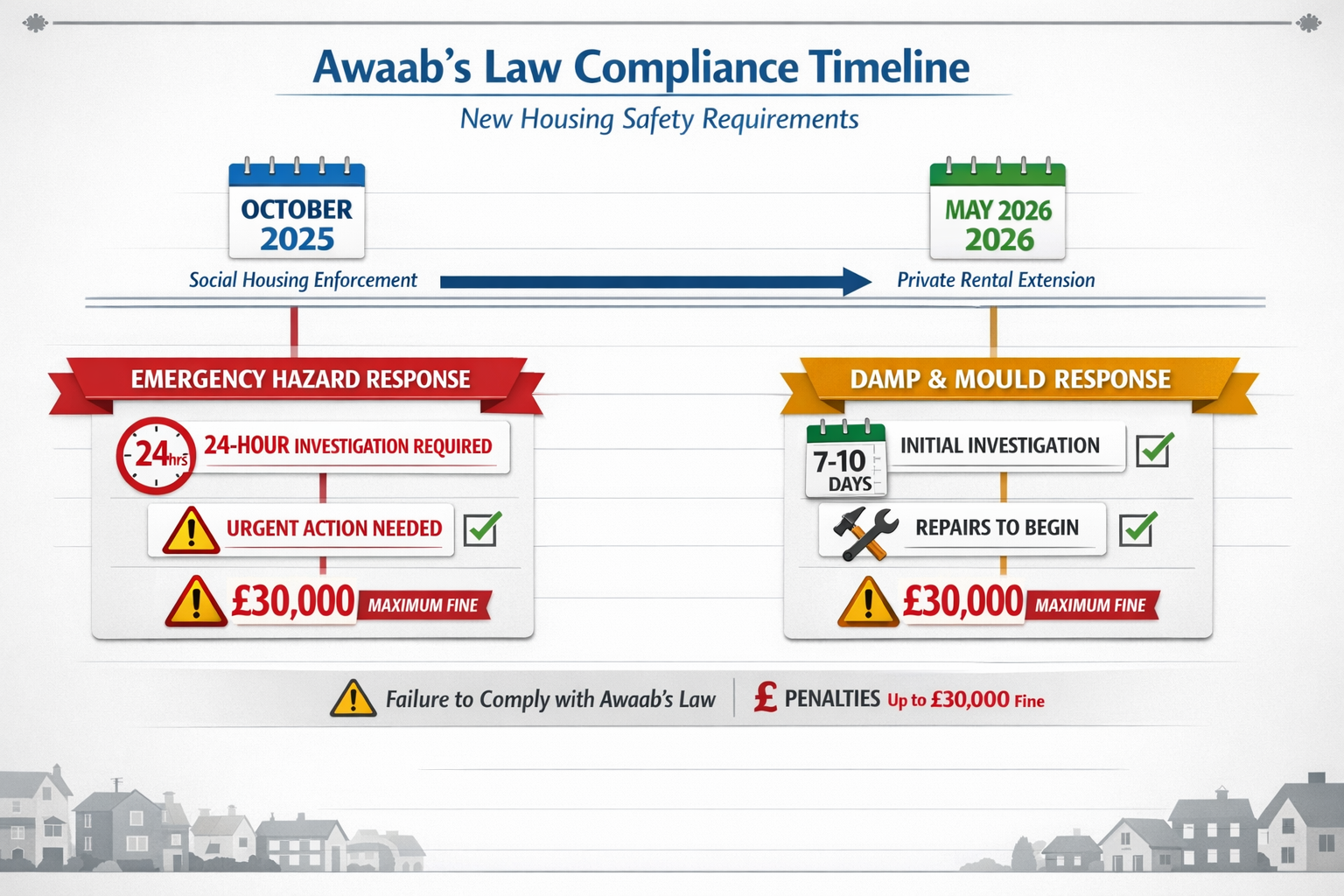
The law came into force for social landlords on 27 October 2025, establishing strict timeframes for investigating and repairing hazards including damp, mould, and emergency safety issues[3][4]. Social housing providers must now investigate significant damp and mould within 10 working days and commence repairs within a further 5 working days[5].
The critical expansion arrives on 1 May 2026, when the Renters' Rights Act extends these obligations to the private rental sector[1]. This extension brings thousands of private landlords under statutory compliance requirements previously limited to social housing providers.
"Awaab's Law represents the most significant shift in landlord obligations since the Housing Health and Safety Rating System was introduced, moving from discretionary action to mandatory intervention timelines."
Key Regulatory Timelines for 2026 Compliance
| Hazard Category | Investigation Timeline | Repair Commencement | Sector Application |
|---|---|---|---|
| Emergency hazards | 24 hours | As soon as possible | Social & Private (from May 2026) |
| Significant damp/mould (social) | 10 working days | 5 working days after investigation | Social housing |
| Serious hazards (private) | 7 days | 14 days after cause identified | Private rental (from 1 May 2026) |
Emergency hazards encompass dangerous electrical faults, damaged external doors or windows preventing security, major water leaks, and structural instability[5]. These require immediate landlord response regardless of property type.
The Housing Health and Safety Rating System (HHSRS) provides the assessment framework local authorities use to evaluate properties. Damp and mould create Category 1 hazards that trigger mandatory enforcement action, including improvement notices and prohibition orders[1].
For landlords seeking to understand which type of survey best identifies these hazards, our guide on which building survey you need provides essential context for compliance planning.
Building Surveys Under Awaab's Law Enhancements: Essential Survey Protocols
Why Level 3 Building Surveys Are Critical for Compliance
Professional building surveys form the cornerstone of Building Surveys Under Awaab's Law Enhancements: Damp and Mould Protocols for 2026 Rental Compliance. A comprehensive Level 3 building survey provides the detailed assessment necessary to identify existing hazards and potential future risks before they escalate into compliance breaches.
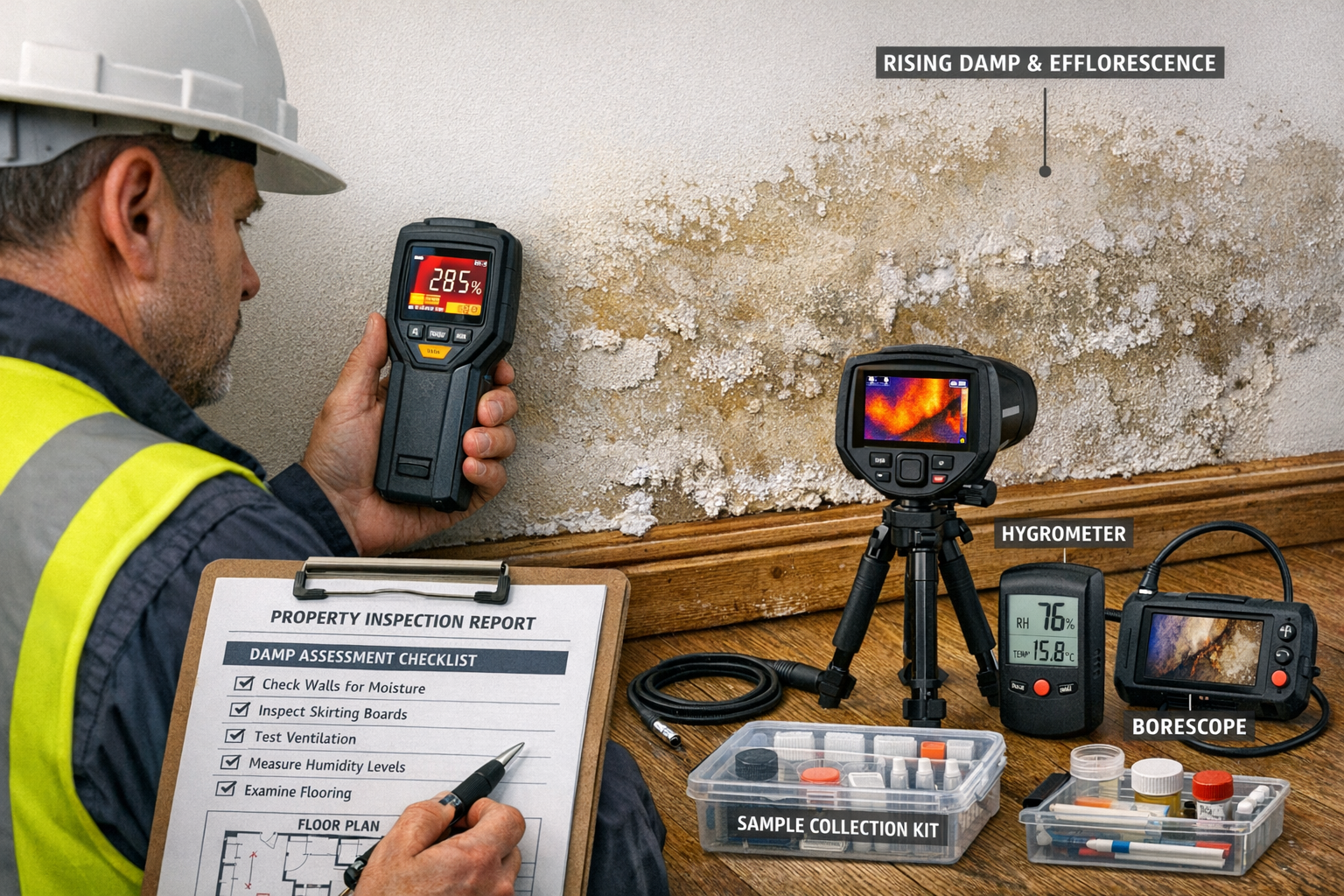
Level 3 surveys deliver:
🔍 Comprehensive moisture detection using thermal imaging cameras, moisture meters, and hygrometers to identify hidden damp sources
🔍 Structural assessment revealing building defects that contribute to water ingress and condensation
🔍 Ventilation evaluation identifying inadequate airflow that creates mould-friendly environments
🔍 Material condition analysis assessing timber decay, plaster deterioration, and other damp-related damage
🔍 Photographic evidence documenting current conditions for legal defence and baseline comparison
Professional damp and timber specialists typically charge between £200 and £500 for moisture surveys utilizing specialized equipment to identify damp types and sources[1]. This investment provides crucial documentation demonstrating proactive compliance efforts should disputes arise.
Damp and Mould Detection Checklist for Rental Properties
Landlords implementing Building Surveys Under Awaab's Law Enhancements: Damp and Mould Protocols for 2026 Rental Compliance should ensure surveys address these critical assessment points:
External Inspection Elements:
- Roof condition, including tiles, flashing, and guttering integrity
- External wall render or brickwork condition and pointing quality
- Window and door frame seals and weatherproofing
- Ground level assessment for soil bridging damp proof course
- Drainage systems and downpipe functionality
- Chimney stack condition and flaunching integrity
Internal Assessment Components:
- Wall surface moisture readings at multiple heights
- Thermal imaging to identify cold spots and thermal bridges
- Condensation risk areas (bathrooms, kitchens, bedrooms)
- Ventilation adequacy and extractor fan functionality
- Evidence of previous water damage or repairs
- Timber condition in floors, joists, and structural elements
- Basement or cellar moisture levels and tanking condition
Specialized Equipment Requirements:
- Protimeter or equivalent moisture meter (pin and pinless)
- Thermal imaging camera with temperature differential analysis
- Hygrometer for relative humidity measurement
- Borescope for cavity wall inspection
- Sample collection tools for laboratory analysis if needed
For comprehensive property assessment, landlords should consider our building survey services which incorporate all necessary compliance elements.
Understanding the Three Types of Damp
Accurate damp diagnosis is essential for effective remediation and compliance. The three primary damp types require different treatment approaches:
1. Rising Damp
Rising damp occurs when groundwater moves upward through porous building materials via capillary action. It typically affects walls up to 1 meter above ground level and leaves characteristic tide marks with salt efflorescence.
Treatment: Chemical damp proof course (DPC) injection remains the most common retrofit solution. Silicone-based water-repellent fluid is injected under pressure into mortar beds to create a moisture barrier[1]. Costs typically range from £1,000-£3,000 depending on wall length.
2. Penetrating Damp
Penetrating damp results from water entering through external defects such as damaged roofing, cracked render, faulty guttering, or compromised window seals. It creates localized damp patches that worsen during rainfall.
Treatment: Requires repair of the external defect causing water ingress. May involve roof repairs, repointing, render replacement, or window seal renewal. Costs vary significantly based on the specific defect.
3. Condensation and Mould
Condensation occurs when warm, moisture-laden air contacts cold surfaces, creating ideal conditions for mould growth. This is the most common damp type in modern properties with inadequate ventilation.
Treatment: Improved ventilation through mechanical extraction, positive input ventilation systems, or enhanced natural airflow. Insulation improvements to raise surface temperatures. Costs range from £500 for basic extractor fans to £2,000+ for whole-house ventilation systems.
Our detailed guide on how to prevent and remove damp and mould growth provides additional remediation strategies for landlords.
Damp and Mould Protocols for 2026 Rental Compliance: Implementation Strategies
Creating a Proactive Compliance Framework
Successful implementation of Building Surveys Under Awaab's Law Enhancements: Damp and Mould Protocols for 2026 Rental Compliance requires landlords to shift from reactive maintenance to proactive hazard management.
Step 1: Baseline Property Assessment (Before 1 May 2026)
Landlords should commission comprehensive building surveys for all rental properties before the May 2026 enforcement date. This baseline assessment:
- Documents current property condition with photographic evidence
- Identifies existing hazards requiring immediate attention
- Establishes priority repair schedules
- Creates defensible records demonstrating compliance efforts
- Provides cost estimates for necessary remediation work
The cost of a measured building survey varies based on property size and complexity, but represents essential insurance against future penalties.
Step 2: Hazard Prioritization Matrix
Not all identified issues carry equal urgency. Landlords should categorize findings using this priority framework:
🔴 Critical Priority (Immediate Action Required):
- Active mould growth affecting habitable rooms
- Category 1 HHSRS hazards
- Emergency hazards (electrical, structural, security)
- Conditions posing immediate health risks
🟡 High Priority (Action Within 30 Days):
- Significant damp without mould growth
- Ventilation deficiencies in moisture-prone areas
- External defects causing water ingress
- Heating system inadequacies
🟢 Medium Priority (Action Within 90 Days):
- Minor damp issues in non-habitable spaces
- Preventive maintenance requirements
- Insulation improvements
- Drainage optimization
Step 3: Tenant Communication Protocol
Awaab's Law compliance begins with effective tenant reporting systems. Landlords must establish:
- Clear reporting channels: Multiple contact methods (phone, email, online portal) for hazard notification
- Written acknowledgment procedures: Confirming receipt of tenant reports within 24 hours
- Investigation scheduling: Booking property access within statutory timelines
- Progress updates: Regular communication on investigation findings and repair schedules
- Completion confirmation: Documented sign-off when repairs are completed
Step 4: Contractor Network Development
Meeting statutory repair timelines requires pre-established relationships with qualified contractors:
- Damp proofing specialists with relevant certifications
- Mould remediation experts following HSE guidance
- Roofing contractors for water ingress repairs
- Ventilation system installers
- Emergency response contractors for 24-hour hazards
Legal Defence Through Documentation
Comprehensive documentation provides essential legal protection should disputes arise. Landlords should maintain:
📋 Survey Reports: Complete building survey reports with moisture readings, thermal images, and condition assessments
📋 Photographic Evidence: Dated photographs showing property condition before tenancy and at regular intervals
📋 Maintenance Records: Detailed logs of all inspections, repairs, and preventive maintenance
📋 Tenant Correspondence: Complete records of all hazard reports, responses, and resolution communications
📋 Contractor Invoices: Proof of repair work completion with detailed scope descriptions
📋 Compliance Certificates: Gas safety, electrical safety, and energy performance certificates
This documentation proves proactive compliance efforts and demonstrates reasonable landlord conduct if enforcement action or tenant claims arise.
For landlords managing multiple properties, understanding building inspections and surveys for homeowners provides valuable context for systematic portfolio management.
Financial Implications and Enforcement Mechanisms
Understanding the Cost of Non-Compliance
The financial consequences of failing to meet Building Surveys Under Awaab's Law Enhancements: Damp and Mould Protocols for 2026 Rental Compliance extend far beyond immediate repair costs.
Direct Financial Penalties:
Local authorities can issue financial penalties reaching £30,000 for serious breaches of Awaab's Law requirements[1]. These penalties apply per property and per breach, meaning landlords with multiple non-compliant properties face exponentially increasing liability.
Penalty levels typically follow this escalation framework:
- Minor breaches: £1,000-£5,000 for first offenses with no tenant harm
- Moderate breaches: £5,000-£15,000 for repeated violations or delayed compliance
- Serious breaches: £15,000-£30,000 for significant tenant harm or persistent non-compliance
Rent Repayment Orders:
Beyond local authority penalties, tenants can pursue rent repayment orders to reclaim up to 12 months' rent if landlords fail to address damp and mould hazards[1]. These orders represent substantial financial exposure:
- Average UK monthly rent: £1,190 (2026 figures)
- Potential 12-month repayment: £14,280 per property
- No requirement to vacate property during claim process
- Applicable even after tenancy ends (within specified timeframes)
Additional Tenant Remedies:
Tenants possess multiple enforcement mechanisms:
- Rent withholding: Legal right to withhold rent for uninhabitable conditions
- Compensation claims: Civil claims for health impacts, property damage, and emotional distress
- Disrepair claims: Legal action under landlord repair obligations
- Environmental Health enforcement: Local authority inspection and improvement notices
Reputational and Commercial Consequences:
- Rogue landlord databases: Public listings affecting future letting ability
- Mortgage lender concerns: Potential breach of buy-to-let mortgage terms
- Insurance complications: Increased premiums or coverage denial
- Tenant acquisition challenges: Negative reviews and reduced demand
Cost-Benefit Analysis: Prevention vs. Penalty
The financial case for proactive compliance is compelling:
| Compliance Investment | Cost Range | Non-Compliance Risk | Potential Cost |
|---|---|---|---|
| Professional building survey | £200-£500 | Local authority penalty | £1,000-£30,000 |
| Chemical DPC installation | £1,000-£3,000 | Rent repayment order | £14,280 (12 months) |
| Ventilation system upgrade | £500-£2,000 | Tenant compensation claim | £5,000-£50,000+ |
| Annual maintenance inspection | £150-£300 | Legal defence costs | £3,000-£15,000 |
| Total proactive investment | £1,850-£5,800 | Total potential exposure | £23,280-£109,280+ |
This analysis demonstrates that comprehensive compliance investment costs approximately 5-8% of potential non-compliance exposure, representing exceptional risk mitigation value.
For landlords considering the broader context of property surveys, our comparison of full building survey vs homebuyer survey clarifies which assessment level provides adequate compliance coverage.
Advanced Survey Techniques for Damp Detection
Thermal Imaging Technology
Thermal imaging cameras have revolutionized damp detection by revealing temperature differentials invisible to the naked eye. These cameras detect:
- Cold spots indicating thermal bridges and insulation deficiencies
- Moisture patterns showing active water ingress paths
- Hidden leaks behind walls, ceilings, and floors
- Condensation risk areas where surface temperatures fall below dew point
Professional thermal surveys should be conducted during heating season when temperature differentials are most pronounced. Surveyors typically capture images at multiple times to account for thermal lag and solar gain effects.
Moisture Meter Protocols
Accurate moisture measurement requires proper technique and equipment calibration:
Pin-Type Meters:
- Penetrate surface to measure electrical resistance
- Provide depth-specific readings
- Ideal for timber moisture content assessment
- Readings above 20% indicate active damp in wood
- Readings above 15% in masonry suggest moisture issues
Pinless Meters:
- Use electromagnetic waves to scan surface area
- Non-destructive testing method
- Cover larger surface area quickly
- Ideal for initial screening before detailed investigation
Professional surveyors take multiple readings at various heights and locations, creating moisture maps that identify patterns and severity.
Relative Humidity Monitoring
Hygrometers measure ambient relative humidity (RH), providing crucial context for condensation risk assessment:
- RH above 70%: High mould growth risk
- RH 60-70%: Moderate risk requiring ventilation improvement
- RH below 60%: Generally acceptable for mould prevention
Long-term data logging over several weeks provides the most accurate assessment of condensation risk, capturing daily and seasonal variations.
Preparing for Future Regulatory Expansion
Beyond Damp and Mould: 2026-2027 Hazard Expansion
While current Building Surveys Under Awaab's Law Enhancements: Damp and Mould Protocols for 2026 Rental Compliance focus primarily on moisture-related hazards, the legislative framework explicitly provides for expansion throughout 2026 and 2027[2][4].
Anticipated future inclusions:
🔧 Electrical safety hazards: Outdated wiring, insufficient earthing, overloaded circuits
🔧 Fire safety deficiencies: Inadequate escape routes, missing smoke alarms, combustible materials
🔧 Structural hazards: Subsidence, wall instability, roof deterioration
🔧 Heating system failures: Inadequate heating capacity, carbon monoxide risks
🔧 Pest infestations: Rodents, insects, and associated health risks
Landlords conducting comprehensive building surveys now gain advantage by identifying these potential future compliance issues before mandatory enforcement begins.
Building a Sustainable Compliance Culture
Forward-thinking landlords are moving beyond minimum compliance toward sustainable property management practices:
Preventive Maintenance Schedules:
- Annual building condition surveys
- Bi-annual gutter cleaning and drainage checks
- Quarterly ventilation system maintenance
- Monthly tenant property condition reviews
Tenant Education Programs:
- Condensation prevention guidance
- Proper ventilation usage instructions
- Early hazard identification training
- Reporting procedure clarification
Property Upgrade Investments:
- Insulation improvements reducing condensation risk
- Mechanical ventilation with heat recovery (MVHR) systems
- Smart home technology for humidity monitoring
- Quality building materials in refurbishments
These proactive approaches not only ensure compliance but enhance property value, reduce void periods, and improve tenant satisfaction.
For landlords seeking comprehensive property assessment, our Level 3 survey details explain the full scope of professional building examination.
Regional Considerations and Local Authority Variations
Understanding Local Enforcement Approaches
While Awaab's Law establishes national standards, local authority enforcement varies significantly across regions. Landlords should:
- Research local authority priorities: Some councils focus heavily on damp and mould, others prioritize different hazards
- Understand regional climate factors: Coastal properties face different damp challenges than inland locations
- Identify local support resources: Many councils offer landlord guidance and compliance workshops
- Build relationships with environmental health officers: Proactive engagement demonstrates compliance commitment
Property Type Specific Considerations
Different property types present unique damp and mould challenges:
Victorian and Edwardian Properties:
- Solid wall construction without cavity insulation
- Original lime plaster vulnerable to moisture
- Historic ventilation systems often compromised
- Require sympathetic retrofitting maintaining character
Modern Apartments:
- Mechanical ventilation dependency
- Thermal bridging at balcony connections
- Condensation risk from airtight construction
- Shared building infrastructure complications
Converted Properties:
- Basement conversions with tanking requirements
- Loft conversions with condensation challenges
- Multiple occupation ventilation demands
- Complex ownership and maintenance responsibilities
Surveyors must adapt assessment protocols to property-specific characteristics, ensuring comprehensive hazard identification regardless of building type.
Practical Implementation Timeline for Landlords
90-Day Compliance Roadmap (February-April 2026)
For landlords approaching the 1 May 2026 private rental sector enforcement date:
Days 1-30 (February 2026):
- Commission professional building surveys for all rental properties
- Review existing maintenance records and identify known issues
- Establish contractor relationships for common repair types
- Create tenant communication protocols and reporting systems
- Budget for identified remediation work
Days 31-60 (March 2026):
- Receive and review survey reports
- Prioritize identified hazards using risk matrix
- Obtain quotes for necessary repair work
- Schedule repairs for critical and high-priority issues
- Update tenancy documentation with reporting procedures
Days 61-90 (April 2026):
- Complete critical priority repairs
- Implement tenant education programs
- Establish ongoing inspection schedules
- Create compliance documentation systems
- Conduct final pre-enforcement property checks
This timeline ensures landlords enter the compliance period with comprehensive understanding of property condition and clear remediation plans.
Conclusion
Building Surveys Under Awaab's Law Enhancements: Damp and Mould Protocols for 2026 Rental Compliance represent a fundamental evolution in landlord obligations, moving from reactive maintenance to proactive hazard prevention. With private rental sector enforcement beginning 1 May 2026, landlords face strict investigation timelines, substantial financial penalties reaching £30,000, and potential rent repayment orders of up to 12 months[1].
Professional building surveys costing £200-£500 provide essential baseline assessments that identify existing hazards and demonstrate proactive compliance efforts[1]. Level 3 surveys deliver comprehensive moisture detection, structural assessment, and ventilation evaluation necessary for legal defence and effective remediation planning.
The financial case for compliance is compelling: proactive investment of £1,850-£5,800 per property mitigates potential non-compliance exposure exceeding £100,000 when penalties, rent repayment orders, and legal costs are considered. Beyond financial protection, comprehensive survey protocols protect tenant health, preserve property value, and establish sustainable management practices.
Actionable Next Steps
✅ Commission professional building surveys for all rental properties before 1 May 2026, ensuring comprehensive damp and mould assessment
✅ Establish clear tenant reporting systems with multiple contact channels and written acknowledgment procedures meeting statutory timelines
✅ Develop contractor networks capable of responding to emergency hazards within 24 hours and completing repairs within required timeframes
✅ Create comprehensive documentation systems maintaining survey reports, photographic evidence, maintenance records, and tenant correspondence for legal protection
✅ Implement preventive maintenance schedules including annual building condition surveys and quarterly ventilation system checks
✅ Invest in property upgrades that reduce condensation risk through improved insulation, mechanical ventilation, and humidity monitoring technology
The tragic circumstances that created Awaab's Law demand that landlords prioritize tenant safety through rigorous compliance protocols. Professional building surveys provide the foundation for this compliance, identifying hazards before they threaten health and creating defensible records demonstrating responsible property management.
For landlords seeking expert assessment of rental properties, Prince Surveyors' building survey services deliver comprehensive compliance-focused inspections that protect both tenants and investment portfolios in the evolving 2026 regulatory landscape.
References
[1] Preventing Damp And Mould In 2026 Under Awaab S Law – https://www.augustapp.com/blog/preventing-damp-and-mould-in-2026-under-awaab-s-law
[2] Awaabs Law Damp And Mould In The Social Housing Sector – https://www.titon.com/blog-ventilation/awaabs-law-damp-and-mould-in-the-social-housing-sector
[3] Awaabs Law – https://www.housing-ombudsman.org.uk/centre-for-learning/key-topics/awaabs-law/
[4] Awaabs Law Guidance For Social Landlords Timeframes For Repairs In The Social Rented Sector – https://www.gov.uk/government/publications/awaabs-law-guidance-for-social-landlords/awaabs-law-guidance-for-social-landlords-timeframes-for-repairs-in-the-social-rented-sector
[5] Awaabs Law Rules To Protect Social Housing Tenants In England From Damp And Unsafe Homes – https://contact.org.uk/about-contact/news-and-views/awaabs-law-rules-to-protect-social-housing-tenants-in-england-from-damp-and-unsafe-homes/