

The tragic death of two-year-old Awaab Ishak from prolonged exposure to mould in 2020 has fundamentally reshaped housing safety legislation across the UK. As of 2026, Building Surveys Under Awaab's Law 2026: Expanded Hazard Categories and Surveyor Protocols now mandate that landlords address not just damp and mould, but a comprehensive range of life-threatening hazards including excess temperatures, electrical faults, fire risks, and structural collapse. For building surveyors, this legislative expansion demands entirely new assessment methodologies, accelerated investigation timelines, and evidence-based reporting protocols that go far beyond traditional survey practices.
The stakes have never been higher. Social landlords face unlimited fines for non-compliance, while private landlords entering the regulatory framework in 2026 must rapidly adapt to mandatory investigation deadlines measured in hours and days rather than weeks[3]. Understanding these expanded hazard categories and implementing compliant surveyor protocols is no longer optional—it's a legal imperative that protects both tenants and property professionals.
Key Takeaways
- 🏠 Phase 2 expansion in 2026 extends Awaab's Law beyond damp/mould to include excess cold, excess heat, electrical hazards, fire risks, and structural collapse across social and private rental sectors
- ⏱️ Emergency hazards require 24-hour response, with significant hazards demanding investigation within 10 working days and written findings delivered within 3 working days[2]
- 📋 Professional building surveys must now incorporate multi-hazard assessment protocols including thermal imaging, electrical testing, structural integrity evaluation, and fire safety compliance
- 📝 Evidence-based documentation has become mandatory, with surveyors required to provide defensible investigation reports, clear remediation plans, and compliance timelines
- ⚖️ Enforcement consequences include unlimited fines and legal proceedings, with liability triggered the moment landlords become aware—or should reasonably have become aware—of potential hazards[2]
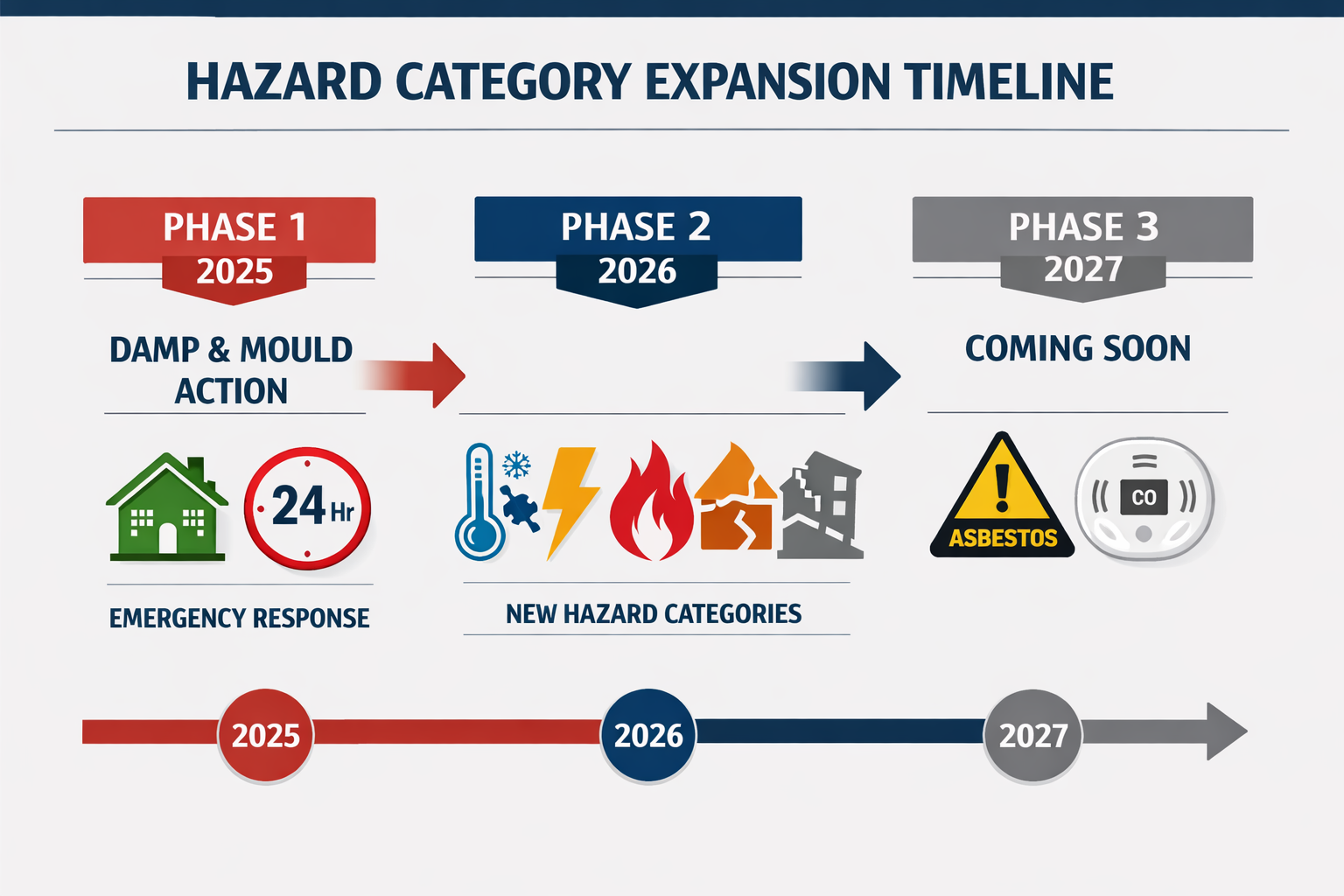
Understanding the Phased Implementation of Building Surveys Under Awaab's Law 2026
Awaab's Law operates through a carefully structured three-phase rollout designed to progressively expand hazard coverage while allowing landlords and surveyors time to develop compliant systems.
Phase 1: Emergency and Damp/Mould Focus (October 2025-Present)
The initial phase, which commenced on October 27, 2025, established the foundational framework for Building Surveys Under Awaab's Law 2026: Expanded Hazard Categories and Surveyor Protocols. This phase applies exclusively to:
- Emergency hazards presenting immediate risk to occupier health or safety
- Damp and mould hazards classified as significant risks under HHSRS (Housing Health and Safety Rating System)
Under Phase 1 requirements, social landlords must respond within 24 hours of becoming aware of an emergency hazard, conducting immediate investigation and implementing "make safe" works[2]. For significant damp and mould hazards, tenants gained the legal right to a professional assessment visit within 10 working days of notification[2].
The investigation process established in Phase 1 created the template for all subsequent hazard categories:
- Initial notification and hazard classification
- Professional investigation within specified timeframes
- Written summary of findings delivered to tenants within 3 working days
- Make-safe works completed within 5 working days or alternative accommodation offered
- Long-term remediation commenced within 5 working days and completed within 12 weeks maximum[2]
Phase 2: Expanded Hazard Categories (2026)
The 2026 expansion represents the most significant development for building surveyors, extending mandatory investigation protocols to five critical hazard categories:
| Hazard Category | Key Assessment Requirements | Survey Tools Required |
|---|---|---|
| Excess Cold | Thermal performance evaluation, insulation adequacy, heating system functionality | Thermal imaging cameras, temperature loggers, U-value calculations |
| Excess Heat | Ventilation assessment, solar gain analysis, cooling capacity | Thermal sensors, airflow meters, heat stress indices |
| Electrical Hazards | Circuit integrity, earthing systems, consumer unit compliance | Multifunction testers, thermal imaging for overheating circuits |
| Fire Risks | Escape routes, fire door integrity, detection systems, compartmentation | Smoke testing equipment, fire door gap gauges, thermal cameras |
| Structural Collapse | Load-bearing capacity, foundation integrity, structural movement | Crack monitoring, structural calculations, ground investigation |
This expansion fundamentally changes the scope of building surveys from primarily visual inspections to comprehensive multi-disciplinary assessments requiring specialized equipment and expertise.
Phase 3: Complete HHSRS Coverage (2027 and Beyond)
Phase 3, scheduled for implementation from 2027, will extend Awaab's Law to cover all remaining HHSRS hazards including:
- Asbestos and manufactured mineral fibers (MMF)
- Biocides and chemical contamination
- Carbon monoxide and combustion products
- Lead contamination
- Radiation hazards
- Volatile organic compounds (VOCs)
For surveyors specializing in asbestos building surveys, this phase will integrate existing asbestos management protocols into the accelerated Awaab's Law timeframes, requiring rapid mobilization and reporting capabilities.
Expanded Hazard Categories: What Building Surveys Under Awaab's Law 2026 Must Now Include
The 2026 hazard expansion requires surveyors to fundamentally reimagine their assessment methodologies. Traditional visual inspections must now incorporate technical testing, environmental monitoring, and compliance verification across multiple disciplines.
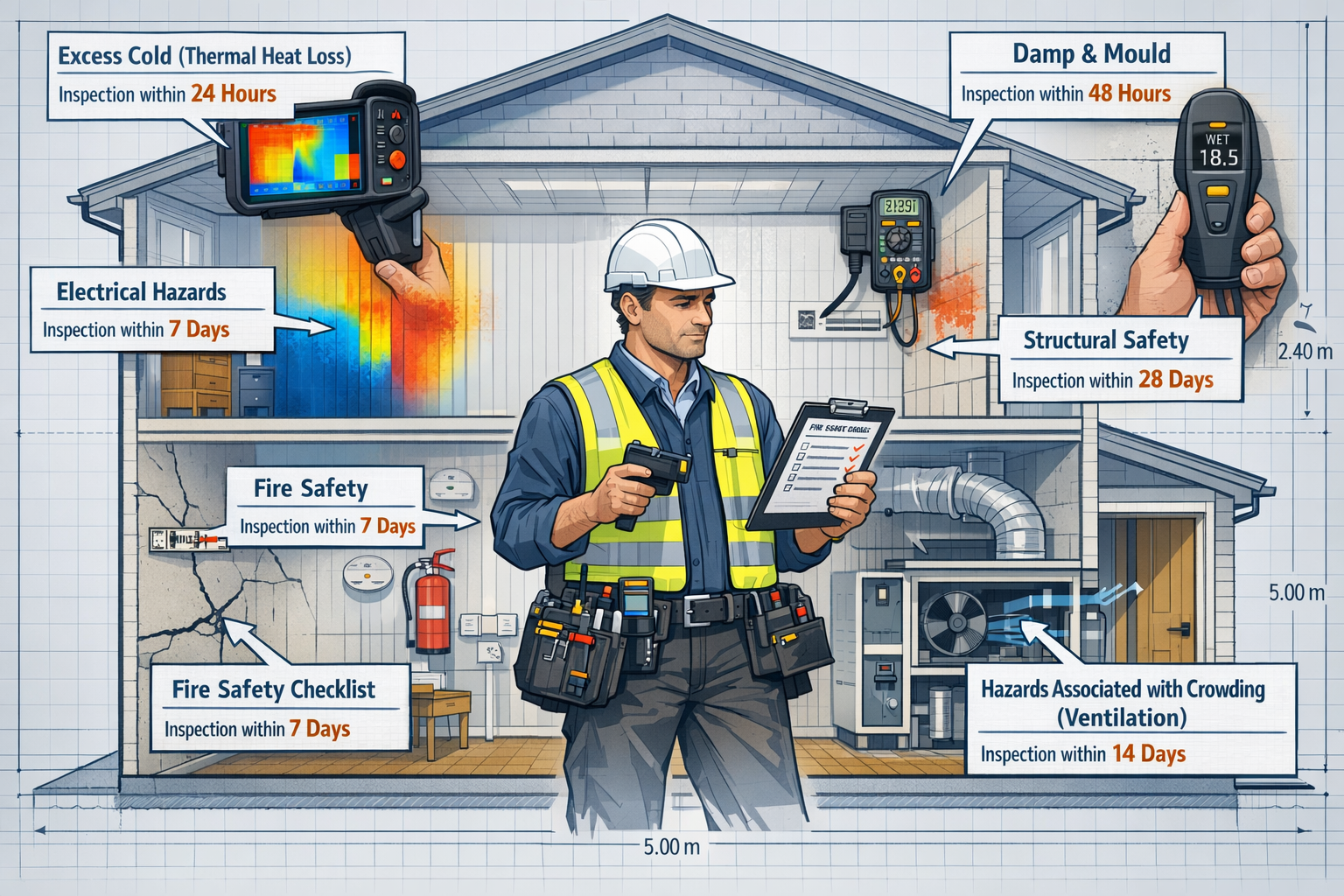
Excess Cold and Heat: Thermal Performance Assessment
Excess cold remains one of the most prevalent hazards in UK housing stock, contributing to respiratory illness, cardiovascular problems, and increased mortality among vulnerable populations. Under the expanded protocols, building surveyors must now evaluate:
Cold Hazard Assessment Protocols
- Thermal imaging surveys to identify heat loss pathways, thermal bridging, and insulation deficiencies
- Heating system capacity calculations to verify adequate output for property volume and construction type
- Ventilation vs. heat loss balance assessment to ensure adequate air quality without excessive heat loss
- Window and door thermal performance evaluation including draught proofing effectiveness
- Occupancy patterns and vulnerable occupant considerations (elderly, young children, health conditions)
Excess heat hazards have gained prominence due to climate change, with UK summers increasingly producing dangerous indoor temperatures. Surveyor protocols now include:
Heat Hazard Assessment Protocols
- Solar gain analysis through window orientation, glazing specifications, and shading provisions
- Ventilation adequacy including natural ventilation pathways and mechanical cooling systems
- Roof and loft space thermal performance particularly in top-floor flats and converted properties
- Urban heat island effects in densely developed areas
- Vulnerable occupant risk factors including medical conditions exacerbated by heat
When conducting Level 3 full building surveys, thermal performance assessment should now be considered a core component rather than an optional enhancement.
Electrical Hazards: Beyond Visual Inspection
Electrical hazards represent one of the most technically demanding additions to Building Surveys Under Awaab's Law 2026: Expanded Hazard Categories and Surveyor Protocols. While building surveyors are not required to be qualified electricians, they must now identify and report potential electrical hazards that require specialist investigation.
Key Electrical Assessment Elements
Consumer unit evaluation:
- Age and type of consumer unit (modern RCD protection vs. outdated fuse boxes)
- Evidence of overloading or unauthorized modifications
- Proper labeling and circuit identification
Visual circuit assessment:
- Damaged or deteriorated wiring
- Inadequate earthing and bonding
- Overheating indicators (discoloration, burning smells, warm outlets)
- DIY electrical work without certification
Appliance and fixed installation checks:
- Condition of fixed electrical equipment
- Portable appliance safety in furnished lettings
- Outdoor electrical installations and weatherproofing
Thermal imaging applications:
- Overheating circuits and connections
- Overloaded circuits showing heat signatures
- Faulty appliances generating excessive heat
Building surveyors must work collaboratively with qualified electricians when electrical hazards are identified, ensuring that building regulation compliance testing is completed within the mandated timeframes.
Fire Hazards: Comprehensive Fire Safety Assessment
Fire safety assessment under Awaab's Law extends beyond simple smoke alarm verification to comprehensive evaluation of fire prevention, detection, and escape provisions.
Fire Safety Survey Components
Detection and alarm systems:
- Smoke alarm coverage and functionality
- Heat detector placement in kitchens
- Interconnected alarm systems in HMOs and multi-story properties
- Carbon monoxide detector provision
Escape route integrity:
- Clear and unobstructed escape paths
- Fire door condition and self-closing mechanisms
- Emergency lighting in communal areas
- Window escape provisions in upper floors
Fire compartmentation:
- Fire-resistant construction between units
- Proper sealing of service penetrations
- Cavity barrier integrity
- Fire stopping around pipes and cables
Fire load and ignition sources:
- Combustible materials storage
- Electrical ignition risks
- Cooking safety provisions
- Smoking-related fire risks
For properties with building defects, fire safety considerations become particularly critical, as structural deterioration can compromise fire compartmentation and escape routes.
Structural Collapse: Identifying Critical Structural Hazards
Structural collapse hazards represent the most severe category in the expanded legislation, requiring surveyors to identify conditions that could lead to catastrophic failure.
Structural Hazard Indicators
Foundation and ground movement:
- Progressive cracking patterns indicating ongoing movement
- Subsidence or heave evidence
- Inadequate foundations for building type
- Ground contamination or instability
Load-bearing element deterioration:
- Timber decay in structural members
- Steel corrosion in load-bearing frames
- Masonry deterioration in load-bearing walls
- Concrete degradation and reinforcement exposure
Structural alterations and modifications:
- Unauthorized removal of load-bearing walls
- Inadequate support for structural openings
- Overloading of floors or roofs
- Inappropriate loft conversions
Water damage and deterioration:
- Long-term water penetration causing structural decay
- Rot in timber structural elements
- Freeze-thaw damage to masonry
- Corrosion of structural fixings and supports
Surveyors must distinguish between cosmetic defects and genuine structural hazards requiring immediate intervention. When areas of further investigation are identified, the accelerated Awaab's Law timeframes demand rapid specialist engagement.
Surveyor Protocols and Compliance Requirements for Building Surveys Under Awaab's Law 2026
The legislative framework establishes strict procedural requirements that fundamentally alter traditional survey workflows. Building surveyors must now operate within tightly defined timeframes while maintaining rigorous professional standards.
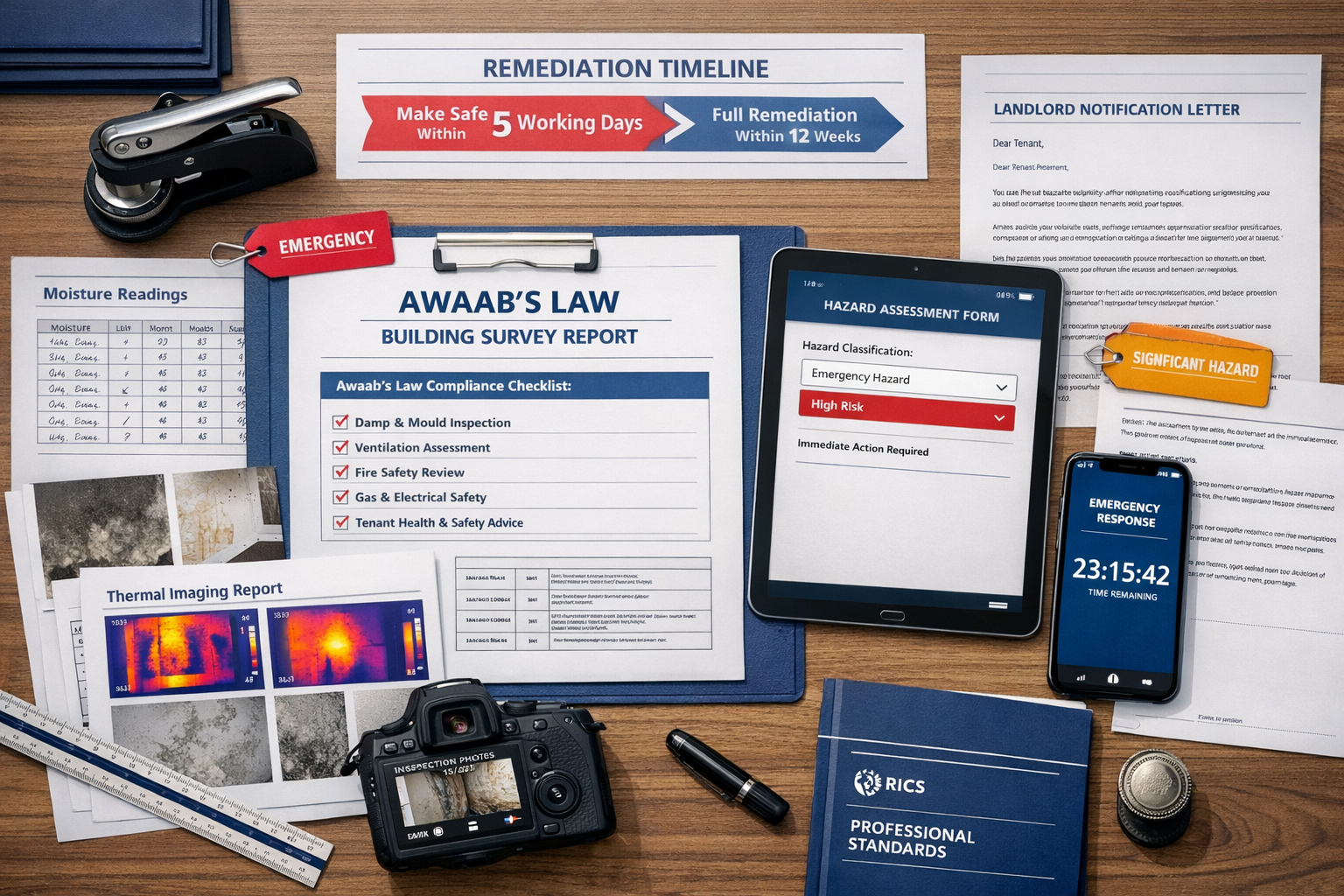
Emergency Hazard Response Protocol (24-Hour Deadline)
When a surveyor identifies or is notified of an emergency hazard—defined as any condition posing immediate risk to occupier health or safety—the following protocol applies:
Hour 0-4: Initial Response
- Acknowledge notification and classify hazard severity
- Conduct preliminary risk assessment
- Implement immediate temporary safety measures if possible
- Notify landlord and relevant authorities
Hour 4-12: Investigation Mobilization
- Deploy qualified surveyor to property
- Conduct comprehensive hazard assessment
- Document findings with photographs and technical measurements
- Identify immediate make-safe requirements
Hour 12-24: Make-Safe Implementation
- Complete emergency remediation works
- If works cannot be completed safely within 24 hours, arrange alternative accommodation
- Provide written notification to tenant of actions taken
- Document compliance with 24-hour requirement
Emergency hazards might include:
- Imminent structural collapse risk
- Live exposed electrical wiring
- Blocked fire escape routes
- Gas leaks or carbon monoxide presence
- Severe water ingress creating electrical hazards
Significant Hazard Investigation Protocol (10-Day Deadline)
For hazards classified as significant under HHSRS but not immediately life-threatening, the investigation protocol follows a structured timeline:
Days 1-2: Assessment Planning
- Review tenant notification and supporting evidence
- Schedule investigation visit with tenant
- Prepare appropriate survey equipment and specialist resources
- Review property history and previous survey reports
Days 3-7: Professional Investigation
- Conduct comprehensive on-site assessment
- Deploy specialist testing equipment (thermal imaging, moisture meters, electrical testing)
- Engage specialist contractors where required (electricians, structural engineers)
- Collect environmental measurements and photographic evidence
Days 8-10: Reporting and Communication
- Complete investigation report with findings and recommendations
- Provide written summary to tenant within 3 working days of investigation completion[2]
- Develop remediation plan with clear timelines
- Submit compliance documentation to landlord
The investigation must meet adequate investigation standards, demonstrating:
- Professional assessment methodology
- Clear identification of hazard sources
- Evidence-based recommendations
- Structured remediation plans moving beyond temporary fixes[3]
Make-Safe Works and Long-Term Remediation Timelines
Following investigation, landlords face two distinct compliance deadlines:
Make-Safe Works (5 Working Days)
Make-safe works address immediate health risks without necessarily resolving underlying causes. Examples include:
- Temporary electrical isolation of dangerous circuits
- Emergency structural propping
- Immediate ventilation improvements for damp/mould
- Temporary heating provision for excess cold hazards
- Fire safety interim measures
If make-safe works cannot be completed within 5 working days, landlords must offer suitable alternative accommodation while works are completed[2].
Structural Resolution (12-Week Maximum)
Long-term remediation addresses root causes and permanent solutions:
- Structural repairs and reinforcement
- Complete electrical rewiring
- Damp-proofing and ventilation system installation
- Heating system replacement
- Fire safety upgrades
These works must commence within 5 working days of investigation completion and be finished within a maximum of 12 weeks[2]. For complex projects requiring budgeting repairs and restoration, surveyors play a critical role in developing realistic remediation schedules that meet legal requirements.
Documentation and Evidence Requirements
Building Surveys Under Awaab's Law 2026: Expanded Hazard Categories and Surveyor Protocols demand comprehensive documentation that provides defensible evidence of compliance:
Essential Survey Documentation
📋 Investigation reports must include:
- Detailed hazard identification and classification
- Technical measurements and test results
- Photographic evidence with timestamps and locations
- Hazard source analysis and causation assessment
- Risk severity evaluation under HHSRS methodology
- Clear remediation recommendations with priority rankings
- Estimated timelines and cost implications
📋 Tenant communication records:
- Written summaries delivered within 3 working days[2]
- Plain language explanations of findings
- Clear timelines for remediation works
- Contact information for follow-up questions
- Rights and responsibilities under Awaab's Law
📋 Compliance evidence:
- Timestamped records of notification receipt
- Investigation scheduling and completion dates
- Make-safe works completion certificates
- Specialist contractor reports and certifications
- Photographic evidence of completed remediation
- Tenant acknowledgment of works completion
This documentation serves multiple purposes: demonstrating regulatory compliance, providing legal protection against enforcement action, and creating an audit trail for future reference. When selecting which building survey you need, landlords should prioritize surveyors with robust documentation systems aligned with Awaab's Law requirements.
Private Landlord Implications and 2026 Compliance Requirements
While Awaab's Law initially focused on social housing, the UK Government confirmed that private landlords will fall fully within the legislative scope from 2026, subject to the same mandatory investigation timescales and enforcement mechanisms[3].
Key Differences for Private Rental Sector
Enforcement authority:
- Social housing: Regulator of Social Housing
- Private rentals: Local authority environmental health officers with enhanced powers
Tenant notification pathways:
- Social housing: Established reporting systems through housing associations
- Private rentals: Direct tenant-to-landlord notification with local authority oversight
Compliance monitoring:
- Social housing: Systematic inspection programs and performance metrics
- Private rentals: Complaint-driven enforcement with proactive local authority inspections
Preparing for Private Landlord Compliance
Private landlords should implement the following preparatory measures before full enforcement begins:
✅ Establish hazard reporting systems with clear tenant communication channels
✅ Conduct proactive RICS building surveys to identify and remediate hazards before tenant complaints
✅ Develop relationships with qualified surveyors capable of rapid mobilization for emergency investigations
✅ Create remediation budgets to address identified hazards within statutory timeframes
✅ Implement preventative maintenance programs targeting common hazards (damp, electrical, heating systems)
✅ Review insurance coverage for compliance-related costs and potential enforcement action
The financial implications are significant. Understanding the cost of building surveys and budgeting for rapid remediation works should be factored into rental property investment calculations.
Professional Survey Tools and Technologies for Multi-Hazard Assessment
The expanded hazard categories demand investment in specialized survey equipment and technical capabilities that go beyond traditional visual inspection tools.
Essential Survey Equipment for Awaab's Law Compliance
Thermal imaging cameras:
- Heat loss identification for excess cold hazards
- Overheating circuit detection for electrical hazards
- Moisture source identification behind surfaces
- Insulation deficiency mapping
Environmental monitoring equipment:
- Temperature and humidity data loggers
- Carbon dioxide and carbon monoxide detectors
- Airflow and ventilation measurement devices
- Light level meters for adequate lighting assessment
Electrical testing equipment:
- Non-contact voltage detectors
- Thermal imaging for electrical installations
- Socket testers for basic circuit verification
- (Note: Detailed electrical testing requires qualified electrician)
Moisture and damp assessment:
- Protimeter moisture meters
- Hygrometers for relative humidity
- Thermal imaging for concealed moisture
- Borescopes for cavity inspection
Structural assessment tools:
- Crack monitoring gauges
- Spirit levels and plumb lines
- Moisture meters for timber decay assessment
- Borescopes for concealed structural inspection
Digital Documentation and Reporting Systems
Modern survey practice under Awaab's Law requires digital systems that enable:
- Real-time field data capture with timestamped photographs and measurements
- Automated report generation meeting statutory content requirements
- Compliance timeline tracking with automated deadline alerts
- Secure cloud storage for evidence preservation and audit trails
- Client portal access for transparent communication with landlords and tenants
Understanding building survey timeframes becomes critical when managing multiple properties with overlapping compliance deadlines.
Enforcement Consequences and Liability Under Awaab's Law
The enforcement regime established under Awaab's Law represents the most stringent housing safety legislation in UK history, with consequences designed to ensure absolute compliance.
Enforcement Powers and Penalties
Social housing enforcement:
- Regulator of Social Housing powers to issue improvement notices
- Unlimited financial penalties for non-compliance
- Publication of non-compliance on public registers
- Potential criminal prosecution for serious breaches
Private landlord enforcement (from 2026):
- Local authority improvement notices with statutory deadlines
- Civil penalties up to £30,000 per breach
- Rent repayment orders for tenants in non-compliant properties
- Prohibition orders preventing property letting until compliance achieved
- Criminal prosecution for serious or persistent non-compliance[3]
Liability Trigger Points
Critically, liability is triggered the moment a landlord becomes aware—or reasonably should have become aware—of a potential hazard[2]. This creates significant implications:
⚠️ Ignorance is not a defense – Failure to implement adequate inspection and reporting systems does not protect against liability
⚠️ Tenant notification creates immediate liability – The countdown to compliance deadlines begins at the point of notification, not investigation completion
⚠️ Constructive knowledge applies – If a reasonable landlord would have identified the hazard through proper maintenance, liability exists even without explicit notification
⚠️ Documentation is critical – Comprehensive survey records provide the only defensible evidence of compliance with investigation and remediation timelines
Risk Mitigation Strategies for Landlords and Surveyors
For landlords:
- Implement proactive inspection schedules identifying hazards before tenant complaints
- Maintain comprehensive maintenance records demonstrating reasonable care
- Respond immediately to tenant notifications with professional investigation
- Engage qualified surveyors with Awaab's Law compliance expertise
- Budget adequately for rapid remediation works
For surveyors:
- Maintain professional indemnity insurance with Awaab's Law coverage
- Document all investigation methodologies and limitations
- Provide clear written advice on compliance timelines
- Recommend specialist referrals where expertise limitations exist
- Maintain CPD (Continuing Professional Development) on evolving hazard assessment protocols
When identifying building problems and solutions, surveyors must balance thoroughness with the accelerated timelines demanded by the legislation.
Conclusion
Building Surveys Under Awaab's Law 2026: Expanded Hazard Categories and Surveyor Protocols represent a fundamental transformation in UK housing safety regulation. The 2026 expansion to include excess temperatures, electrical hazards, fire risks, and structural collapse creates unprecedented demands on building surveyors, requiring multi-disciplinary expertise, specialized equipment, and rapid-response capabilities that extend far beyond traditional survey practice.
For building surveyors, success under this new regulatory framework requires:
🔍 Technical competence across multiple hazard categories with appropriate specialist referral networks
⏱️ Operational agility to meet 24-hour emergency and 10-day significant hazard investigation deadlines
📋 Documentation excellence providing defensible evidence of compliant investigation and remediation
🤝 Collaborative working with landlords, tenants, specialist contractors, and enforcement authorities
💡 Proactive approach emphasizing hazard prevention through regular inspection rather than reactive complaint response
For landlords entering the 2026 compliance framework, the message is clear: professional building surveys are no longer optional risk management tools but mandatory compliance requirements with severe consequences for non-compliance. The investment in qualified surveyors, rapid remediation capabilities, and comprehensive documentation systems is not merely good practice—it's a legal imperative that protects both tenant welfare and landlord interests.
The legacy of Awaab Ishak demands nothing less than a complete reimagining of how we assess, report, and remediate housing hazards. Building surveyors stand at the forefront of this transformation, with the professional responsibility to ensure that no tenant faces preventable health risks in their home.
Immediate Action Steps
For building surveyors:
- Audit current survey equipment against expanded hazard requirements
- Develop rapid-response investigation protocols meeting statutory deadlines
- Create standardized report templates incorporating all mandatory documentation elements
- Establish specialist contractor networks for electrical, structural, and fire safety referrals
- Implement CPD programs covering new hazard assessment methodologies
For landlords:
- Commission proactive building surveys identifying existing hazards before tenant complaints
- Establish clear tenant hazard reporting systems with documented response procedures
- Budget for rapid remediation works meeting 5-day and 12-week compliance deadlines
- Review insurance coverage for Awaab's Law compliance costs and enforcement action
- Develop preventative maintenance programs targeting high-risk hazard categories
The 2026 hazard expansion is not the end of Awaab's Law evolution—Phase 3 in 2027 will bring further requirements. Building surveyors and landlords who establish robust compliance systems now will be best positioned for future regulatory developments, while those who delay face mounting enforcement risks and potential catastrophic liability.
References
[1] Awaabs Law Technical Compliance Hvac Ventilation – arm-environments.com
[2] Awaabs Law Is Here The Surveyors Guide For Compliance – surventrix.com
[3] Awaabs Law Private Landlords 2026 – idealresponse.co.uk
[4] News – showhouse.co.uk
[5] Awaabs Law Private Rented Sector Extension – awaabs-law.com
[6] Is The Government Prepared For Awaabs Law – builders.org.uk
[7] Deadlines Of Awaabs Law – resisure.co.uk
[8] Awaabs Law 2026 Hazard Expansions Surveyor Protocols For Electrical Fire And Excess Heat Risks In Rentals – nottinghillsurveyors.com