

Around 80% of buyers use a building survey as a negotiation tool, and in a subdued market, that figure carries real weight [2]. When house prices are flat or drifting lower, a detailed survey report stops being just a due-diligence document — it becomes one of the most powerful financial instruments a buyer holds. The challenge is knowing how to deploy it without spooking the seller or collapsing the chain.
This guide on Building Surveys in a Flat or Falling Market: How Buyers Can Use Defects to Renegotiate Safely explains exactly how to do that. It covers what the survey should contain, how to cost defects credibly, how to frame the conversation with the seller, and where the legal and ethical boundaries sit.
Key Takeaways 📋
- Around 60% of buyers successfully renegotiate after a survey flags serious defects costing more than £5,000 to fix [2].
- In a flat or falling market, sellers fear losing a proceedable buyer — giving buyers disproportionately strong leverage.
- The average achievable reduction after a survey is 5–10% of the agreed price, provided defects are properly evidenced [5].
- Safe renegotiation means acting before exchange of contracts, with written evidence and a professional cost estimate.
- Not every defect justifies a price chip — focus on structural, damp, and roof issues rather than cosmetic items.
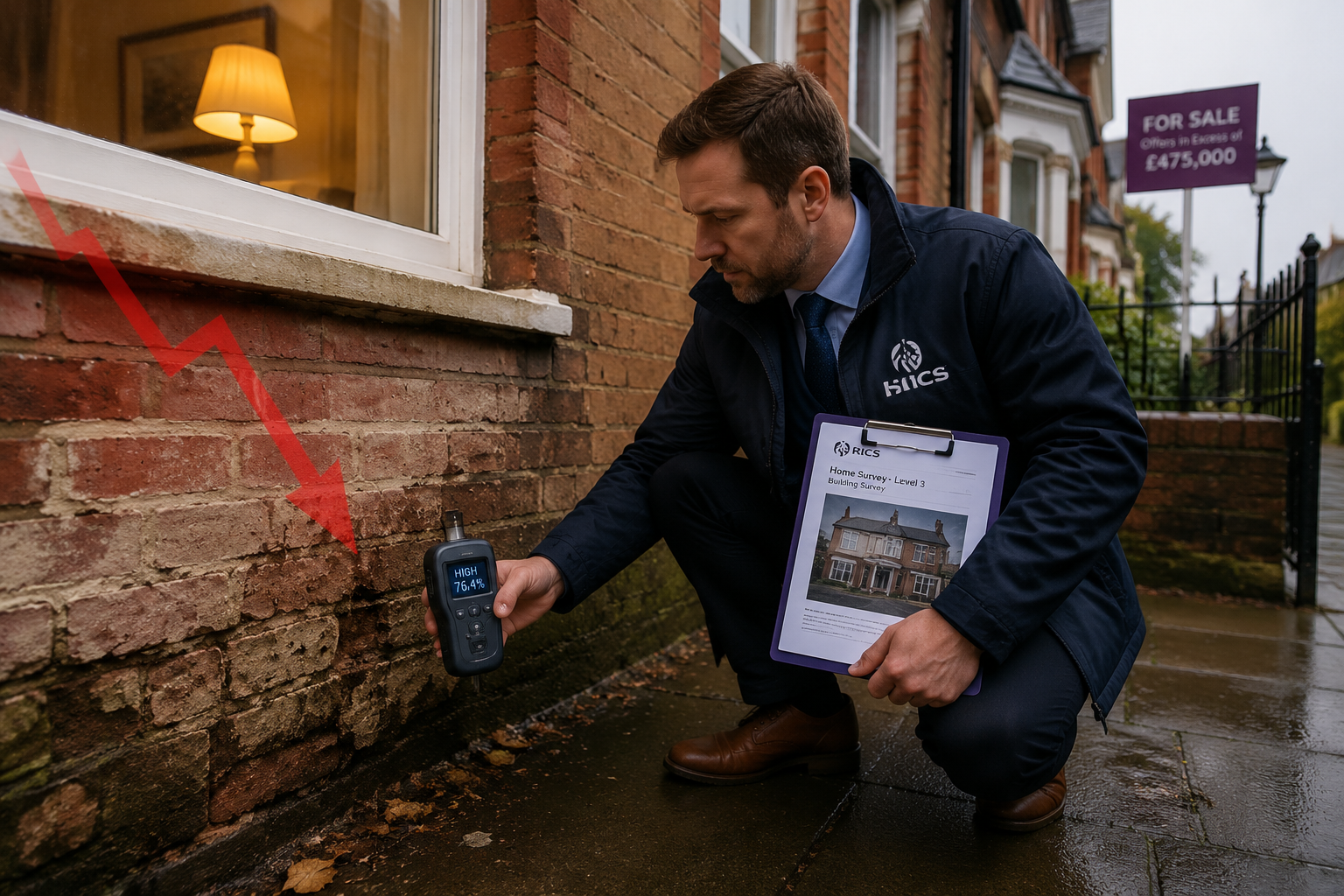
Why a Flat or Falling Market Changes Everything
Most buyers think of a building survey as a safety check. In a rising market, that is largely what it is — a document that confirms the purchase or, occasionally, prompts a modest tweak. In a flat or falling market, the dynamic shifts fundamentally.
When prices are stagnant or declining:
- Sellers have fewer competing offers to fall back on.
- Days on market are longer, meaning sellers are more emotionally and financially committed to completing.
- Estate agents are keener to hold chains together, making them more willing to facilitate renegotiation conversations.
- Lenders are more cautious, sometimes down-valuing properties with unresolved defects — which can force a renegotiation anyway.
The UK Office for National Statistics House Price Index confirmed that UK prices were broadly flat to mildly negative in real terms through late 2024 and into early 2025, with mortgage approvals remaining subdued. RICS Residential Market Surveys from the same period noted a greater incidence of price chip requests following surveys, with agents increasingly treating some degree of post-survey adjustment as standard — particularly for older or previously rented stock.
💬 "In a cooler market, most serious buyers now assume some form of post-survey adjustment is normal rather than exceptional." — Surveyor commentary, Wimbledon Surveyors [2]
This context matters because it reframes renegotiation. Asking for a reduction after a survey is not aggressive or unusual — it is the rational response to new, professionally verified information.
What Lenders Do When Defects Are Found
Buyers sometimes forget that their mortgage lender also has a stake in the property's condition. When a survey flags significant structural or damp issues, a lender's valuer may:
- Down-value the property, reducing the loan available and forcing a renegotiation regardless.
- Attach retention clauses, withholding part of the mortgage until specified repairs are completed.
- Decline to lend altogether on properties with serious unresolved defects.
Understanding this dynamic strengthens the buyer's hand. A seller who refuses to negotiate may find the sale collapsing at the lender stage anyway.
The Survey You Need: Getting the Right Level of Detail
A renegotiation is only as strong as the evidence behind it. A basic valuation report or a Level 2 Homebuyer Survey will not provide the depth of information needed to support a credible price reduction on a property with complex issues. For most older or non-standard properties, a Level 3 Full Building Survey is the right tool.
To understand which level of survey fits the property in question, the guide to choosing the right building survey sets out the key differences clearly. For a direct comparison of the two most common options, the full building survey vs homebuyer survey breakdown is also worth reviewing before instructing a surveyor.
What a Level 3 Survey Should Cover
A robust survey report for renegotiation purposes needs to include:
| Survey Element | Why It Matters for Renegotiation |
|---|---|
| Condition ratings (1, 2, 3) for every element | Identifies which defects are urgent vs. minor |
| Estimated repair cost ranges | Gives a factual basis for any price reduction request |
| Photographs of defects | Provides visual evidence the seller cannot easily dismiss |
| Recommendations for specialist reports | Flags where further investigation is needed |
| Commentary on building materials | Highlights non-standard materials that affect insurability and value |
The building materials assessments section of a Level 3 survey is particularly important for older properties, where materials like asbestos, high-alumina cement, or mundic concrete can have a major impact on mortgage availability and resale value.
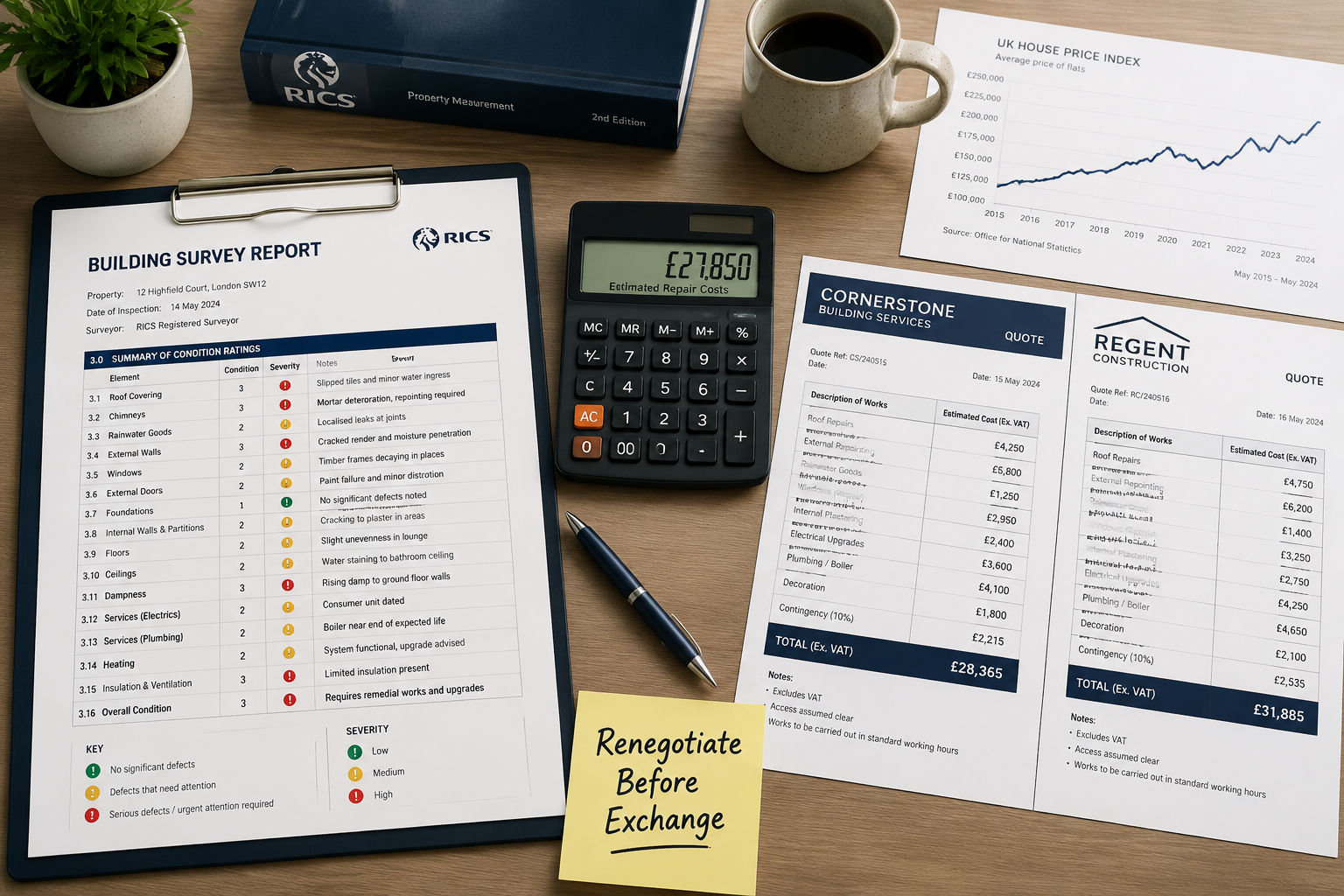
How Buyers Can Use Defects to Renegotiate Safely: A Step-by-Step Approach
The phrase "Building Surveys in a Flat or Falling Market: How Buyers Can Use Defects to Renegotiate Safely" contains the key word: safely. The goal is not to squeeze the maximum possible reduction out of a seller — it is to reach a fair outcome that reflects the true condition of the property, without destroying the deal or the relationship.
Here is a structured approach:
Step 1: Read the Survey Carefully — All of It
Many buyers focus only on the red (Condition 3) items and ignore the amber (Condition 2) ones. That is a mistake. A cluster of amber items — say, ageing guttering, tired pointing, and an old boiler — may not individually justify a price reduction, but collectively they represent a significant maintenance liability. The budgeting for repairs and restoration section of a full survey is specifically designed to help buyers understand the total cost picture.
Step 2: Get Contractor Quotes for the Key Defects
A surveyor's cost estimate is a starting point, not a final figure. Before approaching the seller, obtain two or three written quotes from reputable contractors for the most significant defects. This transforms the renegotiation from "the surveyor said it might cost a lot" to "we have three quotes ranging from £18,000 to £24,000 for the roof repairs."
Written quotes are far harder to dismiss than verbal estimates [4].
Step 3: Decide What You Are Actually Asking For
There are three main options, and the right one depends on the severity of the defects and the state of the market:
- A price reduction — The seller drops the agreed price by an amount equal to (or close to) the estimated repair cost.
- Repairs before completion — The seller fixes specified defects before exchange or completion.
- A retention clause — Part of the purchase price is held back until repairs are verified as complete.
🏠 Pro tip: In a falling market, a price reduction is usually preferable to asking the seller to carry out repairs. Sellers under financial pressure may use cheap contractors or cut corners — leaving the buyer with a poorly fixed problem and no recourse.
Industry data shows that average achievable reductions of 5–10% of the agreed price are realistic where defects are properly evidenced [5]. On a £400,000 property, that is £20,000–£40,000 — a meaningful sum that justifies the cost of a thorough survey many times over [1].
Step 4: Frame the Request in Writing
Verbal renegotiations are easy to misinterpret and hard to evidence. Always put the request in writing — through the estate agent, with a clear summary of:
- The specific defects identified.
- The surveyor's condition rating for each.
- The estimated or quoted repair cost.
- The revised price or arrangement being proposed.
This approach signals professionalism and good faith. It also protects the buyer legally — demonstrating that the request is based on objective evidence, not a last-minute attempt to chip the price for no reason [4].
Step 5: Know Which Defects Carry the Most Weight
Not every survey finding justifies a price reduction. Experienced surveyors and conveyancers consistently advise focusing on:
✅ Structural issues — subsidence, failed lintels, wall tie failure
✅ Roof defects — failed coverings, rotten timbers, missing flashings
✅ Damp — rising damp, penetrating damp, failed DPC
✅ Drainage problems — collapsed drains, root ingress
✅ Electrical and heating systems — outdated wiring, condemned boilers
❌ Cosmetic issues — tired decoration, worn carpets, dated kitchens
❌ Normal wear and tear — minor cracks, scuffed skirting boards
❌ Items already reflected in the price — issues visible at viewing that the buyer accepted
The urgent or dangerous building issues page provides a useful reference for understanding which defect categories carry the most structural and financial significance.
The Legal Position: What Buyers Can and Cannot Do
In England and Wales, renegotiation after a survey is entirely legal provided it happens before exchange of contracts. Offers are "subject to contract" until exchange, meaning either party can walk away or propose revised terms without legal penalty [4].
The key legal considerations are:
- Do not misrepresent the survey findings. If the surveyor said a crack was "likely cosmetic," do not tell the seller it indicates structural failure.
- Do not use the survey as a pretext. Asking for a reduction on the grounds of a minor crack when the real reason is that the buyer has found a cheaper property is ethically and reputationally risky.
- Disclose serious defects to your lender. If a survey reveals significant structural issues and the buyer proceeds without telling the lender, there is a real risk of breaching mortgage conditions.
The concept of gazundering — reducing an offer at the last minute for tactical rather than evidential reasons — is legal but widely considered unethical and can damage relationships with agents and sellers. The distinction between gazundering and legitimate post-survey renegotiation is evidence. A reduction backed by a RICS survey report and contractor quotes is legitimate. A reduction demanded the day before exchange, with no new information, is not [1].
For buyers concerned about the broader statutory picture — including listed building constraints or planning considerations that might affect repair costs — the statutory considerations and planning guidance sections of a full survey report are worth reviewing carefully.

Real-World Outcomes: What the Data Shows
The numbers behind post-survey renegotiation in a subdued market are striking:
- ~80% of buyers use a building survey as a negotiation tool [2].
- ~60% of buyers successfully renegotiate when serious defects (typically >£5,000 to remedy) are identified [2].
- Average reductions of 5–10% of the agreed price are achievable with proper evidence [5].
- Case studies from London in 2023–24 include £25,000 off for damp and £55,000 off for roof defects on properties where the survey provided detailed cost evidence [2].
The average price reduction after a building survey article explores these figures in more detail, including how the type and age of property affects what reductions are realistic.
When Sellers Say No
A seller refusing to negotiate after a survey is not the end of the road. The buyer then faces a genuine decision:
- Proceed at the original price — acceptable only if the defects are minor or the price already reflects the condition.
- Walk away — always an option before exchange, with no financial penalty beyond survey and legal costs.
- Propose a middle ground — a smaller reduction or a retention clause that keeps the deal alive while protecting the buyer.
The consequences of failing to act on survey findings are worth understanding before deciding to proceed regardless. Ignoring a surveyor's recommendations — particularly on structural or damp issues — can lead to significantly higher costs down the line, and may affect the ability to insure or resell the property.
Common Mistakes to Avoid
Even buyers with strong survey evidence can undermine their own position. The most common errors include:
- Waiting too long — raising the renegotiation days before exchange looks tactical rather than evidential.
- Asking for too much — demanding a reduction that exceeds the repair cost estimate is hard to justify and easy for the seller to dismiss.
- Going in verbally — without a written summary, sellers and agents can claim the request was vague or unreasonable.
- Ignoring the seller's position — in a falling market, sellers may already be under financial pressure. A collaborative tone ("we want to make this work") is more effective than an adversarial one.
- Neglecting to check the survey against the asking price — if the property was already priced below market to reflect its condition, a further reduction may be unreasonable.
Conclusion: Turn Your Survey Into a Financial Tool
Building Surveys in a Flat or Falling Market: How Buyers Can Use Defects to Renegotiate Safely is ultimately about using professional evidence to reach a fair price — one that reflects what the property is actually worth in its current condition, not what the seller hoped to achieve when the market was stronger.
The steps are straightforward:
- ✅ Commission a RICS Level 3 Full Building Survey for any older or non-standard property.
- ✅ Read the full report — not just the red items.
- ✅ Get written contractor quotes for the most significant defects.
- ✅ Decide whether a price reduction, seller repairs, or a retention clause best fits the situation.
- ✅ Put the renegotiation request in writing, with evidence attached.
- ✅ Keep the tone professional and collaborative — the goal is a deal that works for both sides.
In a subdued market, sellers need proceedable buyers. A buyer armed with a detailed survey report and credible cost evidence is not being unreasonable — they are being thorough. That is exactly the position every buyer should aim for.
References
[1] How Negotiate House Price Down Survey – How negotiate house price down survey
[2] Average Price Reduction After Survey Negotiating The Purchase Price With A Building Survey – wimbledonsurveyors.com
[3] Renegotiating A House Purchase After A Building – reddit.com
[4] How To Renegotiate With The Vendor After A Bad Survey – ablesurveyors.com
[5] Renegotiating A House Offer After Your Survey – reallymoving.com
[7] Renegotiating Property Price After Survey – allcottassociates.co.uk