

{"cover":"Professional landscape format (1536×1024) hero image featuring bold text overlay 'Building Surveys for Office-to-Resi Conversions: Structural Assessments in 2026's Urban Revitalisation Wave' in extra large 70pt white sans-serif font with dark gradient shadow, centered in upper third. Background shows dramatic split-screen composition: left side displays aging commercial office building exterior with visible structural elements and scaffolding, right side shows modern residential conversion interior with exposed beams and contemporary apartments. Urban cityscape visible through windows. Color scheme: deep charcoal, steel blue, warm amber accents. High contrast, editorial quality, architectural photography style with professional lighting highlighting structural details and survey equipment visible in foreground.","content":["Detailed landscape format (1536×1024) image showing chartered surveyor in hard hat and high-visibility vest conducting structural assessment inside office building marked for conversion, using digital tablet and laser measuring device. Visible concrete columns, floor-to-ceiling measurements marked with bright yellow tape, exposed ceiling revealing mechanical systems and structural grid. Architectural drawings and floor plans visible on tablet screen. Background shows empty open-plan office space with large windows, natural daylight streaming in. Professional documentation equipment including thermal imaging camera and moisture meter on tripod. Color palette: industrial grey, safety yellow, professional blue. Technical, documentary photography style emphasizing thoroughness of building survey process.","Detailed landscape format (1536×1024) technical infographic illustration showing cross-section cutaway view of office building undergoing residential conversion assessment. Left side labeled 'Office Configuration' shows open floor plan, suspended ceilings, central core services. Right side labeled 'Residential Conversion' shows apartment layouts with individual kitchens, bathrooms, partition walls. Bright red and yellow annotation arrows pointing to critical structural elements: load-bearing walls, floor depth requirements, window-to-floor ratios, fire separation zones, acoustic insulation layers. Semi-transparent overlay showing building regulations compliance checklist. Clean architectural diagram style with precise measurements, professional color coding: structural elements in blue, MEP systems in green, compliance issues in red, approved modifications in green checkmarks.","Detailed landscape format (1536×1024) image showing modern converted residential apartment interior within former office building, emphasizing successful transformation. Exposed original concrete ceiling beams painted white, industrial-style ductwork visible, large commercial windows now serving residential space with city views. Contemporary kitchen with island, open-plan living area, polished concrete floors. Inset comparison photos in corner showing 'before' office space versus 'after' residential conversion. Natural light flooding through floor-to-ceiling windows. Subtle overlay graphics showing valuation increase percentages and quality ratings. Color scheme: warm neutrals, natural wood tones, soft greys, pops of contemporary color in furnishings. Architectural photography style showcasing urban revitalization success, professional interior design aesthetic."]"}
The transformation of empty office towers into vibrant residential communities represents one of the most significant shifts in urban planning this decade. As 2026 unfolds, cities across the UK face mounting pressure to address housing shortages while dealing with unprecedented commercial vacancy rates. Building Surveys for Office-to-Resi Conversions: Structural Assessments in 2026's Urban Revitalisation Wave have become the critical first step in determining whether aging office buildings can successfully transition to meet residential needs. These comprehensive structural assessments identify hidden defects, ensure regulatory compliance, and ultimately determine the financial viability of conversion projects that could reshape our urban landscapes.
The stakes have never been higher. With office vacancy rates climbing and housing affordability reaching crisis levels, developers and local authorities are racing to unlock the potential of underutilised commercial properties. However, not every office building makes a suitable residential candidate—and that's where thorough building surveys become invaluable.
Key Takeaways
✅ Structural feasibility assessments are essential before any office-to-residential conversion, identifying load-bearing capacity, floor depth requirements, and critical defects that impact conversion viability
✅ Compliance with residential building regulations differs significantly from commercial standards, requiring detailed surveys covering fire safety, acoustic performance, natural light provision, and ventilation systems
✅ Valuation impacts from conversion surveys can make or break project economics, with structural issues potentially adding 15-30% to conversion costs or rendering buildings unsuitable entirely
✅ Modern survey technologies including drone inspections, thermal imaging, and 3D scanning accelerate assessment timelines while improving accuracy in identifying hidden defects
✅ Early-stage comprehensive surveys reduce financial risk by identifying deal-breakers before significant capital investment, protecting developers from costly surprises during construction
Understanding the Office-to-Residential Conversion Landscape in 2026
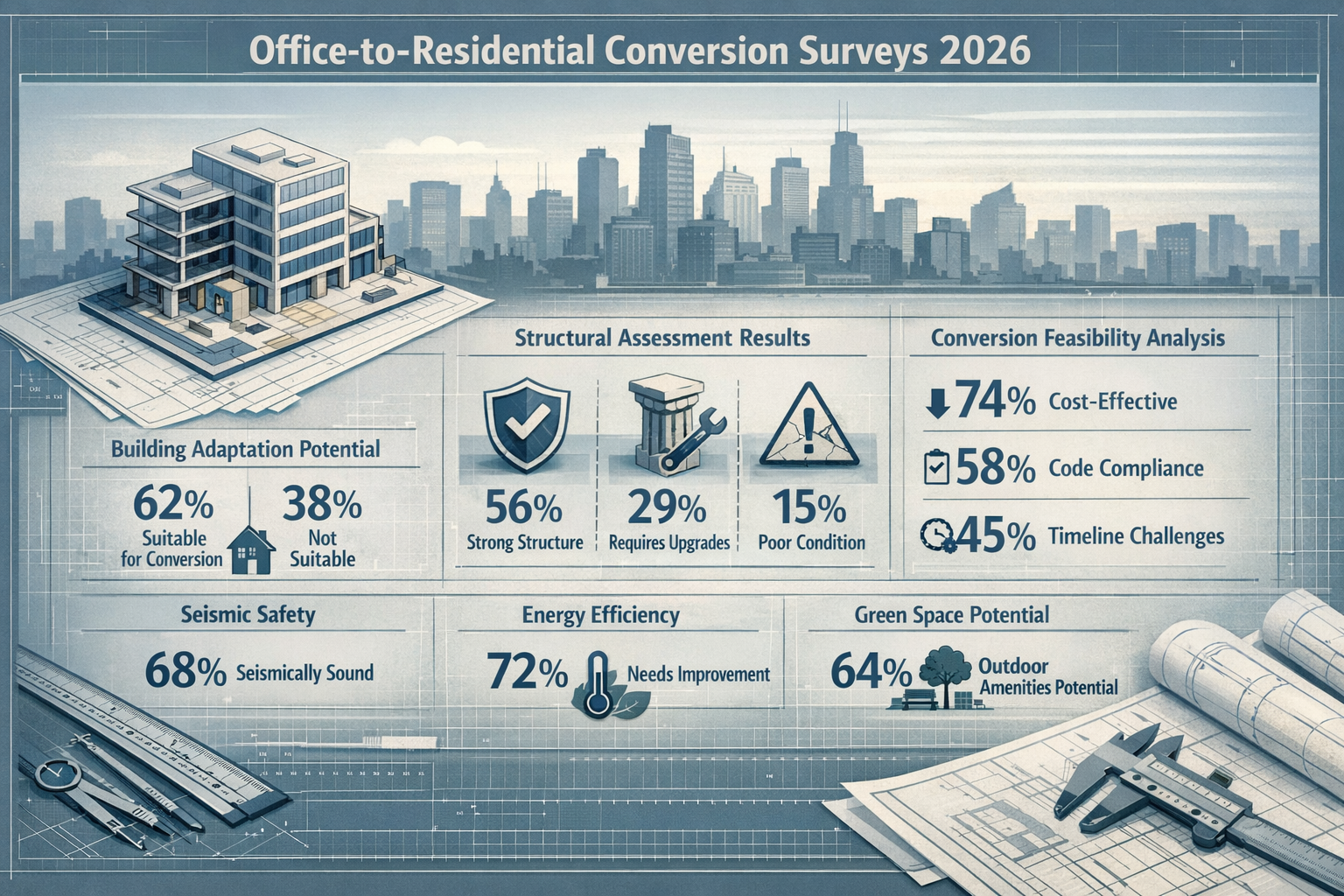
The commercial real estate sector has experienced dramatic upheaval since remote work became mainstream. According to recent industry analysis, office buildings constructed between 1960-1990 represent prime conversion candidates due to their structural characteristics and current market positioning [1]. These buildings often feature floor plates, ceiling heights, and core configurations that—with proper assessment and modification—can accommodate residential layouts.
Why Conversions Are Accelerating Now
Several converging factors have created unprecedented momentum for office-to-residential conversions in 2026:
- Housing supply crisis: Urban areas face severe residential shortages while office space sits vacant
- Economic incentives: Many municipalities now offer tax abatements, expedited permitting, and regulatory relief for conversion projects [2]
- Changing work patterns: Permanent shifts toward hybrid work have reduced long-term office space demand
- Sustainability goals: Adaptive reuse generates significantly less carbon emissions than demolition and new construction
The conversion wave isn't limited to major metropolitan areas. Mid-sized cities have begun implementing policies specifically designed to facilitate office-to-residential transformations, recognizing both the housing benefits and urban revitalization potential [3].
The Critical Role of Building Surveys
Before any conversion project proceeds, developers must answer fundamental questions: Is the building structurally suitable? What hidden defects exist? How much will modifications cost? What regulatory hurdles must be overcome?
A comprehensive Level 3 full building survey provides these answers. Unlike standard property surveys, conversion assessments require specialized expertise in both commercial and residential building standards, structural engineering principles, and local planning regulations.
Key Structural Assessment Components for Office-to-Resi Conversions
Building Surveys for Office-to-Resi Conversions: Structural Assessments in 2026's Urban Revitalisation Wave must address specific technical challenges unique to repurposing commercial structures for residential use. The assessment process typically unfolds across several critical evaluation areas.
Load-Bearing Capacity and Floor Structure Analysis
Office buildings typically support live loads of 50-75 pounds per square foot, while residential conversions require different load distributions. Surveyors must evaluate:
Floor depth and structural integrity: Residential units require adequate floor depth to accommodate plumbing, electrical systems, and sound insulation between units. Many office buildings feature shallow floor-to-floor heights (9-11 feet) that create challenges when installing the infrastructure residential units demand.
Column spacing and layout flexibility: Office buildings with wide column spacing (30+ feet) offer greater flexibility for residential layouts. Conversely, buildings with closely-spaced columns may limit apartment configurations and reduce marketability.
Foundation assessment: The building's foundation must support altered load patterns. Adding bathrooms, kitchens, and partition walls changes how weight distributes throughout the structure.
A detailed construction and condition survey examines these elements, often revealing issues invisible during casual inspection.
Building Systems and Infrastructure Evaluation
Residential buildings have fundamentally different mechanical, electrical, and plumbing (MEP) requirements than offices. Conversion surveys must assess:
| System | Office Standard | Residential Requirement | Survey Focus |
|---|---|---|---|
| Plumbing | Minimal (restrooms, break rooms) | Individual kitchens/bathrooms per unit | Capacity for 10-20x more fixtures; drainage adequacy |
| Electrical | Centralized power distribution | Individual metering per unit | Panel capacity; vertical distribution pathways |
| HVAC | Central systems, open floor plates | Individual climate control | Ductwork feasibility; window opening capability |
| Natural Light | Perimeter focus acceptable | All habitable rooms require daylight | Window-to-floor ratios; light penetration depth |
The mechanical ventilation requirements for residential conversions often exceed original office specifications, particularly in buildings constructed before modern energy efficiency standards.
Defect Identification and Remediation Planning
Older office buildings frequently harbor defects that must be addressed before residential conversion proceeds:
🔍 Structural defects: Concrete spalling, steel corrosion, foundation settlement, or structural cracking require immediate attention and accurate cost estimation
🔍 Building envelope issues: Water infiltration, inadequate insulation, or failing window systems impact residential habitability far more severely than office use
🔍 Hazardous materials: Asbestos, lead paint, or other hazardous materials common in pre-1990s construction require specialized removal during conversion
🔍 Hidden deterioration: Concealed areas behind cladding, above suspended ceilings, or within structural cavities may hide significant deterioration
Understanding common defects in older buildings helps surveyors identify red flags during initial assessments. Advanced survey techniques like drone surveys enable comprehensive facade inspection without expensive scaffolding.
Fire Safety and Compartmentation Assessment
Residential buildings require significantly more stringent fire safety measures than offices:
- Compartmentation: Each residential unit must form a separate fire compartment with appropriate fire-resistant construction
- Means of escape: Residential escape requirements differ from commercial standards, often requiring additional staircases or protected corridors
- Fire detection systems: Individual smoke detection in each unit, plus building-wide alarm systems
- Sprinkler requirements: Many jurisdictions now mandate sprinklers in residential conversions, particularly in buildings exceeding certain heights
Proper fire risk assessments identify necessary modifications early in the planning process, preventing costly redesigns during construction.
Regulatory Compliance and Planning Considerations
Building Surveys for Office-to-Resi Conversions: Structural Assessments in 2026's Urban Revitalisation Wave must navigate complex regulatory landscapes that vary significantly by jurisdiction. The survey process should identify compliance gaps early, allowing developers to assess feasibility before substantial investment.
Building Regulations and Code Compliance
Converting office buildings to residential use triggers comprehensive building regulation reviews. Surveys must evaluate compliance across multiple domains:
Structural safety standards: Residential buildings must meet specific structural codes that may exceed commercial requirements, particularly regarding floor loading, balcony safety, and seismic resistance in applicable regions.
Energy performance requirements: The EPC and MEES regulations mandate minimum energy efficiency standards for residential properties. Many older office buildings require substantial envelope improvements to meet these thresholds.
Accessibility standards: Residential conversions must provide accessible units and common areas meeting current disability access requirements, often necessitating elevator upgrades or additional accessible routes.
Sound insulation performance: Residential units require acoustic separation between units and from common areas that office buildings never needed. Floor assemblies, party walls, and service penetrations all require acoustic testing and potential upgrading.
Planning Permission and Permitted Development Rights
The regulatory pathway for conversions varies dramatically based on location and building characteristics. Some jurisdictions offer streamlined "permitted development" routes that bypass traditional planning applications for qualifying office-to-residential conversions [2].
However, surveys often reveal factors that disqualify buildings from these expedited pathways:
- Conservation area restrictions: Buildings in conservation areas or listed buildings face additional scrutiny and limitations
- Structural modifications: Extensive structural changes may trigger full planning review even in permitted development zones
- External alterations: Changes to building facades, window configurations, or roof profiles often require planning consent
Identifying Areas Requiring Further Investigation
Comprehensive surveys typically identify areas requiring further investigation by specialists. Common referrals include:
- Structural engineers for detailed load calculations and structural modification designs
- MEP consultants for systems capacity analysis and upgrade specifications
- Environmental specialists for contamination assessment and remediation planning
- Acoustic engineers for sound insulation testing and specification
- Planning consultants for navigating complex regulatory approvals
Early identification of these specialist requirements prevents project delays and budget overruns during later development stages.
Valuation Impacts and Economic Feasibility Assessment
The financial viability of office-to-residential conversions hinges on accurate cost estimation derived from thorough structural assessments. Building Surveys for Office-to-Resi Conversions: Structural Assessments in 2026's Urban Revitalisation Wave directly influence project economics in several critical ways.
How Survey Findings Impact Conversion Economics
Research indicates that conversion costs typically range from 40-60% of new construction costs, but this varies dramatically based on building condition and required modifications [4]. Survey findings directly impact this calculation:
Structural modification costs: Buildings requiring extensive structural work—additional columns, floor reinforcement, or foundation upgrades—can see conversion costs approach or exceed new construction economics.
Building systems replacement: Complete MEP system replacement represents 25-35% of typical conversion budgets. Surveys revealing aged or inadequate systems signal higher conversion costs.
Remediation requirements: Discovering asbestos, structural defects, or building envelope failures can add 15-30% to baseline conversion budgets—or render projects economically unviable.
Regulatory compliance gaps: Buildings requiring extensive modifications to meet residential codes face higher costs and extended timelines that impact project returns.
Deal-Breakers Identified Through Surveys
Certain survey findings consistently indicate buildings unsuitable for residential conversion:
❌ Inadequate floor-to-floor height: Buildings with less than 9 feet floor-to-floor height struggle to accommodate residential infrastructure while maintaining acceptable ceiling heights
❌ Excessive floor plate depth: Buildings with floor plates deeper than 45-50 feet from window to core create "dark" interior spaces unsuitable for residential habitation without extensive (and expensive) light wells or atriums
❌ Structural deficiencies: Significant structural deterioration, foundation issues, or seismic deficiencies requiring extensive remediation often exceed economic feasibility thresholds
❌ Environmental contamination: Severe contamination requiring extensive remediation can make conversions economically impossible
Optimizing Value Through Strategic Survey Insights
Conversely, surveys revealing favorable conditions enable developers to maximize returns:
✅ Minimal structural modifications required: Buildings with appropriate column spacing, adequate floor depths, and sound structural condition minimize conversion costs
✅ Existing amenity spaces: Buildings featuring ground-floor retail, parking structures, or rooftop spaces add value with minimal additional investment
✅ Modern building systems: Relatively recent MEP systems in good condition reduce infrastructure replacement costs significantly
✅ Favorable locations: Buildings in areas with excellent transport links command premium residential values that improve conversion economics
Professional property valuations incorporating detailed survey findings provide realistic feasibility assessments that protect investors from costly mistakes.
Advanced Survey Technologies and Methodologies in 2026
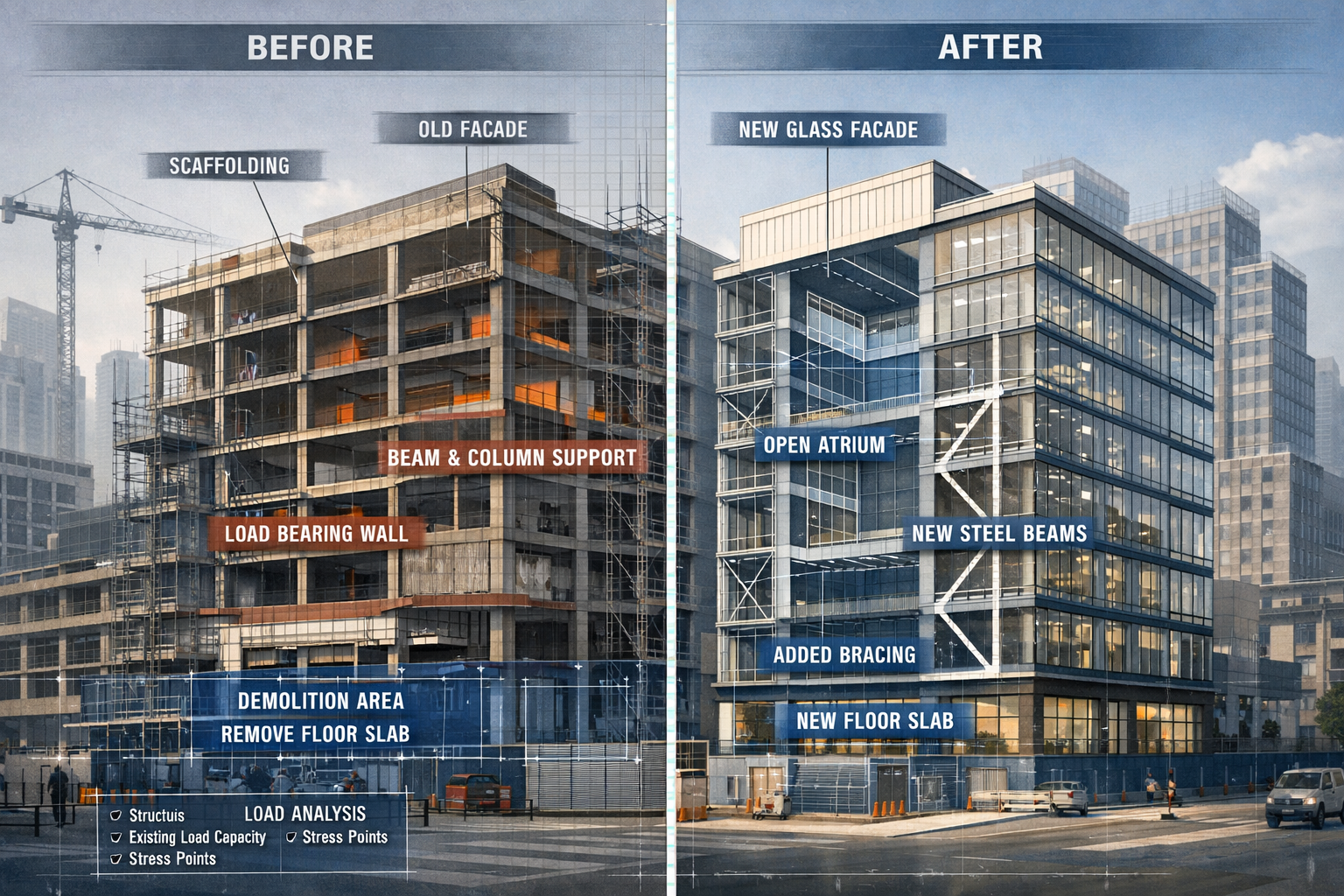
The building survey profession has embraced technological innovations that dramatically improve assessment accuracy and efficiency for conversion projects. Modern Building Surveys for Office-to-Resi Conversions: Structural Assessments in 2026's Urban Revitalisation Wave leverage multiple advanced tools.
Digital Documentation and 3D Scanning
Laser scanning and photogrammetry create precise 3D models of existing buildings, enabling:
- Accurate as-built documentation: Digital models provide exact measurements for design teams, reducing errors and change orders
- Virtual site visits: Stakeholders can review building conditions remotely, accelerating decision-making
- Clash detection: Digital models reveal conflicts between existing structure and proposed residential layouts before construction begins
Thermal Imaging and Building Envelope Analysis
Infrared thermography identifies building envelope deficiencies invisible to visual inspection:
- Insulation gaps: Thermal imaging reveals missing or damaged insulation requiring remediation
- Air leakage: Infiltration points that compromise energy performance become visible
- Moisture intrusion: Hidden water damage appears as temperature differentials in thermal scans
- Structural anomalies: Temperature variations can indicate structural issues behind finishes
Non-Destructive Testing Methods
Modern surveys employ various non-destructive techniques to assess hidden conditions:
- Ground-penetrating radar: Reveals rebar placement, post-tension cables, and subsurface conditions without drilling
- Ultrasonic testing: Assesses concrete quality and identifies voids or delamination
- Moisture meters: Quantify moisture content in building materials, identifying water infiltration issues
- Acoustic testing: Evaluates sound transmission through existing assemblies to determine acoustic upgrade requirements
Drone-Based Facade Inspection
Premium drone surveys have revolutionized facade assessment for tall buildings:
- Cost efficiency: Drone inspections cost 60-80% less than traditional scaffolding or rope access methods
- Safety improvements: Eliminates dangerous working-at-height scenarios
- Comprehensive documentation: High-resolution imagery captures entire building envelopes
- Rapid deployment: Complete facade surveys accomplished in hours rather than weeks
Best Practices for Commissioning Conversion Surveys
Developers and property owners seeking to evaluate office-to-residential conversion potential should follow established best practices when commissioning building surveys.
Selecting Qualified Survey Professionals
Not all building surveyors possess the specialized expertise conversion projects demand. Look for professionals with:
🏆 Conversion-specific experience: Surveyors who have assessed multiple conversion projects understand the unique challenges and regulatory requirements
🏆 Multidisciplinary knowledge: Ideal surveyors understand both commercial and residential building standards, structural engineering principles, and local planning regulations
🏆 Professional credentials: RICS-chartered surveyors maintain rigorous professional standards and continuing education requirements
🏆 Technology capabilities: Firms offering advanced survey technologies provide more comprehensive assessments
Questions to Ask During the Survey Process
Understanding what questions to ask during a building survey ensures comprehensive coverage of conversion-specific concerns:
- What structural modifications will residential conversion require?
- Does the building meet minimum floor-to-floor height requirements for residential use?
- What building systems require replacement or major upgrades?
- Are there any regulatory compliance issues that would prevent or significantly delay conversion?
- What hazardous materials are present and what removal costs should be anticipated?
- How do building characteristics impact the number and configuration of residential units achievable?
Understanding Different Survey Levels
Conversion feasibility assessments typically require Level 3 surveys—the most comprehensive survey type available. Understanding the differences between survey levels helps ensure appropriate scope selection.
Level 3 surveys include:
- Detailed inspection of accessible building elements
- Investigation of specific defects and deterioration
- Assessment of building services and infrastructure
- Regulatory compliance evaluation
- Detailed cost estimates for identified remediation work
- Specialist referrals for areas requiring additional investigation
Timing and Phasing Considerations
Strategic survey timing optimizes both cost and decision-making:
Phase 1 – Initial feasibility: Desktop review and limited site inspection identify obvious deal-breakers before significant expenditure
Phase 2 – Comprehensive assessment: Full Level 3 survey with specialist investigations for projects passing initial screening
Phase 3 – Design development support: Ongoing survey support during design phases addresses questions arising during detailed planning
This phased approach minimizes wasted expenditure on buildings ultimately deemed unsuitable while ensuring thorough assessment of viable candidates.
Case Studies: Survey Findings That Made or Broke Conversion Projects
Real-world examples illustrate how comprehensive structural assessments determine conversion success or failure.
Success Story: Mid-Century Office Tower Transformation
A 1970s-era 15-story office building in a major UK city appeared ideal for residential conversion based on location and market conditions. The comprehensive building survey revealed several favorable factors:
- ✅ 12-foot floor-to-floor heights provided adequate space for residential infrastructure
- ✅ Perimeter column spacing at 30 feet enabled flexible apartment layouts
- ✅ Recent facade renovation eliminated major building envelope work
- ✅ Existing parking structure added value for residential use
However, the survey also identified critical issues requiring remediation:
- ⚠️ Asbestos-containing materials in mechanical spaces required £180,000 removal
- ⚠️ Aging electrical distribution system needed complete replacement
- ⚠️ Floor assemblies required acoustic upgrading to meet residential standards
Despite these challenges, the survey provided accurate cost estimates enabling the developer to proceed with realistic budgets. The project successfully delivered 87 residential units, with survey-identified issues addressed within projected costs.
Cautionary Tale: Shallow Floor Depths Derail Conversion
A seemingly attractive 1980s office building in excellent structural condition appeared perfect for conversion. However, detailed survey work revealed a fatal flaw: 9-foot floor-to-floor heights left inadequate space for residential plumbing, HVAC, and acoustic insulation while maintaining acceptable ceiling heights.
The survey identified that achieving code-compliant residential units would require:
- Removing every other floor to create adequate ceiling heights (reducing unit count by 50%)
- Extensive structural modifications to accommodate vertical plumbing stacks
- Complete MEP system replacement with creative routing to minimize ceiling depth impact
These modifications rendered the project economically unviable. The comprehensive survey saved the developer from proceeding with a project that would have failed during design development—after substantially greater investment.
Lessons Learned
These cases highlight several critical lessons:
- Location and market conditions alone don't ensure conversion viability—structural characteristics matter enormously
- Early comprehensive surveys prevent costly mistakes by identifying deal-breakers before major capital commitment
- Accurate cost estimation from survey findings enables realistic pro forma development and protects against budget overruns
- Some buildings simply aren't suitable for residential conversion regardless of market demand
Future Trends in Conversion Surveys and Urban Revitalisation
As 2026 progresses, several emerging trends are shaping how Building Surveys for Office-to-Resi Conversions: Structural Assessments in 2026's Urban Revitalisation Wave evolve to meet changing market needs.
Sustainability and Circular Economy Focus
Adaptive reuse aligns with broader sustainability goals by:
- Reducing embodied carbon: Conversions generate 50-75% less carbon than demolition and new construction [6]
- Preserving urban fabric: Maintaining existing buildings supports historic character and community identity
- Minimizing waste: Reusing structural elements and building systems reduces construction waste
Survey methodologies increasingly incorporate sustainability assessments, evaluating opportunities for energy efficiency improvements, renewable energy integration, and sustainable material selection during conversion.
Regulatory Evolution and Streamlined Processes
Municipalities continue refining conversion-friendly policies. Recent trends include [3]:
- Expanded permitted development rights: More jurisdictions offering expedited approval pathways
- Parking requirement reductions: Recognizing urban residential conversion sites often have excellent transit access
- Density bonuses: Incentivizing conversions through additional unit allowances
- Tax increment financing: Public financing tools supporting conversion economics
Surveyors must stay current with evolving regulatory frameworks to provide accurate compliance guidance.
Technology Integration and Digital Twins
Building Information Modeling (BIM) and digital twin technologies are transforming how conversion projects are assessed and executed:
- Integrated digital models: Survey data feeds directly into design platforms, streamlining the design process
- Predictive maintenance: Digital twins enable ongoing building performance monitoring post-conversion
- Virtual reality walkthroughs: Stakeholders can experience proposed conversions before construction begins
Expanding Beyond Traditional Office Buildings
The conversion wave is expanding to other underutilized commercial property types:
- Retail conversions: Struggling shopping centers and big-box retail stores face similar conversion potential
- Hotel conversions: Hospitality properties offer natural residential layouts with existing plumbing infrastructure
- Mixed-use approaches: Combining residential with retail, workspace, or community amenities
Each property type presents unique survey challenges requiring specialized assessment approaches.
Conclusion
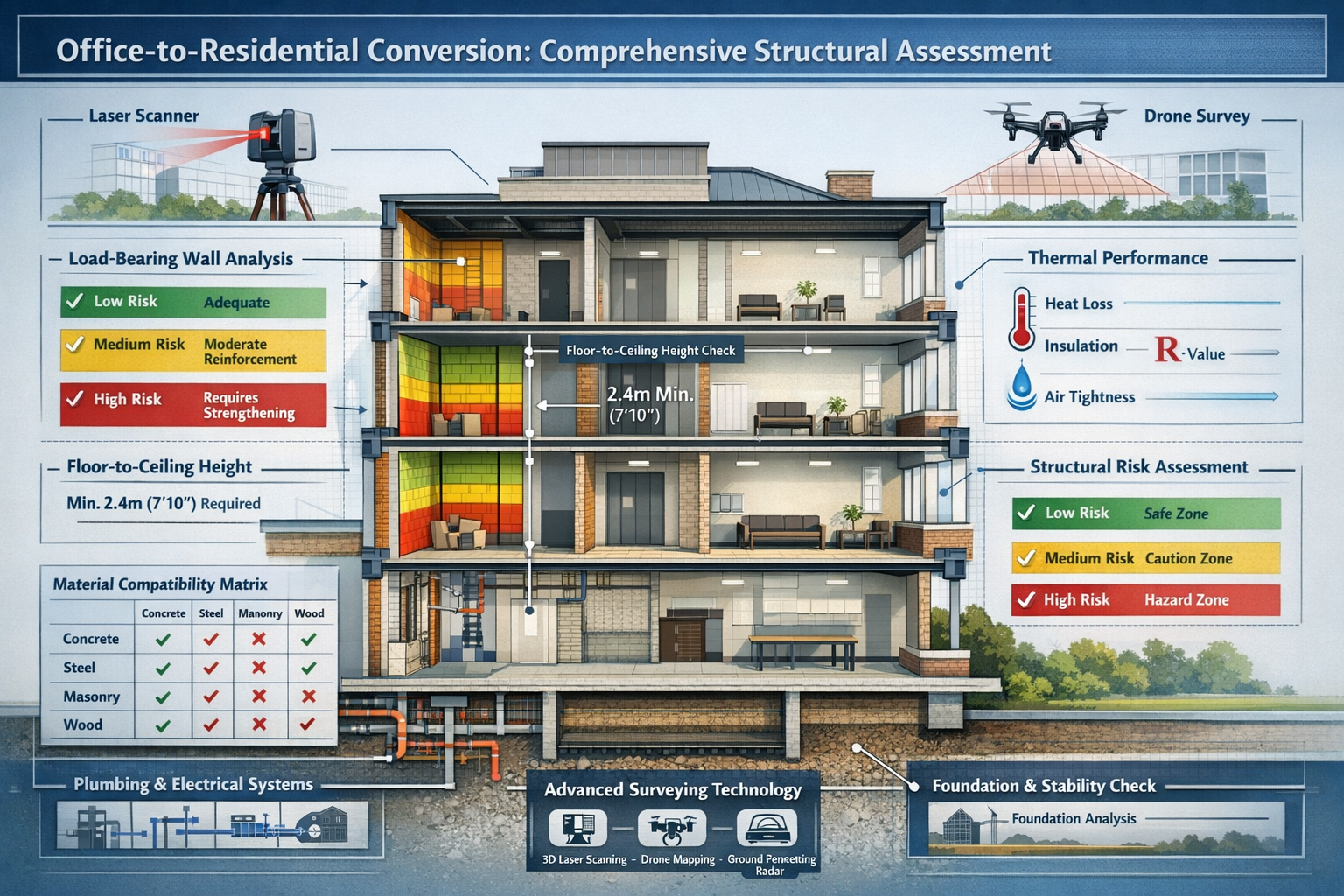
Building Surveys for Office-to-Resi Conversions: Structural Assessments in 2026's Urban Revitalisation Wave represent far more than routine property inspections—they serve as the critical gateway determining which buildings can successfully transform to address housing needs while revitalizing urban centers. As this analysis has demonstrated, comprehensive structural assessments identify the defects, compliance gaps, and economic realities that separate viable conversion candidates from costly failures.
The conversion opportunity before cities in 2026 is substantial, with thousands of underutilized office buildings potentially serving residential purposes. However, success demands rigorous due diligence through professional building surveys that evaluate structural capacity, building systems adequacy, regulatory compliance, and economic feasibility. The survey findings directly impact project costs, timelines, and ultimate viability—making the selection of qualified survey professionals and comprehensive assessment scope essential to conversion success.
Actionable Next Steps
For developers, property owners, and municipalities considering office-to-residential conversions:
1. Commission early-stage feasibility surveys before significant capital commitment to identify deal-breakers and establish realistic cost estimates
2. Engage RICS-chartered surveyors with specific conversion project experience who understand both commercial and residential building standards
3. Leverage advanced survey technologies including 3D scanning, thermal imaging, and drone inspections to maximize assessment accuracy while controlling costs
4. Plan for specialist investigations in areas the initial survey identifies as requiring additional analysis, building these costs into feasibility budgets
5. Stay informed about evolving regulations and incentive programs that may improve conversion economics or streamline approval processes
6. Consider phased assessment approaches that minimize expenditure on unsuitable buildings while ensuring thorough evaluation of viable candidates
The urban revitalization wave of 2026 offers tremendous opportunity to address housing shortages while breathing new life into underutilized commercial properties. Success begins with comprehensive building surveys that provide the technical foundation for informed decision-making. By understanding what these assessments reveal—and acting on those insights—stakeholders can participate in transforming our cities for the better while protecting themselves from costly mistakes.
Whether you're evaluating a single building or an entire portfolio of conversion candidates, professional building surveys provide the essential intelligence needed to navigate this complex but rewarding development opportunity. The investment in thorough structural assessment pays dividends throughout the project lifecycle, from initial feasibility through successful residential occupancy.
References
[1] A Guide To Public Policies Supporting Office To Residential Conversions – https://dcd.com/articles/a-guide-to-public-policies-supporting-office-to-residential-conversions/
[2] Rules And Incentives For Office To Residential Conversions – https://www.swinter.com/rules-and-incentives-for-office-to-residential-conversions/
[3] Office Conversion – https://mrsc.org/stay-informed/mrsc-insight/april-2025/office-conversion
[4] A Community Guide To Office To Residential Conversion Part 1 Economics – https://www.brookings.edu/articles/a-community-guide-to-office-to-residential-conversion-part-1-economics/
[6] Building Conversions – https://www.gensler.com/building-conversions