

Fire-related incidents in UK rental properties have increased by 23% over the past three years, with converted buildings accounting for a disproportionate share of serious incidents. As of 2026, landlords and surveyors face unprecedented regulatory scrutiny under the expanded provisions of Awaab's Law Phase 2, which now mandates strict investigation and remediation timelines for fire hazards in addition to the original damp and mould requirements. Building Surveys for Fire Hazards Under Awaab's Law 2026: Compliance Checklists for Private Rented Conversions have become essential tools for property professionals navigating this complex regulatory landscape, particularly for properties that have undergone conversion from their original use.
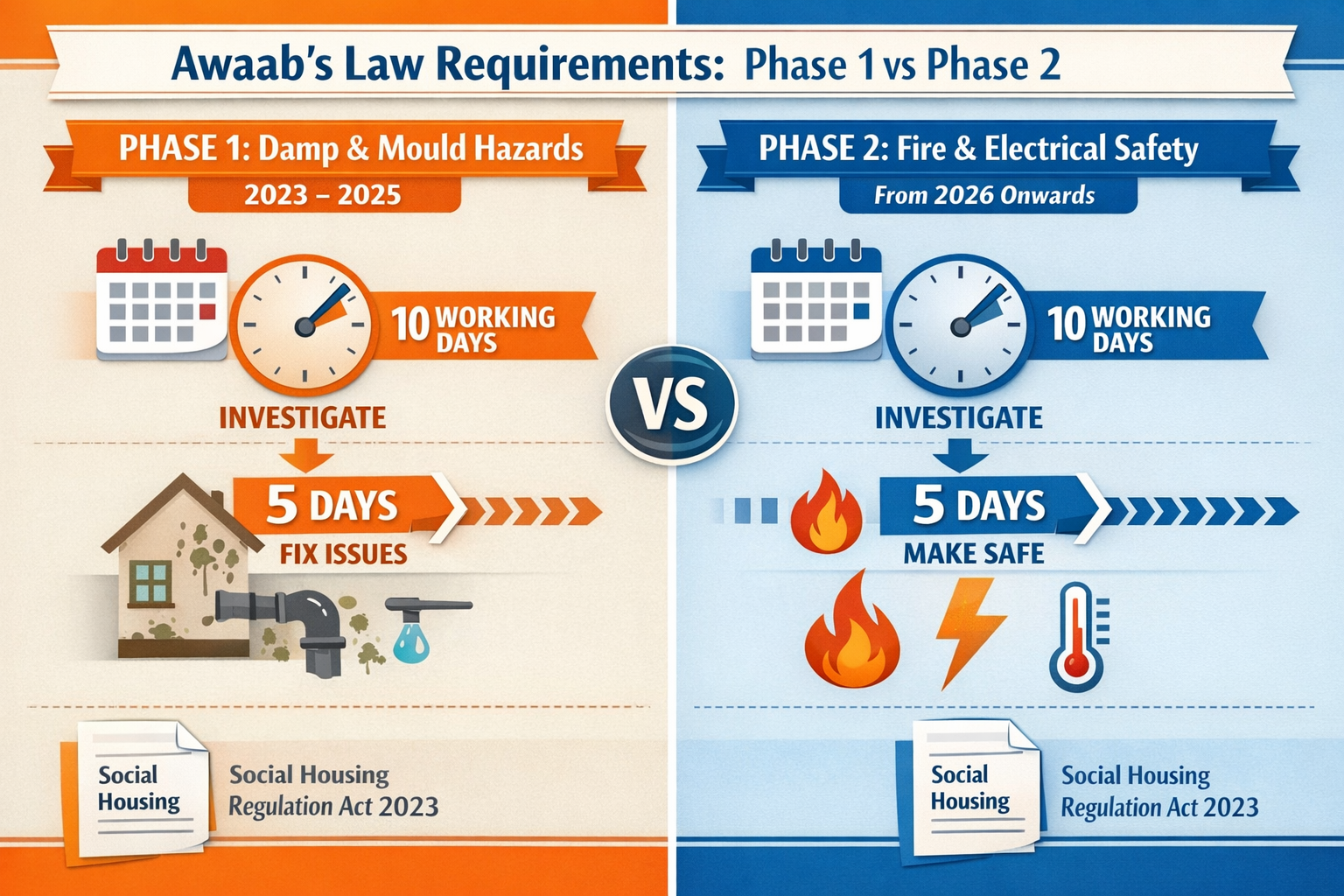
The expansion of Awaab's Law into fire safety represents a fundamental shift in how rental property hazards are assessed, documented, and remediated. With investigation deadlines of just 10 working days and remediation requirements as tight as 24 hours for emergency hazards, surveyors must now integrate specialized fire risk protocols into their standard building survey procedures.
Key Takeaways
- 🔥 Awaab's Law Phase 2 expands beyond damp and mould to include fire and electrical hazards, with enforcement beginning in 2026
- ⏱️ Strict timelines apply: 10 working days for investigation, 5 working days for remediation, and just 24 hours for emergency fire hazards
- 📋 Specialized checklists are now mandatory for converted rental properties, integrating EWS1 assessments and escape route evaluations
- 👥 Person-centered approach required—fire hazard severity must consider tenant circumstances, mobility, and evacuation capabilities
- ⚖️ Enforcement consequences include unlimited fines and legal proceedings for landlords who fail to meet statutory deadlines
Understanding Awaab's Law Phase 2: Fire Hazards in the Regulatory Framework
Awaab's Law emerged from the tragic death of two-year-old Awaab Ishak in 2020, whose respiratory condition was caused by prolonged exposure to mould in social housing. The initial legislation, delivered through the Social Housing (Regulation) Act 2023, focused exclusively on damp and mould hazards. However, Phase 2, which came into effect in 2026, represents a significant expansion of the regulatory framework.[2]
Legislative Structure and Statutory Requirements
The expanded law operates through secondary legislation—specifically the Hazards in Social Housing (Prescribed Requirements) (England) Regulations 2025—establishing clear statutory response times for hazard investigation and remediation.[3] While initially designed for social housing providers, the principles and best practices have rapidly influenced private rented sector (PRS) compliance expectations, particularly for converted properties where fire risks are statistically higher.
The Phase 2 expansion includes several critical hazard categories beyond the original scope:
- Fire safety hazards (primary focus)
- Electrical hazards
- Excess cold and excess heat
- Falls and structural instability
- Domestic hygiene concerns
For surveyors conducting building defects surveys, this expansion means a fundamental reworking of inspection protocols and reporting templates.
The Evidence-Based Accountability Model
The National Housing Federation has emphasized that Awaab's Law represents a shift to evidence-based accountability, requiring landlords to maintain accurate, auditable data on fire hazards and repairs with clear decision-making pathways.[4] This accountability framework demands:
✅ Documented hazard recognition procedures
✅ Time-stamped investigation records
✅ Written tenant communications
✅ Remediation completion certificates
✅ Audit trails for all decision points
For converted properties—such as Victorian houses split into flats or commercial buildings repurposed as residential units—the documentation burden is particularly significant due to the complexity of shared fire safety infrastructure.
Building Surveys for Fire Hazards Under Awaab's Law 2026: Essential Survey Protocols for Converted Properties
Converted rental properties present unique fire safety challenges that require specialized survey approaches. Unlike purpose-built residential blocks, conversions often feature:
- Compromised fire compartmentation from structural alterations
- Inadequate fire-rated doors and partitions
- Insufficient escape routes or secondary exits
- Non-compliant electrical installations from multiple renovation phases
- Shared services and utilities creating fire spread pathways
Mandatory Investigation Timelines
Under Awaab's Law Phase 2, social landlords (and increasingly, private landlords under best practice guidance) must investigate significant fire hazards within 10 working days of becoming aware of them.[3] The investigation process requires:
- Initial assessment (Days 1-3): Surveyor site visit to evaluate reported hazard
- Detailed investigation (Days 4-8): Technical assessment, testing, and documentation
- Written summary (Days 9-10): Formal report to tenant within 3 working days of investigation conclusion
For urgent or dangerous building issues, these timelines compress dramatically. If fire hazards pose an "imminent and significant risk of harm," remediation must be completed within 24 hours, or suitable alternative accommodation must be provided at the landlord's expense.[3]
Person-Centered Hazard Assessment
A critical innovation in Awaab's Law compliance is the person-centered approach to hazard assessment. Traditional Housing Health and Safety Rating System (HHSRS) assessments evaluate hazards based on standardized risk profiles. However, under Awaab's Law, surveyors must consider actual tenant circumstances.[3]
Example scenario: A faulty electrical socket in a ground-floor flat might score as HHSRS Category 2 (moderate risk) under standard assessment. However, if the tenant is elderly with mobility limitations affecting their ability to evacuate quickly, the same hazard could be classified as "significant" under Awaab's Law, triggering the 5-day remediation deadline.
This person-centered methodology requires surveyors to:
- 📝 Document tenant demographics and vulnerabilities
- 🏠 Assess evacuation capabilities specific to the household
- ⚠️ Evaluate how fire hazards interact with tenant circumstances
- 📊 Adjust risk ratings accordingly in compliance reports
EWS1 Integration for Converted Buildings
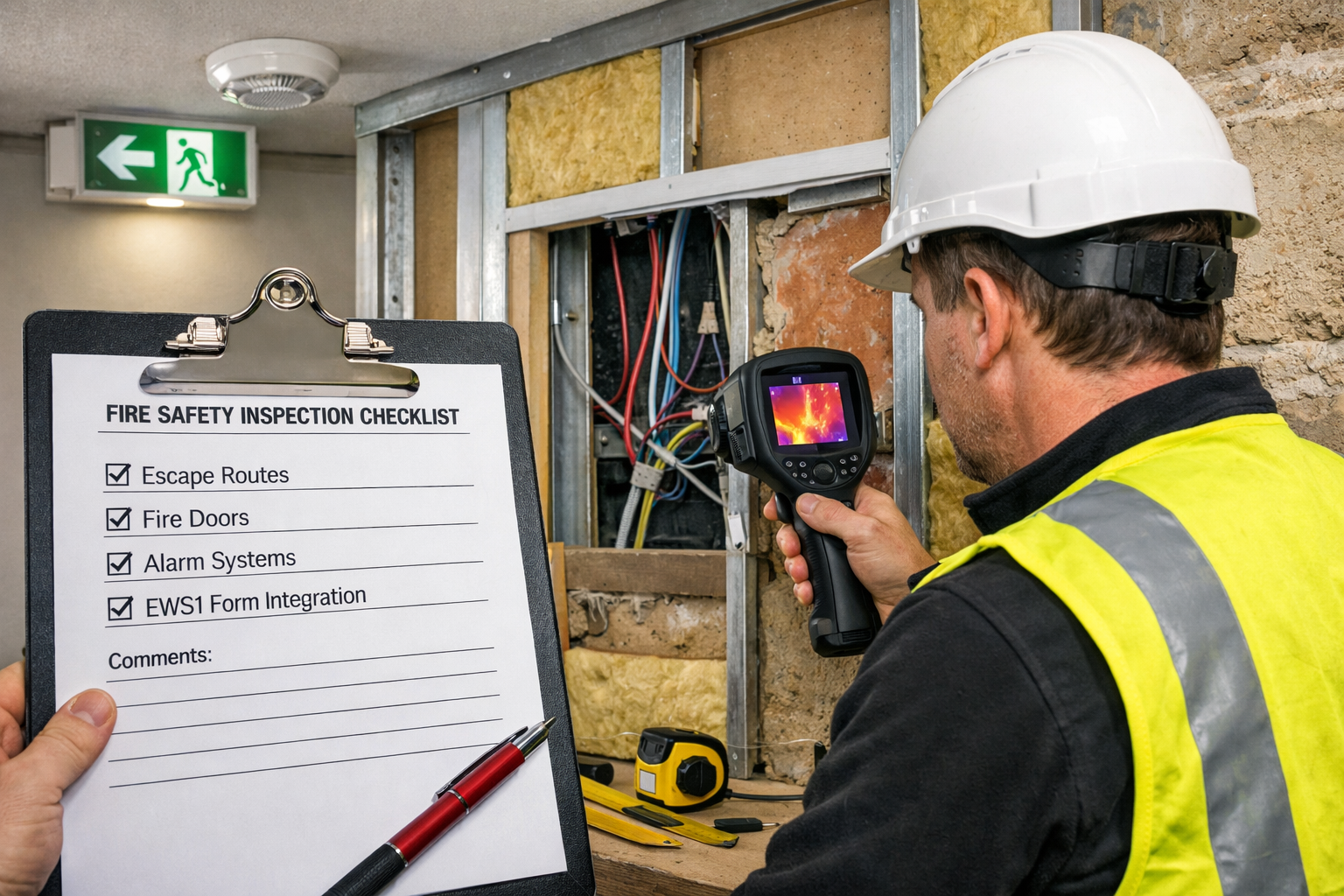
For converted properties, particularly those involving external wall systems or cladding modifications, Building Surveys for Fire Hazards Under Awaab's Law 2026: Compliance Checklists for Private Rented Conversions must integrate EWS1 form assessments (External Wall Fire Review).
The EWS1 process evaluates:
- External wall construction materials
- Cladding systems and fire performance
- Balcony construction and fire spread risks
- Cavity barriers and fire stopping measures
While EWS1 forms were initially developed for mortgage lending purposes, they've become integral to Awaab's Law compliance for converted properties above 11 meters or with specific construction types.
Compliance Checklists: Five-Stage Case Lifecycle for Fire Hazard Management
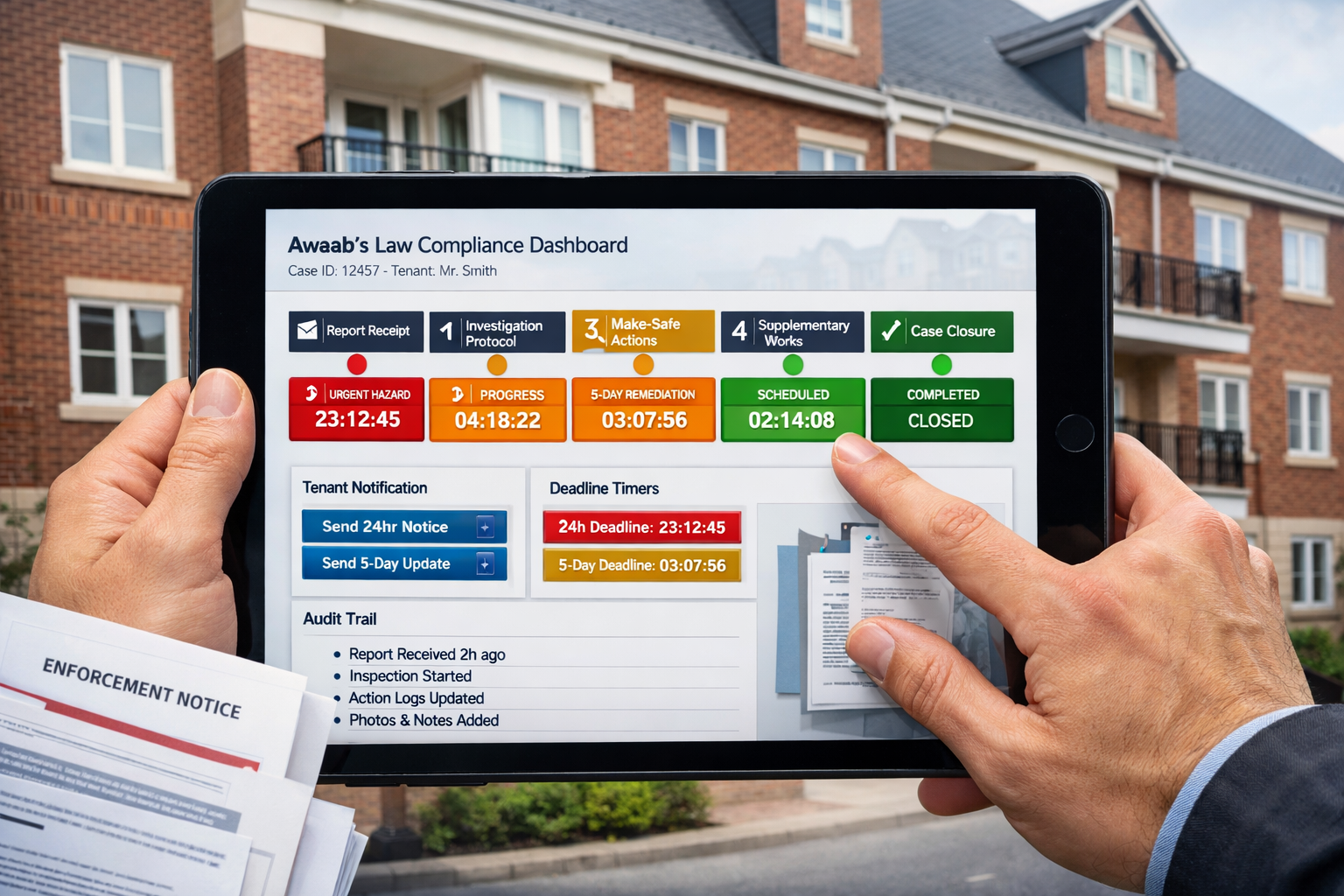
The most effective approach to Building Surveys for Fire Hazards Under Awaab's Law 2026: Compliance Checklists for Private Rented Conversions follows a five-stage case lifecycle model.[5] This structured framework ensures comprehensive documentation and regulatory compliance.
Stage 1: Hazard Report Receipt
Timeline: Day 0 (immediate)
When a fire hazard is reported—whether by tenant, contractor, or during routine inspection—the compliance clock starts immediately. The checklist must capture:
- ⏰ Date and time of report
- 👤 Reporter identity and contact details
- 📍 Precise hazard location within property
- 🔍 Initial hazard description
- 🚨 Preliminary risk assessment (emergency vs. significant vs. routine)
For converted properties, particular attention must be paid to hazards affecting:
- Shared escape routes and communal areas
- Fire doors and compartmentation between units
- Electrical installations serving multiple tenants
- Smoke detection and alarm systems
- Emergency lighting in common areas
Stage 2: Investigation Protocol
Timeline: Days 1-10 (maximum)
The investigation phase requires detailed technical assessment by qualified surveyors. The compliance checklist should include:
Fire Detection and Alarm Systems:
- ✓ Smoke detector locations and functionality
- ✓ Heat detector placement in high-risk areas
- ✓ Alarm system interconnection between units
- ✓ Battery backup and mains power supply
- ✓ Testing records and maintenance history
Escape Routes and Emergency Exits:
- ✓ Primary escape route accessibility
- ✓ Secondary exit availability (where required)
- ✓ Corridor widths and obstruction assessment
- ✓ Emergency lighting adequacy
- ✓ Exit signage visibility and compliance
Fire Doors and Compartmentation:
- ✓ Fire door integrity and self-closing mechanisms
- ✓ Intumescent strip condition
- ✓ Smoke seal effectiveness
- ✓ Fire-rated partition walls between units
- ✓ Service penetration fire stopping
Electrical Safety:
- ✓ Consumer unit condition and location
- ✓ Circuit protection devices (RCDs, MCBs)
- ✓ Wiring condition and installation standards
- ✓ Overloading risks and socket distribution
- ✓ Electrical Installation Condition Report (EICR) currency
Combustible Materials and Storage:
- ✓ Flammable materials in communal areas
- ✓ Accumulation of combustible waste
- ✓ Storage under stairs or in escape routes
- ✓ Furniture and furnishing fire resistance
For construction and condition surveys of converted properties, thermal imaging equipment has become standard practice for identifying hidden electrical faults and overheating circuits that could constitute fire hazards.
Stage 3: Make-Safe Actions
Timeline: 5 working days maximum (24 hours for emergency hazards)
Once investigation confirms a significant fire hazard, immediate remediation work must commence. The compliance checklist tracks:
- 🔧 Contractor appointment and qualifications
- 📋 Work scope and safety measures
- 🏗️ Materials specifications (fire-rated products)
- ✅ Completion certification
- 📸 Photographic evidence (before and after)
- 📝 Tenant notification (work completion summary)
Emergency hazards—such as exposed live electrical wiring, non-functional smoke alarms in occupied units, or completely blocked fire exits—trigger the 24-hour remediation requirement.[3] If immediate remediation is physically impossible, landlords must provide suitable alternative accommodation at their expense until the hazard is eliminated.
Stage 4: Supplementary Works
Timeline: Commence within 5 working days, complete within 12 weeks
Many fire hazards require two-stage remediation: immediate make-safe actions followed by comprehensive supplementary works. For example:
- Immediate: Temporary fire door installation
- Supplementary: Permanent fire-rated door with proper certification
The supplementary works checklist must document:
| Work Category | Specification | Timeline | Certification |
|---|---|---|---|
| Fire door replacement | FD30S or FD60S rated | Week 1-4 | BS 476 certificate |
| Compartmentation repair | Fire-rated plasterboard | Week 2-6 | Installation cert |
| Electrical rewiring | BS 7671 compliant | Week 3-10 | EICR completion |
| Alarm system upgrade | BS 5839-6 Grade D/E | Week 2-5 | Commissioning cert |
Stage 5: Case Closure and Audit Trail
Timeline: Upon supplementary work completion
The final stage ensures complete documentation for regulatory compliance and potential enforcement scrutiny. The closure checklist includes:
- ✓ All investigation reports (surveyor findings)
- ✓ Remediation work orders (contractor instructions)
- ✓ Completion certificates (qualified installer confirmations)
- ✓ Tenant communications (all written summaries)
- ✓ Photographic evidence (comprehensive visual record)
- ✓ Cost documentation (financial audit trail)
- ✓ Lessons learned (process improvement notes)
Interactive digital checklists are now available that mirror this five-stage lifecycle, providing automated deadline tracking and compliance reporting.[5]
Surveyor Role Expansion and Training Requirements
The introduction of fire hazards into Awaab's Law compliance has significantly expanded surveyor responsibilities. Surveyors' workload is expected to increase substantially as their role becomes vital in identifying and reporting on fire hazards across rental housing stock.[7]
Expanded Competency Requirements
Surveyors conducting Building Surveys for Fire Hazards Under Awaab's Law 2026: Compliance Checklists for Private Rented Conversions must now demonstrate competency in:
Fire Safety Principles:
- Fire triangle and combustion science
- Fire spread mechanisms (conduction, convection, radiation)
- Fire resistance ratings and testing standards
- Smoke and toxic gas generation
Regulatory Frameworks:
- Housing Health and Safety Rating System (HHSRS)
- Regulatory Reform (Fire Safety) Order 2005
- Building Regulations Approved Document B
- Awaab's Law statutory timelines and requirements
Technical Assessment Skills:
- Thermal imaging for electrical fault detection
- Fire door integrity testing
- Compartmentation breach identification
- Escape route analysis and capacity calculations
Documentation and Communication:
- Person-centered risk assessment methodology
- Clear, jargon-free tenant communications
- Legally defensible report writing
- Audit trail maintenance
Frontline Staff Training
Awaab's Law Phase 2 requires that frontline staff, surveyors, and contractors be trained to recognize fire risk and other HHSRS hazards, representing a significant expansion beyond the original damp and mould training.[4] For property management organizations, this means:
- 📚 Comprehensive training programs for all tenant-facing staff
- 🎓 Hazard recognition workshops with practical scenarios
- 📱 Reporting systems that capture fire hazards from any source
- 🔄 Regular refresher training to maintain competency
When conducting what questions should you be asking during a building survey, surveyors must now incorporate fire safety queries that extend beyond basic visual inspection.
Enforcement Implications and Liability Considerations
Failure to meet fire hazard investigation and remediation timeframes constitutes a breach of law, exposing landlords to enforcement action, unlimited fines, and legal proceedings.[3]
Regulatory Enforcement Powers
The Regulator of Social Housing (and increasingly, local authority enforcement officers for private landlords) has extensive powers to:
- 🔍 Conduct unannounced inspections of rental properties
- 📊 Audit compliance documentation and case management systems
- ⚠️ Issue improvement notices with mandatory timelines
- 💰 Impose unlimited financial penalties for serious breaches
- ⚖️ Initiate criminal proceedings for persistent non-compliance
For converted properties with multiple units, enforcement action against one landlord often triggers scrutiny of neighboring properties within the same building, creating cascade compliance risks.
Insurance and Liability Considerations
Insurers are increasingly incorporating Awaab's Law compliance into policy terms and conditions. Key considerations include:
Coverage Exclusions:
- Fire damage claims may be denied if compliance failures contributed
- Public liability coverage may be voided for known, unremediated hazards
- Buildings insurance premiums may increase for properties with compliance breaches
Landlord Liability:
- Personal injury claims from tenants injured in fires
- Property damage claims from neighboring units
- Regulatory fine coverage (typically excluded from standard policies)
Professional surveyors should ensure their professional indemnity insurance specifically covers fire hazard assessments under Awaab's Law, as this represents an expansion of traditional survey scope.
Technology Solutions for Compliance Management
Modern compliance with Building Surveys for Fire Hazards Under Awaab's Law 2026: Compliance Checklists for Private Rented Conversions increasingly relies on specialized technology platforms.
Digital Compliance Platforms
Leading property management organizations are implementing:
Automated Deadline Tracking:
- Real-time countdown clocks for investigation and remediation deadlines
- Automated alerts for approaching compliance milestones
- Escalation protocols for overdue cases
Centralized Documentation:
- Cloud-based document repositories for all compliance evidence
- Searchable audit trails with version control
- Secure tenant access portals for transparency
Mobile Survey Applications:
- Tablet-based inspection forms with offline functionality
- Integrated photography and annotation tools
- Instant report generation and distribution
Analytics and Reporting:
- Portfolio-wide compliance dashboards
- Hazard trend analysis and predictive maintenance
- Regulatory reporting automation
Thermal Imaging and Diagnostic Equipment
For electrical fire hazard detection, thermal imaging cameras have become essential survey tools. Modern devices can:
- Identify overheating circuits and connections
- Detect hidden electrical faults behind walls
- Map heat distribution patterns indicating fire risks
- Generate thermal reports for compliance documentation
The investment in diagnostic equipment is increasingly justified by the strict remediation timelines and potential enforcement consequences.
Best Practices for Private Landlords and Property Managers
While Awaab's Law formally applies to social housing providers, private landlords managing converted properties should adopt equivalent standards as best practice—and increasingly, as legal expectation.
Proactive Compliance Strategies
Annual Fire Safety Audits:
Conduct comprehensive fire safety surveys annually, rather than waiting for tenant reports. This proactive approach:
- Identifies hazards before they become emergencies
- Demonstrates due diligence in enforcement proceedings
- Reduces insurance premiums through risk mitigation
- Improves tenant satisfaction and retention
Preventive Maintenance Programs:
Implement scheduled maintenance for fire safety systems:
- Quarterly smoke alarm testing and battery replacement
- Annual EICR inspections for electrical installations
- Bi-annual fire door integrity checks
- Regular escape route assessments
Tenant Education and Engagement:
Provide clear information to tenants about:
- Fire safety features and how to use them
- Hazard reporting procedures and response timelines
- Escape routes and evacuation procedures
- Responsibilities for maintaining safety (e.g., not blocking exits)
Contractor Vetting and Management:
Ensure all contractors working on fire safety remediation:
- Hold relevant qualifications and certifications
- Provide compliant materials and installation methods
- Deliver proper completion documentation
- Understand Awaab's Law timeline requirements
Specific Considerations for Converted Properties
Converted buildings require additional vigilance due to their complex fire safety profiles:
Compartmentation Integrity:
- Regularly inspect fire-rated walls and floors for breaches
- Ensure all service penetrations are properly fire-stopped
- Verify fire doors remain effective throughout their lifecycle
Shared Services Management:
- Coordinate electrical and gas safety across multiple units
- Maintain clear responsibility matrices for communal areas
- Implement building-wide emergency procedures
Planning and Building Control History:
- Maintain complete records of conversion approvals
- Verify that original fire safety specifications were implemented
- Address any retrospective compliance gaps
Conclusion: Navigating the New Fire Safety Compliance Landscape
Building Surveys for Fire Hazards Under Awaab's Law 2026: Compliance Checklists for Private Rented Conversions represent a fundamental evolution in rental property management. The expansion of Awaab's Law to include fire and electrical hazards, combined with strict statutory timelines and person-centered assessment requirements, demands a sophisticated, systematic approach to compliance.
For surveyors, the Phase 2 expansion significantly broadens professional responsibilities, requiring enhanced technical competencies in fire safety assessment, thermal imaging diagnostics, and regulatory documentation. The five-stage case lifecycle model—from hazard report receipt through investigation, make-safe actions, supplementary works, and case closure—provides a structured framework for managing compliance obligations.
Converted properties present unique challenges due to compromised compartmentation, complex shared services, and multiple renovation phases that may have introduced fire safety vulnerabilities. The integration of EWS1 assessments, escape route evaluations, and electrical safety protocols into standard building survey procedures is now essential for comprehensive risk management.
Actionable Next Steps
For Landlords and Property Managers:
- Commission immediate fire safety audits of all converted rental properties to establish baseline compliance status
- Implement digital compliance tracking systems with automated deadline management
- Develop written fire hazard response procedures aligned with Awaab's Law timelines
- Invest in preventive maintenance programs for fire detection, electrical systems, and compartmentation
- Review insurance policies to ensure adequate coverage for fire-related claims and compliance obligations
For Surveyors and Property Professionals:
- Obtain specialized training in fire safety assessment and Awaab's Law requirements
- Acquire thermal imaging equipment and diagnostic tools for electrical fault detection
- Update survey templates and checklists to incorporate person-centered risk assessment
- Establish relationships with qualified fire safety contractors for rapid remediation response
- Implement quality assurance processes for compliance documentation and audit trails
For Tenants:
- Understand your rights under Awaab's Law regarding investigation and remediation timelines
- Report fire hazards promptly through formal channels with written documentation
- Maintain clear escape routes and avoid blocking communal areas
- Test smoke alarms regularly and report any malfunctions immediately
- Request written summaries of all investigations and remediation work
The 2026 expansion of Awaab's Law represents more than regulatory change—it reflects a fundamental commitment to tenant safety and landlord accountability. By embracing comprehensive fire safety protocols, implementing robust compliance systems, and prioritizing person-centered hazard assessment, property professionals can navigate this new landscape while protecting both tenants and their own legal and financial interests.
The stakes are high: unlimited fines, criminal proceedings, and most importantly, the safety of vulnerable residents. Building Surveys for Fire Hazards Under Awaab's Law 2026: Compliance Checklists for Private Rented Conversions are not optional extras—they are essential tools for responsible property management in the modern regulatory environment.
References
[1] Awaabs Law 2026 Hazard Expansions Surveyor Protocols For Electrical Fire And Excess Heat Risks In Rentals – nottinghillsurveyors.com
[2] Awaabs Law – ecosafegroup.co.uk
[3] Awaabs Law Is Here The Surveyors Guide For Compliance – surventrix.com
[4] Awaabs Law Phase 2 Is Coming What Social Landlords Need To Know About Additional Hazard Compliance In 2026 – mobysoft.com
[5] Compliance Checklist – hazardclock.co.uk
[6] Building Survey Checklists For Awaabs Law Compliance 2026 Rental Health And Safety Mandates For Landlords – nottinghillsurveyors.com
[7] Awaabs Law What Property Managers And Surveyors Must Know – howdengroup.com