

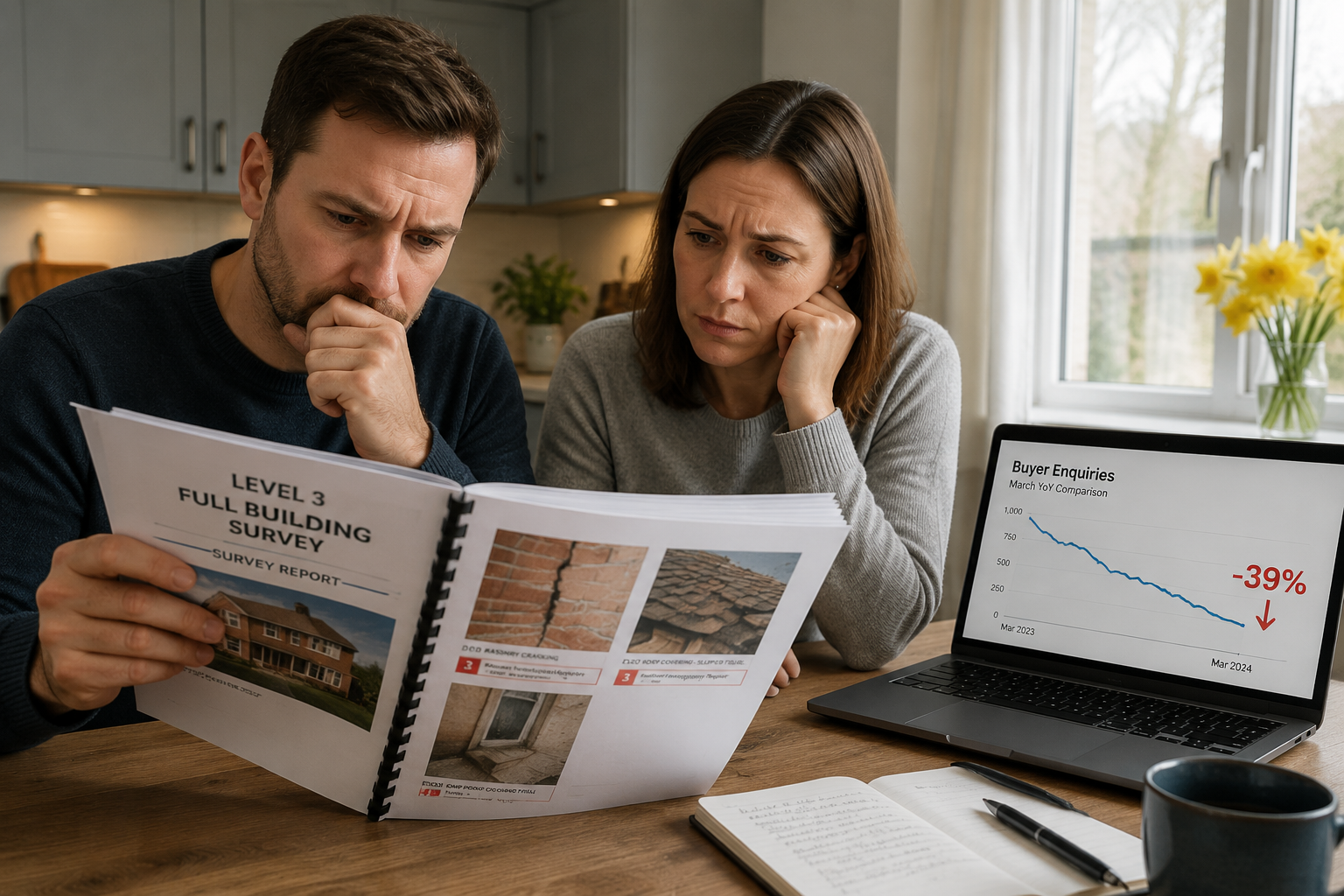
Buyer enquiries in the UK residential property market dropped by 39% in early 2026, according to RICS data — a figure that signals not just hesitation, but a fundamental shift in how purchasers are approaching property transactions. Against this backdrop, building surveys as transaction certainty tools: addressing buyer caution in spring 2026 markets have moved from routine due diligence to strategic necessity. Sellers, agents, and lenders are all beginning to recognise that a comprehensive survey is no longer a box-ticking exercise — it is the primary mechanism through which cautious buyers are persuaded to proceed.
Key Takeaways 📋
- Buyer caution is measurable: A -39% decline in buyer enquiries in early 2026 signals a risk-averse market where certainty commands a premium.
- Level 3 surveys are confidence-builders: Full building assessments directly address the fears driving buyer hesitation by surfacing — and contextualising — property defects.
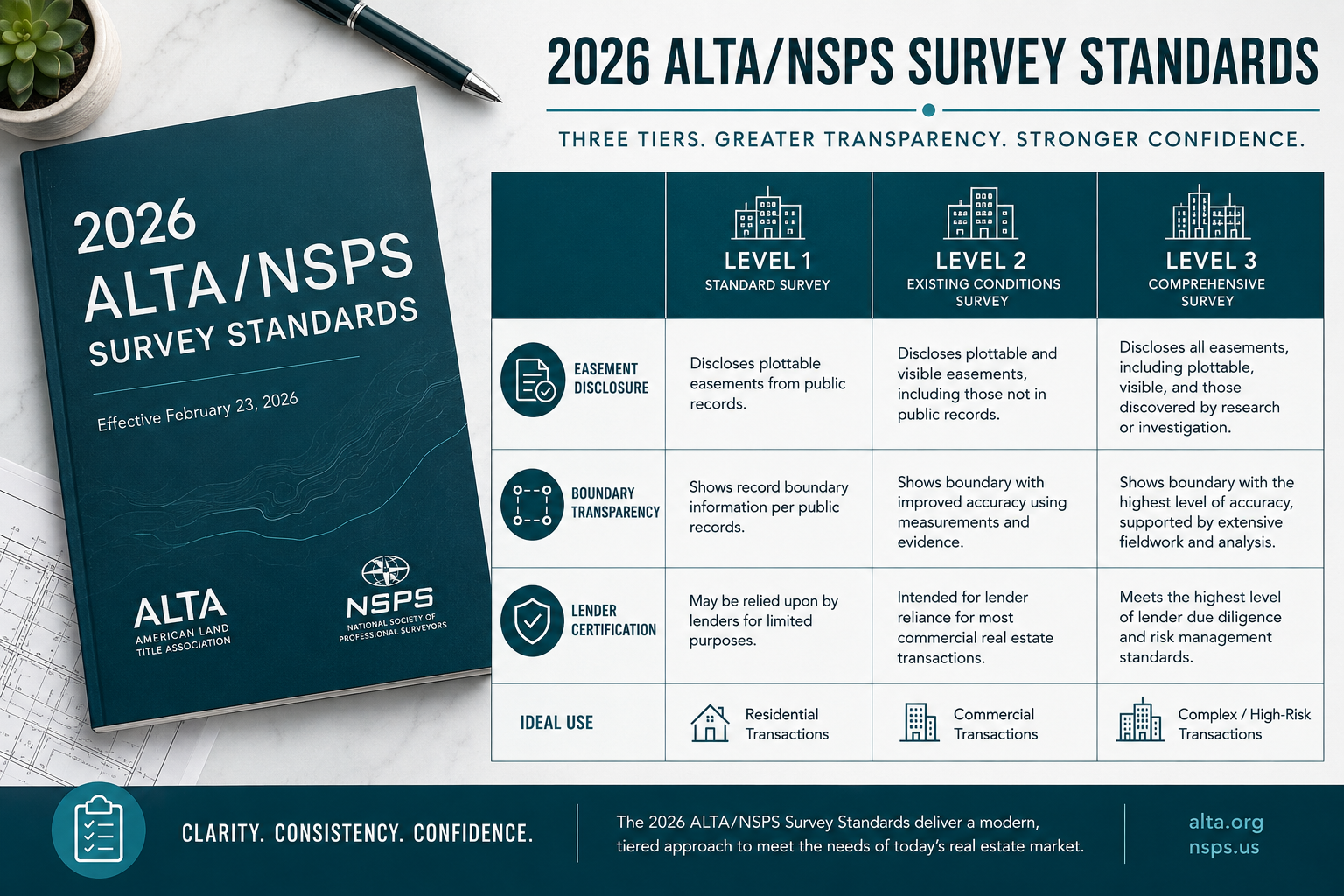
- 2026 ALTA/NSPS standards raise the bar: New mandatory standards effective February 23, 2026 require greater surveyor accountability, transparency, and coordination with title commitments [2].
- Certainty is the product, not a byproduct: Professional surveying protocols now function as explicit competitive advantages in uncertain market conditions [3].
- Regulatory pressure adds urgency: Accelerated deal timelines and increased transaction scrutiny in Spring 2026 make upfront survey documentation more critical than ever [4].
Why Buyer Caution Is Defining the Spring 2026 Property Market
The spring selling season has traditionally been the most active period for UK residential property. In 2026, that pattern has fractured. Rising interest rates, persistent cost-of-living pressures, and a global regulatory environment that is scrutinising transactions more closely than at any point in recent memory have combined to produce a buyer cohort that is fundamentally more cautious than previous generations of purchasers.
💬 "Certainty is not a byproduct of good surveying — it is the product itself." [3]
This shift is not irrational. Buyers in 2026 are acutely aware that:
- Hidden structural defects can cost tens of thousands of pounds post-completion
- Boundary and easement disputes are increasingly common as urban density rises
- Regulatory and antitrust scrutiny of transactions is expanding, making documentation gaps costly [4]
- Lender requirements are tightening, with more emphasis on independent property assessment
The result is a market where transaction certainty — the confident knowledge that a property is exactly what it appears to be — has become the single most valuable commodity a seller can offer. And the most reliable mechanism for delivering that certainty is a professional building survey.
For buyers researching their options, the buying a home resource hub provides a strong foundation for understanding where surveys fit within the broader purchase process.
How Building Surveys as Transaction Certainty Tools Address Buyer Caution in Spring 2026 Markets
The Psychology of Risk-Averse Buyers
Understanding why buyers are cautious is the first step to addressing that caution effectively. In Spring 2026, the hesitation is not primarily about price — it is about unknown risk. Buyers fear committing to a property only to discover post-completion that the roof needs replacing, that there is Japanese knotweed in the garden, or that a neighbouring extension has encroached on the boundary.
A RICS building survey directly addresses these fears by making the unknown known. When a buyer receives a detailed survey report, three things happen psychologically:
- Identified risks become manageable — a defect with a known cost is far less frightening than an imagined one
- Trust in the transaction increases — transparency signals good faith from all parties
- Decision-making accelerates — buyers with full information are more likely to proceed, not less
This is why professional surveying firms are now positioning Level 3 surveys as explicit confidence-building tools rather than simply technical documents [1].
Level 3 Protocols: The Gold Standard for Uncertain Transactions
Not all surveys are created equal. In a cautious market, the depth of assessment matters enormously. Level 3 full building surveys — the most comprehensive option available — are increasingly being deployed specifically for transactions where buyer hesitation is highest [1].
| Survey Level | Scope | Best For | Buyer Confidence Impact |
|---|---|---|---|
| Level 1 (Condition Report) | Basic visual inspection | New builds, modern properties | Low — limited detail |
| Level 2 (HomeBuyer Report) | Standard inspection + valuation | Conventional properties in good condition | Moderate |
| Level 3 (Full Building Survey) | Comprehensive structural + defect analysis | Older, complex, or high-value properties | High — maximum certainty |
The Level 3 full building survey examines every accessible element of a property, from roof structure to subfloor void, providing buyers with a granular understanding of condition that no other survey type can match. In a market where a -12% agreed sales net balance has been cited as a trigger for deploying enhanced protocols [1], this level of detail is not a luxury — it is a transaction enabler.
Drone Technology: Expanding What Surveys Can See
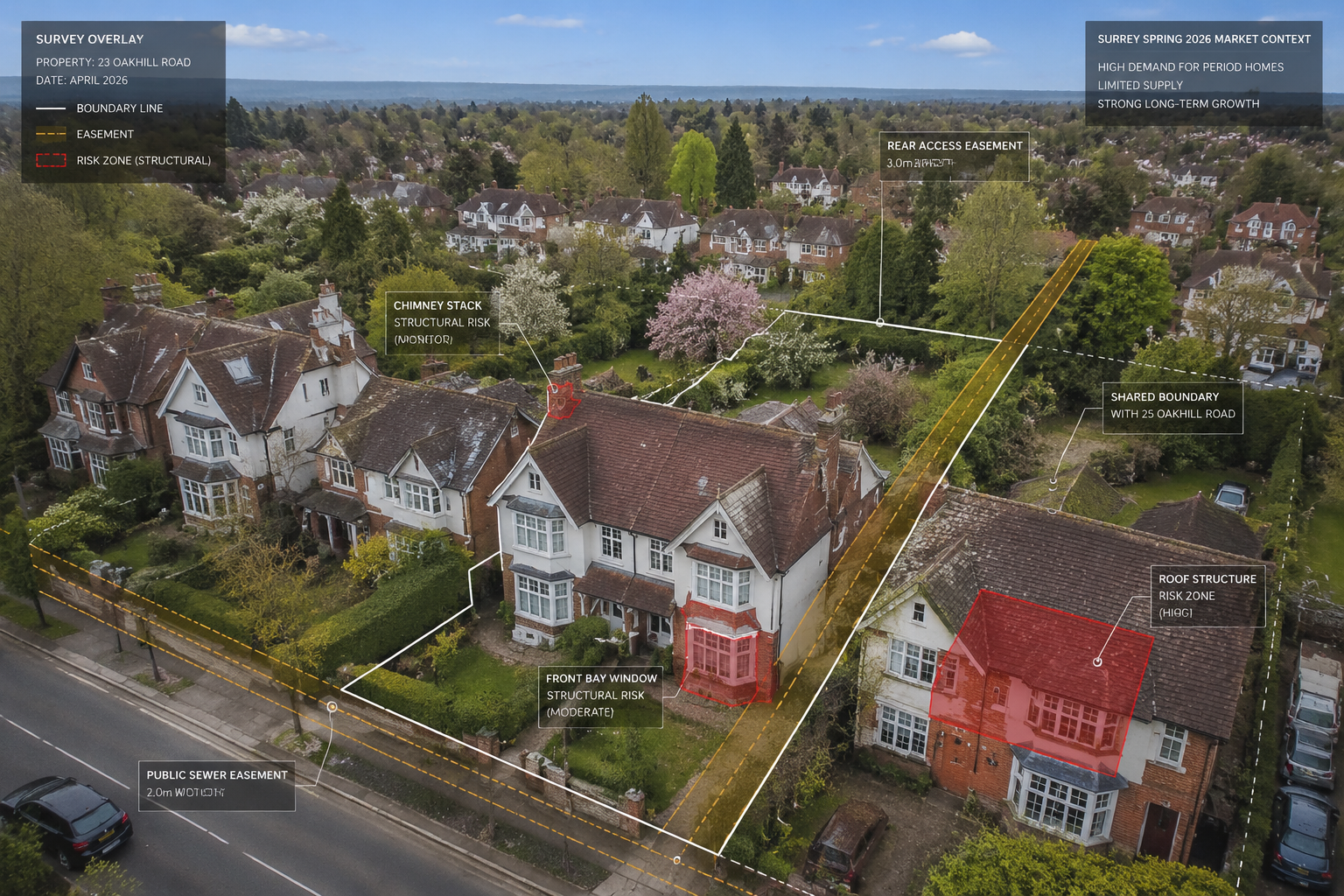
One of the most significant developments in building survey practice in 2026 is the integration of drone technology into standard inspection workflows. Premium drone surveys allow surveyors to inspect roof structures, chimney stacks, high-level masonry, and other inaccessible elements with a level of detail that was previously impossible without expensive scaffolding.
For cautious buyers, this matters because:
- 🏠 Roof defects are among the most common — and costly — surprises in older properties
- 📸 Photographic evidence from drone footage provides irrefutable documentation
- ⚡ Faster inspections support accelerated deal timelines under regulatory pressure [4]
2026 Standards Raising the Bar for Survey Accountability
The February 2026 ALTA/NSPS Mandatory Standards
On February 23, 2026, the American Land Title Association (ALTA) and National Society of Professional Surveyors (NSPS) released revised Minimum Standard Detail Requirements for ALTA/NSPS Land Title Surveys, superseding all prior versions [2]. While these standards apply to the US market, their principles are directly relevant to the broader global conversation about survey quality and buyer protection.
The key changes that directly address buyer caution include:
🔍 Enhanced Surveyor Accountability for Records Research
Surveyors — not just title companies — now bear explicit responsibility for researching non-public and quasi-public documents, including railroad or highway plans and jurisdiction-specific statutory requirements. This expanded accountability means buyers can rely on a more comprehensive due diligence baseline [2].
📄 Mandatory Transparency for Discrepancies
When discrepancies arise between recorded and measured distances, surveyors must now provide comprehensive explanatory notes directly on the survey document. This eliminates the ambiguity that previously allowed disputes to emerge post-closing [2].
🗺️ Clearer Easement and Servitudes Disclosure
All easements must be clearly categorised — shown, cannot be located, blanket, illegible, or not affecting the property — with surveyors required to notify title insurers of any recorded easements not in original title materials [2]. For buyers, this means no post-completion surprises about access rights or boundary encumbrances.
📋 Alignment Between Surveys and Title Commitments
Enhanced guidance ensures that surveys and title insurance commitments are coordinated, with any negotiated Table A items explained directly on the survey document [2]. This closes the gap between buyer expectations and actual transaction outcomes.
🏦 Extended Certification for Downstream Financing
The 2026 standards allow certification to be extended to successors and assigns of lenders upon request, providing more robust documentation for investment and refinancing scenarios [2].
Why These Standards Matter for UK Buyers
Although the ALTA/NSPS framework is a US standard, it reflects a global trend toward greater surveyor accountability and transparency. UK buyers and their advisors should expect — and demand — equivalent levels of disclosure from RICS-accredited surveyors. The building survey services offered by qualified chartered surveyors already incorporate many of these principles, but the 2026 standards provide a useful benchmark for what best practice looks like.
For buyers seeking additional specialist input beyond the standard survey scope, sourcing extra advice from structural engineers, damp specialists, or drainage experts can further reduce residual uncertainty.
The Regulatory Environment: Why Documentation Has Never Mattered More
Transaction Scrutiny Is Intensifying in Spring 2026
The regulatory landscape surrounding property transactions in Spring 2026 has become significantly more complex. Antitrust and regulatory agencies are scrutinising transaction processes, interim covenants, and pre-closing conduct with increasing intensity, including expanded foreign investment screening [4].
For property buyers, this means:
- "Gun jumping" enforcement — conducting due diligence in a manner that pre-empts completion — is under active regulatory scrutiny [4]
- Detection risk is increasing, reducing the time available to respond to compliance issues [4]
- Transaction timelines are under pressure, making upfront certainty more valuable than ever [4]
A comprehensive building survey provides a documented property baseline that protects all parties. If a dispute arises about what was included in the transaction scope, or what condition the property was in at the point of exchange, a detailed survey report is the most defensible piece of evidence available.
Speed and Certainty: Not Mutually Exclusive
One of the most persistent misconceptions about building surveys is that commissioning a detailed inspection slows down a transaction. In Spring 2026's pressured market, the opposite is true. Buyers who have survey certainty proceed faster because they are not paralysed by fear of the unknown.
Professional surveying protocols that reduce transaction risk [3] are therefore not just good practice — they are a competitive advantage for sellers who want to attract committed buyers and for buyers who want to secure properties in a competitive environment.
Practical Guidance: Deploying Surveys as Confidence Tools in Spring 2026
For Buyers: What to Commission and When
The most effective approach for risk-averse buyers in Spring 2026 is to commission a survey before making a final offer, or at minimum, before exchange of contracts. This sequencing allows the survey findings to inform:
- Negotiation on price — defects identified in a survey provide legitimate grounds for price reduction
- Conditions of sale — buyers can make exchange conditional on specific remediation works
- Walk-away decisions — a survey that reveals serious structural issues can prevent a catastrophic financial mistake
Checklist for buyers commissioning a survey in 2026:
- Choose a RICS-accredited surveyor with local market knowledge
- Select Level 3 for properties built before 1980, or any property with visible concerns
- Request drone inspection for properties with complex roof structures
- Ask for explicit easement and boundary commentary in the report
- Ensure the surveyor provides written context for any discrepancies found
- Consider specialist follow-up reports for damp, drainage, or structural concerns
For Sellers: Using Surveys to Reduce Buyer Hesitation
Sellers in Spring 2026 can proactively address buyer caution by commissioning a pre-sale building survey. This approach:
- Signals transparency and good faith to prospective buyers
- Allows defects to be remediated — or priced in — before marketing
- Reduces the risk of survey-triggered renegotiations or collapsed sales
- Speeds up the transaction by eliminating the waiting period for buyer-commissioned surveys
Regional Considerations
Survey findings and property condition profiles vary significantly by region. Buyers and sellers in areas with older housing stock — such as Surrey, Richmond, and Ealing — should expect surveys to identify a higher frequency of period property defects, including:
- Victorian and Edwardian brickwork issues (spalling, repointing needs)
- Timber roof structures with potential woodworm or rot
- Single-skin extensions with inadequate insulation
- Lead pipework in pre-1970 properties
Working with a surveyor who has deep local knowledge of regional building typologies ensures that survey findings are contextualised accurately rather than assessed against inappropriate benchmarks.
Conclusion: Certainty as the Currency of Spring 2026 Transactions
The Spring 2026 property market has fundamentally reframed what buyers are purchasing. They are not simply buying a property — they are buying certainty about that property. In a market defined by a -39% decline in buyer enquiries, risk-averse purchasers are not going to be persuaded by marketing language or estate agent assurances. They are persuaded by evidence.
Building surveys as transaction certainty tools: addressing buyer caution in spring 2026 markets represent the most direct and effective response to this shift. Level 3 full building surveys, enhanced by drone technology and delivered by RICS-accredited professionals operating to 2026 standards, provide the documented, transparent, and comprehensive property baseline that cautious buyers need to commit.
Actionable Next Steps ✅
- Buyers: Commission a Level 3 survey before exchange — treat it as an investment, not a cost
- Sellers: Consider a pre-sale survey to accelerate buyer decision-making and reduce fall-throughs
- Agents: Position survey certainty as a selling point, not an obstacle, in your buyer conversations
- All parties: Ensure your surveyor is RICS-accredited, locally experienced, and familiar with 2026 disclosure standards
- Complex properties: Request drone inspection and specialist follow-up reports for maximum certainty
For expert guidance on commissioning the right survey for your specific circumstances, contact a chartered surveyor for a free initial consultation.
References
[1] Building Surveys Prioritizing Certainty In 2026s Uncertain Transactions Level 3 Protocols For 12 Agreed Sales Net Balance – nottinghillsurveyors.com
[2] 2026 Alta Survey Standards Updates – hklaw.com
[3] Building Survey Certainty As Competitive Advantage How Professional Protocols Reduce Transaction Risk In 2026s Uncertain Market – nottinghillsurveyors.com
[4] Global Antitrust Update Spring 2026 Key 4172892 – jdsupra.com