

Private landlords across England now face a 33% increase in enforcement penalties—from £30,000 to £40,000—for failing to address property hazards, marking the most significant shift in rental housing compliance in over two decades. The Renters' Rights Act 2026 has fundamentally transformed how building surveyors must approach hazard assessment in the private rented sector (PRS), introducing legally enforceable timeframes and expanded hazard categories that demand immediate protocol adaptation.
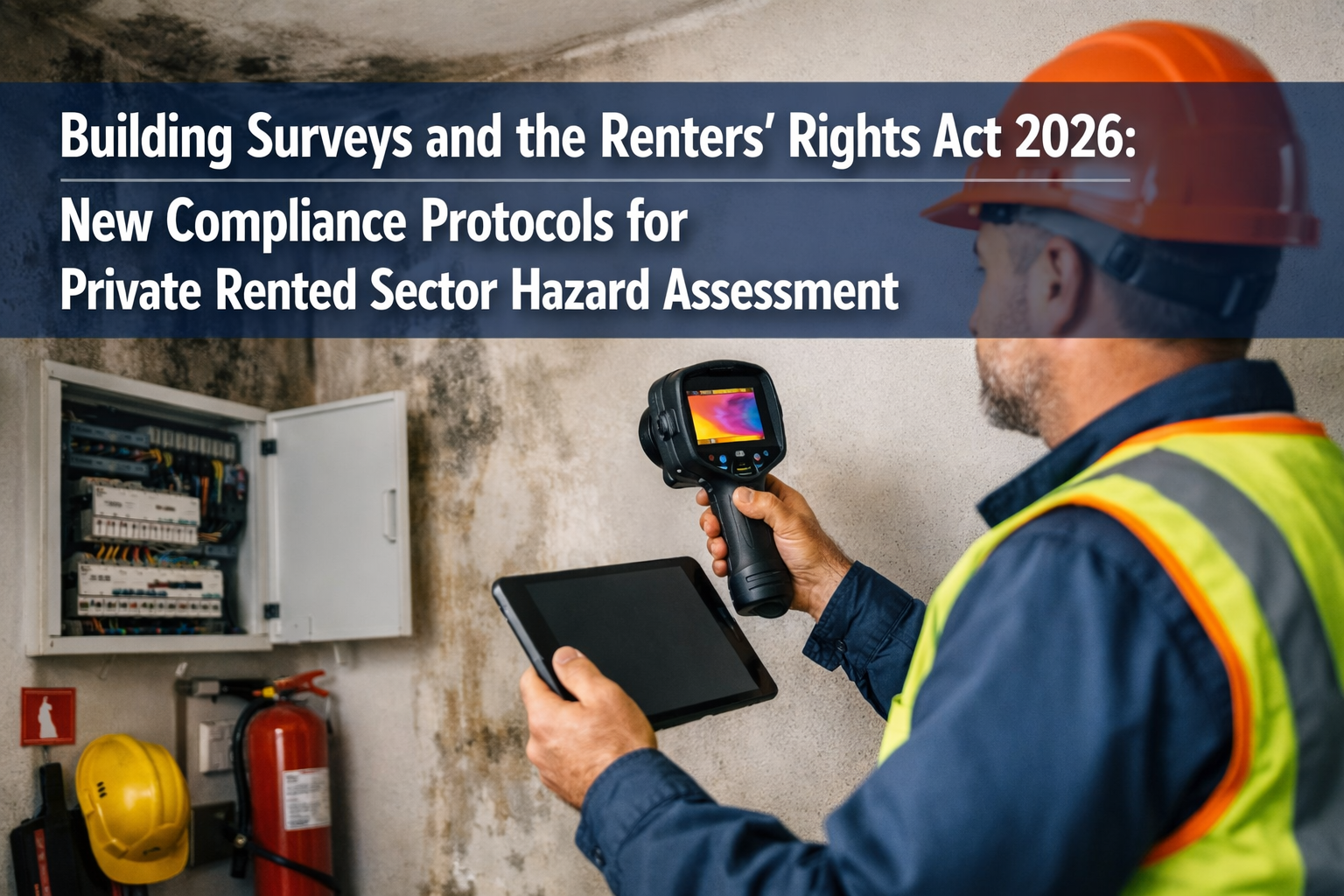
Building Surveys and the Renters' Rights Act 2026: New Compliance Protocols for Private Rented Sector Hazard Assessment represents a critical evolution in property inspection standards. With enhanced local authority enforcement powers effective since December 27, 2025, and Awaab's Law extension to the PRS launching May 1, 2026, building surveyors must now integrate comprehensive hazard evaluation protocols that extend far beyond traditional structural assessments.[1][3]
Key Takeaways
- Enhanced enforcement powers allow local councils to conduct unannounced property inspections and impose civil penalties up to £40,000 for hazard violations since December 2025
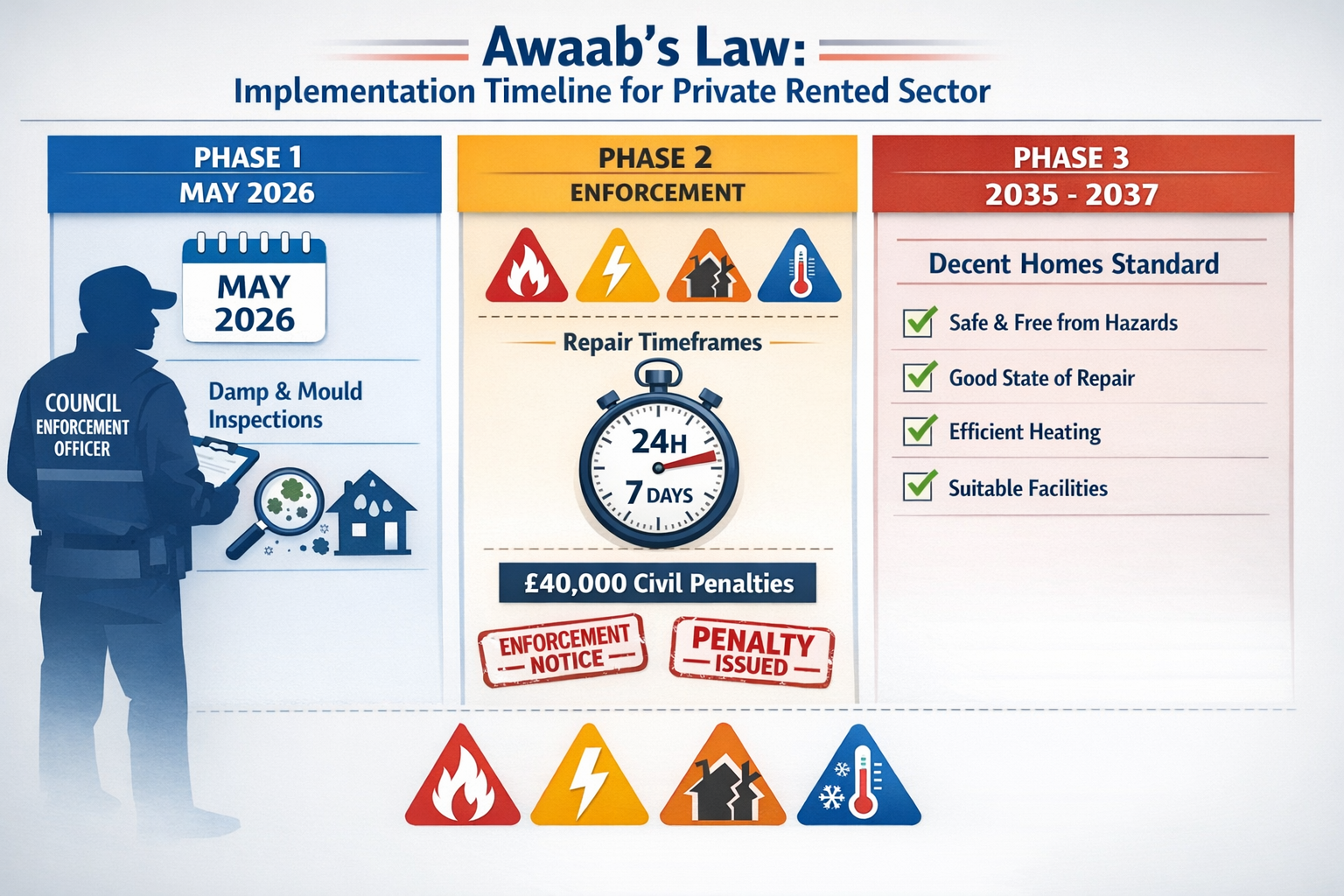
- Awaab's Law expansion (effective May 1, 2026) mandates strict legally enforceable timeframes for landlords to inspect and repair serious hazards including damp, mould, fire risks, electrical faults, and structural defects
- Building surveyors must adapt protocols to assess expanded hazard categories covering fire safety, electrical installations, structural integrity, and temperature control systems
- HHSRS review implementation will establish new baseline standards for hazard rating, requiring surveyors to update assessment methodologies
- Decent Homes Standard introduction (2035-2037) will create minimum quality thresholds affecting all PRS property valuations and compliance surveys
Understanding the Renters' Rights Act 2026 Framework
The Renters' Rights Act 2026 introduces a phased implementation approach that fundamentally restructures landlord obligations and enforcement mechanisms. This legislative framework creates three distinct compliance phases, each with specific implications for building survey protocols.
Phase 1: Enhanced Enforcement Powers (December 27, 2025)
Local authorities gained unprecedented investigatory capabilities on December 27, 2025, transforming the enforcement landscape for PRS properties. Councils can now inspect properties without advance notice when breaches are suspected, demand comprehensive documentation, and access third-party data to verify compliance.[1]
The civil penalty structure increased from £30,000 to £40,000 maximum fines, creating significant financial consequences for landlords who fail to address identified hazards. This enforcement enhancement requires building surveyors to provide more detailed documentation that can withstand regulatory scrutiny during unannounced inspections.
For surveyors conducting building inspections for homeowners, understanding these enforcement mechanisms is essential for advising clients on compliance risks.
Phase 2: Awaab's Law Extension to PRS (May 1, 2026)
The most transformative change arrives May 1, 2026, when Awaab's Law—previously applicable only to social housing—extends to the entire private rented sector. This legislation establishes legally enforceable timeframes for landlords to inspect and repair serious hazards, particularly damp and mould conditions.[2][3]
Named after two-year-old Awaab Ishak, who died from prolonged exposure to mould in social housing, this law empowers tenants to challenge dangerous conditions through formal channels. Building surveyors must now document not only the presence of hazards but also provide actionable remediation timelines that align with statutory requirements.
The expanded hazard categories under Awaab's Law include:
- 🔥 Fire safety deficiencies (inadequate escape routes, faulty detection systems)
- ⚡ Electrical installation hazards (outdated wiring, insufficient earthing, overloaded circuits)
- 🏗️ Structural integrity issues (subsidence, wall cracks, roof deterioration)
- 🌡️ Temperature control failures (inadequate heating, excessive cold, ventilation defects)
- 💧 Damp and mould conditions (condensation, rising damp, penetrating moisture)
Phase 3: Decent Homes Standard Implementation (2035-2037)
The government consulted on Decent Homes Standard implementation between July 12 and September 12, 2025, with proposed enforcement beginning in either 2035 or 2037.[1] This standard will establish minimum housing quality requirements across the entire PRS, creating baseline expectations for property condition that will affect building survey valuations and investment decisions.
While implementation remains several years away, building surveyors should begin incorporating Decent Homes Standard criteria into their assessment frameworks to provide forward-looking compliance guidance.
Building Surveys and the Renters' Rights Act 2026: Expanded Hazard Assessment Protocols
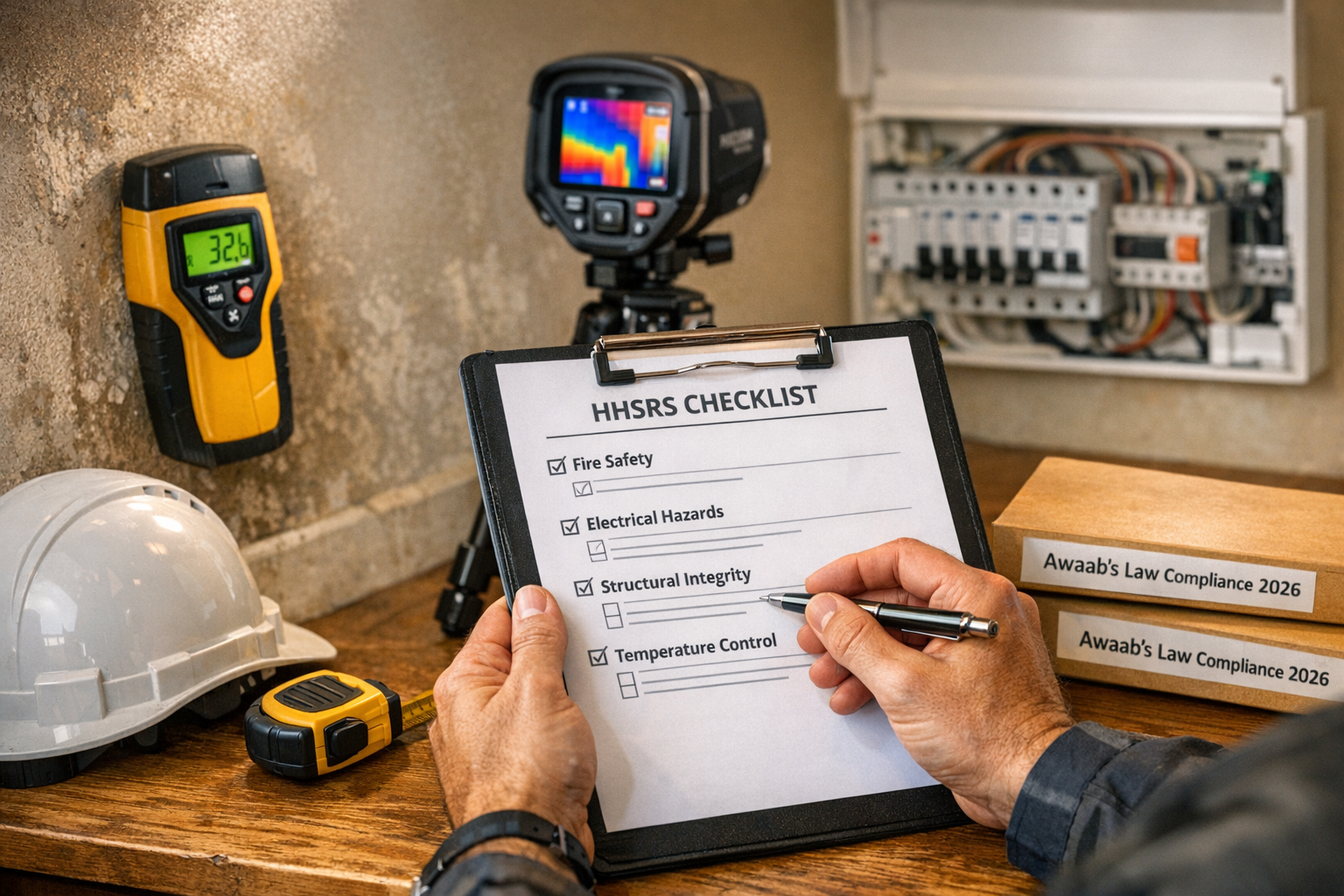
The Renters' Rights Act 2026 requires building surveyors to fundamentally restructure their inspection protocols to address expanded hazard categories systematically. Traditional building surveys focused primarily on structural integrity and major defects, but the new compliance environment demands comprehensive evaluation across multiple hazard domains.
Fire Safety Assessment Requirements
Building surveyors must now conduct detailed fire safety evaluations that extend beyond basic smoke detector verification. The comprehensive fire safety assessment protocol includes:
Escape Route Evaluation
- Measurement of hallway widths and staircase dimensions against regulatory minimums
- Assessment of fire door integrity (self-closing mechanisms, intumescent strips, smoke seals)
- Verification of emergency lighting functionality in common areas
- Documentation of potential escape route obstructions
Fire Detection and Suppression Systems
- Testing of smoke alarm placement in accordance with British Standards
- Verification of heat detector installation in kitchen areas
- Assessment of fire blanket and extinguisher accessibility
- Documentation of fire suppression system maintenance records
Compartmentation and Fire Spread Prevention
- Inspection of cavity barriers in wall and ceiling voids
- Assessment of fire-stopping around service penetrations
- Evaluation of combustible material usage in construction
For properties with complex fire safety requirements, surveyors should consider specialized asbestos building surveys to identify additional hazardous materials that could compromise fire safety.
Electrical Installation Hazard Identification
Electrical hazards represent one of the most frequently cited compliance failures in PRS properties. The Renters' Rights Act 2026 compliance protocols require surveyors to document electrical installation conditions with unprecedented detail.
Essential Electrical Assessment Components:
| Assessment Area | Inspection Requirements | Documentation Standards |
|---|---|---|
| Consumer Unit | Age verification, RCD protection, circuit labeling | Photograph with date stamp, manufacturer details |
| Wiring Condition | Visual inspection for damage, age assessment, insulation integrity | Cable type identification, replacement recommendations |
| Socket Outlets | Load capacity, earthing verification, positioning safety | Count per room, condition rating, hazard flagging |
| Fixed Appliances | Connection security, isolation switch presence, earthing | Appliance inventory, compliance status |
| External Installations | Weatherproofing, cable routing, junction box sealing | Exterior photograph documentation |
Surveyors should note that electrical installation condition reports (EICR) remain separate statutory requirements, but building surveys must now flag electrical hazards that require immediate EICR investigation.
Structural Integrity and Movement Assessment
Structural hazards under the Renters' Rights Act 2026 extend beyond obvious defects to include progressive deterioration that could compromise occupant safety. Building surveyors must implement systematic structural assessment protocols that identify both immediate and developing hazards.
Critical Structural Assessment Elements:
🔍 Foundation and Substructure Evaluation
- Subsidence indicators (diagonal cracking, door/window misalignment)
- Settlement patterns and progression monitoring recommendations
- Ground condition assessment and drainage adequacy
- Tree proximity and root damage risk evaluation
🔍 Superstructure Condition Analysis
- Load-bearing wall integrity and crack pattern analysis
- Beam and lintel deflection measurement
- Floor level variation and joist condition assessment
- Roof structure stability and spread indicators
🔍 External Envelope Integrity
- Wall tie corrosion and cavity wall stability
- Render and cladding attachment security
- Chimney stack stability and pointing condition
- Parapet and boundary wall safety assessment
For comprehensive structural analysis, surveyors should reference building problems and solutions guidance to provide landlords with actionable remediation strategies.
Temperature Control and Ventilation Hazards
Temperature extremes and inadequate ventilation represent significant health hazards under the expanded Awaab's Law provisions. Building surveyors must now assess heating system adequacy, insulation performance, and ventilation effectiveness as core compliance requirements.
Temperature Control Assessment Protocol:
Heating System Evaluation
- Boiler age, efficiency rating, and maintenance history
- Radiator coverage and heat distribution adequacy
- Thermostat functionality and programmability
- System capacity relative to property size and insulation levels
Thermal Performance Assessment
- Insulation presence and thickness in loft spaces (minimum 270mm current standard)
- Wall insulation type and effectiveness (cavity, solid wall, internal)
- Window glazing performance (single, double, triple glazing assessment)
- Thermal bridging identification and cold spot documentation
Ventilation Adequacy Evaluation
- Natural ventilation provision (trickle vents, openable windows)
- Mechanical ventilation system functionality (extract fans, MVHR systems)
- Condensation risk assessment in high-moisture areas
- Air quality considerations and mould growth prevention
Understanding mechanical ventilation requirements provides valuable context for assessing adequate air circulation in rental properties.
Building Surveys and the Renters' Rights Act 2026: Practical Implementation Checklist for 2026 Surveys
Building surveyors must adapt their standard operating procedures to integrate Renters' Rights Act 2026 compliance requirements systematically. The following implementation checklist provides a structured approach for conducting compliant PRS hazard assessments.
Pre-Survey Preparation and Documentation Requirements
Essential Pre-Survey Actions:
✅ Client Briefing and Scope Definition
- Confirm whether property is subject to PRS regulations
- Establish landlord's compliance history and previous enforcement actions
- Identify specific hazard concerns raised by tenants or local authorities
- Clarify reporting format requirements for regulatory submission
✅ Background Information Gathering
- Request previous building survey reports and EICR certificates
- Obtain gas safety certificates and boiler service records
- Review local authority enforcement notices and improvement orders
- Collect property age, construction type, and modification history
✅ Equipment and Technology Preparation
- Thermal imaging camera for temperature variation and moisture detection
- Electrical testing equipment (socket testers, voltage detectors)
- Moisture meters (pin-type and non-invasive models)
- Structural monitoring equipment (crack width gauges, level indicators)
- Digital documentation tools (tablets with survey software, high-resolution cameras)
Understanding building survey timeframes helps surveyors allocate adequate time for comprehensive hazard assessment.
On-Site Inspection Protocol for Expanded Hazard Categories
The systematic inspection sequence ensures comprehensive coverage of all hazard categories mandated by the Renters' Rights Act 2026.
Structured Inspection Sequence:
1. External Envelope Assessment (30-45 minutes)
- Roof condition and weather-tightness evaluation
- Rainwater goods functionality and drainage adequacy
- External wall condition and penetrating damp risk
- Window and door security and weather sealing
- Boundary structures and external hazard identification
2. Structural Integrity Evaluation (45-60 minutes)
- Foundation and substructure visual assessment
- Wall, floor, and ceiling structural condition
- Crack pattern analysis and movement indicators
- Roof structure stability and load-bearing capacity
- Photographic documentation of all structural concerns
3. Fire Safety Compliance Review (20-30 minutes)
- Escape route assessment and measurement
- Fire door condition and self-closing mechanism testing
- Smoke alarm presence, positioning, and functionality
- Fire-stopping and compartmentation verification
- Combustible material identification
4. Electrical Installation Inspection (30-40 minutes)
- Consumer unit age, type, and RCD protection verification
- Visible wiring condition and installation standard assessment
- Socket outlet count, condition, and positioning safety
- Fixed appliance connection and earthing verification
- Documentation of electrical hazards requiring EICR investigation
5. Heating, Insulation, and Ventilation Assessment (40-50 minutes)
- Boiler age, type, and maintenance record review
- Heating system coverage and radiator functionality
- Insulation presence and adequacy (loft, walls, floors)
- Ventilation provision and condensation risk assessment
- Thermal imaging for heat loss and cold bridge identification
6. Damp, Mould, and Moisture Hazard Evaluation (30-40 minutes)
- Moisture meter readings at risk locations
- Visual mould growth identification and extent mapping
- Condensation pattern assessment and causation analysis
- Rising damp and penetrating moisture investigation
- Ventilation adequacy relative to moisture generation
For properties requiring detailed defect analysis, surveyors should consider the comprehensive approach outlined in Level 3 full building surveys.
Post-Survey Reporting and Compliance Documentation
The Renters' Rights Act 2026 requires building survey reports to provide actionable compliance guidance with clear prioritization of hazard remediation.
Essential Report Components:
Executive Summary with Hazard Prioritization
- Immediate hazards requiring urgent action (within 24-48 hours)
- Serious hazards requiring action within statutory timeframes
- Moderate hazards requiring monitoring and planned remediation
- Minor defects and maintenance recommendations
Detailed Hazard Assessment by Category
- Fire safety compliance status and required improvements
- Electrical installation condition and EICR recommendations
- Structural integrity assessment and monitoring requirements
- Temperature control adequacy and insulation upgrade priorities
- Damp, mould, and ventilation remediation strategies
Regulatory Compliance Guidance
- Specific Awaab's Law timeframe requirements for identified hazards
- HHSRS rating implications and local authority notification obligations
- Decent Homes Standard preparation recommendations
- Estimated remediation costs and prioritization rationale
Photographic and Technical Documentation
- High-resolution photographs of all identified hazards
- Thermal imaging results showing temperature variations
- Moisture meter readings with location mapping
- Structural crack width measurements and progression indicators
Surveyors should provide context on how identified defects may affect property valuations, referencing typical price reductions after survey findings.
Technology Integration for Enhanced Hazard Detection
Modern building surveyors must leverage advanced technology to identify hazards that may not be visible through traditional inspection methods.
Recommended Technology Integration:
Thermal Imaging Applications
- Heat loss identification through building envelope
- Moisture presence detection behind surface finishes
- Electrical hotspot identification indicating overloaded circuits
- Insulation deficiency mapping and cold bridge location
Drone Survey Technology
- Roof condition assessment without access equipment
- Chimney stack stability evaluation
- Gutter and rainwater goods inspection
- External wall condition documentation at height
For properties where access presents challenges, premium drone surveys provide comprehensive external envelope assessment.
Digital Documentation Systems
- Real-time data capture and cloud synchronization
- Automated report generation with standardized hazard categorization
- Photographic evidence organization and annotation
- Client portal access for transparent communication
Ongoing Professional Development Requirements
Building surveyors must commit to continuous professional development to maintain competency in evolving PRS compliance requirements.
Essential CPD Focus Areas:
📚 Regulatory Knowledge Updates
- HHSRS review implementation and revised assessment criteria
- Decent Homes Standard development and consultation outcomes
- Local authority enforcement practice and case law developments
- Tenant rights expansion and complaint mechanism evolution
📚 Technical Skill Enhancement
- Advanced thermal imaging interpretation techniques
- Electrical hazard identification for non-electricians
- Structural movement analysis and monitoring methodologies
- Damp and mould causation diagnosis and remediation specification
📚 Technology Proficiency Development
- Building information modeling (BIM) for compliance documentation
- Artificial intelligence applications in defect identification
- Mobile survey software optimization and workflow efficiency
- Data analytics for hazard trend identification and risk assessment
Implications for Landlords and Property Investors
The Renters' Rights Act 2026 creates significant financial and operational implications for private landlords and property investors. Understanding these impacts helps building surveyors provide strategic advice beyond basic compliance reporting.
Financial Impact of Compliance Requirements
Landlords face substantial upfront investment to bring properties into compliance with expanded hazard assessment standards. Building surveyors should provide realistic cost estimates for remediation works to help clients make informed decisions.
Typical Remediation Cost Ranges (2026):
- Fire safety upgrades: £1,500-£5,000 (fire doors, detection systems, emergency lighting)
- Electrical installation improvements: £2,000-£8,000 (consumer unit replacement, rewiring, EICR remediation)
- Structural repairs: £3,000-£25,000+ (underpinning, wall tie replacement, roof repairs)
- Heating and insulation upgrades: £4,000-£15,000 (boiler replacement, loft insulation, cavity wall insulation)
- Damp and mould remediation: £1,000-£10,000 (ventilation systems, tanking, replastering)
Landlords must weigh these compliance costs against the £40,000 maximum civil penalty for non-compliance and potential rental income loss during enforcement proceedings.[1]
For landlords considering property improvements, understanding property renovations that add value for tenants helps prioritize investments that enhance both compliance and marketability.
Property Valuation Adjustments
Building surveyors conducting valuations must now incorporate Renters' Rights Act 2026 compliance status as a material factor affecting property worth. Non-compliant properties face significant valuation discounts reflecting:
- Immediate remediation cost deductions for identified hazards
- Regulatory risk premiums reflecting enforcement probability
- Rental income uncertainty during compliance work periods
- Market perception impacts as tenant awareness increases
Properties demonstrating full compliance with Awaab's Law requirements and proactive hazard management command premium valuations in the investment market.
Strategic Portfolio Management Guidance
Building surveyors should advise landlords on strategic approaches to portfolio compliance management:
Prioritization Framework:
- High-risk properties (previous enforcement actions, tenant complaints, older construction)
- High-value properties (where compliance investment preserves significant asset value)
- Properties approaching tenant turnover (opportune timing for upgrade works)
- Portfolio-wide systematic upgrades (economies of scale for similar remediation needs)
Some landlords may conclude that certain properties cannot achieve compliance cost-effectively, leading to portfolio rationalization decisions. Building surveyors provide essential due diligence for these strategic assessments.
Future Developments and Preparation Strategies
The regulatory landscape for PRS properties continues to evolve, with several significant developments on the horizon that building surveyors must monitor and prepare for.
HHSRS Review Implementation
The government confirmed a comprehensive review of the Housing Health and Safety Rating System (HHSRS) as part of the pathway to Decent Homes Standard implementation.[1] This review will likely introduce:
- Revised hazard categorization reflecting modern building science understanding
- Updated assessment criteria incorporating climate change impacts
- Enhanced guidance on hazard interaction and cumulative effects
- Digital assessment tools standardizing surveyor evaluation methodologies
Building surveyors should engage with consultation processes and industry working groups to influence HHSRS modernization and ensure practical implementation frameworks.
Decent Homes Standard Consultation Outcomes
Following the July-September 2025 consultation period, the government will publish detailed Decent Homes Standard requirements for PRS implementation in 2035 or 2037.[1] Building surveyors should anticipate standards addressing:
- Minimum space standards (room sizes, ceiling heights, natural light)
- Energy efficiency requirements (EPC rating thresholds, renewable energy integration)
- Amenity provisions (bathroom and kitchen facilities, storage adequacy)
- External environment standards (private outdoor space, waste storage, parking)
Early adoption of Decent Homes Standard criteria in current building surveys positions landlords advantageously for future compliance.
Technology and Automation Trends
Building survey practice will increasingly leverage technology to enhance hazard detection accuracy and reporting efficiency:
Emerging Technologies:
- Artificial intelligence image analysis for automated defect identification
- Internet of Things (IoT) sensors for continuous hazard monitoring
- Virtual reality property tours enabling remote hazard assessment
- Blockchain documentation systems creating immutable compliance records
Surveyors who invest in technology adoption will deliver superior service quality and competitive advantage in the evolving PRS compliance market.
Conclusion
Building Surveys and the Renters' Rights Act 2026: New Compliance Protocols for Private Rented Sector Hazard Assessment represents a fundamental transformation in how building surveyors approach PRS property inspection. The expanded hazard categories—covering fire safety, electrical installations, structural integrity, temperature control, and damp conditions—require systematic protocol adaptation and enhanced technical competency.
With enhanced enforcement powers active since December 2025 and Awaab's Law extension launching May 1, 2026, building surveyors must immediately implement comprehensive assessment frameworks that identify hazards across all statutory categories. The £40,000 maximum civil penalties create significant financial consequences for landlords, making thorough building surveys essential risk management tools.
Actionable Next Steps for Building Surveyors
- Update inspection protocols immediately to incorporate expanded hazard assessment requirements across fire, electrical, structural, temperature, and moisture categories
- Invest in essential technology including thermal imaging cameras, moisture meters, and digital documentation systems to enhance hazard detection capabilities
- Develop standardized reporting templates that clearly prioritize hazards according to Awaab's Law timeframe requirements and provide actionable remediation guidance
- Engage in continuous professional development focusing on HHSRS review outcomes, Decent Homes Standard requirements, and emerging assessment technologies
- Establish relationships with specialist consultants (electricians, structural engineers, damp specialists) to provide comprehensive remediation specifications when complex hazards are identified
Actionable Next Steps for Landlords and Property Investors
- Commission comprehensive building surveys for all PRS properties to establish baseline compliance status and identify remediation priorities
- Develop phased compliance investment plans that address immediate hazards first while planning strategic upgrades for longer-term standards
- Implement proactive maintenance programs that prevent hazard development and demonstrate regulatory due diligence to enforcement authorities
- Consider portfolio rationalization where compliance costs exceed property value preservation benefits
- Engage with tenant fee and rent guidance to understand how compliance investments can be reflected in market positioning
The Renters' Rights Act 2026 creates both challenges and opportunities for building surveyors and property professionals. Those who adapt quickly to the new compliance protocols will establish themselves as essential advisors in the transformed PRS landscape, while landlords who proactively address hazards will protect their investments and maintain competitive advantage in an increasingly regulated market.
For comprehensive building survey services that incorporate full Renters' Rights Act 2026 compliance assessment, consider exploring different types of building surveys to determine the appropriate level of inspection for your property needs.
References
[1] Renters Rights Act Implementation 6365569 – jdsupra.com
[2] Renters Rights Act Measures Begin May 2026 – stirlingackroyd.com
[3] Renters Rights Bill A Letting Agents Guide – blog.goodlord.co